
The [journalism] instructor stressed his formula for writing the ideal headline to describe the story below it–a job in which every letter in every word counts (and W’s and M’s, being fat, count double …). You look for the specific word first. Use the specific “pistol” and switch to the general “gun” only if pistol is too long for the line.
I took this dogma with me to the newsroom of The Daily Oklahoman … The slot man … handed to me [a trivial story] that reported a woman filing suit against a doctor who had operated on her eleven years earlier. A subsequent surgery had revealed that the first surgeon hadn’t extracted one of his forceps before stitching up the abdomen.
I wrote: SURGEON’S FORCEPS / LEFT IN WOMAN / ELEVEN YEARS.
The slot man told me the line was too long and tossed it back to me to revise. Forceps is specific of what? It’s a tool, right? The first line became Surgeon’s Tool. That fit. Hours pass with more headlines written. The bulldog edition comes up from the printing plant. The night city editor scans it. Reaches page 27. Shouts: Stop the press, glowers at the slot man, and says, “Who wrote this!” I am identified as the culprit …
That Stop the press shout is often heard in old movies, but that was the only time I ever heard it in real life. Professor Herbert called me in, and … seemed perfectly satisfied that I could be blamed only for innocence in a world full of night city editors with dirty minds. I got a “B” in the course.
Tony Hillerman, Seldom Disppointed, pp. 172 – 173
Tag: Tony Hillerman
I was Seldom Disappointed with this funny memoir

The following review was posted on GoodReads on June 27.
I love Tony Hillerman’s Navajo police procedurals. A few years ago, I got to travel through Navajo country (Dinetah), which was amazing because for fans of Hillerman it’s like getting to visit Middle Earth. At the Navajo Cultural Center gift shop, they displayed many of Hillerman’s books, and this memoir. I picked it up, but it took me several years to get around to reading it.
Once I did, it went fast because this is a page-turner. Hillerman’s writing is understated and vivid (he started his writing career as a journalist).
It turns out that Hillerman is closer to the age of my grandparents. He grew up in the Dust Bowl during the Depression, fought in the Battle of the Bulge. Quite a lot of the book is devoted to his memories of France during WWII. He was then injured (legs, and eyes), spent some time in the hospital, and was sent home with crutches and an eye patch. He discovered that “Military Intelligence is usually neither.” He doesn’t dwell on it, but he had PTSD before that was a word. Nightmares, unable to keep his breakfast down. He recounts, in the 1950s, seeing a grisly car accident that made the police officer on the scene vomit, but Hillerman stood there unaffected.
Hillerman and his wife also adopted a number of children, and raised a big, happy family.
All of this is related with almost no self-pity, and it’s often very funny.
This book contained less about the Navajo than I expected. I guess Hillerman has poured his learning about them into his novels rather than into his memoir. But by the time the book reached his later years, when the Navajo became a big theme, I was not disappointed about this because the book itself had already been such an entertaining ride.
There is an appendix which lists a number of Hillerman’s books and sketches out the process that led to each one. They presented different kinds of problems that will be reassuringly familiar to other authors.
All in all, Tony Hillerman is a total mensch, a good egg, and it’s been an honor to get to know him.
Quote: Unsentimental Young Soldiers
This [hospital] ward had a tradition that no patient would be sent off to surgery without his fellows gathering at his bedside to hold a wake. The commissioned medical staff forbid this custom as insulting to them and contrary to good medical practice. However virtually everyone in the ward was a combat infantryman and the wakes went on anyway after the nurses had left. At these wakes, ambulatory patients would gather around the bed of the fellow due to go under the knife, discuss his character, and regale him with awful stories of ineptitude in military operating rooms (wrong organs tinkered with, arm removed instead of leg, and so forth). They would also establish “dibs” on his various possessions in the event he didn’t come back alive and compose a letter to his family describing his sins and shortcomings. The only nurse who didn’t consider this tradition barbarous was an old-timer captain. She thought it an antidote against self-pity–the worst danger in any ward full of badly damaged young males.
Tony Hillerman, Seldom Disappointed, pp. 140 – 141
Quote: The Invincible Ignorance of the Young
As a matter of fact, I can dredge up nothing much to complain about in my formative period. We children spent those years of the Great American Depression/Great Oklahoma Dust Bowl living miles below the current poverty level but happily protected by love and the invincible ignorance of the young. Life in Sacred Heart then (and now, for that matter) was not complicated by any possibility of getting rich. Everybody was poor and when you’re a kid you don’t know you’re deprived unless you see someone who isn’t. That didn’t happen around Sacred Heart.
Tony Hillerman, Seldom Disappointed, p. 10
Quote: Take Out the Distinctive Stuff
Next to come to mind was my original literary agent delivering her verdict on my first novel. Don’t want to show it to anyone, she said. Why not? It’s a bad book. Have to think of your reputation as well as mine. Why bad? It falls between the stools, halfway betwixt mainstream and mystery. No way to promote it. And where does the bookseller shelve it? Stick to nonfiction, said my agent. I can sell that for you. How about me rewriting it? Well, if you do, get rid of the Indian stuff.
Tony Hillerman, acclaimed author of the Navajo mysteries, in his memoir, p. 5
Incense of the West
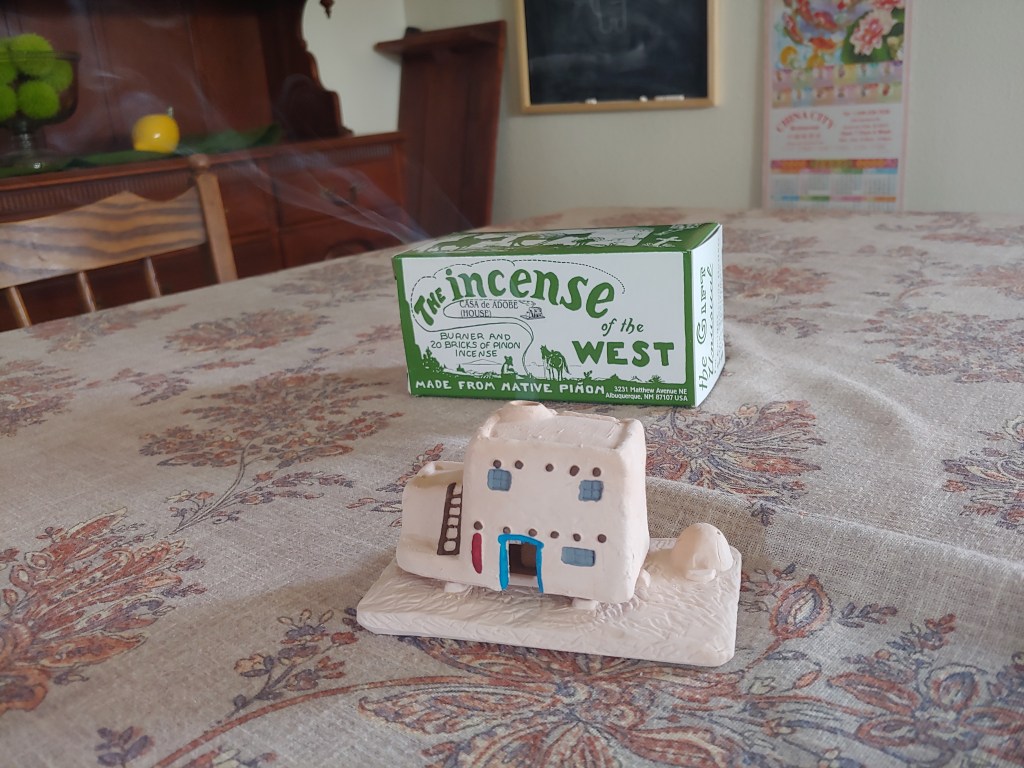
My hubby got me this as a gift on his travels. Thereby hangs a tale.
My husband has had one of these miniature adobe houses in his childhood room for decades. The set comes in two parts. You light a little brick of “incense” (in this case, pin͂on scented), put it upright on the house’s foundation, and then set the house itself over it. The incense burns down in about half an hour, and meanwhile the smoke comes out of the house’s smoke hole. It makes the whole room smell like you are burning a woodfire.
Now, looking at this little thing, and especially the extremely retro style of packaging, you might think this is the sort of hard-to-find item that might appear on the Antiques Road Show as a piece of 1960s memorabilia. But no! They are still being sold, and quite affordably. Nevertheless, when I look at this thing, I can’t help feeling that I have been given a piece of kitsch from a world that is vanishing.
My man got this for me because he knows I like the Southwest, and enjoy Tony Hillerman novels and books about the Anasazi. It looks really good sitting among my potted cacti.
Oh, That Diamond
“Just grocery?” [said retired Navajo cop Joe Leaphorn to store owner McGinnis.] “They take anything else?”
“Took the blanket I had hanging on a rack in there, and some ketchup, and …” he frowned, straining to remember. “I believe I was missing a box of thirty-eight ammunition. But mostly food.”
“None of it ever recovered?”
McGinnis laughed. “‘Course not,” he said. “If the burglar didn’t eat it, you cops would have done that if you caught him.”
“You didn’t mention a diamond. How about that?”
“Diamond?”
“Diamond worth about ten thousand dollars.”
McGinnis frowned. Took another tiny sip. Looked up at Leaphorn.
“Oh,” McGinnis said. “That diamond.”
Skeleton Man by Tony Hillerman, p.45
The Guilty Reader Tag

For the uninitiated, a “tag” is when a fellow blogger asks you to answer a bunch of questions, which usually revolve around a theme. I, for some mysterious reason, tend to get tagged by bloggers who are interested in books, writing, and reading.
This tag was created by Chami @ Read Like Wildfire and passed on to me by my faithful friend The Orangutan Librarian, a fellow INFP who, like me, is also an expert in guilt. Maybe that’s why I love her sensitive and lighthearted book reviews and parodies.
One. Have You Ever Re-Gifted A Book You’ve Been Given?
Hmm. I don’t think so. But probably. I have been known to buy a book for myself, read it, and then a few years later, give the nearly-new copy to a fellow reader as a gift. And then, after they have enjoyed it, after another few years I have even been known to re-claim it.
Also – fun fact! – I was once given a book that eventually turned out to be a library book. It was pretty good, too.
Two. Have You Ever Said You’ve Read A Book When You Haven’t?

I have definitely implied it.
Back in my college days, when I made an idol of being intellectual and was consequently a poser about it, I would talk as though I was familiar with philosophers like Plato, when I had not read their works but only heard about them.
(Hot tip: if you make an idol of your intellect, you will always feel like a dummy who is about to be exposed.)
Three. Have You Ever Borrowed A Book And Not Returned It?
Yes. I borrowed a book about children in history from a history prof, let it sit around unread, and then eventually returned it. At least, I thought I returned it. She was unable to find it, as was I.
Four. Have You Ever Read A Series Out Of Order?
All. The. Time. Some series seem to stretch on forever into both the past and future, having neither beginning nor end. *Ahem* Dragonlance!

Also, I love Tony Hillerman’s Navajo police procedurals. But they have a big flaw: they are not numbered as a series! Each one can be read as a standalone, but if you read more than a few of them, you realize that they develop over time. You have to read each book to find out where it fits in with the others in terms of Jim Chee’s disastrous love life, for example. I’ll bet that somewhere on the Internet, someone has listed them in order just for people like me.
Five. Have You Ever Spoiled A Book For Someone?
Um, probably, but I can’t remember. What I remember, of course, is when people spoil books for me. The most egregious instance was when a friend spoiled Things Fall Apart.
Six. Have You Ever Dogeared A Book?
Um, so, this is one of those habits that I have had to belatedly realize makes me uncivilized, and have had to train myself out of. (I won’t tell you the others.)
Seven. Have You Ever Told Someone You Don’t Own A Book When You Do?
Maybe, if I forget that I own it. Or, I might think that I own a book, but do so no longer.
Eight. Have You Ever Skipped A Chapter Or A Section Of A Book?
In nonfiction, all the time. Often you can see where a section is going (if you’re wrong it will quickly become apparent), or the author is laying out background that you already have.
In fiction, I occasionally skip atrocities.
Nine. Have You Ever Bad Mouthed A Book You Actually Liked?
Yes. I still feel bad about a review that did for a reviewing site, where I gave a very decent historical fiction volume 2 out of 4 stars just because the characters occasionally spoke like modern people. Once I got more experience, I got more fair with my reviews.
Moral: The Heart is Deceitful
So, it turns out that I have committed every single pecadillo on this list, from the harmless (forgetting I own books) to the prideful (posing as an intellectual). Not super surprised by this. Jesus Christ came into this world to save sinners, of whom I am the worst.
But one question was left off this list: Have you ever been lost in a book at a time when, in the opinion of people around you, you should have been doing something else?
Yes, yes, a thousand times yes!
I’ll post a quote about that tomorrow.
You post your book pecadillos in the comments.
Best to you all.
What My Favorite Characters Would Be Doing in Quarantine
Up till now I’ve tried to make posts that don’t mention you know what, because I figure that readers come to Out of Babel for fun and weirdness, not for more mentions of you know what. But, I saw this super fun tag over in the book nook of The Orangutan Librarian. I hope by trying it I’m not letting you down. As you can see, I’ve spun it a little, imagining how the characters would handle coronavirus in their own worlds.
Rules
- Take 5 or more of your favorite book characters and imagine what they would be doing if they were quarantined with us in the real world.
- You can have them be in their own squad if you want, or working on their own.
- Tag 5 friends.
- Link back to this post and credit Reader Voracious.
Narnia Quarantine

The Pevensie kids, of course, would not even be here …
For some reason I imagine Edmund and Lucy quarantining with their cousin Eustace and his parents rather than being with their parents (who got stuck in Greece) or with Peter and Susan (who got stuck at their respective universities). Eustace, though less of a know-it-all since his first trip to Narnia, is still extremely well-informed about epidemiology, government policy, and all the latest economic and medical updates. His mother, Alberta, insists that everyone wear masks and gloves even inside the house.
Middle Earth Quarantine

Gandalf the Grey would have caught the coronavirus early (because he travels a lot), come down with complications (because it hits old people the hardest), died, and been resurrected.
Sam Gamgee, humble, hardworking, and patient, would be the perfect person to quarantine with. He’s also a very resourceful cook.
Faramir and Eowyn would be climbing the walls, holed up in the Houses of Healing in Minas Tirith.
Tom Bombadil and the River Daughter are immune to human ills and they also take a long view of the death of much of the rest of the world.
Gimli would rather risk death than give up smoking.
Tony Hillerman Quarantine
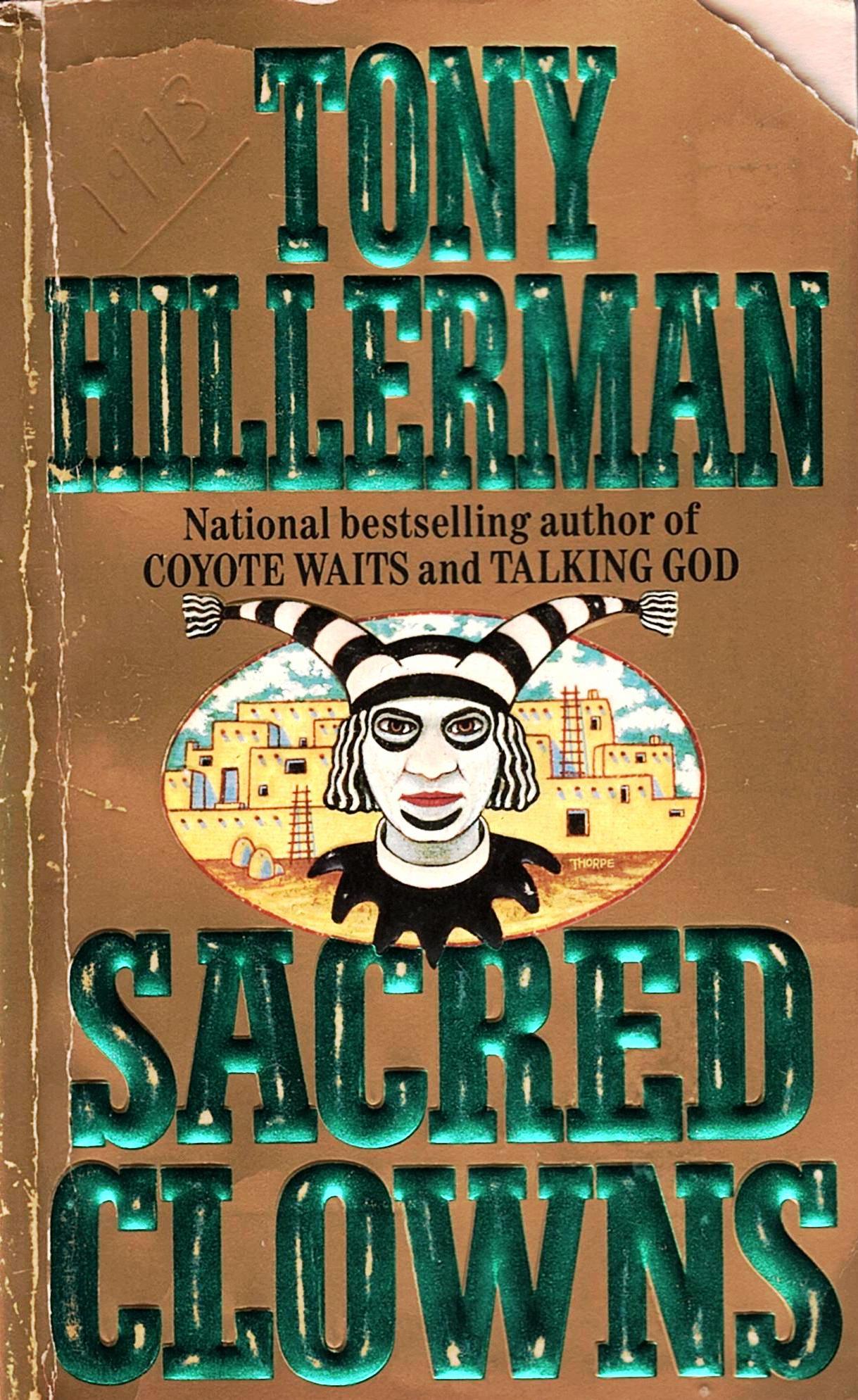
Sadly, in real life, the coronavirus has hit the Navajo nation really hard. Tony Hillerman’s Navajo cop characters, Jim Chee and Joe Leaphorn, would be reacting very differently. Leaphorn, who is older and more of a homebody, would be happily hanging out with his wife Emma at his home in Window Rock. Chee, who is young and restless, would be running around the reservation trying to help everyone he could. He would go to be with an older relative who is dying of the virus, making sure that the person is moved outside as per tradition and that they have someone with them. Though young and healthy, he would unexpectedly develop a bad case himself and would be found recovering in the hospital at the very end of the book, being visited by his girlfriend Janet or Bernie, depending upon where we are in the series.
Emberverse Quarantine

Junie and Mike of the Emberverse have already been through a society-destroying event that resulted in most people dying. Junie heads up a neo-pagan community near Corvallis, Oregon, and Mike runs a more specialized, military one just northwest of Salem. Since the Change destroyed all modern technology, the inhabitants of the Emberverse would probably barely notice the coronavirus. Fewer people develop the diseases of civilization (heart disease, diabetes) in their medieval-style world, living conditions are less crowded, and there are no nursing homes or hospitals. Probably all they would notice was a particularly bad seasonal flu endangering the few remaining old people. They’d be grateful that this sickness, unlike many, was not threatening little children. Junie would be using her herbology and caretaking skills to help as many of her subjects as possible. Because Junie and Mike both grew up in the modern world, before “the Change” happened, they are aware of germ theory and this would help them enforce hygiene on their people.
Agatha Christie Quarantine

Miss Marple has lived through two world wars. She would gamely go along with whatever deprivations and regulations the quarantine brought. She’s been through worse. If anyone complained, she would smile sweetly while silently judging you and simply say, “So many things are difficult.”
Hercule Poirot is already a bit of a germophobe. He would take enthusiastically to masks and hand sanitizer, but would become peevish when unable to procure the foods that he’s used to. Whenever Hastings began to panic about the many unknowns, Hercule Poirot would calm his fears through the use of the Little Grey Cells.
P.G. Wodehouse Quarantine

Airheaded bachelor Bertie could not stand not going to his club. He would beg Jeeves to come up with a way that Bertie could skirt the rules to get out and about. Jeeves would do so, knowing that within hours, Bertie would be back home with a horrible hangover that he would need to sleep off and then drink one of Jeeves’s miraculous restoratives. Jeeves knows that the coronavirus mostly endangers older people, so even if Bertie should become a carrier, there is little danger that he would infect anyone because even in normal circumstances he cannot be induced to visit his Aunt Agatha.
And … I can’t resist … Quarantine with my own characters!

Nirri is, essentially, already in quarantine all the time. He broke his spine in a fall from the Tower of Babel, becoming paraplegic, and is now being reluctantly cared for by people with whom he does not share a language. He is the nightmare person to be quarantined with: arrogant, demanding, unable to communicate or be reasoned with. Though 130 years old, he is healthy as a horse and there is no way he is dying from this. On the bright side, he is an accomplished musician. Give him a lute and he will entertain you all evening, even if you don’t understand the words to his songs.
Zillah is a born caretaker and the tribe’s resident medical expert. It was she who insisted they rescue Nirri. Though young and even middle-aged people don’t usually show symptoms of the virus, in a tribe their size there might be one or two who do. Zillah would spend herself caring for them, and then get sick herself (she is the tribe’s second oldest person, after Nirri). She would survive, cared for by her daughter Ninna, and the weeks when she was sick would be the loneliest of Nirri’s life.
You Sure You Wanna Do This?
If you do, I tag …
- Jyvurentropy, who has been posting so much that I can’t keep up with her
- Bookstooge, for his sarcasm
- Colin, because I want to hear his thoughts
- The hilarious Christopher Waldrop, even though I’m unable to comment on his posts
- … and the always insightful Eustacia, if she has time to do this tag
The Seven Heavenly Virtues Tag
The Orangutan Librarian tagged me for this post that applies the “Seven Heavenly Virtues” to the world of our reading.
By the way. The Seven Deadly Sins are easy to remember, in groups of two, three, and two. There’s The World (Envy, Greed); The Flesh (Lust, Gluttony, Sloth); and The Devil (Anger … and the granddaddy, Pride). The seven virtues are the flip side of these.
Once when I was at university, the theme of our homecoming week was the extremely creative “We’ve Got Pride.” I will always love my fellow English majors who named their contribution to the parade “Beyond pride: the seven deadly sins.” They wanted to show that “[our university] also gots Envy, Greed, Lust, Gluttony, Sloth, and Anger.” And of course it was true.
Onward.
CHASTITY: Which author/book/series you wish you had never read?
Hmm. It’s rare that I go on wishing I had never read a book. Usually if it stuns me with some horror, I hate it at the time, but as my mind assimilates the idea, I’m glad to have encountered it in a book so that I can grapple with that aspect of the world.
A good example is Ken Follett’s Pillars of the Earth. A major part of the plot is a sexual assault. It’s described graphically. The creepy lead-up and the lengthy aftermath include scenes from the point of view of both the victim and rapist. When I read this, it was the first time I’d read a rape described in detail (or, at least, the first time I understood what I was reading). It was very traumatic, and it led to lots of crying and praying for women who were real-life victims. So, as you can see, it bore some good fruit almost immediately.
Later I read another book by Ken Follett in a completely different genre, and it also featured a serial stalker and rapist, with many scenes written from his point of view. At that point I decided that I would not read any more books by Ken Follett, nor would I ever get on an elevator with the man.
TEMPERANCE: Which book/series did you find so good, that you didn’t want to read it all at once, and you read it in doses just to make the pleasure last longer?
I don’t usually show temperance when it comes to serious, emotional reads. … OK, I actually don’t have much temperance at all. I once stayed up all night finishing Mary Doria Russell’s The Sparrow.
However, with comic series, I find that if you binge on them they can become wearing, whereas if you read one every once in a while, they are refreshing. For example, P.G. Wodehouse’e Bertie Wooster books and Janet Evanovich’s Stephanie Plum series.
CHARITY: Which book/series/author do you tirelessly push to others, telling them about it or even giving away spare copies bought for that reason?
Well this question will contain no surprises to anyone who knows me or has followed my blog for any length of time.

The Emberverse series by S.M Stirling: I recommend this often because it encompasses a wide range of interests. The first few books are post-apocalyptic, and then it becomes more of a fantasy series. I’ve recommended it to people because it’s set in the Northwest (Idaho, eastern Washington and Oregon, northern California). Recently I recommended it to someone who is interested in retro martial arts such as sword fighting and archery, because there is a ton of that in these books, including descriptions of how the weapons are made and gripping battle scenes. The research on these books is both wide and deep, from ecology to botany to anthropology to martial arts to Celtic mythology.
‘Til We Have Faces: A searing, emotional novel about friendship, identity, divided loyalty, and religion. One of C.S. Lewis’s less famous works.
The Everlasting Man (non-fiction): G.K. Chesterton discusses paganism and why it expresses important things about being human … with the cheery paradoxes that only he can bring.
The Divine Conspiracy(non-fiction): With wit and wisdom, Dallas Willard applies the Gospels in a fresh way (which we all need frequently). This is so well-written that it’s a pleasure to read, and you just sail through it even though it’s quite thick.
Now, go forth and read these!
DILIGENCE: Which series/author you follow no matter what happens and how long you have to wait?
Agatha Christie. She has such a large corpus of work that even though I think I’ve read all her novels, I’m never sure.
Also, the Brother Cadfael series by Ellis Peters.
Also anything by Tony Hillerman or Dick Francis.
It looks like formula mysteries are my genre for this.
PATIENCE: Is there an author/book/series you’ve read that improved with time the most, starting out unpromising, but ultimately proving rewarding?
Watership Down. It is gripping from the first, don’t get me wrong, but it is so long. Then when you get to the end, you discover that the author is doing things with it that only a really long book can do.
KINDNESS: Which fictitious character would you consider your role-model in the hassle of everyday life?

Any strong, quiet, capable character who consistently takes care of others. Durnik in the Belgariad; Precious Ramotswe in The No. 1 Ladies series; Bardia in ‘Til We Have Faces; Sam Gamgee, Aragorn, Gandalf, Aslan. And, of course, Zillah from my own books.
Unfortunately my gifts and personality are almost opposite from all these characters. But I’ve always wanted to be strong, quiet, calm, and capable.
HUMILITY: Which book/series/author do you find most under-rated?
This is a hard one to answer because I don’t always have a real great idea of what other people are reading. How can I know that the gem I’ve “discovered” hasn’t also been discovered by a bunch of others?
Apparently Thomas Sowell has a bunch of great books about economics and society that have helped the people who’ve read them greatly … but I have not read them, only watched videos of him speaking. There are many such examples.
Now, Discuss
I hesitate to tag people because it seems to freak them out. But if you get inspired by any of the questions in this tag, please answer them either at your own blog or in the comments.
 Out of Babel Books