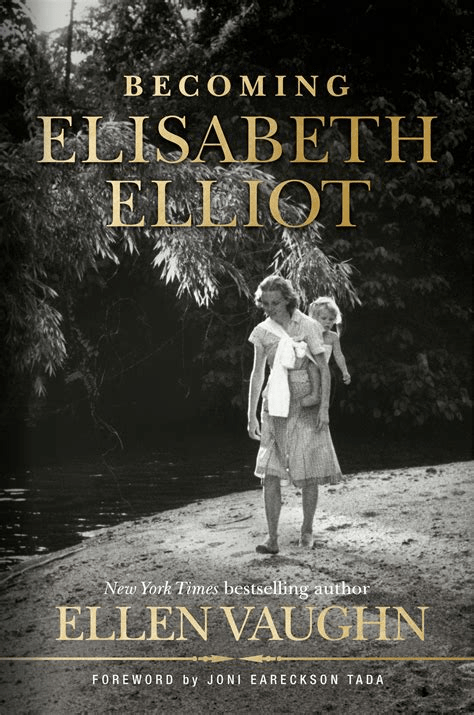
Becoming, and then Being, Elisabeth Elliot: a review

Quick! Who do we know who’s a linguist, a former missionary, a gifted writer, and wants to capture in novel form the human condition and God’s grace to us in it?

Who is awkward, reserved, and can come off as rude and abrupt, but actually has passionate emotions, a deep love for others, and a rich inner life?

Who loves nature? Crosses cultures happily, but doesn’t fit in so well in the American evangelical context? Who has a secret desire to be admired, but also suffers from poor judgement about the opposite sex?

Why, Elisabeth Elliot, of course!

Me and Elisabeth Elliot

When I was college and just discovering the things I ranted about last Friday, like the fact that we as a culture could use some guidelines about the how the sexes ought to relate to each other, I came across Elisabeth Elliot’s book Passion and Purity. I devoured it.

This book was exactly suited for me at the time. I was just starting to grow in Christ. I really wanted to do God’s will. I also, unbeknownst to me, had a lot in the common with the author of Passion and Purity: socially awkward, ascetic tendencies, perfectionistic, a longing for old-fashioned values. This book is basically about the lessons Betty, as she was called at that time, learned during her five years (!) of waiting for Jim Elliot to make up his mind that God had given him the go-ahead to marry her. Their courtship story strikes many Christian young people as really spiritual upon first hearing, and then on a second look, it starts to look as if he didn’t treat her very well possibly. But I bought into it fully.

Anyway. Full of missionary zeal to win other young people over to the idea of an extremely awkward, chaste, long courtship, I gave this book to a friend. She read it, and her reaction was, “There are the Elisabeth Elliots of this world, but I am not one of them.”

That annoyed me at the time (someone had rejected my idealistic ideal!), but from my perspective now, that friend of mine didn’t know how right she was. In fact, not even Elisabeth Elliot herself was one of the Elisabeth Elliots of the world, at least not in the sense of having perfect wisdom and self-control. At the time she was writing this (early 1980s), Elisabeth was enduring an extremely controlling marriage with a man she married because she didn’t want to be lonely. She stayed with him for the rest of her life, despite an intervention by her family. It’s chilling to realize that the woman who wrote Passion and Purity could make such a foolish decision.

Before Passion and Purity, I remember as kid seeing black-and-white photos of Elisabeth toting her small daughter Valerie into the jungle to serve the Waorani people (then called the Auca), a few years after her husband Jim was killed by them. These were the photos taken by Hungarian photographer Cornell Capa. They, and the books Elisabeth wrote about the Waorani, had made her and her martyred husband Jim famous throughout the evangelical world.

Both greater and lesser than I thought

When you think you know a story, you expect it to be boring. I put off for some time reading this duology by Ellen Vaughn, until it finally floated to the top of my reading list. Once I opened the books, I found that I couldn’t put them down. Vaughn is an excellent researcher and a vivid and sympathetic writer, and though I had read a number of books by and about the Elliots, I certainly didn’t know as much of their story as I thought.

Vaughn, aware that she is telling a story the outlines of which are familiar to readers, moves skillfully back and forth through time, as in a novel (though in rough outline, the first book deals with Betty’s early life and the second book with her post-Ecuador years). Vaughn doesn’t try to tell every story–there are too many, many of which have been told elsewhere, and others of which are apparently too private and will stay hidden forever in Elisabeth’s prolific journals. In fact, as I read these books, I felt I was getting to know two fellow woman writers: Elliot and Vaughn.

When you are a former missionary, it’s difficult to read other missionaries’ stories without comparing them to your own. Usually, this means you are reading about people who were far ahead of you in dedication, selflessness, toughness, and in what they suffered. This is certainly true of the Elliots. At the same time, so much of their personalities and stories seemed shockingly familiar. For example, young Jim Elliot was, besides being a great guy, an insufferable holier-than-thou know-it-all, of the “I’m going to go read my Bible” type. Betty, as Elisabeth was then called, was quiet and reserved and often didn’t realize that she was coming off as standoffish. Jim’s family verbally eviscerated her after her first visit to their home in Portland, and foolish young Jim passed all these criticisms on to Betty in a letter. She was devasted, but thought and prayed over the things they had said, and then concluded that none of them were things she could actually change. Later, Jim couldn’t believe he had shared his family’s words with Betty. As Bugs Bunny would say, “What a maroon. What an imBAYsill.”

They were just people, you see. Not angels. Which means that “just people” can always serve God.

Jim Elliot, you beautiful dunce.

The things they suffered also rang poignantly familiar. They suffered setbacks that lost them a year of their work–for her, language work; for him, building a mission station. Neat and tidy Elisabeth at some points had to live in squalor, and felt guilty for the fact that it bothered her. Fellow missionaries (not all) and Waorani Christians alike (not all) proved manipulative and controlling. In fact, it was relationship difficulties that caused Elisabeth eventually to leave the Waorani, after spending only a few years with them. This was not Elisbeth’s fault: person after person found it impossible to work with Rachel Saint, her fellow translator. But she took on as much of the responsibility for it as she possibly could, agonizing before God in her journals, because that was the kind of person she was.

Elisabeth the Novelist

Now we are getting into events of the second book, Being Elisabeth Elliot. Elisabeth knew that she had a gift of writing. She had made so much money from her books Through Gates of Splendor and The Shadow of the Almighty that she was able to build a house for herself and her daughter near the White Mountains of New Hampshire (talk about living the dream!) and settled down to become a writer. She really wanted to write great literature, the kind that would elevate people’s hearts and give them fresh eyes to see the great work of God all around them in the world.

If I were writing a novel about Elisabeth Elliot, I would end it there, and let her have a period of rest, in the beautiful mountains, with her daughter, writing her books, for the rest of her days. I wish that was how it had gone. I kept hoping, as I read this duology, for there to come a point when Vaughn could write, “And then, she rested.” Alas, that moment never came.

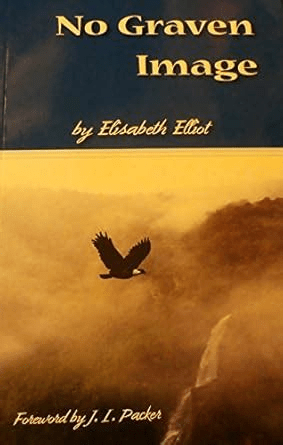
Elliot was indeed a really good writer. Sometime in the twenty-teens, when I was a young mom who had come back from the mission field hanging my head over my many failures, and had unpacked my books and settled into a rented house to minister to my small children, I found on an upstairs shelf a slim volume that looked as if it had been published in the 1960s or 70s, called No Graven Image. This was the novel that Elliot wrote when she first settled down in New Hampshire. She wished, through fiction, to give her readers a more powerful, truer picture of missionary life than her biographies had done.

This is not the cover my copy of the book had, though it also had an image of a condor.

No Graven Image was not well received when it came out. It was the old problem of marketing. To what audience do you market a genre-bending book? The people who liked to read tragic, worldly novels were not interested in a so-called “novel” about a young missionary woman, probably expecting that it would be preachy. The Christians who liked to read missionary stories were shocked and dismayed by a novel in which the protagonist flounders around, makes mistakes, and ultimately, accidently kills her language informant when he has a bad reaction to a shot of penicillin. And then decides that her desire to have a successful language project had been a form of idolatry.

Some readers appreciated the novel (particularly overseas missionaries), but most found it shocking, even blasphemous. They wanted a triumphant novel, not the story of Job. They wondered whether Elisabeth had lost her faith.

When I picked it up, in the twenty-teens, it made me feel extremely understood.

One thing that killed me as I read of Elisabeth’s later years is that this was the only novel she wrote. She very much wanted to write others, and she got as far as making notes for another novel. But life (read: men) intervened, and she was in demand for speaking and for writing nonfiction books such as Passion and Purity. She wasn’t able ever again to get the extended periods of time to concentrate that it would have taken to gestate a novel. She convinced herself that she just didn’t have what it took to write actual good fiction (and perhaps, that it was selfish to try). I am so sad to watch this dream die. I believe that she would have been a good novelist. I don’t know whether her publisher would have kept publishing her books if she had turned to fiction, or whether she would have had trouble finding another publisher. Spiritual non-fiction was what she had already become known for. She probably would have made less money, perhaps found it difficult to support herself. But still … you know … it’s hard to watch. So many things about the second volume of her biography are hard to watch. At the same time, because of Vaugh’s amazing research and writing, it’s hard not to sit back and just stare at this major accomplishment.

A Tale of Two Lost Boys: Perry Smith vs. Ikash son of Endu

Left to right: Dick Hickcock and Perry Smith, killers of the Clutter family; In Cold Blood by Truman Capote; The Strange Land by Jennifer Mugrage; “Don’t Eat My Family” by Jennifer Mugrage.

I hope this image gallery shows up right. I’ve never tried to make one before.

It’s unfortunate that I couldn’t find an image of either Perry or Ikash alone, but in some ways it’s fitting that the image I found for Perry features a mugshot and the image of Ikash shows him protecting his family.

This post will contain spoilers for The Strange Land, which has been out since 2021, and In Cold Blood, which has been out since 1966. This will be a rambling comparison between two character studies. Come along if you like that sort of thing.

It may seem — and O.K., it is — pretentious to compare a book of my own to Truman Capote’s masterpiece. My reasons for comparing the two characters will become clear, but to belabor the obvious, I am not comparing myself to Capote as a writer. It’s my blog, so I can be a little bit pretentious if I want, right? Shall we?

What the two lost boys have in common

The character of Perry Smith has a great deal in common, on a superficial level, with Ikash, the focus of my coming-of-age story The Strange Land. The similarities were strong enough to disturb me when I read Capote’s classic. After all, Perry drifts through the world aimlessly and then commits a senseless murder, whereas Ikash remains kind and courageous and goes on to become the shaman of his people. Perry is real, Ikash is fictional. Does this mean that I had fatally romanticized my character Ikash, a person who would not be nearly so noble in real life?

I do have a tendency to romanticize the sensitive, artistic guys, and ladies, if you share this tendency, it is something you need to watch. Just because a guy is not harsh, does not necessarily mean he is kind. As Jordan Peterson has said, “If you think strong men do a lot of damage, wait ’til you see the damage weak men will do!”

To start at the most superficial level, Smith and Ikash kind of look alike. Both are short and stocky (Smith had underdeveloped legs and feet), with wide faces, fine features, and dark eyes and hair. In fact, both are American Indian, though they are so far removed in time that this fact has no relevance for anything except their appearance. Smith’s father was John “Tex” Smith, an Irishman, and his mother was Florence Buckskin, a Cherokee. Ikash is a fictional character but was supposed to come from a tribe that was ancestral to the American Indians.

Both grew up in rough circumstances and eventually suffered the breakup of their families. Smith’s parents were both drunks. His mother left his father when he was small, and he turned to crime, lived in a series of orphanages, then on the Alaskan frontier with his father as a teenager. He eventually joined the Navy, then proceeded to drift from friend’s house to friend’s house to park bench to jail, not really having a place to go home to. His shrimpy stature was probably from malnutrition as a young child.

Ikash (again, fictional) had it slightly better. He did not suffer from hunger, because the tribe’s Beringian environment provided for them abundantly. However, his father was abusive to mother, leading eventually to her suicide, and periodically to his sons as well. After his mother’s suicide, Ikash’s family essentially broke up, and he and his brother lived together as bachelors. He was a bit of a pariah in the tribe because of his family’s reputation.

Both men are quiet, sensitive types. Both play the guitar (lute, in Ikash’s case) and sing. Both think of themselves as spiritual. In Perry’s case, he has occasional premonitions, visions, and, as he gets more beat up by the world, what appear to be dissociative episodes.

“I could give you a hundred examples. I don’t care if you believe me or not. For instance, right before I had my motorcycle accident I saw the whole thing happen: saw it in my mind–the rain, the skid tracks, me lying there bleeding and my legs broken. That’s what I’ve got now. A premonition.”

… “About that premonition stuff. Tell me this: If you were so damn sure you were gonna crack up, why didn’t you call it quits? It wouldn’t have happened if you’d stayed off your bike–right?”

That was a riddle that Perry had pondered. He felt he’d solved it, but the solution, while simple, was also somewhat hazy: “No. Because once a thing is set to happen, all you can do is hope it won’t. Or will–depending. As long as you live, there’s always something waiting, and even if it’s bad, and you know it’s bad, what can you do? You can’t stop living. Like my dream. Since I was a kid, I’ve had this same dream … What it comes down to is, [in my dream] I want the diamonds more than I’m afraid of the snake. So I go to pick one, I have the diamond in my hand, I’m pulling at it, when the snake lands on top of me… he starts to swallow me. Feet first. Like going down in quicksand.”

Perry hesitated. He could not help noticing that Dick was uninterested in his dream.

Dick said, “So? The snake swallows you? Or what?”

“Never mind. It’s not important.” (But it was! The finale was of great importance, a source of private joy. [It was a] towering bird, the yellow “sort of parrot” … which had first flown into his dreams when he was seven years old, a hated, hating half-breed child living in the California orphanage run by nuns–shrouded disciplinarians who whipped him for wetting his bed. It was after one of these beatings, one he could never forget, that the parrot appeared, arrived while he slept, a bird “taller than Jesus, yellow like a sunflower,” a warrior-angel who blinded the nuns with its beak, fed upon their eyes, slaughtered them as they “pleaded for mercy,” then so gently lifted him, enfolded him, winged him away to “paradise.”

As the years went by, the particular torments from which the bird delivered him altered, but the parrot remained, a hovering avenger.

pp. 90, 92 – 93

Perry has no outlet for his artistic nature and believes that no one appreciates his depth and intelligence.

Ikash, for his part, wants to have visions like his cousin Ki-Ki who is the tribal shaman, and eventually does have visions, but then worries that they are endangering his loved ones.

Ikash can spend a lot of time alone, thinking or praying. Smith travels with a box full of books, papers, maps, and magazines, even when homeless, which is a habit that endeared him to me before I heard more details about the murder he committed.

Ikash, as has been mentioned, moves into a protective role towards members of his tribe. Smith, despite being an unstable character in some other ways, several times protects girls and young women from the predations of his partner in crime, Dick Hickcock.

he had “no respect for people who can’t control themselves sexually,” especially when the lack of control involved what he called “pervertiness”–“bothering kids,” “queer stuff,” rape. And he had thought he had made his views obvious to Dick; indeed, hadn’t they almost had a fist fight when quite recently he had prevented Dick from raping a terrified young girl?

page 202

Finally, another burden these two young men have in common is chronic, or recurring, pain. Smith’s legs were smashed up in his motorcycle crash and appear not to have healed properly. There’s a memorable scene in In Cold Blood where the two criminals, on the way to their heist, stop at a gas station. Perry goes into the bathroom and stays in there for so long that both Dick and the gas station attendant are filled with disgust and impatience. In fact, Perry is first sitting on the toilet, then trying to rise to a standing position, with his legs hurting so badly that he’s holding onto the sink, sweating, and shaking. Ikash has periodic recurring pain from some old broken bones (collarbone, ribs), and also suffers periodic “phantom” pains in other parts of his body, that while short-lived, are severe enough to be temporarily debilitating. Ikash believes that these episodes represent instances of his “bearing” the actual sufferings of other members of his tribe, for them. They can also be understood as the lingering effects of trauma and grief, stored in the body. As can Smith’s health problems.

So what accounts for the different outcomes between these two lost boys?

Easy, you might say. You made Ikash up, so you can make him turn out however you like. Perry Smith lived in the real world, where there are no happy endings.

Well, O.K. I did not write a nihilistic book where characters are trapped by their abusive pasts, character flaws, and poor decisions by themselves and others, because I don’t believe that the world is, ultimately, a nihilistic place. But if you’re going to write hope into a book, it has to come from somewhere. It can’t be deus ex machina hope; it has to be Deus ex caelo, or should I say credo in unum Deum, Patrem Omnipotentem, Factorem caeli et terrae.

Some reviewers of my book said they found the scenes of domestic abuse difficult to read. Actually, I kept them as minimal as I could and still convey the problem, and there is much that I spared Ikash, as can be seen when we compare him to Perry Smith, who had it much worse.

Smith was the youngest in his family, so he was very small when things got chaotic between his mother and father. His mother would bring strange men home and fornicate with them in view of the children, something Ikash’s mother Sari definitely would not do. One of these episodes led to a fight “in which a bullwhip, hot water, and gas lamp were used as weapons.” After the breakup of the family, Perry ended up in orphanages where the nuns would shame and beat him for bedwetting. Ikash was also a bedwetter, as is not uncommon among little boys. Perry Smith had even more reason for it given the instability in his home. This problem continued into adulthood. He believed that his kidneys had been ruined by a childhood diet of bread dipped in sweetened condensed milk, which during the Smith family’s nomadic days was often all they had for supper.

Ikash’s family, though unhappy, remained intact until he was fifteen.

When Smith joined the Merchant Marine, Capote strongly implies that he had another horrible experience which Ikash escaped.

“But I never would have joined [the Merchant Marine] if I’d known what I was going up against,” Perry once said. “I never minded the work, and I liked being a sailor–seaports, and all that. But the queens on the ship wouldn’t leave me alone. A sixteen-year-old kid, and a small kid. I could handle myself, sure. But a lot of queens aren’t effeminate, you know. Hell, I’ve known queens could toss a pool table out a window. And the piano after it. Those kind of girls, they can give you an evil time, especially when there’s a couple of them, they get together and gang up on you, and you’re just a kid. It can make you practically want to kill yourself.”

pp. 133 – 134

Apparently, Smith was the victim of homosexual predators while he was at sea. This kind of violation, arguably the ultimate in horror, is not something I’ve ever felt up to subjecting my characters to. It is, sadly, quite common in the world (especially the ancient world), and I am not saying it’s something that a person cannot come back from. The grace of God is enough to redeem and restore anyone, no matter what they have been through (see The Sparrow.) But I have never had the slightest ability nor desire to put my male characters through this. Real life, on the other hand, is not so merciful.

Ultimately, though, it’s not Perry’s additional bad experiences that left his character to turn sour; instead, it’s relationships that he lacked and Ikash had.

Like Perry, Ikash’s immediate family was not great. His father and his older brothers bullied him. Unlike Perry, Ikash lived in a tribal situation where there were, close at hand, uncles and aunts, cousins, and a grandmother. This kind of situation is not automatically good, of course; tribes can be hotbeds of gossip and social pressure. And indeed, Ikash’s early experiences do cause him to mistrust older relatives who might otherwise be helpful to him. But he is fortunate to have quite a number of kind people in his life who wish to aid him and his mother. Grandmother Zillah does her best to provide breaks for Sari; cousin Ki-Ki mentors Ikash, and a model of a healthy marriage is provided by his father’s sister Ninna and her husband. Even with all these good helpers and models, it is barely enough.

Perry does not seem to have had anything like this kind of potentially beneficial community. His father and mother were itinerant, having met on the rodeo circuit. They don’t seem to live near any extended family. Perry does form connections with friends who he believes understand him, but because of his vagrant lifestyle, the connections are not lasting. At one point, he travels across the entire United States hoping to stay with an old Army buddy, only to find to his dismay that the buddy has moved and left no forwarding address. These kinds of near misses are the story of Perry Smith’s life. What might be called his last friend, Dick Hickock, is a cellmate who wants to use him to pull off a heist, and ultimately puts him in a situation that leads to the moral ruination, and then the death, of both of them. Dick does not understand Perry, nor does he have any concern for the best interests of Perry, the Clutter family–or anyone but himself.

In a counterintuitive dynamic, Perry’s very isolation tends to make him not only lonely, but also increasingly conceited. Having no long-term relationships means there is no check on his delusions. With no one to praise, appreciate and love him properly, there is also no one whose critiques he can take to heart. He’s left to his own assessment of himself, and not able to develop strength of character or clarity of mind. Ultimately, when he cuts Mr. Clutter’s throat, he does it without intending to. “I didn’t want to harm the man. I thought he was a very nice gentleman. Soft-spoken. I thought so right up to the moment I cut his throat.” (p. 244)

Ikash, on the other hand, is surrounded by judgmental relatives who have known him since he was small, who can love on, scold, praise, and criticize him.

Without Hope and Without God in the World

At fourteen, Ikash begs his older cousin Ki-Ki, the tribal shaman, to teach him how to have a vision.

Ki-Ki, the shaman, seemed to be in love with the world and with the many specific things in it. He was in love with his dogs, for example, with the horses, with the wild animals, in love with his wife, in love with God. It was this quality that drew Ikash to him. Ikash would love to approach the world like that. But he had never felt such love for anything, except when it was stirred in him for a few moments by some story or song of Ki-Ki’s. He longed to live in the world of the stories, but he had never been able to manufacture such love inside himself.

p. 93

Ki-Ki is uncertain this will work, or that is even viable (as he says, “visions are dangerous“), but he is willing to give it a try.

They sat, cross-legged, each with his back against a tree. Upstream, there was a view of the grey top of a mountain.

The atmosphere seemed somewhat lacking to Ikash. He looked at his older cousin and muttered, “Aren’t you going to beat a drum or something?”

Ki-Ki grinned whitely. “Then you wouldn’t be sure it was real,” he said. “Besides, God is everywhere. We need no drum to talk to God.”

As soon as he said the word “God” for the second time, a presence was felt in the gully. It was so palpable that Ikash actually gasped.

Ki-Ki apparently felt it too, for he reached out a large, hard hand and grasped Ikash firmly around the wrist as if to keep him from being swept away.

Immediately Ikash knew what his cousin had meant about danger that was not a physical danger. He felt no threat, nor any hostility, such as he had often felt from his father. But the presence was overwhelming, crowding, as of something too huge for the valley to contain.

This was not the sort of vision he had hoped for.

He heard Ki-Ki speak. “It’s too much for him,” he said, and for a second it was as if some great face had turned its terrible eyes towards Ikash … and then, oh thank goodness, the presence was gone suddenly.

pp. 100 – 102

In other words, Ki-Ki, without really trying to, functions as an intermediary to introduce Ikash to God. Later, when quite a few other tragedies have happened and Ki-Ki has been taken from Ikash, the young man has a vision of his own that he can only describe as “a father.”

“A father?” [his brother] Sha blinked, completely thrown.

“A good father.” Ikash was staring earnestly at his brother, as if willing him to grasp this difficult concept. “It gave me a sense of a really good father, the kind we’ve always wanted but never known.”

“What did it look like?” asked [cousin] Mut. He was picturing a bigger, two-eyed version of his own father.

“I told you, it wasn’t visual. I didn’t see anything except the cloud. But I felt the Father. … We have a father.” He made a slight sweeping gesture with his hand that took in himself and, somehow, the entire camp as well. “That’s what makes us able to bear the loss of all the others.”

pp. 512 – 514

A perceptive reader has pointed out that the definition of a horror story is all the bad stuff in the world that happens, minus God. God is what keeps Ikash’s story from remaining one of unremitting horror. This was the horror–the horror of other people’s sins against him, the horror of a complete lack of adequate love, the horror of his own increasingly weak mind, and eventually, his own grievous sins against others–that Perry Smith lived.

Before Smith and Hickock committed their planned robbery, to which Hickock insisted they leave “no witnesses,” they stopped by a Catholic hospital. Perry Smith knew that nuns were guaranteed to have black nylons, and he wanted Hickock to obtain some so the two could cover their faces when they went to rob the Clutter family. Perhaps, if the two had managed to do this, they would not have ended up killing the Clutters. Dick, however, came out of the hospital without having tried to get any nylons (“it was a pukey idea”). Perry was not willing to go in. He believed that nuns were bad luck.

After Smith and Hickock’s arrest, Perry Smith was kept in a cell in the home of the town undersheriff and his wife, a cell that until then had been reserved for female prisoners. (The reason was a desire to keep the two culprits separated.) Sherriff and Mrs. Meier were “deeply Catholic.”

Mrs. Meier had been rebuffed by Perry when she had suggested a consultation with Father Goubeaux, a local priest. (Perry said, “Priests and nuns have had their chance with me. I’m still wearing the scars to prove it.”)

pp. 288 – 289

Now, of course, “nuns and priests” are not necessarily the only way to find out about the redemption offered to us by the God who gives life to the dead, and calls things that are not as though they were. They might not even be the best way. My only point is that unfortunately, for Perry Smith, the only people in his life whom he associated with God, were also people who were abusive to him. He never had a chance to be introduced to the concept of God by anyone he loved and trusted. This is the opposite of the case with Ikash.

Later, in jail, Perry did make friends with a former pastor, now a fellow inmate, who was mystical and simpatico with Perry. This man, however, seemed to be a bit of an apostate, and by that time Smith had already hardened against the whole idea of God. God, certainly, can overcome stories this sad and sadder, but in this case, for whatever reason, He didn’t.

We don’t know whether Perry Smith had a deathbed conversion in the last few seconds before being hung, but tragically, from all appearances, it doesn’t appear so. Neither did Dick Hickcock. That, plus the apparent senselessness of the fate of the Clutters, is what makes In Cold Blood such a tragedy. It underlines how much Smith and Hickock–and indeed all of us–need Jesus, and that is what makes this unedifying event such an appropriate topic for this Easter season.

The Murderer’s Mother

She doesn’t know her son is suspected of murder, at this point. She just thinks he has been passing bad cheques again.

“That gun cost over a hundred dollars. Dick bought it on credit, and now the store won’t have it back, even though it’s not hardly a month old and only been used the one time–the start of November, when him and David when to Grinnell on a pheasant shoot. He used our names to buy it–his daddy let him–so here we are, liable for the payments, and when you think of Walter, sick as he is, and all the things we need, all we do without …” She held her breath, as though trying to halt an attack of hiccups. “Are you sure you won’t have a cup of coffee, Mr. Nye? It’s no trouble.”

Truman Capote, In Cold Blood, p. 171

Just look at that masterful dialog, how it breaks your heart!

Review of the The Innocent

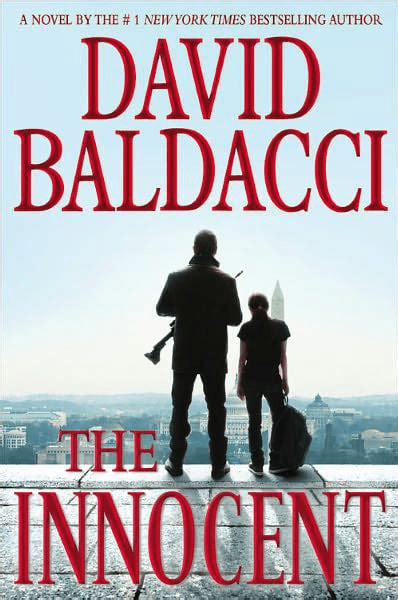
The Innocent, by David Baldacci, Grand Central Publishing, 2012

What can get me to read outside my accustomed genre?

That’s right, free books can!

My husband, a truck driver, knows another truck driver who likes to read. This man has somehow found out that I am also a reader, so when he finishes a book, he sometimes passes it on to me through my husband. I have never met the man, but we now share a number of harrowing mental experiences. Such is the secret society of readers.

The Innocent is a spy thriller. The first several chapters follow the lonely life of crack government assassin Will Robie as he carries out two different hits. (Apparently, this is going to be “the first Will Robie novel.”) We see that Robie is tough, cool under pressure, and professional at killing people. He’s covered in scars, which are covered in tattoos. Due to the nature of his job, he leads a lonely life. He goes to many exotic locales but never has relationships with any of the people there. He gets to eat good food and drink alcohol sometimes, but he has to keep insane hours with very little sleep sometimes. His home base is in Washington, D.C.

Robie was an inch over six feet and a rock-solid one hundred and eighty pounds. He possessed a compact musculature that relied more on quickness and endurance than sheer strength. His nose had been broken once, due to a mistake he had made. He had never had it reset because he’d never wanted to forget the mistake. One of his back teeth was false. That had come with the broken nose. His hair was naturally dark and he had a lot of it, but Robie preferred to keep it about a half inch longer than Marine buzz cut. His facial features were sharply defined, but he made them mostly forgettable by almost never making eye contact with anyone.

the first page

I love that that’s on the first page. That’s how you introduce a character, boys and girls! Now I have a clear mental picture of Robie (like a shorter Jim Caviezel), and the author won’t need to say much about his appearance for the rest of the book. Also, the description is given in a way that’s woven in with a sketch of his history.

It’s a good thing Robie has a cute last name that sounds like a first name. It’s the only thing softens him for some time.

For the first eight chapters (per the thriller genre, they are very short chapters), we see Robie go about his business. He carries out two hits. He withdraws from each successfully. He goes back to D.C. He starts to make tentative friends with a young lady who lives in his apartment complex, though he wonders whether this is a good idea. He gets ready to carry out his next hit, which is local.

Then, finally, in Chapter 9, we meet The Innocent.

She’s a fourteen-year-old girl named Julie Getty. Julie is smart and scrappy. Her parents love her, but they are druggies, so she’s been in and out of foster homes. Nonetheless, she’s in AP Calculus. In Chapter 9, Julie sneaks out of a subpar foster home to go meet up with her mom, who has sent her a note saying they are moving. When she gets to her house, though, she witnesses her parents get shot by unknown men. Not having a phone, Julie flees. Her story and Robie’s will soon intersect.

Julie came along at just the right moment. I didn’t want to read a whole novel that was basically Jason Bourne, consisting only of action + Hero Is No Longer A Normal Person Because of His Past. Once Robie starts to feel responsible for Julie, he now has to behave like a normal person in ways that he didn’t before. He also has to put up with a canny teenager who, naturally, wants to be involved in finding out why her parents were killed. And he has to do this while keeping her safe.

I’ll stop there because of spoilers, but this book was an outstanding example of its genre. It’s mostly action, but the plot is also a twisty puzzle. I don’t think the reader is meant to be able to figure out the puzzle in time to Save the World, but Robie is meant to be able to. Even the assassinations in the early chapters become relevant later. All the subplots get tied in together. There is a satisfying debrief at the end, where it’s all explained from a bird’s-eye view in case the reader missed any pieces. There is some emotional turmoil (Robie might not be normal, but he’s still human, you see). And there are hints that Robie has a heartbreaking back story, no doubt to be alluded to in later novels. Four stars.

You Guys! A Book of Poems about Prehistoric Burials!

There’s a reason I’m posting about this book on Feb. 14.

It does something that I want to do with my novels.

It takes the feeling that I get when hearing about bog burials, stone circles, cave paintings — and amplifies it.

Did I mention that I love it?

I’ll be posting quotations from this book throughout the month of February. The one I posted two days ago – To The Air – could have been written about the scene in The Long Guest where the family cremates … well, I won’t give it away. It was trying for the same thing as that scene, or vice versa. But I mostly posted it for that evocative last line.

you died horribly but are beautiful,

sleeping face and pointed cap and perfect feet,

a peat cutter’s slash dug into your back

but preserved as none of your captors are —

though what a price for immortality.

–from Tollund Man, p. 39

If you’ve ever seen a picture of Tollund Man, this is exactly it.

I haven’t yet read every poem in Bone Antler Stone. They require close attention, and some of them are not short. But every so often I’ll dip into it, and find gems like this one:

The sun sets into the sea with a hiss

and rises with the sound of a driven wheel,

the creak of speaking stone, metal and wood.

The sun sets into the sea to simmer

and rises with the sound of stretched leather

and the song of the horse’s chain and bit.

ibid, p. 23

The idea of the solar system as a great big machine, perhaps made of hoops or wheels, that is alluded to in that first stanza is actually very close to how some ancient cultures conceived of the cosmos.

The last poem in the collection shows the author leaving Orkney, where he went to view the burials, with a friend who is named Pytheas for some reason. This poem raises the thought that not everyone is going to “get” a book of poems like this one.

The price to pay for a place like that,

the price to pay for poems like these…

our intensity is terrifying or just tiresome,

and so the dead and the damp doubleback

into just another of our silent, stone secrets.

It the compares the book itself to a barrow burial waiting to be discovered at the right moment:

So Pytheas proceeded in reply,

assuring me that for us, and for ours,

there was only the odd look, the old look, the awed look,

but rarely the real look of revelation,

or the consolation of having communicated.

And so the motive was to make meaning and memory

a kind of barrow burial in bloom

a garlanded grave underground

forged with turf and stone and fire and then forgotten,

until a propitious step or a sudden storm

blows open this book’s binding

and lays each line out in the light again,

shells of syllables dotting the sand.

Well, with a propitious step, I have found it.

It’s Poem Season and I Don’t Know Why

Poems seem to come over me occasionally, like the weather.

Yesterday, I wrote a long poem about death and being embodied that I will probably never post here. Today, I started one called Take Me Instead. And also today, my students and I whipped out a sentimental but serviceable little Valentine’s Day sonnet. Sonnets are easy because you just plug in the iambic pentameter and the rhyme scheme.

Perhaps I accidentally primed the pumped by reading the book I’m about to review tomorrow.

Take care! Watch out for falling poetry!

Race Marxism by James Lindsay: a book review

Well, it’s that time of year again: the long, long weeks of post-Christmas winter, when we grit our teeth and read the books that are not fun but are good for us. I think it was this time of year, a few years ago, that I read The Gulag Archipelago by Aleksandr Solzehenitsyn. This is similar.

The poison of class war

First, some background. I don’t like Marxism. I don’t like anything that has even the faintest hint of class war in it, in fact.

I was a sensitive, easily guilt-tripped child, and I grew up in a “Christian” denomination that had an intermediate-to-advanced case of marxist infection in its Sunday School materials. They would take verses like “blessed are the poor” and “how hard it is for the rich to enter the kingdom of God!” and use them to make it clear to me that being an American, with a high standard of living relative to the rest of the world, was not only a sin, but a very special sin, in a category all its own, because this was one sin which you could not repent of and to which the blood of Jesus did not apply. I was the “evil rich,” and there was nothing I could do about it. Also, because of this, I was morally guilty for any suffering that happened anywhere in the world, provided that the United States was somehow involved or the people suffering were “poorer” than I was. And I swallowed all this. I felt guilty, not grateful, for every little purchase or luxury. And eventually, I felt defensive about them.

I now know, based upon what I have learned since, that marxian systems by their nature do not include repentance or grace. These are Christian concepts. We cannot expect them from a system that works by designating a villain class, then constantly expanding that class. I had already figured out, simply from applying common sense, that the “logic” of class-war thinking is illogical, years before Lindsay came on the scene, but once I started reading him, it became even clearer.

As a simple piece of first advice for pushing back against Critical Race Theory, stop assuming it has good intentions. Individual people pushing Critical Race Theory might have good intentions, but the Theory they are applying does not. For liberals, this is a tough pill to swallow. Critical Race Theory ideas are not liberal ideas, and they cannot be considered on liberal terms. They are viruses meant to infect the liberal order. Assuming the ideas must mean something more reasonable than it seems or that activists won’t equivocate between meanings in a strategic way to seize power will cause you to lose every single time.

ibid, pp. 254 – 255, emphasis in original

There is no redemption in a marxian system. The only way you, as a dirty resource hog, could possibly redeem yourself would be to fix all the problems and all the suffering in the world. Since you can’t do that, you will probably die in the Revolution. Sorry not sorry. And you’ll deserve it.

It still baffles me when well-meaning people (usually women, TBH) try to “comfort” me by telling me something along the lines of “It’s not your fault. It’s the fault of Capitalism. You are the oppressed. The System needs to change.” (“It” could be anything from the difficulty of navigating the health insurance system, to eating healthy.) I just want to shake their shoulders and say, “Are you kidding? We are the ‘capitalists.’ We are the ones they hate and blame. If you blame ‘capitalism,’ you are blaming me and saying I should not have any private property.”

This sounds kind of self-pitying, so let me hasten to add that I fully realize that being guilt-tripped, blamed, and messed up in the head over your class status is by far the least harmful outcome for anyone exposed to Marxist ideas. For millions of people who were more directly affected, it cost them their very lives. However, my little story does illustrate how the only fruit of class-war rhetoric is to divide people from one another and give them hang-ups. It never makes relationships better.

O.K., so that’s bit of background #1. Me and Marx – not good buddies. No, indeed.

A challenging book to read

Second bit of background: over the past several years, I have listened to many, many hours of lectures by James Lindsay. It was a fellow Daily Wire reader who first pointed me to Lindsay’s website, New Discourses. (Fun fact: one of my kids for several years thought the site was called Nudist Courses.) Anyway, Lindsay’s podcasts quickly became a regular feature of my listening-during-chores lineup. I would do dishes, pick berries, paint, or fold laundry while listening to his dry, mathematician’s voice punctuated by occasional naughty words when the stupidity of the ideas he was describing provoked him really, really bad.

I listened to Lindsay talk about the Grievance Studies Project that he carried off with Peter Boghossian and Helen Pluckrose. I listened to him read and analyze essays by Herbert Marcuse, Kimberle Crenshaw, Derrick Bell, bell hooks, Robin DiAngelo, Jacques Derrida, and Paolo Freire. As I was listening, Lindsay was also learning. He traced modern identity politics back through the postmodernists, back to Marx. Marx’s ideas he traced back to Hegel, as he did long episodes about Hegel’s extremely convoluted philosophy and how Marx tried to remove Hegel’s mysticism. Eventually, he uncovered the occult roots of Hegel and other German philosophers. It was from Lindsay that I first heard the term Hermeticism (although I was listening to a lecture on Gnosticism by Michael Heiser around the same time).

Lindsay started out in the New Atheist movement, with a special interest in the psychology of cults. He then disassociated himself from the New Atheists when he noticed they were behaving, as a group, rather like fundamentalists. His views on religion have matured over the years. He now realizes that not all religions are equally cultlike or equally bad for society. And, after much research, he has correctly identified modern identity politics as a reboot of the ancient Gnostic/Hermetic mystery religions, complete with secret knowledge, sexual initiation rituals, and the promise to transform human nature itself into something greater. “Ye shall be as gods.”

If all of this sounds hard to believe, you can find all these lectures on the New Discourses website and most of them on YouTube as well.

I go on at such length about this in order to convey to you just how well oriented I was when I picked up Race Marxism. I had already heard Lindsay lecture on the thinkers he mentions in the book, many of them multiple times. (And for many of them, it takes multiple times to actually retain their concepts, because they are intentionally complex. Not to speak of the way they love to invent words, flex on their readers, equivocate, and even undermine language itself.)

I was really well oriented, baby.

And even so — even so — I found Race Marxism to be a slog.

I honestly don’t think this is Lindsay’s fault. He’s trying to give us the history of a concept (“Critical Race Theory”) that is intentionally obscure. Many different streams of thought have gone into it, and the Theory’s proponents take advantage of this to toggle back and forth between the different meanings of the concepts in their theory. In fact, they use the Theory’s slipperiness as a sort of shibboleth. That way, if someone says something negative about the Theory, disagrees, or even simply states the theory in terms they don’t like at the moment, they can claim that this person has not really understood it.

Critical Theories exploit this confusion by focusing virtually entirely on “systems,” which are almost impossible to pin down or describe accurately, not least since these “systems” really are stand-in descriptions for “everything that happens in any domain human beings are involved in, and how.” That is, when a Critical Theory calls something “systemic,” what it really means is that it has an all-encompassing Marxian conspiracy theory about that thing. When people don’t think that way, Theorists then accuse them of not understanding systemic thought, or, more simply, of being stupid and intellectually unsophisticated. This little trick is very useful to activists because it allows them to call everyone who disagrees with them too stupid to disagree with them and generally tricks “educated” onlookers into thinking the plain-sense folks must be missing something important, nuanced, and complex.

ibid, p. 233

Any book that tries to engage with, pin down, and define a thought system that uses these tactics is going to be a slog. Lindsay has to trace several different lines of thought, so he’s coming at the same concept from a different angle in chapter after chapter. It’s all one big tapestry, so there’s not a clear, natural place to start. The first few chapters feel as if we are going in circles a bit. Lindsay has to quote CRT authors at some length, and they are not good writers. Additionally, because their entire philosophy is based upon envy and hate, even when they are somewhat clear they are unpleasant to read. But he is not going to make a claim about CRT and then not back it up. So, we get things like, “No, CRT is not simply anti-white-people; instead…” [twenty pages later] “… and that’s how CRT manages to be anti-most -white-people while denying the reality of race.”

The book picks up towards the end, when with much blood, sweat, and tears, the basic claims of CRT have been established beyond a doubt and Lindsay can move on to how it affects organizations and what can be done about it.

What will your experience be like reading this book?

I’m not sure.

It depends upon how familiar you are with these concepts already, and how quick of a study you are. It might also help if you do your reading from this book at a time of day when you are fresh. I think part of my problem is that I was slogging through it, often when tired or otherwise unwell. It’s not really the sort of book that you can take to an event, or dip into in a waiting room.

If these concepts are totally new to you, and you are a very quick study, you might come out of this book with the experience of “mind blown!” However, it’s more likely that you will grasp some things on the first go-round, but will understand more each time you re-read a given chapter. (That’s actually my experience with most non-fiction books.)

It is the nature of Critical Race Theory to have a whole bunch of academic, intimidating-sounding terms to describe just a couple of ideas that, when you get down to it, are fairly simple and also stupid. So the learning curve is steep at first, but quickly flattens out if you know what I mean.

I bought this book primarily to have on hand as a resource. I had to read it cover to cover at least once, so that I know where to find things in it. I probably won’t do that again. But I will certainly dip into it, because it documents painstakingly all the ridiculous, counterintuitive, antihuman, incredibly damaging claims that have been made in this theory, and who made them, when and where in what publication. That is an invaluable resource to have on hand, because there will be new terms and new claims soon, and the Theorists will deny that anyone ever made the old ones.

So, I bought this book more as a reference book than anything. I hope that you will, too. Lindsay has done a fantastic job compiling all this stuff and sorting it all out in some kind of order. Perhaps, if he had spent more years on it, he could have polished the prose and made it more pleasant to read, but that wasn’t the priority. The priority was to get this book out there in time to undeceive as many people as possible about this insidious theory. It doesn’t have to be pretty. It just has to exist.

Wrapping Up the Romance Readalong

To recap, I joined a readalong with Bookstooge of a book with a cover that looks like this:

and whose author looks like this:

… which gives you a better sense of what the book is like than the cover does, really.

Barbara Cartland turned out a book every two weeks for the last twenty years of her life. Keep that in mind.

So, I finished this book pretty quickly. I was expecting a formulaic romance, and that’s what I got. The book does not drag. I can’t say I was super invested in it emotionally, but that’s because I’m a cynical middle-aged woman. And when Richard thinks to himself,

Oh, God, he loved her so much.

page 109

… I believed him. Behold the magic of Barbara Cartland!

Now, this book remains a first draft, and there are some first draft-y things in it, such as a shawl starting out as “lace” in one chapter, and getting transformed into “green silk” in the next. My favorite of these “first draft” moments is this one:

But now — how can I bear to be his wife knowing that he is already be in love with someone else?

page 106

I mean, I can relate. The most comical and confusing typos always show up in my most emotional scenes … and I always get so carried away when re-reading the scenes, that I can never catch them myself.

So, all in all, this was a not-terrible romance novel that read sort of like an outline, because it basically was an outline. If the book had been re-written to be much longer, then I feel certain that many of the minor plot holes/historical vaguenesses would have been ironed out, plus the potential emotional heft might have been successfully deepened to actual emotional heft. But, every author has to say “done” at some point, and in Cartland’s case, that was after whipping up the first draft, because that was her business model. She let readers take care of the historical details and the emotions, handling them with suspended disbelief and imagination. And that’s fair.

There was only one thing I did not like: the angry almost-kiss. (“Almost” because the couple are interrupted by a maid, so they don’t actually kiss except once at the very end of the book.) Anyway … “angry” and “kissing,” they do not go well together, no precious, they do not. I do not want Tiana’s marriage to be the kind of relationship where Richard ever kisses her angrily. And in fact, in most of the book, that is quite out of line with his character. It just happens in one scene, where they both lost their tempers “horribly” (actually quite mildly), and then were nearly overcome with passion. I don’t know why this is a romance trope. I guess I’ve missed something during my four decades of living. But, tip for you guys, in the middle of a fight is not the greatest time to start kissing your beloved.

Readalong with Bookstooge: Love Saves the Day

My faithful fellow blogger, Bookstooge, is doing a readalong of a book someone, possibly as a prank, recommended to him: Love Saves the Day by Barbara Cartland. I went so far as to order this book from Amazon in order to participate. I don’t usually read in the romance genre, but I have read a few, and I don’t despise the genre or its readers or anything like that.

I waited to post this until after Bookstooge’s first reaction post went up on Friday, but I am composing my reaction before I see his.

First, let’s talk about this cover, eh? The word “terrifying” comes to mind. The guy looks more like Dracula – or a 60-year-old uncle- than like a romantic hero. Note that he is grasping the heroine by the upper arms. She, for her part, appears to be very concerned and trying to get away. I don’t mind the fact that this is impressionistically rendered – I don’t even completely mind that her hair is not, as it is described in the book, curly — but the emotional tone of this cover does not match the promised content.

I am, as of this posting, almost all the way through Chapter 4 because I mistakenly remembered that Bookstooge was going to be writing about chapters 1 – 6 in his first post. My impression so far: the plot is a very capable romance plot. The heroine is young, brave, idealistic; the hero is a little older, world-weary, etc.; there’s a rival romantic hero in the picture who is young, blond, and charming; financial circumstances are forcing the couple into co-operation they wouldn’t otherwise undertake. There’s even a bitter, scheming housekeeper a la Rebecca. I can’t see any big holes in the plot.

My first impression of the wordsmithing is that this is a first draft.

There are a ton of comma splices. There is head-hopping. (Though that may be intentional; sometimes it’s hard to tell head-hopping from an omniscient narrator. I omnish, myself.) The tone of the dialog is slightly inconsistent. It’s as if Cartland wants this to be an Edwardian-era novel, like Austen, or even earlier, but it’s set in 1903, and sometimes it comes off as if the characters are pretending to be from an earlier era. I can’t tell whether clothes, technology, and so forth, contain any anachronisms. The clothes are fairly generically described, but there are “omnibuses.” (Edit: I just looked it up, and oops! Edwardian is 1901 – 1910. So, spot on. So, the language sounds like it’s going for … Victorian? But obviously I’m not very savvy about this, so perhaps her language is also period accurate.)

Anyway, after noticing that this read like a first draft, I then went back to the introduction (which, like a good fiction reader, I had skipped), and, lo and behold …. it is a first draft.

Dame Barbara Cartland[‘s] most amazing literary feat was to double her output from 10 books a year to over 20 books a year when she was 77 to meet the huge demand.

She went on writing continuously at this rate for 20 years and wrote her very last book at the age of 97, thus completing an incredible 400 books between the ages of 77 and 97.

Her publishers finally could not keep up with this phenomenal output, so at her death in 2000 she left behind an amazing 160 unpublished manuscripts, something that no other author has ever achieved.

Barbara’s son, Ian McCorquodale, together with his daughter Iona, felt that it was their sacred duty to publish all these titles for Barbara’s millions of admirers all over the world who so love her wonderful romances.

So in 2004 they started publishing the 160 brand new Barbara Cartlands as the The Barbara Cartland Pink Collection, as Barbara’s favourite colour was always pink — and yet more pink!

The Barbara Cartland Pink collection is published monthly exclusively by Barbaracartland.com and the books are numbered in sequence from 1 to 160.

–the introduction

Barbara Cartland was cranking out about one novel every two weeks for twenty years. I’m not even mad, I’m impressed. And I am now a little bit jealous of her. Imagine having such high demand for your books that you can just dash off all your ideas and the publisher will publish them as fast as they can.

Also, I’m tickled. That selection above gets funnier every time I read it. I mean, it sounds made-up, like something from a Bertie Wooster novel. Even the names of Barbara’s son and granddaughter sound like characters from her books. And the fact that they are calling it the pink collection because that was her favorite color … the fact that she loved pink so much … the fact that her author photo looks like this:

Now that I think about, the section above might be my favorite part of the book. The romance between Tiana and Richard is going to have to get awfully good in order to compete with Cartland herself.