
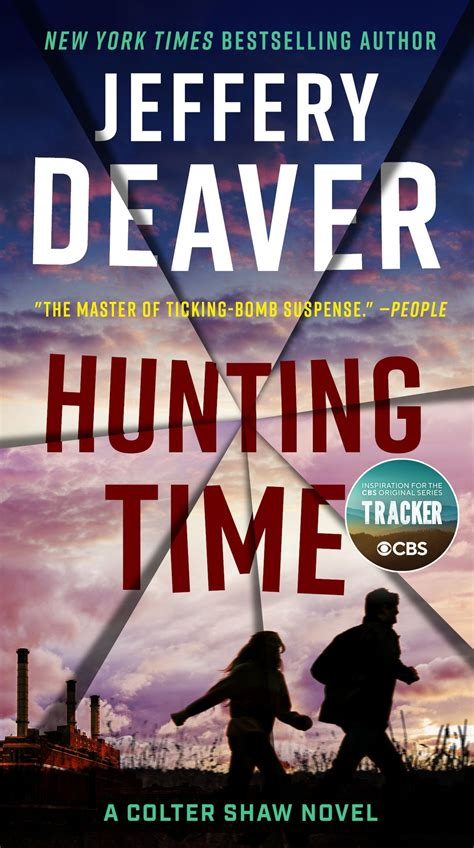
Hunting Time, a Colter Shaw Novel, by Jeffery Deaver.
By the way, it’s “hunting TIME,” not “HUNTing time.” The sense is not “time to hunt,” but “we don’t just save time, we hunt it down.”
This is a very professional modern thriller and the author has tons of blurbs on the back from other modern thriller writers. The plot was intricate, the pacing tense, and the characters were distinctive enough to keep them straight and give some emotional momentum to the story. There was also at least one major twist that I did not see coming, and that I really thought was clever.
Possibly the best-drawn “character” is the Midwestern city of Ferrington, the picture of urban blight but without the glamour of a big coastal city. Ferrington used to be an industrial capital, but then many industries left the city, leaving people out of work. Now the place seems to be nothing but drugs, crime, and despair. There are lot of chain-link-fence-surrounded empty lots filled with trash, long streets full of abandoned warehouses, and there is a badly polluted river. The ugliness of the scenes described rises to the level of beauty. The cops are corrupt in some cases and spread too thin in others. I think the name Ferrington is supposed to remind us of Ferguson, Missouri, and this is where we start to get into the book’s flaws.
Though Deaver mostly sticks to the story, when laying his scenes he makes sure to get in occasional digs at the reader. Bigots are everywhere. Trans is good, gay is good. We capitalize Black but not white. Stuff like that. Oh, and of course, capitalists are the one who ruined Ferrington in the first place.
My other issue with this book is the female characters. They’re not terrible, but … but … well. They are just missing a certain je-ne-sais-quois. For example, one of the point of view characters is a woman, Allison Parker. Deaver uses third person limited with her and with Colter Shaw, the sleuth. When we are inside Allison’s point of view, he frequently calls her Parker. That is just a bit confusing. It makes it sound like there is another person in the room. I am pretty sure that most women don’t think of themselves by their last name. Although maybe men do. Which is really the problem: All Deaver’s “female” characters (he has three main ones in this book) think more like men. Allison Parker is an engineering genius, very organized, very no-nonsense. Her daughter Hannah is a math genius, also no-nonsense. Sonja Nilsson is a former military operative (you guessed it, no-nonsense!) who is willing to sleep with Shaw after having known him for a day or two.
This is not a problem with Deaver alone. Many, many female authors write “male” characters who think and talk like women. It’s just awfully difficult to get into the head of the opposite sex.
Finally, there are occasional little things that made me scratch my head. “Seahorses can be sensuous.” (They can?) “Five-high.” (It’s high-five.) Nilsson lost forty pounds, and kept it off, in order to go into witness protection. (Oh, I didn’t realize it was that easy. Especially since she left the military at the same time! But, as we all know, the only thing keeping fat people from losing weight is the want-to. Eye roll)
Due to all these little flaws, and because the reveal of the villain was less satisfying than I had hoped, I give this book three out of five stars.
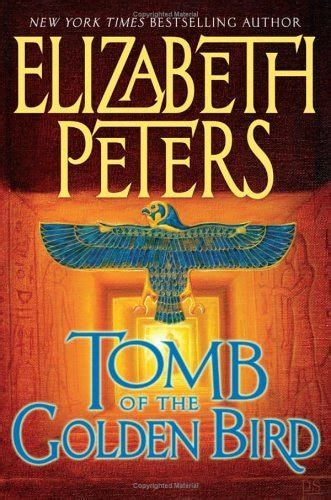
Tomb of the Golden Bird, by Elizabeth Peters
This was pure fun.
The Emersons are a family of British Egyptologists. Emerson, “Father of Curses,” the paterfamilias, is married to Amelia Peabody, whom he calls “Peabody.” This hot couple began their Egyptian adventures back in the Victorian era, but now it is 1922. Their grown son, nicknamed Ramses, is married and has children, and the Emersons have a large, motley household of employees, longtime family friends, relatives, and adoptees, both Egyptian and British. They have returned to Luxor, Egypt, for yet another season of digging. Of course, there are going to be capers, skullduggery, and so forth, and all the Emersons will be involved up to their elbows. Will they be deceived by Emerson’s half-brother Sethos? Will they foil an international plot? Most importantly, will they ever get a peek into the intact tomb that was discovered–technically, by Emerson–and is now being opened by the odious Carter?
This series is exquisitely researched. About 60% of the story is told in the first person by Amelia Peabody, in near-perfect late Victorian/Edwardian language. Scattered everywhere are gems like this one:
… I identified several other [party] guests as journalists. I can always spot them by the bulges in their coat pockets which indicate the presence of notebooks, and by their predatory looks. Messieurs Bradstreet of the New York Times and Bancroft of the Daily Mail were known to me personally (through no fault of mine).
p. 241
The other 40% of the story is told in third person from the point of view of Ramses, who is a quieter character than his colorful parents, but it also includes gems:
He had thought of several innocent explanations for David’s behavior, including the one he had given. It was understandable that [David] might feel the need to be alone; the family en masse or individually could be wearing.
p. 254
I originally came to this series hoping for ancient Egyptian mystical mysteries. It’s not that. It’s more of a romp. Much of this book felt like following the Keystone Cops, but eventually there did turn out to be some twists that gave the whole plot shape and direction. Four out of five stars.
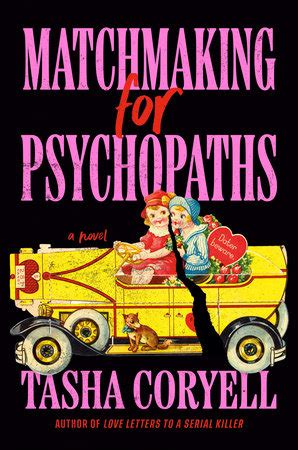
Matchingmaking for Psychopaths, by Tasha Coryell
I picked this up off the New Books shelf at the library. Perhaps I should have left it there, based on the title, but I had read the first few pages and found them engaging. Alas, I returned the book without finishing it. I would have liked there to be at least one main character who I was sure wasn’t a psychopath. A little psychopathology goes a long way.
When I returned the book, the librarian giggled and said, “Oh, that one was silly.” It was indeed silly. But silly and serial murder don’t mix well. At least not for me.
 Out of Babel Books
Do writers today simply not understand the difference between the sexes, or do they deliberately distort it to advance their progressive outlook? Or are they just hacks?
I’m run into the whole “woman is just a man with boobs” thing in a lot of the indie military sf I’ve read over the years. Thankfully, I don’t read too many “man is just a woman with a penis” kind of books. I can overlook the first because I don’t think like a woman, but boy, when I read a male character who is acting like a woman, it annoys the daylights out of me.
On a side note, that first review was long enough (on my blog anyway 😀 ) for it’s own post. Any reason why you lumped all 3 together?
LikeLiked by 1 person
It’s nice to see you leaving long thoughtful comments even on your break!
Here’s my analysis of the “writing the opposite sex” problem. The only writers who are good at it, have to be very insightful and have to be writing stories of which characterization and character development are a main focus. This rules out many of the genres, like adventure writing.
In the past, genre writers could rely on stereotypes for their portrayal of the opposite sex, and while not particularly deep, stereotypes contained enough received wisdom that they allowed a decently accurate portrayal of men by female writers and of women by male writers.
In modern times, we were told that stereotypes are worthless, and in order to be truly “authentic” we have to throw them out. That cast writers back upon their own resources. So they starting writing all the characters from their own point of view and their own values, because what else did they have? The result has been the “woman is a man with boobs/man is a woman with a penis” phenomenon.
Sci-fi is a big offender with the women-with-a-male-brain. As a teenaged girl, the impression that I received from this was these were ideal women, that the best way to be a woman was to “happen to be” one.
As for man-with-a-female-brain, I refer you to Jondalar in the Clan of the Cave Bear series, and all the horribly cringely “male” leads that I wrote in my little stories as a young adult.
Why did I put all three of these reviews in one blog post? Just poor planning, I guess. I had three books that were not particularly important to me and not particularly on theme for my blog, so I stuck them together.
LikeLiked by 1 person
Thanks!
Not taking a break from commenting. Things would have to be pretty dire for a comment hiatus 🙂
Thanks for that. Doesn’t make it any better, but always glad to have more info.
Gotcha.
LikeLiked by 1 person