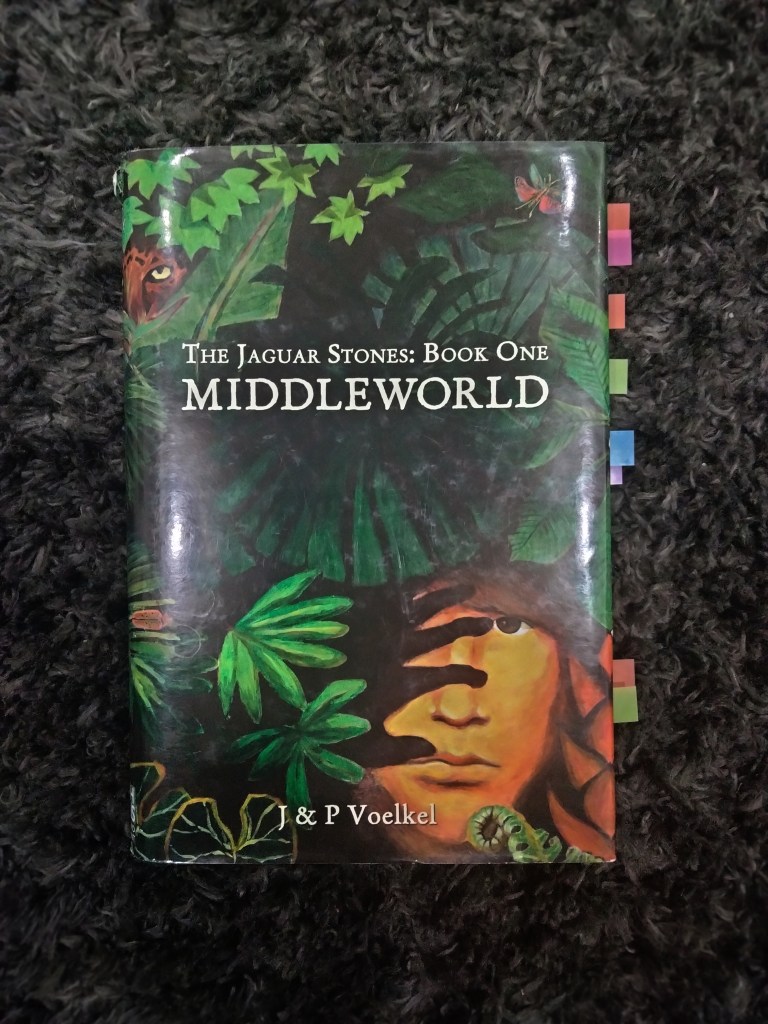
The YA Maya-themed Adventure Series of My Dreams

We continue our journey through darkest Jen’s TBR Pile with this book, which I picked up in an Idaho Falls thrift store several years ago and has been waiting patiently, like a pyramid under jungle cover but more durable, to be excavated.

One week ago, Max Murphy’s biggest problem was deciding which pizza to order. Now he’s lost in the perilous rainforest and running for his life with Lola, a modern Maya girl. Their terrifying journey will take them into the heart of an ancient evil and awaken powers that have slept for a thousand years. For fate has delivered an epic challenge to this pampered city boy. From now on, only one thing is for sure: Max Murphy won’t be eating pizza again any time soon.

from the dust cover

This book is the perfect YA Maya adventure. It starts with Max in Boston. His parents are archaeologists. They have to be gone a lot for their work. Max believes they “care more about the Maya than about him,” and he has learned to leverage this guilt into all the video games and snacks, and other luxuries his heart desires. This beginning is presumably there to ease the book’s target audience (American teens) into the Mayan context without a steep learning curve. They aren’t just thrown in; they find out things as Max does.

“Did anyone ever tell you that you’re bossy?” said Max.

“Did anyone ever tell you that you’re lazy?” said Lola.

“Yes,” said Max proudly, “all the time.”

“In the rainforest, lazy boys get eaten by jaguars.”

p. 150

But the book doesn’t stay in boring Boston for long. By Chapter 2, Max is in the fictional country of San Xavier (based on Belize). There is an excellent description of a nightmarish 3rd-world backcountry bus ride, a chapter or two at Max’s estranged uncle’s mansion, and then, he’s off into the jungle.

Behold this perfect author photo. Apparently, Jon grew up in Central America. Note also that the endpapers have a map of San Xavier. The map includes the Monkey River, Villa Isabella (Max’s uncle’s estate), and the five pyramids of Maya cosmology. If a place appears on this map, be sure we will visit it, either in this book or in a sequel.

Middleworld is an excellent introduction to the Maya cosmology, which is incorporated into a very lively adventure. As Max and Lola visit the different pyramids, they discover the purposes of the still-preserved machines within them: controlling the weather, time, etc., and even opening portals to Xibalba, the Maya underworld, into which Max’s parents have disappeared when they jumped into a cenote.

The overall adventure story is a good blend of actual Maya mythology and fictional or fictionalized characters. Lord Six Rabbit, who comes into the story, is a fictional ancient Maya king. The gods and demons we encounter are taken from actual Maya myths. Friar Diego DeLanda, an actual historical person who burned the majority of the Maya codices, makes an appearance. And because the intricate Maya calendar played such a large role in their cosmology, so it does in the events of this book. An Appendix contains an explanation of the interlocking calendar cycles and of how to read Mayan date glyphs, which are quite complex. Other appendices show a diagram of the Mayan cosmos; how to read Mayan numbers; and a glossary of characters and terms which appear in the book. By the time a reader gets to the end of the book, he or she might be interested enough to actually read this material.

It’s clear that the authors love Mayan culture, but they don’t shy away from the fact that many things about it were horrifying. Most of the rituals described call for blood, but the archaeologists have figured out that the blood doesn’t necessarily have to be from a human sacrifice — or even, necessarily, human:

[The archaeologist] Hermanjilio sighed. “Give me a break, will you? I don’t think there’s a precise science to these rituals. As I understand it, they’re more about showing swagger and confidence than following any particular steps. The Maya gods are like children. They like costumes, special effects, and plenty of action. We just have to put on a good show.”

“So you’re going to bluff it?” said Max.

“In a manner of speaking.”

pp. 244 – 245

For example, here is an entry from the glossary:

LORDS OF DEATH: The Maya underworld, Xibalba, is ruled by the twelve Lords of Death. According to the POPOL VUH … their names are One Death, Seven Death, Scab Stripper, Blood Gatherer, Wing, Demon of Pus, Demon of Jaundice, Bone Scepter, Skull Scepter, Demon of Filth, Demon of Woe, and Packstrap [???]. They are usually depicted as skeletons or bloated corpses. It’s their job to inflict sickness, pain, starvation, fear, destitution, and death … Luckily for us, they’re usually far too busy gambling and playing childish pranks on each other to get much work done.

p. 371

Given that everything in the Maya cosmos is simultaneously gross, horrifying, and (at least in this book) funny, it’s not surprising that Max and Lola are able to convince the Lord Six Rabbit and his mother that their chicken is a fearsome beast much more dangerous than its size would predict.

“Now tell them the bad news,” sighed Lady Coco. “Tell them what we heard!”

“What? What was it?” asked the others anxiously.

“The Chee Ken of Death,” said Lord Six-Rabbit. “We did not see it, but we heard its infernal crowing. It seemed to come from behind the cooking hut. I doubt my sleeping draught will work on that scaly devil.”

“Don’t worry, Lord Six-Rabbit,” said Hermanjilio. “I believe I am more than a match for this Chee Ken.”

“Thou art truly a brave man, Lord Hermanjilio.”

pp. 285 – 286
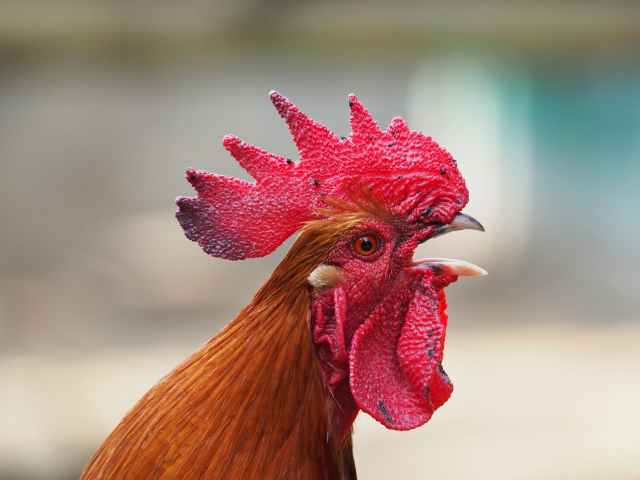
Photo by Pixabay on Pexels.com

This book, apparently the first in a series, strikes a good balance between a satisfying end to the adventure, and leaving some significant unfinished business open for later books. Near the end, Max strikes a deal with the Lords of Death in exchange for “a small favor” that they will ask of him in the future. That can’t be good.

My only complaint with this book is that there’s very little publication information on it. I can’t find the year it was published or the titles of the other books in the series. I guess I’ll have to go online to find out more. I will definitely seek to acquire the other Jaguar Stones books if the opportunity arises.

Edit: According to FictionDB, there are four books in the series:

  • Middleworld (2010)
  • The End of the World Club (2011)
  • The River of No Return (2012)
  • The Lost City (2015)

Elisabeth Elliot’s Boarding School: Wow.

Wow. I have never seen anything go from utopia to dystopia so quickly.

The DuBoses’ school had large, gracious bedrooms, an underground passageway, swimming pool, lake, stables, a bowling alley, laundry, tennis courts, and formal gardens. The public rooms were decorated with invaluable antiques from China. Students’ rooms had ruffled curtains and white bedspreads … which some students augmented with treasures from their homes on the mission field, such as tiger skins on the floor or African spears on the walls.

There were vespers (evening prayer services) every night, a private church service for the school on Sunday morning … The most select female students would be given the honor of hand washing Mrs. Dubose’s underwear and daunting array of girdles, as well as serving her breakfast every morning on a silver tray with a starched white linen placemat …

“We are hand-cutting diamonds,” Mrs. DuBose would explain. Relentless discipline, pressure, legalism, and social pain were evidently her tools for doing so. She would occasionally call errant students to her bedroom; the student would stand, head bowed, at the end of Mrs. DuBose’s big, white bed with its intricately carved eagle headboard. Reclining therein and attired in a pink satin bed jacket, Mrs. DuBose would review the student’s sins. The kids called these “White Eagle Sessions.” Years later, Betty would remember being so stressed during one of Mrs. DuBose’s little reviews that she peed herself.

Becoming Elisabeth Elliot, by Ellen Vaughn, pp. 33 – 35

Lunes Latin: The Mystery of the Helping Verbs

Here’s the latest bulletin from my adventures in trying to read Julius Caesar’s Gallic wars.

Caesar’s sentence:

et regno occupato per tres potentissimos ac firmissimos populos totius Galliae sese potiri posse sperant.

Here’s the English translation given in the book:

“… and hope that, when they have seized the sovereignty, they will, by means of the three most powerful and valiant nations, be enabled to obtain possession of the whole of Gaul.”

Here’s my bumbling translation:

”… and having seized the kingdom, through three most powerful and brave peoples, they hoped to be able to be made able to all of Gaul … um … ones.”

Let’s zoom in on the phrase I am having trouble with:

sese potiri posse sperant

Now, this looks to me like “they hope [sperant] … to be able [posse] … to be MADE able [potiri] … ones [sese].”

Is it really “they hope to be able to be made able”? That’s just a ridiculous amount of helping verbs. It reminds me of the man quoted by Dave Barry, who allegedly said to his wife after she couldn’t get a ride, “If I’d a’ known you’d a’ wanted to went, I’d a seed you’d a’ got to get to go.”

But let’s look up potiri. I think it’s the passive infinitive of posse “to be able,” but maybe it’s something else.

[Duck-Duck-Go]

Ah-ha! It’s a different verb.

potior, potiris, potiri I, potitus sum (Dep.)Verb

user edited

Translations

to obtain, to acquire, to grasp, to attain, to reach (goal), to come by (experiences)

Source: https://www.latin-is-simple.com/en/vocabulary/verb/5550/

OK, so now we have:

“They hope [sperant] to be able [posse] to acquire it [sese potiri] the whole of Gaul [totius Galliae].”

Huh. Looks as if Franz Ruedele knows what he’s doing after all.

For those wondering, it looks as if posse does not actually have a passive infinitive.

Follow me for more deep Latin mysteries! Meanwhile, I’ll be sitting here, throwing in helping verbs until it just feels right.

I Like Bears, Part III: I Go to Bear World

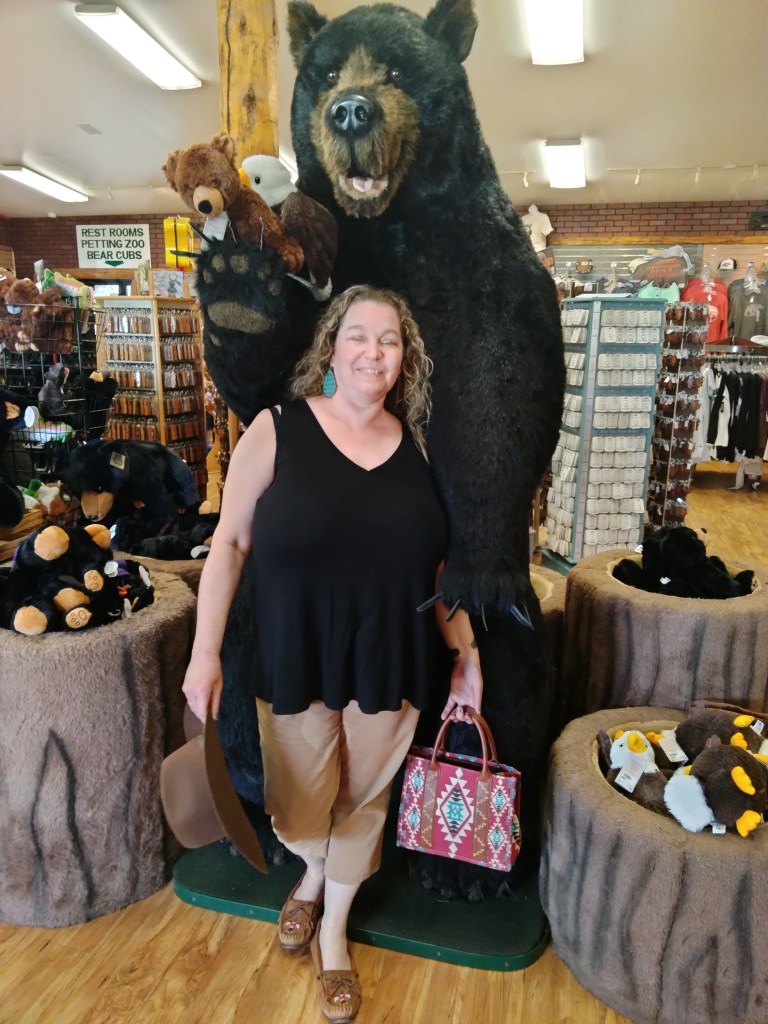
I am so excited to be standing in front of this bear that my eyes are closing!

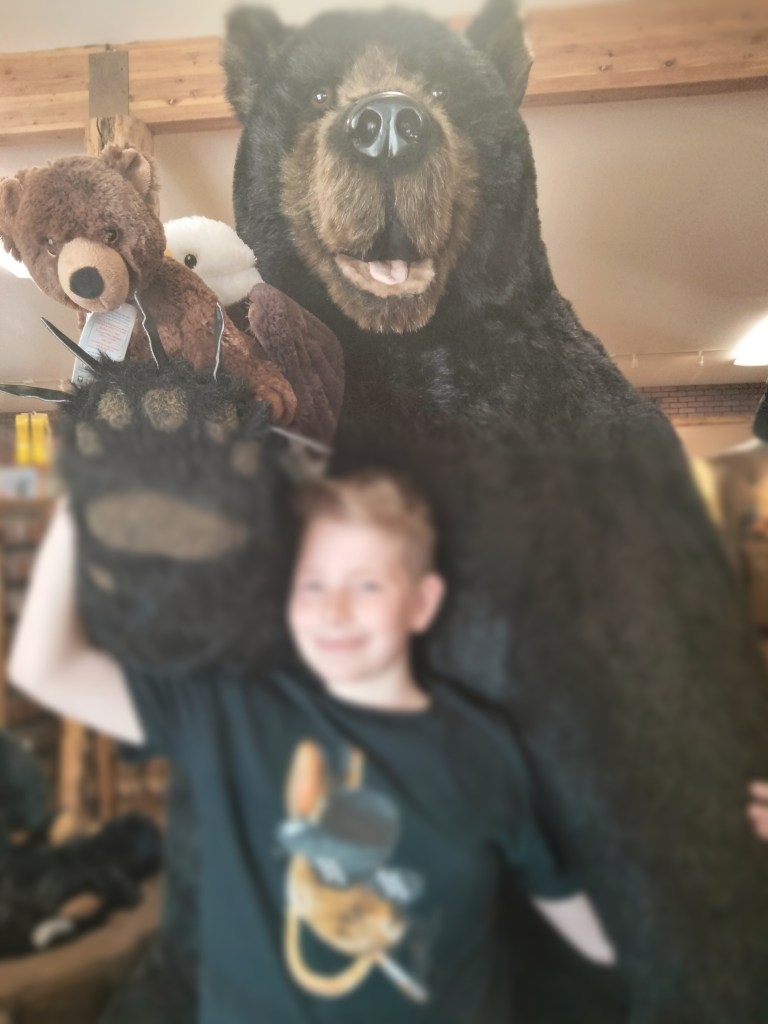
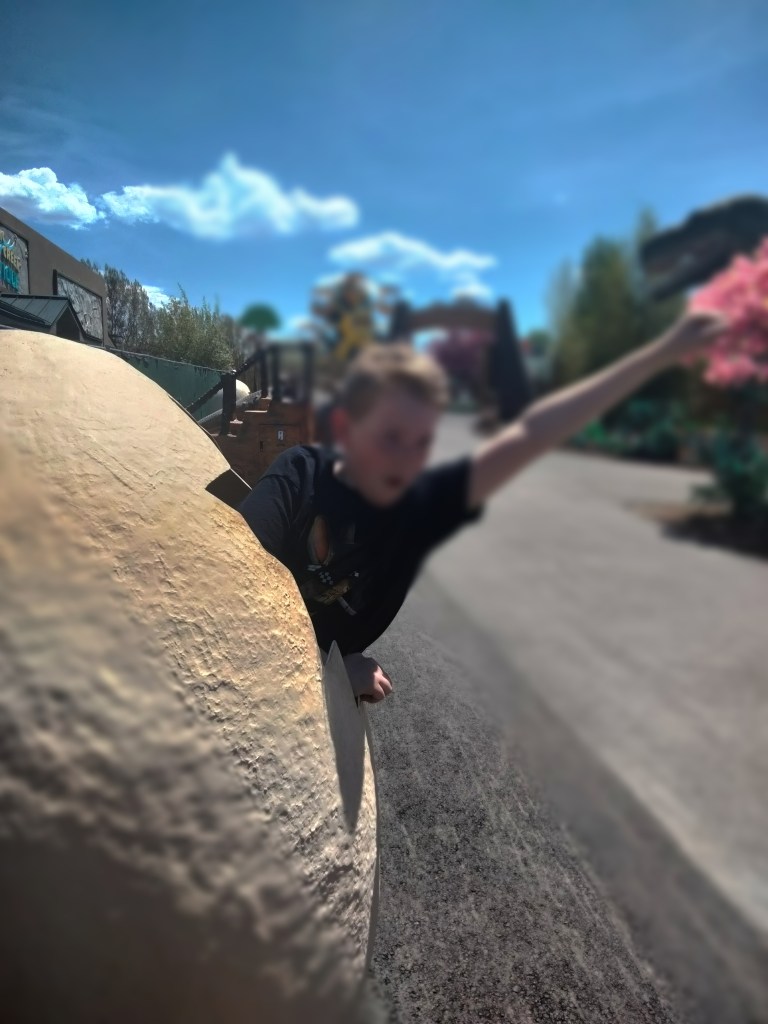
Recently, we had Mother’s Day here in America. My beloved children are now getting big enough that they can take the initiative to do things for me. Thirteen heard on the radio that Bear World was letting moms in free, so he decided we should go. Here he is with the bear, face blurred for privacy. My son is the blonde one and the bear is the dark-haired one.

“Yellowstone” Bear World, despite its name, is not at or in Yellowstone Park but actually closer to Rexburg, Idaho, where you can see the foothills of the Grand Tetons but not the Tetons themselves. The day we went was beautiful and sunny:

The way it works is that you first drive through an animal park, and then you access the parking lot and other attractions. You can drive back through the animal park as many times as you like on one ticket. But there is a very stern warning:

The first part of the park has various ungulates like this rare albino elk:

and this regular elk:

… and also bison.

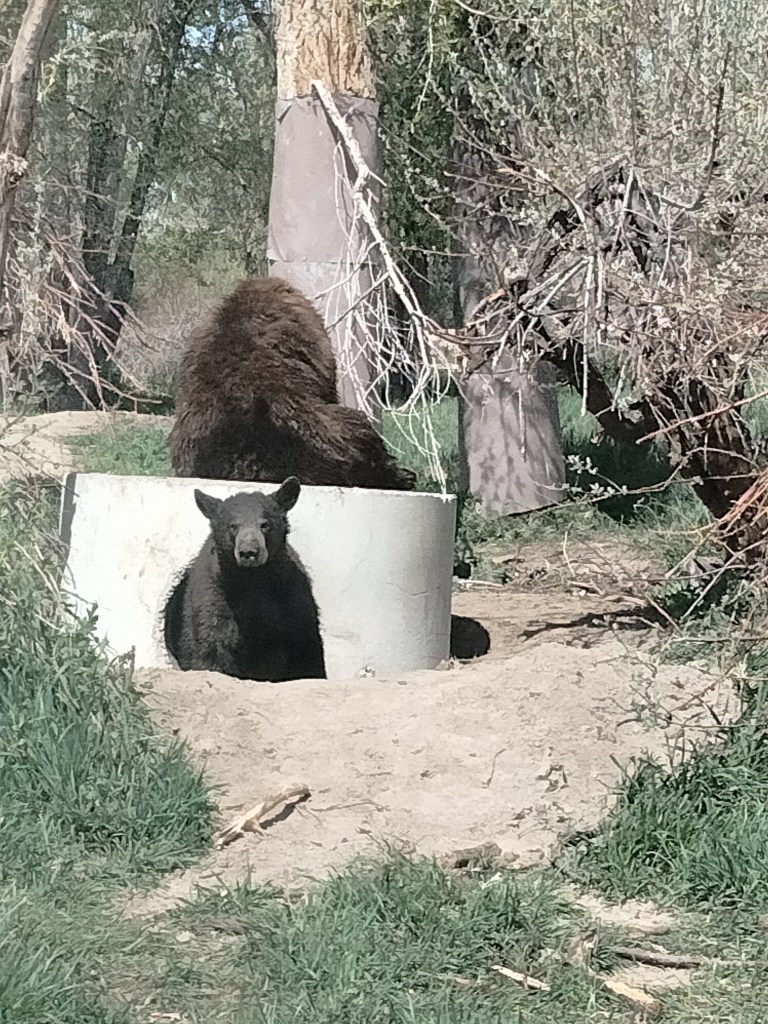
Then you go through a gate where an employee checks your receipt and reiterates the instructions. Beyond the gate, you are in the bear part of bear world, where you can see multiple bears just hanging out. There are, at least in the black bear area, far more bears than you would normally see all in one place. The trees all have metal cuffs on them, I guess to prevent them from being destroyed by all those bears.

There are feeding troughs for the bears,

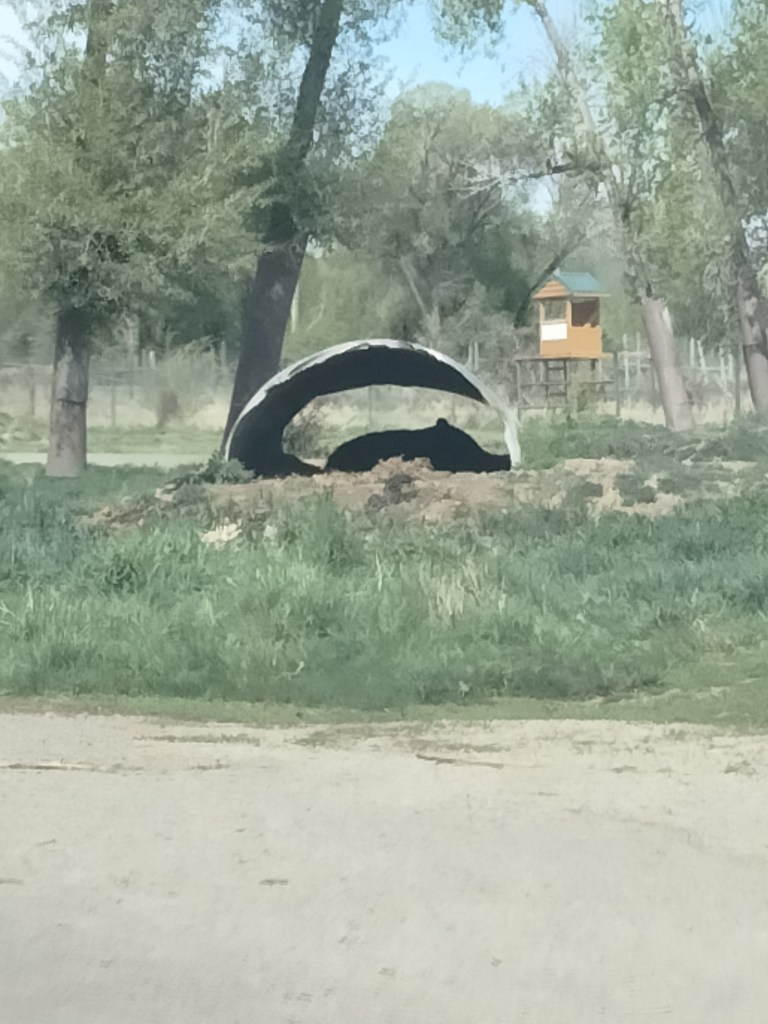
and shady places for them to sleep. Many of them were doing just that.

But before you get to where the black bears are, you pass an enclosure with a few grizzly bears. The grizzlies are behind an electric fence.

This is gal is pacing the perimeter.

Notice that she has the distinctive grizzly look: the concave or “dished” face, and the grizzly shoulder hump. They are also a lot larger than black bears.

I say “she.” We assumed all the bears in the park were females, because it’s hard to imagine you could keep one or more males in these conditions without them fighting each other.

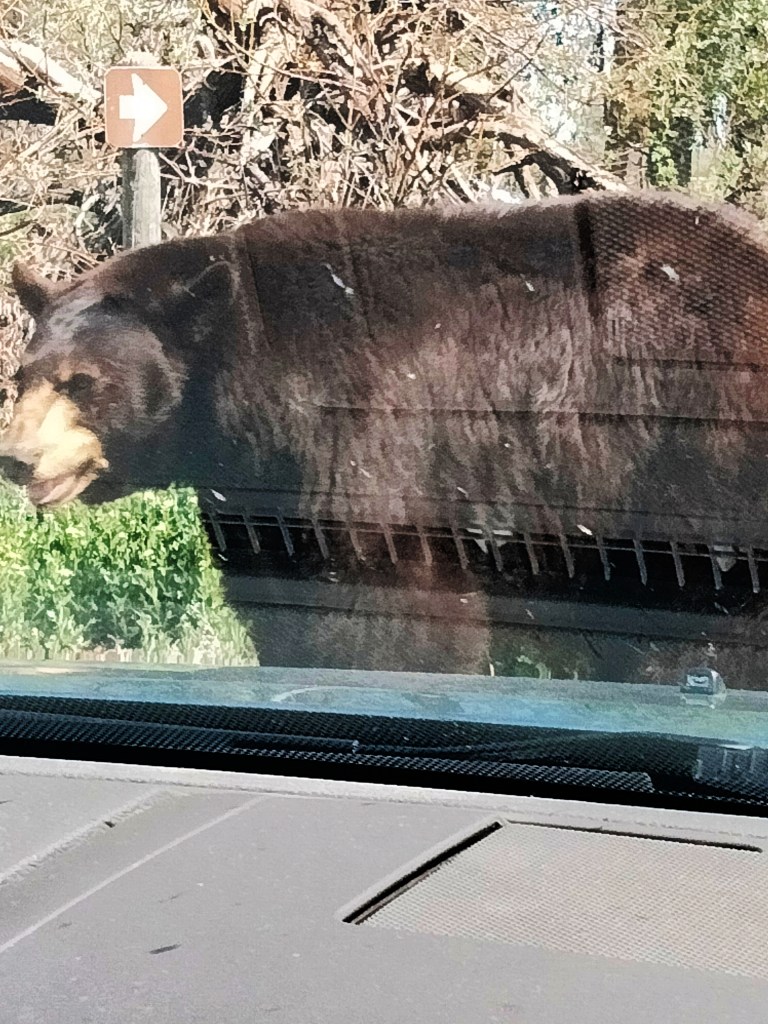
Back to the black bear area. The black bears were free to roam across the road if they liked, even right in front of your car. Notice the black bear silhouette: straight muzzle, no hump, smaller. I love the curving feet!

At one point, we even saw some employees standing among the black bears! They were photographing a large tree whose trunk had been torn up. The bears seemed unconcerned.

And now we get to my favorite thing! You see, “black” bears (and actually grizzlies as well!) can be any color. (I am learning so much from Bear World!) They can be blond, for example. We did see one that was black-and-blond patches. But this here … is a cinnamon bear! It’s hard to tell from the picture, but its brown coat was almost ginger. The hair also looked thicker and more luscious than on some of the other bears, almost as if it had been groomed.

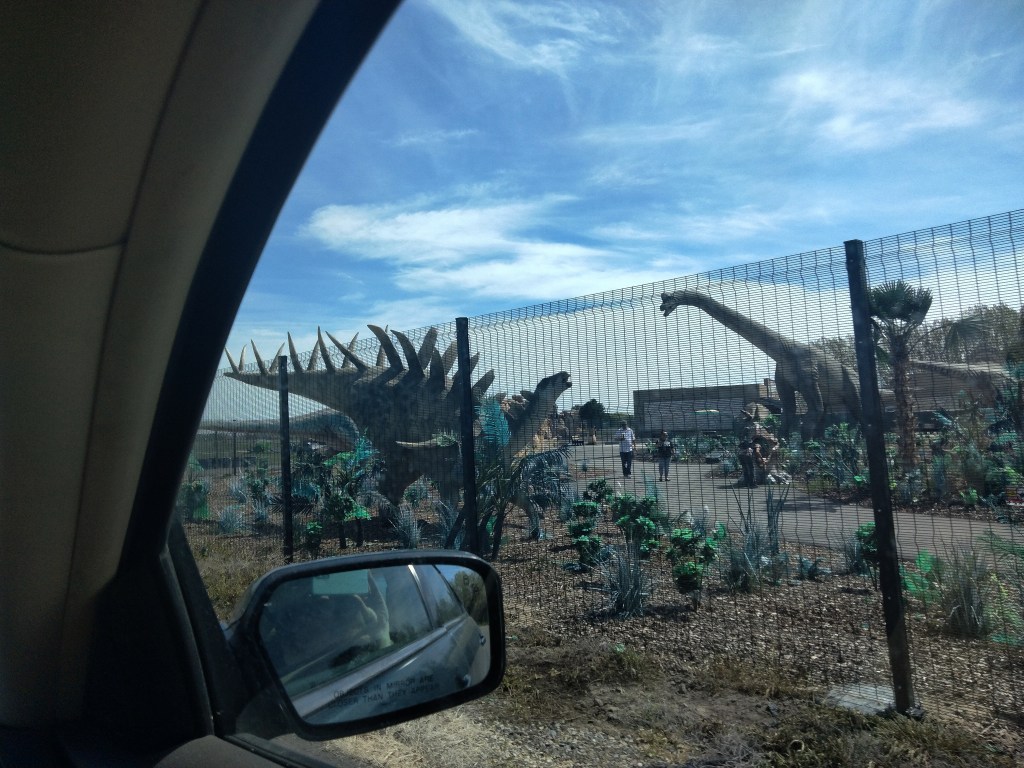
Also … and I bet you didn’t see this coming … Bear World also has DINOSAURS!

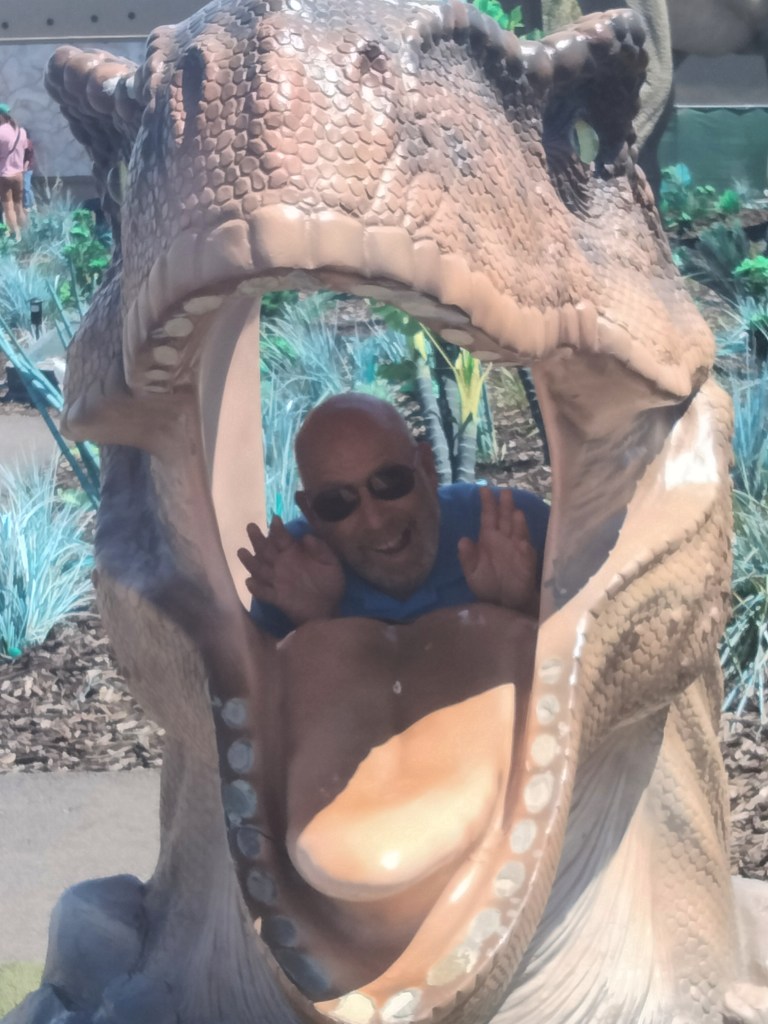
One of them went so far as to eat Mr. Mugrage.

Thirteen, meanwhile, snuck into a dino’s nest and hatched out of its egg:

I have seen better dinosaur parks, but I have never seen more bears.

La Dama de Elche / The Lady of Elche

Disclaimer: None of these pictures are mine. I found them on the Internet. If any of them are yours, and you don’t like them being used in this post, contact me and I’ll be happy to take them down.

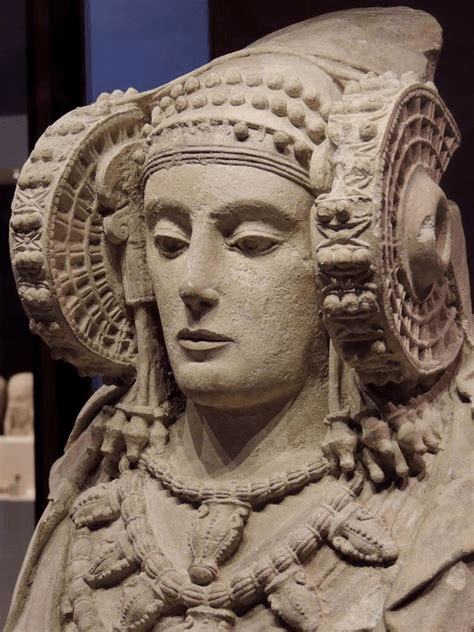
This is the Lady of Elche, Spain.

As you can see, her shoulders are hunched up. Some people describe her as having an “elongated head,” but it could just be the hat. Or it could be a hat meant to imitate elongated heads, as we see in many other cultures, but especially Egypt and MesoAmerica, where there was also head binding.

The following two links are my bibliography. You can follow them to check what I’m about to tell you about the Lady.

https://www.ancient-origins.net/news-history-archaeology/lady-of-elche-002305

https://www.atlasobscura.com/places/the-lady-of-elche

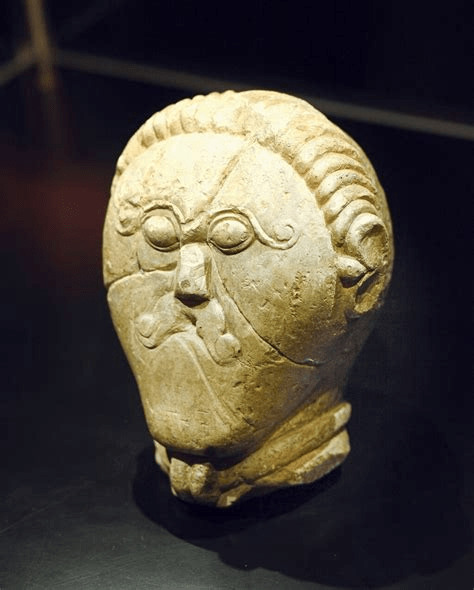
When I first heard that this Lady had been found buried in Iberia, it freaked me out. That’s because my understanding of pre-Roman Iberia was that it was basically Celtic. I was prepared to find Celtic- or Scythian-style artifacts there, such as images of people with narrow chins, large eyes, and moustaches; men with deer antlers; horses, and spirals, perhaps worked in silver, wood, stone, or even gold.

Celtic portrait, with torque necklace

Kurgan stelae in Kyrgyzstan, closer to the probable homeland of the Celts/Indo-Europeans

That’s what I expected to find in Spain. Or maybe something that looked like Etrusacan art, or like statues from the Archaic period of Greece.

I was not prepared for a massive, highly realistic stone statue that looked more classical Greo-Roman in style and featured attire more reminiscent of … I don’t know. Ancient Mesopotamia? Peru? The Lady of Elche freaked me out because it seemed to suggest a whole different style of civilization in Iberia, previously unknown. I was thinking Stone Age or pre-Flood.

Then, I heard that the Lady was believed to be Carthaginian. She instantly became less mysterious, but no less horrifying.

Carthage was a colony of Phoenicians. Phoenicia was an advanced civilization from the Levant. They inhabited the port cities of Tyre and Sidon, near ancient Israel. This explains why the Lady seems to be dressed like someone from the Ancient Near East. The Phoenicians had a shipping empire, so not surprisingly, they started a colony in North Africa. Carthage was here:

As you can see, they are very close to Europe, including territories in Spain. That explains how the Lady of Elche could have Western European facial features and Carthaginian dress.

Like most advanced civilizations of the Ancient Near East, the Phoenicians practiced atrocities in their pagan worship. This was the group that had the god Molech, to whom babies were sacrificed in the fire.

They were dropped down into, or placed in niches in, the red-hot statue. Drums and horns covered the sound of the infants’ screams. Incredibly, Israelites kept taking part in this practice and God had to keep telling them to stop. There was even an Israelite king who “made his son pass through the fire.”

Given that Carthage was part of an advanced, baby-killing empire, the Lady of Elche at once becomes more horrifying. The blank look on the woman’s face becomes more sinister. Is this just a death mask? Or is it because she is cruel? Or mindwiped by all that she had seen and done?

I don’t have any historical reference for this, but an anonymous commenter on the Internet has asserted that the “ear covers” were worn by priests and priestesses to block out the screams of the victims of more gruesome rituals. The bigger the ear muffs, the worse the ritual. I’d like to pooh-pooh that, but it fits with everything else we know about the ancient world. Christ conquering the nations suddenly sounds much less like a step in oppression and more like a relief. If you know more about the earmuff question, I’d love to hear it I wouldn’t exactly love to hear about it, but I’m curious and please send me your information.

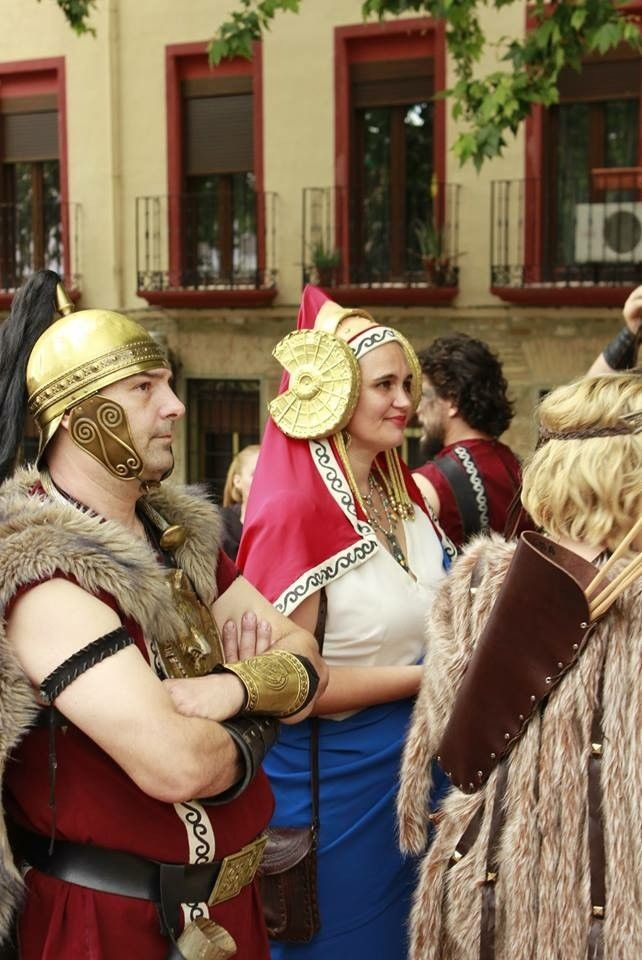
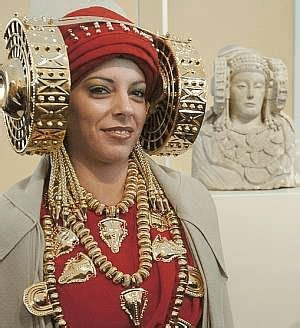
If you know how to indicate your interest in the Lady to the algorithm, you may find people dressed in historical re-constructions of the Lady of Elche’s garb, like these:

These ladies all look significantly happier than the original Lady.

Just Some Amazing Prose about Rooks

Simon scoffed the lot [of cookies] on the trek back to the vicarage, throwing the crumbs to the rooks that trailed him everywhere knowing he always fed them at some point during the day. They had an astonishing collective memory and got quite aggressive with him if he didn’t provide for them. They had been exiled from the East Wing of Burton Makepeace when it was converted into a hotel and seemed to hold him personally responsible for their diaspora.

Kate Atkinson, Death at the Sign of the Rook, p. 186

Lunes Latin: Perfacile Esse

(I’m calling this feature “Lunes Latin” because “Monday Latin” doesn’t alliterate. Work with me here.)

The Latin phrase of the week is perfacile esse: “It would be most easy.”

perfacile esse, cum virtute omnibus praestarent, totius Galliae imperio potiri.

“[Oregetorix persuaded the Helvetii that] it would be very easy, since they excelled in all valor, to acquire command of the whole of Gaul.”

from The Gallic Wars, by Julius Caesar, the Latin and English side-by-side editon, by Franz Ruedle, 2018.

Redemption

It’s been an emotional week.

But that’s partly my own fault. After all, I had to go and listen to this heartrending testimony …

Jonathan Gass’s story is remarkable for how it consisted of essentially unremitting pain until he came to Christ … and then, for how fast he came to Christ and was transformed.

I say remarkable, but I don’t say unique. Many, many other men and women out there are, as we speak, going through the same unremitting pain. This does not make his story easier to listen to. But look at the peace on his face now.

And then, the same week I listened to Jonathan, I was reading my class of elementary-school students The Lion, the Witch, and the Wardrobe, and I came upon this passage:

For a second after Aslan breathed upon him the stone lion looked just the same. Then a tiny streak of gold began to run along his white marble back–then it spread–then the color seemed to lick all over him as the flame licks all over a bit of paper–then, while his hindquarters were still obviously stone, the lion shook his mane and all the heavy, stone folds rippled into living hair. Then he opened his great red mouth, warm and living, and gave a prodigious yawn. And now his hind legs had come to life. He lifted one of them and scratched himself. Then, having caught sight of Aslan, he went bounding after him and frisking round him whimpering with delight and jumping up to lick his face.

The Lion, the Witch, and the Wardrobe, p. 184

Aslan turns him back into a lion, and he immediately starts behaving like … a lion.

But not only the individual creatures, but the Witch’s house itself is a picture of a human soul:

“Now for the inside of this house!” said Aslan. “Look alive, everyone. Up stairs and down stairs and in my lady’s chamber! Leave no corner unsearched. You never know where some poor prisoner may be concealed.”

But at last the ransacking of the Witch’s fortress was ended. The whole castle stood empty with every door and window open and the light and the sweet spring air flooding in to all the dark and evil places which needed them so badly.

[And when the castle gates had been knocked down from the inside], and when the dust had cleared it was odd, standing in that dry, grim, stony yard, to see through the gap all the grass and waving trees and sparkling streams of the forest, and blue hills beyond that and beyond them the sky.

ibid, pp. 187 – 189