Driving home in the dark, I smell freshly turned earth.
I am somehow fifty.
My son’s first year of life was five years long.
It’s like when we are knitting, and the piece is seven inches long for ages and then all of a sudden nine.

Driving home in the dark, I smell freshly turned earth.
I am somehow fifty.
My son’s first year of life was five years long.
It’s like when we are knitting, and the piece is seven inches long for ages and then all of a sudden nine.
The saeculum provides this same opportunity. Regardless of generation, every person who lives into deep old age experiences each of the four seasons of life once–and each of the four turnings of history once. The intersection of these two quaternities does more than just make our own generation unique among the living: It bonds us with every fourth generation that came before or will come after.
Tactius disagreed with moralists who argued that the civic virtue of a great society can only change in one direction. “Indeed, it may well be that there is a kind of cycle in human affairs,” he wrote, “and that morals alternate as do the seasons. Ancient times were not always better. Our generation too has produced many examples of honorable and civilized behavior for posterity to copy. One must hope this praise-worthy competition with our ancestors may long endure.”
–The Fourth Turning, by Strauss & Howe, p. 333

The gist of this book is that history moves in seasonal cycles. The authors spend a lot of time talking about how expecting seasonal cycles in history is the wisdom of the ancients, and that this has been lost to a linear conception of time that came from Christianity and got even more exaggerated during the Enlightenment. Linear time leads people to expect that things will just keep getting “more so;” that the future will look like an extrapolation of the recent past. As a result, people never expect a turn of history coming, and are always gobsmacked when it arrives.
As they urge readers to accept a cyclical view of history, the authors go slightly overboard and make it sound as if we should worship the circle. They point out circular symbolism in various myths. They say that a cycle is associated with the number four and feminine energy, whereas a line, or triangle, is associated with the number three and masculine energy. While this is not wrong, they then make it sound as if the idea of history as a line, moving in a particular direction, should be rejected and has nothing to offer us.
It’s not a big part of the book, but it is foundational and I found myself trying to integrate their view before I moved forward.
I believe that much of the symbolism they describe is correct. (Not all of it is, since the authors tend to cast a really wide net throughout history and literature, and then throw into the book anything they drag in that looks superficially similar to their thesis. But much of it is.) Seeing history as inescapably circular is an ancient, pagan way to view the world. And it does reflect something about the nature of humans and of creation. However, uncorrected, it tends to leave people fatalistic and trapped in the cycle. Exhibit A would be Hinduism. Christianity did indeed break people out of this endless treadmill by presenting a picture of history where the end is not like the beginning, where history moves in a definite arc or story from creation to fall to redemption to glorification. Of the many things that Christ did on the Cross, He broke us out of the endless cycle. That is why history fundamentally changed after His death and resurrection. You get different types of people, who think in different types of ways, and you get cultures that are Christianized developing in very different ways than any culture before them. Of course, one downstream effect of all this was that it made possible the Enlightenment, materialism, and what C.S. Lewis calls “the fatal serialism of the modern imagination.” These things aren’t good, but to put this in perspective, blaming them on Christianity is sort of like blaming your parents because you scraped your knee while you were on a trip that they took you on to Disneyworld.
Here’s how G.K. Chesterton put it:
As we have taken the circle as the symbol of reason and madness, we may very well take the cross as the symbol at once of mystery and of health. Buddhism is centripetal, but Christianity is centrifugal: it breaks out. For the circle is perfect and infinite in its nature; but is fixed forever in size; it can never be larger or smaller. But the cross, though it has at its heart a collision and a contradiction, can extend its four arms forever without altering its shape. Because it has a paradox at its centre it can grow without changing. The circle returns upon itself and is bound. The cross opens its arms to the four winds; it is a signpost for free travelers.
–Orthodoxy, p. 32
So, yeah. Although in the big picture, history is linear, cycles of development do still exist, both in human lives and in human societies, and we would do well to remember that and work within our nature.

Briefly, they assert that history moves in cycles of just over or just under 100 years. These, they call a saeculum, following the Roman word for it. The seasons are:
(Fun fact, if you are into personality typologies, you can also make these seasons match the Four Humors: Sanguine, Choleric, Phlegmatic, Melancholic.)
Each season takes roughly 20 to 25 years. Each one causes the next.
The authors also identify four generational “personalities.” The personality of each generation is determined based upon their experiences in childhood and young adulthood. In what conditions did they grow up, and when did they come of age?
Armed with these thought tools, you can now make applications.
I appreciate the authors for not claiming too much for their rubric. First of all, they point out that these cycles are not precise in the time they arrive. This is an organic cycle, like the seasons. Some years, you might have a cool summer or a mild winter. Sometimes, seasons are delayed beyond what is usual. For example, the authors have a series of detailed charts in which they apply this rubric to American history. They say that during the Civil War, the Crisis came fast and didn’t last the usual 20 years. As a result, the cycle was shorter. That saeculum skipped the Hero generation. It went straight to the Artist generation of traumatized conformists.
Another helpful thing they say is that this year-like cycle in human history does not cause random events. There is still such a thing as chance, and as human will. However, a society’s reaction to events is heavily influenced by what season they are in. The United States did not immediately enter WWI after the sinking of the Lusitania, because we were in an Unraveling period. But we did immediately mobilize for war after the attack on Pearl Harbor, because we were now in a Crisis.
Finally, this cycle of history is not equally prominent in all societies. Because it has to do with changes in public attitudes, fashions, values, and child-rearing practices, in very traditional societies the cycle is muted. One generation is much like the last. When a society throws off tradition and allows its citizens a lot of social mobility and freedom to make their own choices, ironically that is when the cycle becomes a large factor in that nation’s history. It is for this reason, say the authors, that these seasons are particularly easy to spot in the United States.
It can be difficult to spot seasons of history in past societies (beyond speculation) when we know relatively little about them. Sometimes it’s pretty clear, as when we look at the cycle of idolatry-oppression by enemies-repentance-deliverance found in the book of Judges. We can also find many historic diatribes (probably written during an Unraveling) lamenting the loss of civic virtues.
O.K., so, with those caveats, if you are an American, you have probably been applying this rubric to the last hundred years in our country, which is super easy to do. Here we go:
The Great Generation are Heroes, the Silent are Artists, the Boomers are Prophets, and the Xers are Nomads. Tag yourself. I’m an Xer.
Now, how do we define a “generation”? It usually works out that once every 20 to 25 years, there is an identifiable new crop of young people. Hero and Prophet generations tend to be bigger, because of what’s going on around the time they are born. Hence, the Baby Boomers are Prophets. Artist and Nomad generations tend to be smaller, because they were born during a time when adults had other things on their minds (the Crisis or the Awakening).
Also, of course, the generations in a nation don’t necessarily fit with the generations in a given family. The authors point out that, often, it takes one big generation more than 20 to 25 years to reproduce, so that, for example, the children of Heroes are Prophets. The Prophets react against what their parents’ generation valued, but they get along better with their grandparents (also Prophets).
Here’s another example. My parents are Boomers. Now, the Boomer culture was rather anti-baby, anti-family, anti-settling down. However, my folks were not typical Boomers. They swam against the tide. They had six children, and my mom stayed home with us when we were small. They tried to raise us in a very pro-family way. So I was shielded from many of the things that my fellow Gen Xers had to deal with, growing up in an environment where kids were considered to “trap” their mothers, or with parents who divorced or went off to “find themselves.” However, I did pick up on the Gen Xer vibe of living in an unravelling society, being blamed for everything from racism to pollution to the hole in the ozone layer. When I read this line,
[O]ne student mockingly tells his friends in River’s Edge: “You young people are a disgrace to all living things, to plants even. You shouldn’t even be seen in the same room as a cactus.”
-p. 195
… I laughed. The fact that I found this funny, tells me that I am a true Gen Xer.
So anyway, I am a younger Xer. But because my parents had a large family, I have younger siblings who are Millennials (supposed to be the Hero generation; more on this later). Meanwhile, my husband’s parents are Silent generation (Artists). My husband has older siblings who are Boomers, and he is an older Xer. And because we waited a while to have children, our own children are … I guess … Zoomers? Who are supposed to be Artists? Or maybe Alphas? Who … I’m not sure what they should be, because this Crisis seems to be extending. Again, more on this later.
The Fourth Turning, published in 1997, predicted that beginning around or shortly before 2005, America would enter a Crisis. There were a variety of things they thought could happen:
All these are taken from pages 272 – 273 of the book.
So where are we at now? Something that takes 25 years of your life might be too big to see, but I suggest the following. America’s Crisis era started on Sept. 11, 2001, with an unprecedented kind of terrorist attack, which led to big curtailments of freedom like the Patriot Act and the creation of the TSA, and to a number of wars. Then we had a housing market crash and financial crisis in 2008. Meanwhile, there were a series of incidents that, helped by agitators, caused riots in our cities. Police departments responded by being less active, and crime soared. People started to get freaked out, which led to the election of 2016 (nations tend to turn to a “strongman” in a crisis), which caused more people to freak out. The Crisis reached its climax in 2020 – 2022, with you-know-what.
So counting from Sept. 11, 2001, we are almost exactly 25 years into this Crisis era. According to the authors’ rubric of how these seasons usually go, we should be coming out of our Crisis soon, into either a new High with regenerated values, prosperity, and social order, or else into the total destruction of our society.
Which one do you think is happening? For me, I’m not sure. I see elements of people building new values and communities, but I don’t see any national consensus on these things. Nor do I particularly see signs of the Crisis ending.
To prepare for the Fourth Turning, the authors in 1997 recommended that individuals and families do the following:
These are all taken from pp. 318 – 321 of The Fourth Turning.
These are steps that are being, and have been, taken by many who think of themselves as preppers. and by people who are working and hoping for a cultural renaissance. I’m most familiar with those who are doing this within Christian circles.
The only blind spot that the authors seem to have is that they incurably think of the “teamwork” and “coming together” that must take place during a Crisis, as a national affair. They say “we” while thinking primarily of the national government. In the section on “preparing your children for teamwork,” they suggest not pulling your children out of government schools “if the schools are working.” While I have seen many people doing community building throughout this crisis, one thing I have not seen is a newfound trust in, or willingness to comply with, the federal or even in most cases the local governments. People have been coming together in “teams” to found and maintain private schools and other things like that, but not to join federal programs.
O.K., now for the predictions that didn’t prove to be so prescient.
Any book that makes this many predictions (even in general terms) is going to result in some howlers. For example, here’s the authors’ prediction about how the Silent generation would handle Social Security entitlements:
… America’s rising familiarity with the Silent elder persona will erode today’s support for across-the-board senior benefits. Unlike G.I.s, the Silent will not feel entitled. Their prior public deeds will not inspire them (or others) to lobby for a vast elder reward. … [The Silent’s] sense of guilt and instinct for compromise will compel them to give in some, relax their claims on young workers, and drain the electricity out of the third rail of Social Security politics.
— ibid, pp. 220 – 221
This — how to put it?– emphatically did not happen. I have heard with my own ears Silent generation members say, “We paid into the system for a lot of years. Now we need to get out of it.” When you set up a Ponzi scheme, no one wants to be left holding even a little bit of the bag.
They make a similar prediction about Boomers:
When the market hits bottom, millions of Boomers … will immediately have to make do with steeply diminished material consumption. Many will have no choice but to live communally or with their adult children… public spending on elder benefits will necessarily decline. … Congresses will debate massive cuts. To maintain G.I.-style elder dependence on the young, Boomers would have to wage political war on their coming-of-age Millennial children. It is a war they will not wage–and would not win if they did.
ibid, p. 284
Now, the retirement age has been raised, but other than that, I have not noticed any “massive cuts.” And from my observation, Boomers as a group have been perfectly happy to wage political war on Millennials. And they have won it, by convincing Millennials that the solution to their financial woes is more taxes and entitlements, not just for older people but for everyone.
I have not noticed a trend of Boomers moving in with their adult children, either. In the first place, they, not their children, are usually the ones who own homes, a situation brought about by entitlement policy applied to housing. In the second place, their children are often alienated Xers, and relationship isn’t the greatest (present company excepted). Finally, some Boomers I know are effectively the caregivers for their grandchildren.
In short, the collapse of the Social Security/Medicare system has come about more slowly than Strauss & Howe (or, frankly, I) expected. As an Xer, I did not expect to be able to retire, and maybe I still won’t, but my husband is approaching the age when he can start withdrawals to give us some breathing room, and there has not yet been a nationwide apocalypse. Color me surprised.
One more howler:
As they break into their twenties, Millennials will already be accustomed to meeting and beating adult expectations. Basking in praise… they will seek out [their elders’] advice … Every youth domain will become more mannerly, civic-spirited, and emotionally placid. In college, Millennials will lead a renaissance in student decorum and appearance, making profanity as out of date as the backward cap. … On the job, Millennials will be seekers of order and harmony. They will delight employers with their skills, work habits, and institutional loyalties. … Millennials will respond [to economic hard times] with a cheerful patience reminiscent of Depression-era G.I.s.
ibid, pp. 293 – 294
Look, I’m not here to slam on Millennials. I actually have a lot of sympathy for your generation. But there is no way this general picture describes the way things have gone with the Millennial generation.
Strauss & Howe are predicting that the Millennials will emerge as a Hero generation, because that’s what his historical scheme calls for. But this requires a lot more strength and resilience than Millennials, as a group, entered young adulthood possessing.
The authors did not foresee that Millennials would have been intentionally weakened by a number of cultural trends which were pushed on them by earlier generations. These include behavioral meds, and overpraising/participation trophy culture combined with identity politics culture, which gave complimentary messages that, on the one hand, you are so amazing and talented and don’t need to work to improve yourself, and on the other hand, you are a victim of history and society. Each of these messages is weakening; in combination, they are devastating. There is also the horrible sexual confusion that has been foisted upon the Millennial and Zoomer generations. This draws on the power of identity politics (being a sexual minority is an easy way to obtain an oppressed identity), and on the behavioral meds culture (giving powerful new medications in response to emotional distress).
What generation could emerge from such a gauntlet unscathed? It is no exaggeration to compare all these horrors to WWI, which wiped out a generation of young people and traumatized the survivors. These are not conditions that cause young people to “meet and beat adult expectations” in the positive sense, nor to “delight their employers.”
Perhaps Millennials are a Hero Generation in a new sense. If they are functional at all, it’s because they have won through an intense spiritual war. Perhaps we should think of them as veterans. Like veterans, they certainly bear mental and physical scars. But instead of coming back from a physical war and plugging into an existing social structure, they are having to re-invent the wheel in all the most basic domains of life: schedules, self-care, family.
And quite a few Millennials are a “Hero Generation,” itching for action, in the sense that they are committed Marxists who want to see the violent overthrow of society.
Others, like my younger siblings, are more like the G.I. generation after WWII, eager to get married, raise children, contribute to their communities, and build a wholesome cultural high.
The fact that we have Millennials going in these two very different directions makes me rather uncertain about how this Crisis is going to go.
I wonder whether what we have seen is what the author predicted on page 302:
If [the Crisis] ends badly, Millennials would bear the full burden of its consequence throughout their adult lives. If they come of age traumatized, like the Progressive youths of the Civil War, Millennials will thereafter attend to the details of suffering and healing as heirs to the Artist archetype.
It seems to me that our Millennials are behaving more like a “sensitive Artist” generation than like a “hubristic Hero” generation. This would mean that, as with the Civil War, America had once again skipped the Hero generation and gone straight to Artist.
The Prophet, born in the High, seeks vision; the Nomad, born in the Awakening, seeks realism; the Hero, born in the Unraveling, seeks power; and the Artist, born in the (prior or current) Crisis, seeks empathy.
p. 322
So, that’s the outlines of the book plus a few of my thoughts on it. Obviously, there is a lot more material in there. Some of it is really interesting (the parts that apply the seasonal rubric to the past). Other parts feel dated (ironically, the parts written in the future tense). Read it if you’re curious and want to know more. Meanwhile, what do you think? What generation are you? What do you want to do in the coming High?
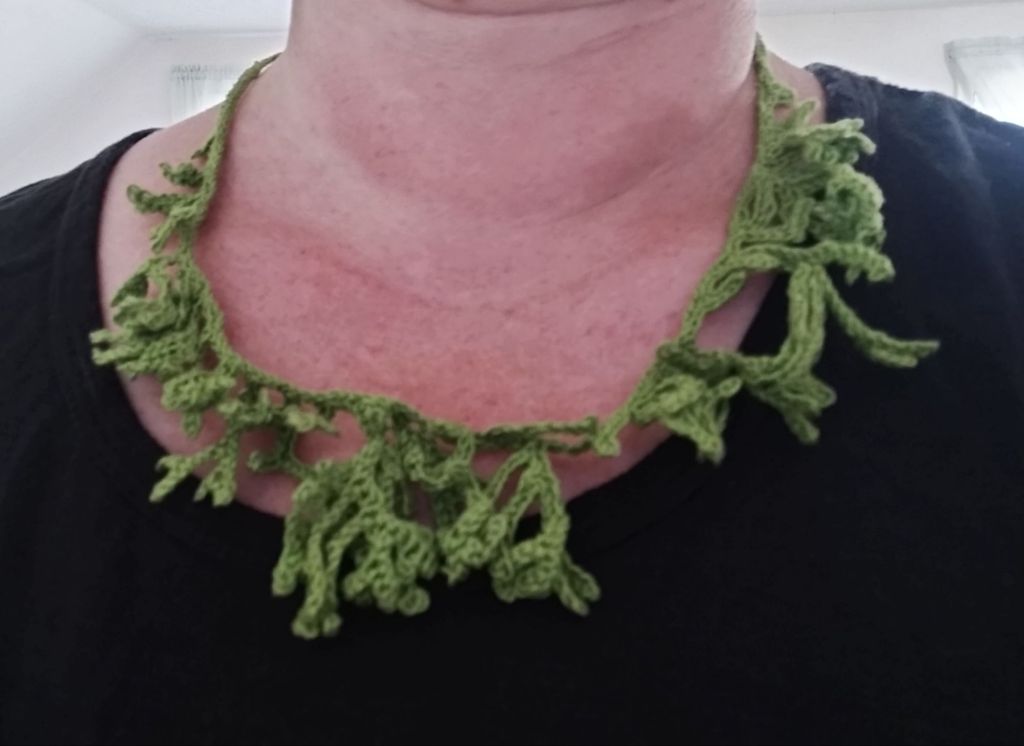
I got the idea for this from a photograph & pattern on Pinterest, then freedhanded this one on my own. It closes with a button and loop. The great thing about such a necklace is, the more tousled it gets, the better it looks! A great naturalistic look for an aspiring crone.
I have bad news. I do not say this lightly.
I have officially traveled from a Western American state to a Midwestern American state–nay, to Eastern Standard Time–and this involved going through some airports. And here is what I have seen.
Men, wearing short, wavy or curly hairstyles with a small mustache and no beard. I have seen this both in life and on a big, sophisticated advertising billboard, so you know it’s real. It used to be that the young, handsome guy look might include any kind of hair, from bald to Jason Momoa, but one thing you were definitely not going to see was a solo mustache. Now, it’s the reverse.
I’ve seen women wearing cotton dresses with large, colorful, odd-looking, semi-abstract prints on them. Colors that are either primary, or slightly off shades of pastels that I once asked myself why any of us would subject ourselves to them. And the reason was: because they were on sale.
Worst of all, friends, I have seen adults wearing short shorts. Lots of them. Men and women both. Sometimes, these short shorts are worn in conjunction with the aforementioned mustaches.
I really don’t know what to do about this. I’m at a loss. I ask the universe, “Why?”
We can only pray that this phase will pass quickly, and (if fashions are going chronologically), we will soon pass on to the 90s. Everyone will be wearing low-slung, baggy jeans; plaid flannel shirts; and knit caps over choppy hair. They will have smeary makeup and bags under their eyes. They’ll look like they either just rolled out of bed, or are in the midst of surviving a zombie apocalypse.
I’m much more comfortable with that look.
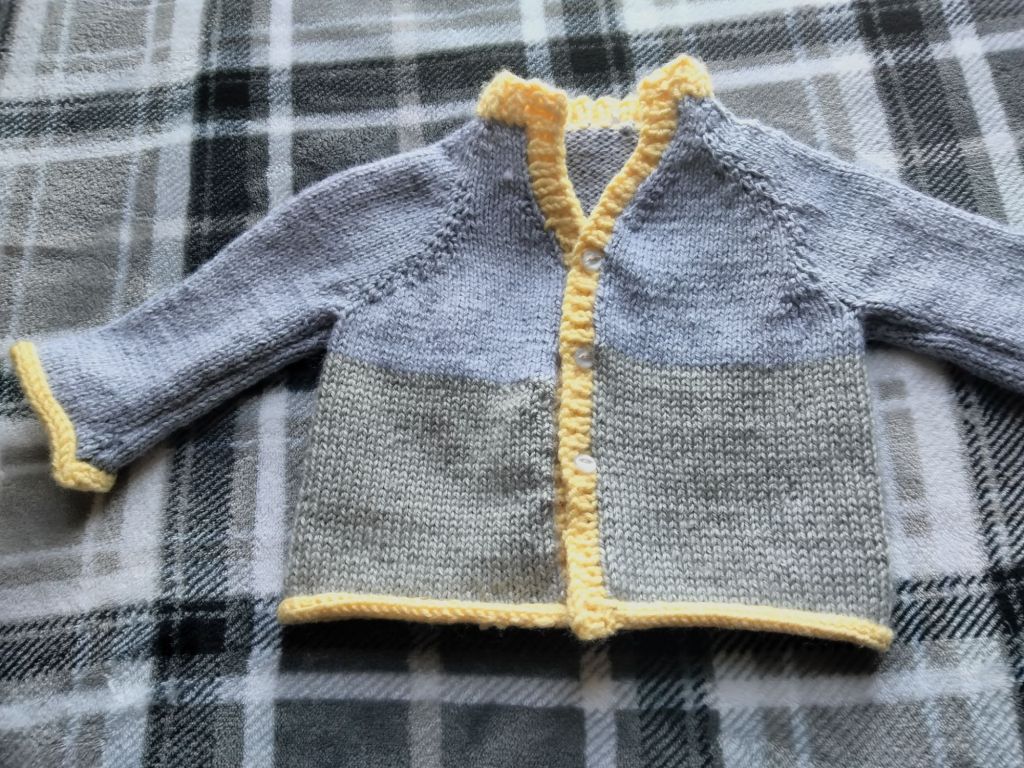
I’m reaching the season of life when a) many women I know are having babies, b) I’m not anymore, and c) I actually have time to knit things for them! Can cronehood be far away?
Behold, I knit this little sweater using my stash and a pattern in a Beginning Knitting magazine. You can tell it’s handmade because of its many flaws, including the visible line where I ran out of “stash” grey yarn and had to buy some more that was almost a match. The sweater features an “i-cord bind-off,” which is the name for the 3D, rounded edges in a different color.
I don’t know whether the arms will be too long. As I recall from when my kids were babies, often if the garment fit the child’s trunk, the arms would be super long.
The yellow and grey colors were chosen because they are close to our school colors, and because the family isn’t finding out whether the baby is a boy or girl.
Behold!
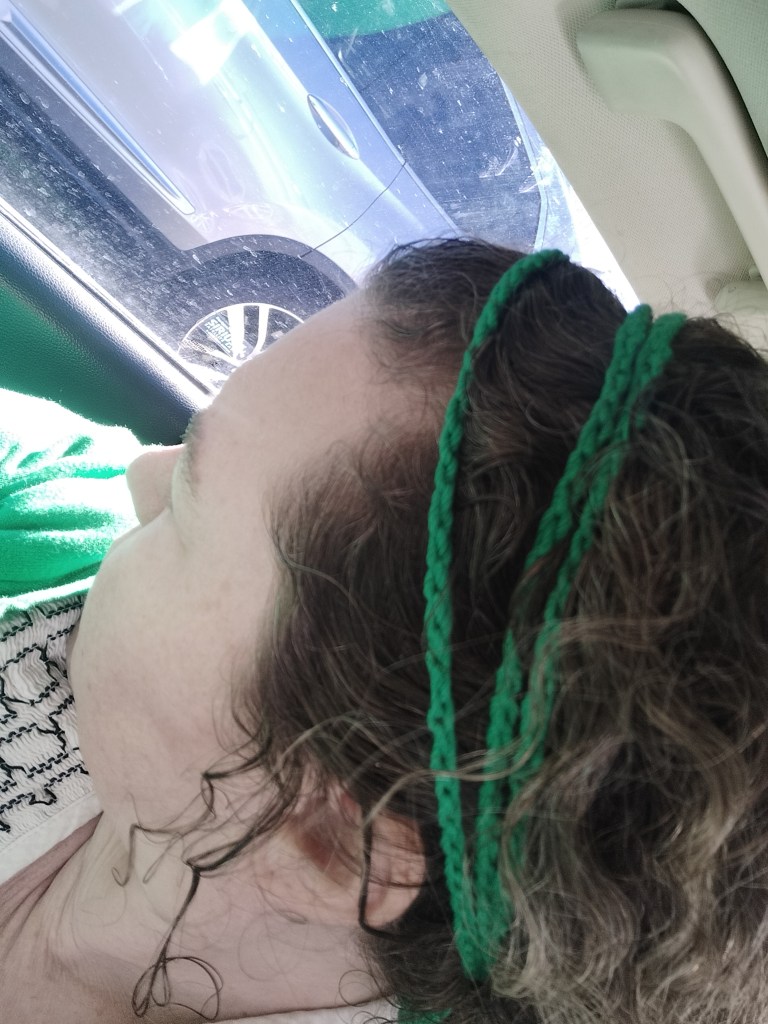
The length of my fiber arts projects is dropping dramatically. First, we had the Indian blanket (1 year) … then, the wool socks (about 6 weeks) … and now, this headband (about half an hour).
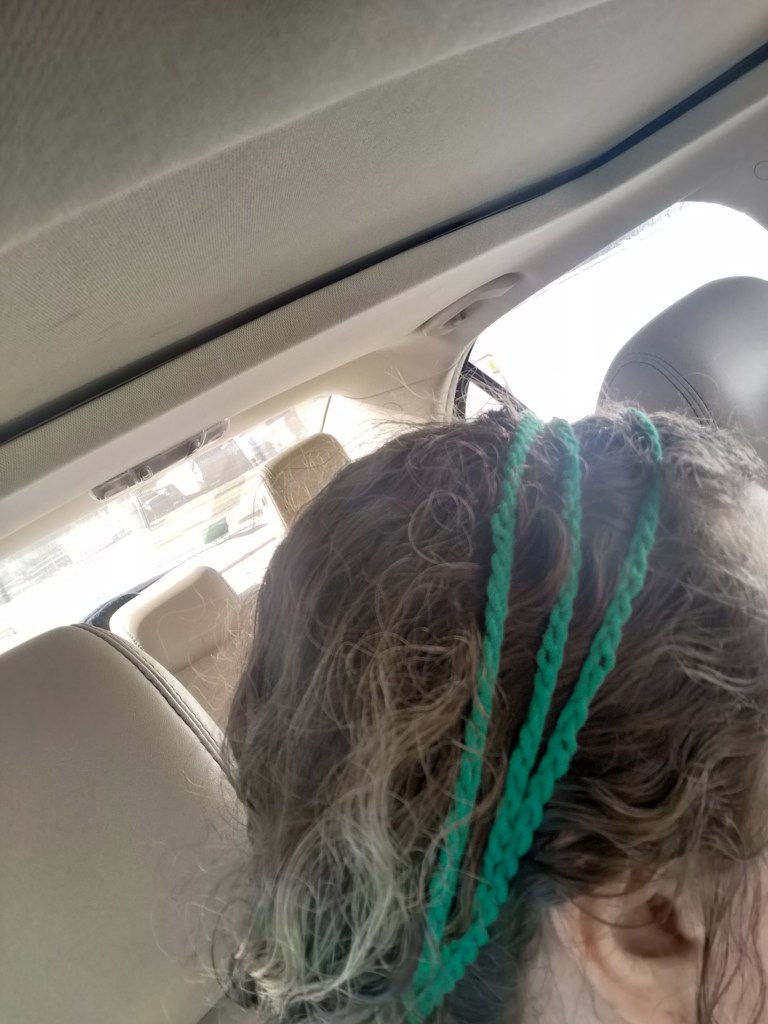
Excuse the poor-quality selfies, taken in my car, but I really think these showcase how this headband is perfect for messy/curly hair. It gives the look of a headband without a wide piece of cloth rubbing and creating frizz on your head (the wind does that instead). It’s supposed to look like it’s barely containing all your curls. To emphasize this look, I did a loose braid and pulled down tendrils.
It’s also on-theme for 2026, what with me reading what I’ve been calling “Greco-fiction” and all.
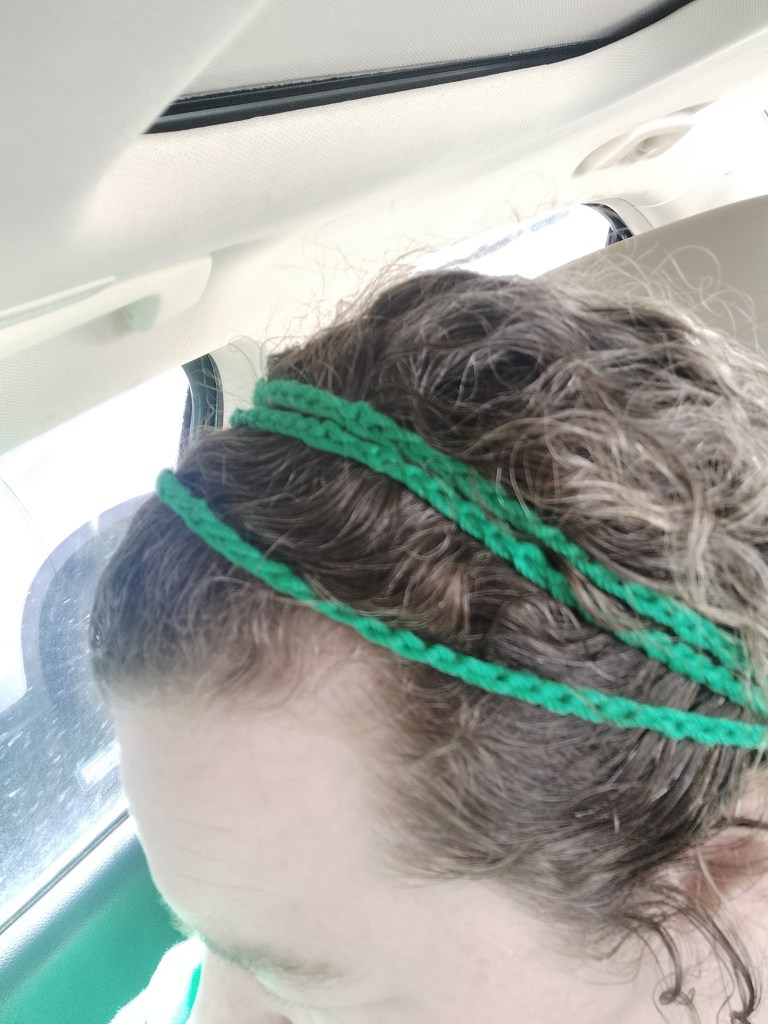
And the price is right. I bought the pattern on Etsy for about a buck fifty, and when I want a new color of headband, I just womp one up out of my stash of yarn.
The original pattern has a large crocheted flower that you are supposed to attach (and I imagine it holds the strands apart), but I didn’t want the flower so I left it off. The pattern promises three strands, but if you were to follow the directions, you’d have four strands, crocheted together at either end. I only wanted three, so I stopped early. It ties at the back of your head. I’m not always a big fan of things that tie, as that can be a tricky process and can catch your hair in the knot, but the thinness and texture of this headband makes it a simple matter.
This may be more detail than you wanted, but hey! I’m excited!
I’ve made a number of iterations of this pattern, “Braided Cable Socks,” that comes in a small book of sock patterns that I picked up in a craft store.
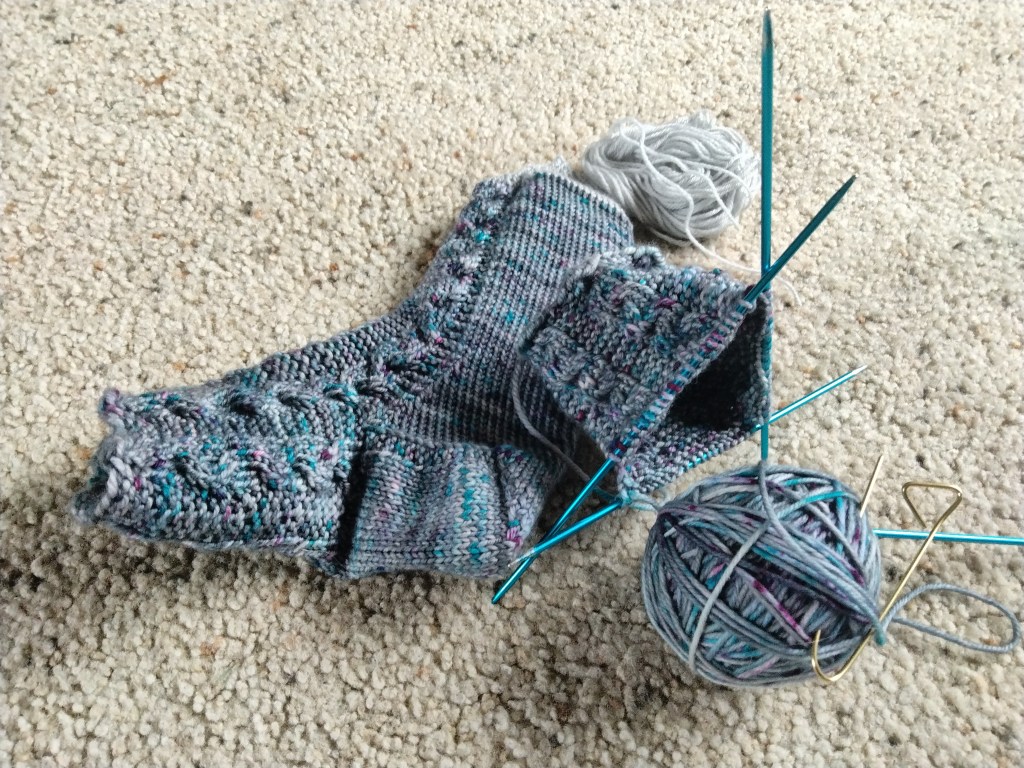
The socks call for superfine yarn, 2 skeins at 230 yards per skein. Previously, I have made them with a fine cotton yarn. I’ve liked the results. Surprisingly, these socks don’t sag even though they contain no elastic. After making and wearing a few pair, I’ve become convinced that hand-knitted socks are the gold standard in luxury.
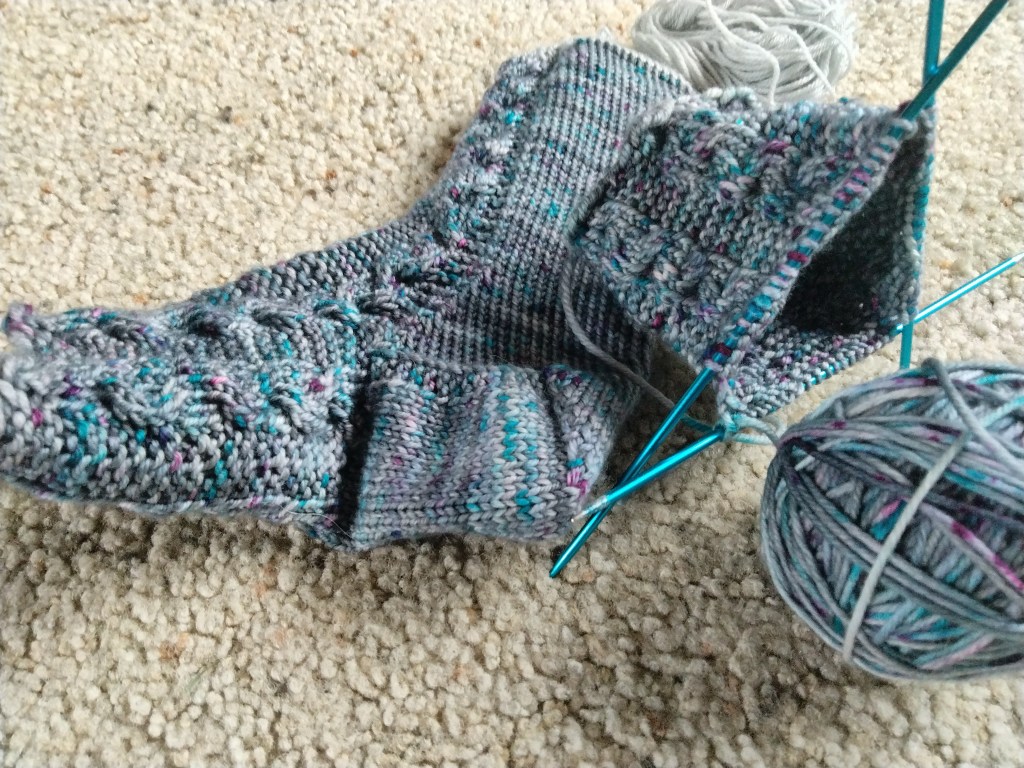
The one minor problem with this pattern is that the socks tend to develop a slight gap in the middle of sole of the foot, where we are doing stocking stitch shared across two needles. In the past, I have dealt with this by varying the number of stitches on each needle.
This time, though, I wanted to use a wool yarn to make this pattern. I had bought a hank of superwash merino wool, hand-dyed, from someone I know socially, via her etsy shop https://www.etsy.com/shop/SarahLizFiberArts . (When I went back to the shop, intending to post a review of the yarn accompanied by one of these pictures, it appears that she no longer sells yarn. Anyway.)
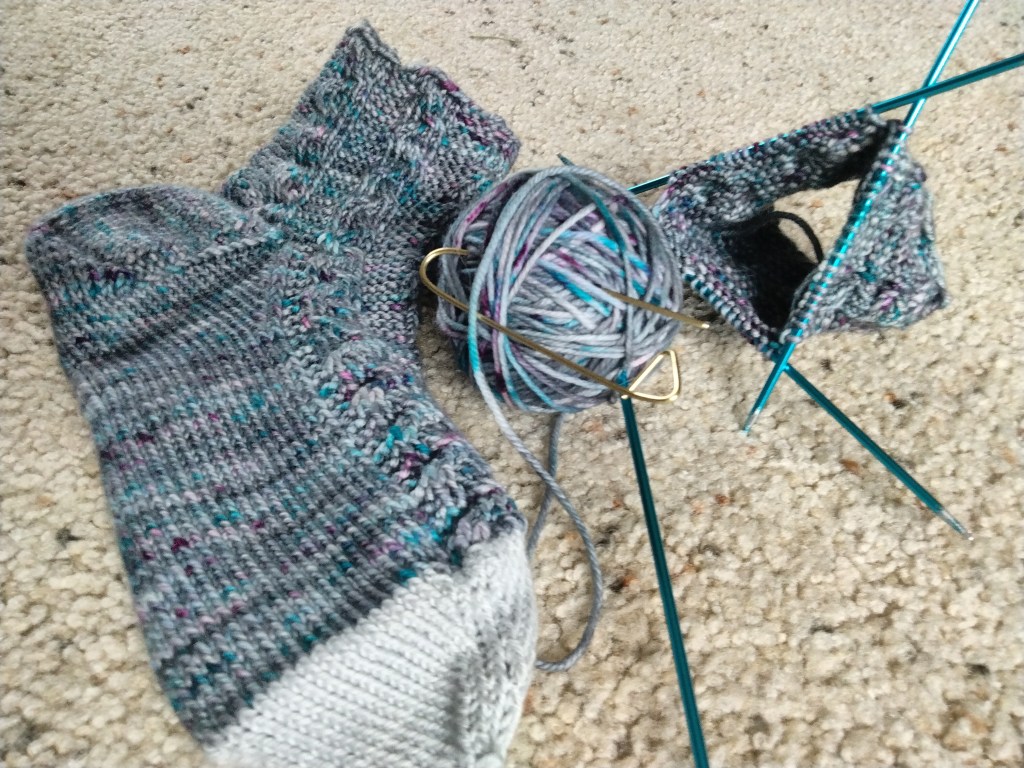
The hank I purchased, with a color pattern she had named Frozen, was less than 300 yards long. I feared that it would only furnish enough to make one sock, so I shortened the ankle part of the socks from 6″ to 3.5″. I also substituted some light grey yarn from my stash for the toe. My reasoning was that, even if I ran out of Frozen yarn partway down the second sock, at least they would look similar when I had shoes on.
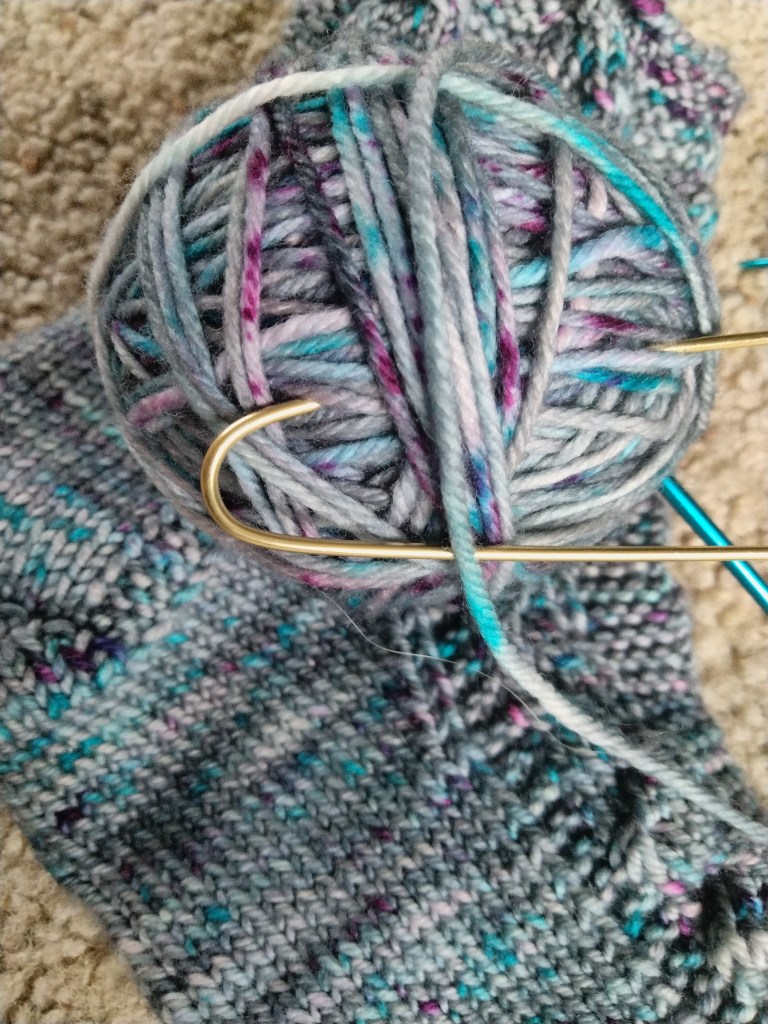
Now, I’m into the heel flap of the second sock, and the ball of Frozen still has not run out. Either because it’s merino wool or because it’s slightly heavier than superfine, Frozen has been more forgiving than the cotton yarn I usually knit with. The sole-of-the-foot gap did not show up, and the stitches even out better and are stretchier than with cotton.
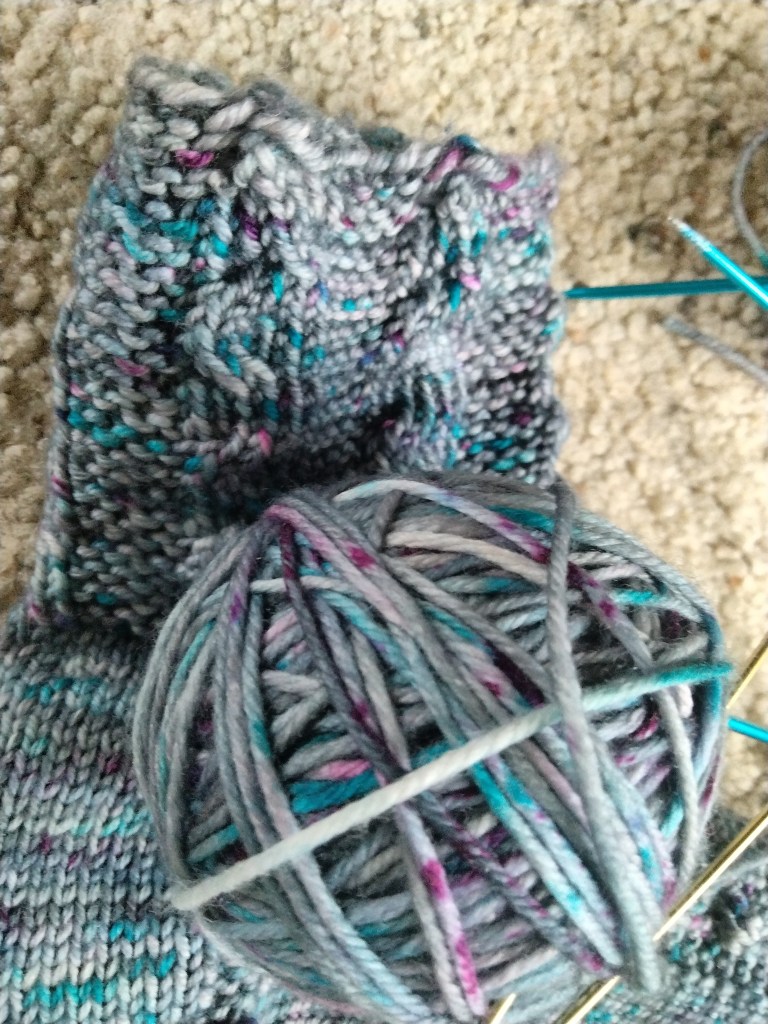
Here’s one more close-up of the yarn ball, taken for the review that never happened. The yarn came in a hank, so I had to unwind it and roll it into a ball before I could begin.
After knitting the Indian blanket, these socks seem to be knitting up incredibly fast.
Which reminds me of a story. One my students, using a vocabulary word, described his grandmother as “adept.” I asked what she was adept at, thinking knitting or else pies. Turns out, she’s a ninja.
“Was the whole place in yesterday?”
“Every man, woman, and child for miles. Crona Nagle, d’you remember her? She’s ninety-two years of age, hasn’t left the house since God was a child, but she got the grandson to drive her down yesterday. And she’d a feckin’ hypothesis of her own, o’course.”
Tana French, The Hunter, p. 339
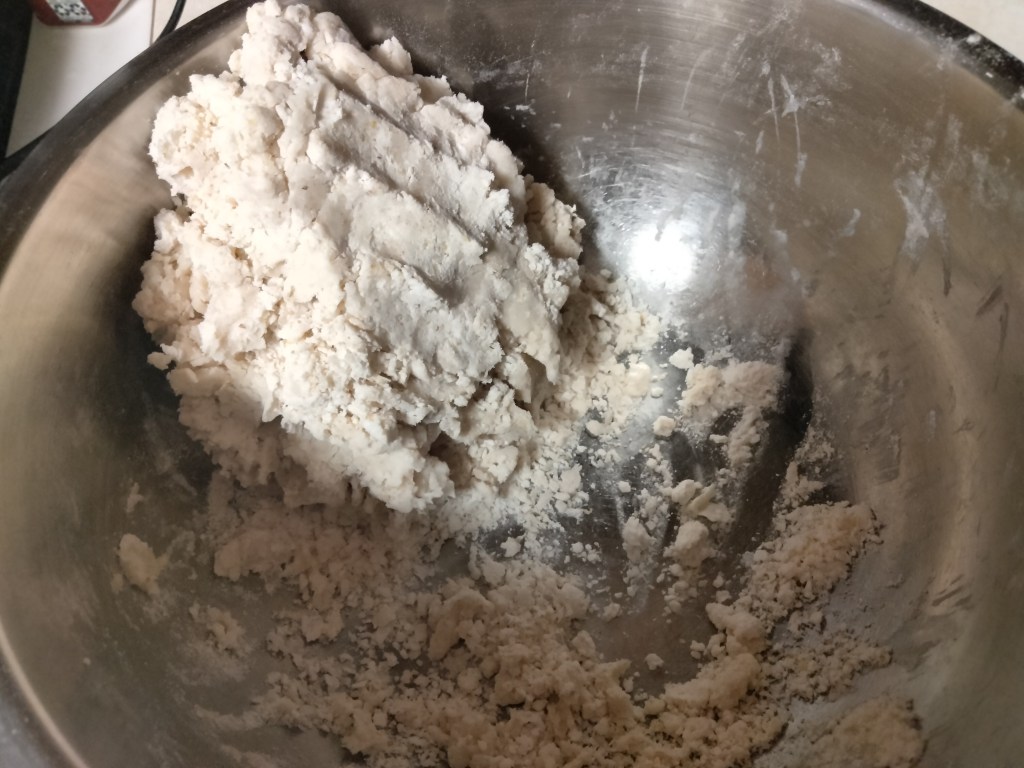
See how it puffs up a little? More so than with vegetable shortening.
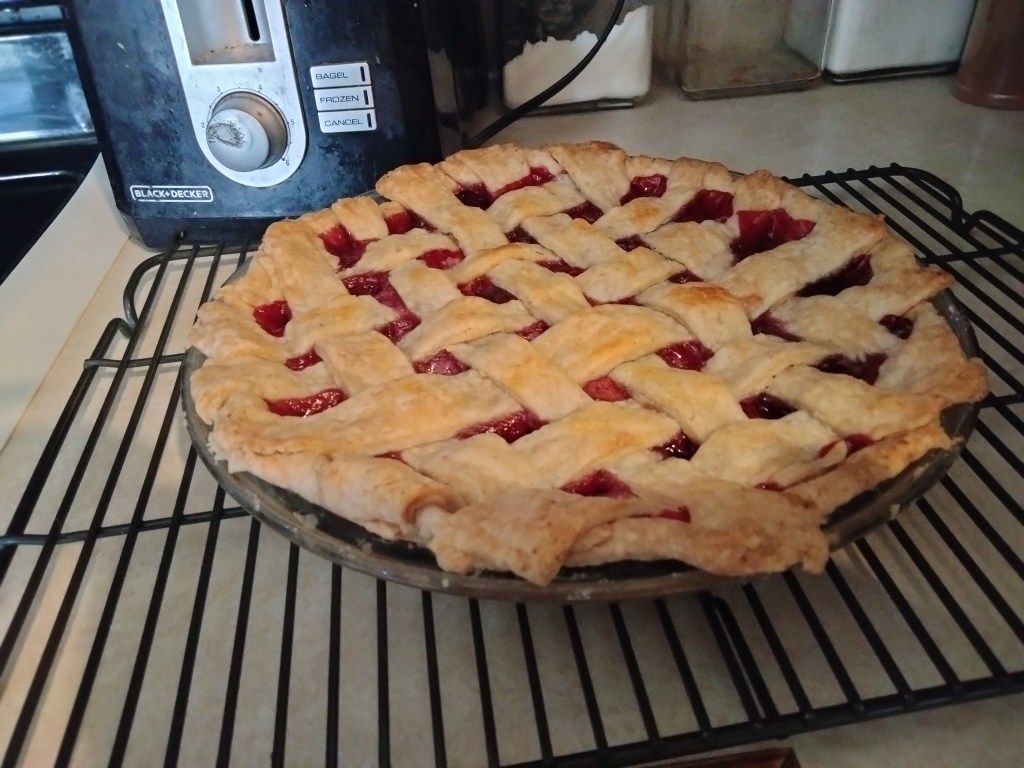
In making this–though I say it myself–dazzling lattice raspberry pie, I am standing on the shoulders (metaphorically) of a long line of matriarchs. Here are three.
My mother-in-law (and actually my father-in-law too) always made pies with lard instead of with shortening. I can remember going to the grocery store and having to hunt around for lard for them to make their pies, because for many years it was not popular. Now, people are starting to realize that emulsified seed oils may actually be as bad or worse for us than animal fat, and so people like me are starting to use lard for the first time in our lives. It gives the pie crust dough a bit more of a taste than shortening, which is a tiny bit off-putting to someone who is used to shortening pies … but in the finished product, the taste is more buttery.
While I tell you about the matriarchs, here are the steps for making a lattice pie, learned long ago from the Better Homes & Gardens cookbook.
First, cut the lard into the flour and then slowly mix in cold water, enough to make a double-crust pie.
Roll out the bottom crust, transfer to the pie pan by loosely wrapping it around the rolling pin, patch cracks, and fill it with whatever fruit you are using. In my case, it’s raspberries picked from our patch, tossed with sugar, cornstarch and a dash of cinnamon.
Next matriarch: A cheerful saint at my church in Ohio, who had home schooled five children. Once I went to Sunday dinner at her house. She referred to her ability to get a full dinner on the table within an hour of getting home from church as “the forty-minute miracle.” She also told me this:
“When I first got married and started cooking meals, I thought that over time, I would become a gourmet cook. That didn’t happen, but what happened was that I got faster.”
Me too, Ruth. Me too. You get faster, which makes things easier, but unfortunately you only get faster at the things you actually practice.
On to the lattice.
Roll out the second half of the pie crust dough and cut it into strips, like this:
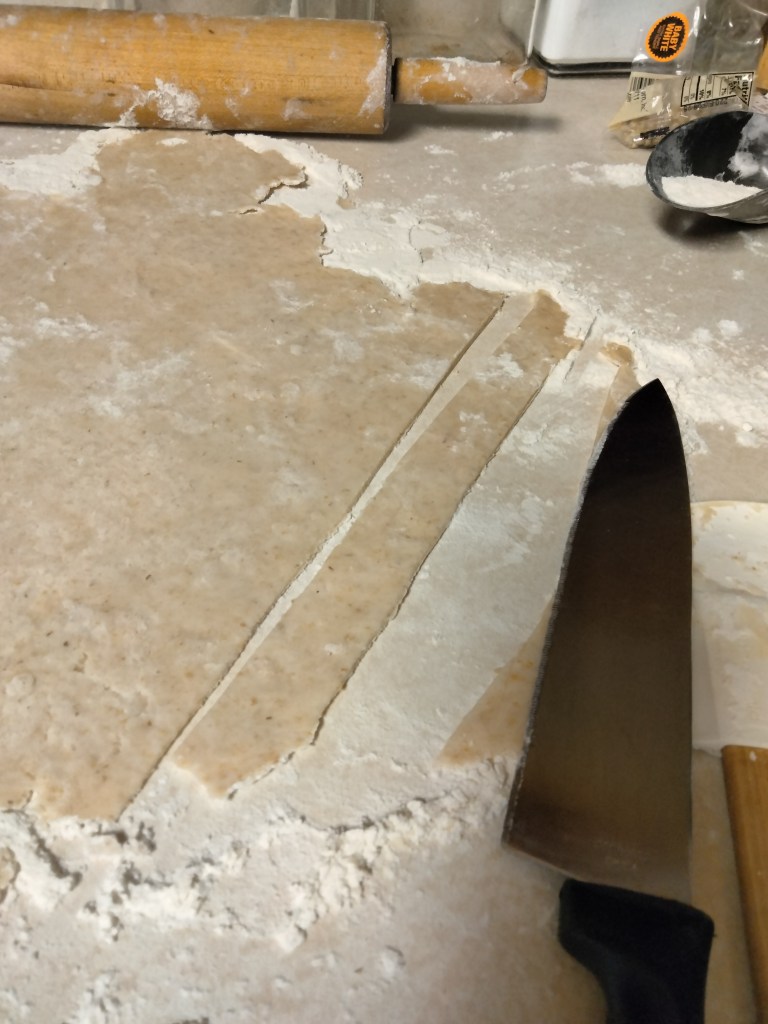
I don’t cut all my strips beforehand. I just make them as I go.
Take a shorter strip and put it across one side of the pie. Take another short strip and put it down at a right angle, so they cross.
And now, the magic happens.
As you add strips, you will need to gently fold back the ones that you want to go over the new strip. Here I am lifting one, to illustrate.

As you add new strips going at right angles to each other, keep folding back every other strip when you place a new one. Then put them back after the new strip has been placed. That’s how you get a weaving effect.

Like this.

The last matriarch I have to thank is whoever planted the large raspberry patch in the yard of the farmhouse we rent. It was probably the older farmer and his wife we rent from. By the time we got here, the bushes were already producing, keeping me busy picking throughout July.

All ready! Scatter small pieces of butter over the crust and put aluminum foil around the edge for the first 25 minutes of baking. Don’t forget to put a baking sheet on the rack underneath the pie. If you have done this right, molten raspberry juice will bubble out, and your smoke alarm will go off. You want the raspberry napalm to fall and burn onto the baking sheet, not the bottom of your oven.
Enjoy!

