I'm a wife, mother, Christian, closet Luddite, Neanderthal advocate, incurable book hound.
I'm also the author of The Scattering Trilogy, which is set in 10,000 B.C. Buy, read, pass it on!
Leave comments. Let's talk!
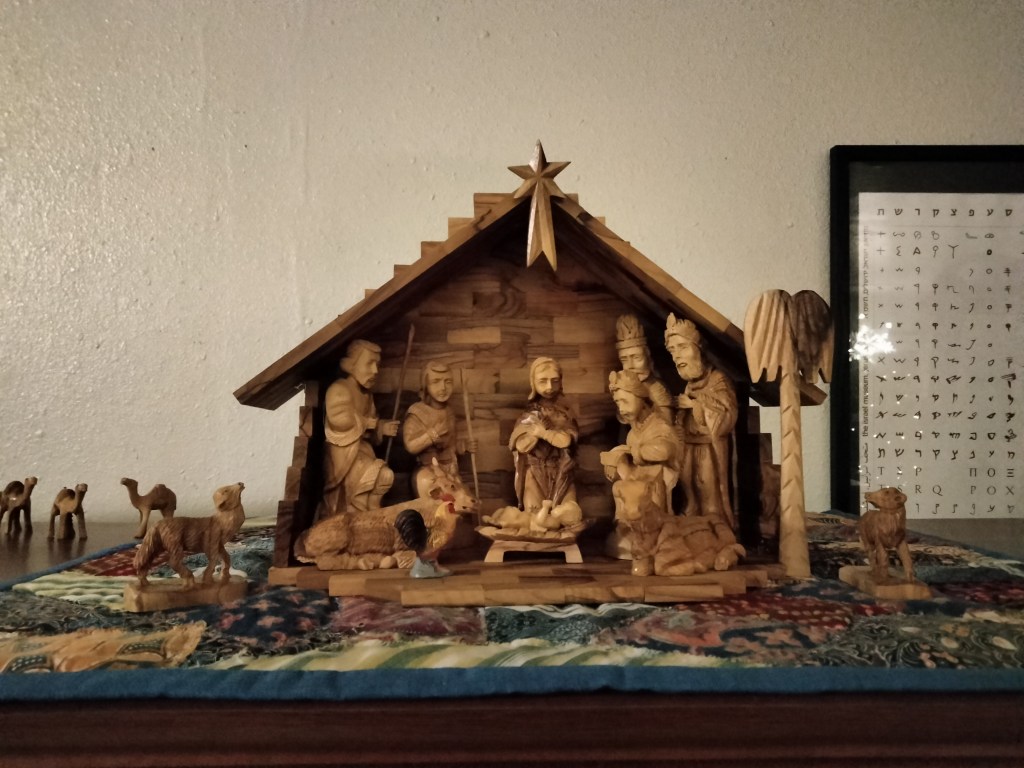
…. I mean, they’re basically all unique. I love the endless variety.
This one, which my husband bought in Israel, is made of olive wood. It’s sitting on a small quilt made of scraps of clothing we wore while in Indonesia (mostly batik patterns), and on the wall behind it is my husband’s poster of ancient alphabets of the world.
The latest addition is the rooster, who, though not made of olive wood, blends right in.
And now to Rome, as always in December, came the Saturnalia.
“Io! Saturnalia!” That was the call that ushered in the merriest holiday of the Roman year — that hilarious, glorious, mid-December festival, the Saturnalia.
“Io! Saturnalia! Io! Io! Io!” That was the greeting that echoed through the holiday season. For it was in honor of Saturn — good, old, generous Saturn, kindest and most provident of the gods.
During those mid-December days (first three, later seven) no war was ever declared, nor battles fought, no criminals tried or punished. Courts were closed; schools dismissed; even the slave markets were shut down. During those days, all slaves were free [just] as in those golden days of old, all people had been equal. Everyone, rich, poor, young and old joined in a glorious holiday.
The day began with a sacrifice of thanksgiving in the early morning, followed by a public feast at midday, which turned into a wild, hilarious carnival before evening. In red pointed caps and colored costumes, merrymakers went singing and laughing through the streets, showering wheat and barley like confetti, and granting every wish, no matter how wild, ridiculous, or disgusting, made by the lucky one who had been chosen “King of the Saturnalia.”
The weeks ahead were always filled with preparation. Candlemakers and makers of dolls were busy pouring wax, turning out little earthenware images, and setting up booths for the doll fair. Every child would want a doll, and every household would need many candles for the Saturnalia.
Holly branches, with their bright berries, had to be cut and carted into the city, and houses trimmed with evergreen. Gifts for the family and friends must be selected and wrapped. For on the second day, after a family dinner of roast young pig, with all the trimmings, came an exchange of presents!
Augustus Caesar’s World: 44 BC to AD 14 by Genevieve Foster, Beautiful Feet Books, 1947, 1975, pp. 56 – 58
My faithful fellow blogger, Bookstooge, is doing a readalong of a book someone, possibly as a prank, recommended to him: Love Saves the Day by Barbara Cartland. I went so far as to order this book from Amazon in order to participate. I don’t usually read in the romance genre, but I have read a few, and I don’t despise the genre or its readers or anything like that.
I waited to post this until after Bookstooge’s first reaction post went up on Friday, but I am composing my reaction before I see his.
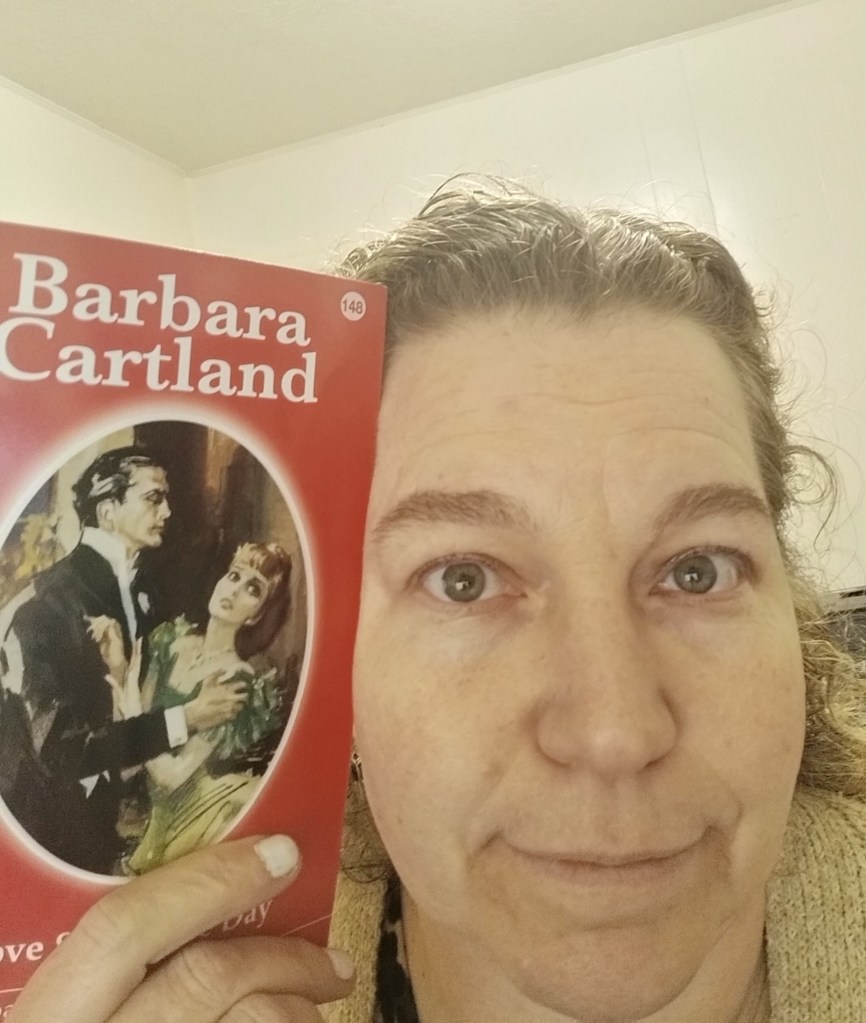
First, let’s talk about this cover, eh? The word “terrifying” comes to mind. The guy looks more like Dracula – or a 60-year-old uncle- than like a romantic hero. Note that he is grasping the heroine by the upper arms. She, for her part, appears to be very concerned and trying to get away. I don’t mind the fact that this is impressionistically rendered – I don’t even completely mind that her hair is not, as it is described in the book, curly — but the emotional tone of this cover does not match the promised content.
I am, as of this posting, almost all the way through Chapter 4 because I mistakenly remembered that Bookstooge was going to be writing about chapters 1 – 6 in his first post. My impression so far: the plot is a very capable romance plot. The heroine is young, brave, idealistic; the hero is a little older, world-weary, etc.; there’s a rival romantic hero in the picture who is young, blond, and charming; financial circumstances are forcing the couple into co-operation they wouldn’t otherwise undertake. There’s even a bitter, scheming housekeeper a la Rebecca. I can’t see any big holes in the plot.
My first impression of the wordsmithing is that this is a first draft.
There are a ton of comma splices. There is head-hopping. (Though that may be intentional; sometimes it’s hard to tell head-hopping from an omniscient narrator. I omnish, myself.) The tone of the dialog is slightly inconsistent. It’s as if Cartland wants this to be an Edwardian-era novel, like Austen, or even earlier, but it’s set in 1903, and sometimes it comes off as if the characters are pretending to be from an earlier era. I can’t tell whether clothes, technology, and so forth, contain any anachronisms. The clothes are fairly generically described, but there are “omnibuses.” (Edit: I just looked it up, and oops! Edwardian is 1901 – 1910. So, spot on. So, the language sounds like it’s going for … Victorian? But obviously I’m not very savvy about this, so perhaps her language is also period accurate.)
Anyway, after noticing that this read like a first draft, I then went back to the introduction (which, like a good fiction reader, I had skipped), and, lo and behold …. it is a first draft.
Dame Barbara Cartland[‘s] most amazing literary feat was to double her output from 10 books a year to over 20 books a year when she was 77 to meet the huge demand.
She went on writing continuously at this rate for 20 years and wrote her very last book at the age of 97, thus completing an incredible 400 books between the ages of 77 and 97.
Her publishers finally could not keep up with this phenomenal output, so at her death in 2000 she left behind an amazing 160 unpublished manuscripts, something that no other author has ever achieved.
Barbara’s son, Ian McCorquodale, together with his daughter Iona, felt that it was their sacred duty to publish all these titles for Barbara’s millions of admirers all over the world who so love her wonderful romances.
So in 2004 they started publishing the 160 brand new Barbara Cartlands as the The Barbara Cartland Pink Collection, as Barbara’s favourite colour was always pink — and yet more pink!
The Barbara Cartland Pink collection is published monthly exclusively by Barbaracartland.com and the books are numbered in sequence from 1 to 160.
–the introduction
Barbara Cartland was cranking out about one novel every two weeks for twenty years. I’m not even mad, I’m impressed. And I am now a little bit jealous of her. Imagine having such high demand for your books that you can just dash off all your ideas and the publisher will publish them as fast as they can.
Also, I’m tickled. That selection above gets funnier every time I read it. I mean, it sounds made-up, like something from a Bertie Wooster novel. Even the names of Barbara’s son and granddaughter sound like characters from her books. And the fact that they are calling it the pink collection because that was her favorite color … the fact that she loved pink so much … the fact that her author photo looks like this:
Now that I think about, the section above might be my favorite part of the book. The romance between Tiana and Richard is going to have to get awfully good in order to compete with Cartland herself.
A few hours’ drive from my house, in the mountains of southern Idaho, we have a hot springs attraction. The pools are tucked into a niche between the town on one side and the highway on the other.
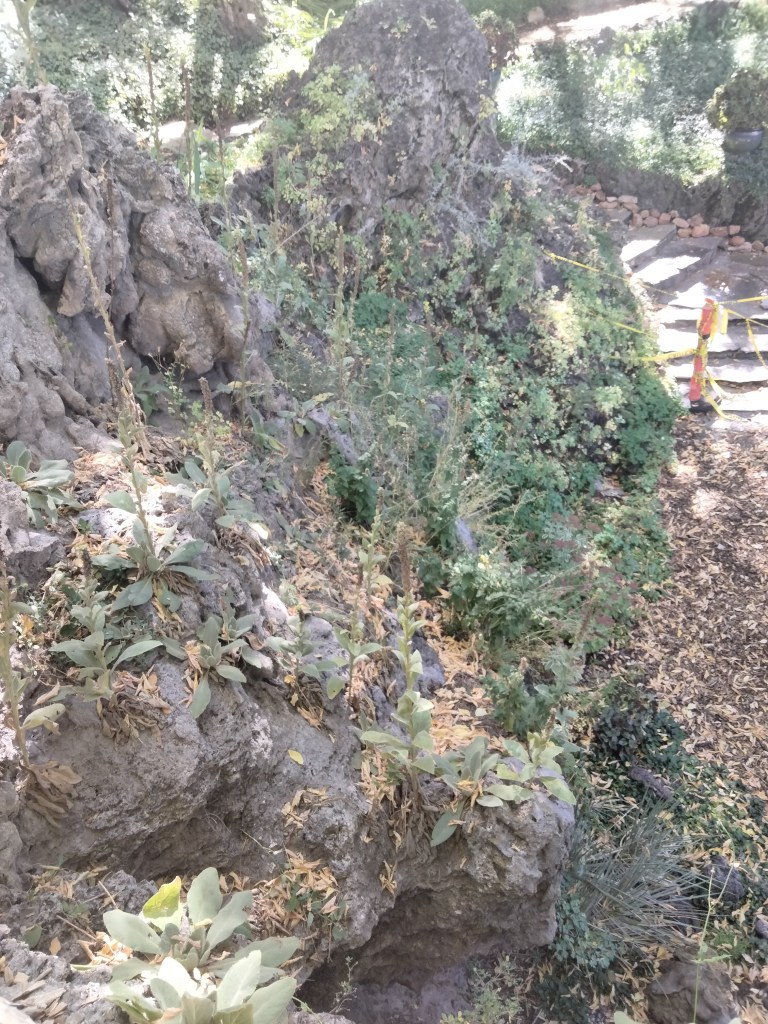
The photograph above was taken from the east end of the little canyon. Behind me, as I took this photograph, was something called “The Grotto.” It consists of paths and small garden areas winding along the lava-rock hillside. The rocks are basalt, but covered with mineral deposits from the days when the springs gushed out over here.
My husband and I went to the town of Lava, which is very touristy and has a lot of old-timey, cowboy-themed restos and hotels, back in September. I had never walked in The Grotto before. (Usually, I’m just either going in the hot springs or not going in the hot springs.)
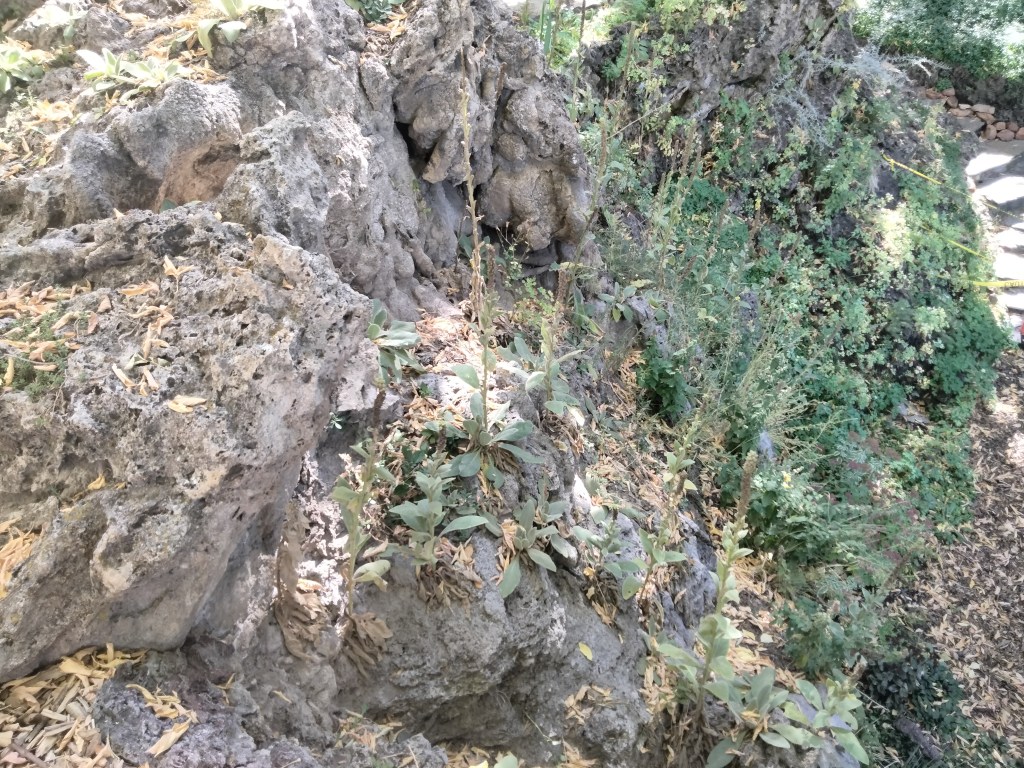
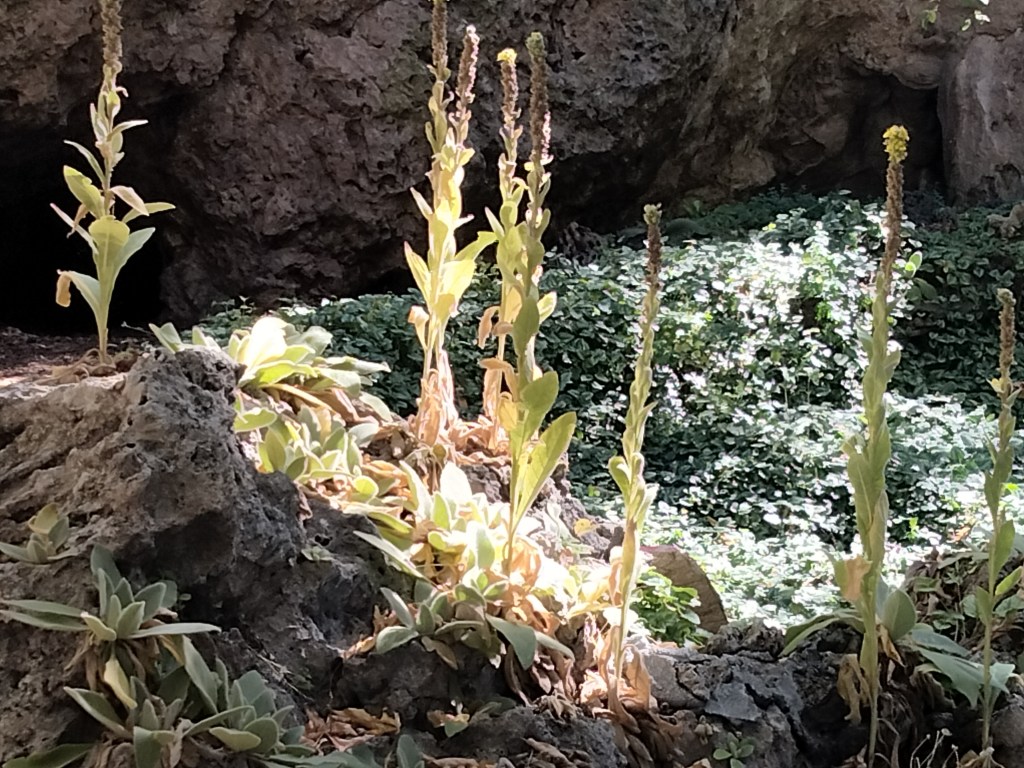
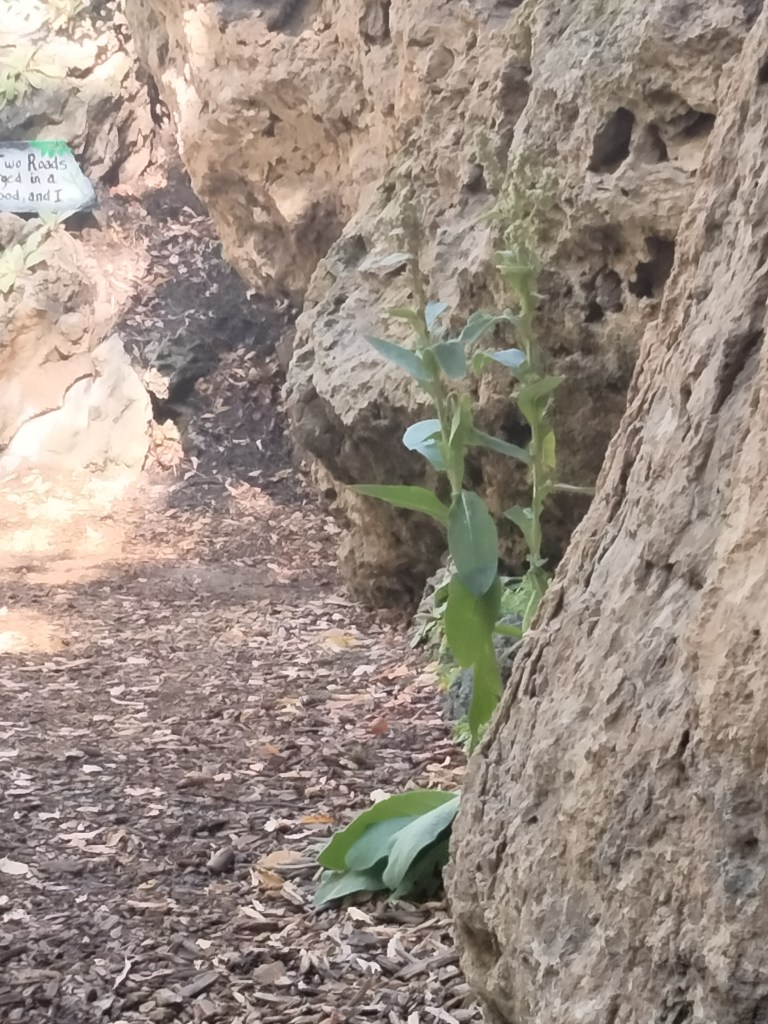
But on this particular September, The Grotto was simply alive with the most Wooly Mullein I had ever seen in one place! Wooly Mullein are those plants you see with broad, pale-green, pillowy-looking basal leaves and (in some cases, not all) a tall spike of a flower.
I blogged about these plants a few years ago, when I had photographed one growing in a farmer’s field near my house. According to Central Rocky Mountain Wildflowers, “They are biennial plants, growing the first year as a round cluster of large radiating basal leaves covered with thick, woolly hair. The second year, they rapidly grow a 1 – 6′ tall stalk, crowded with yellow flowers in a spike arrangement. Then, with all its energy expended, the plant dies.” (p. 157)
“This introduced weed colonizes disturbed places from the valleys and plains to montane forests.” (ibid) Look at how many of them there are! They must love the dry climate.
But Wooly Mullein is not just a weed. “Dioscorides, the Greek physician to the Roman armies in the first century, used mullein to treat coughs, scorpion stings, eye problems, tonsillitis, and toothache. Today, herbalists value it as a medicinal herb for asthma, bronchitis, coughs, throat inflammation, earache, and various other respiratory complaints.” (ibid) My copy of Prepper’s Natural Medicine confirms this.
Hence, Lava is really the place to come if you’re ill in apocalypse situation! The Shoshoni Indians would bathe in and drink the hot-spring water to cure illnesses, plus there is all this mullein here. Still, it might be better to plan ahead.
I walked down this path and sat on a bench set into the rock wall. Lo and behold, up in a niche was Spiderman watching over me! Lava truly does have everything you might need!
[I]t’s much easier to understand Critical Race Theory as the co-opting of black Americans (and feminists) by neo-Marxists (many of whom were Black Feminists) to Marcuse’s revolutionary program than it is to recognize it as a new dimension of approaching civil rights. In fact, it’s like staring at the murder of the Civil Rights Movement for the purposes of promoting a tiny coalition of neo-Marxists … to the role of a revolutionary vanguard …
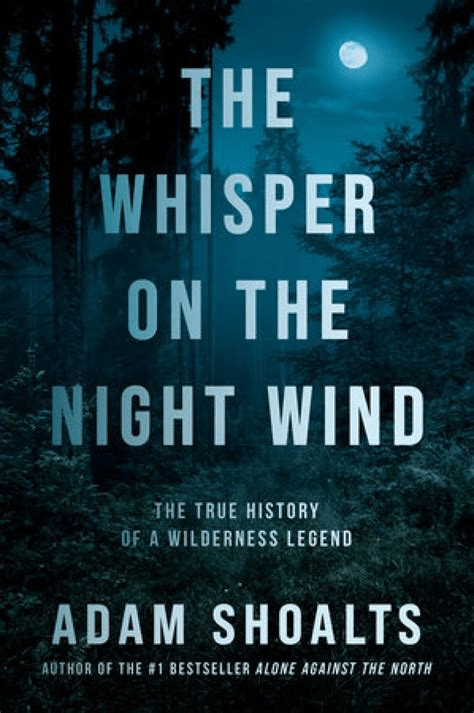
This book was recommended to me by The Geeky Jock, who has since dropped off my feed.
The author is a wilderness writer, and like many wilderness writers, he can write lyrically about the Canadian forests, giving you a sense of eerie beauty, and then he can turn around and be funny with the hardships that he and his hiking partner have to go through. In this book, he’s on the hunt for “the Traverspine demon,” a mysterious creature that, according to historical records, terrorized a remote outpost in Labrador. It sounds like a Sasquatch (which Shoalts, oversimplifying merrily, says is only attested in the Pacific region), but it leaves cloven footprints.
Shoalts and his friend push on through conditions that would have made this Bigfoot buff turn back, such as days of impassable brush. They don’t find the creature, but they do find a theory. Shoalts, a materialist, decides it was probably a combination of sightings of a wolverine, and moose tracks (both animals were rare in the region at the time). His theory is pretty convincing. He undermines his case a bit by dismissing the Greek centaurs as people’s first sighting of a man on a horse, while ignoring all the other, harder-to-dismiss chimeras that populate Greek legend.
Jack Reacher, drifting through town as is his wont, stops to help out a random guy who’s being bullied, and once again ends up stopping an international plot basically single handedly. He then has a gratuitous affair (not graphically described) with a female character he will never meet again, before leaving town.
Also, Nazis. (Not very creative, guys. Do better.)
One thing I like about the Reacher books is that I’m never worried about him. No matter how outnumbered or apparently outgunned he is, I know Reacher is smarter, quicker, and has more martial arts and military skills than his opponents. But, at the same time, he consistently gets into situations where any sane person would be worried, and I know I should be scared for him. In that way, these books strike a good balance. I’m neither terrified nor bored.
Heartbreaking novel about an American ex-cop who has recently moved to rural Ireland. Super well-written. Very evocative of the landscape, the weather, and the people, including the way they use the English language. For example, they say things like, “He’s after leaving for work” instead of “He just left for work.”
Felix Francis has carried on the beloved institution of “racing thrillers” written by his jockey father, Dick Francis. All novels by Francis (pater and fils) take place in “the racing world.” Sometimes the main character is a jockey, sometimes a trainer or an owner, and sometimes the connection to racing is looser. All are written in the first person.
In this novel, the main character, Chester, very profitably runs a “syndicate.” He buys racehorses and sells shares of them to wealthy people who want to participate in the lifestyle. So each horse has multiple owners, but Chester is the main owner, and the one who liases with the trainers and jockeys to plan out the horses’ careers. Chester is less of a tough-guy character than the typical Francis protagonist. He’s also older and more established than Franics main characters usually are. His children are grown (just), and his wife is aging and losing interest in their marriage.
Syndicate had less action than previous Francis books I’ve read, and considerably less violence (though Francis books do vary a lot in this regard). It is not as tense as the cover makes it appear. I also wasn’t too impressed with some of Chester’s choices. All in all, this wasn’t the strongest Francis novel I’ve read, though it was on-brand. Three stars.
An indispensable reference book. Neither easy nor fun to read. I’ll be reviewing this in greater detail later.












 Out of Babel Books