I'm a wife, mother, Christian, closet Luddite, Neanderthal advocate, incurable book hound.
I'm also the author of The Scattering Trilogy, which is set in 10,000 B.C. Buy, read, pass it on!
Leave comments. Let's talk!
Lisa Fulton: Lisa Fulton’s best-selling debut novel The Balance of Justice shook the foundations of crime fiction on release twenty-one years ago with its white-hot rage and brutal truth, and was long-listed for the Justice in Fiction Award, Women’s Prize, 2003. She is currently working on her long-awaited second novel.
Wait, what? Why the 21-year gap? What happened in the interim?
S.F. Majors: S.F. Majors’s gripping thrillers have captivated the world with their psychological complexity and hair-raising twists and turns. Her books include the New York Times bestselling Twists and Turns …
OMG …
Wolfgang: Winner, Commonwealth Book Prize 2012; short-listed, Bookseller’s Favorites Award 2012; short-listed, Goodreads Reader’s Choice, Literary Fiction, 2012; short-listed, Best of Amazon, 2012; [font becomes smaller] short-listed, Justice in Fiction Award, Women’s Prize (special exemption granted), 2003 …
All these fictional author blurbs are from Benjamin Stevenson’s Everyone on This Train is a Suspect.
Today’s post comes from chapters 4 and 5 of this book.
Originally Posted as, “Writer: The World’s Third Oldest Profession”
Writing is a human practice.
Of course it is possible to have a human society without writing, but the impulse to devise a writing system, looked at historically, may have been the rule rather than the exception.
This is counter-intuitive, of course. “Symbolic logic” seems like it ought to be unnatural to humans, especially if we are thinking of humans as basically advanced animals, rather than as embodied spirits. But if we think of mind as primary, everything changes. It’s telling that reading and writing are one of the learning channels that can come naturally to people, in addition to the visual, the audio, and the kinesthetic. But I’m getting ahead of myself.
Welcome to the third post taken from Lost Civilizations of the Stone Age by Richard Rudgley. Call this the writing edition. This post hits the highlights of Rudgley’s chapters 4 and 5, pages 58 through 85.
Nah, Ancient People Didn’t Write, They were Barbarians!
The idea of writing as an exception in human history has become dogma:
The proposition that Ice Age reindeer hunters invented writing fifteen thousand years ago or more is utterly inadmissible and unthinkable. All the data that archaeologists have amassed during the last one hundred years reinforce the assumption that Sumerians and Egyptians invented true writing during the second half of the fourth millennium. The Palaeolithic-Mesolithic-Neolithic progression to civilisation is almost as fundamental an article of contemporary scientific faith as heliocentrism. Writing is the diagnostic trait … of civilisation. Writing, says I.J. Gelb, ‘distinguishes civilised man from barbarian.’ If the Ice-Age inhabitants of France and Spain invented writing thousands of years before civilisation arose in the Near East, then our most cherished beliefs about the nature of society and the course of human development would be demolished.
Allan Forbes and Thomas Crowder, quoted in Rudgley, p. 75
Of course, the demolishing of our most cherished beliefs about the course of human development is exactly what, Rudgley is arguing, is going to have to happen.
In the last few chapters I have selected only a small number of the complex sign systems that have been preserved from prehistoric times. My concentration on the Near East and more particularly on Europe should not be taken to imply that such systems did not exist elsewhere in the prehistoric world. Far from it; investigations of numerous collections of signs are being undertaken in places as far afield as the Arabian peninsula, China and Australia. Millions of prehistoric signs across the continents have already been recorded, and more and more are being discovered all the time. … It no longer seems sufficient to retain a simplistic evolutionary sequence of events leading up to the Sumerian [writing] breakthrough some 5,000 years ago.
Rudgley, p. 81
Let’s look at these complex sign systems that Rudgley has mentioned.
The Vinca Signs
I was an adult before I ever heard the phrase “Old Europe.” I was doing research for a planned book, and I was surprised to learn that in southeast Europe (between the Balkans and the Black Sea), as early as 4,000 or 5,000 BC, there were not only cities but a writing system (undeciphered) known as the Vinca signs. It turns out that these cities and this writing system were probably part of a culture that obtained over much of Europe before the coming of the Indo-Europeans, which is called Old Europe. This is the culture that Marija Gimbutas believes was “the civilization of the goddess.”
Just as a reminder, these dates for the Vinca culture are before the very first human cities and writing are supposed to have arisen, in Sumeria in Mesopotamia, about 3,000 BC.
Perhaps I didn’t hear about the Vinca signs in school because they were only discovered in Transylvania 1961. (I was born in 1976, but we all know how long it takes new archaeological findings to get interpreted, integrated into the overall system, and eventually make it into school textbooks.) After being discovered, the signs were assumed to be derived from Mesopotamian cultures such as Sumer and Crete, because it was accepted dogma that writing was first invented in Mesopotamia. Later, the tablets on which the Vinca signs were discovered were carbon-dated and found to be older than the Mesopotamian writing systems. This led to a big disagreement between those who wanted to believe the carbon dates, and those who wanted to believe the more recent dates for Old European archaeological sites, which were then conventional.
Then, in 1969, more, similar signs were discovered on a plaque in Bulgaria and dated to be 6,000 – 7,000 years old. By this time, archaeologists were beginning to accept the carbon dating of these Old European sites. But since they still did not want to admit that writing might have been invented before Sumer, most of them decided “[the signs] could not be real writing and their apparent resemblance was simply coincidental.” (Rudgley p. 63)
An archaeologist named Winn analyzed the Vinca signs and while he is not willing to go further than calling them “pre-writing,” he concludes that they are “conventionalised and standardised, and that they represent a corpus of signs known and used over a wide area for several centuries.” (Rudgley 66)
Meanwhile, Marija Gimbutas and also Harald Haarmann of the University of Helsinki both feel the Vinca signs are true writing and that they developed out of religious or magical signs, not out of economic tallies like the Sumerian alphabet.
Haarmann notes that there a number of striking parallels between the various strands of the pre-Indo-European cultural fabric – especially those related to religious symbolism and mythology. Among these common features is the use of the bull and the snake as important religious symbols. In the case of the snake it is a form of the goddess intimately intertwined with the bird goddess motif in both Old European and later Cretan iconography. The bee and the butterfly are also recurrent divine attributes, and the butterfly is represented by … the double ax. Haarmann sees the goddess mythology of Old Europe echoed in these motifs that also feature prominently in the ancient civilisation of Crete. He then traces the links between the Old European script – as found in the Vinca culture – and later systems of writing, particularly those of Crete.
Rudgley, pp. 68 – 69
Rudgley’s Figure 15 (p.70). On the left are the Vinca signs, on the right is Linear A from Crete.
Ice Age Signs
There are quite a number of symbols that appear on artifacts or are associated with paintings from the Neolithic and even the Palaeolithic period. These include crosses, spirals, dots, “lozenges” (ovals), and the zigzag, which is very common and seems to have been used to represent water. (By the way, note the zigzags among the Kachina Bridge petroglyphs.) “The discovery in the early 1970s of a bone fragment from the Mousterian site of Bacho Kiro in Bulgaria suggests that the use of the signs may date back to the time of the Neanderthals. This fragment of bone was engraved with the zigzag motif …” and apparently on purpose, not accidentally in the course of doing some other repetitive task. (Rudgley 73)
“The single V and the chevron (an inverted V) are among the most common of the recurrent motifs in the Stone Age.” (Rudgley p. 74) Gimbutas, of course, interprets the V as a symbol for the female genitals and/or Bird Goddess, but it could be just … you know … a symbol.
Archaeologist André Leroi-Gourhan has interpreted the many signs found at various Palaeolithic cave art sites not as a form of hunting magic (contra previous interpretations), but as a symbolic system. “Leroi-Gourhan admitted to us shortly before his death, ‘At Lascaux I really believed they had come very close to an alphabet.’” (Rudgley p. 77)
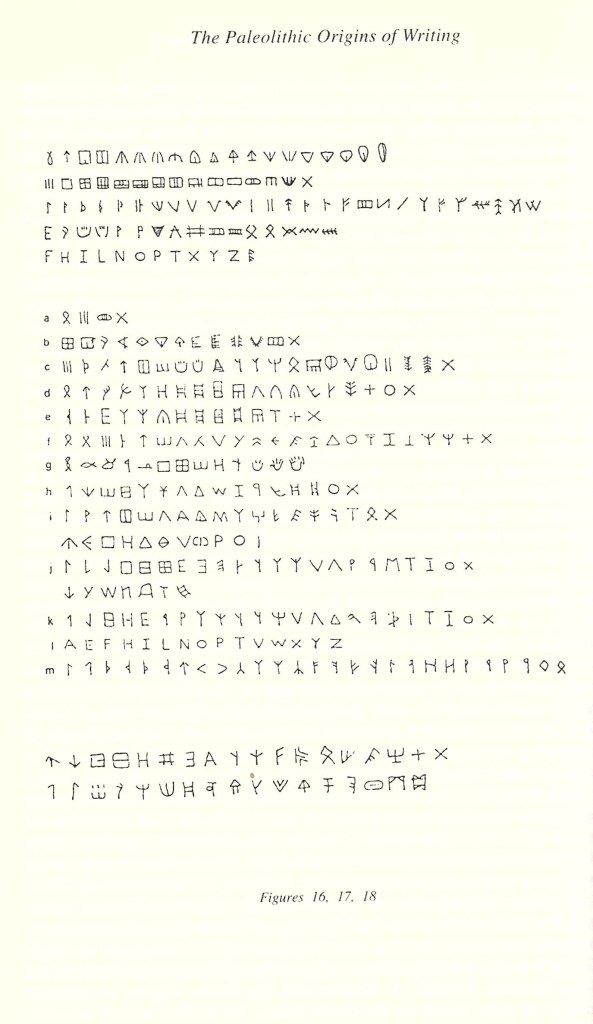
Rudgley’s Figures 16 – 18 (p. 78). Top paragraph: some of the Franco-Cantabrian (Stone Age) signs. Middle paragraph: a – hieroglyphic determinatives; b – Sumerian pictoral writing; c – Indus Valley; d – Linear A; e- Linear B; f – Cypriote; g – Proto-Sinaitic; h- Phoenician; i – Iberian; j – Etruscan; k – Greek (Western Branch); l – Roman; m – Runic. Bottom paragraph: some of the signs found on oracle bones in very ancient China.
But Can You Prove It’s Writing?
Every time some symbols are discovered that are so ancient they strain belief, anyone who doesn’t want to accept them as writing can easily go in to a number of calisthenic moves to cast doubt on this. If the item the signs are found on is in poor condition, they can question whether the marks were even intentional. Perhaps they were accidental scratches, the product of some other activity. If the marks are undeniably made by people, they can be dismissed as doodles. The Vinca signs, when first found, were speculated to have been copied randomly from Mediterranean signs by people who believed these things had mysterious power, but did not understand their meaning. Rudgley also notes that the Old European signs have been interpreted as purely magic symbols, as if a magical intent were to make them non-writing.
In short, any time we are presented with a complex system, there are always a million ways to get out of attributing it to a mind. This is doubly true if we aren’t able to interpret its meaning, but you will even see people do this with messages that they ought to be able to understand. Of course, it can also work the other way, where people see meaning in complex patterns where it wasn’t intended. Often what it comes down to is whether we want there to be a meaning there. Do we, or do we not, want to be in contact with another mind? If for whatever reason we don’t, we can always find a logical way to avoid that contact.
So in the case of apparent writing systems that we haven’t cracked and probably never will, our attitude towards them is going to depend heavily on what we believe about ancient people’s minds. Were they basically like ours, or were they different, animal? We will see more writing systems if we are expecting that they came from people. If we are not expecting to encounter people, then nothing is going to convince us that these are writing systems.
Was Adam a Writer?
My mind was blown, while taking an Old Testament Backgrounds course years ago, when I read an essay that asserted that Adam was able to write and in fact had left a written record for his descendants.
This idea seems completely loony on the face of it … until you realize that the only reason it seems loony is that we are assuming that writing is a recent, unnatural development, the product of tens of millennia of human cultural evolution, and not a characteristic human activity that is, so to speak, wired in.
The essay interpreted the early chapters of Genesis in this way. There will be a short historical record, followed by the phrase “the book of [name],” indicating that the passage immediately preceding was by that author.
Passage
Recounts
Closes with
Genesis 1:1 – 4:26
Creation (in poetry), fall, Cain and Abel, some of Cain’s descendants, Seth
Gen. 5:1 “the book of Adam”
Gen. 5:1b – 6:8
Recap of creation of Adam, Seth’s descendants up to Noah and his sons, Nephilim, God’s resolve to wipe out mankind, God’s favor on Noah
Gen. 6:9a “the book of Noah”
Gen. 6:9b – 11:9
Building of the ark, the Flood, emerging from the ark, the Table of Nations, the Tower of Babel
Gen. 11:10 “the book of Shem”
Gen. 11: 10b – 11:26
Genealogy from Shem to Terah and his son Abram
Gen. 11:27 “the book of Terah”
Gen. 11:27b – 25:18
Terah moves his family to Haran, Terah dies, a whole bunch of stuff happens to Abram, death of Sarah, Isaac finds a wife, Abraham dies, genealogy of the Ishmaelites
Gen. 25:19 “the book of Abraham’s son Isaac”
Gen. 25:19b – 37:1
Jacob’s entire life, death of Isaac, genealogy of Esau
Gen. 37:2 “the book of Jacob”
In Genesis, the author’s name comes after the notes he left.
I realize this might be a lot to accept. It’s just food for thought. It does explain why it says “the book of _________” (or, in my NIV, “this is the account of __________”), after the bulk of that person’s story.
Get it? Get it?
(By the way … for those wondering about the title of this post … prostitution is referred to as “the world’s oldest profession.” Erma Bombeck, mother and humorist, has published a book hilariously titled Motherhood: The Second Oldest Profession. The title of this post references those two, because the post is about the fact that writing is very, very old. I don’t mean to imply that a writer’s life has any necessary connection to the other two professions, although of course this does invite all kinds of clever remarks.)
This spring also [1634], those Indians that lived about their [the Plymouth settlement’s] trading house there, fell sick of the small pox and died most miserably; for a sorer disease cannot befall them, they fear it more than the plague. For usually they that have this disease have them in abundance, and for want of bedding and linen and other helps they fall into a lamentable condition as they lie on their hard mats, and pox breaking and mattering and running one into another, their skin cleaving by reason thereof to the mats they lie on. When they turn them, a whole side will flay off at once as it were, and they will be all of a gore blood, most fearful to behold. And then being very sore, what with cold and other distempers, they die like rotten sheep. The condition of this people was so lamentable and they fell down so generally of this disease as they were in the end not able to help one another, no not to make a fire nor to fetch a little water to drink, nor any to bury the dead. But would strive as long as they could, and when they could procure no other means to make a fire, they could burn the wooden trays and dishes they ate their meat in, and their very bows and arrows. And some would crawl on all fours to get a little water, and sometimes die by the way and not be able to get in again. But of those of the English house, though at first they were afraid of the infection, yet seeing their woeful and sad condition and hearing their pitiful cries and lamentations, they had compassion of them, and daily fetched them wood and water and made them fires, got them victuals whilst they lived; and buried them when they died. For very few of them escaped, notwithstanding they did what they could for them to hazard of themselves. The chief sachem himself now died and almost all his friends and kindred. But by the marvelous goodness and providence of God, not one of the English was so much as sick or in the least measure tainted with this disease, though they daily did these offices for them for many weeks together. And this mercy which they showed them was kindly taken and thankfully acknowledged of all the Indians that knew or heard of the same.
William Bradford, Of Plymouth Plantation, pp. 302 – 303
This post is the first in a series I have planned about prehistory. Each post will draw on one or more chapters from the book The Lost Civilizations of the Stone Age, by Richard Rudgley, Touchstone, 2000. From the front flap:
Our long-held myths are exploding. Recent discoveries of astonishing accomplishments from the Neolithic Age – in art, technology, writing, math, science, religion, and medicine, and exploration – demand a fundamental rethinking of human history before the dawn of civilization.
Lost Civilizations, inside flap
So, Rudgley’s thesis is basically that there was, in fact, civilization long before there was civilization. That is, of course, also a theme of this blog. “Ancient people were smarter than we think,” or that art, literature, science and civilization are the natural state of human beings and have been present (ebbing and flowing of course) as long as there has been humanity.
A near-universal theme in the mythologies of the world is that the present state of the world, and more specifically the social world, is in decline — a fall from the Garden of Eden or from a Golden Age. Modern civilization has turned these traditional mythological assumptions on their head and written a new script, one based on the idea of social progress and evolution. In this new mythology the notion of civilization (as it is generally understood) replaces Eden and this novel paradise exists not at the beginning of time but, if not right now, then just around the corner. Civilization is … presented as the final flowering of human achievement born out of a long and interminable struggle against the powers of darkness and ignorance that are represented by the Stone Age.
Lost Civilizations, Introduction, page 1
I have come to believe in the ancientness of civilization because I take ancient documents seriously as historical records: Genesis, primarily, but also the other legends and myths from around the world which Rudgley mentions in his intro. This suspicion that ancient people were much smarter than we give them credit for was further strengthened as I learned about some of their buildingprojects. Now Rudgley is presenting archaeological evidence that they knew far more than we suspect about art, mathematics, the natural sciences, and medicine.
Disclaimer about Dates
By the way, I don’t have a coherent way to sort out which archaeological dates to accept and which ones to doubt. As far as I can tell from my reading, all methods of dating archaeological sites are based on some form of dead reckoning.
Carbon dating depends on certain assumptions about rates of molecular decay, which can’t be proven in the first place and can also be thrown off universally or locally by events such as a comet strike. Carbon dating also seems to be less reliable the farther we go back in time.
Dating by archaeological layers also depends on assumptions about different historical periods and what might be diagnostic of each, except in cases where a site can be reliably linked to a known historical event (which is obviously only the case for relatively recent sites). Other than that, it’s all dead reckoning.
Dating events in human history by the use of genetics depends upon assuming that all genetic differences evolved and assuming certain rates of change. Historical linguistics has the same problem.
Finally, historical records such as the genealogies found in Genesis and in the oral traditions of other peoples worldwide hit only the highlights of a family line and don’t give us any idea how many generations were skipped.
Each of these methods can be pretty convincing in specific cases. It is even more convincing when one or more methods converge, yielding the same date range. But even when that happens, it’s still just one method of dead reckoning appearing to validate another. And most often, different dating methods contradict each other. If a plurality of them converged on one timeline for human history, maybe we could accept that. But they don’t. It’s complete chaos.
I would love to present a clever, coherent, data-grounded rubric for sorting all this stuff out. But I’m not a professional in any of these fields. Even if I were, the pros don’t all agree with one another. It’s starting to look like, in order to have a sorting method that makes sense, I would have to do full-time research for several years. Maybe for a lifetime. So I got nothin’.
My working theory is that humanity, and hence human civilization, is tens of thousands but not hundreds of thousands and certainly not millions of years old. I can’t prove this. No one can.
So, in these posts about Rudgley’s book, I’ll just present the dates as he gives them. I won’t try to integrate them with the picture of ancient human history that I have been piecing together in my books and in other posts on this site, all of which could be invalidated at any time by a new historical or archaeological discovery. Sometimes Rudgley gives dates that are hundreds of thousands or even millions of years old (though not in this chapter). I might be skeptical that they are really that old, but can still accept that these people were living long before mainstream archaeology tells us that there was “civilization.”
On to the Icky Stuff!
So. Stone Age Surgery.
Undoubtedly the widest-known major surgical operation in tribal cultures is trepanation … which, as will become clear, was also known in the Stone Age. This operation involves the removing of one or more parts of the skull without damaging the blood vessels, the three membranes that envelop the brain … or the actual brain.
Lost Civilizations, p 126
That’s right, removing parts of the skull. There are three methods by which this can be done: scraping, “a mixture of boring and sawing,” and “the push-plough method,” which involves creating an oval groove in the skull (basically another method of scraping).
Thomas Wilson Parry, MD (1866 – 1945), became fascinated by trepanation and practiced various methods of it on human skulls (not on live patients), “using implements made of obsidian, flint, slate, glass, shell and shark teeth.” “Parry records that the average time it took him to perform a trepanation by the scraping method on a fresh adult skull was half an hour. He found both flint and obsidian excellent materials to work with surgically, and also expressed the opinion that shells — which were used in Oceania to perform such operations — were highly effective too.” (page 128)
Trepanation appears to be less painful than it sounds. It has been used at various times and places to treat epilepsy, mental illness, head injuries, severe headaches, vertigo and deafness (129). It is “still regularly practised among the Gusii of Kenya, a Bantu people with a population of about one million, and theirs is perhaps the last surviving traditional practice of its kind.” (130) Trepanation was also practiced by the Incas and the pre-Inca peoples; in Neolithic Europe; in 6th-century BC Palestine; and now, trepanned skulls a few thousand years old have also been found in Australia.
Rudgley points out that “as it is usually only the bones of Stone Age people that survive to be discovered … any operation that was performed on the soft parts of the body cannot be detected.” (136) If Neolithic people were willing and able occasionally to practice trepanation, it seems likely that they were able to perform less risky kinds of surgery too. There is some evidence from Neolithic Europe of various kinds of dentistry, including toothpick grooves, birch bark chewing gum, and even a skull with a tooth that has been drilled. (136)
Rudgley’s chapter on trepanation (“Stone Age Surgery”) comes after a chapter called “Under the Knife” (pp 116 – 125), which discusses medical procedures in “tribal” cultures that are known from history and ethnography. This includes everything from circumcision in the Ancient Near East, to amputation among the Australian aborigines, to very detailed anatomical knowledge among the Aleutian islanders. The chapter concludes with two horrifying yet impressive accounts of successful surgeries in a tribal context. There is a c-section performed in Uganda in 1879, and various tumor removals performed in the Ellice [sic] Islands in the 1920s. The message is clear: modern, “civilized” people don’t have a corner on medical knowledge.
Antiseptics and Painkillers
We don’t know whether Stone Age people had germ theory. Nor, if they had it, do we know how they referred to germs. In one of Ursula le Guin’s novels, a wound getting infected is called “the evil of the blade.” That’s hardly less scientific than calling it an “infection,” as long as you know how to prevent or treat it.
Studies of both the trepanned skulls of the Incas and some of those found in Neolithic Europe indicate that healing seems to have been the norm in both cases. It is hard to explain the Stone Age success rate without concluding that some kind of effective antiseptic agent must have been used. Furthermore, the surgeons of the time must have understood the need for it.
Lost Civilizations, p 131
If germ theory was ever explicitly known, it was obviously forgotten at some point in human history, only to be re-discovered much later. But even if people were operating on a different theory, it would be possible for them to know the importance of cleanliness and to know how to treat a patient using any of a large number of natural substances that have antiseptic properties. The words “Stone Age” naturally evoke the image of a cave man, and the idea of a cave man naturally includes an individual who never takes a bath. But it ain’t necessarily so.
It is also possible that people’s immune systems were much stronger many years ago, if we are willing to entertain the idea that the human race has declined over time rather than evolving upwards.
Now, I am sure you want to know about painkillers. Here, gleaned from Rudgley’s Stone Age Surgery chapter, is a short list of substances that have been used as painkillers at different times and places:
cocaine (in coca leaves — South America)
wine mixed with extract of mandrake (first-century Greece)
mandrake beer (ancient Egypt)
possibly just beer
the opium poppy (starting in the Mediterranean around 6000 BC and spreading west from there)
cannabis (native to Central Asia, but quickly spread to Old Europe and China)
betel nut (Southeast Asia)
tobacco (in the Americas)
pituri (a nicotine-bearing plant used by the Australian Aborigines)
Clearly, although we might prefer modern anesthesia, ancient peoples were not completely without recourse when it came to pain. Most of the substances on this list are attested not only in history but also in ancient burials.
This has been a repost from January 2020, which by now is … ancient history.
It is not demonstrably unchristian to kill the rich as violators of definable justice. It is not demonstrably unchristian to crown the rich as convenient rulers of society. It is not certainly unchristian to rebel against the rich or to submit to the rich. But it is quite certainly unchristian to trust the rich, to regard the rich as more morally safe than the poor.
G.K. Chesterton, Orthodoxy, chapter 7: The Eternal Revolution
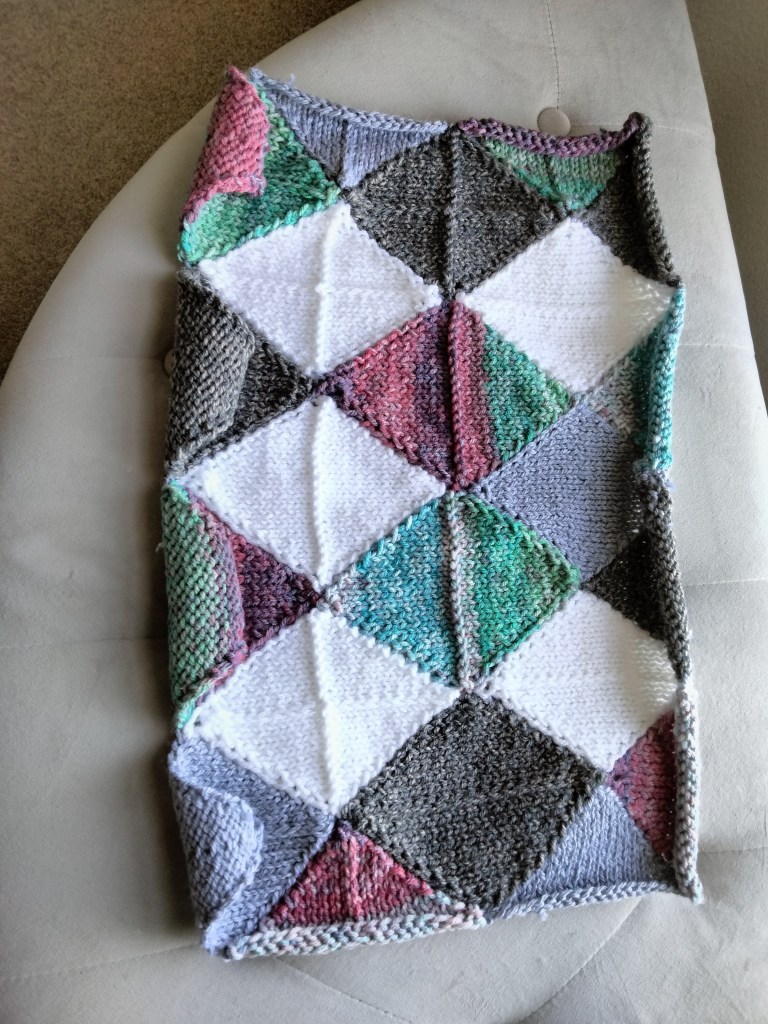
I heard my baby niece was going to receive a baby doll (and really, who loves babies more than babies?) and that I could make a blanket for same. I had some yarns in my stash that would look pretty together, so I started making diamond shapes and grafting them together using the ladder stitch.
I wanted there to be more visual interest, so I added ridges on some of the diamonds, using a row of garter stitches when horizontal and a column of slipped stitches when vertical. The result was a random windowpane type pattern overlaying the harlequin pattern.
The blanket took longer than I expected, but it was a big hit.
Too many Atlantises. An embarrassment of Atlantises. One Atlantis, two Atlantis, red Atlantis, blue Atlantis …
Atlantis is Now Off the Coast of Cuba
This articledescribes an intact granite city, with pyramids, discovered off the West coast of Cuba, about 2,000 feet down, in December of 2001. As our old friend KFM, of Bad Archaeology, points out, the city would be unlikely to survive intact like this if it actually dropped dramatically from what is now sea level, as Plato seems to describe. The article points out that there is another city, the Yonaguni Monument, off the coast of Japan, and Graham Hancock in his book, Underworld, points out that there are submerged megalithic cities in many places around the world, including off the coast of India. (Hancock has cycled through seriously advancing a number of different Atlantis theories, so he will be sort of the workhorse of this post.)
It seems to me that the city off the coast of Cuba is part of a worldwide phenomenon where sea levels were once much lower. We can include in this phenomenon Doggerland (which will make another appearance later in this post), and the land bridges known to have once connected Asia to the Americas and the Indonesian islands to the mainland.
If you are an old-earth believer and have to juggle millions of years, multiple cooling and warming periods, slow but somehow effective continental drift, and some confusing archeological indications that humans were perhaps around well before they should have been … good luck. As someone who believes that the history of the earth is measured in thousands or tens of thousands, but not millions or billions of years, my guess is that this period of low sea levels plus advanced civilization came right after the Great Flood.
You would have a much colder, rainier climate as the earth adjusted to the recent cataclysm (about this more in a minute). You would have had frequent snow and rain storms, with all this precipitation getting frozen in the rapidly forming ice sheets, causing Earth’s water supply to be greatly reduced. Meanwhile, you would have Noah’s children and grandchildren branching out as quickly as possible, building megalithic cities wherever they went, still remembering the techniques and technology (and possibly still assisted by the giants and gods) that they had seen pre-Flood. This period of low sea levels would have had to last long enough for people to disperse and to build, but it need not have been very long. It could have a been a matter of a few hundred to a thousand years. As the climate stabilized, you would have had floods covering settlements and civilizations in different parts of the world. This, I believe, is the reason we have an embarrassment of Atlantises.
There have also been assertions that the reason for the Bermuda Triangle phenomenon is that Atlantis lies underneath it. (Note that the west coast of Cuba is outside of the Bermuda Triangle.) This theory certainly appeals to those who are interested in the potential paranormal effects of the lost city, but I do not know of any actual submerged city found in the Bermuda Triangle area. (If you do, please enlighten me in the comments. I’m always looking for another Atlantis to add to my collection.) This article discusses how ocean-floor mapping technology can create lines that look like city streets.
Atlantis as Antarctica
Graham Hancock makes the case for this in his book Fingerprints of the Gods. He posits that the evidence points to an ancient, advanced civilization which was destroyed by a cataclysm, and asserts that the refugees from it seeded their scientific knowledge, in code form, by creating new religious cults all around the world that featured certain sacred numbers.
If you’ve been reading Out of Babel for a while, you know my assessment of all of this is that it’s right, but not in the way that Hancock thinks it is. Among other things, his scientific materialism and evolutionary beliefs make it impossible for him to imagine that people groups like the Maya, for example, would have come up with advanced mathematics on their own, so he needs to posit a more “advanced” civilization bringing these things from without.
Anyway. For his advanced ancient civilization, Hancock realizes he needs a continent-sized homeland (because, again, his evolutionary beliefs about man require that such a civilization develop gradually, over millennia, from hunter-gatherers to farmers and so on). Antarctica is a good candidate because it’s an entire continent; there is some evidence that it was mapped before it was quite so covered in ice; its general pre-ice outline corresponds roughly to Plato’s description of Atlantis; and there is a theory available for how it could have gone from being in a temperate part of the Atlantic, to being at the South Pole, in a relatively short amount of time. Hancock calls this “earth crust slippage” and posits that it happened about 20,000 B.C.
Now for the version I find more plausible: Creation scientist Dr. Kurt Wise presents his team’s model for “continental sprint” in this video. I find Dr. Wise’s model persuasive as a model of the Great Flood, and as we will discuss, it could explain the Atlantis legend wherever in the world Atlantis proves to have been. However, even if you buy into “continental sprint,” it does not follow that Plato was describing Antarctica when he wrote about Atlantis. If all the land on the earth were breaking up, the ultimate fate of that portion that later became Antarctica would seem like a minor detail.
Atlantis as North America
This one was put forward by Graham Hancock, after he abandoned his Antarctica theory, in his book America Before, a review of which I react to here. Although weak, the theory relies on the fact that there are large structures, either megalithic or earthworks, which align to different astronomical features and/or function as observatories, all around the world, including in North America. For example, the pyramid complex at Teotihuacan appears to be a model of the solar system; the Giza Plateau appears to be a model of Orion, and Serpent Mound in Ohio, which sites towards the sunrise at solstices, may be according to Hancock a model of the constellation Draco.
All that to say, anywhere you can find a large astronomical structure, you can make a case for Atlantis, and Hancock has made that case for North America.
Atlantis as the Cyclades Plateau in the Aegean
This article, which I posted last summer, asserts that Plato’s descriptions of Atlantis are admirably matched by the Cyclades Plateau (now the Cyclades islands), which would have existed when sea levels were 400 feet lower than they are now. The Cyclades Plateau is a rather large formation right in the middle of the Aegean. (If we consider that lower sea levels would have also expanded the coastlines of the rest of Greece, then it would have been even closer to the mainland.) This is an attractive theory in terms of its being what Plato was actually talking about (since he makes Atlantis contemporary with Athens), but it does depend upon this:
Recently, a four year study that included a thorough analysis of Plato’s work established that serious errors by early translators allowed for the mixed messages in the translated document.
Atlantis as Part of Doggerland
Yet another underwater location that used to be inhabited when sea levels were lower, Doggerland was a vast region that stretched between England, France, Holland, and Scandanavia, and is now the relatively shallow southern part of the North Sea. Archaeological discoveries have handily established that this area was once inhabited, here and here among others. As with other now-submerged human habitations, the reader’s preconceptions will determine how long ago you believe it was inhabited, and for how long.
This article describes an entire book which puts forth a detailed theory Plato was describing Doggerland. Apparently, Atlantis had a large, roughly rectangular plain surrounded by “ditches,” which the author thinks could also be translated “dikes.” He imagines the inhabitants of AtlantiDoggerland using these dikes to keep the sea back from a certain region of Doggerland for a period of time. Without some very expensive underwater archeological expeditions (in a notoriously dangerous sea), there is no way to confirm whether the ruins of a large city lie where this theory would predict. The maps are well worth looking at.
Atlantis as the Richat Structure
The Richat Structure, of the “Eye of the Sahara,” is a large (c. 40 km) formation of concentric rings of stone located in present-day Mauritania. Because of its size and remote location, it is hard to spot except from orbit.
Depending upon how you calculate, the structure matches the recorded dimensions of Atlantis quite well. There are also, of course, explanations about how this structure could have formed geologically. I’m not enough of an expert to assess these, but I am more skeptical of geological explanations than I used to be, now that I’ve seen “mountains” that turned out to be pyramids with insides, and geologists’ attempts to explain how a single fossilized tree could cross-cut millions of years’ worth of sedimentary rock layers. In other words, could go either way.
For the Richat structure to be Atlantis, we have to imagine that it was once nearer to coast and was inundated by a tsunami or something of that nature. This theory actually works fairly well with the geological model that Dr. Kurt Wise presents above. “Continental sprint” would have included many earthquakes and resultant tsunamis. Africa, in the model, does not move as much as the other pieces of Pangea, but it would still have undergone earthquakes and, possibly, some uplift.
On this theory, with his tale of Atlantis Plato somehow retained a memory of a pre-Flood incident (and read Athens back into it?). Below is a video of Pastor Joel Webbon discussing the theory with Brian Suave and Ben Garrett of Haunted Cosmos. They get into local lore around the Richat structure, how this dovetails with Greek legends about Atlantis, and how this all could have been plausible in a pre-Flood world haunted by gods and nephilim.
Conclusion
When I first started composing this post, I thought I was going to come out in support of the Richat Structure. Now, I just don’t know. The Haunted Cosmos guys make it sound very plausible, but a few of the other candidates are also plausible (some less so). There does not seem to be any way to “find” Atlantis without sacrificing at least some of what Plato has to say about it. (For example, Athens existed before the Flood? Before there was a Europe?) This makes it really difficult to favor any one theory (although we can probably discard others). What is clear, is that the prehistoric world had many sophisticated cities, lots of things built with megaliths, pyramids on almost every continent, and that there was a period when many human settlements were submerged as sea levels rose. The details are a matter of speculation, of the kind suitable for someone writing a novel.









 Out of Babel Books