
This one is 18×24 and

These acrylic paintings of late-winter Idaho clouds are suitable for a living room, den, or hallway that has neutral colors and needs a large (but not huge) accent painting.

This one is 18×24 and
These acrylic paintings of late-winter Idaho clouds are suitable for a living room, den, or hallway that has neutral colors and needs a large (but not huge) accent painting.

Snarky review, cross-posted at GoodReads, incoming!
This is a Message book.
Abortion is good. It doesn’t kill a baby. The baby is not a baby. Or, it is, but if you abort it, its soul goes back to heaven and comes back to you in the next child you have. (Yes, really.)
No one should force a 15-year-old to have a baby. People who help the 15-year-old sneak behind her mom’s back to get an abortion are heroes. People at Planned Parenthood are super nice, professional, and caring, and never put pressure on the 15-year-olds or rush them through. The abortion process itself is super safe.
Blue states good, red states bad. Ohio is a red state. (Actually, it’s purple.) Pastor from red state is, of course, a televangelist and the only reason he preaches against abortion is because he doesn’t sufficiently love his daughter.
Also … we shouldn’t stop sleeping around if we want to. If you are 33 and don’t want kids yet, you can “just freeze your eggs.” Look, here are two elderly couples who have been spouse-sharing for 30 years and it hasn’t wrecked their friendships and no one has gotten jealous and they’re perfectly happy!
This other guy is extremely promiscuous, but that’s only a problem because it’s part of toxic masculinity, and he isn’t being self-reflective enough. This habit in no way damages his ability to want just one woman and be faithful to her when he decides to do so. He also doesn’t have an STD.
Jennifer Weiner always writes spunky, usually plus-sized female heroines who realize they have been wrong about the thinner woman they judged, whether it was their mom or their college roommate or their sister. This might lead you to think her books are cozy or relatable. Or that they actually contain life wisdom of some kind. In fact, they’re extremely radical.
And, when the heroine starts healing and growing as a person, here’s what it sounds like:
ibid, p. 372
She couldn’t stop herself from thinking about him, but she didn’t let herself call or text. For the first month, she crossed each day off her calendar, getting through them hour by hour. She started a gratitude journal and a skin-care routine.
I mean, this is just sad.
I’m giving this three stars because, as always with Weiner, the writing is really good and compulsively readable. I stuck around and finished the book for the romance. Actually, the fact that Weiner’s writing and characterization are so good make this book that much more of a menace. If you read without paying attention, you could come out of this thinking that abortion, spouse sharing, and freezing your eggs are No Big Deal, and that by getting girls secret abortions and starting a gratitude journal you can save your own soul.
Perhaps no man has ever troubled to imagine how strange his life would appear to himself if it were unrelentingly assessed in terms of his maleness … if he were compelled to regard himself, not as a member of society, but as a virile member of society. … His newspaper would assist him with a “Men’s Corner,” telling him how, by the expenditure of a good deal of money and a couple of hours a day, he could attract the girls and retain his wife’s affection … He would be edified by solemn discussions about “Should Men Serve in Drapery Establishments?” and acrimonious ones about “Tea-Drinking Men”; and by irritable correspondence about men who expose their anatomy on beaches (so masculine of them), conceal it in dressing-gowns (too feminine of them), think about nothing but women, pretend an unnatural indifference to women, exploit their sex to get jobs, lower the tone of the office by their sexless appearance, and generally fail to please a public opinion which demands the incompatible.
Dorothy Sayers, Are Women Human?, 1938
Heh heh heh. Oh my. I have a number of thoughts about this.
Some of this seems to me to reflect a society that was, for the first time, dealing with a big influx of women into the public workplace, and did not quite know how to handle the new workplace dynamics this created. This was a problem unique to Sayers’ age. Now, we tend to fall into the other ditch, insisting that men and women are exactly the same and should be treated as completely interchangeable, which does not prepare us well for those many ways in which we aren’t.
But part of this rant, particularly the part about how women can’t seem to wear anything without attracting criticism from some quarter, remains relevant, because it is an outworking of a human universal, to wit: a grown woman stands out, in public, in a way that a man doesn’t.
It took me an embarrassingly long time to figure this out, so I would go around doing what I thought of as “normal person” activities, not realizing that when I, a woman, did them, it came off looking as if I was (at best) trying to attract attention.
I also could not wear “normal person” clothes.
Deborah Tannen has pointed out that there is no “neutral” outfit for a woman. Whatever she chooses to wear will be seen as a choice, and an image she is trying to cast.
It’s easy to be annoyed this by (Dorothy Sayers was!), but as I put more thought into this, I realize that we might as well be annoyed by the fact that people notice loud noises or color contrasts, or that they get grumpy when they’re hungry. It’s a fact of life, nobody’s fault, that we all have to work with. Us ladies need to realize that, whatever we do (or, especially, wear), we will stand out, and adjust accordingly.
Thanks to my cute little sister for helping me think through this.

Not even exaggerated .
Some day, we are going to have to do a long post about Doggerland. Right now is a busy time of year, so I don’t have the time for that at the moment, but long story short, Doggerland has everything.
Doggerland was an area that you probably know as “the bottom of the North Sea.” Apparently, there is a shallow area there, with evidence that when sea levels were lower, it was once not only exposed but inhabited. This vast area of land would have joined England and Ireland to what is now Holland and Denmark. The proximity to Holland, plus the theory that Doggerland is the setting for The Lord of the Rings, are what I mean when I say this place has everything.
For now, let’s put a pin in this article. Jean Deruelle, the French guy with the theory, has detailed ideas about exactly what the inhabitants of Doggerland got up to. He assumes (reasonably, I think) that they were part of the Old European megalithic culture. The article also includes lots of cool speculative maps of Doggerland in various stages of submersion by the sea. We can argue about the exact timing of it all, later.
In spite of the mask and theatre hat he wore, I could see at once that Kenn Gifford was exceptional-looking; not handsome, quite the opposite in fact, but striking all the same. The skin I could see above the mask was fair, the type that reveals blood vessels beneath it and looks permanently pink after a certain age. He hadn’t reached that age yet, but the theatre was hot and his colour was high. His eyes were small and deep set, hardly visible from a distance and of an indeterminate colour, even close up. They weren’t blue or brown or green or hazel. Dark rather than light; grey perhaps came the closest, and yet I didn’t look at him and think, grey eyes. Large, half-moon shadows lay beneath them.
Sacrifice, by S.J. Bolton, pp. 23 – 24

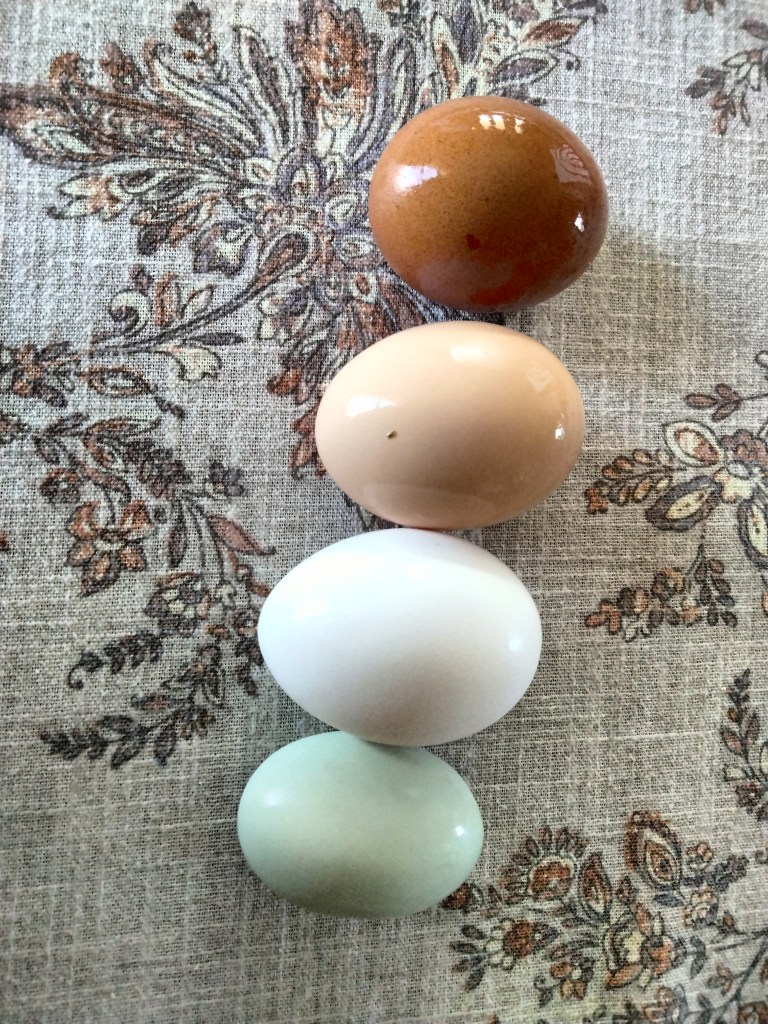
We now get up to seven a day, including blue from our Americauna, white from our Leghorn, pale brown from various ones, dark brown possibly from the Rhode Island Red, the occasional brown speckled one, and someone is laying pink.

Here is the basic wooden door pull that finally came off my son’s closet in our rented farmhouse. The closet is plywood or chipboard or something like that, hollow, and from repeated usage, this screw had stripped around itself and now just popped out whenever you tried to open the accordion door.

Here is the replacement, from my best bud, Hobby Lobby.
I love Hobby Lobby. It’s my source for knitting supplies, including wool and cotton yarns and needles; affordable canvases, acrylic paints, palettes and brushes for my (and my son’s) painting vice; model-railroad materials for whenever I need to build a model of Tenochtitlan; fabric for a Renfaire tent or a cave woman costume; and wood for those hippie woodburning projects, not to mention the usual scrapbooking supplies, gift wrap, stickers, and Christmas decorations.
Sadly, or perhaps happily, this post is not a paid promotion.
In addition to all this, Hobby Lobby has an impressive selection of themed shelf brackets, towel and key hooks, and drawer pulls, often in cast-iron. These are not just cutesy country style fixtures (though they do have that). You could put together a goth or steampunk or French Country or Log Cabin look for a room, easily, with the supplies found there.
Long story short, I walked into the Hobby Lobby variety-drawer-pull section, and within seconds I had found the beauty above. It was 50% off, so I think I paid about two bucks for it. In order to put it into the plywood door, I had to use a plastic drywall anchor.
The thing that made this find so serendipitous, though, was that the closet in question resides in the room of my rabbit-obsessed son. (Rabbits!) Additionally, said room has the following window valance:
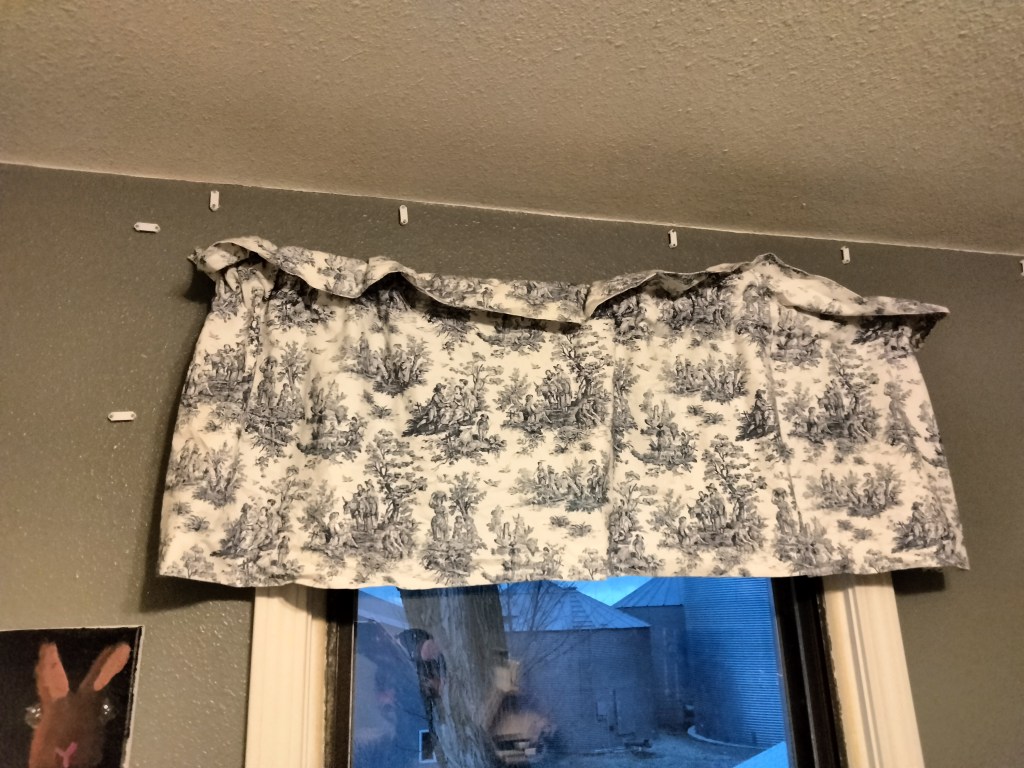
I mean.
The only downside is that, as I now notice in the picture, the rest of the door looks kind of bad by comparison.
The upside is that this post is now long enough to appear on a Friday and not on a Monday.
Stephen Renney was in his windowless office, eating a sandwich and drinking Fanta from a can. He sensed me standing in his doorway, looked up and then started making those slightly embarrassed, fidgety movements we all make when we’ve been caught eating alone. As though eating were some sort of not-quite-respectable indulgence instead of the most natural thing in the world.
“Sorry,” I said, giving the time-honoured response, and looking slightly embarrassed myself, as though I’d caught him on the loo.
“Not at all,” he responded, ridiculously forgiving me.
Sacrifice, by S.J. Bolton, p. 299


 Out of Babel Books