I'm a wife, mother, Christian, closet Luddite, Neanderthal advocate, incurable book hound.
I'm also the author of The Scattering Trilogy, which is set in 10,000 B.C. Buy, read, pass it on!
Leave comments. Let's talk!
In the last few years, quite a few actual headlines have sounded like jokes … but I think this one is the jokiest of all. In fact, I once saw a comic where a kid, dressed as the back half of a camel at a Nativity display, is “liberated” by PETA.
Him: I’m not really a camel.
PETA activist: Don’t tell me they’ve brainwashed you too!
Now that joke has become a reality.
“Animal-themed carousel sets reinforce the notion that these sentient beings are simply here for our entertainment, rather than individuals with the same capacity to experience fear, pain, joy, and love as any of us,” the letter added.
PETA President Ingrid Newkirk said in a press release, “Children learn through play, and teaching them to have respect and compassion for all living, feeling beings can help create a more just and merciful world.”
actually from this article
Right. Kids will never learn to love animals if they are allowed to interact with … portrayals of animals. They will never want to ride on or care for real horses if they are allowed to ride on artificial horses. We should remove all references to animals from their environment, and then they will become animal lovers.
I picked this up in the new-to-us section of the public library. This is a really well-chosen title, really lets you know what you are getting.
From the back:
If you’re struggling to stay on top of your to-do list, you probably have a good reason: anxiety, fatigue, depression, ADHD, or lack of support. For therapist KC Davis, the birth of her second child triggered a stress-mess cycle: the more behind she felt, the less motivated she was to start. …
Inside, you’ll learn to: See chores as a kindness to your future self, not a as rejection of your self-worth; Start by setting priorities; Stagger tasks so you won’t procrastinate; Clean in quick bursts within your existing daily routines; Use creative shortcuts to transform a room from messy to functional.
With KC’s help, your home will feel like a sanctuary again. It will become a place to rest, even when things aren’t finished.
I really wish that I had written this book, or that it had been written by Allie Beth Stuckey. This book, or a version of it, needs to be written by someone who understands human sin nature, grace, and the freedom that is found in Christ Jesus. It’s so, so close, but because of the author’s wokeness, there are jarring notes.
The Practical
To some, this book might sound as if it was written by a sloppy, disorganized person, to sloppy, disorganized people, to help them justify their sloppiness. On the contrary, it was written by a naturally distractible person, to distractible people, to help them achieve the level of organization that they actually want to, without letting the perfect become the enemy of the good.
KC went through rehab as a teenager. She has ADHD, is married with two small children, and is a therapist, which means that people talk to her about their frustrations with themselves and their inability to get their houses in order.
Consequently, the intended audience for this book is people who are responsible for keeping house, but have some major obstacle such as chronic pain, being in the midst of grieving, ADHD, depression, or having “issues” around cleaning due to the way they were raised … or all of the above. The goal is to help these people develop strategies to get over the mental (and sometimes physical) blocks so they can maintain their houses in basic livability. And I am there for it!
People in these situations might not have the time, energy, or attention span for a long book, so this little gem is written in short chapters, each of which gets right to the point. To accommodate people who might be very literal-minded (such as those on the autism spectrum), KC re-states all figurative language very literally. For example: “We are going to flex our motivation muscle” becomes “We are going to practice this skill until we get good at it.”
While I don’t believe that ADHD is a literal, physical brain disease, nor that it should be treated with drugs, I do believe that what we call ADHD is a good description of how some people’s minds, bodies, and sensory-processing work. And while I’ve never been diagnosed with ADHD (and have no desire to), their descriptions of how their minds work, and the strategies they use to get things done, usually sound so familiar and relatable that I find myself asking, “Doesn’t everyone experience that?” So, I could probably get a diagnosis if I wanted to. I just don’t think it would help me. I’m an older person and I’ve learned how to set up systems that work for me.
With that in mind, many of the aphorisms and strategies that KC presents here, are ones that I’ve come to myself, over years of keeping house, in season and out of season, through small children, international moves, unemployment, depression, the lot. Things like this:
“I have a responsibility to make sure my family always have clean clothes. I don’t have a responsibility to make sure that they never have dirty clothes.”
Any cleaning is better than no cleaning.
Better a less efficient method or system that you can actually do, than a perfect system that never gets done.
Doing “closing chores” the night before is a favor to your future self.
Most people don’t have a motivation problem (since they do actually want to be able to do the task and enjoy the clean result). Instead, they have a task-initiation problem.
And the like.
The Spiritual
Of course, there is not a firm frontier between the practical and the spiritual in our everyday lives. As Solzhenitsyn has said, the line between good and evil runs “through every human heart.” Which means that, even as we face mundane choices like do I do the dishes, the laundry, or take a nap, we are interacting with issues of bondage to sin versus freedom, and grace versus shame. So it’s not really possible to talk about practical things like task initiation without also addressing the spiritual.
KC does a pretty good job of this in her book. She starts out by saying (page 11), and this is in bold, “Care tasks are morally neutral. Being good or bad at them has nothing to do with being a good person, parent, man, woman, spouse, friend. Literally nothing. You are not a failure because you can’t keep up with laundry. Laundry is morally neutral.”
Now, since I can hear howls of objection, let me address this. What she is trying to express here, is that shame does not energize people. It paralyzes them.
Yes, moms do have a duty to keep on top of the laundry cycle and yes, (contra KC Davis), there IS such a thing as laziness, and laziness IS sinful.
But when it comes to “care tasks,” many people (most people?) grew up being shamed not for character flaws such as laziness, but for lack of technical skills in the tasks, for not doing them up to an adult’s standard, for not doing them perfectly, or for not knowing where to start. Consequently, many (most?) people have a huge burden of shame and failure around household tasks. And this burden of shame, and this perfectionism, makes it much, much more difficult to get these tasks accomplished (or in some cases even started). See? KC is not saying, “Let’s get rid of the shame because it is 100% OK to never clean your kitchen.” She is saying, “Let’s get rid of the shame associated with these tasks because only then will you be able to do them.”
In other words, KC in her self-examination and her work as a therapist has stumbled upon that biblical truth: “the law kills, but the Spirit gives life.” The only people who are free to act and move in this world are those who are not paralyzed by shame.
It’s at this point that I wish this book had been written by a Christian, because this point really deserves to be developed further. How does one set others free from shame? Certainly, if people have indeed been shamed over things that are morally neutral (such as being slow at doing chores, or doing the dishes a different way than your parent), then this needs to be clarified. But this is not enough, because not all our shame is spurious. We actually are sinners, and we actually do know it. It is not enough to say, as KC says, “I don’t think there is any such thing as laziness.” Even when we have gotten rid of the spurious shame over morally neutral things like being naturally untidy, even if your particular client is not actually lazy … what about the other shame? What are we going to do about that?
In other words, the only way that people can truly be set free from shame is when they turn to Jesus, the living Christ, who alone has the power to free us from shame, so that we can “do the good works that He prepared in advance for us to do.” I think Allie Beth Stuckey could do a lot with this. In fact, I’d love it if she were to have KC Davis on her podcast.
But then, she proceeds to shoot herself in the foot
The other problem I have with this book is as follows. For the most part, KC does a great job of being gentle with her readers and treating them like responsible human beings. But every so often, she turns around and sucker-punches them with identity politics.
Many self-help gurus overattribute their success to their own hard work without any regard to the physical, mental, or economic privileges they hold. You can see this when a thin, white, rich self-help influencer posts “Choose Joy” on her Instagram with a caption that tells us all joy is a choice. Her belief that the decision to be a positive person was the key to her joyful life reveals she really does not grasp just how much of her success is due to privileges beyond her control.
pp. 14 – 16
It’s hard to know where to start with this paragraph. Does KC really think that a “thin, rich, white influencer” posts “Choose Joy” because she is already joyful? That such people have no insecurities or struggles? That all that is necessary for joy is having circumstances line up in your life such that you avoid three major conditions which the Identity Crowd considers to be disadvantages? This is so dehumanizing as to beggar belief.
I’m not saying “Choose Joy” is advice that would be helpful to anyone, really, but I at least recognize that most people who say things like “Choose Joy” obviously mean “Choose joy in spite of all the awful things that are happening in your life.” If people are happy, at peace, and free from shame or struggle, they don’t go around saying stuff like “choose joy.” And based on the practical wisdom in the rest of her book, I think KC actually knows this. But, blinded by identity politics, she considers it OK to lay aside what she knows and take a swipe at some of her readers in a misguided attempt to build up others of her readers. Unfortunately, this undercuts her message that she doesn’t want to shame anyone. You see, this book is not for you if you are rich, thin, or especially, white. And as we know, those always go together.
In the very next paragraph, KC says what she was actually trying to say, but in a much more sane and humane way, namely that different things work for different people:
Different people struggle differently — and privilege isn’t the only difference. Someone might find a way to meal plan, or exercise, or organize their pantry that revolutionizes their life. But the solutions that work for them are highly dependent on only their unique barriers but also their strengths, personality, and interests.
p. 16
Really, that paragraph would have been sufficient, excepting the word privilege. I do wish people would stop using the word privilege — which is a legal term — when what they actually mean is “advantage.” But that’s a rant for another day.
All this while no supply [from England] was heard of, neither knew they [the Pilgrims] when they might expect any. So they began to think how they might raise as much corn as they could, and obtain a better crop than they had done, that they might not still thus languish in misery. At length, after much debate of things, the Governor (with the advice of the chiefest among them), gave way that they should set corn every man for his own particular, and in that regard trust to themselves; in all other things to go on in the general way as before. And so assigned to every family a parcel of land, according to the proportion of their number, for that end, only for present use (but made no division for inheritance) and ranged all boys and youth under some family. This had very good success, for it made all hands very industrious, so as much more corn was planted than otherwise would have been by any means the Governor or any other could use, and saved him a great deal of trouble, and gave far better content. The women now went willingly into the field, and took their little ones with them to set corn; which before would allege weakness and inability; whom to have compelled would have been thought great tyranny and oppression.
This experience that was had in this common course and condition, tried sundry years and that amongst godly and sober men, may well evince the vanity of that conceit of Plato’s and other ancients applauded by some of later times; that the taking away of property and bringing in community into a commonwealth would make them happy and flourishing; as if they were wiser than God. For this community (so far as it was) was found to breed much confusion and discontent and retard much employment that would have been to their benefit and comfort. For the young men, that were most able and fit for labour and sevice, did repine that they should spend their time and strength to work for other men’s wives and children without any recompense. The strong, or man of parts, had no more in division of victuals and clothes than he that was weak and not able to do a quarter the other could; this was thought injustice. The aged and graver men to be ranked and equalized in labours and victuals and clothes, etc., with the meaner and younger sort, thought it some indignity and disrespect unto them. And for men’s wives to be commanded to do service for other men, as dressing their meat, washing their clothes, etc., they deeemed it a kind of slavery, neither could many husbands well brook it.
Upon the point all being to have alike, and all to do alike, they thought themselves in like condition, and one as good as another; and so, if it did not cut off those relations that God hath set amongst men, yet it did at least much diminish and take off the mutual respects that should be preserved amongst them. And would have been worse if they had been men of another condition [i.e., character]. Let none object this is men’s corruption, and nothing to the course [of communism] itself. I answer, seeing all men have this corruption in them, God in His wisdom saw another course fitter for them.
William Bradford, Of Plymouth Plantation 1620 – 1647, pp. 132 – 134
First, I have to explain why we are doing this gimmick with gnomes and not some other creature.
My mom used to have this little pair of porcelain statues that she kept in her china cupboard. You may have seen this type of thing before. They were shaped like a little Dutch boy and girl in stylized traditional costume, and they were both leaning forward adorably with their eyes closed. You were supposed to position them facing each other so that they appeared to be kissing …. which, of course, Mom always did.
I didn’t think much of these figures when I was younger. I took them for granted, as one does. They were readily available in Holland, Michigan, near where we lived.
But this year, as I was reviewing Mary Harrington’s book and thinking about the Prov. 31 woman, it occurred to me that those little figures were teaching us a profound lesson. I thought I would like to photograph them for a blog post.
But alas, the Dutch boy and girl were either in storage, or lost.
The next step was to buy a similar pair of my own. It was around Thanksgiving, so I thought the home decor store might have such a set. Boy and girl Pilgrim? Boy and girl Indian?
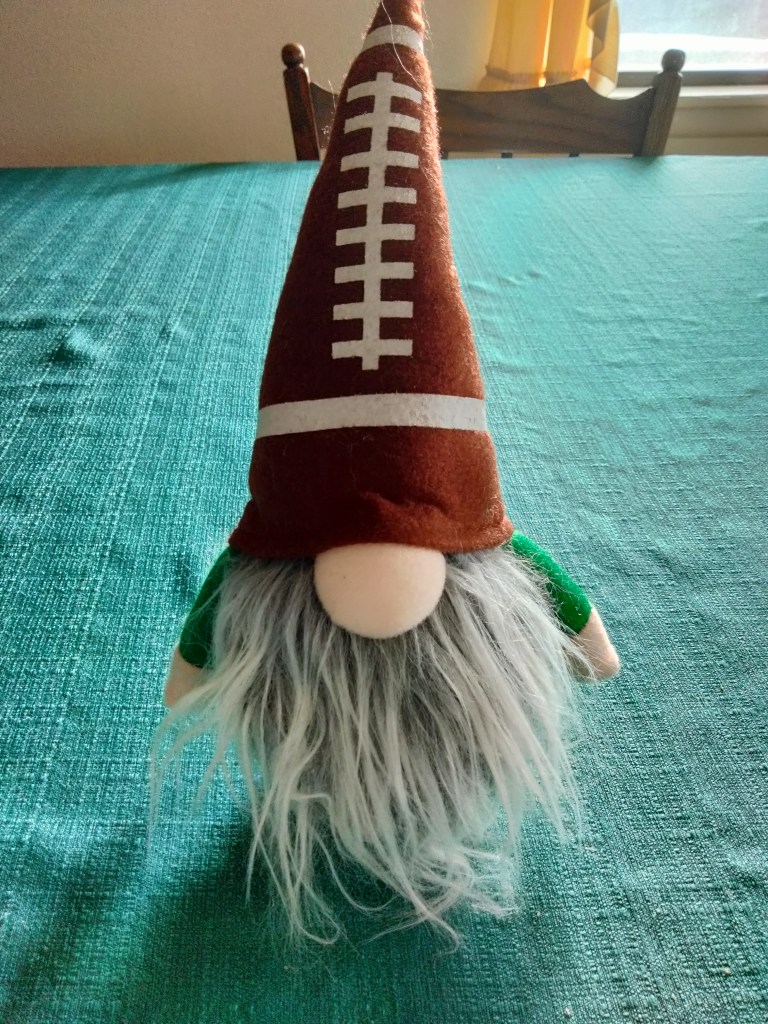
Long story short, the closest I could get was football-fan gnomes.
This isn’t a complete disaster. I like gnomes, and Mr. Mugrage and I are now football fans (though these gnomes are not wearing the colors of our sons’ team).
But anyway, if you find kissing boy-and-girl sculptures (especially Dutch ones), please send them to me. In the meantime, Mr. and Mrs. Gnome will do nicely for our illustration of a matching set.
You see … this is not patriarchy. A man by himself cannot be a patriarch.
And this … is not matriarchy. A woman by herself cannot be a matriarch.
You see, term “patriarch” OR “matriarch” implies the existence of a household. It implies that the “-arch” has had children and possibly grandchildren with a member of the opposite sex (hence the patr- or matr- part), to whom they are married, and with whom they are now ruling over this household (hence the -arch part), seeing that it prospers. This situation is simply not possible without either the mom or the dad. If the dad is a patriarch in the true sense of the term, then he has a matriarch beside him, and as the -arch implies, she is receiving just as much honor in her motherly role as is he in his fatherly one.
See, like this:
What those little kissing Dutch figures were trying to tell us is that patriarchs and matriarchs are a matching set.
Happy Valentine’s Day to all you gnomes out there!
Once upon a time, in the 1950s, dating just meant “going on a date.” It was a very short-term commitment, lasting only a few hours. You went out for ice cream or whatever, and then you went home. If you couldn’t stand the person, there was a natural limit to how long to you had to spend with them (the length of the date). If you liked each other, you might go on another date some time. But you were not bound to go on date after date with the same person. The idea was to go out with a variety of people, to get a sense of what sort of person might be for you. Eventually, you might “go steady” with a person you really liked, and maybe eventually get married.
But then … the Sexual Revolution happened. The expectation that a date might mean actually having sex was introduced. Suddenly, dating a variety of people made less sense. It clashed with the old-fashioned sexual mores (and with common sense) that said it wasn’t good to sleep around. Now, “going steady” with one person became the norm, and people who dated around were seen in a negative light. After all, if you were going to be sexually involved with somebody, it had better be with just one person at a time.
Futhermore, because this was a big societal shift, now nobody knew what the rules were. On the part of some of the drivers of the sexual revolution, this was intentional. They thought that society, rules, and norms as such were inherently oppressive, and that getting rid of all these things would usher in a hippie, free-love paradise. What it actually ushered in was total confusion. And while total confusion might work to the advantage of a few libertines who want to live completely unrestricted, it stresses out regular people (especially young people) who just want to know what they are supposed to do.
This confusion has persisted from my generation (X) down to the present day. It creates endless amounts of frustration, misunderstanding, and wheel-spinning as generation after generation struggles to re-invent the wheel. It also creates lots of tension and hostility between the sexes, because as it turns out, the way men naturally approach things and the way women do, do not mesh terribly well when completely unguided by any kind of norm.
The secondary car crash, caused by the train wreck
Christians, naturally, had their own reactions to all of this. We looked at modern dating, which could mean getting very sexually involved as a teen, cohabiting as a young adult, and so on, clapped our palms to our cheeks, and went “AAAAAG! This is not right!” Nor were we wrong. When I was growing up, in the 90s, the choice seemed to be between trying to do the highly risky methods of modern dating – but hopefully in such a way that you didn’t have sex before marriage, although that was kind of a crapshoot to be honest – or taking the sensible course and not dating at all. I, and many other Christians, went for the latter, but this left us without any path to get to know the opposite sex or find a suitable spouse.
Some Christian communities decided that the solution to all this confusion was “courtship” — or, as some called it, “biblical courtship.” One of the early advocates of this system was Douglas Wilson, a pastor and writer for whom I still have great deal of respect. Courtship seemed to a lot of people, myself included, like a godly alternative to the train wreck we were witnessing. Unfortunately, in an effort to avoid the train, the courtship car drove directly into the other ditch, into a wreck that was equally fiery. That’s what Thomas Umstattd Jr.’s book is about.
Components of Courtship
As older Gen Xers, my now-husband and I dodged a bullet on this one. We had both read some Douglas Wilson and we both saw the problems with modern dating since the 60s, and so when we met and realized we kinda liked each other, we wanted to do some kind of courtship. However, both of us were adults, out of the house, and living hundreds of miles away from our parents. I had gone to university, then lived with my parents again for a year while working so I could go to missions school. My husband, almost a decade older, had been to university, grad school, and had lived in various countries overseas. So, we were fully launched. Still, we tried to “court.” My husband e-mailed my dad (yes, e-mailed) and asked for permission to date me. I called my dad and said, “Aren’t you going to ask me what I think?” and he said, “Well, I assume you like him?”
In our case, “courtship” ended up meaning little more than meeting each other’s parents, getting to know them, and showing them honor as we prepared for marriage. And that’s certainly not a bad thing. But it’s very different from how it was implemented in some Christian communities, where the parents were hard-core.
When I write about courtship online, defining courtship often becomes the most controversial point in the comments. I believe that the lack of clear definition may be contributing to the crisis.
Each community feels that its form of courtship is superior to the others. Many feel that any problem pointed out in Modern Courtship as a whole doesn’t apply to them.
Umstattd, p. 53
As such, Umstattd describes courtship with a list of common characteristics:
Modern Courtship is exclusive (only court one person at a time – not like 1950s dating)
Courtship is explicitly “for the purpose of marriage.” “This kind of thinking leads to unintended consequences. Offering to take a girl out for ice cream is tantamount to asking for her hand in marriage. Awkward!” (p. 54)
Courtship requires parental approval. “Modern Courtship gives parents the right to veto any relationship. In essence, they have only a very definitive no vote. The more people in the relationship with a no button in front of them, the higher the likelihood that one of them will press it. The result is that fewer people get married.” (p. 56 – 57)
Courtship requires high accountability. “The courtship trend of high accountability at the beginning of the relationship and lower accountability as the couple moves towards marriage is exactly backward. First dates are awkward enough without a third wheel sitting there not talking — or worse, not shutting up.” (p. 58)
Courtship comes packed with purity rules. “‘The problem,’ [one man] said, ‘was that we were so accountable, we never had a moment to get to know each other. Sure, we didn’t have physical temptation, but we also didn’t have quality social interaction. After we got married, I felt like I’d married a stranger.'” (p. 59)
Courtship is intentional and intense. “Greater intensity leads to greater awkwardness. There is a lot to be said for slowing down and reducing the intensity.” (p. 62)
Courtship requires marital readiness. Most people do not feel ready to get married when they are young. They worry about finances, or about finding or being the perfect person. But a good model is to get married young. Most people will never feel ready.
These bullet points are taken from pages 53 to 64 of the book.
Uh oh, we turned the dial the wrong way!
Getting too serious too soon is a problem that Modern Dating and Modern Courtship share. Both of these systems result in singles going through one committed, heartbreaking relationship after another. They differ only in frequency and style of intensity. Modern Dating is more physically intense, while Modern Courtship of often more emotionally intense. Going steady too soon is one of the leading causes of unnecessary heartbreak for young people.
ibid, p. 88
In other words, the courtship crowd, in an effort to fix the inappropriate sexual involvement of modern dating, turned the dial in exactly the wrong direction: in the direction of more intensity, not less! This leads to more heartbreak, not less. That, if I had to sum it up, is the thesis of this book.
Umstattd goes into some detail about additional problems, one of which is the enormous amount of leverage that the courtship system gives to overprotective dads. The result is young men who are never allowed even to take a young woman out for coffee, and consequently feel like failures, and young women who feel unattractive, unaware that there are many young men who would like to date her, but her dad has been screening them out without even telling her.
How to date like a normal person
The [Christian] Baby Boomers created the rules of courtship out of fear. They wanted to protect their children from the mistakes they made during the Sexual Revolution and its aftermath. The rules came from good intentions.
During the 1990s and early 2000s, millions of young people embraced the tenets of courtship in part or in whole. And it’s no wonder why — in a culture where we demonized dating, and divorce ran rampant, Modern Courtship seemed like the only alternative.
Many of those young people are still single today, but they don’t have to be.
If you’re one of the millions of frustrated singles, there’s hope for you: there’s an easier path to marriage that’s more fun and still honors God.
If we want to get back to the marriage rates of our grandparents, we need to learn from them and adopt their approach. It’s my hope that the Traditional Dating practiced by our grandparents will be part of the solution to resolving the Courtship Crisis.
Umstattd, p. 68
In other words, according to Umstattd, the way to date like a normal person is to date the way your grandmother (or maybe now, great-grandmother) would have: don’t go out with the same fellow twice, and be home by ten.
I really wish this had been the system when I was growing up. Courtship wasn’t really a thing in my circles, so we were left, as I said, with Sexual Revolution or Nothing. Or Make It Up As You Go. Consequently, although not scarred by purity culture or courtship, I was one of those women who felt unwanted and never got asked out … and was afraid to say yes on the rare occasions when I was.
I would like my kids to be able to enjoy the practice of Traditional Dating. However, there’s a problem. Traditional Dating, like any society- or community-wide custom, depends upon everybody knowing the rules. Everybody does not know the rules. In my observation, most Zoomers still have the expectation that once a boy and girl go out or hang out once, they are “a couple” until further notice (whether that means they are sexually involved or not), and would have to “break up” if they wanted to go out with someone else. I’d like to take this pressure off our kids. But, as with so many cultural rebuilding tasks, it looks as if we are going to have to do this the hard way. Which means doing it on a case-by-case basis, with parents of Christian young people talking to one another about norms and expectations.
I would really love it if the parents of all the young women my sons know would read this book.
One Last Disclaimer
A major goal of the courtship trend, as well as purity culture (“guard your heart!”) was to avoid heartbreak. And yes, there is a large amount of totally unnecessary heartbreak that the sexual revolution had brought to those who faithfully practices its tenets. (Idols always devour their worshippers.) I absolutely agree that it ought to be possible to live in this world without throwing your heart and body out into the arena, going out and collecting heartbreak after heartbreak, trauma after frustrating and degrading trauma.
However, that doesn’t mean that it’s possible to go from being a kid to being a married adult without ever getting your heart broke.
Being a teenager is rough in every society. You feel things more intensely. Finding a wife or husband is a challenge in every society. Most people are going to have some near misses.
In other words, no system, certainly not courtship but also not Traditional Dating, guarantees protection from living in a fallen world. And no system, however wise, guarantees every person a smooth, easy path to marriage.
When applying Scripture, particularly the Old Testament, we have to differentiate between biblical practice, principle, and command. Just because Jacob had two wives and a seven-year engagement doesn’t mean that God wants all men to have two wives and seven-year engagements.
What we have in the Old Testament are a lot of stories: each one different from the others.
Sometimes a woman is the protagonist in a romance (such as Ruth with Boaz) and at other times the man takes the lead (like Jacob with Rachel). There are arranged marriages (Isaac and Rebekah) and women who entered marriage through a harem (David and Abigail, Michal, and Bathsheba). Some women even chose their own husbands (Zelophehad’s daughters).
The Bible is surprisingly quiet when it comes to laying out a system of courtship. In fact, Jesus even qualified the Old Testament marriage laws when He said the divorce code was written because of the hardness of Israel’s hearts (Matt. 19:8).
The Apostle Paul, who is usually very direct, speaks with all kinds of qualifiers when talking about romantic relationships. He makes a special point to say that not all of his instructions are from the Lord in I Corinthians 7:25 – 28. I can’t think of another topic where Paul is this cautious with his words.
Could it be that God expects courtship systems to reflect the culture of the folks getting married?
What we need is a system to help young people make good decisions.








 Out of Babel Books