I'm a wife, mother, Christian, closet Luddite, Neanderthal advocate, incurable book hound.
I'm also the author of The Scattering Trilogy, which is set in 10,000 B.C. Buy, read, pass it on!
Leave comments. Let's talk!
the elaborate plan (This is going to be a character from Doors.)
some of the many results
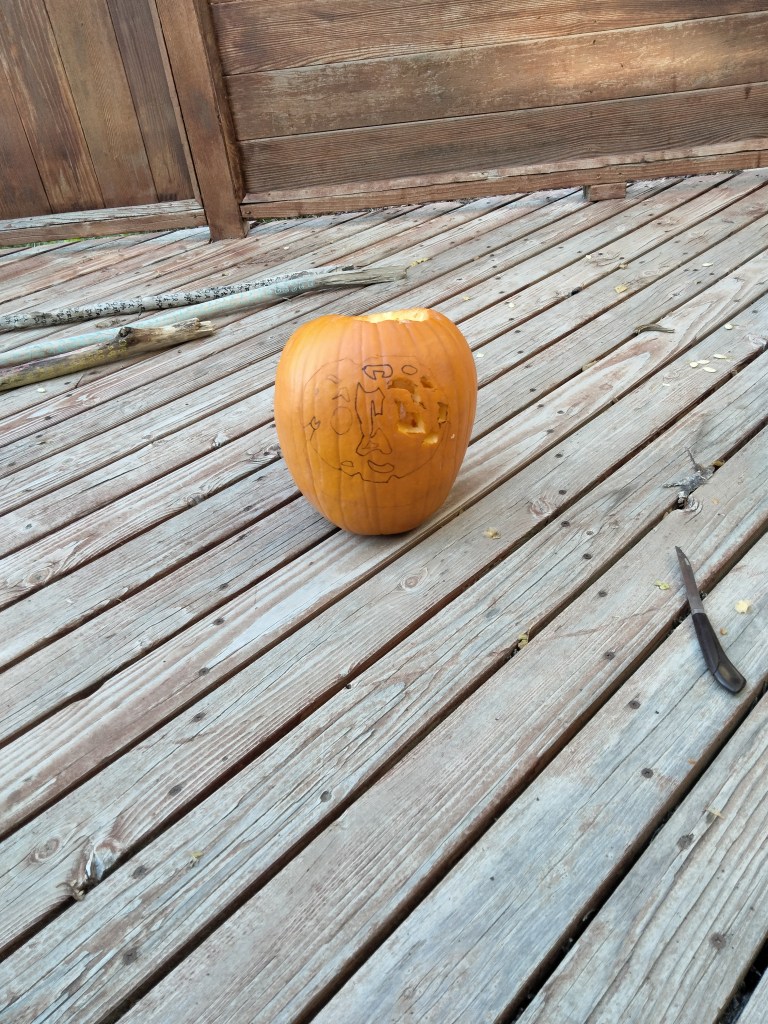
My son keeps asking me to buy more pumpkins cause he keeps getting more ideas. I don’t mind; pumpkins are cheap this time of year. Jack o’lanterns are no longer a measure to keep evil spirits away. (We don’t need that; we have Christ!) They are now a whimsical autumn art form. My son is an artist and I can’t restrain him from doing artist things.
Tenochtitlan was the capital of the Aztec Empire. (We call them Aztecs after the legendary land from which they said they had come; they called themselves the Mexica, so as you can see, all of Mexico is named for their empire.)
The city was built out in a shallow, semi-salt and semi-fresh lake, Lake Texcoco. It was reached by large stone causeways which had forts guarding them and had gaps in them where bridges could be lifted to repel invaders. The city itself was honeycombed with canals. It had four residential quarters and a large central plaza where all the main temples were. Buildings tended to have flat roofs.
When I read Cortez and the Aztec Conquesta while back, I found out that, as you might expect, the geography of Tenochtitlan played a huge role in all that went down there. The Spanish were first welcomed (uneasily) into the city. They later got trapped there and had to fight their way out, with catastrophic casualties, when things went wrong. When they returned, fortified with Tlaxcala Indians and additional Spaniards, they spent months building a fleet of boats and then capturing the towns that ringed Lake Texcoco to use as bases. Even then, they had to besiege the city for 50 days. Even then, the construction of the city was so useful for street fighting that the Spaniards and Tlaxcalans eventually had to literally tear down the buildings in order to take the city.
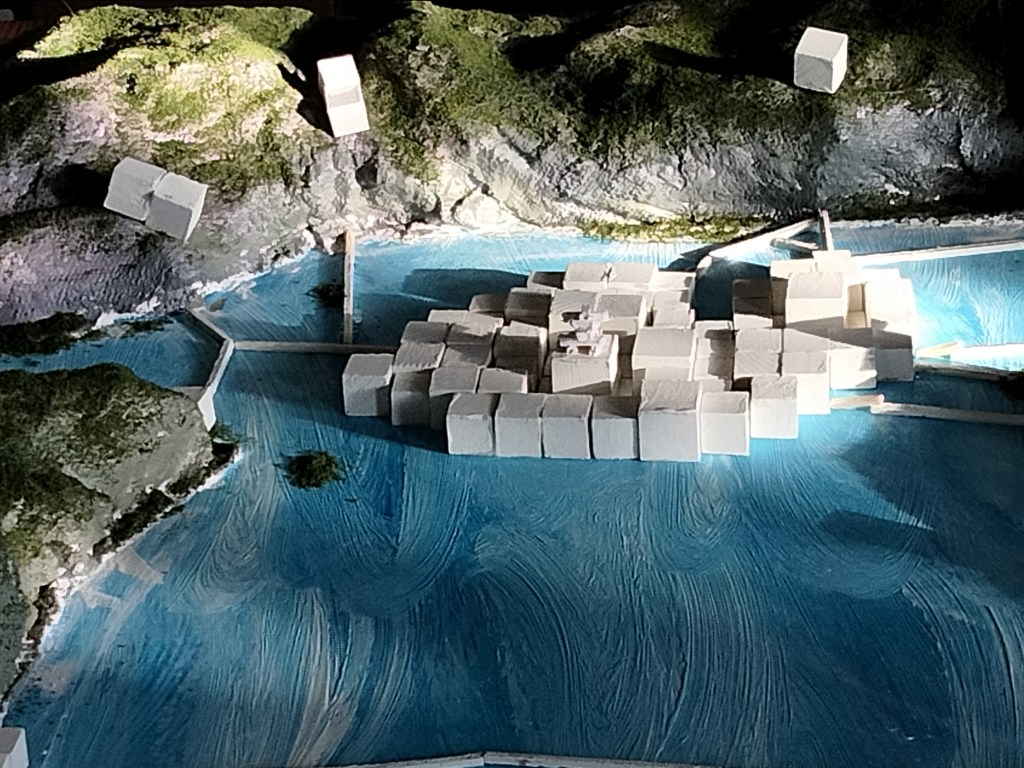
It’s funny how a person’s most eccentric interests sometimes come in useful. This year, I was given the task of teaching the period of about 1400 – 1800 A.D. to young minds. When we came to the part about Cortez, I thought it would be useful to have a model of the city. I thought I could use model-train materials to build it. For sources on how the city layout looked, I drew on Cortez and the Aztec Conquest by Irwin R. Blacker, The Aztecs by Brian M. Fagan, and maps I found on Pinterest. There is not perfect agreement among all sources about the exact location of the different villages and causeways, and there were far more settlements in the hills surrounding the city than I will be able to show. I also had to leave out some causeways for the sake of simplicity.
So, here goes:
I took a wooden display board (actually meant to bear an inspirational slogan) and painted in Lake Texcoco.
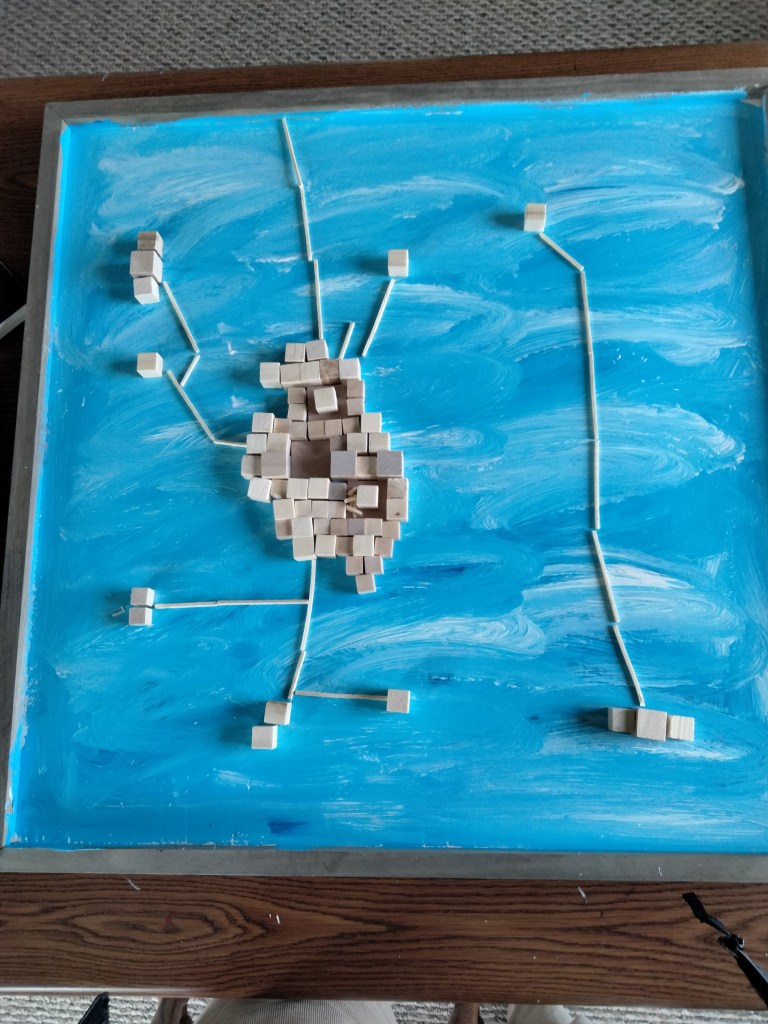
Then I set out the variously-sized wooden blocks, slabs, and matchsticks I had purchased at the hobby store, planning where the city, towns, and causeways would go.
Based on this plan, I was then able to add the “land.” The first step was crumbled packing paper, masking taped down.
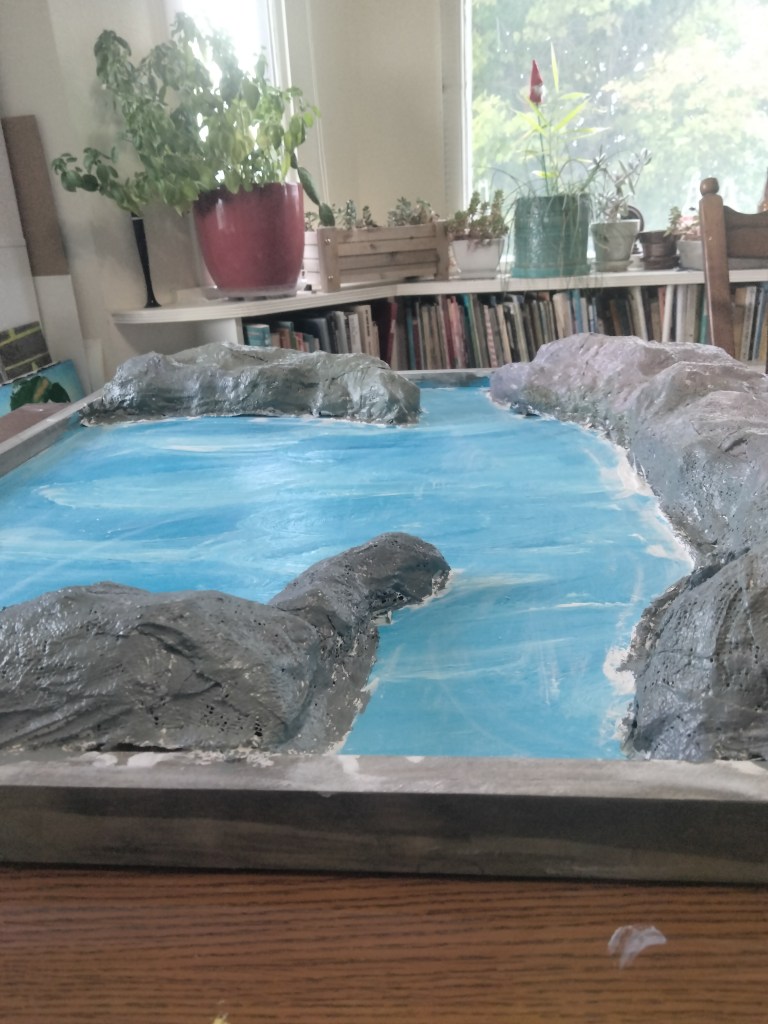
Then, paper-mache strips that can be dipped in water and smoothed down to make the hills.
I then painted the hills. I had to mix colors several times, so some of the hills are more greenish and some more greyish. That’s not a huge problem because I have “jungle” greenery to add, and also, the area is somewhat arid.
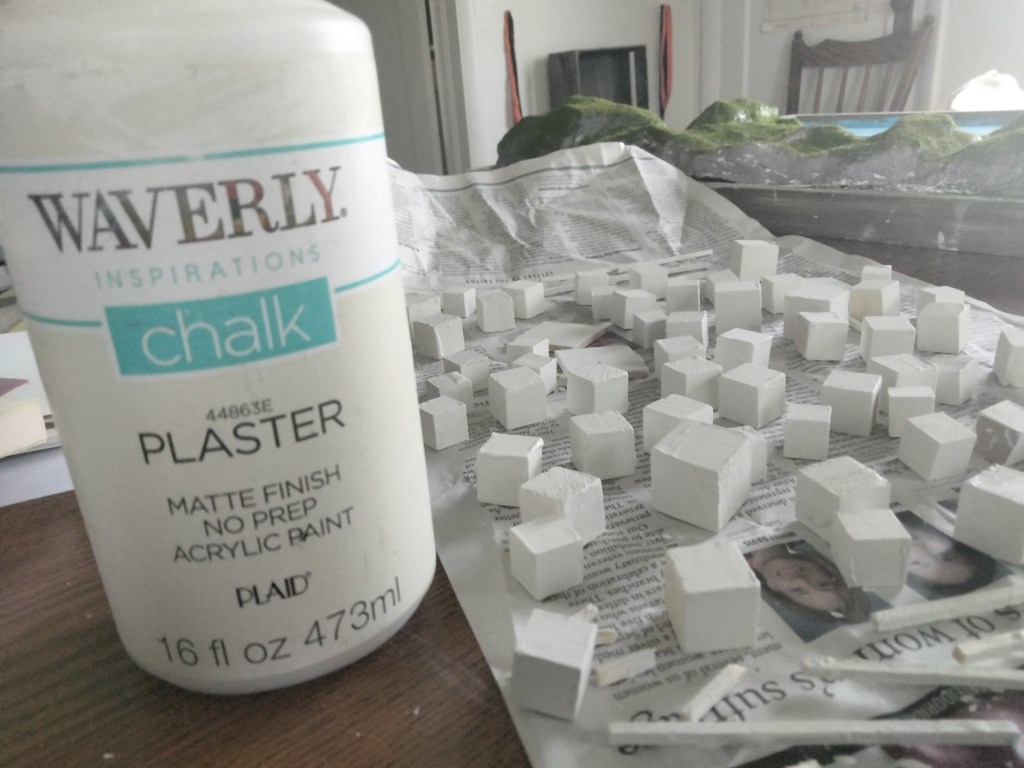
Meanwhile, I painted the blocks white. Actually, the city was probably very colorful, but I am going for a basic look. White represents stone. If desired, I can add color to the temple area over the following years.
Then it was time for the fun part: the hobby store sells “greenery” in a shaker can. I painted glue onto the hills and shook the greenery on. It sticks amazingly well. Let dry, then vacuum up the extra.
Now I placed the city and towns and glued them down, then added additional glue and greenery to make “islands.”
The city is actually two cities: Tenochtitlan, and Tlatelolco slightly to the north and west. I have given each city its own central plaza with a temple in it. The “temples” in my model are actually way too big relative to the size of the city, but this model is not meant to be perfectly to scale.
Final step: photograph in slanting sunlight.
Epic!
In days ahead, I plan to add a compass rose out in the lake and fancy title on the side, but for now, this ain’t bad.
But the safety of the people of America against dangers from foreign force depends not only on their forebearing to give just causes of war to other nations, but on their placing and continuing themselves in such a situation as not to invite hostility or insult; for it need not be observed that there are pretended as well as just causes of war.
It is too true, however disgraceful it may be to human nature, that nations in general will make war whenever they have a prospect of getting any thing by it; nay, absolute monarchs will often make war when their nations are to get nothing by it, but for purposes and objects merely personal, such as a thirst for military glory, revenge for personal affronts, ambition, or private compacts to aggrandize and support their particular families or partisans.
Turns out, “uncovering your father’s nakedness” isn’t quite as bad you suspected … but it’s still pretty bad.
Also, lots of interesting stuff about other aspects of worldview in the ancient world, including that hair was seen as a genital structure by first-century Greek scientists, which is probably the explanation for why women were supposed to cover their hair in public (particularly in church) and men to wear theirs short.
This is their first trip outside in the grazer after being in the garage under the red heat lamp. As you can see, their main concern is to drink water.
After the Great Chicken Massacre of 2023, we waited impatiently until we could buy more chickens at the farm store. This time, we bought one of each kind of layer they had. With these seven, plus Jane Wayne, our run will be full up.
If they all survive to adulthood, we will have …
Henrietta (the Americauna – dark stripe down her back)
Mesa Falls is located up in the northeastern area of Idaho. If you head due east from there, you’ll find yourself crossing the border into Wyoming and into Yellowstone National Park. It’s also near popular campsite Island Park, as well as near lots of hunting and fly fishing, well-positioned to attract people who are enjoying all the beauties of the region.
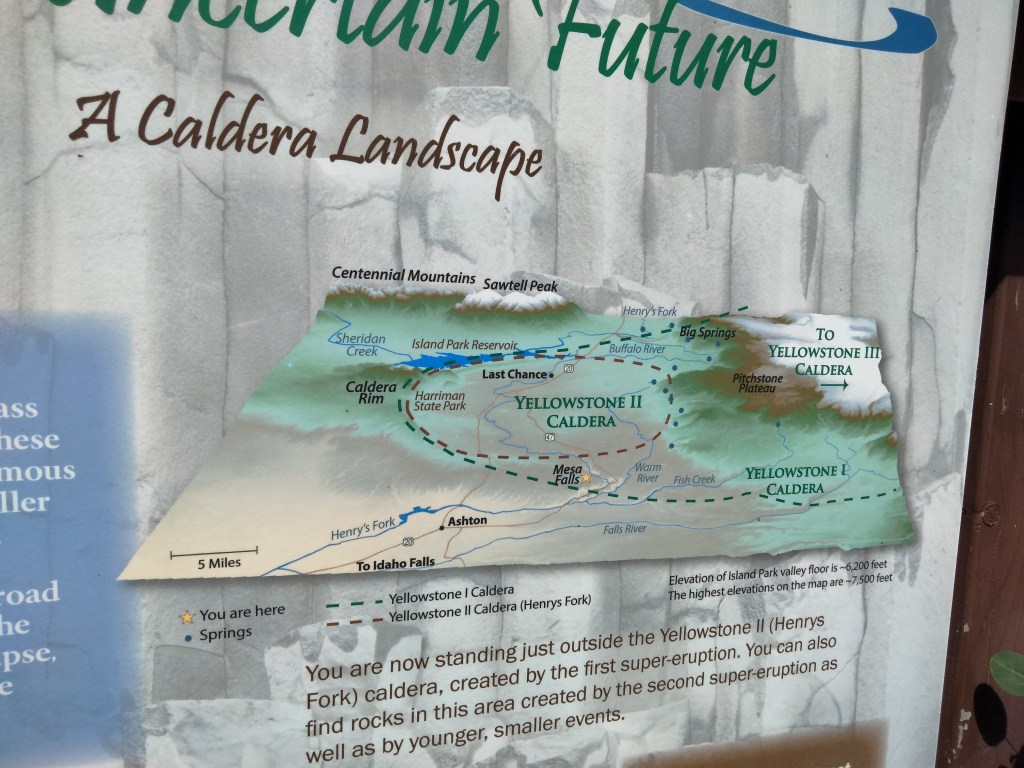
As you can see from the map above, Mesa Falls lies in part of an old caldera. The earth’s crust has moved, putting the fresh caldera under Yellowstone National Park. Hence the geysers that can be found in Yellowstone, and the eerie, sulfur-scented, brightly colored, deadly hot springs (which incidentally play a cameo role in my book The Strange Land).
This summer, I went up to Ashton, Idaho for a writing retreat. (What was I writing? That is for me to know and for you to find out!) Ashton is a relatively small, relatively remote town, but it’s touristy because of its proximity to hunting, fishing, and the Yellowstone area. I stayed in a mom ‘n’ pop motel consisting of camping cabins that have been there for ages.
On the way back from Ashton to my home stompin’ grounds, it would have made sense for me just to get on the highway and go south. But my husband has hike radar, which lets him know whenever he is within twelve hours’ drive of a good hike. This radar also works remotely, when someone he knows is in range of a good hike. So he let me know that I should go north instead, view Mesa Falls, and then head back. As it was a Sunday afternoon, I did so.
Mesa Falls is on a forest service road or something like that, so my paper map actually showed the road ending well before I got there. Thankfully, in real life it continued.
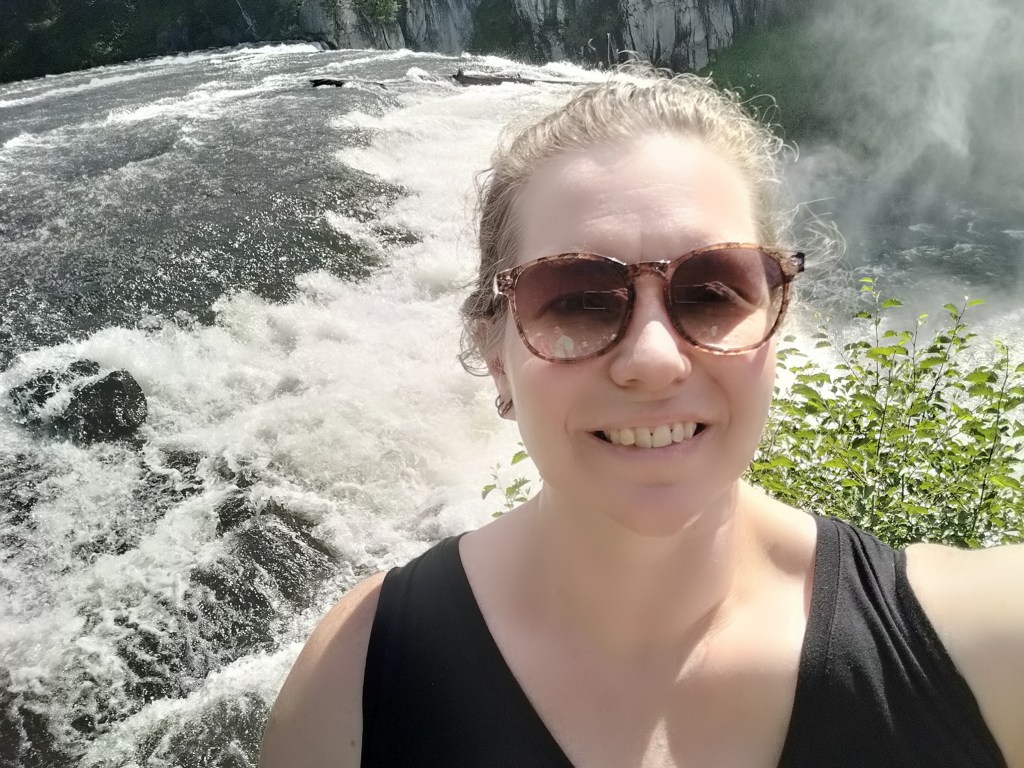
Here is proof I was there.
The hike was not at all demanding. There’s a capacious parking lot ($5 entry, envelope system), and then a series of well-maintained steps and boardwalks that bring you down to the very top of the falls, with many specially designed niches for selfies.
I did not bother to photograph the other falls-goers, but place was packed.
Now I’ll post some short videos I took of the falls.
The cliff opposite the falls was lush and green due to the permanent plume of mist that hits it.
“I knew something like this was going to happen,” said Nellie.
Nellie always knew what was going to happen. She’d see someone trip on the sidewalk, two cars crash at an intersection, lightning hit a rooftop, and shake her head.
“I knew that was going to happen.”
During what experts call the “magic years” of childhood, when children believe in impossible behaviors and events, Jane truly thought her mother had special powers. As Jane grew into the less magical years, she grew slightly more judgmental.
“If you knew it was going to happen, Mom, why didn’t you stop it?”
Nellie shrugged. Her powers could not be explained.
Having a “life verse” used to be a thing in evangelical Christian culture.
I once knew this guy who was interested in dating this girl. He was kind of a new Christian, and she wasn’t 100% sure he was sincere, because guys have been known to fake spirituality in order to get the girl. So she kept grilling him, trying to figure it out. And one question she asked him was, “What is your life verse?”
So if you thought the title of this blog post sounded like a pickup line, you weren’t entirely wrong.
I don’t actually know whether life verses have faded away as a practice, or whether they are still a thing that gets talked about, but I have just moved into denominational circles that are less silly.
Why do I say silly? Not because picking a “life verse” involves meditating intensely on a passage from the Bible. The Word of God is certainly powerful and active and worth returning to as a theme (provided we are actually responding to what the verse actually says, not just to a meaning that we project onto it). Anyone who makes a regular practice of prayerfully reading their Bible has had the experience where a verse, or a passage, seems to pop off the page and hit you between the eyes like a two-by-four. And then you spend several weeks or months revisiting that verse, turning it back and forth in your mind like a huge jewel with many facets, internalizing it, wondering why you didn’t notice it before.
No, the reason I think the idea of a “life verse” is kind of stupid, is that it’s too restrictive. You are going to limit yourself to just one two-by-four verse? Why? The Bible is full of two-by-fours just waiting to whack you. It can happen every few months, or once a year, but definitely there is a going to be a different theme verse for every season in your life.
And if we are talking about a verse that describes your particular experience of life, that might exist, but it’s hard to imagine you how you could pick it as a 20-year-old. Sounds more like the kind of thing that is awarded retroactively, maybe by your biographer.
For example, after several decades of experience, I think my life verse might just be II Corinthians 12:11: “I have made a fool of myself, but you drove me to it.”
I think that would look great on my tombstone. Although, the “you drove me to it” part is debatable.
Anyway. As faithful Out of Babelites are aware, I spent part of last year further educating myself on Gnostic and Hermetic philosophy. Partly as a result of this, I’ve been steeping in the book of Colossians, which is almost entirely about Hermetic and Gnostic beliefs and cults, and how they are not the Gospel once delivered to the saints. Paul was worried about Colossians, who in his absence might be confused by one of the Hermetic “teachers” who were so numerous in the Mediterranean world in the first century. If you want to know whether Gnositc/Hermetic teaching is really the same as what Jesus taught, just in different words, please read Colossians.
So, one of my two-by-four verses this year is this:
Such regulations indeed have an appearance of wisdom, with their self-imposed worship, their false humility and their harsh treatment of the body, but they lack any value in restraining sensual indulgence.
Colossians 2:23
Especially in my youth, I was easily impressed by ascetic and mystical claims and practices. How could these things be bad? They have an appearance of wisdom. “Such regulations” could be found in yoga, Mormonism, Islam, legalistic/Hebrew-roots sects of Christianity, or modern environmental Gnosticism where we save ourselves by education, sensitivity training and clean living.
Now I know: such regulations lack any value in restraining sensual indulgence. They do not give people power to resist sin. That explains why every ascetic cult seems to generate its own sex scandals. It explains why we can expect such scandals from such quarters, even when they have not yet come to light.
So anyway, that’s my life verse for now. Patiently waiting to be clocked by the next two-by-four.












 Out of Babel Books