I'm a wife, mother, Christian, closet Luddite, Neanderthal advocate, incurable book hound.
I'm also the author of The Scattering Trilogy, which is set in 10,000 B.C. Buy, read, pass it on!
Leave comments. Let's talk!
How long will you love worthlessness and seek falsehood? Selah.
But know that the LORD has set apart for Himself him who is godly;
The LORD will hear when I call to Him.
Be angry, and do not sin.
Meditate within your heart on your bed, and be still. Selah.
Offer the sacrifices of righteousness,
And put your trust in the LORD.
There are many who say, “Who will show us any good?”
LORD, lift up the light of your countenance upon us.
You have put gladness in my heart,
More than in the season that their grain and wine increased.
I will both lie down in peace, and sleep;
For You alone, O LORD, make me dwell in safety.
Psalm 4. By David.
So.
My dad used to quote me the last verse of this psalm as a bedtime prayer when I was small.
The classical Christian school where I teach had selected this psalm for memory work for the month of October.
And then …
We hear of atrocities in Israel, committed against Israelites. Every single verse of this psalm, written by David millennia ago, instantly becomes 100 times more relevant and poignant.
When I hear about mothers and babies murdered, reading that last verse out loud is almost more than I can handle.
Rhoda’s fete had passed off in the manner of fetes. Violent anxiety about the weather which in the early morning appeared capricious in the extreme. Considerable argument as to whether any stalls should be set up in the open, or whether everything should take place in the long barn and the marquee. Various passionate local disputes regarding tea arrangements, produce stalls, et cetera. Tactful settlement of same by Rhoda. Periodical escapes of Rhoda’s delightful but undisciplined dogs who were supposed to be incarcerated in the house, owing to doubts as to their behavior on this great occasion. Doubts fully justified! Arrival of pleasant but vague starlet in a profusion of pale fur, to open the fete, which she did very charmingly, adding a few moving words about the plight of refugees which puzzled everybody, since the object of the fete was the restoration of the church tower. Enormous success of the bottle stall. The usual difficulties about change. Pandemonium at teatime when every patron wanted to invade the marquee and partake of it simultaneously.
There have been a number of proposed sites for Atlantis. Graham Hancock has proposed Antarctica,North America, and probably some other places that I don’t know about. I’ve also heard rumors that the sunken continent could be in the Bahamas area and could explain the Bermuda Triangle phenomenon. The Disney movie Atlantis locates it off the coast of Iceland, and I have also heard people advocate the Eye of the Sahara in Mauritania. (The idea being that, before continental uplift, this site was closer to the coast, and it could have been inundated by a tsunami or something like that.) Well, the article above makes what strikes me as the most likely proposal yet.
The super-island of the Cyclades Plateau (Plato’s Atlantis) was drowned by the sea at around 8000 BC, during the rapid rise of the Mediterranean and just prior to the flooding of the Black Sea (see UNESCO study, 2009.) Incidentally, around this time, Lake Agassiz, a gigantic glacial lake in North America, also burst open and began to drain into the Atlantic. It is worth noting that Lake Agassiz covered an area larger than all the Great Lakes combined (440,000 Km 2) and at times, it contained more fresh water than all the lakes in the world today. The total fresh water outflow from this lake alone was so immense, scientists believe it raised the oceans worldwide by as much as nine feet and further produced the 8.2 kilo-year event that followed, a mini ice age that lasted 400 years! This global cataclysm at the end of the last Ice Age, which ultimately raised sea levels by 400 feet, not only erased our early history, but this could also be the event we all inadvertently refer to as the “Great Flood.”
ibid
Proposing the Cyclades Plateau as the site of Atlantis ties its inundation to a known rise in sea levels that happened right around the date that Plato says Atlantis was submerged. The article shows maps of what the plateau would have looked like and how it roughly matches Plato’s description of Atlantis (though the scale is slightly off). Of course, in my integrated version of ancient history, it went like this:
Pangea
Continental Sprint, involving cataclysmic earthquakes and also tsunamis. This is the Great Flood
A cold, rainy period after the Flood, leading to the Ice Age, which meant lower sea levels, coinciding with human dispersion across the newly shaped continents
As the Ice Age ended, we get sea levels rising and large but not worldwide local floods like those described above.
The article also suggests that this civilization was part of a larger pan-Mediterranean civilization:
Finally, a 10,000 year old Mediterranean civilization, may help explain more archaeological oddities in this region. Recent erosion and seismic tests at the Giza Plateau, indicated that the Great Sphinx may be much older structure than previously thought, and along with the site of Gobekli Tepe in Turkey, both seem to coincide with Plato’s story of Atlantis. Is it possible that Gobekli Tepe and the monument of The Great Sphinx could be remnants of the same advanced civilization Plato referenced in his story, one that was aggressively advancing against its neighbors in Africa and the Middle East, or do those belong to another culture? And what about the advanced proto-Euphratean people who descended upon the Mesopotamia around 7000 BC, from a region “unknown.” Could these enigmatic people be the refugees of the same culture who fled the Mediterranean basin and moved eastwards to escape the inundation? Undoubtedly, they could have brought with them the story of the great flood as well as the skills and technology to incite yet another great civilization, like that of ancient Sumer (just as the survivors around the Cyclades and neighboring islands may have ultimately contributed to the rise of the Minoans).
ibid
This sort of thing is catnip to me.
Finally, for the reconstructive geneticsnerds among us (raises hand), the article offers bonus evidence that the residents of this Aegean Atlantis may have island-hopped their way to North America, which would explain why Haplogroup X is concentrated most heavily in the eastern Mediterranean and around the Great Lakes. (Bonus: the Great Lakes area was also the source of a particular type of copper that was used in the Mediterranean during the Bronze Age.)
I enjoyed this movie more than I expected to. I thought it was going to be some kind of mystical journey with a guru or something. Instead, it’s a pretty good story reminiscent of those found in The Arabian Nights.
I don’t recommend you watch it necessarily, because there are a lot of scenes with naked people. Including multiple scenes with multiple obese naked people in a room covered with fur. (Yes, strange. And disgusting. It was the Ottoman Empire, what can I say?)
So given that you will probably not be watching it, I won’t worry about spoilers.
The Summary
Alithea is a “narratologist” (story expert) who travels to Istanbul for a conference. While in front of an audience, she keeps seeing a frightening, oversized, deadly white guy dressed as, maybe, an ancient Babylonian. This vision opens its mouth and appears to swallow her, and she passes out. Now, maybe I wasn’t paying very good attention, but it seems to me that this scary guy is a plot hole that never gets explained. He shows up in the background in some scenes later in the story, but it is never brought out what, if anything, is his relationship to the main action of the story. Ditto the odd dwarf character with the tall, Nephilim-like head who tries to take Alithea’s suitcase in the Istanbul airport.
Anyway, it’s after this that the main story begins. In a Turkish junk shop, Alithea buys a little blown-glass bottle that has been somewhat deformed at some point by a fire. She takes it back to her hotel room, starts scrubbing it, and out comes a djinn (Idris Elba). At first, Alithea and the djinn can’t communicate, but she finds that she can speak to him in Greek, and after a few moments of watching TV, he picks up on English. He tells her that she gets three wishes, but as a story expert, she knows that every single story involving three wishes is a cautionary tale, so her response is something along the lines of “no way.”
Then the djinn starts to tell his own story, which spans three thousand years. He has had three episodes of being imprisoned in various small vessels. Apparently, he was originally a free djinn, and was in love with the queen of Sheba (incidentally also his cousin – cue nakedness). When Solomon, who in this version of the story was the supplicant, shows up and woos the queen, the djinn’s heart is broken, and Solomon, “a powerful wizard,” imprisons him for the first time.
The first person to release him is a slave girl who’s in love with a prince. She wishes for the prince to fall in love with her, and then to become pregnant by him. Unfortunately, she gets caught up in palace politics, and when the prince falls out of favor, she is killed before she can make her third wish.
The second attempted escape, and imprisonment, is the one featuring the fat people in the sable room. It’s sad and grotesque, but has no love interest for the djinn.
In the third go-round, the djinn is released by a plain but intelligent young woman who is the third wife of a rich man and is essentially a prisoner. (No nudity, but horrifying brief sex scenes with her aged husband.) This young lady uses her first two wishes to learn “all the knowledge in the world” (she and djinn are shown studying together) and to become a formidable scientist. This is where we learn that the djinn is made of electromagnetic particles: “You are made of dust. I am made of subtle fire.” He falls in love with her mind, and tries to prevent her making her third wish so that he can stay with her forever. Feeling controlled, she accidentally traps him in the glass bottle with her third wish.
By the time the narratologist has heard these moving stories, she is ready to make a wish. She wishes to experience that kind of world-without-end love … with the djinn.
C’mon … Really?
At this point the cynic in me wakes up and says, Lady, has it occurred to you that this very large magical dude is telling you these sad stories in order to elicit precisely that wish? He’s lived through millennia having a once-in-a-lifetime love with one human woman after another. The man is an interdimensional slut.
However, the writers for this movie are not as cynical as I am. The djinn appears to make a good-faith effort to fulfill Alithea’s wish, even traveling back with her to London. When it becomes apparent that living in a large, modern city is too hard on him, in a metaphysical sort of way, Alithea wishes “If you cannot stay with me, I wish that you could be where you belong.” (Again: Was that his goal all along?) He does come back and visit her from time to time, which is nice and makes it seem less like she got played.
And here come the giants finally
For those who are interested in my books, this movie has a similar sort of vibe in a few different ways. For one thing, it features an older woman having an affair with a large, impressive foreign man with whom she can’t at first communicate. (I’m always a sucker for scenes where people try to find a common language.) In fact, if Hollywood is paying attention, Idris Elba could do a fine job playing Nimri. (Tilda Swinton could not play Zillah. Sorry.)
But secondly, and on to the main point of this post … giants.
I have put giants in my books because they feature in Scripture and in history. I have made them scary, nonhuman creatures because that is what they are in Scripture and in history, but prior to this, I was never particularly frightened by the idea of giants. I didn’t think of a larger size as anything necessarily to be afraid of, so I didn’t find them scary until I started researching what the historical record says about their behavior.
But watching this movie, I discovered that their size itself makes me physically uncomfortable.
When the djinn first comes out of the bottle, it’s in the form of particles. These particles swirl out of the hotel bathroom and into the main part of the hotel room. The next thing that Alithea sees are enormous golden toes sticking in through the bathroom door.
When she goes out into the bedroom, the djinn is so large that he is literally crouched over like a person trapped in a small box. The camera doesn’t show us this right away. It just shows her face looking at something disturbing and incredible. Then when we do see the djinn, we still don’t get a look at his face, because his back is to us.
Already at this point, I was thinking my first wish would be, “Could you please make yourself smaller?” His size is inconvenient and it makes the room seem weird.
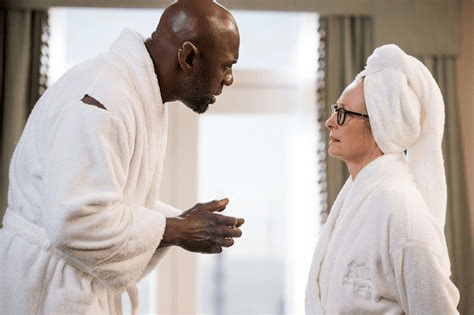
Soon, the djinn makes himself a bit more human-sized (and dons a hotel bathrobe, as you can see above). But even then, he is not … quite … on a human scale. He’s just a little bit too big. The picture above doesn’t capture this very well, but it’s the closest I could find. Tilda Swinton is petite, but she’s not that petite compared to the other humans in the story. She’s not that much shorter than they are.
Somewhat surprisingly, this also made me uncomfortable. Maybe it’s the way that the different scale messes with your perception of reality and your ability to trust your own senses. He’s too big to be human, but he’s not a tank like, say, Shaq. He’s in proportion – just not human proportion.
I was surprised by the fact that this made me — I repeat — physically uncomfortable. So, I guess, it turns out, my stories are even creepier than I realized. Because even when they are well-intentioned (?), like this djinn, I really don’t like giants.
[Ned, the serial killer] went down like a board, as stiff as a 2-by-10. [Pearl, the homeless lady] landed in the middle of his back.
I glanced at Pearl’s face, which was a mask of bruises. One eye was black, one tooth was missing, and a cut at the corner of her mouth oozed blood. She’d positioned herself in the middle of Ned’s back, and the gravity was sufficient to hinder the rise and fall of his chest.
She said, “Sh–. I think I broke my hip again, but right now I’m numb and it doesn’t feel like nothing.”
She bounced a couple of times and I heard an oof of air escape Ned’s lungs. She bounced again, though she winced as she did so. “What’s this here? What I’m doing. You’re a smart girl. I bet you know.”
“As a matter of fact I do. It’s called ‘compressive asphyxia,’ which is mechanically limiting expansion of the lungs by compressing the torso, hence interfering with breathing.”
“Hence. I like that. I’m setting here bouncing on Ned, hence making it impossible for him to draw breath. That’s what he did to them little girls, isn’t it?”



 Out of Babel Books