Becoming Free Indeed: My story of disentangling faith from fear, by Jinger Duggar Vuolo: A Review

Wow. This was devastating. It shows exactly how, not only the weird Christian subculture created by Bill Gothard, but the patriarchy and Christianity itself, which supports it, create an environment where sexual abuse and cover-ups are rampant.

Just kidding. That’s what the media desperately wanted this book to say. And because it doesn’t, that’s why they are going to call this book just another cover-up. In a moment, I’ll address the claims in the paragraph above. But first, what is this book actually?

A Memoir and A False Teacher

I would say the book has two goals. One, it’s a memoir. Two, it tackles head-on the false teaching offered by Bill Gothard’s Institute in Basic Life Principles, and distinguishes it from the true Gospel. These two purposes are woven together in a very natural way in this book.

In case you didn’t know, Jinger was one of the Duggar family. They were a Christian family who, partly because of the teachings of Bill Gothard, came to the conviction that it is wrong to use birth control of any kind. Now, some families who make this decision only end up with a few children. But the Duggars ended up having nineteen. Later, they were approached about making their family the subject of a reality show, and after praying about it, decided to do it. They did not expect that the show would continue for ten years. Part of their rationale for agreeing to do the show was that they believed their family could be an example to the watching world of how following Gothard’s teachings leads to happiness.

Unfortunately, Gothard was, in retrospect, an obvious false teacher.

In the late 1960s, Gothard started teaching his seminars at churches, Christian schools, camps, and youth programs around the country. His timing could not have been better. For Bible-believing Christians, [the 1960s] were a scary, uncertain time. Parents feared losing their children to sex, drugs, and rock and roll. Bill Gothard offered parents confidence. In his lectures, he claimed that he had discovered the key to a successful Christian life. According to Gothard, to enjoy God’s blessing, a Christian should closely follow the seven principles he laid out in his seminars.

ibid, p. 26

Right away, Gothard displays several marks of a false teacher. The number one red flag is that he made himself indispensable to living the Christian life. He would find secret principles in the Bible that no one else had, and would identify unintentional sins that a person could commit that could wreck their entire life. Like a classic cult leader, he created fear in his followers (in this case, fear of accidentally displeasing God, which could lead to any number of bad consequences including death). Then, he offered himself as the solution to that fear. In other words, he was trying to take the place of Christ, the Bible, and the Holy Spirit.

I shouldn’t need to point this out, but Gothard was teaching what the Apostle Paul would have called “a different gospel.” In this case, it was the hoary old heresy of works righteousness, whereby a person can save themselves simply by following the right rules. Gothard didn’t seem to understand that sin nature is far too powerful to be restrained by rules. Nor did he understand the need for the new birth. It was a new insight to Jinger to realize:

Contrary to what I grew up believing, the ultimate threat to you and me is not the world. Instead, the ultimate threat to me is … me. I need freedom not from the influence of world, not even from a religious system, but from myself. I am born enslaved by my own sin.

ibid, p. 130

(Reformed folks call this idea “total depravity,” and it’s the first of the five theses in the TULIP acronym. Needless to say, Bill Gothard’s teaching was far from Reformed.)

Gothard also didn’t seem to think that God has revealed His plan of salvation clearly in the Bible, implying instead that God was a trickster who hides His will from people. Jinger gives many examples in this book of how Gothard would cherry-pick proof texts to support whatever point he was trying to make, but never taught straight through a long passage of the Bible, following the flow of thought. Finally, Gothard appears to have added a little “health and wealth” heresy to his teaching: follow these rules, and you will be blessed in every way.

Interestingly, Jinger remembers having an overall positive experience as she grew up in the Duggar household. Her parents did actually understand the Gospel and teach it to her, so she got that alongside Gothard’s harmful false teaching. However, Gothard’s false teaching seriously stunted her spiritual growth, causing her to live with an attitude that was simultaneously fearful and Pharisaical. It wasn’t until she met her future husband that she was exposed to better, more solid biblical teaching and was encouraged to study the Bible on her own, looking at what the passages were actually saying, not through the lens of Gothard. She left his false teaching in order to step in to a truer, richer understanding of the Gospel. I think it’s entirely appropriate that she share her story in a memoir that also examines Gothard’s false teachings. Through no choice of her own, as a Duggar she has been made a minor public figure and a representative of Christianity (not to be confused with Gothard’s teachings).

However, not everyone who grew up in a Gothard community was so fortunate. Gothard himself, who never married even though he gave lots of marriage and parenting advice (think that’s a red flag???), for years flirted with and sexually abused young women in his community. And Jinger’s older brother, Josh, became a sexual predator who ended up going to jail for possession of child pornography. As Paul points out about rules like Gothard’s, “Such regulations indeed have an appearance of wisdom, with their self-imposed worship, their false humility, and their harsh treatment of the body, but they lack any value in restraining sensual indulgence.” (Col. 2:23)

However, instead of seeing these sexual sins as an indictment of false teaching like Gothard’s, many people will see them as the natural outcome of Christianity. They will hold Jinger, as it were, responsible for these things unless she also rejects Christ. So, let’s look at the claims in my intro paragraph.

A Series of Theses About Sexual Abuse in the Church

  • Claim: Sexual abuse in any church, anywhere, proves that Christianity is harmful and false. Reality: By some estimates, 1 in 4 girls and 1 in 6 boys are sexually molested. Some people think this sounds high, but I have found it to be true. Any time I am in a group of three to five women, it invariably comes out that one of them was molested. This is true in all kinds of different contexts. What this tells me is that the human heart is deceitful and desperately wicked. Another lesson: Any group of, say, twenty or more people is going to have a molester in it, whether that group is a public school, a private school, a camp, a church, or yes, a large family. Every institution that involves people and lasts more than a year or two is going to have to deal with a molester. I’m not happy about this, but it is better to face this reality.
  • Claim: Anything short of immediate jail time is a cover-up. Reality: Sadly, most institutions don’t know what to do with cases of abuse, especially with young offenders. This requires a lot of wisdom, which many leaders don’t have. Some institutions do, indeed, cover things up, and protect and keep moving their offenders. Others don’t do this, but nevertheless don’t handle the situation perfectly (which is very hard to do). Even if there is not an actual cover-up, the victims often feel that there has been, or that they have been blamed (often because the abuser has told them they will be blamed). This, too, is a less than ideal situation. Acknowledging reality #1 would help mitigate this somewhat.
  • Claim: Sexual abuse is caused by Christianity, because it is sexist, or by the patriarchy, which Christianity supports. Reality: Sexual abuse is caused by the depraved human heart. Not every religion acknowledges that the human heart is “deceitful and desperately wicked.” Christianity does, so Christians at least start out in a better position to tackle this issue. (Note, again, that Gothard’s teaching was subChristian, and did not recognize human depravity or the need for a new birth). Regarding the alleged sexism of Christianity, see Nancy Pearcy’s book Love Thy Body, which points out that the most reliable historical index for the spread of Christianity in the ancient world, was the outlawing of sex slavery.  As for “the patriarchy” causing sexual abuse, this is true only if by “the patriarchy” we mean “human sinful nature and a fallen world.” Men are more powerful than women; in a fallen world, men and women are both sinful; therefore, in a fallen world, the powerful sinners tend to exploit the less powerful ones. This the world into which Christ came to redeem it. It is foolish to look only at the exploitation that has happened during Christian history, without looking at the much worse exploitation that happened before Christ came, and still happens in many places that have not been deeply Christianized.
  • Claim: Christians are in favor of sexual abuse, because they think women are inferior to men. Reality: Give me a break. That is slander.
  • Claim: Cover-ups are more common in religious institutions, because of concern about looking righteous at all times. Reality: Most human institutions are concerned with looking righteous at all times, and therefore are tempted to engage in cover-ups. This is true whether or not they are overtly religious in the sense of talking about a God or gods. I give you Exhibit A: Loudon County School district.
  • Claim: Jinger Duggar Vuolo should have written this book denouncing her brother, not telling her own story.  Reality: Reader, have you ever been in a workplace, school, church, or family where sexual abuse occurred? Did you therefore condone it? Should you not be allowed to talk about any topic without first mentioning and denouncing that incident?
A Wrong ‘Un

After a minute or two, while [the two men] stood watching Lombard’s progress [climbing down the cliff on a rope], Blore said:

“Climbs like a cat, doesn’t he?”

There was something odd in his voice.

Dr. Armstrong said:

“I should think he must have done some mountaineering in his time.”

“Maybe.”

There was a silence and then the ex-Inspector said:

“Funny sort of cove altogether. D’you know what I think?”

“What?”

“He’s a wrong ‘un!”

Armstrong said doubtfully:

“In what way?”

Blore grunted. Then he said:

“I don’t know — exactly. But I wouldn’t trust him a yard.”

And Then There Were None, by Agatha Christie, pp. 107 – 108

This is a very tense book. I was planning to dedicate an entire Friday post to it, but being short on time, I’m just using this quote from it on Quote Wednesday.

This bit of dialogue really shows the atmosphere of the book, and how the atmosphere is coming from the theme. In most Christie murder mysteries, there is one murderer among a group of people who are not murderers (even if they are not innocent in other ways). In this book, ten people are trapped together on a small island. None of them knows the others very well, and so they don’t trust each other either. As the book unfolds, it becomes clear that this lack of trust is well founded. Every single guest on the island has committed a murder in the past. They are all capable of killing. As Christie says in her other books, once a murderer has killed, they will do it again. So, any one of them could be “the murderer” who is picking off the guests one by one. In a sense, they are all “the murderer.” They are all a “wrong ‘un.”

I didn’t much enjoy this book the first time I read it, because it so disorienting (one point of the book was to create “an impossible puzzle”). The second time through, I was of course less confused, but I also didn’t enjoy it much because there is no character we can sympathize with. The one who comes closest, Vera, turns out to have been responsible for the death of a child. She, too, is a wrong ‘un.

The third time, this summer, I appreciate that this book is a sort of exaggerated picture of our predicament as human beings. We are trapped in this world (the island) surrounded by people, including ourselves, who are all totally depraved, who are all “wrong ‘uns.”

Guilty Pleasure: Stoneware

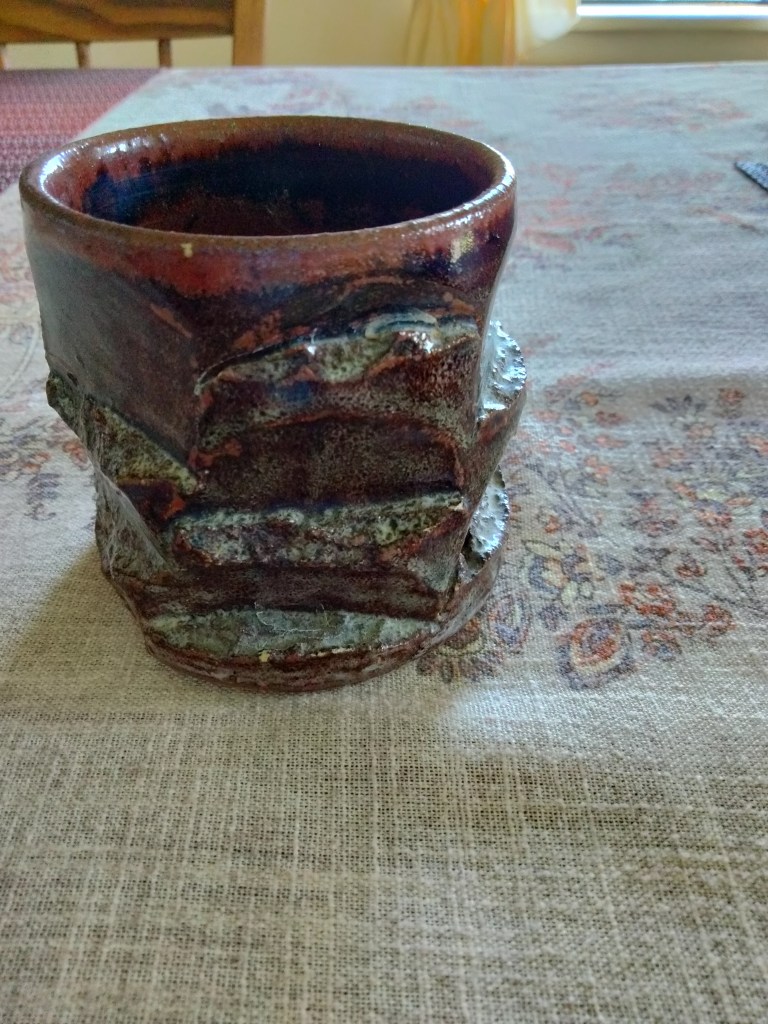
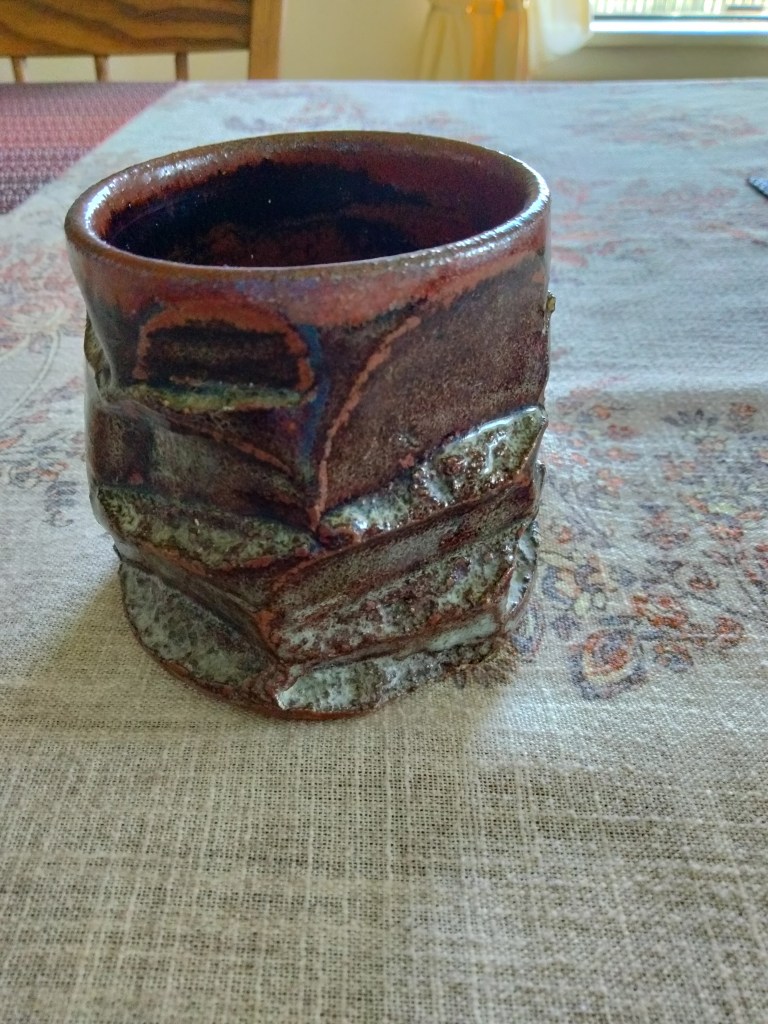
I got this fantastic mug at university. I bought it from a sale the Art Dept students were having. Back then, buying anything at all was a big decision that I had to justify. When my Japanese roommate saw it, she got all excited and said the mug looked Japanese. I probably should have given it to her (sorry, Makiko!), but I didn’t. I am still treasuring it all these years later.

Faithful OOB readers have seen this mug before, in my “I Like Bears” post. I think my husband got it for me during a trip to Yellowstone years ago, then it spent several years in storage, then I re-discovered it, with new appreciation, after our most recent move. I use it now because my book The Strange Land features a Bear of Justice.

This lovely thing was purchased at the Fantasy Faire, from a stonewear booth (advertising slogan: “Get Stoned”). I asked the potter, an older lady, about her process, and she said, “I take some clay. I throw it on the wheel. I make a cup. I glaze it, and then I fire it.”

Do you like stonewear?

Phantasy Phaire Photos

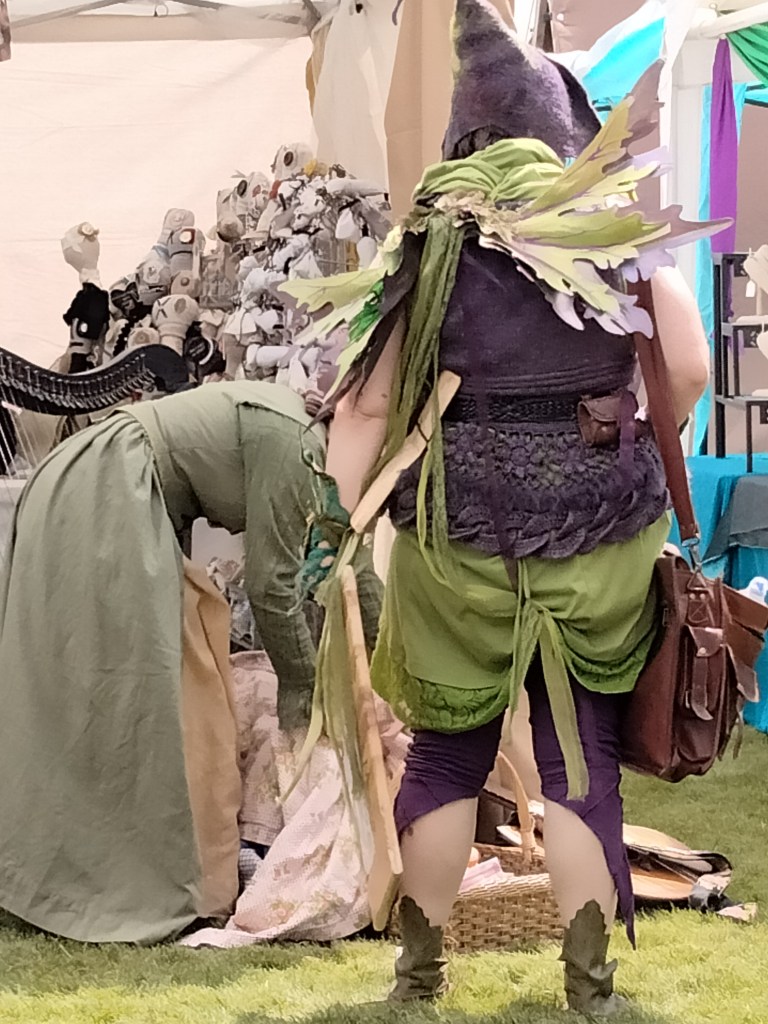
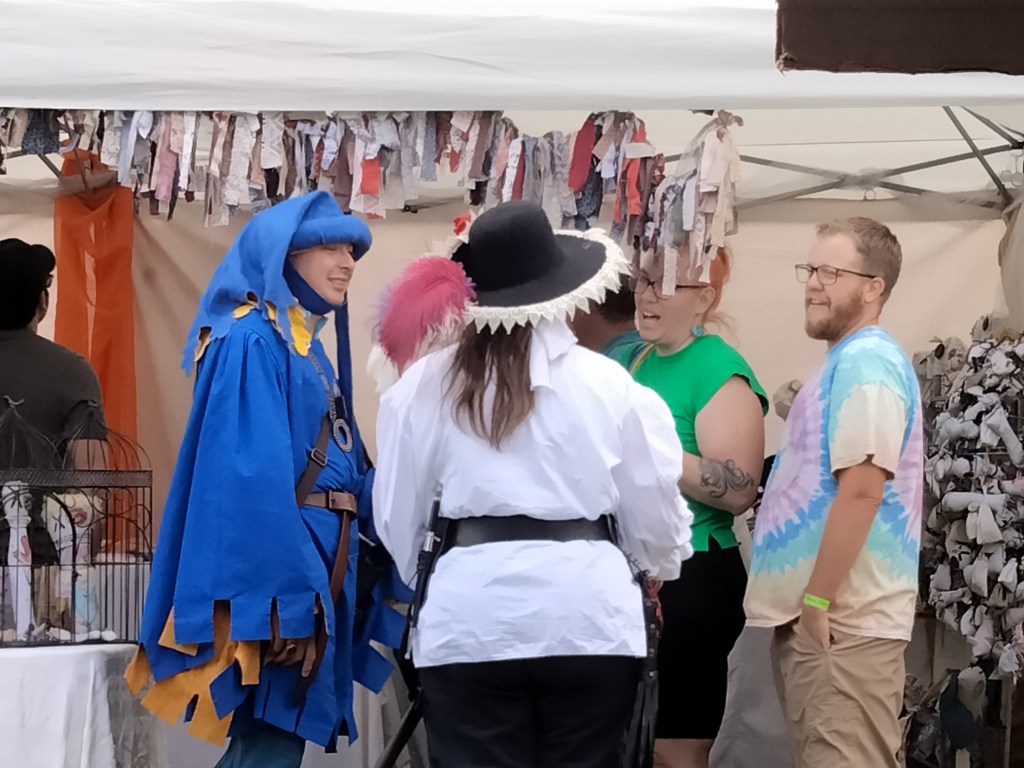
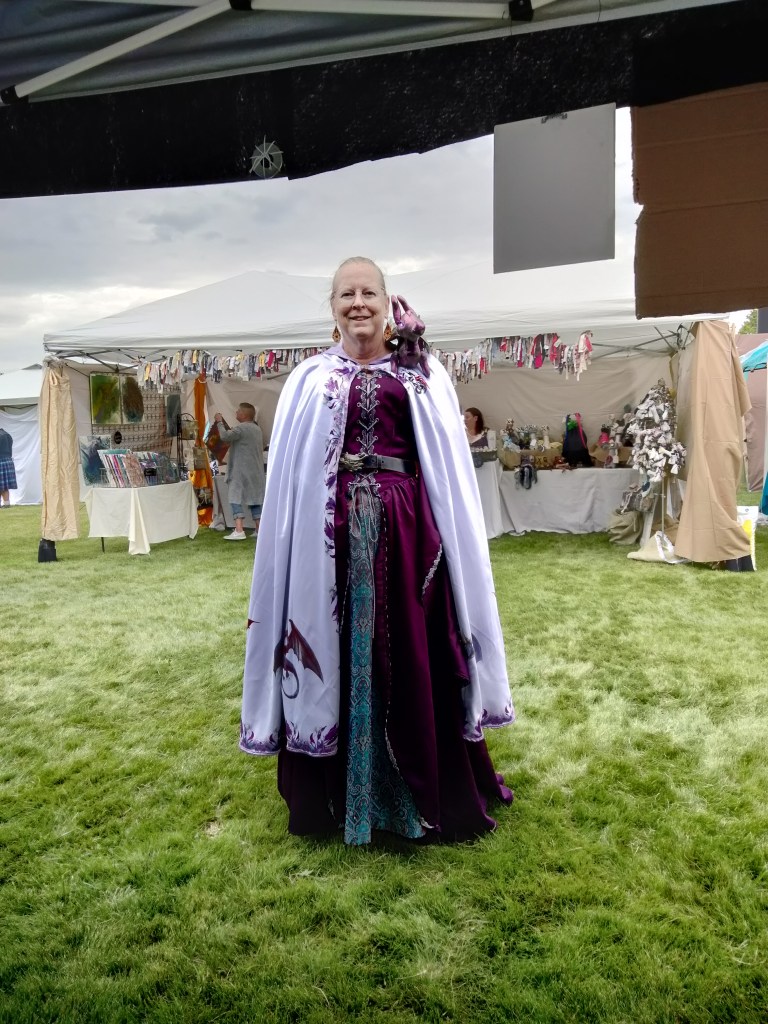
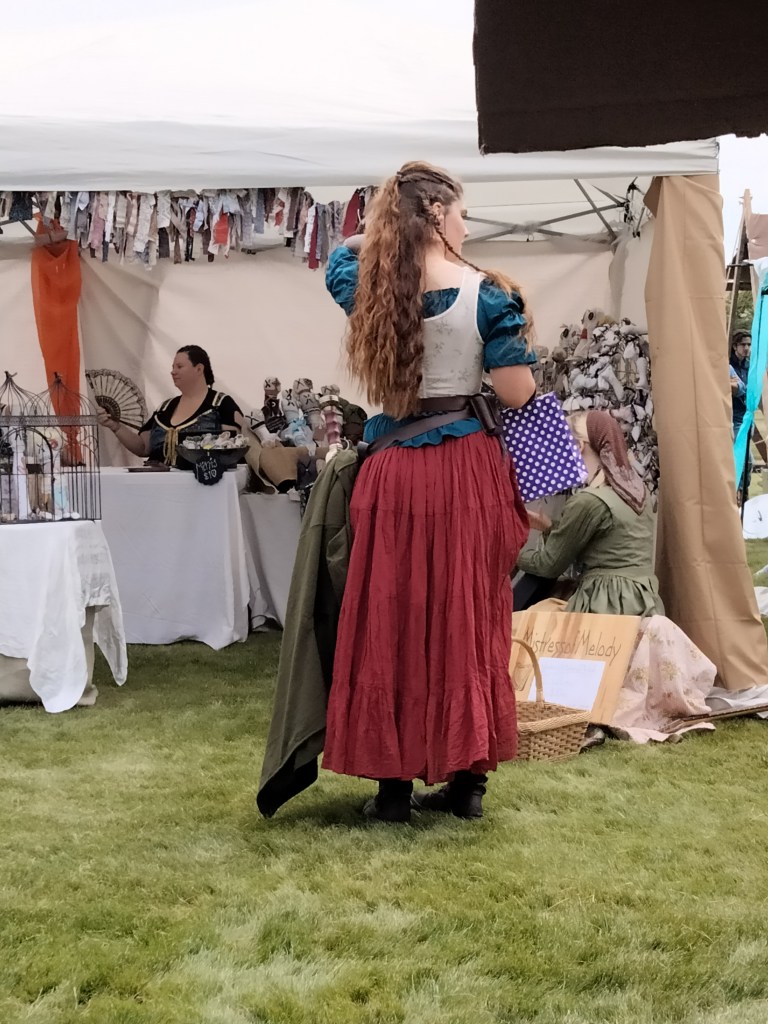
Literally every person who passed by our booth was worthy of a photo essay, so these are just a few highlights.

Here’s the alley behind the booths on Saturday. My son said, “It’s beautiful the way everyone shows up and sets up their own booth, and instantly there is a city where there was none before.” He’s eleven.

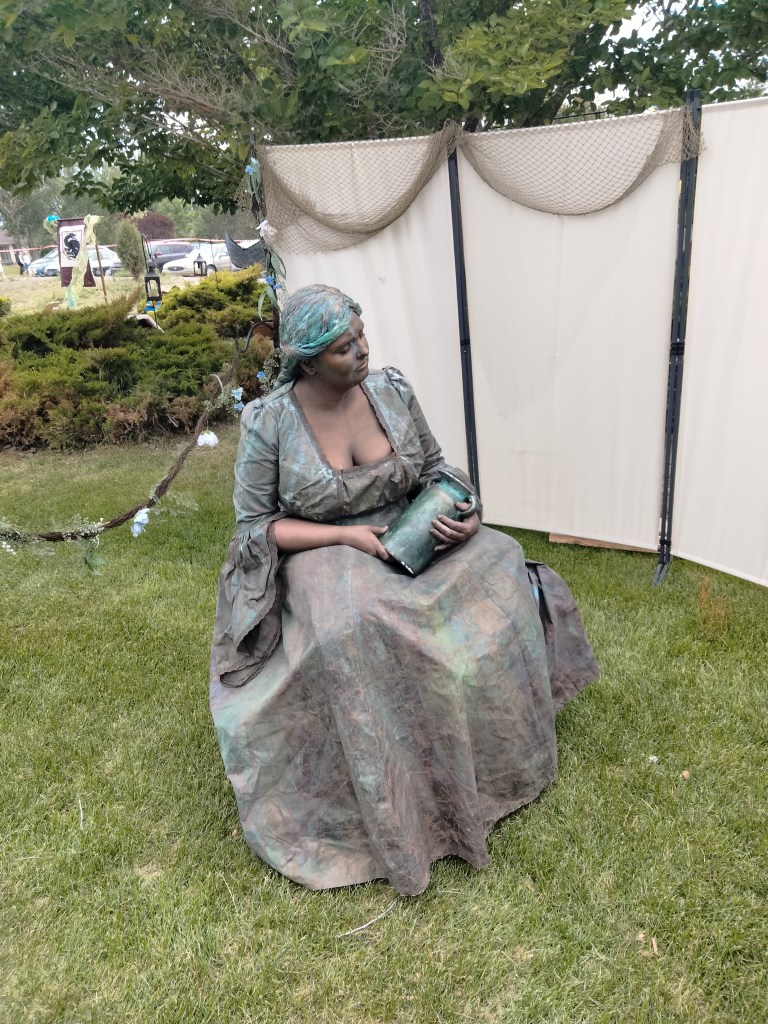
There was this “Enchanted Statue” who, when given a tip, would wink at you.

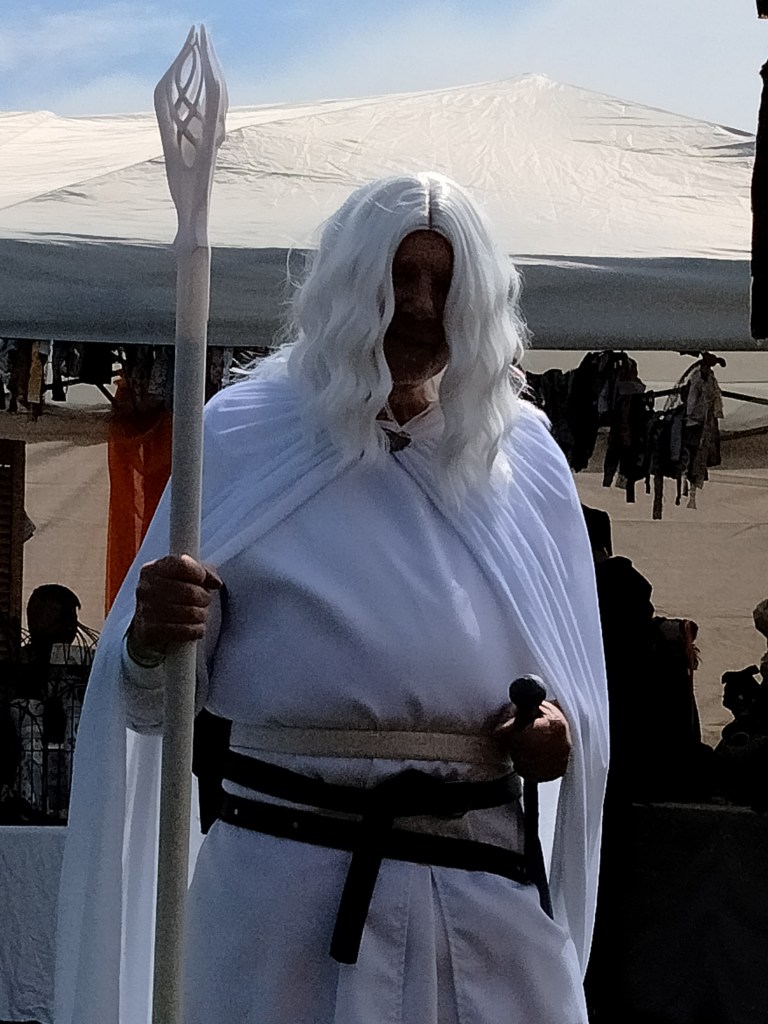
Gandalf the White showed up first thing on Saturday morning.

There were many Scotsmen and a few Scots women.

… one ogre …

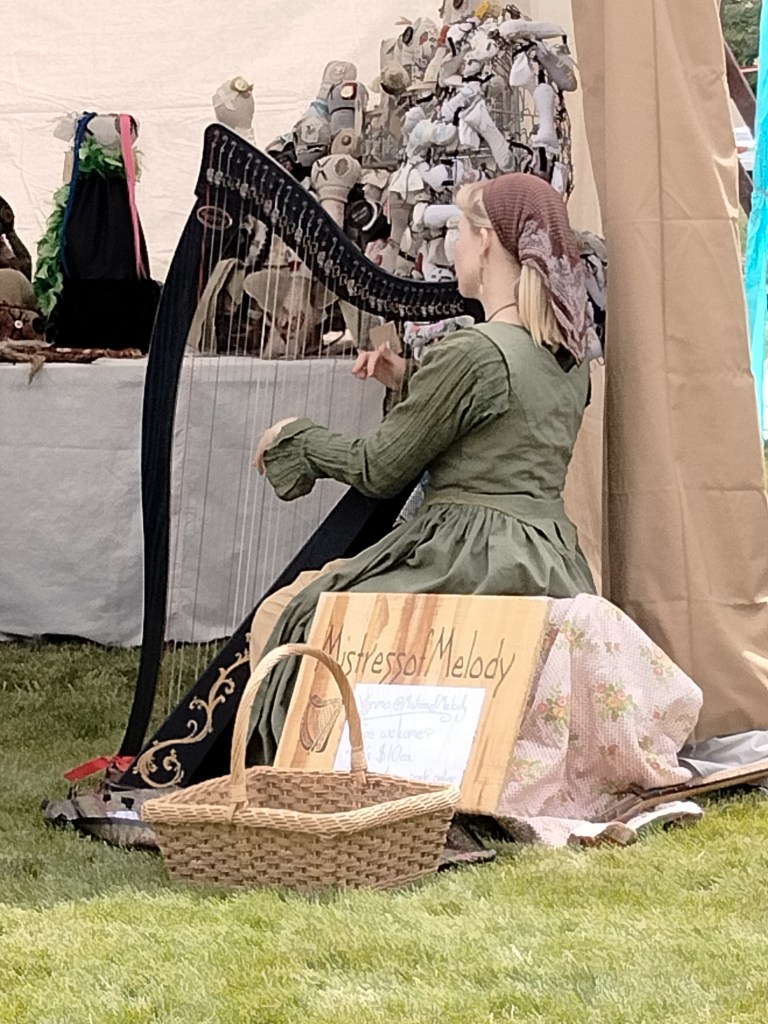
… musicians …

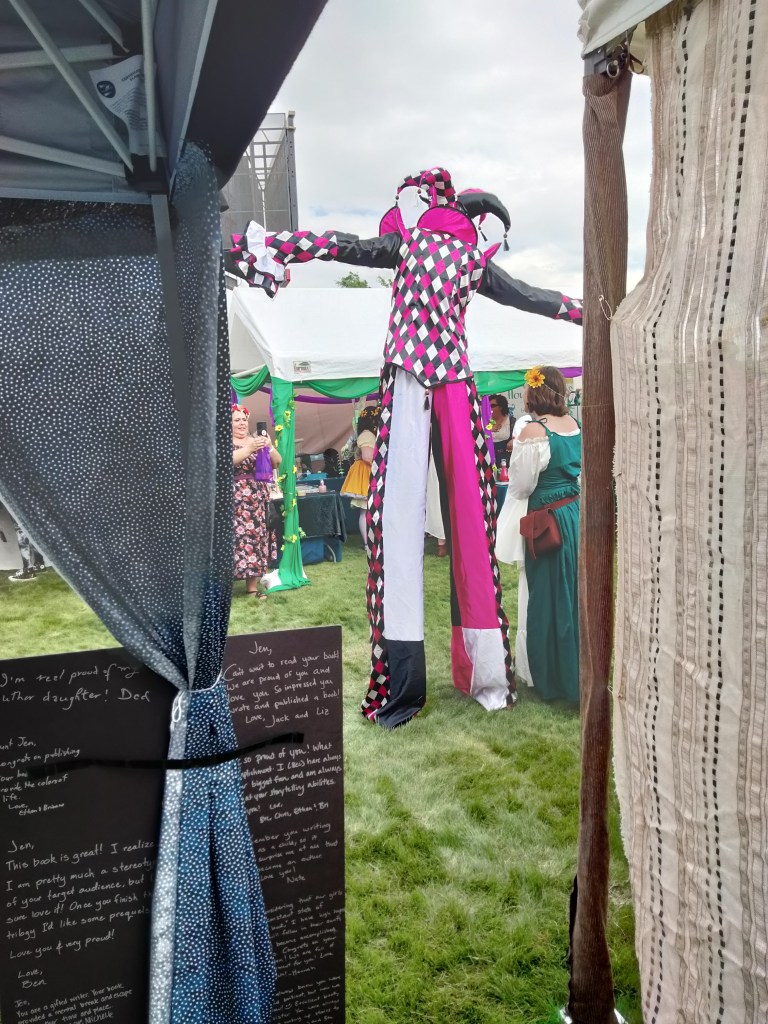
… jesters …

… mushrooms …

… elves …

And quite a few pirates. The pirate with her back to the camera would, for $5, “arrest” a victim of your choice and parade them throughout the Faire, calling out “Shame the prisoner!” as they wore a placard stating their crime.

Here she is arresting a lady merchant whose crime was running out of fudge at her booth. The person who put her up to this was my son, who wanted to do everything.

Ensuring that we became friends.

Here’s another friend, from the Pocatello Writers’ Group.

And some more people worth looking at.

One thing I regretfully realized after putting together this post was that I do not have a single picture of a knight or warrior. In fact, there were many of these fellows at the Fantasy Faire. A tall, portly warrior in Viking-style armor bought one of my son’s paintings. Also prominent were the Salt Lake City Crusaders, whose motto is “Real Armor. Real Weapons. Real Athletes.” They had a ring set up in which, twice a day, men in authentic armor battled it out. (I swear that, as I wandered by, I saw one armored guy hitting another armored guy on the helmet with a frying pan.) These warriors would periodically come striding through the Faire, but they always walked so fast that I never got a picture. Plus, I guess, there were so many armored men about that I just took them for granted. But, let the record show that they were there.

Preparing for the Fantasy Faire

  1. Set up modern tent, measure proportions

2) Measure and cut four panels of black felt. (Three can be cut whole out of the fabric we purchased; one needs to be pieced together from two end pieces.)

As I worked in the yard, the chickens kept coming up and I had to chase them away from the felt. The rooster tried to eat one of my pins.

3) Join panels together with a whip stitch, using yarn in a contrasting color. Besides making the tent look sort of cool, this will allow us to locate the corners of the felt cover more easily.

(This is the biggest sewing project I have ever worked on. It’s very physical handling these big pieces of cloth. Still, the pressure is less than when making tailored clothes. The biggest mistake I have made so far was I began to join one of the panels with the wrong side facing out. I had to pull out the whip stitch and turn the panel over.

The felt has a pleasant odor. I’ve always like fiber smells. Unfortunately, I don’t know whether this odor is a property of felt itself, or whether it comes from chemicals perhaps used in the modern but not the ancient felt-making process.)

4) Put the cover over the modern tent to see whether it fits.

When we got the tent out this time, we were confronted with a problem. Two screws from the frame had fallen out. I was able to locate & replace one. Looks like the other will have to be a substitute screw from our junk drawer. We suspect a chicken ate it.

Yay! The cover fits! And is even a little roomy. Now, to patch pieces of felt to complete the peak.

5) Put the cover back on again. It looks okay

The tops of the pieces don’t join in a perfect cone, but it’s got a nice witch hat/smoke hole look, so I think I’m going to leave it. Fixing it won’t be worth the extra time, when there is so much more prep to do.

6) Pin star fabric to corners to make sure you have enough.

7) Sew large washers to the sides of the canopy to hold it down in windy conditions.

8) LEDs

9) Set everything up exactly as it is going to look the next day.

I Love It When them Aliens Be Comin’ Around

I posted the following several years ago in response to some information being released from Navy pilots about UFOs. Making the necessary adjustments, most of what I say below is still relevant to the more recent sensational revelations about aliens, which are getting ignored by everyone except Matt Walsh.

If you want more interesting theories about all this, see also the interviews I’ve done with Jason McLean. I am watching his YouTube channel, SIRU papers, for his reaction to these latest news stories.

So, now for the repost …

Finally Facing the News

You guys may have noticed, there has been a spate of news articles and videos about U.S. Navy pilots sighting what appear to be UFOs.

U.S. Navy videos declassified last year

60 Minutes interview with Navy pilots

Former head of the Pentagon’s UFO program says they have “exotic material” … what???

I’ve ignored these news items for a long time, mostly because I didn’t know what to do with them. Now I’m ready to give my analysis. It will be just as expert as anyone else’s, and no more expert than any comments you may leave.

Problems with all the Possible Theories

  1. This is all just a big hoax by our government, to distract us from the attempted power grab by [fill in your favorite villains]. The problems: First of all, it’s not working if that was indeed the plan. The media have not camped on this nearly as hard as on some other, less sensational things, and even when they have run stories, the public (including me, I might add) seem much more interested in their own problems. The government and media are not using these reports to whip up fear or preparations for an intergalactic war, nor are they trying to turn this into a scandal about past administrations’ lack of preparedness on the space alien issue. They have just kind of thrown out all this newly declassified information with a clunk, a shrug, and a big trombone slide. Secondly, the pilots who were interviewed seemed like sane, professional people. They did not seem like people who “want to believe” in space aliens. Thirdly, some of these reports and videos go back for decades.
  2. These aircraft belong to another world power, such as China, which has developed technology far more advanced than we suspected. Possible but implausible, because again, these sightings go back for decades. It’s hard to imagine a geopolitical rival having advanced millennia beyond us in terms of their technology, and not having already used it to conquer us. Regular earth people don’t have that kind of self-control.
  3. The aircraft belong to a private, independently wealthy genius, like Elon Musk, who does not want to take over the world but just zips over the Pacific Ocean as a hobby. Possible. Very possible. Although again, it would take phenomenal humility and self-control for a private organization to have these capabilities and not try to leverage them for whatever their own pet project is: fame, space travel, stopping perceived climate change, etc.
  4. The aircraft belong to an advanced civilization of space aliens. The first problem with this is that, if this is an invading force, they are taking their time. At the risk of repeating myself: these sightings go back decades. So if these are space aliens, they frankly don’t seem super interested in us. Perhaps they are just here as tourists. The Pacific Ocean would certainly be a worthy destination for tourism, and perhaps it is more interesting to them than humans. But there is another huge problem with the space alien theory; that is, if we are imagining these space aliens as they are usually conceived of: physical beings, designed to live in three dimensions, like us, physically inhabiting a very different ecosystem on a distant planet or planets in a distant solar system. The problem is this: any possible life-supporting planets in our universe are prohibitively distant for vehicles traveling at normal speeds. The time (and, if I may say so, the risks) involved are not at all practical for tourism or warfare, or even for beings not designed for space to survive the journey probably. Of course, there is a that hoary sci-fi trope of hyperspace (going faster than the speed of light). But everything I’ve ever heard about this indicates it’s either not possible, or would almost certainly destroy any object that accelerated to that speed, and would certainly kill any physical being, designed to live in three dimensions, that tried it. All of this makes it impossible for me to swallow a Star Wars or Avatar-like scenario where there are physical aliens living galaxies away, who have traveled through hyperspace to get to Earth. But there is another possibility.

Interdimensional Beings

In the short satirical novel Flatland, the protagonist is a square who lives in a two-dimensional world of geometric beings. These two-dimensional beings are visited by a sphere. The sphere shows himself to them by intersecting his body with the plane of their universe. The way this looks to the two-dimensional beings is that a point appears out of nowhere, then becomes a rapidly growing circle as the sphere inserts more of his diameter into their plane of existence. When he wishes to, the sphere can move out the other side. This looks to the two-dimensional shapes as if the circle shrinks and then vanishes. The sphere can then move to somewhere else on the two-dimensional plane and appear there, again giving the impression that he has appeared out of nowhere. Later, the sphere takes the square on a mystical journey to observe lower dimensions, so as to give him an idea of how higher dimensions might exist. There is a one-dimensional world (a line) where the inhabitants are all line segments. Each can only see the end of his neighbor (he or she looks like a point), but they can hear one another and communicate by harmonizing. The square is also shown a universe that consists of a single point. This point is the only being in its universe and thinks it is God. It is impossible to communicate with this point. If it hears a voice not coming from within its own universe, it imagines that it must be having auditory hallucinations.

Returning to the vehicles in the section above, I’m sure you can see where I’m going with this. If these mysterious vehicles turn out to be piloted by nonhuman beings, it seems most probable to me that they would be creatures designed to live in more dimensions than we do. Creatures in a higher dimension can do things that appear miraculous in lower dimensions, such vanishing abruptly or appearing to defy the laws of physics. Though wild, the “higher-dimensional beings” theory seems to me more plausible than the idea of three-dimensional beings who are subject to the same laws of physics that we are, yet somehow have managed to pull off intergalactic travel and vanishing through “technology.”

And, by the way, notice your own reaction to this. Did you breathe a sigh of relief? Does the phrase “interdimensional beings” sound way more intelligent than “space aliens” or “angels”? I confess it rolls off my tongue much more smoothly. (More syllables = better?) Some people might say that interdimensional beings was what they meant all along by “aliens,” and moving through multiple higher dimensions was what they meant by “technology.” O.K., that’s fair. Such beings would certainly be alien to us. Still, I think it’s a helpful distinction to make, because I don’t think “creatures designed to live in a higher dimension” is the first thing that comes to most people’s minds when they hear “aliens,” or especially “space aliens.” We might think of aliens as having the ability to mess with higher dimensions than we can, but I think most people think of that as a sort of extra, while conceiving of the aliens as primarily creatures like us (perhaps smarter and uglier), who make their primary home on a physical planet and are anchored in the three dimensions (four if you count time).

The Third Circle of Weird

Ready to get even stranger with me? Let’s go.

On this blog, I have in the past reviewed the excellent, very odd, very mind-blowing Collision Series, which consists of the books The Resolve of Immortal Flesh and The Formulacrum. That series is a lot of things, including a hilarious, Hitchhiker’s Guide-style romp … but more than anything it’s an extended exploration of this idea of interdimensional beings. Human characters in the series get ahold of a vehicle that can travel in higher dimensions. They exploit their access to higher dimensions to move through walls, travel the depths of the sea, and vanish when there’s trouble, and they do it a lot. Of course, the convenience of this is limited by the fact that throughout the books, the human protagonists are at different times being hunted by beings who also have access to these higher dimensions.

A major thesis of these books is that the beings we are used to referring to as angels and demons are actually interdimensional beings whose goals intersect with human life in complex ways. One interesting thing that comes up is that humans do in fact move through some of these higher dimensions, but we do so without knowing it. We experience our interdimensional blunders as intuitions, insights, creepy feelings, etc. This makes sense. After all, in theory there’s nothing to stop a two-dimensional creature from blundering through the body of a three-dimensional creature, right? Anyway, that’s an interesting detail but I’m getting off track here.

Helped by Rich Colburn, the author of The Formulacrum, I am now ready to cap off the weirdness by integrating this interdimensional beings idea into the world view of my own book series.

The Long Guest and The Strange Land both proceed on the premise, taken from Genesis 6, that in ancient times “the sons of God” (interdimensional beings?) walked the earth in some kind of physical form that allowed them somehow to reproduce with human women, thus producing a race of monsters. The resulting chaos was in fact the main reason for the Flood: God was doing triage to save the human race as originally created. This horrifying period in history was also the source of the all the legends and origin stories about gods, giants, and monsters that we find in cultures worldwide. For more on this theory, see my post, here, or the book Giants: sons of the gods by Douglas Van Dorn.

So, yes, strange as it sounds, I am speculating that your “aliens” might be what the ancient world called “gods” … but only if we specify that they were not regular “space aliens” but interdimensional beings who could probably appear as people or animals or whatever they wanted to look like (hat tip to the Greek myths).

So, Why Am I Not Terrified?

I’m not terrified because the gods ain’t what they used to be.

I see the “gods” as having less influence on human life now than ever before. I basically see three phases of this. In the first phase, they were actually here, manifesting physically, demanding worship in person. God put a stop to that with the Flood.

After the Flood, people still remembered the gods, and they seem to have continued to be pretty active on earth, but unable to manifest physically. So, each nation had a god that was responsible for it (or that it was responsible to). They built altars to these gods, identified them with different stars and constellations, and kept trying to get in touch with them physically even though that door had now been closed. “In the past,” Paul says, “God let all nations go their own way.” He picked one people and told them not to worship false gods (gods which were not the Creator and which, in many cases, didn’t even try to hide the fact that they were evil). If we look at legends and even recorded history, it seems to me that often these gods were actual spiritual presences who, though they could no longer manifest physically, could have quite an influence on human life through things like visions, possessions, illnesses, and disasters. For example, in Palestine in Jesus’ day we see many cases, unironically reported, of people being possessed by “unclean spirits.” This is in a region that had been heavily Hellenized, and where people were definitely still worshipping the Roman gods, the Greek gods, and the pre-Hellenistic local deities such as Artemis of the Ephesians. In this second phase, it was truly a dangerous thing to turn from your local deity to worship “the living God,” the God of Israel. Local deities perhaps could actually harm people they took a hate-on to. God spends a lot of time in the Old Testament reassuring the people that if they forsake the fertility and rain gods, and worship Him, He will bless their households and crops and will take care of them.

So, in phase two, God has set some limits on the interdimensional beings but there are still lots of manifestations from other dimensions and lots of communication (or attempts at such) between them and humans.

In phase three, we get Jesus. He opens the way for all human beings to relate directly to the living God. When people turn to Him, they turn away from the worship of the lesser gods. And when people do this in large numbers, a funny thing happens. Paganism no longer works any more. It’s as if the lesser gods have been banished — not partially, but completely now — from their traditional territories. In the Christian era, as worship of the true God spreads slowly but surely throughout the world like leaven, the world becomes less and less spooky. Now, 2000 years later, in many parts of the world, interdimensional/spooky/spiritual manifestations are so rare that we do not have to worry about them and many people don’t even believe that they exist or ever did. If we see a weird thing, we have to find some kind of physical explanation for it, whether it’s a hallucination caused by chemicals in our brain or physical, three-dimensional beings from somewhere else in our physical galaxy.

I’m OK with this change, frankly. It might make the world a little more boring … but, my gosh, it makes it so much less scary! It even means that, if these tic-tac-shaped spacecraft are being driven by interdimensional beings, we probably don’t have to worry. Probably the reason they have not used their capabilities to enslave us is that they aren’t allowed to interact with us in any significant way. Zip around a little, make us scratch our heads, yes. Manifest, show their power, attack us, no. Those days are gone. Christ is the victor. We can all breathe a sigh of relief.

A Murder Is Announced: A Reread

Photo by Ylanite Koppens on Pexels.com

A long review, but with no spoilers! That’s how much is going on in this book!

This is about my third time to read this book. The first instance was many, many years ago, when I knew very little about life or about postwar England. At that time, the characters, their life circumstances, their personalities didn’t give me clues about the mystery, but rather were just another part of the exotic setting through which I stumbled, gaping and blinking.

I remember that I reread the book at least once in the interim, but I can’t remember the occasion. Probably I was so busy immersing myself to escape the stresses of everyday life that I didn’t absorb much except “how fun to read an Agatha Christie book.”

And then there’s this trip round. Third time’s the charm?

Lock Up Your Daughters Christies!

I bought this book in response to the news that Christie’s books are now going to be edited before they are published. New editions will remove language that could be hurtful, such as references to class, race, nationality, or people’s personal appearance. In other words, all the distinctive parts of the British world-view in the 30s through 60s that make the books interesting period pieces, that Christie often conveys subtly and sympathetically, and that often figure as important factors in the psychology of the murder mysteries. When I heard this news, my immediate thought was that I’d better build up my own library of older editions of Christie. Her whole corpus has always been widely and cheaply available in libraries and bookstores, but precisely because of this availability, it never occurred to me to build up a collection. I purchased A Murder Is Announced and then at once had occasion to lend it to a young person who had never heard about Christie, so that was my good deed for the month I guess. She finished it in a night or two, and when I got it back I of course re-read it.

It’s not hard to see, in this book, what parts would go on the sensitivity editor’s chopping-block.

Through the door surged a tempestuous young woman with a well-developed bosom heaving under a tight jersey. She had on a dirdl skirt of a bright colour and had greasy dark plaits wound round and round her head. Her eyes were dark and flashing.

She said gustily:

“I can speak to you, yes, please, no?”

Miss Blacklock sighed.

“Of course, Mitzi, what is it?”
Sometimes she thought it would be preferable to do the entire work of the house as well as the cooking rather than be bothered with the eternal nerve storms of her refugee “lady help.”

ibid, p. 21

Wow! Just look at that English stereotype of a foreigner. Mitzi wears bright colors, her hair is “greasy,” she is too curvy (body shaming!), and she is subject to “nerve storms.” Later in the story, we learn that Mitzi is dramatic, boastful, and “a liar.” What could be worse? Surely the sensitivity editor should get rid of this entire character. Unfortunately, Mitzi is rather important to the plot. She also embodies one of the themes in this book: the new conditions of life in the British countryside immediately after WWII.

Post-War Britain

“Helps to find out if people are who they say they are,” said Miss Marple.

She went on:

“Because that’s what’s worrying you, isn’t it? And that’s really the particular way the world has changed since the war. Take this place, Chipping Cleghorn, for instance. It’s very much like St. Mary Mead where I live. Fifteen years ago one knew who everybody was. … They were people whose fathers and mothers and grandfathers and grandmothers, or whose aunts and uncles, had lived there before them. If somebody new came to live there, they brought letters of introduction, or they’d been in the same regiment or served in the same ship as someone there already. If anybody new–really new–really a stranger–came, well, they stuck out–everybody wondered about them and didn’t rest till they found out.”

She nodded her head gently.

“But it’s not like that anymore. Every village and small country place is full of people who’ve just come and settled there without any ties to bring them. The big houses have been sold, and the cottages have been converted and changed. And people just come–and all you know about them is what they say of themselves. They’ve come, you see, from all over the world. People from India and Hong Kong and China, and people who used to live in France and Italy in cheap little places and odd islands. And people who’ve made a little money and can afford to retire. But nobody knows any more who anyone is. People take you at your own valuation. They don’t wait to call until they’ve had a letter from a friend saying that So-and-So’s are delightful people and she’s known them all their lives.”

And that, thought Craddock, was exactly what was oppressing him. He didn’t know. They were just faces and personalities and they were backed up by ration books and identity cards–nice neat identity cards with numbers on them, without photographs or fingerprints. Anybody who took the trouble could have a suitable identity card–and partly because of that, the subtler links that had held together English social rural life had fallen apart. In a town nobody expected to know his neighbor. In the country now nobody knew his neighbor either, though possibly he still thought he did …

ibid, pp. 126 – 127

The postwar conditions that Miss Marple is describing are pretty much what it’s like everywhere in America … at least, everywhere that I have lived. The idea that you might not visit someone, or get to know them, until you’ve had a letter of introduction from someone you do know, strikes an American as stifling. (In Indonesia, by the way, when you come to visit a new place you need a letter of introduction not from a mutual friend but from some kind of bureaucrat.)

Many of these “people” from overseas that Miss Marple describes would have been Englishmen and Englishwomen who had been living abroad before the war. One such person is Miss Blacklock, a main character in this mystery, who came to Chipping Cleghorn only two years ago. Her friend, Dora, and her niece and nephew, Julia and Patrick, who live with her, also came recently. But many others would have been not English but foreigners. Apparently, England had to digest a large influx of postwar refugees and this fact forms the background to many of Christie’s stories, this one in particular. Besides Mitzi, another character is a young Swiss man who works at a nearby hotel and who might not be entirely honest with money.

Christie is not entirely unsympathetic to foreigners. One of her sleuths, Hercule Poirot, is Belgian. English people tend not to take him seriously because he is a “dapper little man with an egg-shaped head” and a French accent, and this tendency to underestimate him often works in Poirot’s favor, just as the fact of her being an unprepossessing old maid works in Miss Marple’s. For example, here is a passage from another of Christie’s books:

Fortunately this queer little foreigner did not seem to know much English. Quite often he did not understand what you said to him, and when everyone was speaking more or less at once he seemed completely at sea. He appeared interested only in refugees and post war conditions, and his vocabulary only included those subjects. Ordinary chitchat appeared to bewilder him. More or less forgotten by all, Hercule Poirot leant back in his chair, sipped his coffee and observed, as a cat may observe, the twitterings, and comings and goings of a flock of birds. The cat is not yet ready to make its spring.

Funerals Are Fatal, pp. 167 – 168

In A Murder Is Announced, English characters make frequent references to the possibility that they themselves, or others, might be unjustly prejudiced against foreigners. And we get passages like this one:

“Please don’t be too prejudiced against the poor thing because she’s a liar. I do really believe that, like so many liars, there is a real substratum of truth behind her lies. I think that though, to take an instance, her atrocity stories have grown and grown until every kind of unpleasant story that has ever appeared in print has happened to her or her relations personally, she did have a bad shock initially and did see one, at least, of her relations killed. I think a lot of these displaced persons feel, perhaps justly, that their claim to our notice and sympathy lies in their atrocity value and so they exaggerate and invent.”

She added, “Quite frankly, Mitzi a maddening person. She exasperates and infuriates us all, she is suspicious and sulky, is perpetually having ‘feelings’ and thinking herself insulted. But in spite of it all, I really am sorry for her.” She smiled. “And also, when she wants to, she can cook very nicely.”

ibid, pp. 59 – 60

This is a really interesting speech. One the hand, it represents Miss Blacklock (and, presumably, Agatha Christie) trying to be fair to Mitzi. On the other hand, from my perspective it still doesn’t give Mitzi enough credit. Any European refugee from WWII was quite likely to have actually lost their entire family, and to have seen and suffered many real atrocities which would sound unbelievable if they were not documented. It was one of the most harrowing periods in modern history. Such people were likely to have severe PTSD which would, in fact, make them “suspicious” and jumpy. For example, when Mitzi is being interviewed by the police in the wake of the murder, she predicts that they will torture her and take her away to a concentration camp. There is no reason to think this is melodrama.

Other parts of Mitzi’s character, such as her boastfulness, emotionalism and tendency to get insulted, may be cultural differences that have nothing to do with the war. Nearly every culture is boastful and demonstrative compared to the Brits, and people tend to get insulted and sulky in shame-based cultures such as we find in Asia (and perhaps some parts of Eastern Europe).

Another aspect of postwar Britain is the increase in bureaucracy. Identity cards have already been mentioned–a sort of top-down attempt to keep track of people bureaucratically now that the older system of everybody knowing everybody has disintegrated–but there is also bureaucratic control of all aspects of the economy, even down to whether people barter:

Craddock said, “He was quite straightforward about being there, though. Not like Miss Hinchcliffe.”

Miss Marple coughed gently. “You must make allowances for the times we live in, Inspector,” she said.

Craddock looked at her, uncomprehendingly.

“After all,” said Miss Marple, “you are the Police, aren’t you? People can’t say everything they’d like to say to the Police, can they?”

“I don’t see why not,” said Craddock. “Unless they’ve got some criminal matter to conceal.”

“She means butter,” said Bunch. “Thursday is the day one of the farms round here makes butter. They let anybody they like have a bit. It’s usually Miss Hinchcliffe who collects it. But it’s all a bit hush hush, you know, a kind of local scheme of barter. One person gets butter, and sends along cucumbers, or something like that–and a little something when a pig’s killed. And now and then an animal has an accident and has to be destroyed. Oh, you know the sort of thing. Only one can’t, very well, say it right out to the Police. Because I suppose quite a lot of this barter is illegal–only nobody really knows because it’s all so complicated.”

ibid, pp. 214 – 215

I didn’t even notice this aspect of the book during the previous times I read it. This time, it jumped out at me, because somewhere I had seen an essay about how in the postwar years, England continued rationing as a sort of experiment in socialism and this kept people poor for longer than they otherwise would have been. C.S. Lewis, for example, like many in England, relied on care packages from friends in America for such things as ham. Having been sensitized to this aspect of it, on this go-round I realized how much this Christie book really is a time capsule.

And … “nobody really knows because it’s all so complicated” is truly the essence of bureaucracy!

The Fun of Being a Woman

But the Christie goodness doesn’t stop there. (Really, there is so much going on in this book!) There is the delightful Mrs. Goedler. She is actually a very minor character … the widow of Miss Blacklock’s financier employer. Miss Blacklock stands to inherit if Mrs. Goedler predeceases her, which is very likely to happen because Mrs. Goedler has had poor health for years and is now likely to die within a few weeks. Inspector Craddock visits her, and Mrs. Goedler has this to say:

“Why, exactly, did your husband leave his money the way he did?”

“You mean, why did he leave it to Blackie? Not for the reason you’ve probably been thinking.” Her roguish twinkle was very apparent. “What minds you policemen have! Randall was never in the least in love with her and she wasn’t with him. Letitia, you know, has really got a man’s mind. She hasn’t any feminine feelings or weaknesses. I don’t believe she was ever in love with any man. She was never particularly pretty and she didn’t care for clothes. She used a little makeup in deference to prevailing custom, but not to make herself look prettier.” There was pity in the old voice as she went on: “She never knew any of the fun of being a woman.”

Craddock looked at the frail little figure in the big bed with interest. Belle Goedler, he realized, had enjoyed–still enjoyed–being a woman. She twinkled at him.

“I’ve always thought,” she said, “it must be terribly dull to be a man.”

ibid, p. 169

Now, that’s awfully inspiring to a gal like me. But Belle Goedler is not finished giving us advice on how to live:

She nodded her head at him.

“I know what you’re thinking. But I’ve had all the things that make life worth while–they may have been taken from me–but I have had them. I was pretty and gay as a girl, I married the man I loved, and he never stopped loving me … My child died, but I had him for two precious years … I’ve had a lot of physical pain–but if you have pain, you know how to enjoy the exquisite pleasure of the times when pain stops. And everyone’s been kind to me, always … I’m a lucky woman, really.”

ibid, p. 171

Go and do likewise.