“Mushrooms can ‘talk’ to each other with up to 50 words.“
I really feel this needs no comment.

“Mushrooms can ‘talk’ to each other with up to 50 words.“
I really feel this needs no comment.

Big Southern Butte is not really a butte, more of a freestanding hill or mountain. But that’s what we call it around here, and in this post it will be abbreviated BSB.
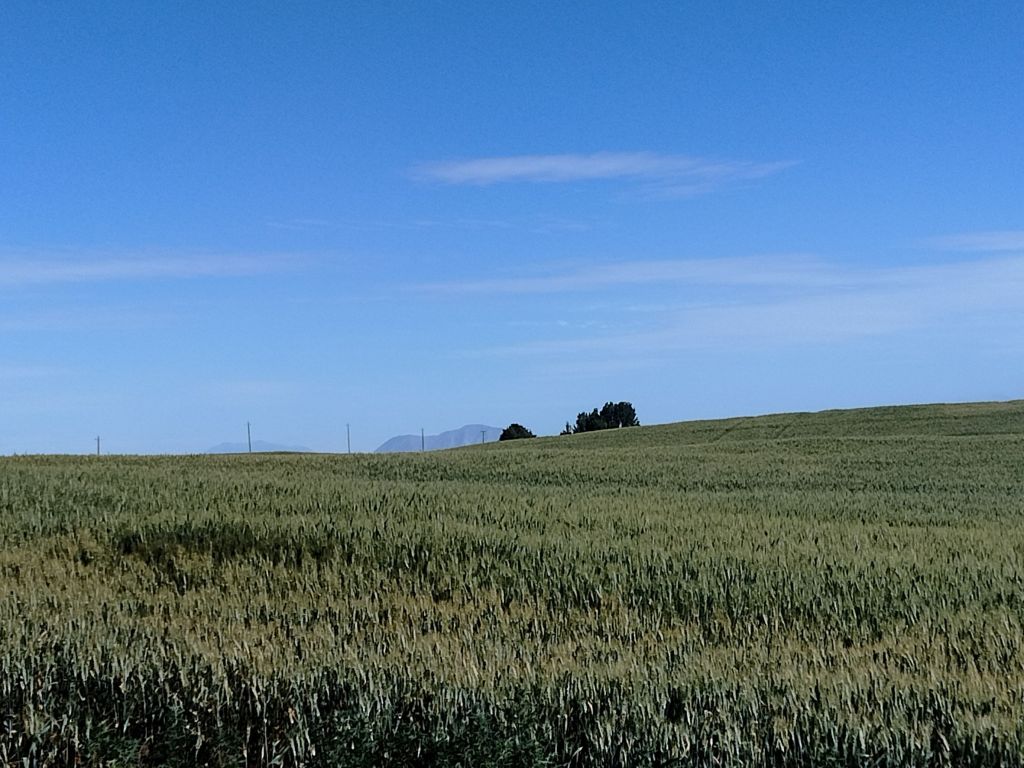
BSB is one of the biggest perks of living in the particular farmhouse where we do. Our house is perched on a rather high spot in the midst of relatively flat farms and desert. Looking north from our yard, you can see 30 miles to Big Southern Butte, and on clear days, to the Sawtooths beyond. It looks best around sunset, when it and the Twin Buttes to east of it are lit dramatically and often attract their own clouds. I have been trying to photograph it since we moved here, usually without much success, but in the picture of our downed tree above, you can see BSB in the distance. And here it is looming over the wheatfields:
A few weeks ago, the explorer to whom I am married expressed a desire to drive up BSB and then hike the last hundred yards to the top. He had read some travel materials that said the road was passable. (bum bum bum) Of course I had to come along, because it has long been my dream to actually go to the butte.
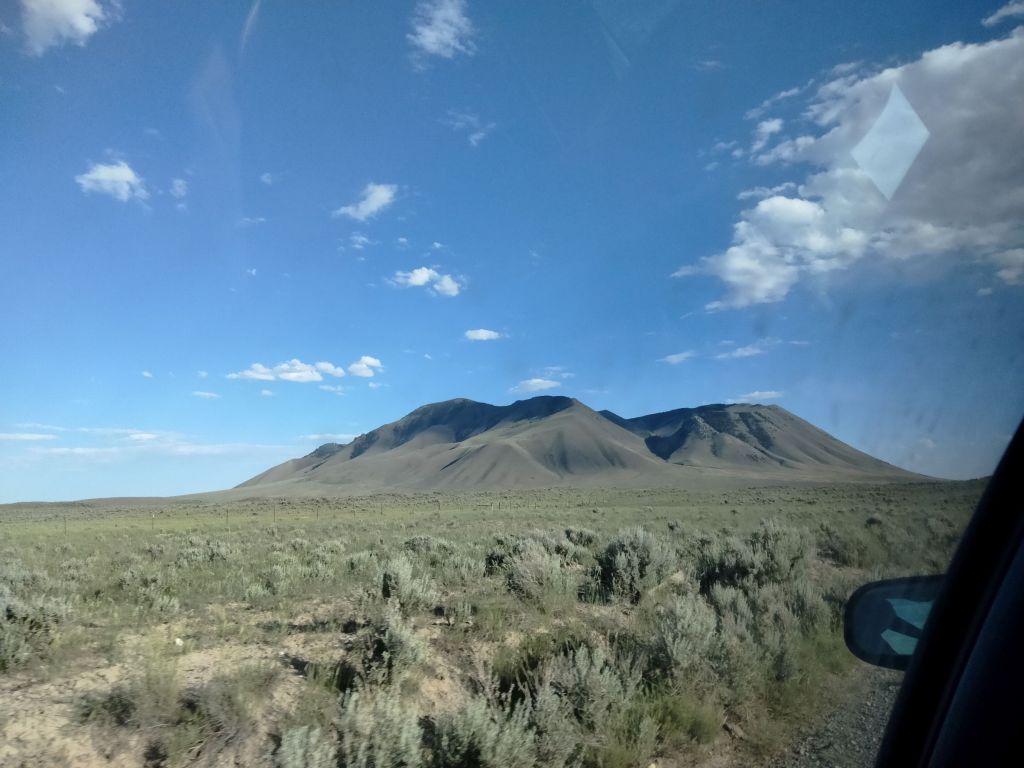
The road leading to BSB from Atomic City is dirt with patches of basalt rock sticking out. We approached our goal from the southeast and drove completely around it, which was satisfying. There are quite a few roads tracks in the area, but all of them are better suited for pickup, jeep, or ATV. Above is a view of the butte from the North, as we were leaving.
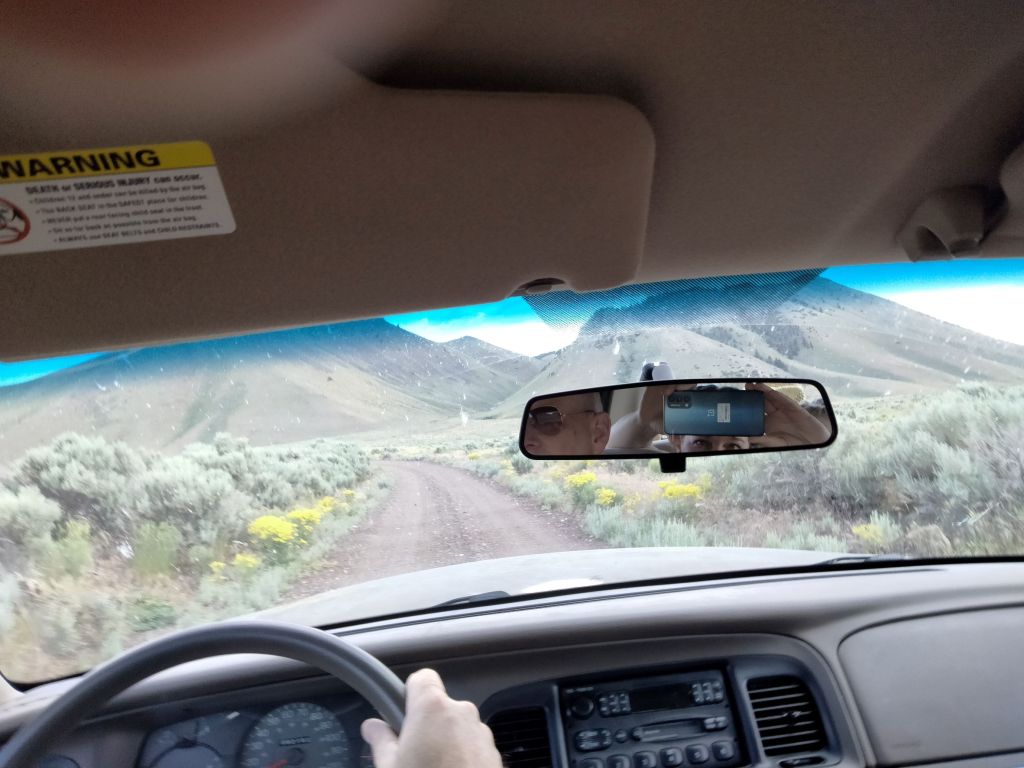
The road that supposedly led to the top of the butte enters it via a crack (the “butte crack”) on the northwest side. Here we are approaching it. You can see the terrain, which is basically “high desert,” with rabbitbrush and silver sage.
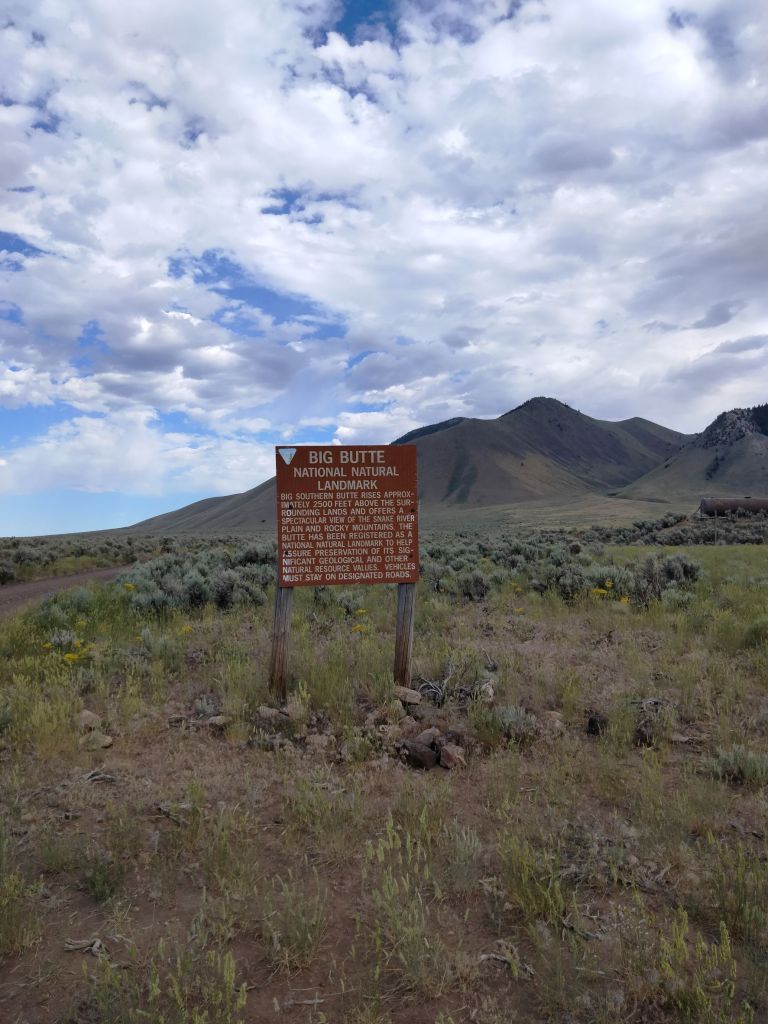
Here are the butte’s bona fides.
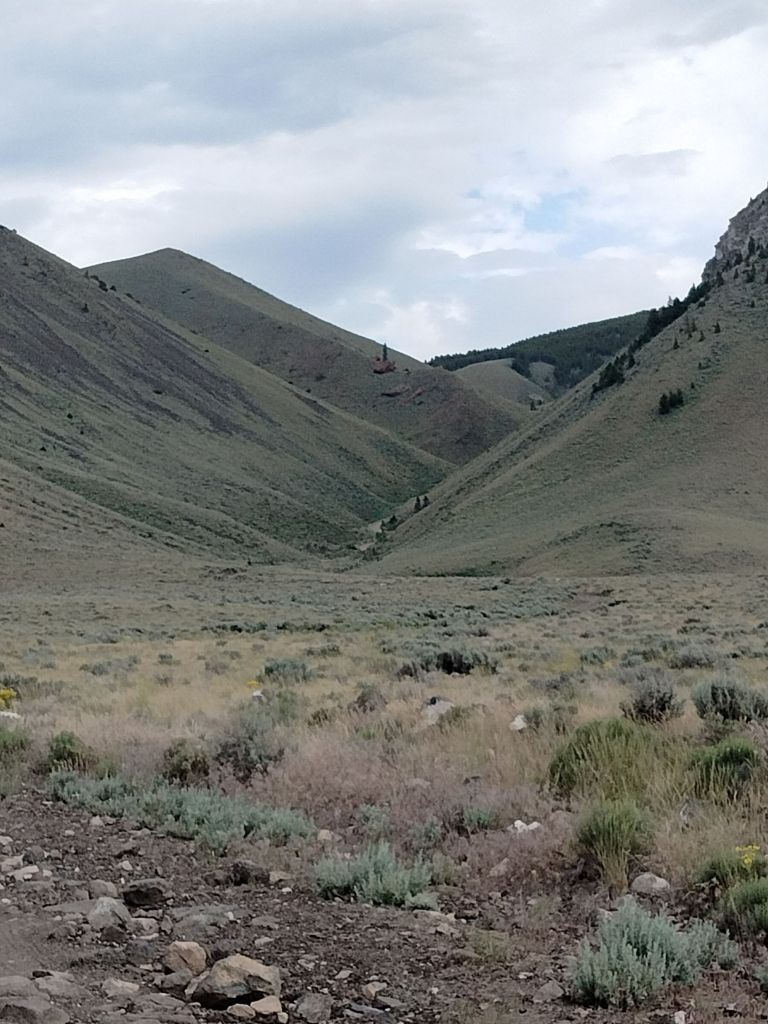
We drove a ways into this crack, but whatever travel articles said the road was good must have been written a season or two ago. My husband did an amazing job maneuvering our sedan over many patches of rock, but at last we reached a point where it was pretty clear we could get high-centered if we were to continue.
Luckily, that point was partway up the side of the butte (past the first turn you see in the photo above) and there was a pull-out place to park. Some of our party hiked a ways farther up the trail, but did not go all the way to the top as it would have been 3 miles from there.
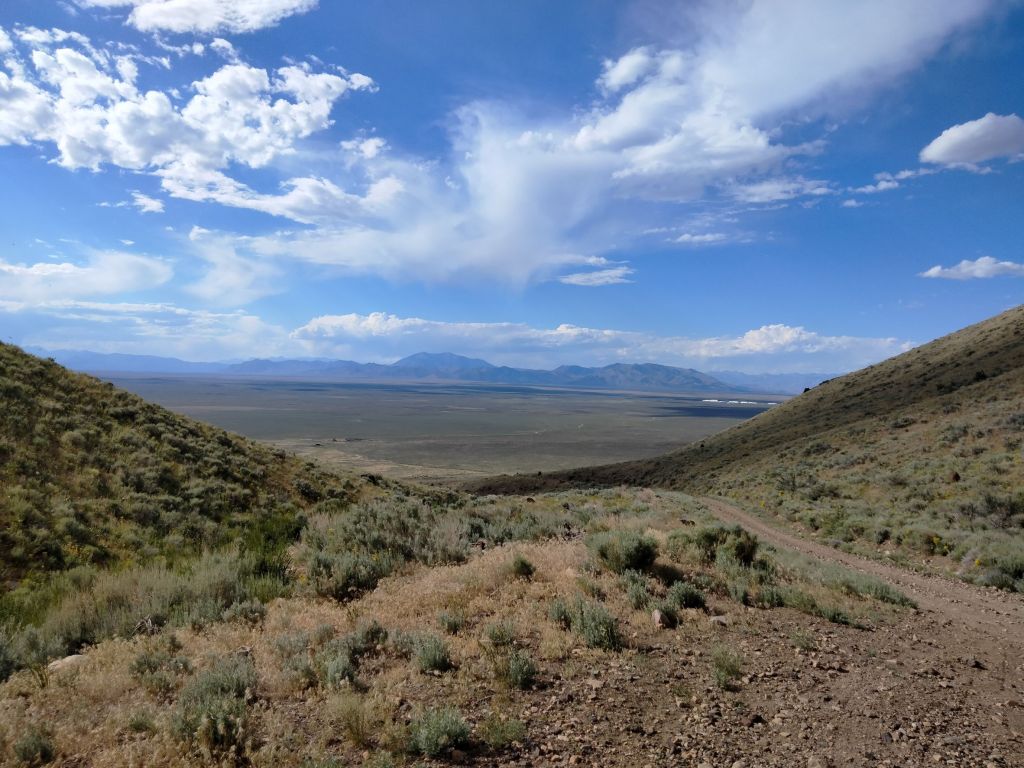
Here are the Sawtooths as seen from our parking spot. My husband says these are not the actual Sawtooths. I understood the whole region was called the Sawtooths, and then there were sub-ranges within the region, so I don’t know. Even with this little bit of height, you can start to see into the ranges. Back here are the Pioneer Mountains and the Lost River Range, among others.
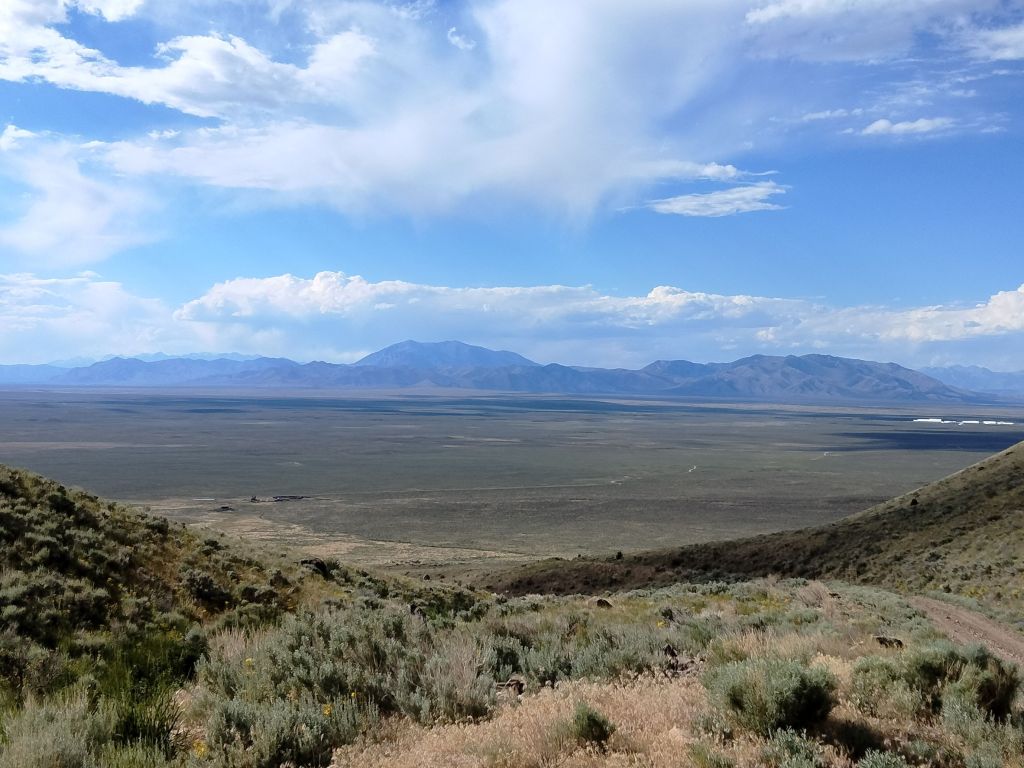
It’s amazing what a difference results from going a mere 30 miles north and attaining just a little bit of height. From our house, it looks as if there is just one large mountain beyond BSB. From BSB itself, you can see that there is a whole range, and we plain-dwellers can just see the tallest.
For now, I’m content with having seen BSB up close. I would like to go to the top some day, but that will have to wait until we have, or borrow, a more suitable vehicle. In the meantime, at least we don’t have to say that we lived near a topographical wonder and never touched it.
“Why the dickens couldn’t you have held her feet?” said Eustace.
“I don’t know, Scrubb,” groaned Puddleglum. “Born to be a misfit, I shouldn’t wonder. Fated. Fated to be Pole’s death, just as I was fated to eat Talking Stag at Harfang. Not that it isn’t my own fault as well, of course.”
The Silver Chair, by C.S. Lewis, chapter 15
“The natural brickwork was actually the result of volcanic geology which has fractured the rock in a curiously uniform way.”
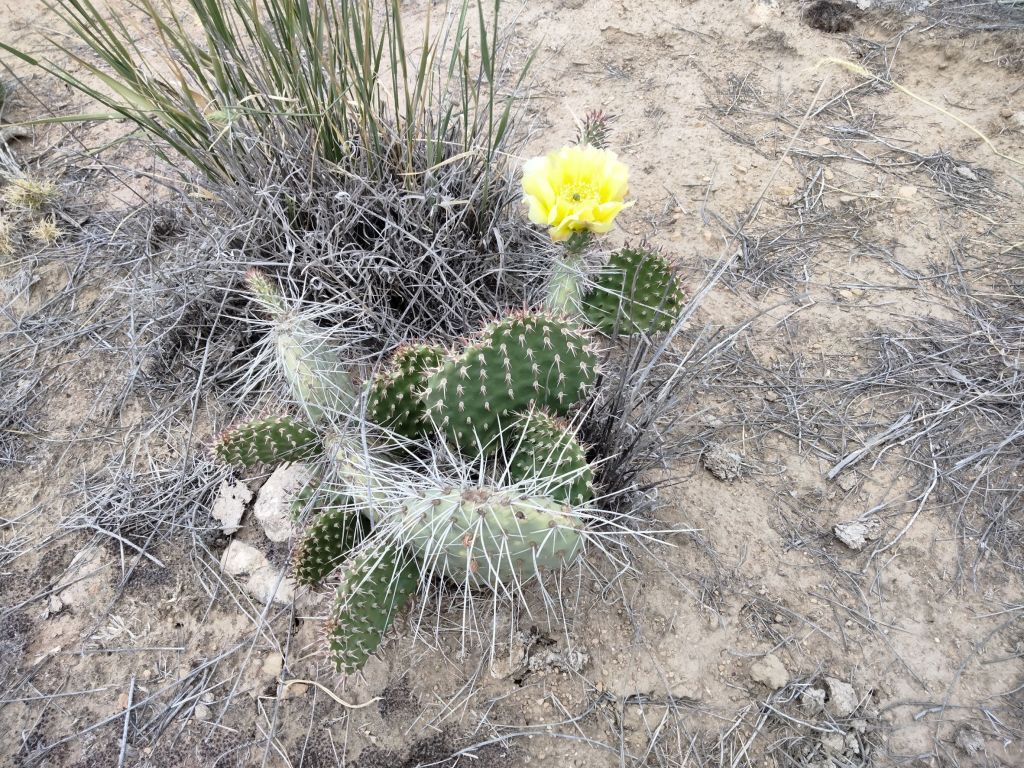
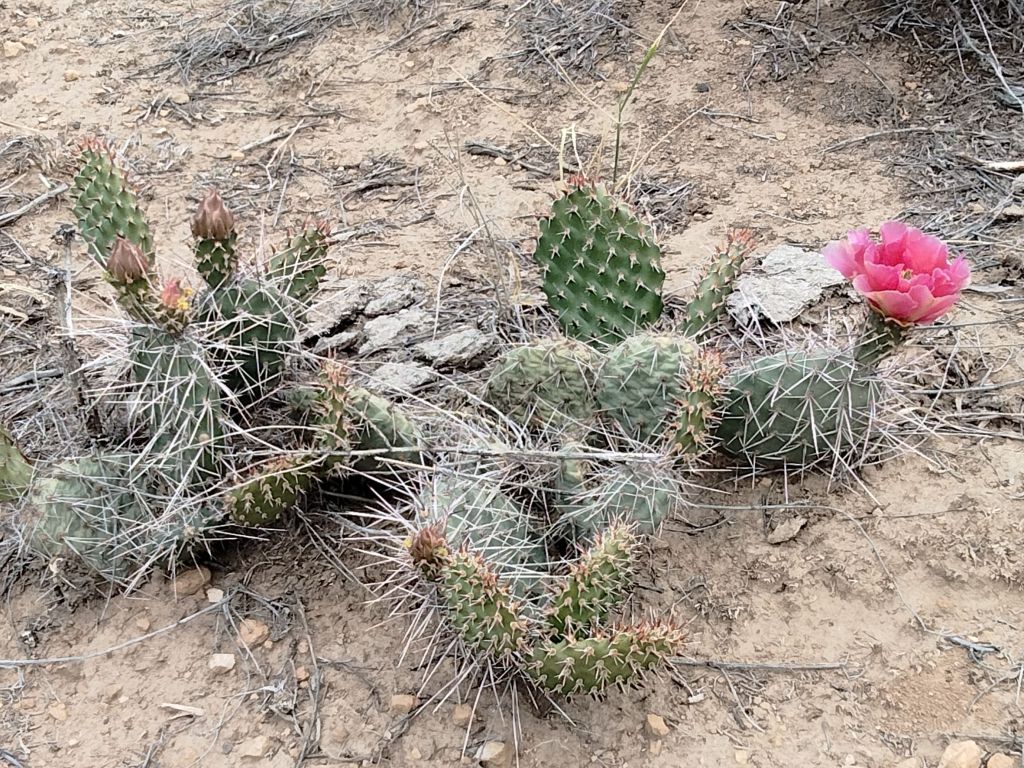
The long spines and flattened, blue-green pads of the plains prickly pear are familiar to anyone who has had the misfortune to step on one. As if the sharp, long spines are not trouble enough, the plants are also armed with a ring of tiny, hairlike barbs (glochids) at the base of the larger spines. These tiny barbs look harmless, but once touched they penetrate the skin and refuse to let go. However, the beautiful flowers of prickly pear more than compensate for the dreaded spines. The flowers are large, up to 3″ or more, with numerous red to yellow petals. The fruit is a pear-shaped berry, dry and very spiny, unlike the juicy “tunas” of some southwestern species of prickly pear.
Habitat/Range: Dry grasslands from the valleys and plains into the foothills, canyons, and montane forests.
Comments: This was the most dreaded plant encountered by the Lewis and Clark Expedition (1804 – 6), because the spines would penetrate the explorers’ moccasins, causing great discomfort. On July 15, 1805, while ascending the Missouri River near the mouth of the Smith River, Lewis noted in his journal: “[T]he prickly pear is now in full blume and forms one of the beauties as well as the greatest pest of the plains.”
Central Rocky Mountain Wildflowers, by H. Wayne Phillips, p. 125
This book was a pleasure to read.
This review was originally posted by me on Goodreads and has been edited for clarity. The book is by Gregory Maguire, the author of Wicked, and is part of the same universe. It is the first book by Maguire that I have read. I gave it four stars.
The prose is almost like poetry, but not purple. Not hard to plough through; it draws you through. The psychology is amazing. So is the portrayal of a sort of ancient-Greece-based world. I picked up this book for the brides, who are sort of like pagan nuns (Vestal Virgins?) living all alone on a remote island, performing bloodletting and weaving rituals in order to guard a sacred artifact.
Every morning, the “brides,” who range in age from ten to about eighty, troop down to the seaside where they use sawgrass to cut crosshatched lines into the soles of their feet. Then they sit with their injured feet in the salt water and tie seaweed into a net. This ritual supposedly “weaves time” so that the world can go on. The brides are almost entirely self-sufficient, keeping gardens, goats, chickens, and an orchard. None of them have ever seen the mainland. They are brought to their island, called Maracoor Spot, as babies. There are always seven brides, so whenever one dies, a baby is brought to replace her.
The way Maguire introduces all this information is magical, as if he were weaving a spell. There are lyrical (but not sappy) descriptions of the island’s weather, the sea, the rain, the clouds, interspersed with descriptions of the brides’ suffering at their morning ritual. This slowly expands to show us their names, ages, personalities, and daily routines. They sleep in the outer part of a small marble temple, the inner room of which houses the terrifying artifact.
By the time Maguire was finished showing us the brides and their way of life, I was hooked. I knew I was going to finish this book.
The moral lessons, at least to which the story seemed to be heading, weren’t ones I could completely get on board with, however. So now let’s to spoiler town (though I should add that there are vast swathes of this book I haven’t addressed, so this is not a complete spoiler).
Rain, who seems to be the character we are most supposed to identify with considering that she is the one who comes from a beloved earlier series, makes the argument that Acaciana (“Cossy”) can’t be tried for murder because she is a 10-year-old child who has been raised in the very restricted environment as a Bride of Maracoor, not having a natural family, not having been given any chance to develop a conscience. She argues that the whole setup with the brides living on an island and ritually mutilating themselves every day, in service of the country’s religion, is inherently unjust and oppressive, and thus Cossy can’t be expected to know right from wrong.
It’s true that there are some troubling things about the “brides,” who are brought to the island as foundling babies and know no other life, being deprived of the chance to marry and have families and live in normal society. However, I can’t tell if this is a critique of ancient pagan customs such as the Vestal Virgins, or of there being traditions or religion at all. Obviously some religious customs are more oppressive than others. The brides are better off on Maracoor than if they had been made into temple prostitutes, for example.
It’s also not entirely true that Cossy was raised without any family at all. Cossy had a grandmother figure in Helia, who did some significant parenting, both good and bad. She had a sister in Scyrilla, and aunts in the other brides. Though there are only seven of them, the brides form a definite human society, with all the benefits and problems that come with that.
This raises the other point that Rain overlooks: no one gets to choose what family, society, or social station they are born into. The brides’ life might be more restricted than most people’s, but no one’s life is completely unrestricted. No one has infinite choices, and everyone has obligations placed upon them that they didn’t choose and don’t at first fully understand. These can be just or unjust, and we can argue that on the merits. But we should remember that they are not unjust simply because they are restrictions, obligations, and unchosen. Since the brides are all foundlings, we can assume that if they had not been brought to the island of Maracoor Spot, they would have either died of exposure (the fate of so many unwanted Greek and Roman babies), or been raised in some kind of institutional environment like an orphanage, where their lives would have been just as restricted, but without any sacred purpose.
Actually, I happen to agree that Cossy isn’t entirely responsible for the murder she committed, but it’s not because she was raised in an odd, isolated environment. It’s because Helia, her beloved grandmother figure, implicitly encouraged her to do it, told her exactly how to do it, and almost physically walked her through the steps. Helia is morally responsible, not only for the death, but also for taking an impressionable ten-year-old girl who is curious about death and making her into a murderer … and then throwing her under the bus. I don’t blame “the system,” I blame Helia.
That said, you can’t argue that Cossy absolutely did not know right from wrong or that she was in no way responsible. Witness how she falls apart after the death. She knows that she has done a terrible thing from which there is no going back. If she herself had not really committed murder, thus really changing her own character, then what Helia did to her would not have been such a terrible thing.
This book ends on a bit of a cliffhanger. There are lots of unanswered questions, such as the nature and fate of the Hammer of Mara, whether Maracoor is going to continue sliding into paranormal chaos, and whether Rain is going to get back to Oz. For me, there are also unanswered questions about Rain’s back story, though I suppose those answers are already known to faithful readers of Maguire’s previous books.
Soon the station came into sight. It had the appearance of an iron cathedral on the shore of the frozen sea. It had spires and arches in its makeup, but none of them were for decoration. The arching structures that clawed into the ground and the sea carried heavy-gauge superconductors and the spires and turrets were microwave receivers that employed field technology rather than the bulky dishes used heretofore.
Gridlinked, by Neal Asher, p. 108
I get regular e-mails from The Survival Mom. Learning to prep is a steep curve, and I have definitely not reached the pinnacle (and, after all, who has?). But I got this very relevant e-mail from her last week (copy-pasted below), and I think she is absolutely right.
Hi there, ,
After being in the survival and prepping niche for more than 12 years, I’ve heard just about every survival strategy and tactic there is.
One of the most popular is this, “Learn how to grow your own food.”
And more recently, “Better get a garden started right now!”
That isn’t a bad idea, but for the vast majority of people — like 75% or more — it’s not only unrealistic but foolish to think you can grow enough food in a garden to sustain life.
“How much did you say I have to grow???”
Just to maintain average health, the average adult needs anywhere from 1600 calories to 2000 or more per day. The most popular and easiest to grow vegetables, like tomatoes, zucchini, and cabbage, have around 20 calories per serving. Clearly, the typical vegetable garden is not going to save anyone’s life
Let’s take a look at potatoes. They’re a lot higher in calories (160 for a medium potato), very versatile, and they can store for long periods of time. To live on nothing but potatoes, you would need to grow around 6000 potatoes per person per year. This can be done, but you’ll need at least an acre of land, growing nothing but potatoes, not to mention optimal growing conditions, farming equipment, fairly high level skills, and knowledge.
You’ll get the calories you need from those potatoes, but is that any way to live? For a year?
Have you ever tried to farm even just one acre? I never have, but I imagine it takes more effort than a few Square Foot Gardening boxes!
Growing one or two other high-calorie crops will provide more variety, but you’ll also need more land. No one really wants to survive on just potatoes and maybe some corn or beans, so raising chickens, some rabbits, and maybe a few goats seems like the way to go — but have you ever done that before? And maintained a couple of acres of crops at the same time?
How will you preserve all the food you grow, and maintain healthy soil so it keeps producing? The depletion of nutrients from soil is a significant issue, so to keep your multi-acre garden producing enough food to keep from starving, you’ll need to factor in the right types and amounts of fertilizer.
There are hidden expenses in all these endeavors that you usually won’t learn about until they suddenly become urgent!
What a garden is good for
Depending on a garden for survival is unrealistic for nearly everyone. An old farmer once told me, “It takes about 10 years to get to know your land,” and even if all you’ve ever done is some container gardening, you’ve probably learned the truth in that statement!
A more realistic plan for integrating a garden with your prepping plans might include:
Personally, I use my garden as an excuse to get outside and into nature every single day, and for me, that’s reason enough to always have some type of garden. I just don’t have any expectations that it will someday save my life with its bounty, or lack of, depending on the year!
I’m not trying to discourage you or mock your plans for survival
The plans we make ahead of difficult times and worst-case scenarios need to be made with the least amount of emotion and the clearest view of reality.
I cannot stress that enough.
Gardening can be incredibly expensive, and in a time of inflation and unpredictable product shortages, this isn’t the time to pour money into something you hope will be life-sustaining only to find out how impractical and difficult it really is.
We’ve all heard stories about the $45 tomato — or maybe you’ve grown one of those yourself!
Calories count. Nutrients and micronutrients are vital, but if there’s anything susceptible to the whims of Mother Nature, it’s growing food.
So what is Plan B?
Keep working on your garden and improve your skills and knowledge each season and with each seed planted — if you’re enjoying the process and have the time, money, energy, and manpower to continue. Expand your garden. Try new crops, but also integrate some of these into your plans and routines:
Survival is more than just “get a garden started”
I really do wish it were that easy! However, you’ve probably learned by now that “survival” is never a one-size-fits-all and there are always multiple layers for your plans and preps to be effective.
All the best,
Lisa

I had a little trouble identifying these, as they are clearly yellow, whereas the Ball-Head Gilia described in my trusty Central Rocky Mountain Wildflowers Falcon Guide are “white and sometimes flecked with purple” (page 233). But everything else seems to fit.
This is Ipomopsis congesta, from the Phlox family (Polemoniaceae). It grows in “[d]ry, open places from the valleys and plains to the alpine zones” and “[s]everal varieties occur.”

 Out of Babel Books