I'm a wife, mother, Christian, closet Luddite, Neanderthal advocate, incurable book hound.
I'm also the author of The Scattering Trilogy, which is set in 10,000 B.C. Buy, read, pass it on!
Leave comments. Let's talk!
You Don’t Own Me, by Mary Higgins Clark but actually by Alafair Burke, 2018
I reached for a Mary Higgins Clark because it’s autumn and I wanted me some New York City. I would never want to live there, mind, but a certain version of NYC gives autumn vibes that can’t be beat. I wanted wet leaves, Burberry plaid, private schools, brownstones, Italian restaurants, snobbery, and houses in the Hamptons. (Don’t even know where the Hamptons are, but I know they come with the package.) This book delivered those vibes adequately. It even had me turning to DuckDuckGo to look up some hole-in-the-wall restaurant in the art district that has been a NYC fixture for years apparently. Or I don’t know if New Yorkers would consider it a hole in the wall. The pictures make it look like one, to my West-of-the-Mississippi eyes, where everything is spread out from everything else.
Anyway. This was very New York-y. The protagonist’s dad is a retired NYC cop. There are Italian restaurants. There are nannies. The fiance has a live-in butler. The couple spend most of the book looking for an apartment that has to be in a certain part of the city. In fact, their realtor was so pushy that I started to wonder whether she would turn out to be in on the crime-spiracy. For NYC vibes, it was second only to a Mary Higgins Clark that I read years ago, where the protag’s mother was in the fashion industry and was killed in Central Park by being strangled with a high-fashion scarf.
As with every Mary Higgins Clark, the plotting is very good, very intricate, and the dialogue not so much. Every person who talks is very smooth, articulate, and sounds like a news anchor or else like the narrator. Oh well. I didn’t come here for Chaucer. This book went down easy.
Sweetgirl, by Travis Mulhauser, 2016
This is a Michigan gothic, which is like a Southern gothic, but with blizzards and rude people instead of polite people.
It veers very close to being a horror story, but my overwhelming impression is that of heartbreaking sorrow, but sorrow with a lot of human sweetness in it too.
The very first line sets up the whole plot by outlining the problem and introducing the principle characters in one fell swoop:
Nine days after Mama disappeared I heard she was throwing down with Shelton Potter.
Percy James is a sixteen-year-old girl who is an adult before her time. She has quit school and taken a job so that she can support herself and her druggie mother. Shelton Potter is sort of the opposite: he’s twenty-five, but his mental life is more like that of an immature teen.
The chapters alternate between Percy’s point of view, told in the first person, and Shelton’s, told in limited third. Although Percy goes through a lot of horrible stuff, which I won’t share because of spoilers, the parts that really broke my heart were Shelton’s internal monologue. Although Shelton spends the entire book high–making one horrible decision after another–a danger to himself and others–he still has thoughts and feelings. Quite a lot of feelings, actually. Mulhauser does an amazing job making us follow Shelton’s train of thought, feel his sorrow, and see his naive good intentions. Shelton really does have a good heart. It’s just that he doesn’t have any self-control or common sense. Oh, and he’s high all the time. Many books will give us an antagonist who’s a drug dealer/addict, may be violent and touchy, and may not be too bright, and often at or near the end of the book we get a tiny, poignant glimpse into this person’s sad back story. It’s a rare book that has us in that person’s mind from the very beginning, sympathizing with him to a degree but also hoping something stops him before he does major damage.
One more thing I will say in praise of this book: the prose is top shelf. To take just one example, the last paragraph of the book has Percy going through a variety of complex, poignant emotions. It does not have a single sentence telling us what Percy was thinking or feeling. Instead, every sentence in that paragraph describes something she can hear from where she’s standing. It’s all entirely concrete, and it will rip your heart out. That, my friends, is showing-not-telling. I learn at Travis Mulhauser’s feet.
I believe that history will judge the tick-borne disease outbreak that began in 1968 as one of the worst public health failures of the last century. In the beginning, we were slow to recognize the triple threat. A situation that is now out of control, spreading far and wide, could’ve been contained with an early intervention of tick-control projects and a public education campaign.
The myopic focus on only of the tick diseases, Lyme disease, has led to treatment delays and fatalities in patients with serious mixed infections.
[My mother’s] first bout of Lyme disease was diagnosed at the Bethesda Naval Hospital when a physician discovered three large bull’s-eye rashes on her behind. The physician was so excited at this classic presentation of Lyme that he called in several other handsome young navy doctors for a viewing. (My mother, somewhat of a flirt, loved telling this story.)
my review of The Penitent by C. David Belt, posted on GoodReads on July 31
I’ve been enjoying these Mormon vampire stories by C. David Belt. This one is the second in the trilogy. In the first book, The Unwilling, a Mormon man named Carl accidentally became a vampire while investigating what he believed was a cult that had seduced his sister. He took the vows you need to take to become a vampire, but didn’t mean them or think they were real. Hence, he is the first “unwilling” vampire in history. Whether or not you think that taking vows while holding mental reservations about them actually lets a person off the hook, for the purposes of this series, it does. The first book is written in the first person, present tense, from Carl’s point of view.
This second book is written in the first person, present tense, from the point of view of Carl’s vampire wife, Moira. (How that came about is a long story, told in the first book.) Moira is a Scottish lass who, more than two hundred years ago, became a vampire intentionally in order to get revenge on the British. But she has since repented and has managed to spend her life without killing any mortals. Hence, she is “The Penitent.” Through a long and convoluted chain of events, Carl and Moira are both somehow vampires and also faithful Mormons who were married in the Temple in Salt Lake City, and who call people to repent and turn to Christ whenever they get a chance.
The worldbuilding in these books is detailed and consistent, in terms of scientific explanations for why vampires are freakishly strong, why they can fly, what can and cannot kill them, and so forth. Oh, and how they can be Christians. The main antagonist is Lilith, “Mother of Night.” The lore around Lilith seems to be a little different in the Mormon world than elsewhere. I had heard that the legend was that Lilith was Adam’s first wife, created before Eve, but in one passage, the characters in this book refer to her as being “three generations down from Adam.”
The theology behind this book is Mormon, which is to say it sounds about 90% Christian, but isn’t quite there. For example, in one scene, Moira is telling a wretched, extremely bitter woman that instead of self-terminating, she should repent and turn to Christ. So far so good. But then Moira tells her that she can be saved if she “turns to Christ and lives a righteous life.” Meanwhile, this poor woman is obviously totally unable to live a righteous life. That’s her whole problem. Mormon theology doesn’t have a really deep grasp of sin nature. I really like the author of this series, C. David Belt, and I sincerely hope that he soon comes to grips with this problem and realizes that people are truly helpless sinners who need something more than what moralism can offer.
The language in this book is pretty good. I don’t personally prefer books written in the present tense, but Belt’s books include a lot of action and also vision/dream sequences that lend themselves to the present tense. Moira tells her story in a slightly Scottish dialect (for example, she consistently uses “nae” instead of “not”), and it’s fun to hear Carl, a former fighter pilot, revert to “pilot speak” when the vampires are flying on a military-like mission.
Based on the plot, worldbuilding, and language, I give this book 5 out of 5 stars for the genre, and in fact it may be the only series of its kind in this genre.
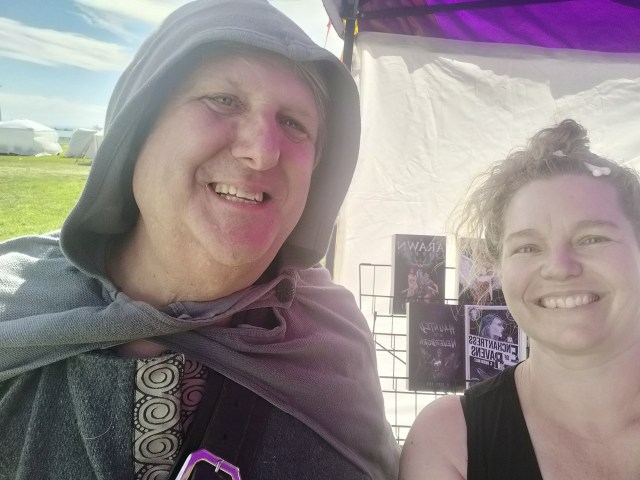
me and C. David Belt at a RenFaire a few years ago. I was dressed as a cartoon cave woman, and he was dressed as a medieval Scot.
This is my favorite recipe that I learned how to make while in Indonesia, and it’s the only Indonesian dish I still cook. Who knew that it would look so good in a temperate zone, where we have seasons!
This dish is called tempeh orek. It uses tempeh, an affordable meat substitute similar to tofu. It’s firmer and chewier than tofu, with soybeans embedded in a sort of block that you can cut into strips and fry up like meat.
To make tempeh orek, you first deep-fry the tempeh all by itself in a pan full of that Indonesian cooking staple, palm oil. When the pieces are light brown, take them out with a strainer and drain them on paper towels.
Let the oil in the pan cool and pour off most of it (say, into a reserve jar). Leave enough to sautee spices. Then you need to sautee a large pile of chopped or grated shallots, grated garlic, and grated ginger for about 30 seconds. (If you have no shallots, you can substitute white or yellow onion, or even leave them out.) While sauteeing, add about a tablespoon of MSG, powdered chicken stock, or a powdered seasoning packet from an instant Ramen.
Once you have the flavors prepared, add back in the tempeh strips and stir to coat. Then sprinkle on palm sugar — about a quarter cup per six ounces of tempeh. Brown sugar makes a fine substitute. Stir, and the sugar will melt and coat the tempeh to make a savory syrup. Finally, add chopped steamed green beans and red peppers that you have pre-prepped. You may need to add a dash of water to the pan in order to get the syrup liquidy enough to coat all the goodies within.
Serve over rice. If you want a really authentic Indonesian experience, you should have sweet soy sauce (kecap manis) and pureed chile peppers (sambal) on the side, and fruit for dessert.
The only drawback to this meal is that tempeh costs $3 to $4 per six ounces (or is it eight ounces?) at my grocery store. I usually buy two blocks and make a double batch, which is sometimes enough for my family, but really, they would eat twice that in a sitting if they could.
Back in August, I got thoroughly shook when I heard a conversation between Dr. Oz and Ben Shapiro, on the Ben Shapiro show. I have saved my reaction for October, a month when I post about scary things, because Dr. Oz does not seem to realize how scary his plans are.
They are discussing the MAHA (Make America Healthy Again-) government initiative. Ben asks about the problem that patients have difficulty getting ahold of their medical records (their “charts”), which makes it difficult to get your information from one specialist to another.
Dr. Oz’s solution, though he doesn’t articulate it in this short, is that each patient chart will exist in a big government database. It will be tied to your social security number, and to “facial recognition, like in airports.” There will also be a big database of MAHA-approved healthcare providers, so these people can have instant access to your patient records. The MAHA bot can recommend to you an approved provider in your area, and, as Dr. Oz forecasts in this short, the MAHA bot can also call your attention to incipient health problems that you may have, and recommend, say, an app to help you lower your blood sugar. And it can tell you not to eat that thing that you’re about to eat. All this, said Dr. Oz on The Ben Shapiro Show, will be “completely optional.”
What could possibly go wrong?
I believe that Dr. Oz has good intentions. He wants to help Americans be healthier, and direct action on this by a massive, centralized government department is the only way he can imagine to get this done.
Whenever we create an awesome new power, we have to game out all the scenarios. We have to imagine not only how it will be used by people with good intentions, but how it could be used by people with bad intentions. Because every awesome new power will fall into the bad-intentioned hands eventually.
So, what could go wrong?
First of all, how long will participation in this system remain optional? And how “optional” will it really be? Will there be any health-care providers who accept patients whose charts haven’t been uploaded into the Leviathan database? Will this system, in fact, make it more difficult to find niche specialists who can help you with your particular problem? Because I gotta say, everyone I know who has become healthier, has done it by using resources outside the official healthcare system.
What happens if an error gets encoded in the official system? We saw this last week, where the diagnostic criteria for Lyme disease were dead wrong. Anyone who wanted to get diagnosed needed to find a rogue doctor. What will we do when Dr. Oz has gotten rid of all the rogue doctors?
Even if you try to opt out, you probably have some former doctors who would willingly turn over their records about you to Leviathan, to be listed next to your face scan and social security number. So you now have a, possibly outdated or incomplete, patient chart that is going to follow you around. Perhaps this chart will include an earlier misdiagnosis, like hysterical hypochondria instead of Lyme disease. Or “drug-seeking behavior” instead of chronic pain.
And how might our bad actors use this chart that is linked to all your other citizen data? Let me count the ways. You could be denied medical care if you don’t comply with a new, untested treatment. (Nevermind. That has never happened before.) Your taxes could go up if you are pre-diabetic; after all, you are costing the taxpayer more money! Never mind that you tried to opt out of Medicaid. You could have your grocery-store purchases restricted (card turned down!) if you try to buy something that the app deems inappropriate for a person of your health status. (These are the same people, recall, who apparently taught us the wrong food pyramid for sixty years.)
And, since this is October, let’s go for the really scary, but still plausible, scenario.
You’re walking down the street in your neighborhood. A drone buzzes up to you, identifies you using face-recognition technology. A friendly little Clippy pops out and chirps,
“Hello! It looks like your blood sugar is high. You have one year to get it down, using this app, or my brother drone will find you and euthanize you in order to save money for the taxpayers.”
“No name. I refuse. You should too. … So long as you answer to a name people can make you do things. You write your name down on a piece of paper and suddenly you have obligations. They say Prism go here, Prism go there, and you have to, because you answer to your name.”






 Out of Babel Books