
Oh. It’s Lupine again.

Oh. It’s Lupine again.
When I went to see Sage Wall, we stayed in Butte, Montana (pronounced byoot or biut), which is a relatively short drive from my house by the standards of the American West. Butte is a mining town, once known as “The Richest Hill in the World,” although generally, the riches were being spread thin, not going to the people who actually lived there. The riches are copper, silver, and, I believe, opals. If you have more time than we had, Butte has many things like rock shops and a mining museum. You can see little mining towers dotted all over the landscape.

A view of Butte, looking down from the hill above the town.

This plaque talks about women in Butte when it was a boom mining town. Sadly, Old West boom towns are notorious for having a lot of brothels, and Butte was no exception.
Over the town looms the hill itself, and in this hill is a huge, sandy-colored strip mine known as the “Berkeley Pit.” My husband, being the explorer that he is, wanted to visit the Pit. We got there just after the viewing platform closed, so instead, we drove up into the hills above and behind the Pit so as to get a glimpse into its depths.


And lo and behold … on a lookout point that overlooks one section of the Pit, we found this monument to fallen miners.
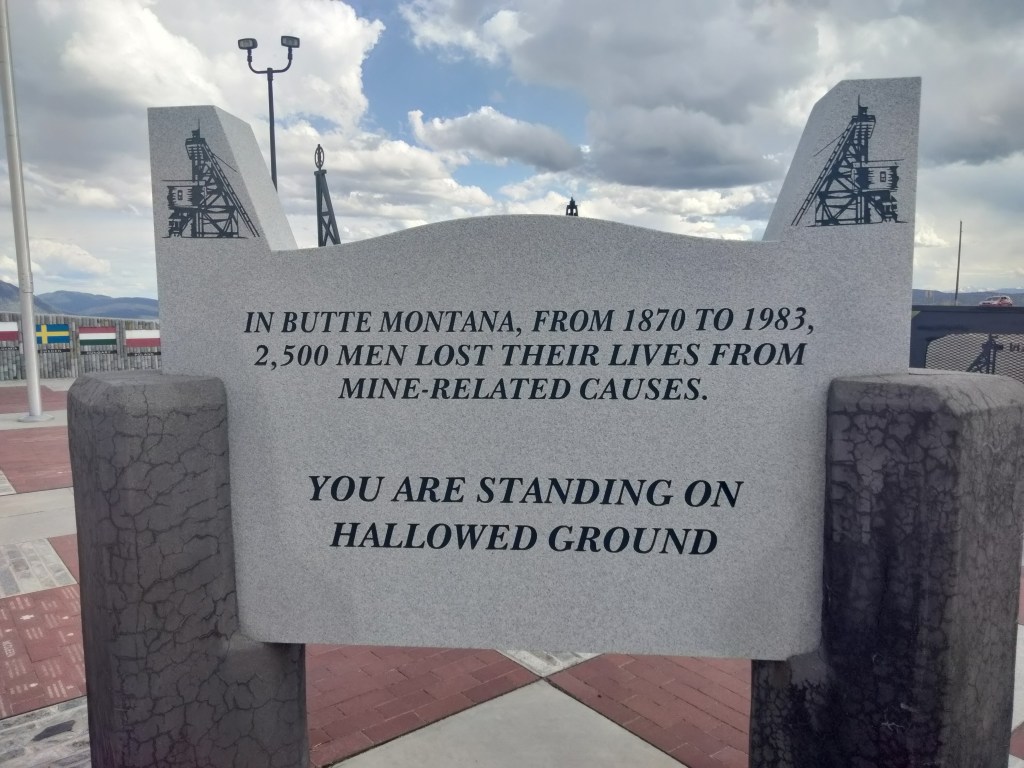
The monument is a large, paved area with the U.S. and Montana flags in the middle, surrounded by a wall on which informational plaques are mounted. I’m going to let my photos of the plaques do most of the work in telling you this story.
The flags you see in the background represent the nationalities of the miners who lost their lives in the disaster.
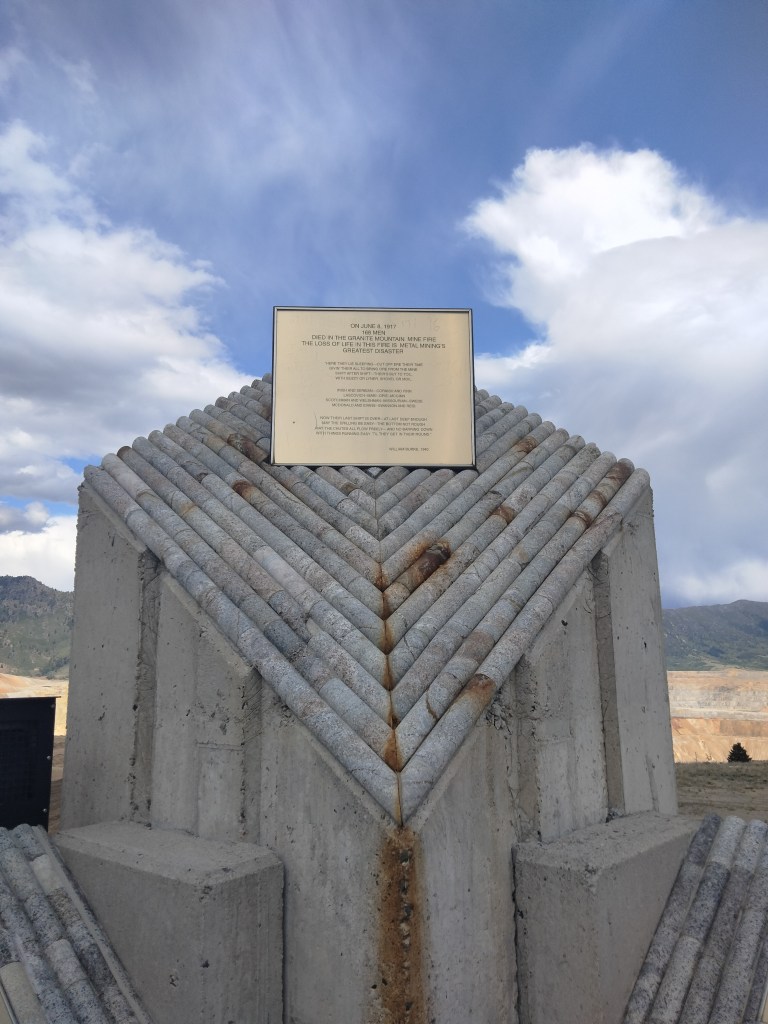
This prominent central plaque gives some basic information about the Granite Mountain Fire in June of 1917. The fire did not take place in the Berkely Pit, but in an underground mine. A cable, which was covered in a paperlike covering, broke and fell down a shaft. A group of miners went down to inspect the damage, and the paper covering on the cable was accidentally caught on fire by one of their headlamps.


This plaque, filled with names of men lost in the fire, is one of several.
The fire quickly filled the mine. Groups of miners, trapped in tunnels, built barricades (“bulkheads”) to protect them from the fire while they awaited rescue. Sealed off like this, their main danger became the limited air supply, plus fear and despair as their food and water ran low and their lamps began to go out.
Some of these men wrote letters to their loved ones. Here is one.

The town of Butte essentially stood vigil for several days. Firemen worked around the clock to put out the fire and rescue miners. Restaurants stayed open and gave meals to the rescue workers. Grocery stores provided for the families of missing miners. People went into churches to pray for their loved ones.

The plaque below describes Butte as “the strongest union town on earth.” My feelings on unions are mixed to say the least, but I can certainly understand the need for them in the early days of mining.

The [journalism] instructor stressed his formula for writing the ideal headline to describe the story below it–a job in which every letter in every word counts (and W’s and M’s, being fat, count double …). You look for the specific word first. Use the specific “pistol” and switch to the general “gun” only if pistol is too long for the line.
I took this dogma with me to the newsroom of The Daily Oklahoman … The slot man … handed to me [a trivial story] that reported a woman filing suit against a doctor who had operated on her eleven years earlier. A subsequent surgery had revealed that the first surgeon hadn’t extracted one of his forceps before stitching up the abdomen.
I wrote: SURGEON’S FORCEPS / LEFT IN WOMAN / ELEVEN YEARS.
The slot man told me the line was too long and tossed it back to me to revise. Forceps is specific of what? It’s a tool, right? The first line became Surgeon’s Tool. That fit. Hours pass with more headlines written. The bulldog edition comes up from the printing plant. The night city editor scans it. Reaches page 27. Shouts: Stop the press, glowers at the slot man, and says, “Who wrote this!” I am identified as the culprit …
That Stop the press shout is often heard in old movies, but that was the only time I ever heard it in real life. Professor Herbert called me in, and … seemed perfectly satisfied that I could be blamed only for innocence in a world full of night city editors with dirty minds. I got a “B” in the course.
Tony Hillerman, Seldom Disppointed, pp. 172 – 173

The following review was posted on GoodReads on June 27.
I love Tony Hillerman’s Navajo police procedurals. A few years ago, I got to travel through Navajo country (Dinetah), which was amazing because for fans of Hillerman it’s like getting to visit Middle Earth. At the Navajo Cultural Center gift shop, they displayed many of Hillerman’s books, and this memoir. I picked it up, but it took me several years to get around to reading it.
Once I did, it went fast because this is a page-turner. Hillerman’s writing is understated and vivid (he started his writing career as a journalist).
It turns out that Hillerman is closer to the age of my grandparents. He grew up in the Dust Bowl during the Depression, fought in the Battle of the Bulge. Quite a lot of the book is devoted to his memories of France during WWII. He was then injured (legs, and eyes), spent some time in the hospital, and was sent home with crutches and an eye patch. He discovered that “Military Intelligence is usually neither.” He doesn’t dwell on it, but he had PTSD before that was a word. Nightmares, unable to keep his breakfast down. He recounts, in the 1950s, seeing a grisly car accident that made the police officer on the scene vomit, but Hillerman stood there unaffected.
Hillerman and his wife also adopted a number of children, and raised a big, happy family.
All of this is related with almost no self-pity, and it’s often very funny.
This book contained less about the Navajo than I expected. I guess Hillerman has poured his learning about them into his novels rather than into his memoir. But by the time the book reached his later years, when the Navajo became a big theme, I was not disappointed about this because the book itself had already been such an entertaining ride.
There is an appendix which lists a number of Hillerman’s books and sketches out the process that led to each one. They presented different kinds of problems that will be reassuringly familiar to other authors.
All in all, Tony Hillerman is a total mensch, a good egg, and it’s been an honor to get to know him.
This [hospital] ward had a tradition that no patient would be sent off to surgery without his fellows gathering at his bedside to hold a wake. The commissioned medical staff forbid this custom as insulting to them and contrary to good medical practice. However virtually everyone in the ward was a combat infantryman and the wakes went on anyway after the nurses had left. At these wakes, ambulatory patients would gather around the bed of the fellow due to go under the knife, discuss his character, and regale him with awful stories of ineptitude in military operating rooms (wrong organs tinkered with, arm removed instead of leg, and so forth). They would also establish “dibs” on his various possessions in the event he didn’t come back alive and compose a letter to his family describing his sins and shortcomings. The only nurse who didn’t consider this tradition barbarous was an old-timer captain. She thought it an antidote against self-pity–the worst danger in any ward full of badly damaged young males.
Tony Hillerman, Seldom Disappointed, pp. 140 – 141
5. All other pines besides Ponderosa. Especially creosote.
4. Ponderosa pines. They have a sweet smell that’s natural and can’t be faked.
3. Trees in the aspen/poplar/cottonwood family. They have a slightly spicy smell that lets you know you are outside.
2. Sycamore trees. They have wide-spaced branches and flaky bark that make them terrible for climbing, and their foliage isn’t particularly beautiful, but their smell …? Amazing. Instantly calms me whenever I am near them.
Notice that none of the trees on this list grow in the tropics. Sorry, tropical jungle! I have lived there, and while the tropical jungle may have much to recommend it (it is certainly better than the tropical city!), I am sorry to say that it does not smell good. Its trees and bugs are generally weird-smelling or stinky. And don’t get me started on the odor of unprocessed rubber!

Click through to the Amazon review for the traffic, or enjoy this excerpt:
Many potentially interesting things are going on in this story, but it is unclear who or what it is about. Endu has the most significant character flaw to overcome, but even he does not create the thin red line necessary to create a cohesive plot line, nor does he have a character arc. None of the characters do. Instead, it’s a series of events tend to ramble too much about mundane things.
…
Luckily, as the story progresses, it becomes very visual. However, it still lacks the emotional connection needed to captivate the reader’s mind because the author tells us some of the dramatic beats, which lessen the impact.
The author is on the cusp of developing a writer’s voice. I found some treasures that express that voice: “Wildflowers rose up like an army.” “Knowing the hidden rocks in the sea.” They are not only vivid, they express the theme and help set up the events.
I’m kind of tickled with this 3-star review. I’m also impressed, because it appears the person read the book over the weekend and then wrote this review to post on Monday.
As a matter of fact, I can dredge up nothing much to complain about in my formative period. We children spent those years of the Great American Depression/Great Oklahoma Dust Bowl living miles below the current poverty level but happily protected by love and the invincible ignorance of the young. Life in Sacred Heart then (and now, for that matter) was not complicated by any possibility of getting rich. Everybody was poor and when you’re a kid you don’t know you’re deprived unless you see someone who isn’t. That didn’t happen around Sacred Heart.
Tony Hillerman, Seldom Disappointed, p. 10
… multo facilius atque expeditius, propterea quod inter fines Helvetiorum et Allobrogum …
“… much easier and freer from obstacles, because the Rhone flows between the boundaries of the Helvetii and those of the Allobroges …”
Gallic Wars, pp. 14 – 15
My translation of the Latin above was initially this way:
“Many things [were] easy and indeed unencumbered, on account of the fact that [it went] between the borders of the Helvetii and Allobrog …”
I thought that the unexplained inter (between) referred to the road, but apparently it’s the Rhone, which shows up later in the sentence. Other than that, I had it pretty close.
When I first looked at the phrase propterea quod, I thought it meant “therefore because.” Propterea can mean therefore, and quod can mean because. On a closer look, a better translation was “on account of (propterea) the fact that (quod).” On account of the fact that. Translator Ruedele just took a shortcut and rendered it “because.”
 Out of Babel Books