The following review was recently posted by me on GoodReads:
So, it looks as if the “In Death” series by J.D. Robb is yet another very long-running series that I was unaware of. They are police procedurals set in the 2060s. This future world differs from our own about as much as you’d expect. Things are recognizable, and the terms, trends, and technologies that look different seem like reasonable extrapolations from what we have now. Obviously, this isn’t the only way the world could go, but it’s a plausible one. For example, people live slightly longer in this future world, so that one character casually mentions he’s going upstate for his parents’ 75th wedding anniversary.
The world and characters are introduced masterfully in a way that’s very much showing, not telling … so much so that I almost felt lost during the first few chapters. I don’t know whether this is because of an extreme leaning towards showing, or whether because this particular book comes very late in the series. The one thing I wished for more of was a physical description of Eve and of her husband, Roarke. Perhaps these were given in earlier books.
Forgotten also contains easter eggs. Eve’s husband, Roarke, and another family, the Singers, are both in the construction industry in New York City. Sound familiar? When I first started this book, I wondered whether it was going to be a re-telling of The Fountainhead. It wasn’t. There is also an allusion to The Cask of Amontillado. There are probably other literary allusions that I didn’t pick up on. These allusions take this book to a whole new level beyond its genre.
Realistic speech in books is important to me, and Forgotten excels in this area. The characters all speak differently from one another, whether they are a tough cop, a bubbly teenager, or a Russian gangster. I should also note that, although this book is gritty and deals with horrible domestic abuse and crime, it does not portray the world cynically. There are many characters who are genuinely good people, including main and side characters. I didn’t feel I was being sold a vision of the world where everything is class war or patriarchy or whatever.
Though long, this book covers only about three days of investigation. We follow the detective, Eve, through every minute of her day and night. Like many hard-boiled detectives, she and her team are very driven. She works late into the night. She forgets to eat unless someone makes her. She sleeps for … I don’t know. It looks like five or six hours maybe. I don’t enjoy this aspect of detective fiction, because it makes me tired. However, I know it’s part of the genre.
Personal Addenda because this is a blog:
I got this book from my husband’s trucker friend. After reading it, I checked on FictionDB, and oh my goodness! Forgotten is #53 of a 62-book series! And that series includes some books that are, say, number 11.5 as well. This friend of my husband’s is really expanding my horizons.
One other possible reason that I felt disoriented as I began this book was chronic pain. For the entire time reading it, I’ve been suffering nerve pain in my left arm. On and off, but mostly on. Update: it’s now about 7 weeks later, and the arm no longer painful, just pins and needles.
Next to come to mind was my original literary agent delivering her verdict on my first novel. Don’t want to show it to anyone, she said. Why not? It’s a bad book. Have to think of your reputation as well as mine. Why bad? It falls between the stools, halfway betwixt mainstream and mystery. No way to promote it. And where does the bookseller shelve it? Stick to nonfiction, said my agent. I can sell that for you. How about me rewriting it? Well, if you do, get rid of the Indian stuff.
Tony Hillerman, acclaimed author of the Navajo mysteries, in his memoir, p. 5
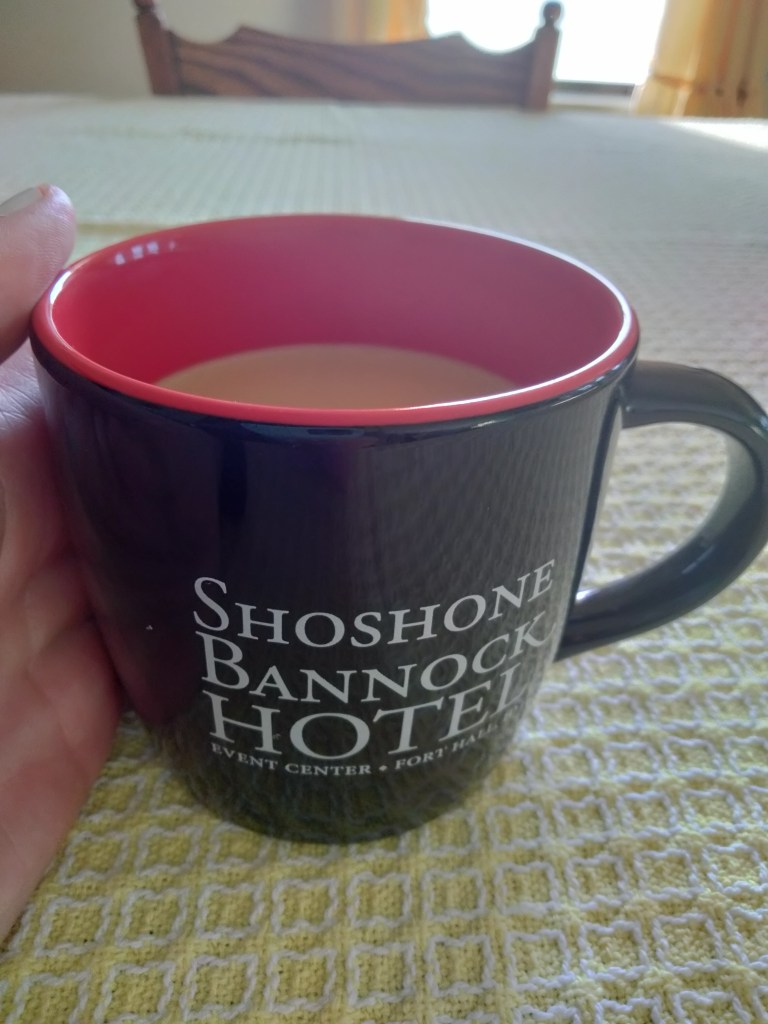
Continuing with the “nails and mugs” series, just for fun. It’s these tiny luxuries that make life pleasant.
I got this mug at a local thrift store. I have never gambled at our local casino, but here is its web site.
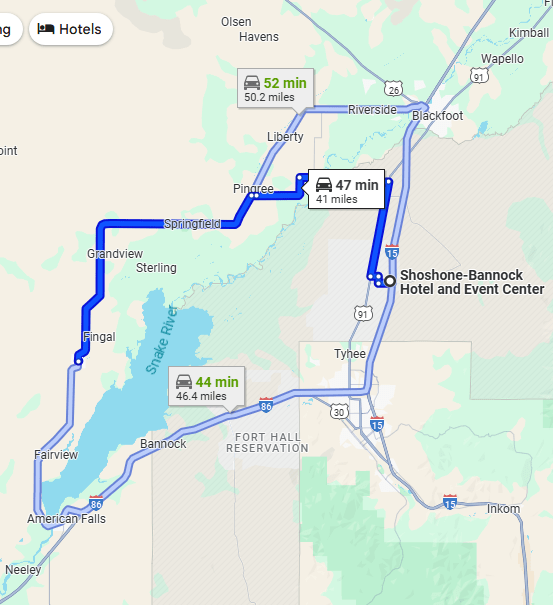
The Sho-Ban tribal lands are less than an hour’s drive from my house. The Shoshone and Bannock tribes used to have a range that extended farther north, into central Idaho and Montana, as you can verify if you read the book Naya Nuki. They were moved to a smaller place, as has happened to so many tribes. Read this book for a strong argument that American Indians should be treated just like regular American citizens, not as collectivist wards of the state.
Anyway. Although I do not go to the Sho-Ban casino/hotel/event center to gamble, I have been there a number of times. Its banquet halls have hosted our local pro-life banquet for the last several years. Plus, I like to go and eat at their resto (fry bread! bison burgers!) and go to their gift shop. For my last two birthdays, I’ve asked my husband to get me a hand-beaded Sho-Ban item from the gift shop there. These things are not cheap, but boy oh boy, I love them so much. They also smell like woodsmoke when you first buy them.
Here’s a leather barrette beaded in classic Sho-Ban colors.
Apparently, people will come from out of state to play at the Sho-Ban casino. I’ve seen billboards advertising it in Utah, for example. And when my husband and I go and eat at the resto there, the servers assume we are staying at the hotel. I guess we are getting old enough to look the part.
To get from the Sho-Ban event center to our house, you can take the back roads. You can drive through the reservation, over Sage Hill, cross the Snake River, and come out on Highway 39.
It’s a little longer, but it’s prettier and gives a fresh perspective.
Rodeos also take place on the Fort Hall Reservation. I aim to attend one some day. We moved here in 2019, and by the time I realized I ought to attend a rodeo on the rez, they had been cancelled indefinitely because of you-know-what. But I think they are having them again now.
In the only episode of Black Mirror that I ever watched (“Nosedive “), everyone can rate their interactions with everyone else on a scale of one to five, using an ocular implant that shows them a screen in their field of vision. Citizens’ jobs, housing opportunities, and so forth all depend directly on their composite rating. Of course this episode portrayed a dystopia, and I have no wish to live there. But this week, for the first time, I found myself wishing I could give strangers “five stars” from a distance, just to boost their morale. You know, what the old-timers used to call a compliment, but without the human interaction that makes it weird.
I guess this post will have to do. So, if you were at Silverwood amusement park in mid-June, know that I gave you five stars.
First, to all the beautiful young ladies in bikinis, short jean shorts, and summer dresses. You are lovely. Five stars.
Then, to all the deeply tanned grannies and the middle-aged ladies wearing racerback swimsuits. To the slender elderly ladies in linen pants and hiking shoes, and to the tough-looking older woman with the very short haircut. I want to be you. Five stars.
To the, possibly Mennonite, girls doing the park in long braids and even longer jean skirts, I love your outfits. I love your outfit, woman with a blue polka dot tiered skirt that echoed the shape of your short, pink-tipped ringlets. Five stars.
Now, about hair. I award five stars to all the ladies wearing intricate braids, hippy braids, or beachy buns. Five stars to the lady with the glossy black curls up in a high bun, and to the girl with touseled, Molly-Ringwald style short bob. Skinny girl with amazing natural hair who looks like Zendaya — five stars to you for keeping your hair in that condition. Redheads, young and old, I love your color. I love your hair, chubby American Indian kid with a true-black ponytail so long you can sit on it. Sikh family, your daughter’s forehead bun is awesome. Five stars.
People with tattoos, two stars. Some of you look cool.
Hairy guy with the nipple piercings … um, three stars. Ouch.
I love you, grandpa with the huge smile riding the scooter. Family applying sunscreen to your developmentally delayed adult son, five stars. He is adorable, because you are taking such good care of him. Five stars to your sweet-faced baby passed out in your arms, and to your excited baby with the very expressive feet. And even five stars to the baby who had HAD ENOUGH on the train ride. I hope you got cooled down or whatever you needed.
Five stars to your curly-headed toddler, and to your toddler in a life vest holding your hand. Five stars to the adorable couple where he was big and freckled, and she was slight, sweet, tanned, and Asian. And to the couple where he was big and dark and had dred locs, and she was short and pale and ginger. Five stars to the pregnant woman in a swim suit who looked like the Mona Lisa.
Five stars to mothers and daughters who look exactly alike, especially those who walk through the park holding hands. Five stars to the cool, bespectacled brunette who sold us tickets to the barbeque tent. And five stars to the tanned and muscled guy with his baby on his shoulders, who was dancing to the classic rock played over the speaker system.
And let’s not forget the beards. The guy with the white, squared-off, excuse-me-miss-my-eyes-are-up-here beard gets five stars. So does the guy who looks like he got up that morning as a starved mountain man, took a bath, and put on a T-shirt and some Bermuda shorts.
right — a right is an enforceable moral claim upon another person. It follows that, for every right, there is a corresponding prohibition or obligation. For example, people have a right to life because murder is wrong. We have a right to private property because theft is wrong. Children have a right to be cared for by their parents, because parents have an obligation to care for their children. If anything is claimed to be a right, you ought to be able to flip it around and find a crime on the other side.
privilege — an additional legal or procedural right granted to one person but not others, by an authority. Privileges can be based upon seniority; for example, high-school seniors may be allowed to drive their own vehicle to school, leave campus for lunch, or pull off a “senior prank” without being punished. Or a privilege may be awarded on a case by case basis. For example, Darius asked Haman, “What should be done for the man the king delights to honor?” Haman’s answer was the man should be dressed in the king’s robe, mounted upon the king’s horse, and paraded through the city. These were privileges. Privileges can be one-time, or they can be enjoyed indefinitely, like the right of officers to eat in the captain’s cabin. Privileges can be revoked in response to bad behavior. If someone enjoys something good, but it is not a special right granted by an authority or by virtue of seniority, then the good thing is not actually a privilege but perhaps one of the things below.
advantage — a factor of any kind, from any cause, that makes it easier for someone to accomplish a goal. If the feature does not help the person accomplish the goal in view, then it is not an advantage with respect to that goal. For example, being tall is an advantage if you want to make a basket, but not if you want to take a long bus ride. Thomas Sowell has pointed out that it is very common for people who are envious of each other, for example, siblings, to each consider the other more advantaged.
benefit — a benefit is a good thing that comes to someone as a result of something else. Benefits can come to us as a result of a privilege, as a gift, from luck, or even as a result of something bad (“the benefit of experience”). Not all benefits are privileges. This is a flexible word with a wide range of meaning. Every factor in our lives has both costs and benefits. Because this is such a wide category, many benefits come to people due to factors beyond any one person’s control.
blessings, needs, the ideal — These words all describe the life we would like everyone, ideally, to have. We would like everyone to have good health; enough to eat; a clean, comfortable home; two loving parents; and a good education. We might describe these things as things people “need” in order to thrive, though many, many people live without them. Given that people seem to need them, but they turn out to be more of an ideal, we can infer that this is the sort of environment human beings were designed to function in before the world fell. We try to get as close to these as possible. To the degree that they are lacking, we suffer. When we have these things, we can consider them blessings or gifts. They are not rights in the sense of enforceable moral claims on others. To try to compel others to provide these things would, in most cases, be impossible or would constitute us doing them an injustice. (The exception is two married parents, which can be justly compelled to some degree.) Continuing with the ideals, we would like everybody to be good-looking, athletic, intelligent, talented, comfortable in their own skin, have good friends, and be easily understand by others. This is our ideal, but obviously it would be insane to try to compel other people to provide these things for us. Then we find ourselves in Harrison Bergeron territory.
It is my observation that many people use the word “right” to describe things they would like everyone to have. They say “right” when they mean “need” or “ideal.”
I’ve also noticed that many people describe every perceived advantage or benefit as a “privilege.” This is at best unclear language; at worst, it’s an attempt to foment class war. We need to cut it out.
If you are able to view video embeds on my blog, please enjoy Disney’s exploration of this concept:
Here I am at Sage Wall, to give you some idea of the scale.
Sage Wall is a possible megalithic site near Butte, Montana. In this post, I am going to thoroughly embarrass my geologist husband by saying that Sage Wall looks manmade to me. But first, how did I come to visit Sage Wall in person?
Getting to Sage Wall
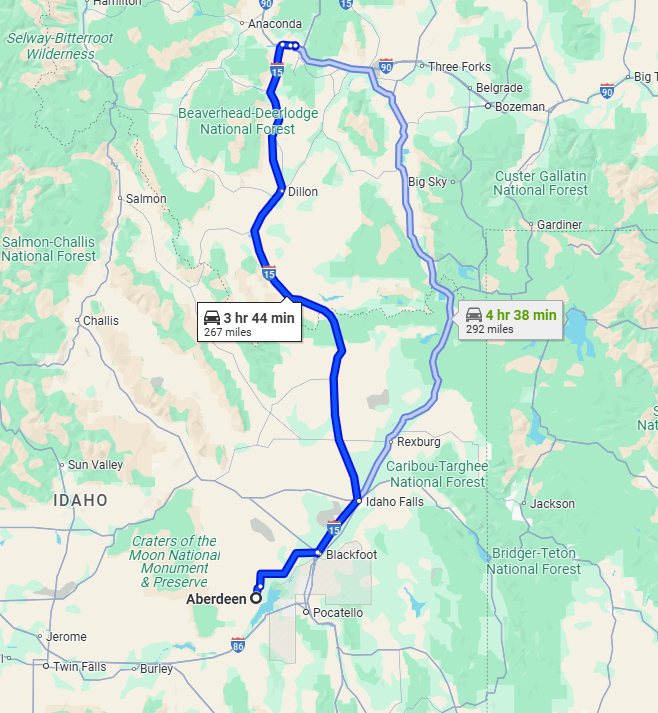
It’s on my bucket list to visit as many archeological sites as a I can, the older the better. Sage Wall was a no-brainer because it’s only a half a day’s drive from my house. It is also a good candidate to visit because looking at photos is kind of ambiguous. To really get a sense of whether it seems manmade or like a natural formation, I felt I had to be there in person.
We drove up into the beautiful Montanan Pioneer Mountains (Idaho has some as well), stayed the night in Butte, and the next day, made our way to Sage Mountain Center, where I had a reservation. We could not have asked for a more beautiful day, weather-wise. Early June in the Butte area is still basically Spring.
Chris and Linda are the property owners at Sage Mountain. About three decades ago, they wanted to move out to the middle of nowhere and build a sustainable house and retreat center. They were not looking for megaliths. Linda stumbled upon the wall on a hike one day, and Chris, who has a background in building, looked at it, said, “Yep. That doesn’t look natural. Well, let’s get back to our projects.” It wasn’t until years later, when they had established a sustainability-themed retreat center and had started to create some hiking trails for their guests, that other people started noticing the wall. Chris and Linda cleared the brush around the wall, roped it off, and had it examined by LIDAR and ground-penetrating radar.
Now, many people are coming to see the wall, seemingly to a point where it is almost becoming a problem. Sage Mountain Center is still on a wind-y, washboard-y dirt road, but now many people, seeking to get away from it all, have built new houses and cabins along that same road. Chris asked us, as we drove out, not to “go too fast past our neighbors. We’re trying not to bother them.” I got the impression that his main desire is still to just run a sustainability B&B in peace, but he’s been saddled with this danged wall.
What Would a Skeptic Say?
I want to give the skeptical geologists their due here. I think what they would say is this: “All these people who are saying Sage Wall is amazing megalithic structure are forgetting one thing: It is right in the middle of the Boulder Batholith! There are big granite rocks everywhere!”
source: formontana.net
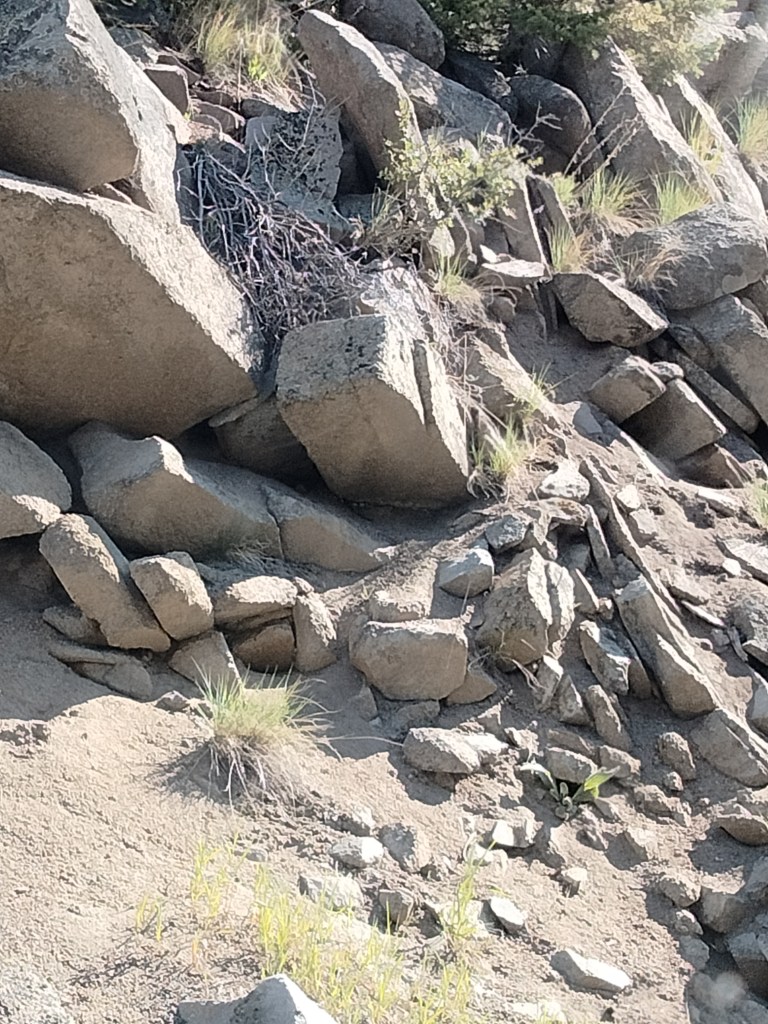
They are not wrong. The mountains to the east of Butte, where Sage Mountain Center is located, are strewn with large granite boulders and outcroppings. These tend to fracture into shapes resembling worked blocks of stone.
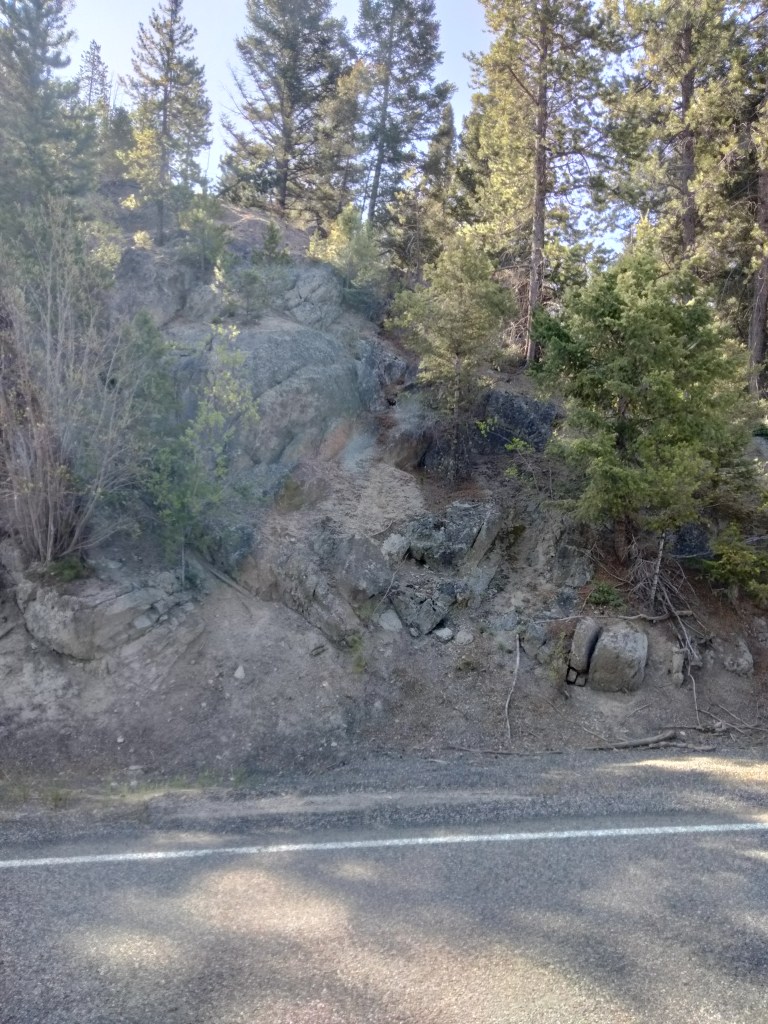
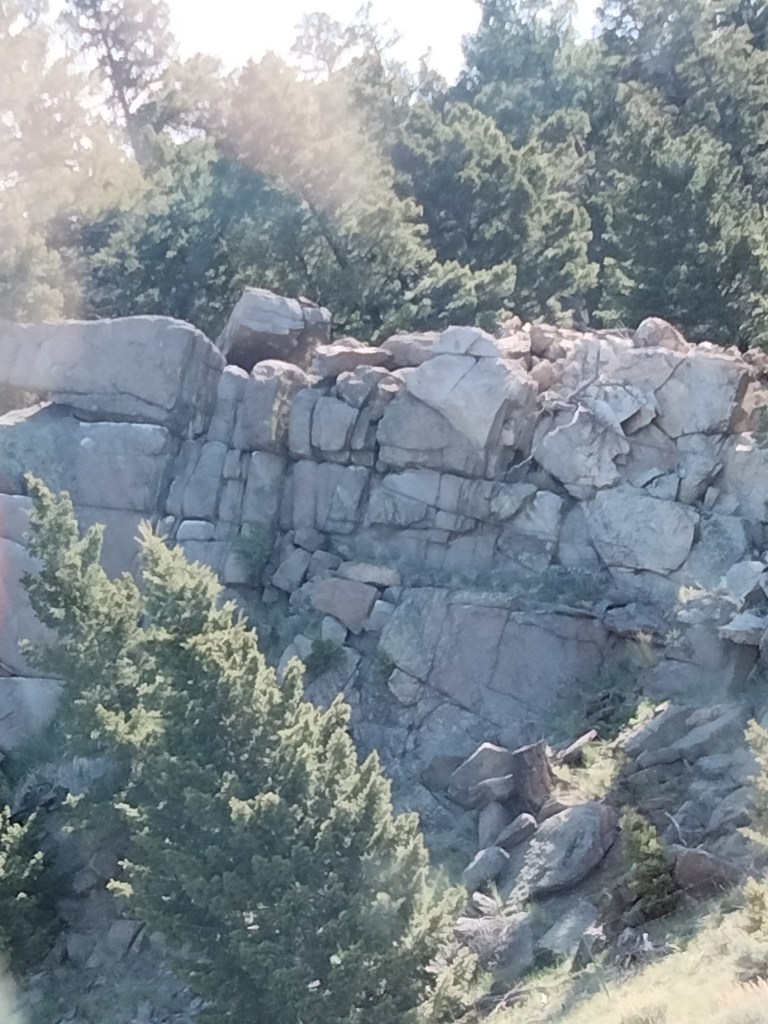
Here are some pictures I took, on the way in, of natural granite outcroppings so you can see how they normally look and how they tend to fracture:
You can see that the fractures are often horizontal and strikingly block-like.
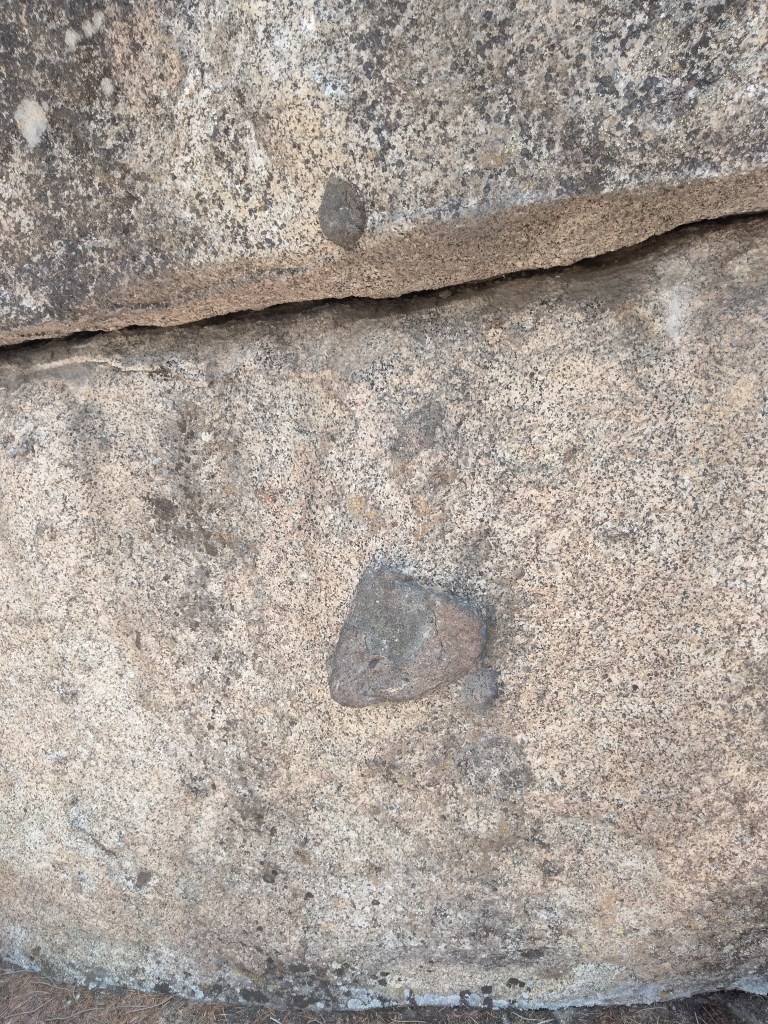
We also saw some pieces of granite that had very large quartz crystals formed in them, which stuck out like chips in a chocolate chip cookie:
And, just for fun, here’s a balanced rock:
I’m not sure whether this balanced rock is natural, but I’m leaning towards no. I’m thinking it was put there to mark the trail.
Anyway, the skeptics are correct that the presence of big, blocky rocks does not an ancient megalithic structure make. This is part of the reason I wanted to see Sage Wall myself. I did not take any videos of it, because I’m not good with video and didn’t have a script ready. But there are now many videos of Sage Wall online, including drone videos. I’ll try to embed some of them at the end of this post.
Why Sage Wall is Likely Man-Made in my Amateur Opinion
So no, the claim is not that this must be a megalithic structure because it is located somewhere that we would not expect rocks. It is definitely surrounded by rocks. However, it looks distinctly different from the more random rock outcroppings around it.
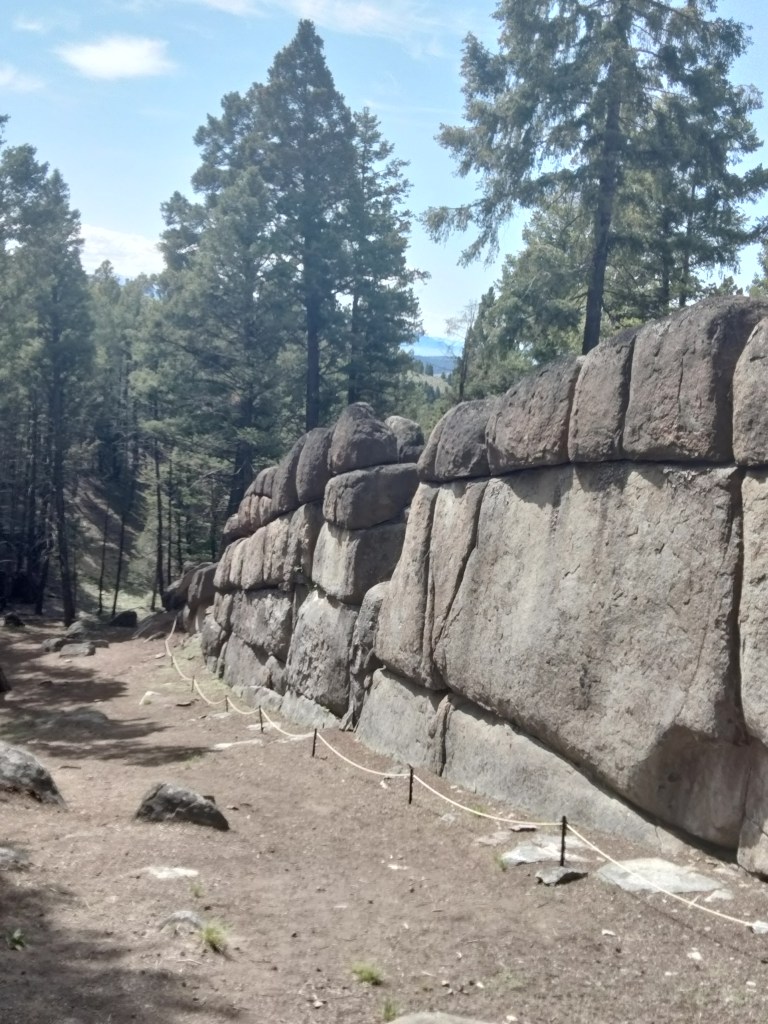
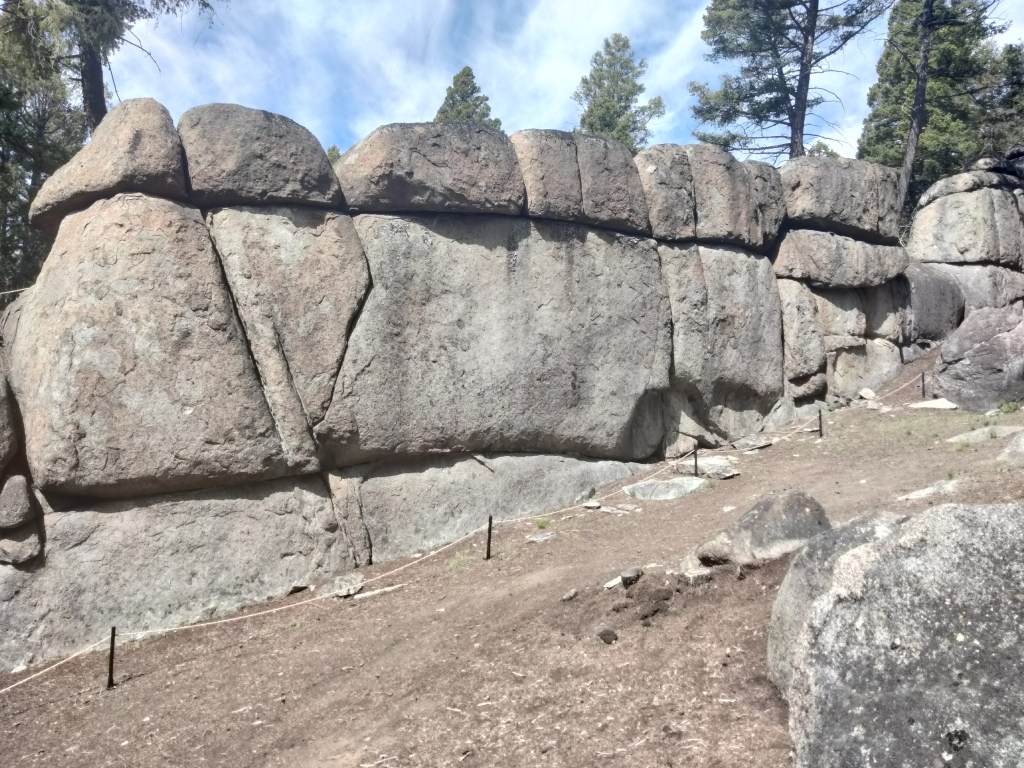
It is very long, and very straight. (The wall extends past the Sage Mountain Center property, but only their section of it has been cleared.)
Unlike what we see with other fracturing patterns, the wall consist of very big blocks laid out in what appear to be courses. To my (again, amateur) eye, when we see natural fracturing the blocks tend to fracture into smaller pieces where they are exposed.
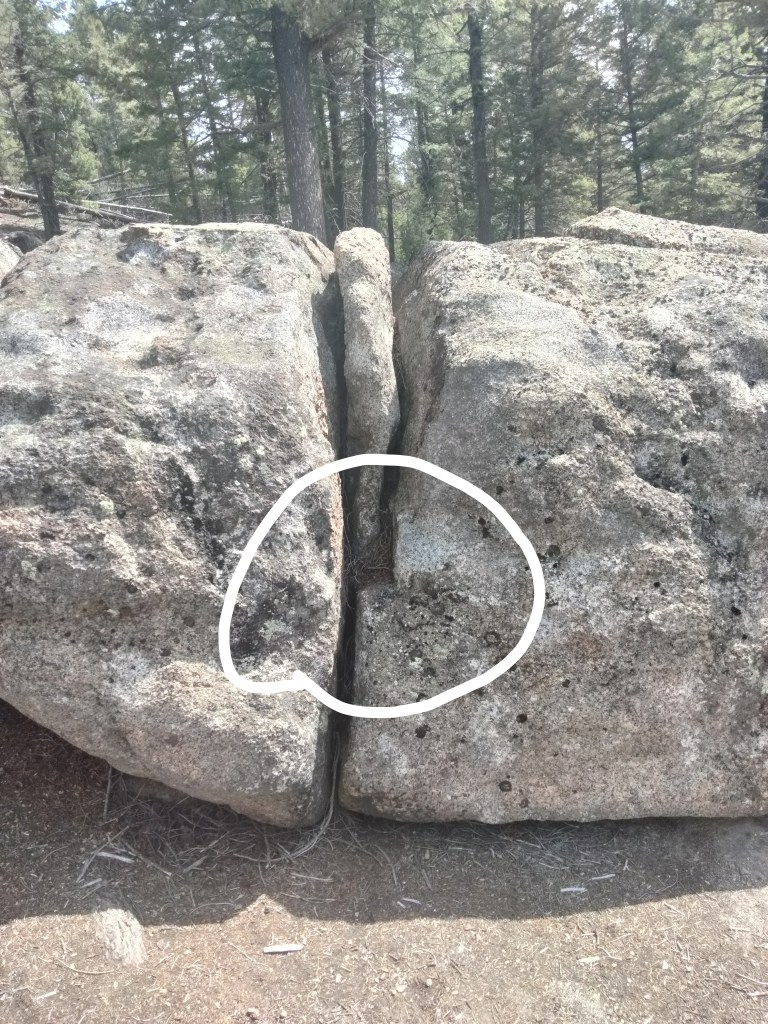
In the pictures above (and in the one where I’m posing), you can see a hollow lower down in the wall where a block obviously fell out.
At three different places in the exposed section of the wall, there are gaps in the top similar to doors. Chris told us there had been a lot of speculation about these before researchers realized that they were simply places where boulders had fallen out. In fact, you can see the boulders below them, almost completely buried in dirt and pine duff.
On the picture above, you can also see the remains of a triangular shape. The left side of the triangle is made with shaped blocks, and the right side is incised into the megalith. The triangle happens to frame the gap where a block fell out.
According to Chris, the geophysicist who examined the wall with ground-penetrating radar found that it goes down into the ground about another 20 feet. At the bottom was something that reflected the radar, as it might be a floor or stone foundation.
All of this research is shortly to be posted on the wall’s website, here or possibly here.
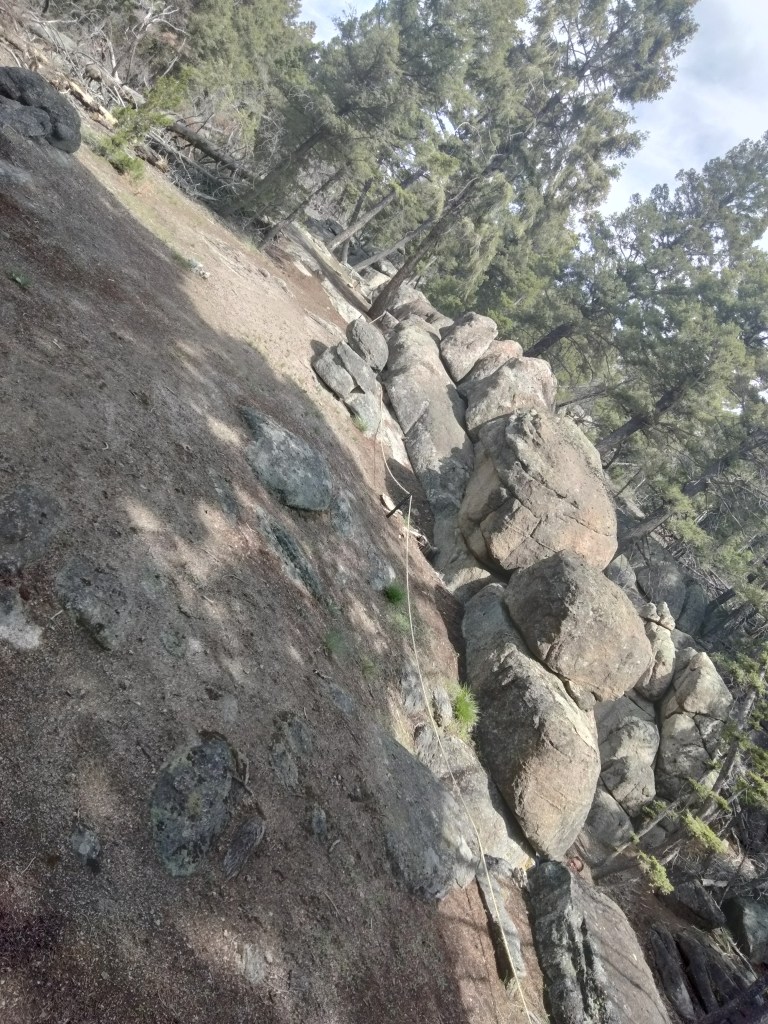
Parallel to the wall are the fallen remains of what appears to be another wall. You can see that it is “fractured” in the same way, and these other blocks also have some of the nub and cup features that we’ll talk about below.
Here’s a bit of the second wall, seen end-on.
Behind the Wall
Here’ a view behind the more intact wall. Chris and Linda have installed a rope that allows visitors to climb up behind the wall. As you can see, the wall is not just part of a cliffside, but it does have earth and rocks filled in behind, either as terraces/a retaining wall, or the ravages of time.
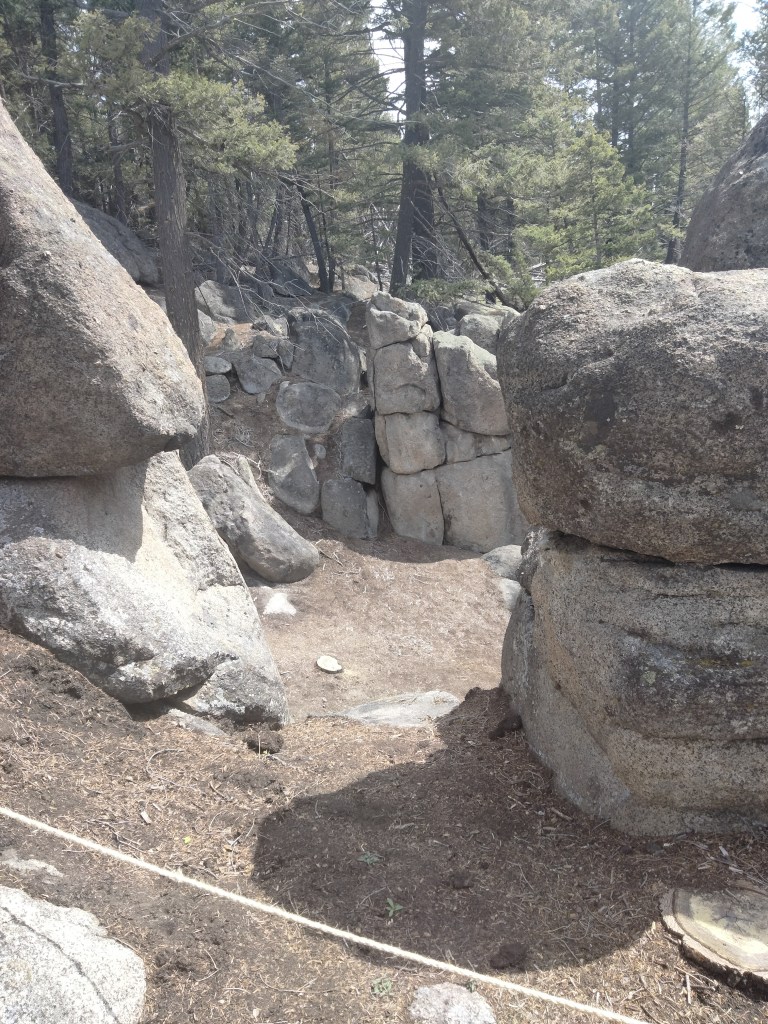
From behind the wall, we look out through a gap left by a fallen stone across the avenue at the remains of the second wall.
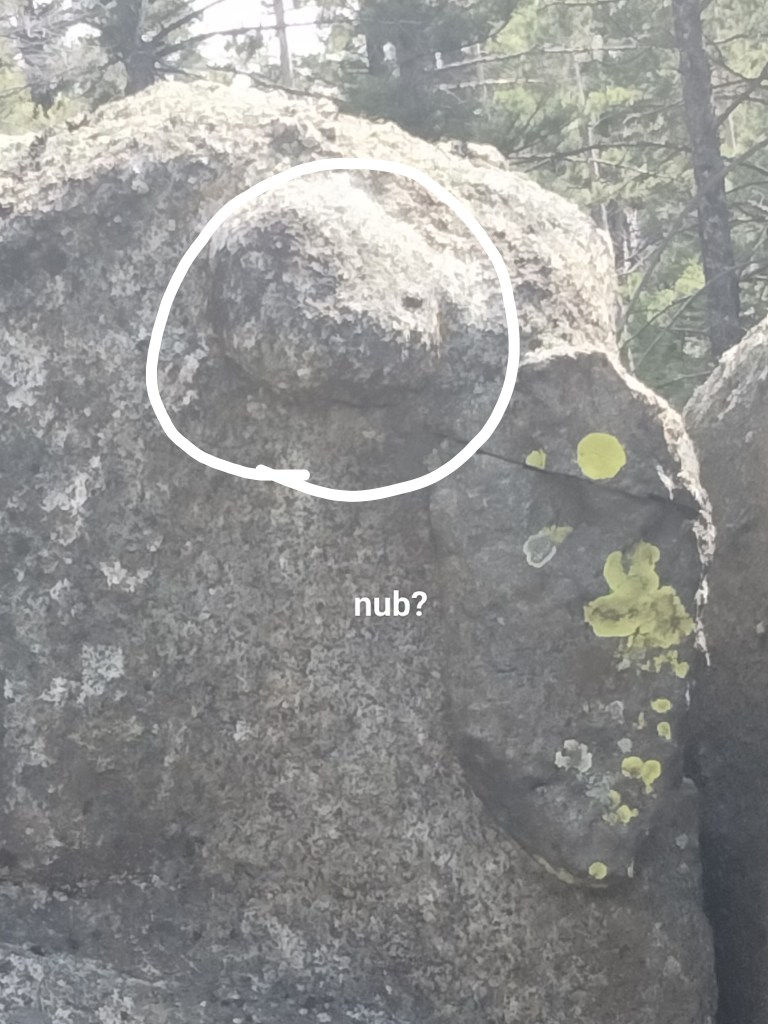
Getting close to the top of the wall allows us to see what might be nubs and cups.
Nubs and Cups
Stone nubs and cups (not necessarily corresponding to each other) are sometimes features of megalithic architecture in other parts of the world.
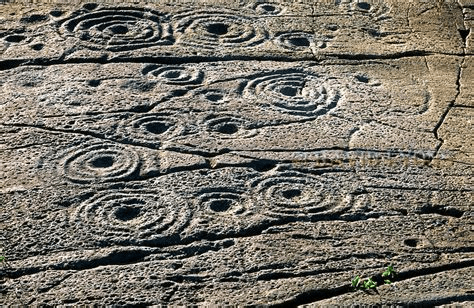
“Cup and ring” markings are apparently found all over the world, but especially in Northern Europe. Here are two articles about them.
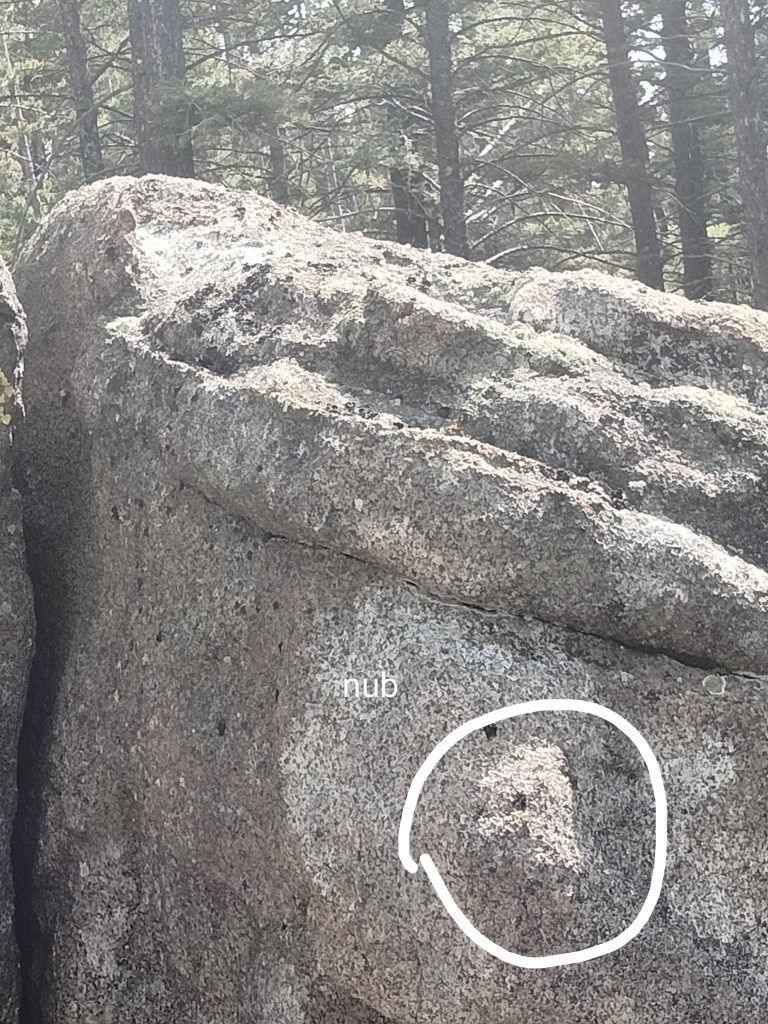
Here are some nubs found on top of the intact wall.
They are not the same as the pieces of quartz sticking out of the natural stone that we photographed earlier.
Because the wall is so weathered, some of them are not certain.
Note the possible incised lines above this last nub.
Here are some other things we saw on the back of the wall:
Incised straight line
Suspiciously square fracture line
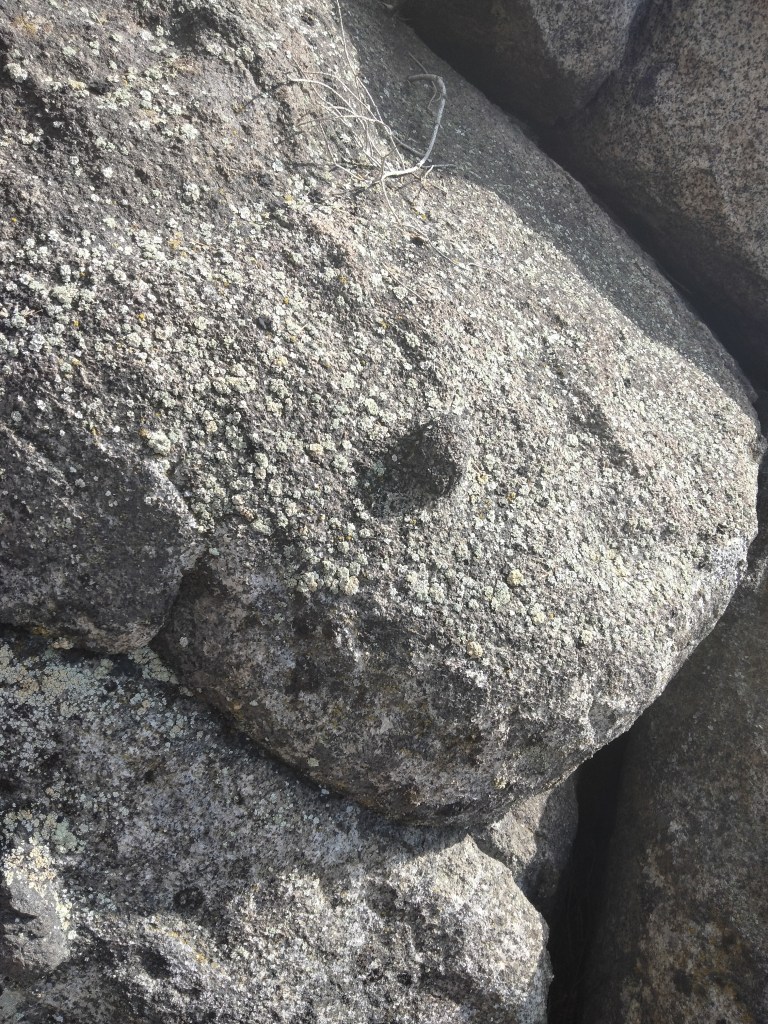
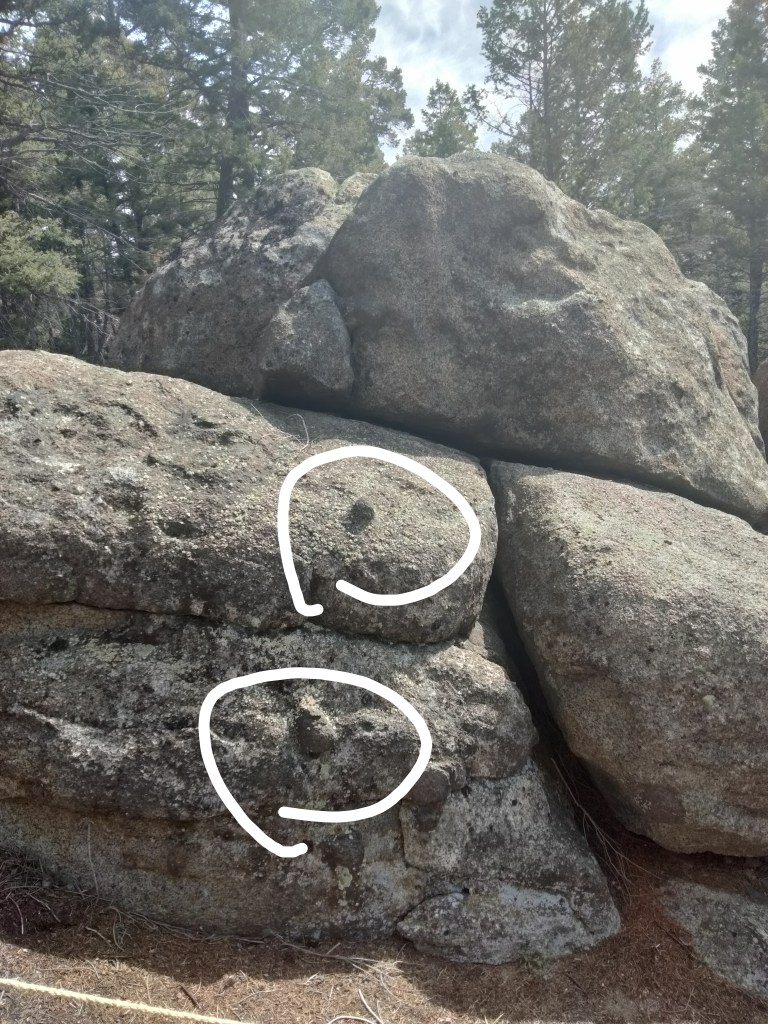
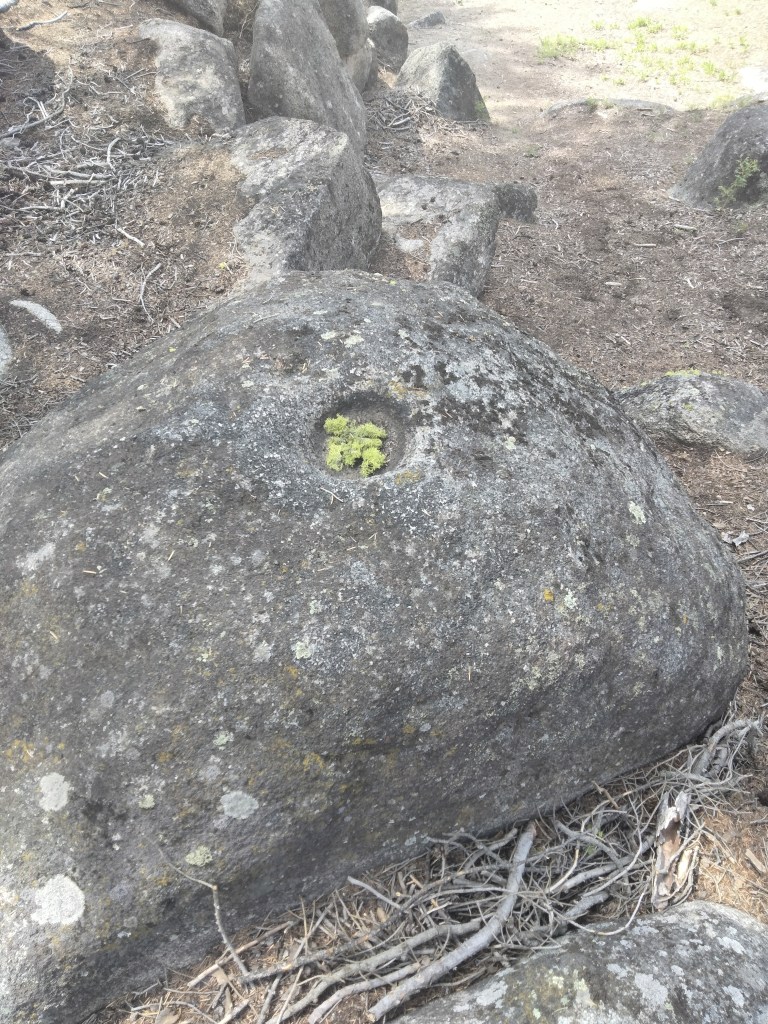
On the fallen wall as well, we found some things that look like nubs, and some possible cups. As a nod to the skeptics, yes, these “cups” do look like they could have been caused by water erosion. This would be especially true if they were found under a waterfall or a persistent drip, which they are not, as far as I can see. Some of them are also suspiciously round.
Very round “cup” in which someone has placed some fresh lichen
Some also have very straight lines incised near them. My son suggested they could be a water feature.
Looks like a cup with a spout
False Nub Alarm? Or Another Part of the Complex?
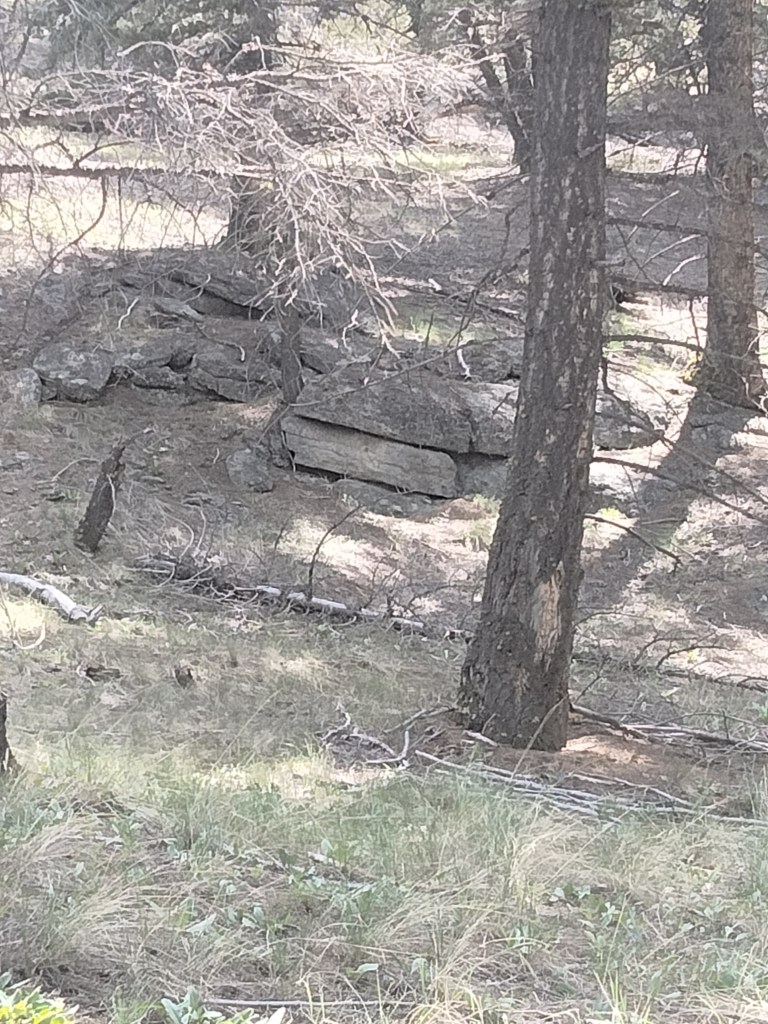
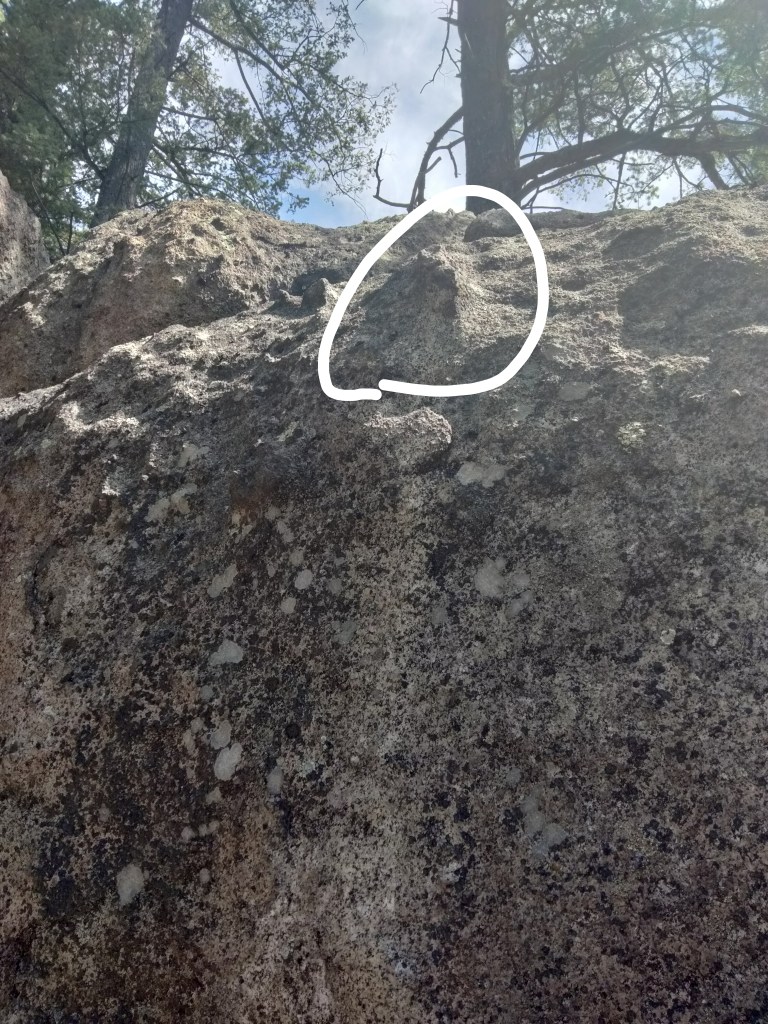
As we hiked away from Sage Wall, I took care to photograph natural rock formations for comparison. Not very far from the walls, I saw something that also looked like nubs.
Did this mean that such nubs are a natural feature of the way granite weathers? Or could this be another part of the same complex as the wall? The formation on which I spotted these nubs certainly looks like the remains of a constructed passage.
A Post-Flood Megalithic Culture
After I left Sage Wall, my husband asked, humoring me, what I thought its purpose had been. My answer is that I have no idea. It is way too old, weathered, and partially buried for me to speculate. (This does not bother Julie Ryder over at Montana Megaliths, so if you want to see some people speculate very confidently, you can visit there.)
What I can say is that, granted this is not a natural formation, it most reminds me of Sacsahuayman and other sites in Peru. You have the same dry stone construction with megalithic blocks that are shaped, but are not in uniform sizes or in a regular pattern. And, of course, you have the nubs. As for scale, it appears that if Sage Wall were excavated down to its foundation, it would be thirty or forty feet high.
Another similarity is that both Sage Wall and the Incan or pre-Incan complexes are built at very high elevations (the Continental Divide runs near Butte).
This suggests to me that they partake of the same culture area.
Sage Wall, of course, has been abandoned much longer than any of the impressive Incan complexes, some of which Europeans got to witness still in use. Consequently, it’s much more weathered, run down, and filled in. But it looks like the same sort of thing.
So, it appears that Sage Wall and any other structures we might find in association with it were built by a group of people who knew how to build with megaliths, and who then had to abandon this site for some reason. It was before recorded history in North America, but that doesn’t mean it was before recorded history was happening elsewhere. Then, they or their descendants or people who partook of the same megalithic culture, moved on towards South America and continued their building there.
I believe there is plenty of evidence–not from Sage Wall, but from other sources–that human dispersion happened very quickly after the Flood, and that when people spread out, they took a megalithic culture with them. Dolmens, pyramids, cities, and inexplicable megaliths have been discovered all over the world. In many cases, as with the Bosnian pyramids, they have been abandoned for so long that they are not immediately recognizable as the work of human hands. You have to know what you are looking at before you can see it. The Bosnian pyramids, first thought to be extremely regular hills, were confirmed as artifacts only when a team dug into them and found tunnels. It looks like something similar happened with Sage Wall.
Immediately after the Flood, the earth would have entered an Ice Age. The climate was in a tailspin: temperatures were low, precipitation at an all-time high. Much of that precipitation quickly got locked up in glaciers. Sea levels fell around the newly configured continents. There were land bridges all over: in Beringia, in Doggerland, in Sundaland. People took advantage of all this newly revealed, very humid land and scattered. But the Ice Age was short, and as glaciers melted, there were sudden catastrophic local floods. People had to abandon their sites. Many of their cities, camps, and settlements are now hidden under water along our coasts. In some cases, such as Gobeklitepe and the Vinca cities, they burned, buried, or otherwise destroyed their sites before moving on. Some of these sites might have been built very quickly and inhabited for only a short time before they were abandoned. Other things being equal, archaeologists tend to overestimate how long it took to build something, and how long ago it appeared. But even very recent sites can be quite mysterious. They have had trouble re-constructing Woodstock, for example.
How Did They Build It?
I don’t know. Obviously they were purty smart. Probably an argument is going to be made that Sage Wall must be a natural formation because “we know” that people in the Stone Age didn’t have the ability to make things like this, despite constant evidence being discovered to the contrary. Or they will argue that “we know” that there were no advanced civilizations in North America, despite Sage Wall itself. Such arguments tend to be self-re-enforcing.
I do know that we do not, currently, have the ability to build with megaliths … at least, not so easily that we consider them our first choice in building material. We might make a monument or a gravestone, but we wouldn’t attempt to build an entire house or city out of megaliths. The effort would just not be worth it. This suggests that the ancients may have had ways that were easier than our current methods.
It is worth noting that there is a well-established oral tradition of giants living in North America. There have also been giant skeletons discovered. In Peru, meanwhile, there is the tradition of the Viracochas, bearded, godlike culture-bringers. No, I’m not suggesting aliens. I do think we should take a closer look at the worldwide oral traditions of apocalypses, floods, gods, and giants, and that we should pay attention to myths that suggest that civilizations were “advanced” right from the beginning. If you want to dig into this more than you already have (and if you are reading this, I assume you already have!), please feel free to look at my page The Research Behind the Books for a suggested reading list.
Charles Fillmore, the cofounder of Unity, wrote an entire book called Prosperity in 1945 about lessons and laws of abundance. He even changes Psalm 23 to say, “The Lord is my banker. My credit is good … Though I walk in the very shadow of debt, I shall fear no evil … Thou fillest my wallet with plenty.” Can you believe it?
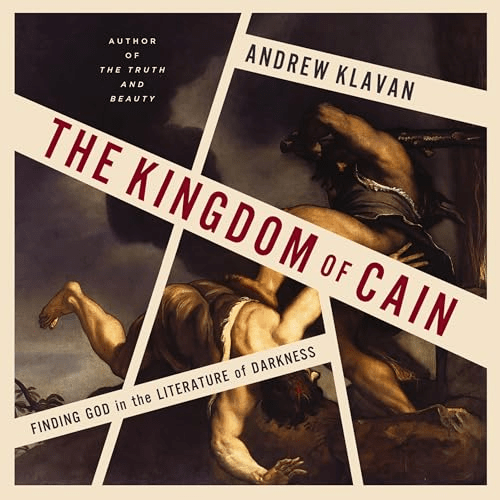
A review of noir writer Andrew Klavan’s The Kingdom of Cain: Finding God in the Literature of Darkness. I have already posted this review on Amazon and Goodreads.
This is a very readable book that fleshes out Andrew Klavan’s thesis:
The opposite of murder is creation–creation, which is the telos of love. And because art, true art, is an act of creation, it always transforms its subject into itself, even if the subject is murder. An act of darkness is not the same thing as a work of art about an act of darkness. The murders in Shakespeare’s Macbeth are horrific, but they are part of a beautiful play.
page 17
In other words, Klavan is wrestling with the problem of evil. Based on his decades of thinking about this, he has concluded that in this life, there is no theological answer that can redeem evil for those who have suffered it. Theological answers there may be, but those are not what redeem it for us. The only answer to suffering is not an answer, exactly; it is beauty. The example he frequently re-visits is the Pieta, “the most beautiful statue in the world,” a statue of Mary cradling her maimed and innocent, dead son.
I think Klavan’s thesis is a very strong one. I think of the book of Job. Job suffers horribly, and apparently undeservedly, and to add to his suffering, he is told that it must be his fault. He asks God why. Now, as it happens, there is an explanation for everything that is happening to Job. But God doesn’t give it. He just starts talking to Job about the wild animals and their habits. This is beauty, it is wonder, and it is far beyond Job’s experience. But ultimately, God answers Job with Himself, with His presence. He answers Job out of the whirlwind. He mentions just a few of His mighty, mysterious works in creation. And this is a good answer. It is enough. It is a much better answer than if God had said, “Well, it all started when I got into this argument with Satan …”
Kingdom of Cain is a hard book to read because of the real-life crimes described in it. Klavan tries not to get too graphic unless he has to, but this is a book about murders after all, including copycat murders. The blurb says it examines the impact of three murders on our culture, but there are a lot more than that, both fictional and–this is the hard to read part–real. The hardest one for me was the kidnap, rape, and murder of a 14-year-old boy by a pair of older teenagers who were later lionized in fiction.
This book is very insightful. Perhaps if I had never heard Klavan make these points before, I’d have given it five stars. But I have been following him for years, and he has been working on this concept for years, so the idea was not new to me. Especially in the later chapters, it felt a little belaboring. Hence, four stars.

















 Out of Babel Books