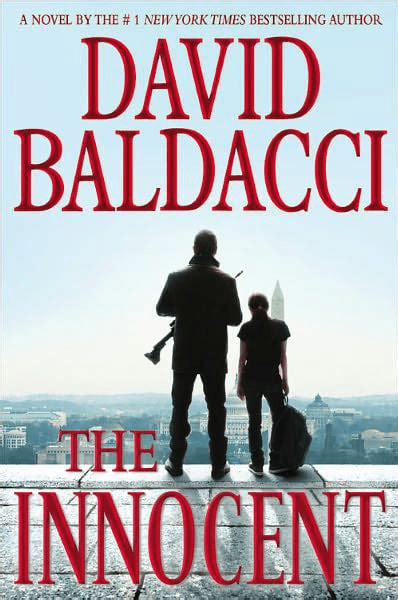
The Innocent, by David Baldacci, Grand Central Publishing, 2012
What can get me to read outside my accustomed genre?
That’s right, free books can!
My husband, a truck driver, knows another truck driver who likes to read. This man has somehow found out that I am also a reader, so when he finishes a book, he sometimes passes it on to me through my husband. I have never met the man, but we now share a number of harrowing mental experiences. Such is the secret society of readers.
The Innocent is a spy thriller. The first several chapters follow the lonely life of crack government assassin Will Robie as he carries out two different hits. (Apparently, this is going to be “the first Will Robie novel.”) We see that Robie is tough, cool under pressure, and professional at killing people. He’s covered in scars, which are covered in tattoos. Due to the nature of his job, he leads a lonely life. He goes to many exotic locales but never has relationships with any of the people there. He gets to eat good food and drink alcohol sometimes, but he has to keep insane hours with very little sleep sometimes. His home base is in Washington, D.C.
Robie was an inch over six feet and a rock-solid one hundred and eighty pounds. He possessed a compact musculature that relied more on quickness and endurance than sheer strength. His nose had been broken once, due to a mistake he had made. He had never had it reset because he’d never wanted to forget the mistake. One of his back teeth was false. That had come with the broken nose. His hair was naturally dark and he had a lot of it, but Robie preferred to keep it about a half inch longer than Marine buzz cut. His facial features were sharply defined, but he made them mostly forgettable by almost never making eye contact with anyone.
the first page
I love that that’s on the first page. That’s how you introduce a character, boys and girls! Now I have a clear mental picture of Robie (like a shorter Jim Caviezel), and the author won’t need to say much about his appearance for the rest of the book. Also, the description is given in a way that’s woven in with a sketch of his history.
It’s a good thing Robie has a cute last name that sounds like a first name. It’s the only thing softens him for some time.
For the first eight chapters (per the thriller genre, they are very short chapters), we see Robie go about his business. He carries out two hits. He withdraws from each successfully. He goes back to D.C. He starts to make tentative friends with a young lady who lives in his apartment complex, though he wonders whether this is a good idea. He gets ready to carry out his next hit, which is local.
Then, finally, in Chapter 9, we meet The Innocent.
She’s a fourteen-year-old girl named Julie Getty. Julie is smart and scrappy. Her parents love her, but they are druggies, so she’s been in and out of foster homes. Nonetheless, she’s in AP Calculus. In Chapter 9, Julie sneaks out of a subpar foster home to go meet up with her mom, who has sent her a note saying they are moving. When she gets to her house, though, she witnesses her parents get shot by unknown men. Not having a phone, Julie flees. Her story and Robie’s will soon intersect.
Julie came along at just the right moment. I didn’t want to read a whole novel that was basically Jason Bourne, consisting only of action + Hero Is No Longer A Normal Person Because of His Past. Once Robie starts to feel responsible for Julie, he now has to behave like a normal person in ways that he didn’t before. He also has to put up with a canny teenager who, naturally, wants to be involved in finding out why her parents were killed. And he has to do this while keeping her safe.
I’ll stop there because of spoilers, but this book was an outstanding example of its genre. It’s mostly action, but the plot is also a twisty puzzle. I don’t think the reader is meant to be able to figure out the puzzle in time to Save the World, but Robie is meant to be able to. Even the assassinations in the early chapters become relevant later. All the subplots get tied in together. There is a satisfying debrief at the end, where it’s all explained from a bird’s-eye view in case the reader missed any pieces. There is some emotional turmoil (Robie might not be normal, but he’s still human, you see). And there are hints that Robie has a heartbreaking back story, no doubt to be alluded to in later novels. Four stars.
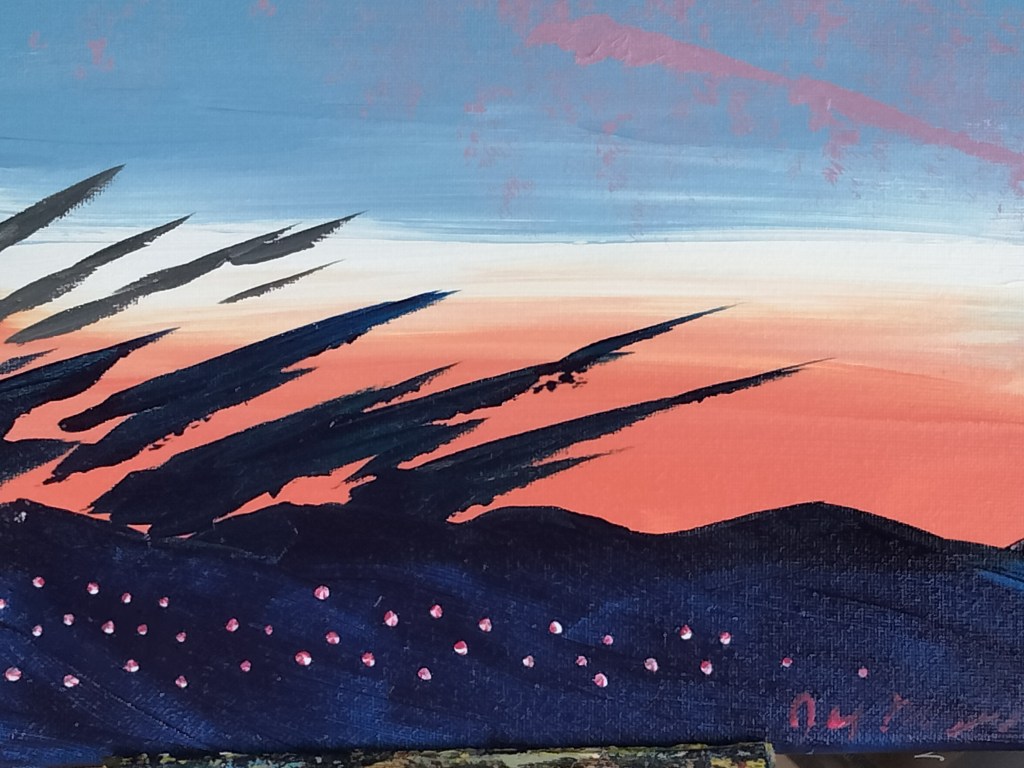
I live in the West, where you can see long distances. About twenty-five miles south of our house is wind farm perched on the foothills. At night, you can clearly see the windmills’ lights twinkling. This painting portrays a more close-up view, glimpsed as I started the drive home on a winter evening.
I never minded seeing wind farms, even in the daytime. I had a positive association with them, almost entirely because of the cover of a Petra album I had as a teenager:
I also believed what I was told, that these windmills would provide cleaner power than oil, coal, and natural gas.
Then, I started hearing about the downsides of wind farms. I heard that people who live near them develop health problems. I heard that, shockingly, it is not unusual for birds to get chopped up by them. The windmills have to be built in naturally windy areas, which are also migration routes for birds, which are apparently hard-wired in to the birds and can’t be changed.
Then, I found out that these turbines are expensive to build, last only about twenty years, and are difficult to dispose of:
Unfortunately, my aesthetic response to these windmills has already been locked in by Petra. I don’t think it’s going to change. Now, though, I no longer think of them as a good thing, a step in the right direction. I think of them as evidence that we are living in a sci-fi dystopia. Maybe some day, the wind farm in my part of the state will come down. But this little painting will remain as evidence that I lived in the Age of Man when we feared the imminent end of the world and thought we could forestall it by building these things.
Well, we have made it through February, when I did a post about something I love every single week. Phew, I’m certainly glad that is over with! What a relief to get into March, and start writing about stuff I hate again.
Just kidding. I didn’t hate this book; in fact, I mostly really enjoyed it. It just wasn’t a perfect bull’s-eye like all the stuff I posted about last month.
This 2024 book is narrated by Jolene, a Canadian woman whose mother is Iranian-Canadian and who works in a regular, that is to say fairly miserable, office. She has social anxiety, a moderate drinking problem, a big cohort of Persian Aunties (her mom’s friends) who really really hope she will get married, and a dark trauma from high school. Oh, and she has a habit of adding passive-aggressive postscripts to her e-mails to her colleagues, hidden in white text.
One day she forgets to turn the text white, and that kicks off her madcap adventures.
If this setup sounds like it’ll be boring and full of self-pity, all I can say is it’s anything but. Jolene, despite her hermitlike ways, is a keen observer of human nature and is mistress of the witty, cunning turn of phrase, which is exactly what makes her e-mail postscripts so devastating, and this narrative so fun to follow.
This little human [baby] doesn’t even realize the greatness of this: the only time in your life when people will simply ignore your public outbursts. The rest of us must cry without actually crying. This child, I learn as Celeste continues to soothe it, is named Thomas. I watch his little eyes dart around the room, taking it all in. Maybe Thomas is just now realizing that eventually he will grow up to spend all his daylight hours under fluorescent lights and water-stained ceiling tiles.
I don’t mean to chuckle at this depressing thought, and I stifle it as soon as I can, but that doesn’t stop a few eyes from drawing my way while I pretend I didn’t just cackle at a technically crying baby.
Then Thomas begins being passed around like a hot burrito. I curl my hands close against my chest and try to back away. When Caitlin takes said bundle, it stops crying in an instant, and her face softens in a way that makes me realize how hard it’s been lately.
“So, how is being a mom?”
Celeste starts describing things that sound dire as sh-t.
Gregory randomly pokes the ——- baby in the belly, and the cries start again in a screeching pitch.
Has anyone ever punched him in the face?
“How was the birth?” Stu for some cursed reason has to ask. I take a step back in order to avoid sticking around for Celeste’s answer.
Rhonda flashes me a disapproving stare. Why is it socially acceptable to discuss a human getting pushed or cut out of a body, yet somehow, it’s unprofessional for me to simply work rather than hold the tiny person I don’t even know?
page 102
That’s a pretty good sample of the writing style — and also a pretty good, lively description of what it’s like to be a woman with social anxiety or maybe autistic tendencies. Very very relatable.
I finished this book very quickly because of the good writing. However, it’s not uplifting or heartwarming. Jolene is engaging in some pretty significant deception throughout almost the entire book, which made it hard to enjoy. She’s under a lot of stress with several different crises bubbling (including one with the Persian Aunties), which keeps the pace fast, but makes the read also stressful. I knock off one star for this dynamic and for the author’s use of the phrase “white-passing.”
It was ideal apple-eating weather; the whitest sunlight descended from the purest sky, and an easterly wind rustled, without ripping loose, the last of the leaves on the Chinese elms. Autumns reward western Kansas for the evils that the remaining seasons impose: winter’s rough Colorado winds and hip-high, sheep-slaughtering snows; the slushes and the strange land fogs of spring; and summer, when even crows seek the puny shade, and the tawny infinitude of wheatstalks bristle, blaze.
This is the last February post dedicated explicitly to stuff I love, and I admit it, I love clothes. When Marie Kondo, writing to the “Visual” person, said, “You tend to like clothes, and have a lot,” truer words were never spoke.
I try not to go overboard on my interest in clothes here at outofbabelbooks unless I can tie to ancient clothing. There are plenty of good fashion blogs out there, including “modest” fashion blogs by Christians, and compared to them, I don’t really have any expertise to offer. I haven’t had much money to spend on clothes until recently, and my tastes are what you might call eccentric. I also have a short attention span, which means I am not good at buying just a dozen “basic pieces” and wearing the heck out of them.
However, lest you think that fashion is by its nature a shallow subject, I present you this interview with Dimitry Toukhcher, a high-fashion men’s suit designer who voluntarily wangled himself into the position of becoming Jordan Peterson’s personal tailor. This man is very smart, and it’s amazing the significance he finds in trends in men’s clothing. (Let alone women’s.) For samples of his analysis, I have posted my transcript of snippets of the interview below.
Triggernometry: How does fashion reflect the people that you design for? And your beliefs and your politics?
DT: Yeah, I’ve thought a lot about this. … The bespoke movement in England actually started after the London Fire … so what happened was, as the luxury consumption started to elevate in England, the society also became more liberal. You saw this during King George IV, Edward VII – I know my clothing history — so a lot of the clothing brands that were built during those years, were built on a vision of moving towards a more liberal society. Tom Ford would be an example of that. Tom Ford’s entire mantra is libertine living.
Triggernomentry: What’s the logic behind that?
DT: Well, the logic is that you’re spoiling yourself. And so, in the 60s and 70s we saw the cultural shift with the Vietnam War. That’s actually when the bespoke tailoring thing kind of fell apart, because everyone was struggling. So everybody moved away from their father’s uniform. You know, it wasn’t cool. The counter-culture was liberal.
But what’s interesting to me — and this is completely serendipitous, not intentional — is today’s counter-culture is not liberal. Today’s counter-culture is a re-awakening. It’s a Renaissance. Today’s counter-culture is seeking iconography … baptisms … rules! And Jordan Peterson has sort of risen as the Internet’s father as a central figure for that. So it wasn’t that I purposely set out to design anything that would invoke society into some kind of a conservative movement, I just happened to work with the suits.
Triggernometry: And do you think the structure of the suit reflects people seeking a more structured way of life as opposed to the chaotic elements that extreme liberalism brings?
DT: I’m very intentional with that. I e-mailed Jordan [Peterson] and I said, “Hey, Jordan. The outfit you’re wearing [to meet] with this prime minister is the wrong outfit. This prime minister has a military background, and you’re wearing an unstructured jacket. … I wanna do a structured, more militaristic-looking jacket in a darker tone, so that you would pay homage and respect to the person with whom you’re sitting.”
I have a book coming out, and part of the book is actually talk [sic] about the evolution of suits through the decades – the 30s, 40s, 50s, 60s, etc. What’s interesting to me is [that] the movement of suits specifically — fashion in general, but suits specifically — today, is kind of moving towards what suits looked like back in the 1950s. Which is a fuller cut suit, which is a more traditionally conservative suit, not a lot of exuberant details. And the 1950s were an interesting era for that. We were coming out of the 40s where things were being rationed, so fabric was difficult to come by, and before that we had the 30s, where we had opulence. The 50s were not a re-emergence of the opulent 30s, but they were a breakaway from the restrictive 40s. And now that I look at the 2020s, what’s happening with clothing [is] it’s coming back to the 1950s. It’s almost like the clothing today is a re-emergence from a war. We didn’t actually have a very big physical war in the West, but we surely had a cultural war.
And the Triggernometry boys nod soberly, with the look of war survivors.
DT: So I do see suits coming back. I see a lot of really cool hats coming back. I have a friend who’s in the hat business, and business is booming. When was the last time you saw a guy wear a hat ten years ago?




 Out of Babel Books