
I peer over the half wall of my cubicle towards hers, which boasts a shelf lined with an assortment of dusty trinkets, inspirational quotes printed on crinkled yellow paper affixed to the wall, and a file box I know is filled with medications, tea bags, and biscuits that expired in 2012. It’s as though she anticipates being trapped here one day and not only surviving the ordeal, but thriving.
I Hope This Finds You Well, by Natalie Sue, p. 2
Knitting: Gift Shawl

I spent probably 6 months on this shawl. I’ve already given it to the recipient – who truly earned it, by the way – but here are pictures I took while I was blocking it.


Megalithic Ruins in Montana
Deep in Montana’s remote wilderness lies the Sage Wall, a stunning megalithic structure composed of massive granite blocks intricately stacked in a straight line extending 275 feet (84 meters). Reaching up to 25 feet (8 meters) high, with some blocks weighing 91 tons, it is believed that the wall continues an additional 15 feet underground. This unique formation appears to have precise, interlocking stones resembling ancient masonry found worldwide.
Despite its remarkable features, the Sage Wall remained hidden for centuries, covered by dense foliage on private land owned by Christopher Borton and Linda Welsh. Its discovery occurred when the landowners cleared their heavily forested property, revealing the wall and sparking scientific interest.
These paragraphs are taken from the article linked below:
It turns out that I have been sitting practically on the doorstep of a potential bucket list item!
If I had money and could travel, my destinations would be all the remarkable archeological sites in the world, particularly the ones that seem to partake of what appears to have been a worldwide megalithic culture. As I have pointed out before on this very blog, new examples of these are discovered almost yearly. Anyway, this site in Montana is one that I could actually be in a position to check out.
There are other sites in Montana that some believe are intentionally erected dolmens, and others believe are natural rock formations. Sage Wall, if it really is as it appears in the picture above, looks suspiciously manmade and highly similar to sites such as Sacsayhuaman in Peru. However, I realize that anyone who takes it as a given that there was never an ancient megalithic culture in North America will argue that Sage Wall is just a natural formation, and that rock does sometimes tend to fracture this way, as demonstrated by formations like Sage Wall.
The best way to deal with this is to see it in person.
Here’s how you do that:
Quote: a machine with only one command
We can thus understand the synthetic goal of Critical Race Theory. It is to awaken a critically conscious racial awareness … In this sense, Critical Race Theory is, as the warning in artificial intelligence ethics research might describe, a Theoretical paperclip maximizer, except instead of making paperclips, it makes Critical Race Theorists.
James Lindsay, Race Marxism, pp. 217, 224
The Predawn Walk to the Chicken Coop Painting II

Here it is with its predecessor:

O Come, All Ye Faithful Is Much Better in the Original Latin (a repost)
Adeste fideles, laeti triumphantes
“O come, all ye faithful, joyful and triumphant”
Venite, venite in Bethlehem
“Come, come into Bethlehem”
Natum videte, regem angelorum
“Born see, the king of angels”
Venite adoremus [3x]
“O come, let us adore him” [3x]
Dominum
“The Lord”
Deum de Deo, lumen de lumine
“God from God, light from light” *(these are direct objects, so the subject and verb are coming up)
Gestant puellae viscera
“A girls’ innards carry” (the subject and verb, and by far my favorite line)
Deum verum
“True God” (and still the direct object)
genitum non factum
“Begotten, not made”
Refrain: Venite adoremus, Dominum “O come, let us adore/The Lord”
Cantet nunc io, chorus angelorum
“Sing it now, chorus of angels”
Cantet nunc aula caelestium
“Sing now, heavenly court”
Gloria, gloria in excelsis Deo
“Glory, glory to God in the highest”
Refrain: “O come, let us adore/The Lord”
Ergo qui natus die hodierna
“Therefore, who is born on the day of today”
Jesu, tibi sit gloria
“Jesus, to you be glory”
Patris aeterni Verbum caro factum
“Word of the eternal Father made flesh”
Refrain
See how the Latin is actually more direct/efficient than the English? Kind of shockingly so?
I think because the original Latin version had so many syllables, to translate the lines into English, additional words had to be added, and sometimes even new ideas such as “Yea, Lord, we greet thee,” which is how the fourth verse begins in English and is one of my favorite lines in that version.
Christmas Trees are Christian, but still Very Ancient

This post is about how we got our Christmas trees. For the record, I would probably still have a Christmas tree in the house even if it they were pagan in origin. (I’ll explain why in a different post, drawing on G.K. Chesterton.) But Christmas trees aren’t pagan. At least, not entirely.
My Barbarian Ancestors
Yes, I had barbarian ancestors, in Ireland, England, Friesland, and probably among the other Germanic tribes as well. Some of them were headhunters, if you go back far enough. (For example, pre-Roman Celts were.) All of us had barbarian ancestors, right? And we love them.
St. Boniface was a missionary during the 700s to pagan Germanic tribes such as the Hessians. At that time, oak trees were an important part of pagan worship all across Europe. You can trace this among the Greeks, for example, and, on the other side of the continent, among the Druids. These trees were felt to be mystical, were sacred to the more important local gods, whichever those were, and were the site of animal and in some cases human sacrifice.
God versus the false gods
St. Boniface famously cut down a huge oak tree on Mt. Gudenberg, which the Hessians held as sacred to Thor.
Now, I would like to note that marching in and destroying a culture’s most sacred symbol is not commonly accepted as good missionary practice. It is not generally the way to win hearts and minds, you might say.
The more preferred method is the one Paul took in the Areopagus, where he noticed that the Athenians had an altar “to an unknown god,” and began to talk to them about this unknown god as someone he could make known, even quoting their own poets to them (Acts 17:16 – 34). In other words, he understood the culture, knew how to speak to people in their own terms, and in these terms was able to explain the Gospel. In fact, a city clerk was able to testify, “These men have neither robbed temples nor blasphemed our goddess” (Acts 19:37). Later (for example, in Ephesus) we see pagan Greeks voluntarily burning their own spellbooks and magic charms when they convert to Christ (Acts 19:17 – 20). This is, in general, a much better way. (Although note that later in the chapter, it causes pushback from those who were losing money in the charm-and-idol trade.)
However, occasionally it is appropriate for a representative of the living God to challenge a local god directly. This is called a power encounter. Elijah, a prophet of ancient Israel, staged a power encounter when he challenged 450 priests of the pagan god Baal to get Baal to bring down fire on an animal sacrifice that had been prepared for him. When no fire came after they had chanted, prayed, and cut themselves all day, Elijah prayed to the God of Israel, who immediately sent fire that burned up not only the sacrifice that had been prepared for Him, but also the stones of the altar (I Kings chapter 18). So, there are times when a power encounter is called for.
A wise missionary who had traveled and talked to Christians all over the world once told me, during a class on the subject, that power encounters tend to be successful in the sense of winning people’s hearts only when they arise naturally. If an outsider comes in and tries to force a power encounter, “It usually just damages relationships.” But people are ready when, say, there had been disagreement in the village or nation about which god to follow, and someone in authority says, “O.K. We are going to settle this once and for all.”
That appears to be the kind of power encounter that Elijah had. Israel was ostensibly supposed to be serving their God, but the king, Ahab, had married a pagan princess and was serving her gods as well. In fact, Ahab had been waffling for years. There had been a drought (which Ahab knew that Elijah — read God — was causing). Everyone was sick of the starvation and the uncertainty. Before calling down the fire, Elijah prays, “Answer me, O LORD, answer me, so these people will know that you, O LORD, are God, and that you are turning their hearts back again.” (I Kings 18:37)
Similar circumstances appear to have been behind Boniface’s decision to cut down the great oak tree. In one of the sources I cite below, Boniface is surrounded by a crowd of bearded, long-haired Hessian chiefs and warriors, who are watching him cut down the oak and waiting for Thor to strike him down. When he is able successfully to cut down the oak, they are shaken. “If our gods are powerless to protect their own holy places, then they are nothing” (Hannula p. 62). Clearly, Boniface had been among them for some time, and the Hessians were already beginning to have doubts and questions, before the oak was felled.
Also note that, just as with Elijah, Boniface was not a colonizer coming in with superior technological power to bulldoze the Hessians’ culture. They could have killed him, just as Ahab could have had Elijah killed. A colonizer coming in with gunboats to destroy a sacred site is not a good look, and it’s not really a power encounter either, because what is being brought to bear in such a case is man’s power and not God’s.
And, Voila! a Christmas Tree
In some versions of this story, Boniface “gives” the Hessians a fir tree to replace the oak he cut down. (In some versions, it miraculously sprouts from the spot.) Instead of celebrating Winter Solstice at the oak tree, they would now celebrate Christ-mass (during Winter Solstice, because everyone needs a holiday around that time) at the fir tree. So, yes, it’s a Christian symbol.
Now, every holiday tradition, laden with symbols and accretions, draws from all kinds of streams. So let me hasten to say that St. Boniface was not the only contributor to the Christmas tree. People have been using trees as objects of decoration, celebration, and well-placed or mis-placed worship, all through history. Some of our Christmas traditions, such as decorating our houses with evergreen and holly boughs, giving gifts, and even pointed red caps, come from the Roman festival of Saturnalia. This is what holidays are like. This is what symbols are like. This is what it is like to be human.
Still, I’d like to say thanks to St. Boniface for getting some of my ancestors started on the tradition of the Christmas tree.
Bonus rant, adapted from a discussion I had …
... in a YouTube comments section with a Hebraic-roots Christian who was insisting that Christmas is a “pagan” holiday:
So, as we can see, the evergreen tree is a Christian symbol, not a pagan one, and has been from the very beginning of its usage. St. Boniface cut down the tree that was sacred to Thor, and that was an oak tree, not a Christmas tree. Sacred oaks are pagan. Christmas trees, which incidentally are not actually considered sacred, are Christian.
Yes, I am aware, as are most Christians, that Jesus was probably not actually born on Dec. 25th. Yes, I am aware that Yule was originally a pagan feast time.
But let’s look at the symbolism, shall we?
For those of us who live in northern climes, and especially before the industrial revolution, the winter solstice is the scariest time of the year. The light is getting less and less, and the weather is getting worse and worse, and all in all, this is the time of year when winter officially declares war on humanity. Winter comes around every year. It kills the sick and weak. It makes important activities like travel and agriculture impossible. It makes even basic activities, like getting water, washing things, bathing, and going to the bathroom anywhere from inconvenient to actually dangerous to do without freezing to death. If winter never went away, then we would all surely die. That is a grim but undeniable fact. Read To Build A Fire by Jack London, and tremble.
Thus, people’s vulnerability before winter is both an instance and a symbol of our vulnerable position before all the hardships and dangers in this fallen world, including the biggie, death. And including, because of death, grief and sorrow.
Yule is a time of dealing with these realities and of waiting for them to back off for another year. After the solstice, the days slowly start getting longer again. The light is coming back. Eventually, it will bring warmth with it. Eventually, life.
Thus, it is entirely appropriate that when the Germanic tribes became Christians, they picked the winter solstice as the time to celebrate Jesus’ birth. He is, after all, the light of the world. A little, tiny light – a small beginning – had come into the bitter winter of the sad, dark world, and it was the promise of life to come. The light shines in the darkness, and the darkness has not overcome it. All this biblical, very Hebrew symbolism answers beautifully the question raised by the European pagans’ concern with the sun coming back.
Our ancestors were not “worshipping pagan gods” at Christmas. They were welcoming Christ (who is the God of Abraham, Isaac, and Jacob) into the heart of their culture. They were recognizing that He was the light, using terms they knew, which were Germanic terms, and this is not surprising because they were Germans.
So, if you want to make the case that no holidays are lawful for Christians except those prescribed in the Old Testament for Israel, be my guest. Try to find some Scriptures to back that up. And maybe you can. But you cannot make that case by accusing people who put up a Christmas tree of worshipping pagan gods. All you’ll do then is reveal yourself to be historically ignorant.
Sources
BBC, “Devon Myths and Legends,” http://www.bbc.co.uk/devon/content/articles/2005/12/05/st_boniface_christmas_tree_feature
Foster, Genevieve, Augustus Caesar’s World: 44 BC to AD 14, Beautiful Feet Books, 1947, 1975, Saturnalia on p. 56 ff.
Hannula, Richard, Trial and Triumph: Stories from church history, Canon Press, 1999. Boniface in chapter 9, pp. 61 – 64.
Puiu, Tibi, “The origin and history of the Christmas tree: from paganism to modern ubiquity,” ZME Science, https://www.zmescience.com/science/history-science/origin-christmas-tree-pagan/
When God Is in the Dative
This post is for language nerds.
Gloria in excelsis Deo.
Angels We Have Heard on High
gloria – nominative singular, “glory”
in excelsis – preposition in with ablative plural object excelsis, “in the heights.” (–is is an ablative plural ending)
Deo – dative of Deus. The dative case is for indirect objects; hence “to God”
A Unique Creche
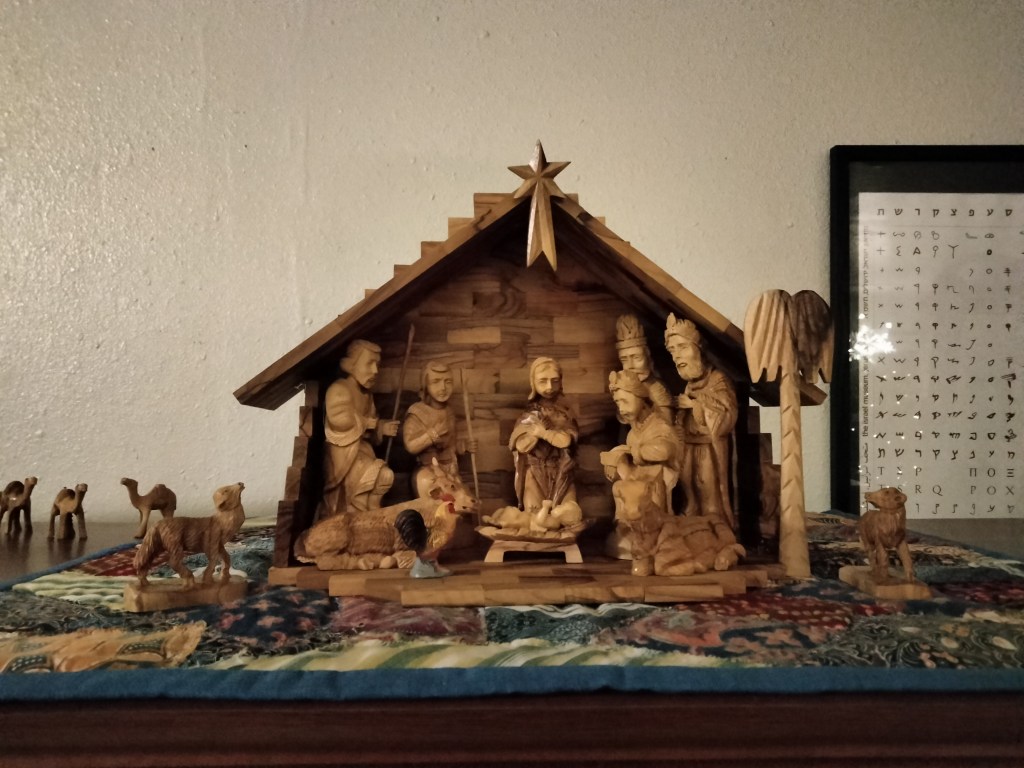
…. I mean, they’re basically all unique. I love the endless variety.
This one, which my husband bought in Israel, is made of olive wood. It’s sitting on a small quilt made of scraps of clothing we wore while in Indonesia (mostly batik patterns), and on the wall behind it is my husband’s poster of ancient alphabets of the world.
The latest addition is the rooster, who, though not made of olive wood, blends right in.
Saturnalia: The Roman Precursor to Christmas

And now to Rome, as always in December, came the Saturnalia.
“Io! Saturnalia!” That was the call that ushered in the merriest holiday of the Roman year — that hilarious, glorious, mid-December festival, the Saturnalia.
“Io! Saturnalia! Io! Io! Io!” That was the greeting that echoed through the holiday season. For it was in honor of Saturn — good, old, generous Saturn, kindest and most provident of the gods.
During those mid-December days (first three, later seven) no war was ever declared, nor battles fought, no criminals tried or punished. Courts were closed; schools dismissed; even the slave markets were shut down. During those days, all slaves were free [just] as in those golden days of old, all people had been equal. Everyone, rich, poor, young and old joined in a glorious holiday.
The day began with a sacrifice of thanksgiving in the early morning, followed by a public feast at midday, which turned into a wild, hilarious carnival before evening. In red pointed caps and colored costumes, merrymakers went singing and laughing through the streets, showering wheat and barley like confetti, and granting every wish, no matter how wild, ridiculous, or disgusting, made by the lucky one who had been chosen “King of the Saturnalia.”
The weeks ahead were always filled with preparation. Candlemakers and makers of dolls were busy pouring wax, turning out little earthenware images, and setting up booths for the doll fair. Every child would want a doll, and every household would need many candles for the Saturnalia.
Holly branches, with their bright berries, had to be cut and carted into the city, and houses trimmed with evergreen. Gifts for the family and friends must be selected and wrapped. For on the second day, after a family dinner of roast young pig, with all the trimmings, came an exchange of presents!
Augustus Caesar’s World: 44 BC to AD 14 by Genevieve Foster, Beautiful Feet Books, 1947, 1975, pp. 56 – 58
 Out of Babel Books