There was a detour sign on [Calvin’s] road from Paris to Strasbourg. Francis I and Charles V were in the opening stages of their third major war. Armies sprawled across the roads forbade passage. Calvin bent his way southward by Geneva … He went to an inn, planning to spend one restful night and be gone. But … there was knock on the door of Calvin’s chamber, and an importunate caller entered, who felt himself commissioned to remake the scholar into a leader. This was, of course, Guillaume Farel, the venturesome, big-voiced, red-haired little evangelist and controversialist … Farel and his associates were intent on reconstruction [in Geneva] and had taken some significant steps in the ordering of discipline, worship, and education. [W]hen [he found out] that Calvin had come for the night, Farel eagerly sought him out, resolved in to enlist him in the Geneva work.
The interview was both dramatic and historically momentous. Farel was twenty years Calvin’s senior, and a man of flaming zeal. Calvin longed for the library and the study; to Farel this would be a desertion of the cause of the Lord.
“If you refuse,” he thundered, “to devote yourself with us to the work … God will condemn you.”
Calvin later testified that he had been terrified and shaken by Farel’s dreadful adjuration, and had felt as if God from on high had laid His hand upon him.
John T. McNeill, The History and Character of Calvinism, pp. 131 – 136
Happy New Year! Don’t let anybody guilt you into any historically significant moves!
This wasn’t done from a photograph, as you can tell by the lack of detail. It wasn’t done plein-air either, but it was closer to a plein-air painting.
A few weeks ago, after I had gone outside to feed the hens, I was greeted by this scene. The sun hadn’t yet reached our homestead, but it was striking the hills up northaway. I stood there for a few moments memorizing the colors and thinking about how I would paint it. Then, over the course of the next week, whenever I had a chance I would add to the painting. I painted only when there was natural light in the studio. Pretend plein-air, if you will.
Let me show you my process …
Step 1: cover the canvas in light green for the sky and light grey for the predawn snow.
Step 2: add BSB and its mountain friends in appropriate dawn colors.
Step 3: the lava fields near them have not yet been hit by the sun, so they are navy blue.
Step 4: add stripes of cloud, just as they looked on that morning.
And finally, add distant trees, canal edge, ploughed-up snowy field with tire tracks, and black road with tire tracks in the snow.
A recent conversation with my son (the chicken-loving one):
Him: Why are there cows and sheep in the manger scene, but no chickens? Did they just not have chickens back then?
Me: No, probably chickens were just so common that no one thinks to include them. Remember, they definitely had chickens because Jesus told Peter he would deny him three times before the rooster crowed.
Him: Oh, that’s right!
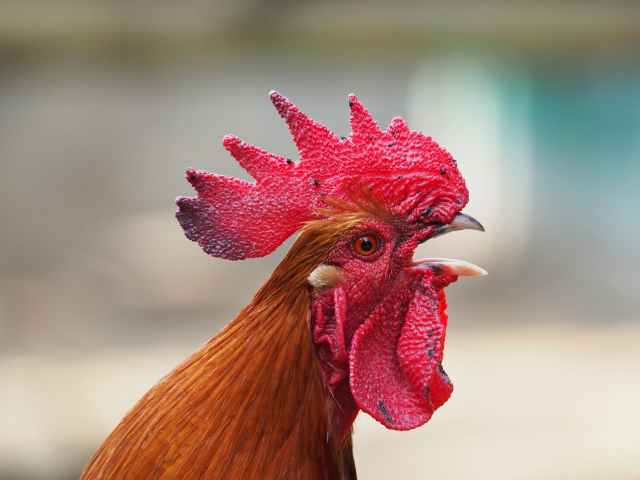
We decided that every manger scene needs a few chickens, actually. The presence of the rooster would foreshadow Christ’s suffering and death. They are Easter birds, but they are Christmas birds, too. Christmas chickens!
This post is about how we got our Christmas trees. For the record, I would probably still have a Christmas tree in the house even if it they were pagan in origin. (I’ll explain why in a different post, drawing on G.K. Chesterton.) But Christmas trees aren’t pagan. At least, not entirely.
My Barbarian Ancestors
Yes, I had barbarian ancestors, in Ireland, England, Friesland, and probably among the other Germanic tribes as well. Some of them were headhunters, if you go back far enough. (For example, pre-Roman Celts were.) All of us had barbarian ancestors, right? And we love them.
St. Boniface was a missionary during the 700s to pagan Germanic tribes such as the Hessians. At that time, oak trees were an important part of pagan worship all across Europe. You can trace this among the Greeks, for example, and, on the other side of the continent, among the Druids. These trees were felt to be mystical, were sacred to the more important local gods, whichever those were, and were the site of animal and in some cases human sacrifice.
God versus the false gods
St. Boniface famously cut down a huge oak tree on Mt. Gudenberg, which the Hessians held as sacred to Thor.
Now, I would like to note that marching in and destroying a culture’s most sacred symbol is not commonly accepted as good missionary practice. It is not generally the way to win hearts and minds, you might say.
The more preferred method is the one Paul took in the Areopagus, where he noticed that the Athenians had an altar “to an unknown god,” and began to talk to them about this unknown god as someone he could make known, even quoting their own poets to them (Acts 17:16 – 34). In other words, he understood the culture, knew how to speak to people in their own terms, and in these terms was able to explain the Gospel. In fact, a city clerk was able to testify, “These men have neither robbed temples nor blasphemed our goddess” (Acts 19:37). Later (for example, in Ephesus) we see pagan Greeks voluntarily burning their own spellbooks and magic charms when they convert to Christ (Acts 19:17 – 20). This is, in general, a much better way. (Although note that later in the chapter, it causes pushback from those who were losing money in the charm-and-idol trade.)
However, occasionally it is appropriate for a representative of the living God to challenge a local god directly. This is called a power encounter. Elijah, a prophet of ancient Israel, staged a power encounter when he challenged 450 priests of the pagan god Baal to get Baal to bring down fire on an animal sacrifice that had been prepared for him. When no fire came after they had chanted, prayed, and cut themselves all day, Elijah prayed to the God of Israel, who immediately sent fire that burned up not only the sacrifice that had been prepared for Him, but also the stones of the altar (I Kings chapter 18). So, there are times when a power encounter is called for.
A wise missionary who had traveled and talked to Christians all over the world once told me, during a class on the subject, that power encounters tend to be successful in the sense of winning people’s hearts only when they arise naturally. If an outsider comes in and tries to force a power encounter, “It usually just damages relationships.” But people are ready when, say, there had been disagreement in the village or nation about which god to follow, and someone in authority says, “O.K. We are going to settle this once and for all.”
That appears to be the kind of power encounter that Elijah had. Israel was ostensibly supposed to be serving their God, but the king, Ahab, had married a pagan princess and was serving her gods as well. In fact, Ahab had been waffling for years. There had been a drought (which Ahab knew that Elijah — read God — was causing). Everyone was sick of the starvation and the uncertainty. Before calling down the fire, Elijah prays, “Answer me, O LORD, answer me, so these people will know that you, O LORD, are God, and that you are turning their hearts back again.” (I Kings 18:37)
Similar circumstances appear to have been behind Boniface’s decision to cut down the great oak tree. In one of the sources I cite below, Boniface is surrounded by a crowd of bearded, long-haired Hessian chiefs and warriors, who are watching him cut down the oak and waiting for Thor to strike him down. When he is able successfully to cut down the oak, they are shaken. “If our gods are powerless to protect their own holy places, then they are nothing” (Hannula p. 62). Clearly, Boniface had been among them for some time, and the Hessians were already beginning to have doubts and questions, before the oak was felled.
Also note that, just as with Elijah, Boniface was not a colonizer coming in with superior technological power to bulldoze the Hessians’ culture. They could have killed him, just as Ahab could have had Elijah killed. A colonizer coming in with gunboats to destroy a sacred site is not a good look, and it’s not really a power encounter either, because what is being brought to bear in such a case is man’s power and not God’s.
And, Voila! a Christmas Tree
In some versions of this story, Boniface “gives” the Hessians a fir tree to replace the oak he cut down. (In some versions, it miraculously sprouts from the spot.) Instead of celebrating Winter Solstice at the oak tree, they would now celebrate Christ-mass (during Winter Solstice, because everyone needs a holiday around that time) at the fir tree. So, yes, it’s a Christian symbol.
Now, every holiday tradition, laden with symbols and accretions, draws from all kinds of streams. So let me hasten to say that St. Boniface was not the only contributor to the Christmas tree. People have been using trees as objects of decoration, celebration, and well-placed or mis-placed worship, all through history. Some of our Christmas traditions, such as decorating our houses with evergreen and holly boughs, giving gifts, and even pointed red caps, come from the Roman festival of Saturnalia. This is what holidays are like. This is what symbols are like. This is what it is like to be human.
Still, I’d like to say thanks to St. Boniface for getting some of my ancestors started on the tradition of the Christmas tree.
Bonus rant, adapted from a discussion I had …
... in a YouTube comments section with a Hebraic-roots Christian who was insisting that Christmas is a “pagan” holiday:
So, as we can see, the evergreen tree is a Christian symbol, not a pagan one, and has been from the very beginning of its usage. St. Boniface cut down the tree that was sacred to Thor, and that was an oak tree, not a Christmas tree. Sacred oaks are pagan. Christmas trees, which incidentally are not actually considered sacred, are Christian.
Yes, I am aware, as are most Christians, that Jesus was probably not actually born on Dec. 25th. Yes, I am aware that Yule was originally a pagan feast time.
But let’s look at the symbolism, shall we?
For those of us who live in northern climes, and especially before the industrial revolution, the winter solstice is the scariest time of the year. The light is getting less and less, and the weather is getting worse and worse, and all in all, this is the time of year when winter officially declares war on humanity. Winter comes around every year. It kills the sick and weak. It makes important activities like travel and agriculture impossible. It makes even basic activities, like getting water, washing things, bathing, and going to the bathroom anywhere from inconvenient to actually dangerous to do without freezing to death. If winter never went away, then we would all surely die. That is a grim but undeniable fact. Read To Build A Fire by Jack London, and tremble.
Thus, people’s vulnerability before winter is both an instance and a symbol of our vulnerable position before all the hardships and dangers in this fallen world, including the biggie, death. And including, because of death, grief and sorrow.
Yule is a time of dealing with these realities and of waiting for them to back off for another year. After the solstice, the days slowly start getting longer again. The light is coming back. Eventually, it will bring warmth with it. Eventually, life.
Thus, it is entirely appropriate that when the Germanic tribes became Christians, they picked the winter solstice as the time to celebrate Jesus’ birth. He is, after all, the light of the world. A little, tiny light – a small beginning – had come into the bitter winter of the sad, dark world, and it was the promise of life to come. The light shines in the darkness, and the darkness has not overcome it. All this biblical, very Hebrew symbolism answers beautifully the question raised by the European pagans’ concern with the sun coming back.
Our ancestors were not “worshipping pagan gods” at Christmas. They were welcoming Christ (who is the God of Abraham, Isaac, and Jacob) into the heart of their culture. They were recognizing that He was the light, using terms they knew, which were Germanic terms, and this is not surprising because they were Germans.
So, if you want to make the case that no holidays are lawful for Christians except those prescribed in the Old Testament for Israel, be my guest. Try to find some Scriptures to back that up. And maybe you can. But you cannot make that case by accusing people who put up a Christmas tree of worshipping pagan gods. All you’ll do then is reveal yourself to be historically ignorant.
As yet, most excellent Spalatin, you have only asked me things that were in my power. But to direct you in the study of Holy Scriptures is beyond my ability. If, however, you absolutely wish to know my method, I will not conceal it from you.
It is very certain that we cannot attain to the understanding of Scripture either by study or by intellect. Your first duty is to begin by prayer. Entreat the Lord to grant you, of His great mercy, the true understanding of His Word. There is no other interpreter of the Word of God than the author of this Word, as He Himself has said: “They shall be taught by God.” Hope for nothing from your own labors, from your own understanding: trust solely in God and in the influence of His Spirit. Believe this on the word of a man who has experience.
Martin Luther, quoted in The Triumph of Truth by Jean Henri Merle D’Aubigne , p. 96
(I was going to include a picture of our angel Christmas cookies, but … we ate them all.)
Angels are scary beings that usually inspire terror whenever they appear. We don’t really understand what they are. We know they have a different kind of body, one that exists in the heavenly realms, and is probably unpicturable to us as it actually is. We know they were created by God and serve Him (the unfallen ones, anyway), but we don’t know how many kinds there are or much at all about what they actually do. We do know that they are very dangerous.
And we make … cookies of them.
I just love that.
I think it’s hilarious.
I’m sure that being made into a cookie is very insulting to the dignity of angels … those that care the most about their own dignity, anyway, which would be the fallen ones.
The unfallen ones probably just get a smile out of it, because they know that the reason for their cooki-fication, the reason humans refer to them at all, is that they played a minor but striking role in announcing the birth of Jesus … that is, in God’s dealings with humanity. And being unfallen, they probably know that since this was part of God’s plan, it was in fact very good, so it follows that having cookies made of them is actually to the glory of God. So I suppose they don’t mind.
It’s on the Ancient Origins website, which compiles and presents a lot of fascinating stuff, but which also has many annoying ads. Sorry about that!
So, to answer my own question, I think that many of these structures could have just been houses. Particularly when we get circular or triangular structures facing or intersecting each other, they don’t look so different to me than the pit houses and kivas of Mesa Verde. The only difference would be that they are much older.
Consider: Saudi Arabia was once much more verdant than today (as was Egypt, evidenced by the erosion channels on the Sphinx). These structures seem to be very old (evidenced by the fact that some of them have been partially covered with lava flows). They could be habitations dating back to a time when the area was actually rainy (immediately post-Flood?). The stone walls, now fallen, could have been topped with domed or conical roofs made of a more perishable material.
“But they think the cairns in them contain burials!” True. It’s interesting that they only think this. Apparently, they haven’t been allowed to show up in person so as to excavate/investigate. These are sites I’d like to visit … except, of course, I’d rather the demons didn’t get me. Anyway … if the cairns do turn out to be burial mounds and not something more prosaic like ovens, even that wouldn’t be completely unprecedented. It might seem a little odd to have Grandpa buried right there in your family housing complex, but it has been done before, at least with ossuaries (bone boxes). The cairn would become a sort of ancestral shrine. It’s not unheard of in human history.
[A] pure democracy, by which I mean a society consisting of a small number of citizens, who assemble and administer the government in person, can admit of no cure for the mischiefs of faction. A common passion or interest will, in almost every case, be felt by the majority of the whole; a communication and concert result from the form of government itself; and there is nothing to check the inducements to sacrifice the weaker party or an obnoxious individual. Hence it is that such democracies have ever been spectacles of turbulence and contention; have ever been found incompatible with personal security or the rights of property; and have in general been as short in their lives as they have been violent in their deaths.




 Out of Babel Books