So, one Latin word for brother is germanus. (Sister = germana.) The others, of course, are frater and soror.
We get our derivative “germane” from this, but also “German.”
That’s right, the Romans looked at the Germanic tribes and just started calling them “the brothers.” I guess they must all have looked alike to them. And probably they were all actually related to each other.
Meanwhile, the Spanish Celts were speaking their adorable pidgin Latin, so we get the Spanish hermano/hermana.
There are fewer words in this world than it first appears, actually.
The name Huitzilopochtli means “hummingbird of the left [hand]” or “hummingbird of the South.” Now, if we were to play a word-association game and I said “hummingbird,” I doubt that the first thing out of your mouth would be “human sacrifice.” This was not true of the tribe of the Mexica, however.
The hummingbird was closely linked both with human sacrifice and with rain, since it appears in the rainy season, so the bird was associated with the form of death believed to feed the sun and with fertility as well. Huitzilopochtli [after, in the myth, killing his sister and routing his brothers] was no longer just an obscure earth deity, he was now the Lord of the Daylight Sky, the Rising Sun, and his symbol, the hummingbird, also came to represent the fallen warriors who accompanied the sun on his daily journey. Among his other attributes, the Mexica came to believe in Huitzilopochtli as the God of War … who incited his chosen people to greatness … by the force of their own hearts and their arms which would “lift the Mexican nation to the clouds.” These same hearts and arms were also to provide the vital, nourishing blood that sustained the god and the Aztec world.
The Aztecs, by Brian M. Fagan, pp. 55 – 56
Got that? Hummingbird >>> rainy season >>> fertility >>> human sacrifice >>> war.
The Mexica were sacrificing to Huitzilopochtli as they wandered around central Mexico, fighting one people after another, before they ever founded their great capital city of Tenochtitlan. (We are still not clear on the location of their original homeland.) However, if we count from the founding of Tenochtitlan in the year Two House (probably about A.D. 1325), when the Mexica built a reed temple to the hummingbird god on the small island where they had seen an eagle perched on a prickly pear, then Huitzilopochtli reigned in central Mexico just under 200 years. Cortez arrived in 1519, and by 1522, Tenochtitlan was destroyed.
According to the ancient world view that dates back to Genesis, the One God temporarily gave the lesser gods control over various nations. At Babel, when He scatters the peoples, there are 70 groups, corresponding to the 70 gods that traditionally composed God’s council in Ugaritic and Hebrew mythology. But the gods do a rotten job of leading their people. They tend to behave tyrannically, as do the human rulers who both serve and imitate them. Hints begin very early that one day, the gods’ time will be up. The One God will take back direct rule, not just of the Hebrews, but of all nations of the earth. Then all the nations will once again be His portion, His inheritance.
In the meantime, He lets them run, and things get very bad. When things get too bad in a nation, the One God often judges them. He brings that civilization to an end, usually by using another nation (equally wicked but not yet ready for their own judgement). Defeat in war was well known in the ancient world as a sign that our god had either abandoned us or been defeated by a foreign god. It was well known to the Hebrews as a sign that the One God had had enough of the way this lesser god, and these human kings, were running this nation.
Some nations got to go a very long time. Before the Israelites went into slavery in Egypt, the One God predicted that He would bring them to the land of Canaan four hundred years later — but not yet, “for the sin of the Amorites has not yet reached its full measure.” The Phoenicians, who would burn live babies to appease their god Moloch, got to go on with their wicked ways until Rome destroyed Carthage in 146 B.C. … a very long run indeed. Rome would have her turn many centuries later.
Using this scale, the reign of Huitzilopochtli was shockingly short. Less than two centuries … but what centuries they were! By the time judgement arrived in the person of Cortez, the Mexica were carrying out raids and wars farther and farther afield (almost to Guatemala) to feed the demand for prisoners whose hearts were ripped out of them and offered to Huitzilopochtli, now almost daily. The bodies were kicked down the steps of the temple. Depending upon the type of sacrifice, the arms and legs might later be eaten with some prickly pear on the side. The skulls were stored on massive skull racks. Aztec warriors moved up the ranks based upon how many prisoners they had captured for sacrifice. After a certain number, they were allowed to wear a mohawk. More captures, and they earned a cotton cloak, a necklace, a feathered headdress.
When Cortez and his men were fighting their way out of the city for the first time, astoundingly they managed to capture the temple, though it was covered in hundreds of very tough Aztec warriors. They then took the statue of Huitzilopochtli and hurled it down the temple steps … the very steps down which so many human bodies had been flung. Then, with heavy casualties, a few of them managed to escape the city. On the way back to their base among the Tlaxcalans, they fought battle after battle in which they were massively outnumbered. They should have perished dozens of times, but they didn’t. About a year later, Tenochtitlan was under siege and the Mexica, unable to keep up with death rate, began throwing the bodies of their fallen loved ones into the canals of the city. Hardened Spanish warriors couldn’t handle the smell when they entered the city. Nor could they stop their Tlaxcalan allies from slaughtering the Aztec civilians. God’s judgement on a 200-year orgy of bloodshed was a terrible thing to behold.
Today, Huitzilopochtli is an obscure name. Many people have heard of the Aztecs, and even of Quetzalcoatl, but the hummingbird of the south is not a name on everyone’s lips. He who once filled millions of people with terror has passed into obscurity. Now he’s a bit of trivia, a name known to experts on Mesoamerican history and archaeology only. Nor is Huitzilopochtli alone in this. He has joined the ranks of many gods, such as Moloch, Ishtar, Vesta, Cernunnos, and Tanit, who were once mighty in their lands and now are known only by people with a special interest in a particular corner of history. There are other gods, of course, whose names we do not know. We find a strangely shaped cultic object and we can only speculate. All of these lesser gods have become part of history. But everyone knows the name of Christ, the one Who sets the prisoners free. If someone wants to break into a strong man’s house and take his precious possessions, his people, one must first tie up the strong man.
R.I.P., Huitzilopochtli. You had a good run — 200 years — but beating hearts will be cut out and offered to you no more.
There are again two methods of removing the causes of faction: the one, by destroying the liberty which is essential to its existence; the other, by giving to every citizen the same opinions, the same passions, and the same interests.
It could never be more truly said than of the first remedy, that it was worse than the disease. Liberty is to faction what air is to fire, an aliment without which it instantly expires. But it could not be less folly to abolish liberty, which is essential to political life, because it nourishes faction, than it would be to wish the annihilation of air, which is essential to animal life, because it imparts to fire its destructive agency.
The second expedient is as impracticable as the first would be unwise. As long as the reason of man continues fallible, and he is at liberty to exercise it, different opinions will be formed. As long as the connection subsists between his reason and his self-love, his opinions and his passions will have a reciprocal influence on each other … The latent causes of faction are thus sown in the nature of man.
But this one is not a debate nor an interview about ancient giants, but a gentle rambling testimony interview. Chris and I discuss what it’s like having a pastor for a father, how to read the Bible without pressure, and what it means to “lean not on your own understanding.”
Have we not already seen enough of the fallacy and extravagance of those idle theories which have amused us with promises of an exemption from the imperfections, weaknesses, and evils incident to society in every shape? Is it not time to awake from the deceitful dream of a golden age, and to adopt as a practical maxim for the direction of our political conduct that we, as well as the other inhabitants of the globe, are yet remote from the happy empire of perfect wisdom and perfect virtue?
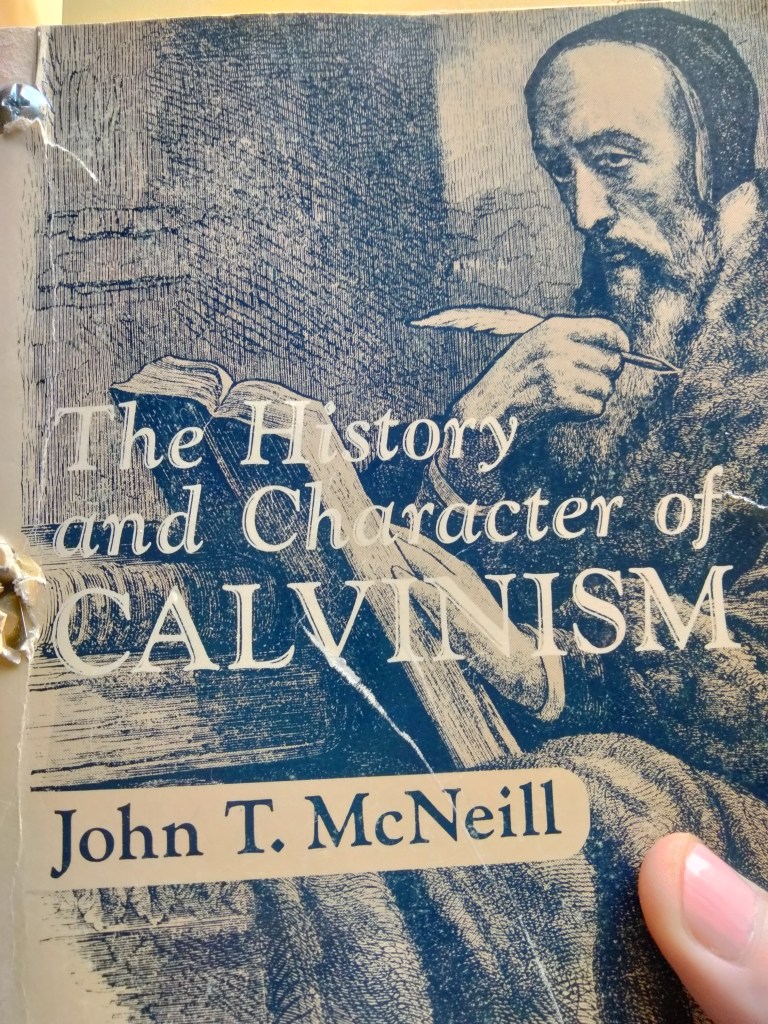
How I fell down the Calvinist rabbit hole: a 25-year saga
Do you want to know how I fell down the Calvinist rabbit hole? Of course you do.
I was raised in your basic free-will-Baptist, Arminian environment. I discovered Calvinism in college, but I didn’t know right away that it was called Calvinism. I just knew I was encountering deeper Bible teaching than I had seen before, teaching that seemed to be based on good exegesis, to contain a great deal of psychological insight, and to fit with my own experiences of belief, spiritual growth, and successful and unsuccessful evangelism. Above all, this teaching had the effect of exalting Christ and making the great kindness and mercy of God shine all the more bright. In other words, Gospel teaching.
Not long after, I found out that one of its most copious articulators had been Calvin.
That was OK with me. Anybody who does a great job expounding the grace of God abounding to the chief of sinnners is someone I call friend. If they wrote volumes about it and were insightful and articulate, so much the better. I think this teaching is Biblical; that’s why I’m a Calvinist. But I’m not personally loyal to Calvin or to the idea of Calvin. (“I am of Apollos; I am of Paul.”) I wasn’t growing in the grace and knowledge of Calvin, but of Christ.
Anyway, the upshot was that I started attending Presbyterian churches whenever I was able to find one. That seemed to be where the good stuff was. Oh, and then I married a guy who was also a convert to what we call Reformed Theology or covenant theology. So, you know. I was in pretty deep by this time. All this went down about twenty-five years ago.
Over the years, I’ve interacted with quite a few Christians who are hostile to the name Calvin. These interactions have, in general, served to strengthen my conviction that the doctrine is true. That is because anti-Calvinist arguments, instead of presenting troubling “oh, I never thought of that!” Bible passages that make me call covenant theology into question, usually just seem to be reacting to a straw man of Calvinism, often a really egregious straw man. Here are a few.
No Free Will
The straw man of Calvinism that I most commonly hear presented is as follows: Calvinism is a completely deterministic system in which God controls all people, angels, and demons like He’s Jim Henson and they are the Muppets. It looks like you are making decisions, but it’s actually God steering you with His hand inside your little felt head. You have no free will.
Usually, this straw man came about in one of two ways. First of all, the person has not actually read much (or any?) Calvinist literature but has just heard the doctrine of predestination summarized, often in a hostile way, by someone else. And/or, the person has taken the doctrine of predestination and/or irresistible grace and has tried to work out all its implications in a completely logical system of thought such as we might find in the hard sciences, ignoring human psychology, other Bible passages, and even other Calvinist doctrines.
At its very base, this caricature is based on a naive misunderstanding of the nature of human will.
You see, my friends, our wills are not actually free when we are bound in sin. Sin is like addiction, and we all know that the addict is not free. He is not free to do anything but indulge over and over again in the the thing that has mastered him. Believe me, the working of the Holy Spirit of God on your heart is not nearly so damaging to your free will as is sin. That’s why the Bible says that whoever sins is a slave to sin.
This is basic human psychology, and most people understand it when they are not contemplating Calvinism. None of our decisions are ever completely “free” in the sense of not being influenced by anything at all. That doesn’t make them not decisions. Yes, you did decide to follow Jesus … it’s just that first, He had to set your heart free to do so.
But wait, isn’t the doctrine that God decided back in eternity past who would be saved and who would be damned? How, Madame Calvinist, you ask, can you call that free will? Hmmm?
Well, true. But keep in mind that this doctrine does not only apply to salvation. The sovereignty of God over all things in the universe is a doctrine that is found throughout the Bible. Who of you by worrying can add one hour to his life? God knows about every sparrow that falls, and don’t worry, you are worth at least several sparrows. And even the very hairs of your head are all numbered. He sends rain on the just and on the unjust. He changes times and seasons; he sets up kings and deposes them. The heart of the king is like a watercourse, and the Lord turns it wherever he pleases. The Lord opens and closes the womb. He gives and takes away. Blessed be the name of the Lord.
The sovereignty of God, as I say, is an extremely basic doctrine, and even Christians who hate the name of Calvin will affirm it in a general way when it is presented like this. To try to deny it would land us in much deeper difficulties. (Cue Darwinistic determinism.)
So, God is sovereign over every molecule and every sentient being in the universe (a basic doctrine), AND this universe includes beings other than God (animals; demons; you and me) who make actual decisions with actual consequences. That is another doctrine that is not only blindingly obvious from our experience, but is affirmed, directly and indirectly, in numerous places in Scripture.
Is this a paradox? You bet. Not everything in Scripture is a paradox, but this one is. Not everything in our universe is a paradox, but this one definitely is. Don’t ask me to explain how it works. I’m not God. But to be fair, I should not have to be able to explain how it works in order to assert that God is sovereign over all of creation including the human heart, AND that humans make decisions. Remember, no one else has been able to come up with a philosophical system that accounts for human nature without landing us in determinism, either. This is a paradox that all of us, Calvinist and non-Calvinist, have to live with. If you follow Darwin or Marx instead of Calvin, you will get to determinism a lot faster, and you will like it even less when you get there.
So, this thing about “Calvinisim means we have no free will” is the result of an attempt to woodenly apply human, binary logic to a doctrine about the sovereignty of God, and to draw the conclusions that we think must follow from it (even though they don’t actually follow from it in Calvinist teaching or in Scripture).
So, there’s no point in doing anything, is there?
Another objection I often hear (which is actually a corollary of the first misunderstanding): “If, as Calvin says, God ultimately determines who will be saved and who will be lost, why then there is no point in preaching the Gospel, calling people to repentance, teaching our children about Christ, or combating false teaching. After all, it’s all decided already.”
Again, this is a mischaracterization of actual Calvinist teaching. It’s what people think follows from what they think Calvinism is. But if you crack open any Reformed piece of writing (say, the Canons of Dort), you will very quickly encounter the doctrine that God uses means to accomplish His purposes. Prayer, preaching and the Lord’s Supper are called “the ordinary means of grace.” In other words, sometimes God can use extraordinary means, as He did with Saul on the road to Damascus, in order to call someone to Himself. But ordinarily, the means He uses are someone gave you some good Bible teaching, and so you heard the Gospel. God is sovereign, AND, due to the way He has designed the world, false teaching can do real harm and Gospel teaching can do real good.
Furthermore, God typically (not exclusively, but typically) works in families. So, if you were born into a Christian family, were loved and were taught God’s Word, these were the means He used to bring about your salvation (which He had determined from all eternity past, but that part might not be super relevant to your experience right at first). In my experience, parents in Reformed churches are more serious about giving their children good Gospel teaching than those in other Protestant traditions. So, you may think that Calvinism implies there is no need to teach our children the Gospel, but in actual fact that is not how Calvinists behave, nor is it what they teach.
From childhood, I have sat under both Arminian and Calvinist types of teaching. (Arminian would be the typical Baptist “altar call.”) From personal experience, I can say that certain types of Arminian teaching, especially the kind you get around the campfire in youth group, put a lot of pressure on the individual. “Deciding to follow Jesus” becomes a work that you do, whereby you whip yourself up into an emotional fervor to manufacture a spiritual experience. “Turn over every area of your life to Christ.” That’s right, don’t just repent of the sins you know about and that the Holy Spirit is bringing to mind right now, and then trust Him to reveal more of your sin later. That would be too easy. Instead, you need to do a thorough self-examination and personally peer into and clean out every dark corner of your heart, right now, tonight. After all, it’s your choice. You save yourself, Christ does not save you.
Another bad effect of this shallow understanding of choice, will, and grace is that it tends to keep us trapped in spiritual immaturity. Since people choose God instead of God choosing people, when a child or a teen who has believed on Christ shows that they are still immature, or falls back into sin (which we all do), the tendency of an Arminian is to take this as a sign that the person did not “really” decide to follow Jesus. So instead of being given rebuke, teaching, encouragement, and exhortation, they are terrified with the prospect that they’re not really saved, and invited to manufacture a second (or a fifth or a twentieth) conversion experience. It would be much more helpful to these young people to treat them as Christians who are immature and sinful. This would allow them to grow in spiritual maturity as they gain practice in battling against sin. Such an approach (Calvinist, by the way) is also less insulting to Christ. Christ can save teens and children. He does not just save the good ones. His power is not so frail as to be foiled by the fact that we are lazy, stupid, proud, a bully, or have fallen into sexual sin.
Farther down the rabbit hole
So, over the past 25 years of delightedly growing in grace, I have read a number of books by Calvinist authors. These include books and essays by Martin Luther, R.C. Sproul, John Piper, Ted Tripp, Ed Welch, Matt Whitling, Douglas Jones, and Douglas Wilson. I’ve read a few of the older confessions and creeds, such as the Westminster Confession and the Canons of Dort. I’ve sat under some fantastic Reformed teaching. But one thing I had never done was read a history of Calvin’s life, conversion, and time in Geneva.
That changed this fall, when I was obliged to read up on Calvin (and on his magnum opus, Institutes of the Christian Religion), in order to teach a unit on him. Reading, in fact, is what I am supposed to be doing instead of writing this excellent blog post.
Anyway, what I have found out so far is that his original name was Jean Cauvin. It got Latinized to Calvinus when he entered school, and then later the -us was dropped. He grew up in northeastern France, in and around the stunning cathedral of Noyon, as a Roman Catholic. His dad actually worked as a secretary to the bishop of Noyon, and Calvin was educated with the bishop’s children. Later, Calvin boarded for a while with a godly old man who was a Waldensian (French Protestant). At this same time, the Waldensians who had settled in the Piedmont in Italy were being gruesomely butchered for refusing to convert to Roman Catholicism (read Foxe’s Book of Martyrs, and tremble). The Inquisition was still going on.
Now I have to get back to reading the Institutes and stuff like that. I haven’t come to the bottom of the rabbit hole yet. Have a great weekend, and if you feel a tug, read the Scriptures! It’s probably God calling you, as He determined to do out of His sheer kindness to you from all eternity past!
Is it not (we may ask these projectors in politics) the true interest of all nations to cultivate the same benevolent and philosophic spirit? If this be their true interest, have they in fact pursued it? Has it not, on the contrary, invariably been found that momentary passions, and immediate interests, have a more active and imperious control over human conduct than general or remote considerations of policy, utility, or justice? Have republics in practice been less addicted to war than monarchies? Are not the former administered by men as well as the latter? Are there not aversions, predilections, rivalships, and desires of unjust acquisitions, that affect nations as well as kings? Are not popular assemblies frequently subject to the impulses of rage, resentment, jealousy, avarice, and other irregular and violent propensities? Is it not well known that their determinations are often governed by a few individuals in whom they place confidence and are, of course, liable to be tinctured by the passions and views of those individuals? Is not the love of wealth as domineering and enterprising a passion as that of power or glory? … Let experience, the least fallible guide of human opinions, be appealed to for an answer to these inquiries.



 Out of Babel Books