

“What’s Your Life Verse”?

Having a “life verse” used to be a thing in evangelical Christian culture.
I once knew this guy who was interested in dating this girl. He was kind of a new Christian, and she wasn’t 100% sure he was sincere, because guys have been known to fake spirituality in order to get the girl. So she kept grilling him, trying to figure it out. And one question she asked him was, “What is your life verse?”
So if you thought the title of this blog post sounded like a pickup line, you weren’t entirely wrong.
I don’t actually know whether life verses have faded away as a practice, or whether they are still a thing that gets talked about, but I have just moved into denominational circles that are less silly.
Why do I say silly? Not because picking a “life verse” involves meditating intensely on a passage from the Bible. The Word of God is certainly powerful and active and worth returning to as a theme (provided we are actually responding to what the verse actually says, not just to a meaning that we project onto it). Anyone who makes a regular practice of prayerfully reading their Bible has had the experience where a verse, or a passage, seems to pop off the page and hit you between the eyes like a two-by-four. And then you spend several weeks or months revisiting that verse, turning it back and forth in your mind like a huge jewel with many facets, internalizing it, wondering why you didn’t notice it before.
No, the reason I think the idea of a “life verse” is kind of stupid, is that it’s too restrictive. You are going to limit yourself to just one two-by-four verse? Why? The Bible is full of two-by-fours just waiting to whack you. It can happen every few months, or once a year, but definitely there is a going to be a different theme verse for every season in your life.
And if we are talking about a verse that describes your particular experience of life, that might exist, but it’s hard to imagine you how you could pick it as a 20-year-old. Sounds more like the kind of thing that is awarded retroactively, maybe by your biographer.
For example, after several decades of experience, I think my life verse might just be II Corinthians 12:11: “I have made a fool of myself, but you drove me to it.”
I think that would look great on my tombstone. Although, the “you drove me to it” part is debatable.
Anyway. As faithful Out of Babelites are aware, I spent part of last year further educating myself on Gnostic and Hermetic philosophy. Partly as a result of this, I’ve been steeping in the book of Colossians, which is almost entirely about Hermetic and Gnostic beliefs and cults, and how they are not the Gospel once delivered to the saints. Paul was worried about Colossians, who in his absence might be confused by one of the Hermetic “teachers” who were so numerous in the Mediterranean world in the first century. If you want to know whether Gnositc/Hermetic teaching is really the same as what Jesus taught, just in different words, please read Colossians.
So, one of my two-by-four verses this year is this:
Such regulations indeed have an appearance of wisdom, with their self-imposed worship, their false humility and their harsh treatment of the body, but they lack any value in restraining sensual indulgence.
Colossians 2:23
Especially in my youth, I was easily impressed by ascetic and mystical claims and practices. How could these things be bad? They have an appearance of wisdom. “Such regulations” could be found in yoga, Mormonism, Islam, legalistic/Hebrew-roots sects of Christianity, or modern environmental Gnosticism where we save ourselves by education, sensitivity training and clean living.
Now I know: such regulations lack any value in restraining sensual indulgence. They do not give people power to resist sin. That explains why every ascetic cult seems to generate its own sex scandals. It explains why we can expect such scandals from such quarters, even when they have not yet come to light.
So anyway, that’s my life verse for now. Patiently waiting to be clocked by the next two-by-four.
Quote: Originally Written in Hebrew
Hear me when I call, O God of my righteousness!
You have relieved me in my distress;
Have mercy on me, and hear my prayer.
How long, O men, will you turn my glory to shame?
How long will you love worthlessness and seek falsehood? Selah.
But know that the LORD has set apart for Himself him who is godly;
The LORD will hear when I call to Him.
Be angry, and do not sin.
Meditate within your heart on your bed, and be still. Selah.
Offer the sacrifices of righteousness,
And put your trust in the LORD.
There are many who say, “Who will show us any good?”
LORD, lift up the light of your countenance upon us.
You have put gladness in my heart,
More than in the season that their grain and wine increased.
I will both lie down in peace, and sleep;
For You alone, O LORD, make me dwell in safety.
Psalm 4. By David.
So.
My dad used to quote me the last verse of this psalm as a bedtime prayer when I was small.
The classical Christian school where I teach had selected this psalm for memory work for the month of October.
And then …
We hear of atrocities in Israel, committed against Israelites. Every single verse of this psalm, written by David millennia ago, instantly becomes 100 times more relevant and poignant.
When I hear about mothers and babies murdered, reading that last verse out loud is almost more than I can handle.
Let’s all use this psalm to pray for them.
Look what floated to the top of my TBR List
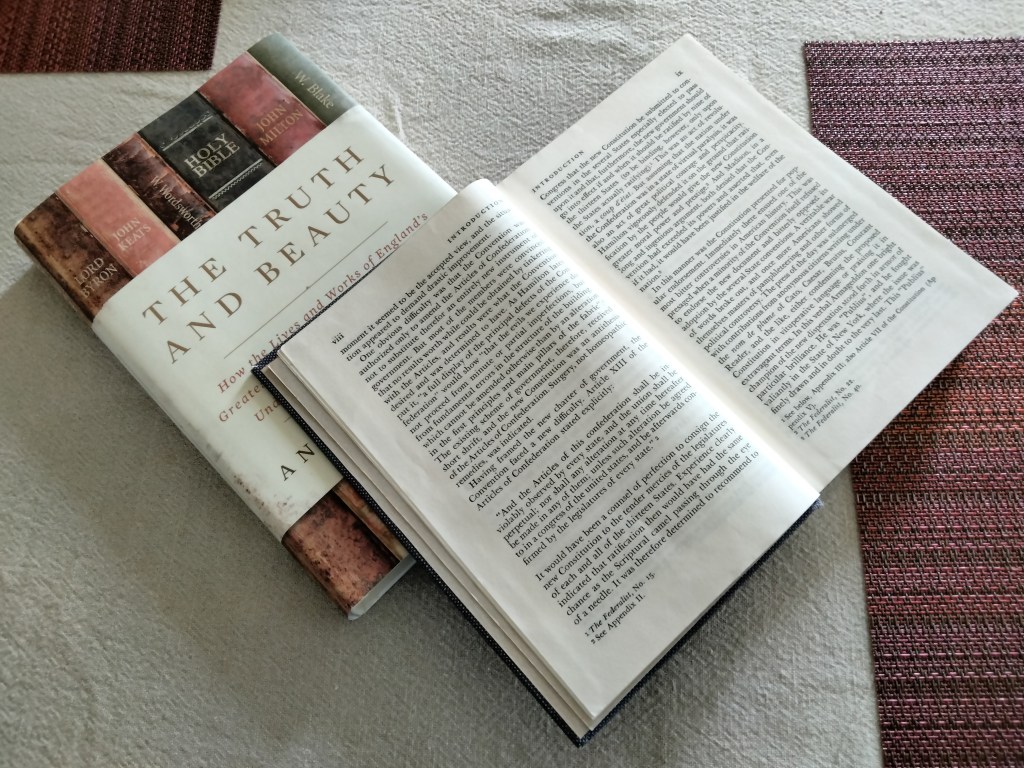
That’s the Federalist papers (remedial), and Andrew Klavan ‘s new book about the English Romantic poets and Jesus.
The Best Latin Pun

Welcome back to school! At a teacher training event, I was shown this amazing four-way pun taken from the seal of St. John’s College.
“Facio Liberos ex Liberis Libris Libraque”
Facio = “I make”
Liberos = “free [men or people]
ex Liberis = “from children”
Libris Libraque = “by means of books and a scale”
The words books (libris) and scale (libra) are both in the Ablative. In this case it’s ablative of Instrument.
-que is an enclitic word for “and,” which means it leans on the end of the last item in the list.
If you want to remember that libra means scale, just think of this:

So, the whole motto is,
“I make free men from children with books and a scale.”
It sounds a lot better in Latin.
Quote: Who Needs Verbs? Not Agatha Christie!
Rhoda’s fete had passed off in the manner of fetes. Violent anxiety about the weather which in the early morning appeared capricious in the extreme. Considerable argument as to whether any stalls should be set up in the open, or whether everything should take place in the long barn and the marquee. Various passionate local disputes regarding tea arrangements, produce stalls, et cetera. Tactful settlement of same by Rhoda. Periodical escapes of Rhoda’s delightful but undisciplined dogs who were supposed to be incarcerated in the house, owing to doubts as to their behavior on this great occasion. Doubts fully justified! Arrival of pleasant but vague starlet in a profusion of pale fur, to open the fete, which she did very charmingly, adding a few moving words about the plight of refugees which puzzled everybody, since the object of the fete was the restoration of the church tower. Enormous success of the bottle stall. The usual difficulties about change. Pandemonium at teatime when every patron wanted to invade the marquee and partake of it simultaneously.
Agatha Christie, Pale Horse, pp. 56 – 57

Another Candidate for Atlantis

There have been a number of proposed sites for Atlantis. Graham Hancock has proposed Antarctica, North America, and probably some other places that I don’t know about. I’ve also heard rumors that the sunken continent could be in the Bahamas area and could explain the Bermuda Triangle phenomenon. The Disney movie Atlantis locates it off the coast of Iceland, and I have also heard people advocate the Eye of the Sahara in Mauritania. (The idea being that, before continental uplift, this site was closer to the coast, and it could have been inundated by a tsunami or something like that.) Well, the article above makes what strikes me as the most likely proposal yet.
The super-island of the Cyclades Plateau (Plato’s Atlantis) was drowned by the sea at around 8000 BC, during the rapid rise of the Mediterranean and just prior to the flooding of the Black Sea (see UNESCO study, 2009.) Incidentally, around this time, Lake Agassiz, a gigantic glacial lake in North America, also burst open and began to drain into the Atlantic. It is worth noting that Lake Agassiz covered an area larger than all the Great Lakes combined (440,000 Km 2) and at times, it contained more fresh water than all the lakes in the world today. The total fresh water outflow from this lake alone was so immense, scientists believe it raised the oceans worldwide by as much as nine feet and further produced the 8.2 kilo-year event that followed, a mini ice age that lasted 400 years! This global cataclysm at the end of the last Ice Age, which ultimately raised sea levels by 400 feet, not only erased our early history, but this could also be the event we all inadvertently refer to as the “Great Flood.”
ibid
Proposing the Cyclades Plateau as the site of Atlantis ties its inundation to a known rise in sea levels that happened right around the date that Plato says Atlantis was submerged. The article shows maps of what the plateau would have looked like and how it roughly matches Plato’s description of Atlantis (though the scale is slightly off). Of course, in my integrated version of ancient history, it went like this:
- Pangea
- Continental Sprint, involving cataclysmic earthquakes and also tsunamis. This is the Great Flood
- A cold, rainy period after the Flood, leading to the Ice Age, which meant lower sea levels, coinciding with human dispersion across the newly shaped continents
- As the Ice Age ended, we get sea levels rising and large but not worldwide local floods like those described above.
The article also suggests that this civilization was part of a larger pan-Mediterranean civilization:
Finally, a 10,000 year old Mediterranean civilization, may help explain more archaeological oddities in this region. Recent erosion and seismic tests at the Giza Plateau, indicated that the Great Sphinx may be much older structure than previously thought, and along with the site of Gobekli Tepe in Turkey, both seem to coincide with Plato’s story of Atlantis. Is it possible that Gobekli Tepe and the monument of The Great Sphinx could be remnants of the same advanced civilization Plato referenced in his story, one that was aggressively advancing against its neighbors in Africa and the Middle East, or do those belong to another culture? And what about the advanced proto-Euphratean people who descended upon the Mesopotamia around 7000 BC, from a region “unknown.” Could these enigmatic people be the refugees of the same culture who fled the Mediterranean basin and moved eastwards to escape the inundation? Undoubtedly, they could have brought with them the story of the great flood as well as the skills and technology to incite yet another great civilization, like that of ancient Sumer (just as the survivors around the Cyclades and neighboring islands may have ultimately contributed to the rise of the Minoans).
ibid
This sort of thing is catnip to me.
Finally, for the reconstructive genetics nerds among us (raises hand), the article offers bonus evidence that the residents of this Aegean Atlantis may have island-hopped their way to North America, which would explain why Haplogroup X is concentrated most heavily in the eastern Mediterranean and around the Great Lakes. (Bonus: the Great Lakes area was also the source of a particular type of copper that was used in the Mediterranean during the Bronze Age.)
Misanthropic Quote from The Federalist Papers
Experience on a former occasion teaches us not to be too sanguine in such hopes.
John Jay, Federalist #2
Susceptible Systems
Here is my top six list of systems, other than our own sinful hearts, through which it is particularly easy for demons to attack us:
6. Barometric pressure
5. Your hair
4. Your skin
3. Electronics
2. Your digestive system
- Bureacracy
 Out of Babel Books