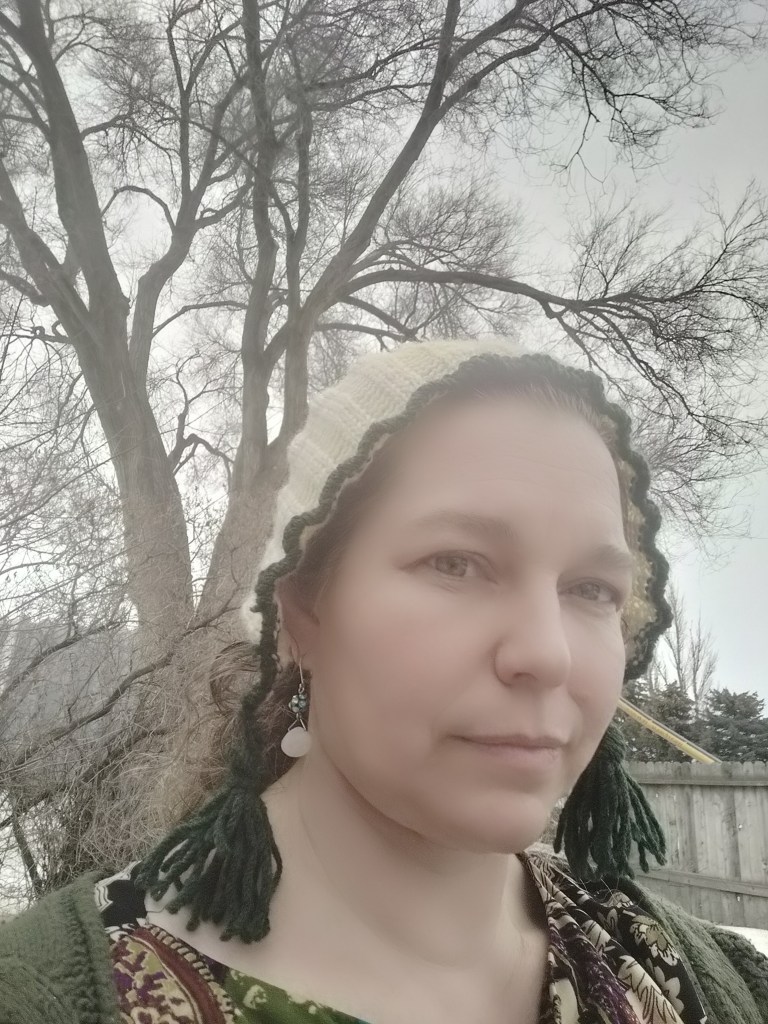
Ragtag Bonnet

Also known as the Stashbuster Bonnet. But this one just felt like it should be named Ragtag to me. Perhaps I was thinking of the book The Ragamuffin Gospel by Brennan Manning.

Believe it or not, I made this bonnet using this ribbed bonnet pattern. Here are the changes I made:

  • Instead of knitting in 3×3 rib, I used moss stitch (I love moss stitch! so textury!) for the first four inches, then switched to stocking stitch for the next three inches before doing garter for the back.
  • As before, I knit for seven inches instead of six before joining in the round. (Again, big head.)
  • I also made the bonnet larger from ear to ear by casting on an additional six stitches. I decreased these as I ended the moss stitch section. This created slightly longer ear flaps.

The most striking thing about the bonnet, its “bag of rags” look, came because I used a variety of odds and ends of yarns in my stash, including a dark brown wool, a dark green wool, a dark blue blend, a couple of ombre balls, and even a leftover ball of glittery navy blue (used sparingly). The result is more or less the color story that I was going for. It was inspired by a hat on Pinterest made from a ball of yarn that wavered between shades of gold, brown, and grey. Making my own edgy colored hat was a lot more work, because I had to keep stopping to twine the ends of the different colored yarns together. When I get time, I’ll definitely knit this hat again, but “cheat” and buy a self-striping ball.

For now, I absolutely love this and I also love how it helps me pull off the “witchy lady” look that I am going for as I age. As you can see, it’s still cold here. A poor old woman needs a warm wool bonnet to wear when she toddles out to gather a few sticks for her meagre fire.

What Was Your First Fictional Crush?

I know this sounds like a book lovers’ blog tag, but actually, this question was asked of me by my reader son. I love that he has reached an age where it’s not uncommon that we will have discussions about books while I chauffeur him to his different activities.

However, feel free to answer it as you would a tag.

I had to think about this one, because I’ve been having emotional reactions to fictional characters probably since before I could read.

I remember weeping buckets over the doomed friendship between Todd and Copper, as experienced by me through the little book accompanied by a 45 record that we had and played on our little record player.

So I guess you could possibly say that Todd was my first fictional crush. I was certainly in love with the woodsy setting as well.

I continued to be drawn to wilderness-dwelling characters who were thin, spry, quick, fey, and solitary. As a little girl, of course, it wasn’t so much that I consciously had a crush on these characters as it was hero worship. I wanted to be them. I remember feeling that way about Peter Pan, and this guy:

At the age of about twelve, I had a thing for Durnik from the Belgariad. He was strong, quiet, capable and practical … everything I wasn’t.

Photo by Rene Asmussen on Pexels.com

But now we are getting closer to my teenaged years, about which, the less said the better. I’ll give you one more though, which was a literary crush when I was about thirteen: Odysseus. That was the year that I read a simplified version of The Odyssey in school. Odysseus is a beefcake like Durnik (after all, he is the only one who can draw that big bow!), but he’s also clever and quick like my old favorites.

So there you have it.

Knitting: Peasant Bonnet

This all started because I wanted a hat that would cover my ears.

Most hats, like berets, slouches, and beanies, only protect your ears from the wind if they are pulled way way down so as to cover your eyebrows. That’s not necessarily bad (especially in truly Arctic conditions), but we don’t always need it. Also, such hats tend to have tightish bands that don’t play well with most hairstyles.

It occurred to me that, for covering the ears and gracefully skimming over a bun or whatever, a bonnet might be just the thing. I checked Pinterest for bonnet patterns was immediately drawn into a whole new, magical world. Many of the patterns are for little girls or babies, and, well … swoon. Others are elfin-looking (swoon again). Plus, it turns out that women as far back as the Iron Age were wearing knitted or crocheted looking hair nets, and these can be found intact on bog bodies in Denmark, but I digress.

After one false start that involved purchasing a darling pattern that was way too small for me, I remembered this pattern.

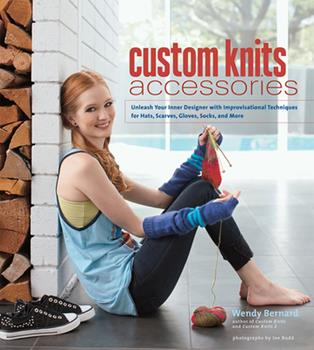
It was in this book, which was the first-ever knitting book I tried to do a pattern from. It was actually too advanced for me, but I didn’t realize that at the time. I had found it in our local library when I lived in the Midwest, and interestingly, it’s also in our local library here in rural Idaho! I guess the book’s marketing team is really good with libraries, or maybe it has something to do with the gorgeous photographs. Anyway, I checked it out yet again, and looking at all the patterns and the photography was quite a trip down memory lane. I remembered that there was a bonnet pattern in this book, and it turns out that it’s a really useful and basic one.

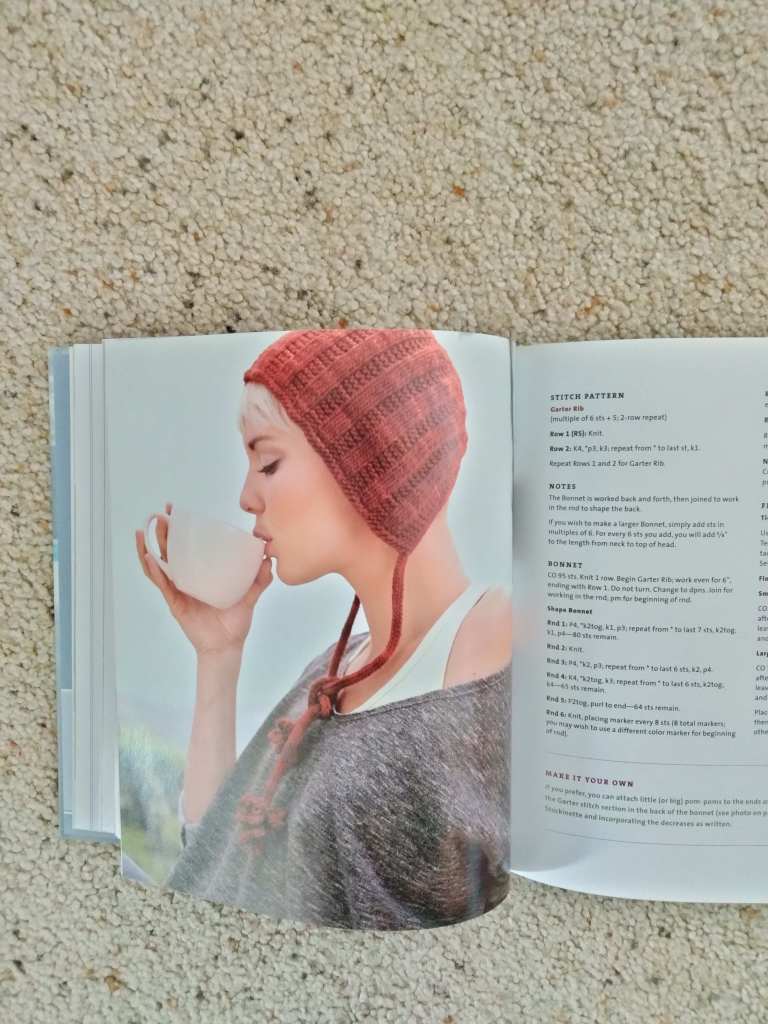
Here’s what the bonnet looks like on the model in the book. As you can see, she has taken it in a more punk direction. I didn’t realize that putting my own spin on the bonnet – and then wearing it – would make me look like a close-up of a Millet painting, but I’m pleased with the results.

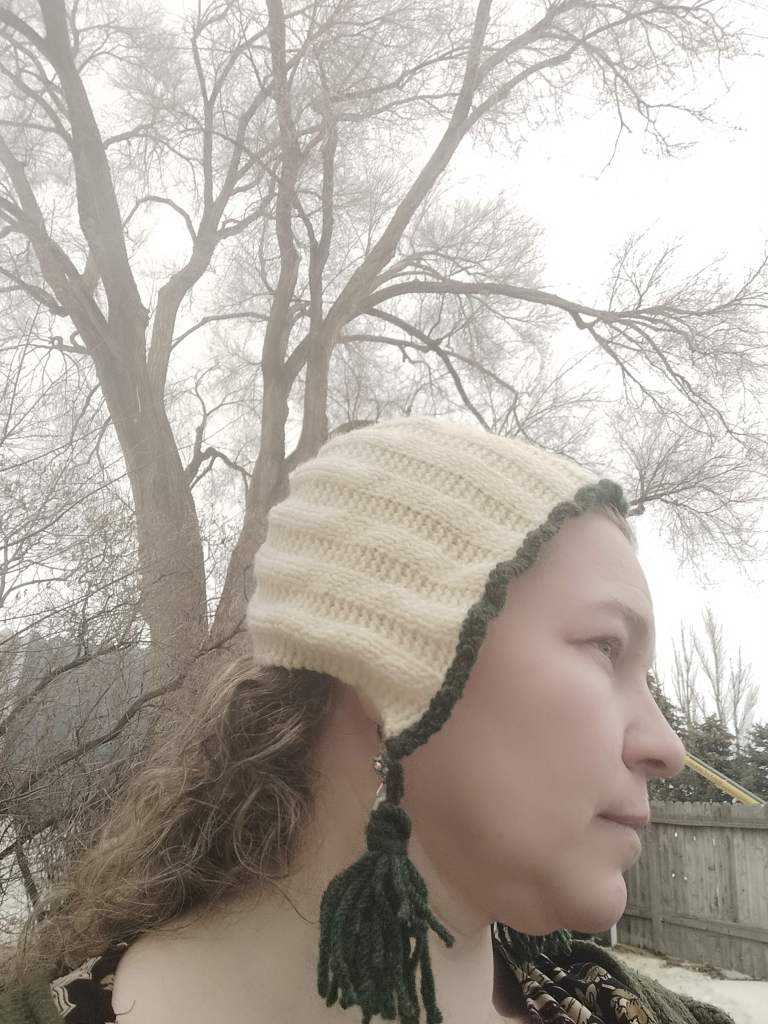
Here’s my version from the side so that you can compare them. I’m not sure why my edge is rolling in and hers isn’t. Theories: different yarn; my tassels have less weight than her long i-cord ties; they blocked their bonnet and/or pulled it straight right before the photographer snapped the picture.

I made mine with ivory-colored wool which I had left over, until I ran out; then I used ivory-colored acrylic that was also in my stash. (Did you know that if yarn sits around your house for several years, it becomes free?) Other changes: I cast on with dark green wool. I knit an extra inch of length before joining the hat in the round, because I have a big head. As you can see, the bonnet hits me right where it hits the model, even with the extra inch. Finally, I used tassels hung from a short crochet chain rather than long i-cords with “flowers” on the end for accents.

The bonnet does OK keeping my ears warm in windy subzero conditions, and it hasn’t blown off my head yet. If I were going to do a serious outdoor version, I’d want to line it with flannel or something and make sure it could tie under the chin. But this is fine for looking like a peasant and not getting rained or winded on while running to the car.

Kind of Disorganized Over Here

… my thoughts, I mean.

This post might be a little … rambling. A poorly thought-out combination of recent events in my life, vague political implications, and nostalgic revisiting of old favorite fantasy novels. You know, the way blogs used to be back in the day. Because I am just so dedicated to bringing you, my faithful Internet friends, content, even if it is crummy content.

Over the past few weeks, I’ve done a couple of knitting marathons (about which, more in the near future). I like having something to watch while knitting, and the least repellant thing on Netflix was The Lord of the Rings, so I have recently watched through all three movies. I enjoyed the movies mostly because they reminded me of the books, which I haven’t read in a long time. Yeah, I’m a purist. I couldn’t believe they left out Old Man Willow, Tom Bombadil, the Barrow Wights, and they completely messed up the scene in Bree, and they Hollywooded up Gandalf’s confrontation with Saruman and with Theoden, and they destroyed Faramir … but even so, even so, they kept enough of the original plot that watching the movies was edifying.

The theme that jumped out to me this time — well, there were a couple. One was the way that every single member of the party pays a high cost in the service of the quest. Even people with fairly minor roles, such as Merry and Pippin, suffer greatly – Merry from stabbing the Witch King, and Pippin has to deal with Denethor’s madness. Multiple people had to be willing to pour out their lives. Not just Gandalf, and not just Frodo. This rings true to me. Whether we are fighting the good fight by building a family, a school, or a local church, everyone feels like they are giving 110%, and then the job just barely gets done.

The other theme that I noticed this time was that of despair. Denethor succumbs to despair, kills himself, and nearly kills Faramir. Well before that, he essentially abandoned his duty to the people of Minas Tirith because he believed the cause was lost. And it turns out, this was a stratagem of the enemy, who had been showing him misleading things in the Palantir.

Meanwhile, over in Rohan, Wormtongue has gotten Theoden to abandon his duties to his people by convincing him that he’s old and tired and the heroic age has ended. Wormtongue gets inside Eowyn’s head, getting her to see Edoras, the glorious hall of her ancestors, as a stupid redneck hovel, and her own role in it as boring and stultifying. She ends up, essentially, suicidal, but luckily the presence of Aragorn has turned her suicidal impulses in the direction of brave self-sacrifice, rather than foolish action like Denethor’s. But this is another case where despair doesn’t just happen, it is a direct, intentional action of the enemy.

Other characters suffer feelings of, or temptations to, despair, pretty much in direct proportion as they come in contact with the enemy. Physical contact with the Ringwraiths pulls a personal partially into their world, as happens to Frodo at Weathertop, and the Eowyn and to Merry, who says to Pippin, “Are you going to bury me?” Victims don’t just despair of victory, but they doubt their own judgment, their own senses, even their own existence. It’s at times like these that we need the shoulder of a friend.

James Lindsay has posted recently about how modern-day deceivers will try to induce despair by robbing us of epistemic authority (“you don’t know what you are talking about.” “Do you have a degree?”), psychological authority (“you are crazy/phobic”), and moral authority (“you are a bigot/oppressor” “It’s so heartless/insensitive to say that”). The goal is to get their interlocutor to stop trusting their own mind and conscience, and just accept the new system of thought they are being offered. Perhaps this podcast of his was the thing that caused me to notice this dynamic happening in Middle Earth.

Anyway, you can make your own applications. Don’t despair. Your mind is probably working OK. You are probably not a crazy bigot oppressor who doesn’t have a working conscience. You are not the only one who has questions. There are friendly shoulders to lean on.

I was going to call this post “Don’t Despair,” but I thought that would sound too cliched and I wasn’t sure I could follow through on the promise of such a title.

This Is So Scary, Innit?

More from the Scary Book.

America is not lost. It is better to say the United States, as a whole, is lost; the GAE [Global American Empire] has captured it. But parts of America are certainly not lost. Hundreds of counties in the United States have a majority of conservative Christians, as do several states. … [W]e should organize and support Christian political visions for towns, counties, and states. In many places, our success or failure is not a matter of numbers but of whether we have the will for success.

Many claims in this book will worry American conservative Christians. I’ve said that political governments can suppress false religion, establish a church, even require people to attend church. I also wrote about a “Christian prince,” which is not the sort of title one would find in America. I will not walk back these arguments; I affirm my conclusions as good and true principles. But I have demonstrated that Christian nationalism can and should look different in different places, for all principles are applied according to a concrete situation. One application that is righteous in itself is not necessarily suitable for all situations. The means by which a Christian people achieve their good depend on their identity, their experiences, and their way of life.

Ibid, pp. 474 – 475 (Epilogue)