
I don’t really feel that I’m outdoors unless I can smell Roundup or cow poop.
Bonnet Mania
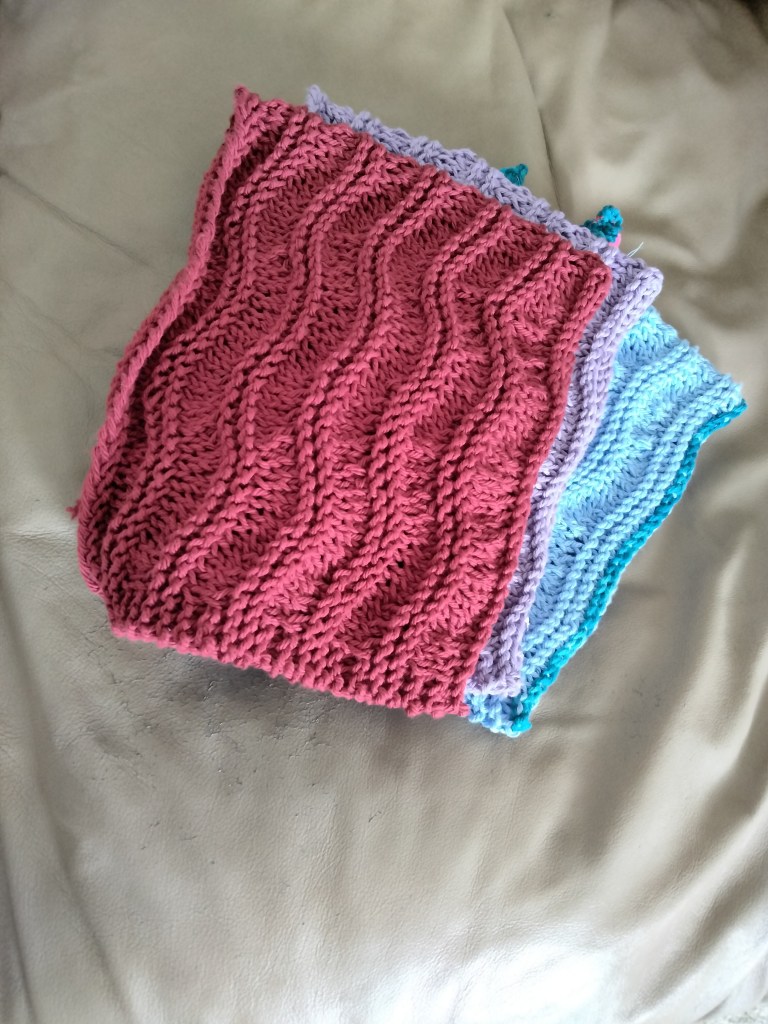
Here are three “fairy bonnets” that I made using a pattern I bought off Etsy. It’s a very simple, easy pattern. The bonnet is worked flat and then sewed up the back. You can do it with one ball of yarn if you are making a child’s size. In this case, I used cotton because these were meant to be spring bonnets for some little girls I know.
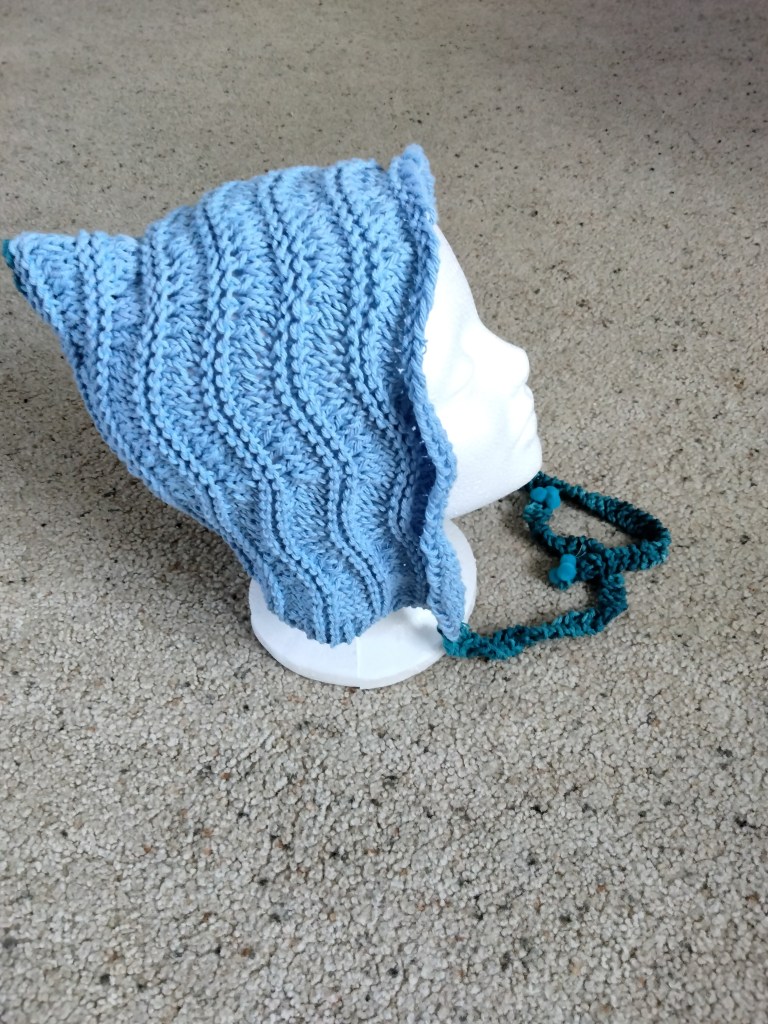
It’s not good to post picture of kids’ faces, so this Styrofoam model will have to do. As you can see, the corner where the bonnet was sewed becomes an adorable point on the wearer’s head. The wavy, tipsy effect is achieved as follows. On one row, a bunch of extra stitches are added. Two rows later, these stitches are reduced, alternately using Knit Two Together (which tends to lean right), and Slip-Slip-Knit (which tends to lean left).
I later made a navy-blue version of this same bonnet, and then completed one with a varicolored ball of yarn. They knit up quickly and make good gifts. (At least, I think they are good gifts!)

I am experimenting with adding a large button on one side and a crocheted loop on the other, rather than the long knitted tie strings, which look cool but might be inconvenient. I’ve had good luck with the button/loop arrangement on bonnets I’ve made for myself. The loop is less obtrusive than a string or a tassel when the bonnet is not fastened, and you can pull the loop across and hook it around the button one-handed if you need to.
Mildly Amusing Quote of the Week
[They said to us], “Hey, people are hurting here! … stop reading.”
Voddie Baucham
Signs of Spring
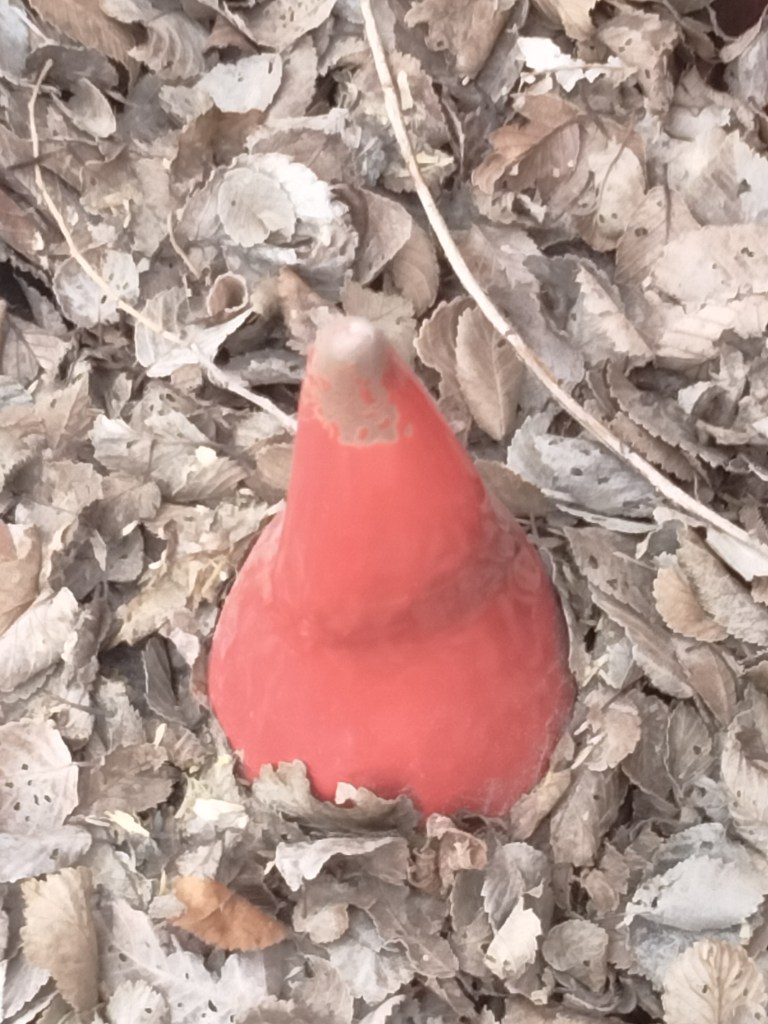
A gnome is emerging hat-first from his hibernation.
New Review of The Strange Land

I paid for an honest review of The Strange Land by one of the reviewers over at OnlineBookClub. Reviewers bid to review books in a genre that interests them. I ended up getting E.F. Emmanuel. You can view his review here:
Very, Very Anthropic Quote of the Week
Why should your heart not dance?
‘Til We Have Faces by C.S. Lewis
This Is Us Grocery Shopping
As we approach the register, my boys are chattering rapidly to each other.
Clerk lady: Are they speaking English?
Me: Yes, they are just talking really fast.
Youngest child: Why didn’t you tell us we were so incoherent?
Clerk lady, to me: What did he say?
Time for some Poetry!
Last week, I had the pleasure of reading, and discussing with a class of children, The Lake Isle of Innisfree by William Butler Yeats.
Now, Yeats was such a prolific playwright and poet, and he had such a complicated — not to say convoluted — personal philosophy, that in my university days I actually took an entire class just about Yeats. And I didn’t become an expert, either. Taking a class just sort of orients you to the man. Anyway, perhaps I was a bad student, but I don’t recall reading this particular poem.
Yeats was almost a terrorist, but it turns out, he could write an evocative poem about the beauty of nature with the best of them. (Actually, there might be quite a few terrorists who could do that.)
I’m going to analyze the poem first, and then post it down below, so you can see the different elements coming and marvel at Yeats’ mastery of the language. But if you like your poetry straight, no appetizer, feel free to scroll down and read it first.
I could say a lot about finding peace in nature, and how far that’s a valid concept and what its limitations are, but I won’t. The impulse is universal enough that elementary school students can understand it. I’m sure you’ve felt it, and I’m sure you’ve had your own thoughts about it too. What I want to discuss is the masterful way that Yeats slows the reader down.
The most obvious way is his use of three stressed syllables at the end of a line. The first stanza ends with the words “bee loud glade,” and there is no way to read this except slowly and with emphasis. This is also true of the last three words of the poem, which will echo in the reader’s mind: “deep heart’s core.”
Secondly, Yeats makes you repeat yourself a lot. “I will arise and go now, and go to Innisfree.” Repeating the verb, and chaining it on to more detail, prevents the reader from hurrying the line, and it gives the impression that the speaker is rather relaxed. (Relaxed would not have been the first word I’d say, if you had said to me, “Yeats.”)
Finally — and I know this may sound a little strange — this poem has a lot of l’s. Glade, glimmer, linnet, slow, clay and wattles, lake water lapping, shall, will, while, always … the list goes on. L is not the easiest sound to say, as consonants go. You have to put your tongue on the roof of your mouth and leave it there for a moment, allowing the air to flow around it … much like water around an obstruction in a lake. Because [l] is voiced, it gives a warm, rich, liquid rather than an airy feeling. In fact, [l] is classified as a liquid, a consonant in which the air flow is not completely obstructed. As you read this poem that keeps forcing you to slow down a bit and to practice your l’s, you can almost feel the peace dropping over you.
I will arise and go now, and go to Innisfree,
And a small cabin build there, of clay and wattles made:
Nine bean rows will I have there, a hive for the honey bee,
And live alone in the bee-loud glade.
And I shall have some peace there, for peace comes dropping slow,
Dropping from the veils of the morning to where the cricket sings;
There midnight’s all a glimmer, and noon a purple glow,
And evening full of the linnet’s wings.
I will arise and go now, for always night and day
I hear the lake water lapping with the low sounds by the shore;
While I stand on the roadway, or on the pavements gray,
I hear it in the deep heart’s core.
William Bulter Yeats
Poetry Fragment of the Week
Oh, do not ask, “What is it?”
Let us go and make our visit.
T.S. Eliot, The Love Song of J. Alfred Prufrock
Baby Chicks
You can see that they are bigger and more developed just in the day or two between the first and second videos.
Now, as I post this, they are so much bigger as to be unrecognizable.
Arguably, the most fun part of getting baby chicks is the naming of them. Meet:
- Jane Wayne
- Ginny Cash
- Andrea
- Chick-sha-Mary
 Out of Babel Books