
Here’s what it might look like on their shelf.
Here’s where you can buy it:

Here’s what it might look like on their shelf.
Here’s where you can buy it:
This post is for language nerds.
Gloria in excelsis Deo.
Angels We Have Heard on High
gloria – nominative singular, “glory”
in excelsis – preposition in with ablative plural object excelsis, “in the heights.” (–is is an ablative plural ending)
Deo – dative of Deus. The dative case is for indirect objects; hence “to God”

I worked on this all summer. It took a long time, because it’s oversized. I planned this project mainly to showcase the variety of coordinating colors, which were sold as a group at the yarn store. The color palette matched several items of clothing I already had. It can be worn with grey, green, gold, orange, or camel. Basically anything in the warm or cool neutral families. I ended up having to buy the coordinating yarn sets three times.
For the dimensions, I referred to a pattern for a bulky sweater with sleeves and a shawl collar, but just left those off. I began by knitting granny squares and then sewing them together, but as the work progressed, I found I had to pick up stitches on the end of finished squares and then just sew the sides together. I added a few rows of ribbing at the arm holes and neck, and a few more rows of ribbing along the bottom.

Here it is from the front. (This picture was taken on Halloween, hence the cave woman hairdo.)
Even with the ribbing, the sides and arm openings tend to roll in.
If only, before I began, I had come across this Pinterest video:
This is such a simple but brilliant way to join knitted squares.
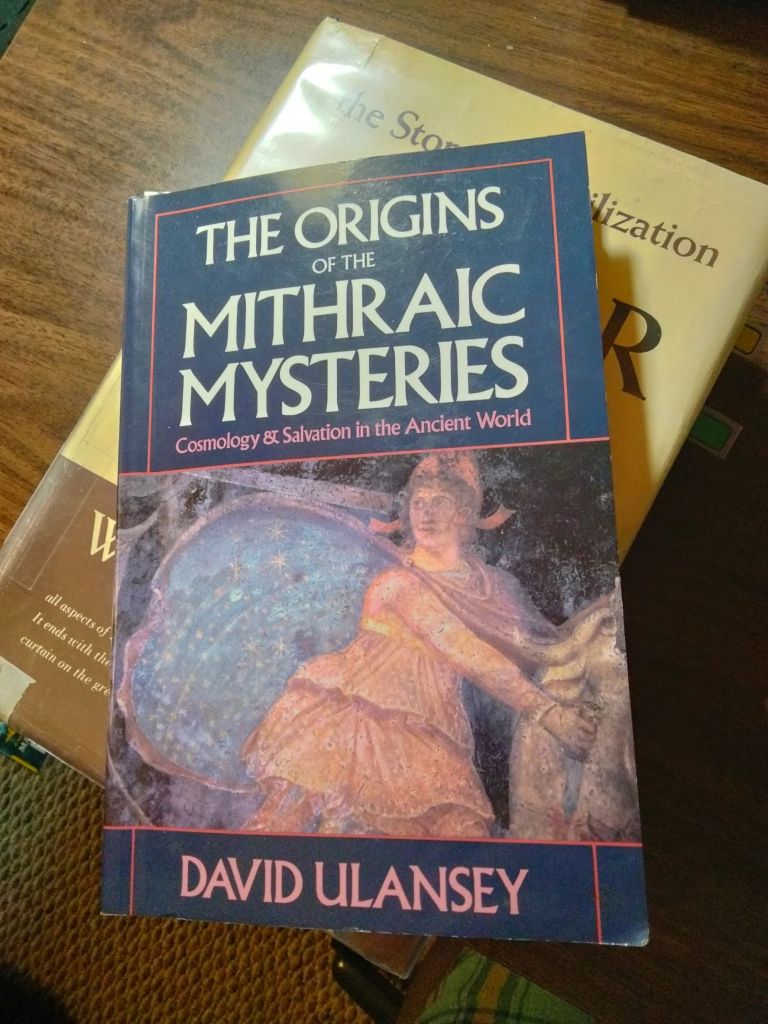
I thought you should know that this book exists.
I don’t even remember where I got it. I have a feeling I got it at a used book store or a library sale, or maybe I stole it from my dad’s library. I know it’s been sitting around my study for a few years, waiting for me to get to it. It was published in 1989.
This is a good, accessible piece of scholarly work that first explains what the cult of Mithros was, then traces the history of scholarly thinking about it, and then advances Ulansey’s theory about what was really behind the cult.
Mithraism began to spread throughout the Roman Empire in the first century C.E., reached its peak in the third century, and finally succumbed to Christianity at the end of the fourth century. At the cult’s height mithraea could be found from one end of the empire to the other, “from the banks of the Black Sea to the mountains of Scotland and to the borders of the great Sahara Desert,” as one authority puts it.
ibid, p. 4
As a result, many of the underground Mithraic temples whose iconography Ulansey shows pictures of are found in Germany or in Italy, although this is a cult that had its origins in Tarsus, in southern Turkey.
For a long time, the accepted theory among scholars was that the god Mithras got his start as the Iranian god Mithra, because they happen to share a name. However, the attributes of Mithras don’t line up very well with those of Mithra, which leaves the door open to other explanations.
The cult was apparently based on a story where Mithras slaughters a bull, and from the bull’s body sprang all the plants that man finds useful, such as wheat, grapes, etc. Because it was a mystery cult, nothing was ever written down about the secret meaning of this story, nor of the levels through which the neophyte progresses as he is initiated deeper and deeper into the mysteries. But in all Mithraic temples, there is consistent iconography. This includes a picture of Mithras slaying the bull, with wheat coming out of the wound. Mithras is typically looking away from the bull (though this is “corrected” in some reconstructions), wearing a distinctive hat which was associated with Persia and with Perseus in the ancient world. Around him are placed other figures which will prove to have significance in unravelling the meaning of the cult. Sometimes, the whole scene is placed under an arch or inside a circle that shows the zodiac. Sometimes, Mithras is also portrayed as standing inside a circle or hoop lined with star symbols.
In unfolding his theory, Ulansey takes us on a fascinating tour of the ancient world. For example, he spends a lot of time establishing how and why Mithras came to be associated with (based on?) Perseus, who was the founder and hero of the city of Tarsus and, in fact, the local god of that whole region. (Mithras’ hat — a “Phrygian cap” — was originally worn by Perseus, and Ulansey contends that he looks away from the bull as he slaughters it because Perseus looked away from Medusa as he slaughtered her.) He gets into the fact that the cult may have originated with pirates of Cicilia, which lies just off the coast from Tarsus:
[T]he Cicilian pirates were far more than a mere band of thieves. Rather, the pirates, who numbered at least twenty thousand, formed what amounted to a small nation which at its height controlled the entire Mediterranean Sea.
ibid, p. 88
Ulansey then quotes Plutarch from Life of Pompey:
“The power of the pirates had its seat in Cicilia at first … then, while the Romans were embroiled in civil wars, the sea was left unguarded … until they no longer attacked navigators only, but also laid waste islands and maritime cities … There were also fortified roadsteads and signal-stations for piratical craft in many places … more annoying than the fear [the pirate fleets] inspired was the odious extravagance of their equipment, with their gilded sails, and purple awnings, and silvered oars … For you see, the ships of the pirates numbered more than a thousand, and the cities captured by them four hundred … Presently men whose wealth gave them power, and those whose lineage was illustrious, and those who laid claim to superior intelligence, began to embark on piratical craft and share their enterprises.”
ibid, p. 88
There are plenty of other fascinating historical nooks in this edifice, such as the figure of a lion-headed man, entwined by a snake, standing on a sphere; the idea of Mithras being born out of the rock; the exact nature of the Gorgon, and many, many others. Every single one makes sense when it comes up in context. That said, there were certainly some bizarre ideas floating around in the ancient world.
So, to get right down to it, Ulansey’s case is that the Mithraic mysteries were a way of encoding astronomical knowledge. Because this is the ancient world we are talking about, this knowledge could equally be considered scientific, cosmological, and religious, as will become clear shortly.
Lately, I’ve been studying the zodiac in a desultory fashion. Don’t worry, I am not planning to take up astrology. Astrology is specifically forbidden to faithful Jews, and to children-of-Abraham-by-faith like myself. But it is of interest to me, because it was so important to the people of the ancient world. They worked it into their monuments and their mythology. The signs of the zodiac, and other constellations, were associated with the gods, and a good case could be made that this association started in pre-Flood days.
The other thing that fascinates me about the zodiac is that it’s so hard to observe. Now that I keep chickens and also work outside the home, I’ve been obliged to get up before dawn to let the chickens out. I live in a rural area with relatively dry weather, so you’d think it would be easy for me to take a quick glance at the horizon while I’m out there, and be able to tell which constellation is in the east, right where the sun is going to rise in an hour or two. As it turns out, it’s not so easy as all that. You not only have to know which direction is due east, you also have to have something that helps you sight where the sun is going to rise … and it moves. Then you have to be able to recognize the constellations. To really figure out the whole zodiac, you’d have to be making these observations daily, throughout all the seasons of the year, until you noticed that the constellations of the zodiac make a notional belt around the earth, and that at different times of year, they take turns “housing” the sunrise. This is already difficult enough that you’d have to have a pretty strong motivation to pursue it. (Stronger than mine is right now.) Ancient people thought this was so worthwhile that they managed to master the very difficult science of astronomy. Many ancient monuments, in fact, were built as observatories, from Stonehenge to many structures in the Americas.
Why were they so motivated to study the stars? That’s a discussion for another time.
According to Ulansey, the Mithraic iconography (and probably the whole cult) was designed to encode the secret of Equinoctal Precession. This is a really complicated phenomenon, so if you don’t know what it is, I’ll let you look it up. Basically, because of an irregularity in the earth’s rotation, the zodiac sign that “houses” the sunrise on the equinox will stay the same for 2,160 years, by which time the sunrise has migrated back to the previous zodiacal sign (hence, precession). (Also, incidentally, Polaris has not always been the the pole star.) Precession has been discovered at different times in the past by different civilizations. Graham Hancock makes a pretty good case that it was known by somebody, before conventional history began. But due to the difficulty of observing it, it has not been known at all times by all peoples. Around the time that the cult of Mithras apparently started, it had recently been discovered, and begun to be talked about, in the vicinity of Tarsus, in the same intellectual circles that were also providing aristocratic pirates.
Now, to you and me, equinoctal precession might fall into the category of “Oh, that’s interesting.” Not so for the ancients. For one thing, this cult probably started among pirates, who use the stars to navigate. The idea that the stars were once different and are not the same all the time would be earth-shattering to them. But this news gets even more ominous when we understand ancient cosmology.
(And when I say “ancient” here, I am talking about the cultures of the Mediterranean, Ancient Near East, and parts of Europe. Though, not to keep mentioning Graham Hancock, but in his book Fingerprints of the Gods he finds similar cosmology in ancient India, Central America, and Scandanavia. So a case could be made that this cosmology was once worldwide.)
This ancient cosmology, then, conceived of the heavens as a huge machine, constructed of two or more intersecting hoops (the zodiac, the celestial equator, and, essentially, the prime meridian/international date line projected into the sky). Sometimes the heavenly machinery is portrayed more as a big edifice with four pillars supporting it. Sometimes it’s a “mill” that turns. Probably some ancient people took this more literally than others; some understood it was notional, but represented something real.
Now, imagine that you think of the universe as a big, finely tuned machine, where the constellations always end up in the place they are supposed to be. If the whole hoop has moved out of its place, this could be conceived of as “breaking” the machine. This is why cycles of a certain number of years (not everyone got the precessional intervals right) were thought to bring cataclysms upon the world. So, we get myths worldwide about a mill being broken, and this causing the stars to fall from their places, the sky to become dark, fire and floods to sweep over the earth, etc. Again, read Hancock to find out more about this than you ever wanted to know.
But the point is, whether the Cicilian pirates thought that precession caused a cataclysm, or whether it just meant the universe was less stable than they had imagined, this would have been a revolution in their scientific, cosmological, and religious thought. (Religious because, in ancient times, science and cosmology and religion were really all a part of one system, especially when you consider that the stars and other heavenly bodies were thought to metaphysically influence events on earth.) So, whether you count it as belonging to three, two, or just one unified field of knowledge, this was a big enough discovery to be kept secret (a “mystery”) and passed on to initiates in a whole new cult religion.
Publius Valerius won the name Publicola — “friend of the people” — by putting through the Assembly several laws that remained basic in Rome: that any man who should try to make himself king might be killed without trial; that any attempt to take a public office without the people’s consent should be punishable with death; and that any citizen condemned by a magistrate to death or flogging should have the right of appeal to the Assembly. …
In 486 [B.C.] the consul Spurius Cassius proposed an allotment of captured lands among the poor; the patricians accused him of currying popular favor to make himself king, and had him killed; this was probably not the first in a long line of agrarian proposals and Senatorial assassinations, culminating in Gracchi and Caesar. In 439 Spurius Maelius, who during a famine had distributed wheat to the poor at a low price or free, was slain in his home by an emissary of the Senate, again on the charge of plotting to be king. In 384 Marcus Manlius, who had heroically defended Rome against the Gauls, was put to death on the same charge after he had spent his fortune relieving insolvent debtors.
The Story of Civilization: Caesar and Christ, by Will Durant, pp. 16, 23
Adeste fideles, laeti triumphantes
“O come, all ye faithful, joyful and triumphant”
Venite, venite in Bethlehem
“Come, come into Bethlehem”
Natum videte, regem angelorum
“Born see, the king of angels”
Venite adoremus [3x]
“O come, let us adore him” [3x]
Dominum
“The Lord”
Deum de Deo, lumen de lumine
“God from God, light from light” *(these are direct objects, so the subject and verb are coming up)
Gestant puellae viscera
“A girls’ innards carry” (the subject and verb, and by far my favorite line)
Deum verum
“True God” (and still the direct object)
genitum non factum
“Begotten, not made”
Refrain: Venite adoremus, Dominum “O come, let us adore/The Lord”
Cantet nunc io, chorus angelorum
“Sing it now, chorus of angels”
Cantet nunc aula caelestium
“Sing now, heavenly court”
Gloria, gloria in excelsis Deo
“Glory, glory to God in the highest”
Refrain: “O come, let us adore/The Lord”
Ergo qui natus die hodierna
“Therefore, who is born on the day of today”
Jesu, tibi sit gloria
“Jesus, to you be glory”
Patris aeterni Verbum caro factum
“Word of the eternal Father made flesh”
Refrain
See how the Latin is actually more direct/efficient than the English? Kind of shockingly so?
I think because the original Latin version had so many syllables, to translate the lines into English, additional words had to be added, and sometimes even new ideas such as “Yea, Lord, we greet thee,” which is how the fourth verse begins in English and is one of my favorite lines in that version.
Few students are inclined to follow the extreme skepticism of Ettore Pais, who rejects as legendary all Roman history before 443 B.C., and believes that the two Tarquins were one person, who never existed.
The Story of Civilization: Caesar and Christ, by Will Durant, p. 15

Yes, I know it is no longer late summer, but I have all these great pictures from that time that I want to share.
Here is a stormy evening in farm country.
“But you are eagerly desiring the greater gifts.” (Yes! Yes we are! We want to be initiated into the spiritual mysteries!)
“And now I will show you the most excellent way.” (Oh goody! He is going to let us in on the esoteric secret that only the initiates get to know.)
“If I speak in the tongues of men and of angels, but have not love, I am only a resounding gong or a clanging cymbal. If I have the gift of prophecy and can fathom all mysteries and all knowledge, and if I have a faith that can move mountains, but have not love, I am nothing.” (Do you mean that neither secret knowledge nor the ability to work miracles is the most excellent way?) “If I give all I possess to the poor and surrender my body to the flames, but have not love, I gain nothing.” (And neither is asceticism or heroic feats of denying the body?)
“Love is patient, love is kind. It does not envy, it does not boast, it is not proud. It is not rude, it is not easily angered, it keeps no record of wrongs.” (This is actually harder than secret knowledge would be. The leaders of esoteric mystery religions do tend to be impatient, unkind, envious, boastful, and proud.) “Love does not delight in evil but rejoices with the truth.” (You mean that there is such a thing as truth? And that evil is not a necessary part of spiritual enlightenment?) “It always protects, always trusts, always hopes, always perseveres. Love never fails. But where there are prophecies, they will cease; where there are tongues, they will be stilled; where there is knowledge, it will pass away.” (It will??? Do you mean that humans are not perfectible through learning? That knowledge is not the path to salvation?) “For we know in part and we prophesy in part,” (We are not gods. We are limited.)
“… but when perfection comes, the imperfect disappears.” (So all our enlightenment now will disappear as unnecessary when Christ comes.) “When I was a child, I talked like a child, I thought like a child, I reasoned like a child. When I became a man, I put childish ways behind me.” (Perhaps the idea that we can be given secret knowledge that will make us better than everyone else is a child’s way of thinking.) “Now we see but a poor reflection as in a mirror; then we shall see face to face.” (The ultimate revelation is knowing Christ as one person knows another.) “Now I know in part; then I shall know fully, even as I am fully known.” (The important thing right now is not that we know all the secrets of the universe, but that our Shepherd knows us and calls us his own.)
“And now these three remain: faith” (in the one who calls us) “hope” (in his promise to save us) “and love. Follow the way of love [as you] eagerly desire spiritual gifts.”
(What follows is a discussion about how to engage in prophecy and speaking in tongues in a way that doesn’t show off, create chaos, or confuse or exclude anyone from the worship service.)
“In the church I would rather speak five intelligible words to instruct others than ten thousand words in a tongue. Brothers, stop thinking like children. In regard to evil be infants, but in your thinking be adults.”
taken from I Corinthians 12:31 – 14:1, 19 – 20, NIV

 Out of Babel Books