The Big Five Personality Traits … and My Characters

I’ve posted before about the “Big Five” personality traits. Though I like personality typologies such as the MBTI, almost all of them come from a pre-existing theory the researchers have and then seek to impose on the data. The Big Five are the closest thing we have to traits that emerged from almost pure data … that is, from casting a very wide net (in this case over adjectives used to describe people), and then seeing if those adjectives “clumped” around certain traits, and then eventually finding biochemical analogues to these traits in the brain. So says Jordan Peterson.

Since the Daily Wire made all of Jordan Peterson’s old materials available on their web site, I’ve been watching my way through a psychology class he taught about the Big Five. His lectures are always so rich and insightful, even if they do get a bit Jung-y, that they never fail to fire my imagination. And the traits never fail to remind us of people we know who are particularly low or high in each of them. Today, I thought it would be fun to name a character from my series who exemplifies each of these traits. All the technical information about these traits in the paragraphs below comes from my recent viewing of Peterson’s lectures.

Extraversion

Extraversion, according to Peterson’s lectures, basically means the person has a very active incentive/reward system in the brain. The basic impulse of extraversion is “There’s a good thing … I’m going to go and get it.”

Nimri (later, Nirri), the main character in The Long Guest, is high in extraversion. Though paraplegic and living basically as a prisoner of people he can’t communicate with, he remains as active as he can, doing arm exercises, keeping a journal, and continually seeking to expand his sphere of activity and influence as much as possible.

Neuroticism

Neuroticism is the technical term for “high sensitivity to negative emotion.” In Peterson’s evolutionary terms, this is the brain system that keeps prey animals alert and hence alive. Statistically, women tend to be higher than men in neuroticism. There are obvious reasons for this: they need to be hair-trigger sensitive to the distress of their babies, and in fact, the world is a more dangerous place for a woman, especially if she is caring for an infant.

However, in my books, Exhibit A for neuroticism is a man. Enmer is 30 years old when an apocalypse hits his society. His father is killed, and Enmer becomes the new head of the family. He feels the burden of keeping them safe very keenly, and when subsequent disasters hit the family, Enmer enters a deep depression with which he will struggle for years.

Enmer is also high in conscientiousness, but we have another character to exemplify that for us.

Conscientiousness

Conscientiousness is made up of two sub-traits: industriousness and orderliness. Industrious people feel bad if they are not working on some task. The evolutionary (or design) usefulness of this trait to the community is obvious. Orderly people like things to be in neat, known categories. This plays on the fear system in the brain, where the unknown or chaotic constitutes a threat.

Though it might seem that being very conscientious would be a miserable experience, under normal circumstances conscientious people have lower levels of anxiety than less conscientious people. Peterson’s theory is that this is because conscientious people tend to order their environment well, which reduces levels of anxiety compared to people who live in a disordered environment (even if they think they like it). Conscientiousness is also a good predictor of overall life success.

Hur is a very conscientious character. He is small, fair-haired, and not very prepossessing, and he starts the series as a slave in Enmer’s household. But he has all kinds of skills, including being a good shot with a bow and knowing how to make bows and arrows. He takes advantage of the apocalypse to demand his freedom and soon becomes the tribe’s go-to guy for both hunting and security. Eventually, he becomes tribal cheif.

Agreeableness

Agreeable people like to please other people and keep relationships good. In any given situation, they will not necessarily ask themselves what they want (or even, in some cases, be aware of it), but will just do what other people want them to do. Statistically, women tend to be higher than men in agreeableness. Being very agreeable is a necessity when you are caring for an infant, as the infant’s needs must always take priority over your own. It does not, Peterson points out, prepare you well to function in an out-of-the-home work environment. You tend to get taken advantage of.

Sari, one of the main characters in The Strange Land, is an agreeable wife and mother. She spends years living with an abusive husband, trying to keep the household running and to mother her children as best she can. When a crisis hits, she does not know how to ask for help and does not want to inconvenience others.

Openness (to new experiences)

Open people are adaptable. If there is a major crisis, you want some people who are high in openness around, as they will handle it better than someone who is very high, for example, in orderliness. Openness plus fluid intelligence is a good predictor of a person’s creative output.

Zillah, who is a main character throughout my entire series, is high in openness. She is the one who encourages the family to take in the injured foreigner Nimri when they stumble upon him as they are fleeing the Tower of Babel apocalypse. She adjusts to the new reality and accepts it far more quickly than Enmer, who never really comes to terms with it.

Though Zillah is not a “creative” person in the sense of producing visual art and music, she shows a great deal of creativity in the way she cares for her extended family, responding to crises, delivering babies, and bearing the brunt of caring for Nimri, including learning to speak with him. She becomes the tribe’s medicine woman and builds up a store of medical knowledge, and she is always on the lookout for someone who needs help.

Quote: “But it hasn’t.”

If there is a cultural problem [on American Indian reservations], it’s the culture of dependency that the federal government and the tribal governments have created. Whether it’s money from Washington to pay for housing or food or fuel costs, or whether it’s annuities coming from gaming endeavors, it has caused more problems than it has solved. And these funds haven’t done much to alleviate the suffering of individual Indians. Except for the wealthiest of the casino owners, most Indians still live in poverty, with little access to good education, health care, or jobs.

The leaders of Indian nations often mean well. They believe that more revenue will fix their schools, their homes, and even their families. But it hasn’t.

The New Trail of Tears, by Naomi Schaefer Riley, p. 179

We Go to Big Southern Butte

Big Southern Butte is not really a butte, more of a freestanding hill or mountain. But that’s what we call it around here, and in this post it will be abbreviated BSB.

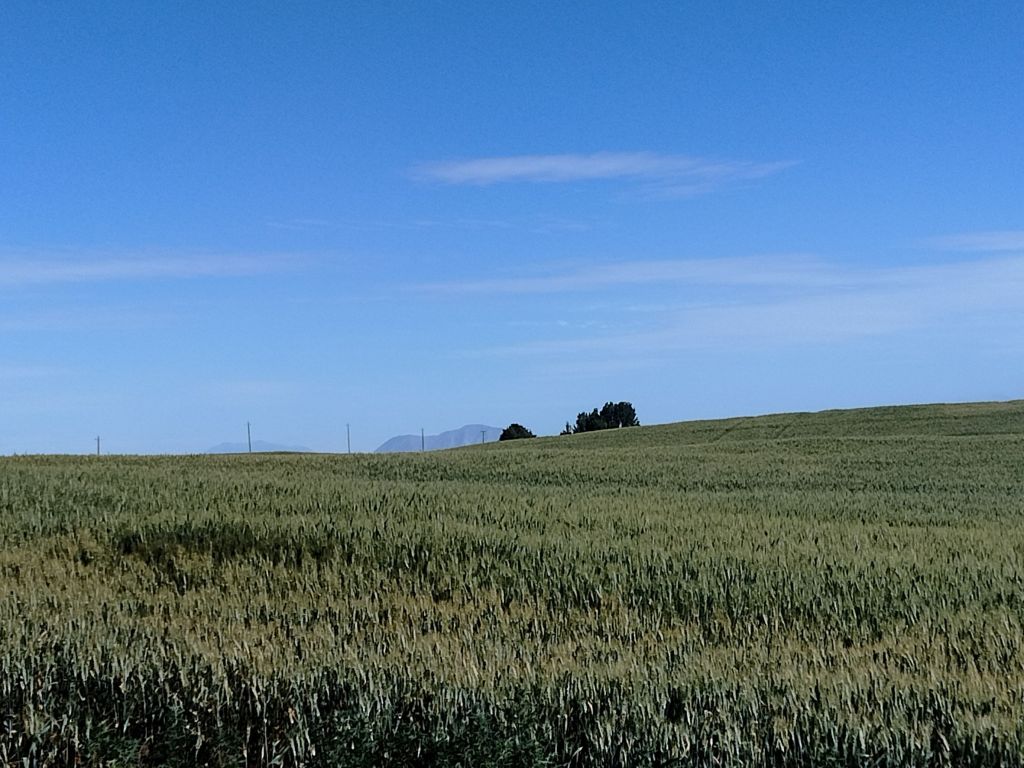
BSB is one of the biggest perks of living in the particular farmhouse where we do. Our house is perched on a rather high spot in the midst of relatively flat farms and desert. Looking north from our yard, you can see 30 miles to Big Southern Butte, and on clear days, to the Sawtooths beyond. It looks best around sunset, when it and the Twin Buttes to east of it are lit dramatically and often attract their own clouds. I have been trying to photograph it since we moved here, usually without much success, but in the picture of our downed tree above, you can see BSB in the distance. And here it is looming over the wheatfields:

A few weeks ago, the explorer to whom I am married expressed a desire to drive up BSB and then hike the last hundred yards to the top. He had read some travel materials that said the road was passable. (bum bum bum) Of course I had to come along, because it has long been my dream to actually go to the butte.

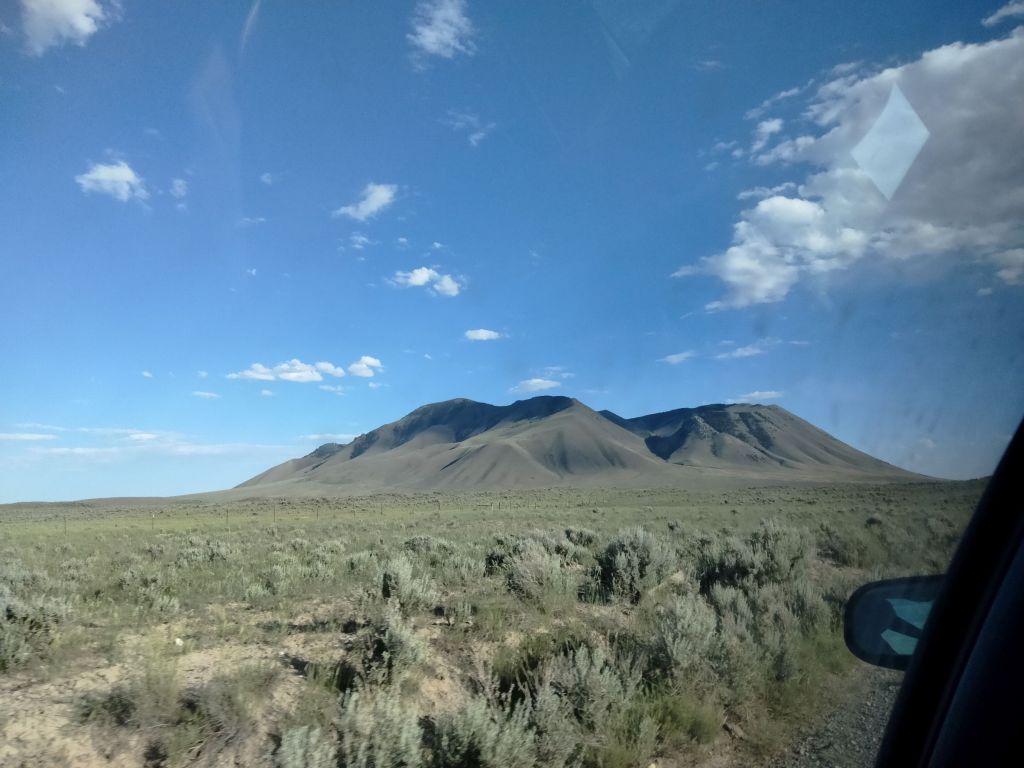
The road leading to BSB from Atomic City is dirt with patches of basalt rock sticking out. We approached our goal from the southeast and drove completely around it, which was satisfying. There are quite a few roads tracks in the area, but all of them are better suited for pickup, jeep, or ATV. Above is a view of the butte from the North, as we were leaving.

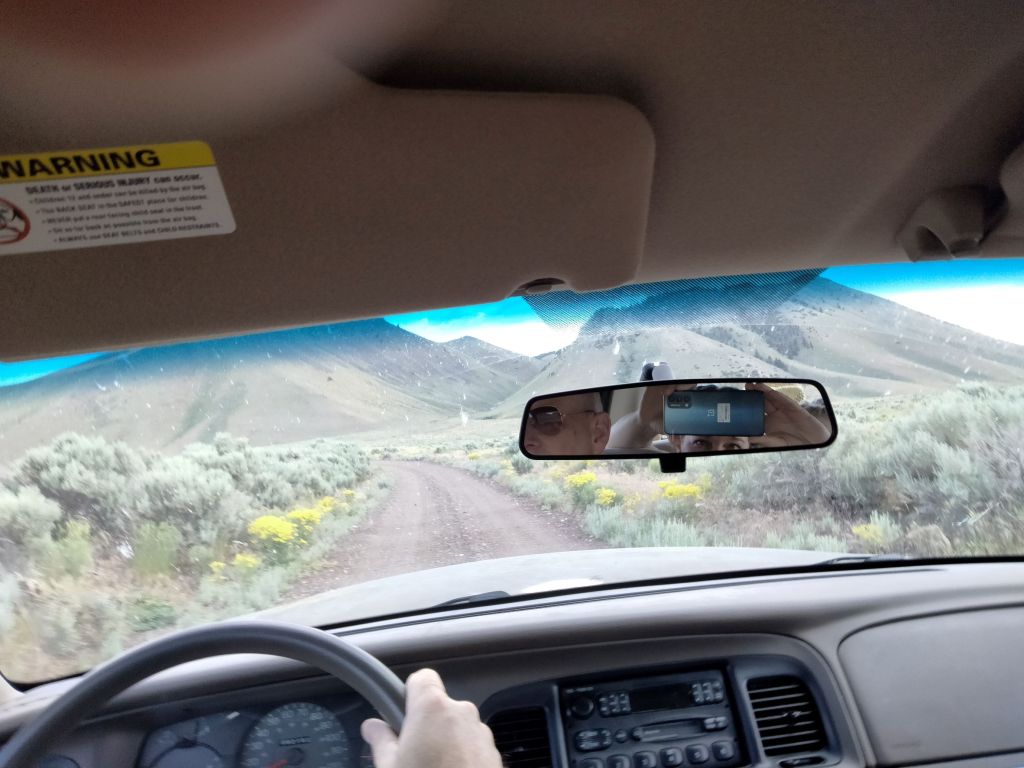
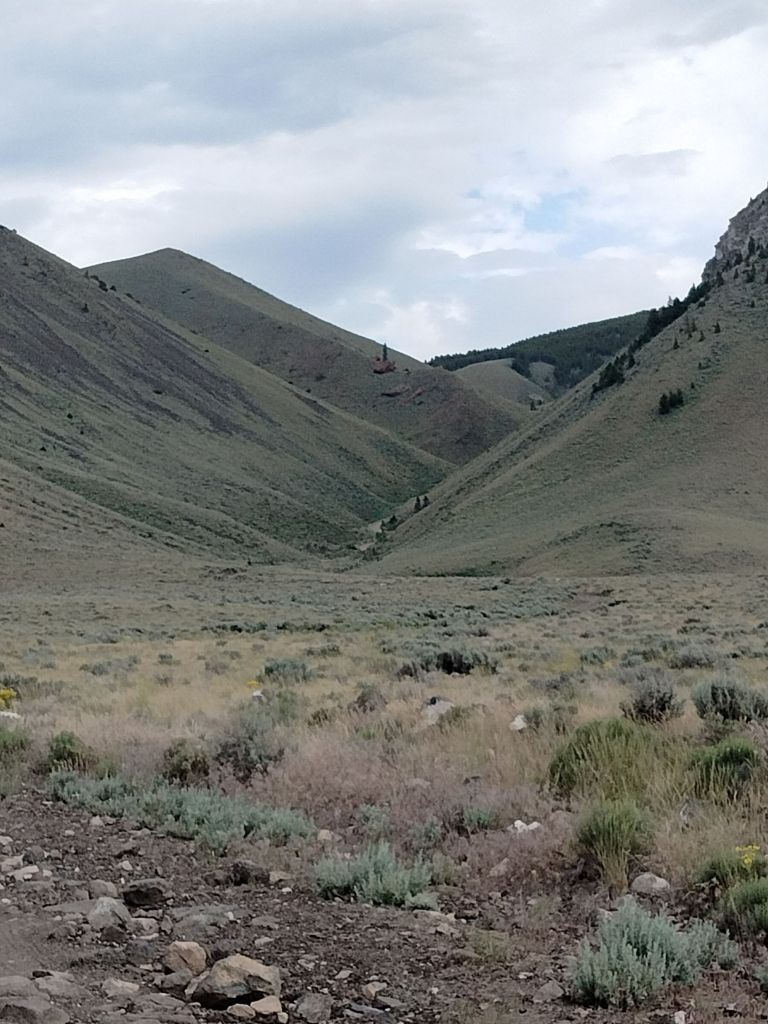
The road that supposedly led to the top of the butte enters it via a crack (the “butte crack”) on the northwest side. Here we are approaching it. You can see the terrain, which is basically “high desert,” with rabbitbrush and silver sage.

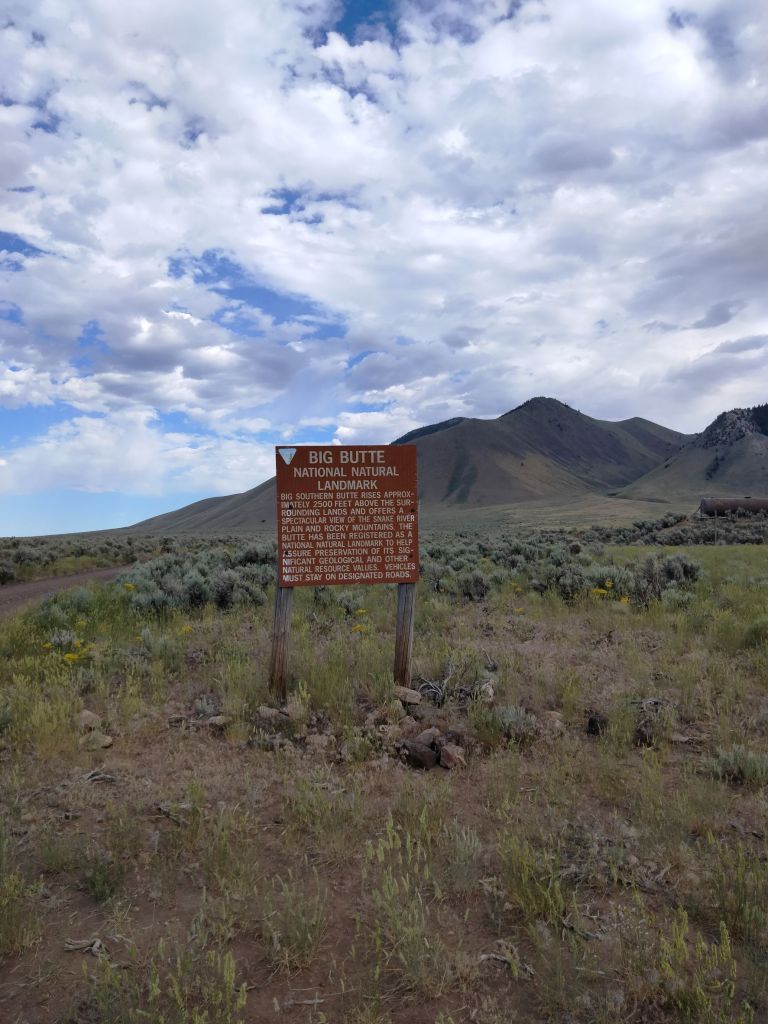
Here are the butte’s bona fides.

We drove a ways into this crack, but whatever travel articles said the road was good must have been written a season or two ago. My husband did an amazing job maneuvering our sedan over many patches of rock, but at last we reached a point where it was pretty clear we could get high-centered if we were to continue.

Luckily, that point was partway up the side of the butte (past the first turn you see in the photo above) and there was a pull-out place to park. Some of our party hiked a ways farther up the trail, but did not go all the way to the top as it would have been 3 miles from there.

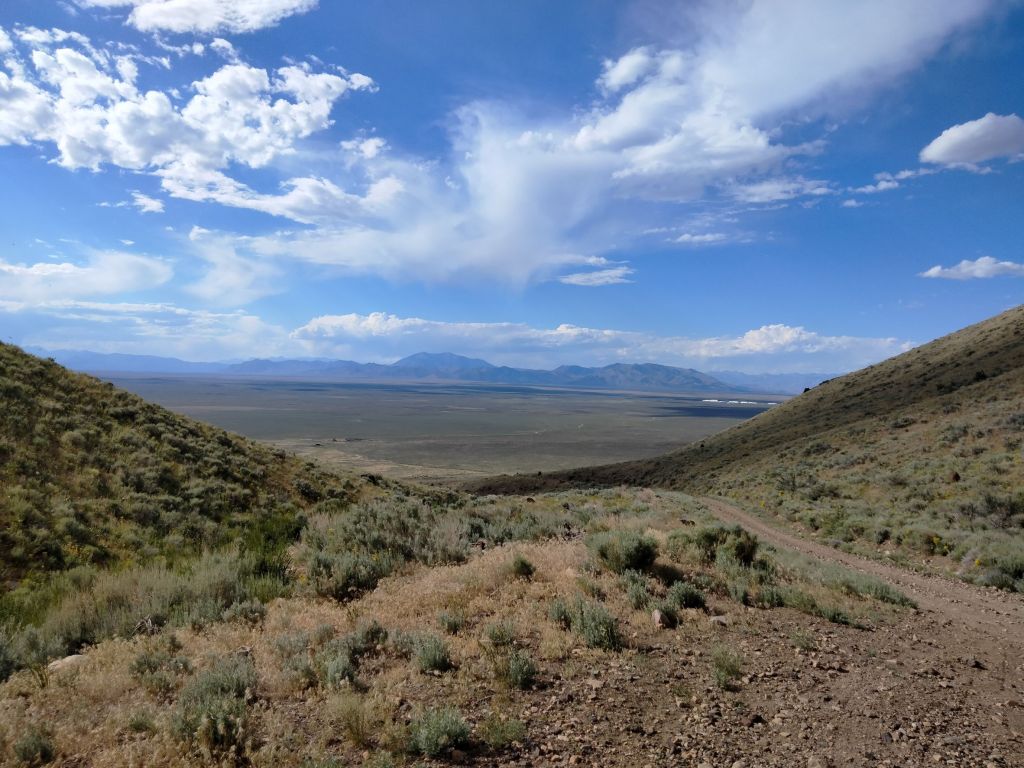
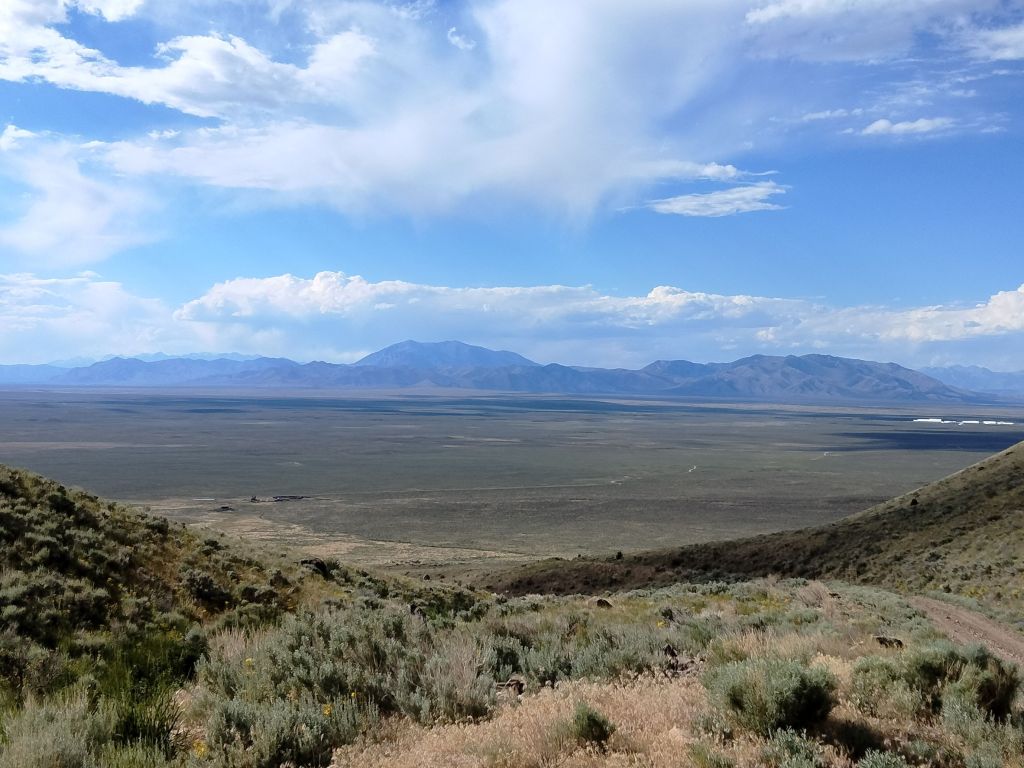
Here are the Sawtooths as seen from our parking spot. My husband says these are not the actual Sawtooths. I understood the whole region was called the Sawtooths, and then there were sub-ranges within the region, so I don’t know. Even with this little bit of height, you can start to see into the ranges. Back here are the Pioneer Mountains and the Lost River Range, among others.

It’s amazing what a difference results from going a mere 30 miles north and attaining just a little bit of height. From our house, it looks as if there is just one large mountain beyond BSB. From BSB itself, you can see that there is a whole range, and we plain-dwellers can just see the tallest.

For now, I’m content with having seen BSB up close. I would like to go to the top some day, but that will have to wait until we have, or borrow, a more suitable vehicle. In the meantime, at least we don’t have to say that we lived near a topographical wonder and never touched it.

Puddleglum is a Scottish Presbyterian

“Why the dickens couldn’t you have held her feet?” said Eustace.

“I don’t know, Scrubb,” groaned Puddleglum. “Born to be a misfit, I shouldn’t wonder. Fated. Fated to be Pole’s death, just as I was fated to eat Talking Stag at Harfang. Not that it isn’t my own fault as well, of course.”

The Silver Chair, by C.S. Lewis, chapter 15

Idaho Wildflowers: Plains Prickly Pear

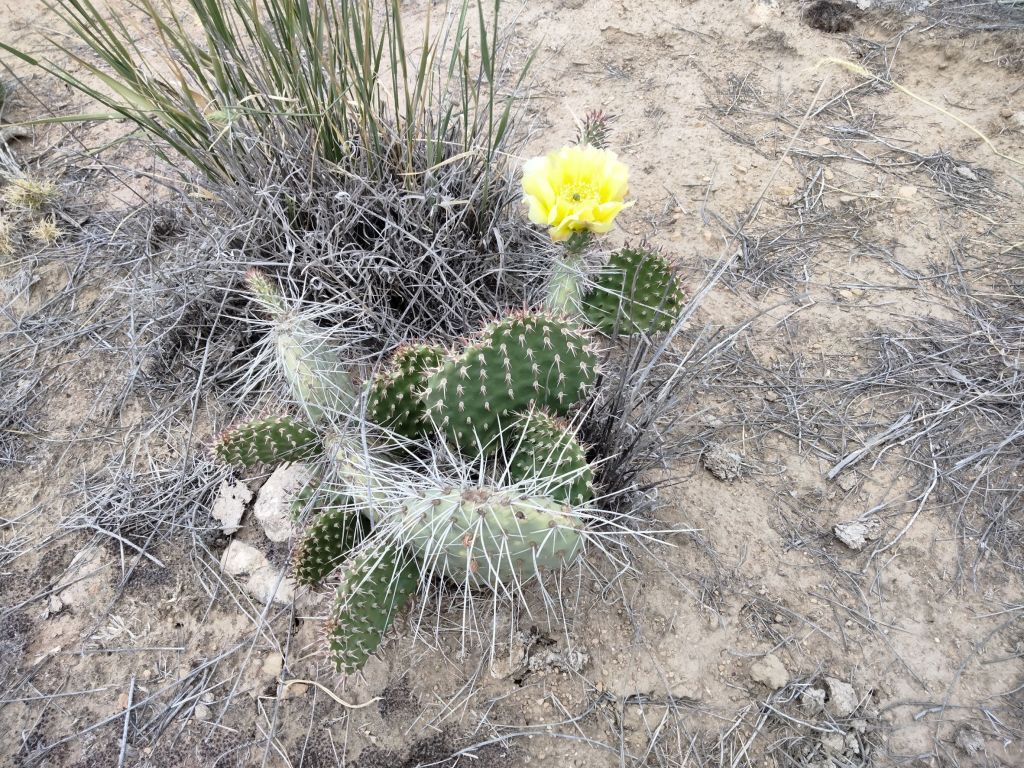
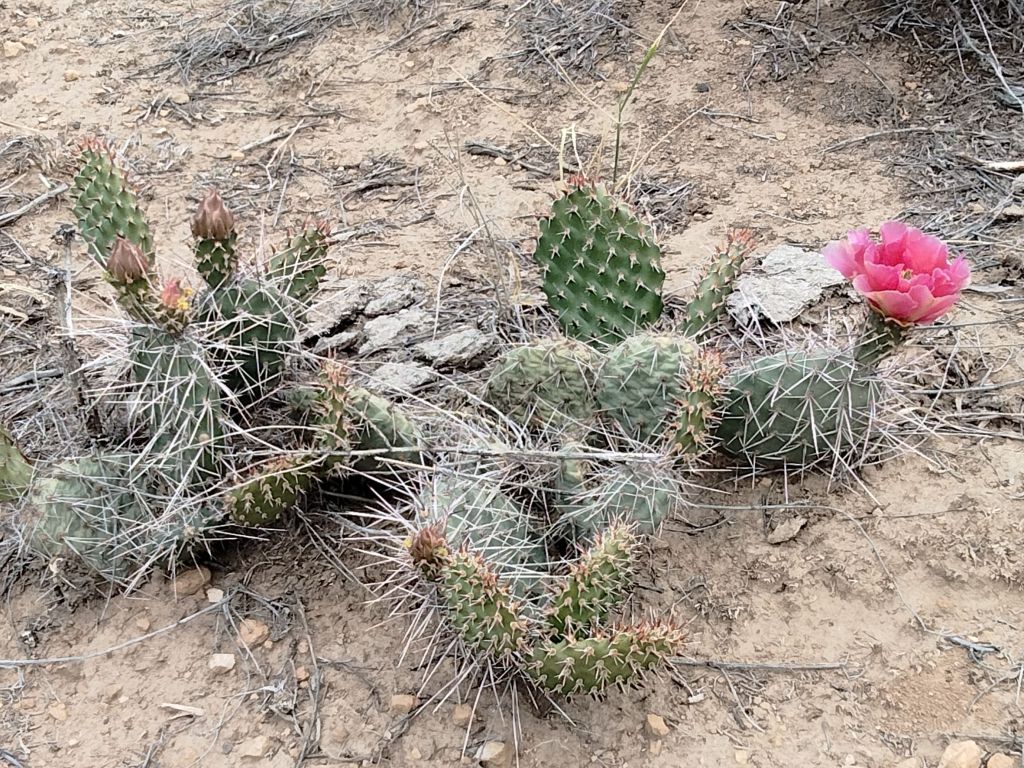
The long spines and flattened, blue-green pads of the plains prickly pear are familiar to anyone who has had the misfortune to step on one. As if the sharp, long spines are not trouble enough, the plants are also armed with a ring of tiny, hairlike barbs (glochids) at the base of the larger spines. These tiny barbs look harmless, but once touched they penetrate the skin and refuse to let go. However, the beautiful flowers of prickly pear more than compensate for the dreaded spines. The flowers are large, up to 3″ or more, with numerous red to yellow petals. The fruit is a pear-shaped berry, dry and very spiny, unlike the juicy “tunas” of some southwestern species of prickly pear.

Habitat/Range: Dry grasslands from the valleys and plains into the foothills, canyons, and montane forests.

Comments: This was the most dreaded plant encountered by the Lewis and Clark Expedition (1804 – 6), because the spines would penetrate the explorers’ moccasins, causing great discomfort. On July 15, 1805, while ascending the Missouri River near the mouth of the Smith River, Lewis noted in his journal: “[T]he prickly pear is now in full blume and forms one of the beauties as well as the greatest pest of the plains.”

Central Rocky Mountain Wildflowers, by H. Wayne Phillips, p. 125

Book Review: The Brides of Maracoor

This book was a pleasure to read.

This review was originally posted by me on Goodreads and has been edited for clarity. The book is by Gregory Maguire, the author of Wicked, and is part of the same universe. It is the first book by Maguire that I have read. I gave it four stars.

The prose is almost like poetry, but not purple. Not hard to plough through; it draws you through. The psychology is amazing. So is the portrayal of a sort of ancient-Greece-based world. I picked up this book for the brides, who are sort of like pagan nuns (Vestal Virgins?) living all alone on a remote island, performing bloodletting and weaving rituals in order to guard a sacred artifact.

Every morning, the “brides,” who range in age from ten to about eighty, troop down to the seaside where they use sawgrass to cut crosshatched lines into the soles of their feet. Then they sit with their injured feet in the salt water and tie seaweed into a net. This ritual supposedly “weaves time” so that the world can go on. The brides are almost entirely self-sufficient, keeping gardens, goats, chickens, and an orchard. None of them have ever seen the mainland. They are brought to their island, called Maracoor Spot, as babies. There are always seven brides, so whenever one dies, a baby is brought to replace her.

The way Maguire introduces all this information is magical, as if he were weaving a spell. There are lyrical (but not sappy) descriptions of the island’s weather, the sea, the rain, the clouds, interspersed with descriptions of the brides’ suffering at their morning ritual. This slowly expands to show us their names, ages, personalities, and daily routines. They sleep in the outer part of a small marble temple, the inner room of which houses the terrifying artifact.

By the time Maguire was finished showing us the brides and their way of life, I was hooked. I knew I was going to finish this book.

The moral lessons, at least to which the story seemed to be heading, weren’t ones I could completely get on board with, however. So now let’s to spoiler town (though I should add that there are vast swathes of this book I haven’t addressed, so this is not a complete spoiler).

Rain, who seems to be the character we are most supposed to identify with considering that she is the one who comes from a beloved earlier series, makes the argument that Acaciana (“Cossy”) can’t be tried for murder because she is a 10-year-old child who has been raised in the very restricted environment as a Bride of Maracoor, not having a natural family, not having been given any chance to develop a conscience. She argues that the whole setup with the brides living on an island and ritually mutilating themselves every day, in service of the country’s religion, is inherently unjust and oppressive, and thus Cossy can’t be expected to know right from wrong.

It’s true that there are some troubling things about the “brides,” who are brought to the island as foundling babies and know no other life, being deprived of the chance to marry and have families and live in normal society. However, I can’t tell if this is a critique of ancient pagan customs such as the Vestal Virgins, or of there being traditions or religion at all. Obviously some religious customs are more oppressive than others. The brides are better off on Maracoor than if they had been made into temple prostitutes, for example.

It’s also not entirely true that Cossy was raised without any family at all. Cossy had a grandmother figure in Helia, who did some significant parenting, both good and bad. She had a sister in Scyrilla, and aunts in the other brides. Though there are only seven of them, the brides form a definite human society, with all the benefits and problems that come with that.

This raises the other point that Rain overlooks: no one gets to choose what family, society, or social station they are born into. The brides’ life might be more restricted than most people’s, but no one’s life is completely unrestricted. No one has infinite choices, and everyone has obligations placed upon them that they didn’t choose and don’t at first fully understand. These can be just or unjust, and we can argue that on the merits. But we should remember that they are not unjust simply because they are restrictions, obligations, and unchosen. Since the brides are all foundlings, we can assume that if they had not been brought to the island of Maracoor Spot, they would have either died of exposure (the fate of so many unwanted Greek and Roman babies), or been raised in some kind of institutional environment like an orphanage, where their lives would have been just as restricted, but without any sacred purpose.

Actually, I happen to agree that Cossy isn’t entirely responsible for the murder she committed, but it’s not because she was raised in an odd, isolated environment. It’s because Helia, her beloved grandmother figure, implicitly encouraged her to do it, told her exactly how to do it, and almost physically walked her through the steps. Helia is morally responsible, not only for the death, but also for taking an impressionable ten-year-old girl who is curious about death and making her into a murderer … and then throwing her under the bus. I don’t blame “the system,” I blame Helia.

That said, you can’t argue that Cossy absolutely did not know right from wrong or that she was in no way responsible. Witness how she falls apart after the death. She knows that she has done a terrible thing from which there is no going back. If she herself had not really committed murder, thus really changing her own character, then what Helia did to her would not have been such a terrible thing.

This book ends on a bit of a cliffhanger. There are lots of unanswered questions, such as the nature and fate of the Hammer of Mara, whether Maracoor is going to continue sliding into paranormal chaos, and whether Rain is going to get back to Oz. For me, there are also unanswered questions about Rain’s back story, though I suppose those answers are already known to faithful readers of Maguire’s previous books.

This is the Sort of Description I Come to Sci-Fi For

Soon the station came into sight. It had the appearance of an iron cathedral on the shore of the frozen sea. It had spires and arches in its makeup, but none of them were for decoration. The arching structures that clawed into the ground and the sea carried heavy-gauge superconductors and the spires and turrets were microwave receivers that employed field technology rather than the bulky dishes used heretofore.

Gridlinked, by Neal Asher, p. 108