Link: “Don’t Count on a Garden to Save Your Life”

I get regular e-mails from The Survival Mom. Learning to prep is a steep curve, and I have definitely not reached the pinnacle (and, after all, who has?). But I got this very relevant e-mail from her last week (copy-pasted below), and I think she is absolutely right.

The E-mail:

Hi there, ,

After being in the survival and prepping niche for more than 12 years, I’ve heard just about every survival strategy and tactic there is.

One of the most popular is this, “Learn how to grow your own food.”

And more recently, “Better get a garden started right now!”

That isn’t a bad idea, but for the vast majority of people — like 75% or more — it’s not only unrealistic but foolish to think you can grow enough food in a garden to sustain life. 

“How much did you say I have to grow???”

Just to maintain average health, the average adult needs anywhere from 1600 calories to 2000 or more per day. The most popular and easiest to grow vegetables, like tomatoes, zucchini, and cabbage, have around 20 calories per serving. Clearly, the typical vegetable garden is not going to save anyone’s life

Let’s take a look at potatoes. They’re a lot higher in calories (160 for a medium potato), very versatile, and they can store for long periods of time. To live on nothing but potatoes, you would need to grow around 6000 potatoes per person per year. This can be done, but you’ll need at least an acre of land, growing nothing but potatoes, not to mention optimal growing conditions, farming equipment, fairly high level skills, and knowledge.

You’ll get the calories you need from those potatoes, but is that any way to live? For a year?

Have you ever tried to farm even just one acre? I never have, but I imagine it takes more effort than a few Square Foot Gardening boxes!

Growing one or two other high-calorie crops will provide more variety, but you’ll also need more land. No one really wants to survive on just potatoes and maybe some corn or beans, so raising chickens, some rabbits, and maybe a few goats seems like the way to go — but have you ever done that before? And maintained a couple of acres of crops at the same time?

How will you preserve all the food you grow, and maintain healthy soil so it keeps producing? The depletion of nutrients from soil is a significant issue, so to keep your multi-acre garden producing enough food to keep from starving, you’ll need to factor in the right types and amounts of fertilizer.

There are hidden expenses in all these endeavors that you usually won’t learn about until they suddenly become urgent!

What a garden is good for

Depending on a garden for survival is unrealistic for nearly everyone. An old farmer once told me, “It takes about 10 years to get to know your land,” and even if all you’ve ever done is some container gardening, you’ve probably learned the truth in that statement!

A more realistic plan for integrating a garden with your prepping plans might include:

  • Use it primarily to grow herbs and seasonings. These can easily be dehydrated and would be one less thing to purchase and stock.
  • Use it to grow seasonal vegetables and extend your growing season with a greenhouse, the use of cold frames, and/or indoor garden with grow lights. Do what you can and enjoy the process.
  • Focus on the easiest and fastest-growing vegetables for your zone, grow as much as you can, and then preserve with canning, pickling, and/or dehydrating. These will add fiber and nutrients to your other stored food.
  • Learn how to grow anything that has the highest calories, and experiment with different crops until you find the one that is the best fit for your growing zone, the amount of land you have, and your specific growing conditions. This might take a while.
  • If you live in an area prone to drought, take this into consideration! There are some food crops that require less water and smart techniques for using the water you do have.
  • Use it to teach gardening and the love of nature to your kids and grandkids.

Personally, I use my garden as an excuse to get outside and into nature every single day, and for me, that’s reason enough to always have some type of garden. I just don’t have any expectations that it will someday save my life with its bounty, or lack of, depending on the year!

I’m not trying to discourage you or mock your plans for survival

The plans we make ahead of difficult times and worst-case scenarios need to be made with the least amount of emotion and the clearest view of reality.

I cannot stress that enough.

Gardening can be incredibly expensive, and in a time of inflation and unpredictable product shortages, this isn’t the time to pour money into something you hope will be life-sustaining only to find out how impractical and difficult it really is.

We’ve all heard stories about the $45 tomato — or maybe you’ve grown one of those yourself!

Calories count. Nutrients and micronutrients are vital, but if there’s anything susceptible to the whims of Mother Nature, it’s growing food.

So what is Plan B?

Keep working on your garden and improve your skills and knowledge each season and with each seed planted — if you’re enjoying the process and have the time, money, energy, and manpower to continue. Expand your garden. Try new crops, but also integrate some of these into your plans and routines:

  • Learn to forage in your area.
  • Continue building your food storage, “stack it high and deep.” The plain truth is that 10 cans of pinto beans will always be cheaper for the average person than trying to grow your own and a heck of a lot easier and faster.
  • Work towards a well-balanced food storage pantryMinimum goal: 90 days worth of food.
  • Learn gardening skills through your county’s Master Gardener program. If your county doesn’t have one, then find a county in a similar climate and growing zone, and see if you can take their course. Many courses are now online. Do a search for your county’s name + Master Gardener.
  • Might there be a community garden near you where you can rent a small piece of land to grow more food or volunteer in exchange for a share of the harvest?
  • Take a look at this list of places to find free or nearly free food. Focus on what you can later preserve by canning, pickling, or dehydrating.
  • Visit a farmer’s market and see what crops and varieties they’re selling for ideas about what grows best in your area.
  • Get family and close friends involved. The more you all learn and cooperate together, the better the chances are that you can grow much, much bigger amounts of food.

Survival is more than just “get a garden started”

I really do wish it were that easy! However, you’ve probably learned by now that “survival” is never a one-size-fits-all and there are always multiple layers for your plans and preps to be effective.

All the best,

Lisa

Idaho Wildflowers: Ball-Head Gilia (?)

I had a little trouble identifying these, as they are clearly yellow, whereas the Ball-Head Gilia described in my trusty Central Rocky Mountain Wildflowers Falcon Guide are “white and sometimes flecked with purple” (page 233). But everything else seems to fit.

This is Ipomopsis congesta, from the Phlox family (Polemoniaceae). It grows in “[d]ry, open places from the valleys and plains to the alpine zones” and “[s]everal varieties occur.”

Video: Christians Talk Aliens, Bigfoot

In this video, I am keeping company with Jason McLean, a Christian paranormal researcher. That moniker should tell you a lot about the nature of this video. We discuss Bigfoot, the flood, and ancient alien theory. Our interests have a lot of overlap, but I must confess that even so, I was exposed to some ideas in the course of this conversation that (even) I found startling.

We were hosted by the lovely podcaster Chris K.

If you want to forget your troubles and bury yourself in Christian paranormal weirdness, please enjoy this 2+-hour conversation.

(N.B.: At one point, Chris asks, “Have you ever heard of Michael Heiser?” and I start squealing that I am right now reading one of Heiser’s books. Then the three of us jump into a discussion of beings called the elohim, without giving any background about what these things are. What they are, is created beings who dwell in a different realm (for convenience let’s call it “the heavens”), and are called “gods” relative to human beings. They are referred to as elohim in the Old Testament, although confusingly the same word is used to refer to the Most High God. If you want to see both uses in a single verse, see Psalm 82:1, “God [Elohim] stands in the divine council; He gives judgement among the gods [elohim].” This is an Ancient Near Eastern world view that is endorsed, with some caveats, by both the Old and New Testaments. If you’re curious how this could possibly be good theology, I encourage you to read Michael Heiser’s book The Unseen Realm.)

Pagan Quote of the Week

“I think you should be careful what suggestions you put into the air, Scyrilla,” said Helia. “You never know which god, disturbed of his or her rest, will play with a notion. You could be sorry. For all their power, gods are highly suggestible. Almost like children.”

The Brides of Maracoor, by Gregory Maguire, pp. 252 – 253

In a pagan world, this is very true, very insightful, and also a basic safety precaution to keep in mind.

Very Old Pyramids in Peru

The sacred city of Caral-Supe

Random thoughts:

  • The dates, as always, are messed up and questionably to be trusted. For example, the idea that the step pyramid at Saqqara is the oldest known pyramid in ancient Egypt.
  • Still, Caral-Supe seems to be old and I’ll accept that it was the region’s “mother culture.”
  • “The design of both the architectural and spatial components of the city is masterful, and the monumental platform mounds and recessed circular courts are powerful and influential expressions of a consolidated state.” Also, “Archaeologists think the sites collectively reflect the Americas’ earliest core of civilization, which existed from 3000 to 1800 B.C. and was totally uninfluenced by outside factors.” Both cannot be true. Given that it is a sophisticated city-state centered around pyramidal temples, it seems have been an expression of the ancient, pagan bureaucratic urban human culture. Triangulating with genetic evidence, it was probably carried to Peru across the Pacific when humanity was dispersing after the Flood.
  • “No trace of warfare has been found at Caral: no battlements, no weapons, no mutilated bodies. Findings suggest it was a gentle society, built on commerce and pleasure.” That’s a nice thought, but I’m withholding judgement. The same thing was said about the Maya until we got better at interpreting their inscriptions, and started finding pictures of gruesome human sacrifice, piles of bones, etc. As Caral-Supe is much older than the Mayan civilization, the traces of warfare might be even harder to find.

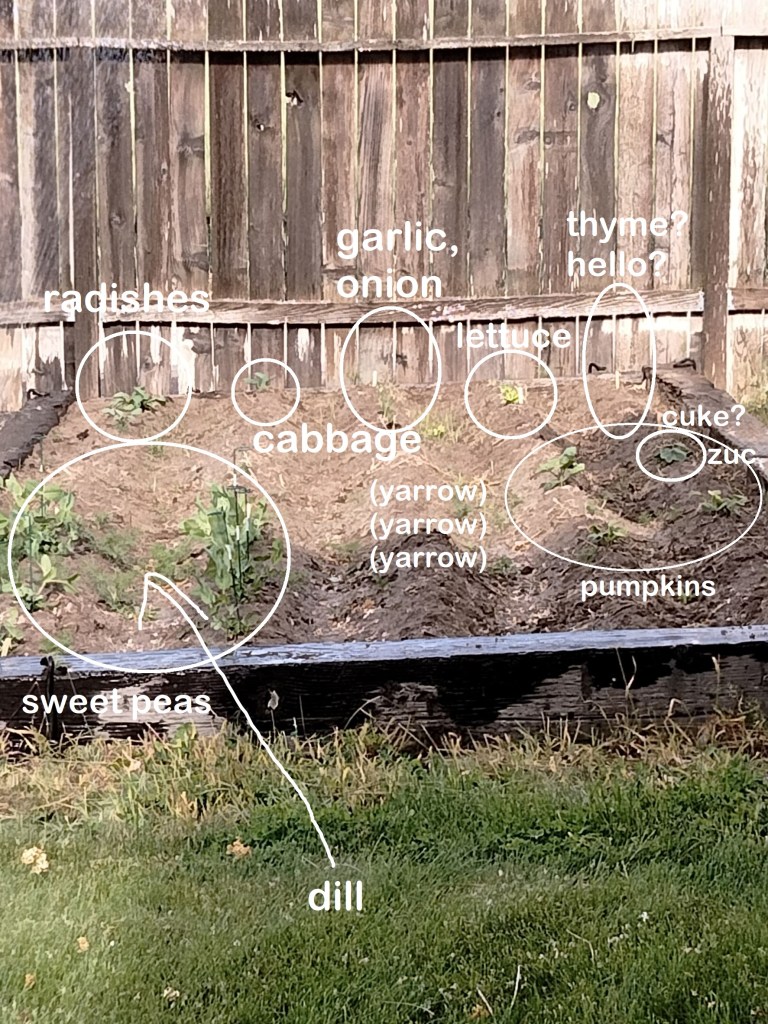
How Does Your Garden Grow?

Really slow.

We had a cold, late Spring, and some things aren’t even up yet.

Meanwhile, I planted dill and yarrow seeds on the actual rows (both plants are supposed to repel pests and support the growth of other veggies), but with the strong winds we had around here, they apparently got carried into the furrows and that is where they are coming up.

I’m just a beginner.

Honor’s Reserve by Michael La Ronn: A Book Review

I’m sorry. This just did not hold my attention.

More than a year ago, I read Phantom Planet, which is the second book in the Galaxy Mavericks series but came out before the first one. Near the end of that, Grayson, the main character in Honor’s Reserve, shows up to rescue Keltie (he’s in the space equivalent of the Coast Guard). At the time, the vibes I got were definitely eyebrow-raise-what-have-we-here-man-in-uniform-potential-romantic-interest-alert. So it’s disappointing to find that Grayson’s back story is, so far, more boring than Keltie’s.

I don’t have a problem with the fact that this space opera takes liberties with science. In fact, the author includes a hilarious disclaimer at the beginning announcing that he is planning to do just that. Some other Goodreads reviewers actually DNF’d this book because of perceived inaccuracies with hyperspace travel and the like. I would just like to remind my fellow science-fiction readers that hyperspace travel, no matter how convincingly it is “explained,” is FICTION. Travel that even approaches the speed of light probably physically destroys the object traveling. All hyperspace travel is fiction. So is evolution. And boy, is there some fictional evolution in Honor’s Reserve!

Scientists think that the nanocraft [carrying a selection of DNA from humans and various animals] collided with an asteroid that had some kind of molecular life on it, and that that asteroid crashed onto an Earthlike planet that supported carbon life. The two life forms mixed, rapidly evolved, and Arguses were born.

Honor’s Reserve, p. 36

Arguses are aliens that basically have human bodies and the heads of pigs. And this entire, intelligent species evolved in … how long? “Nine hundred and fifty years.” Actually less, if you count the transit time for the nanocraft. Wow, that really gives a new meaning to “rapidly evolved.” But frankly, if you look into molecular biology, an intelligent species evolving from bacteria at all is just as unlikely as it evolving in 950 years. So, why not? Remember, this is science FICTION.

I also don’t mind the things in this series that might be considered anachronisms. The year might be in the 3000s, but human nature remains the same. So, Grayson and his fellow crewmembers getting onto a private spacecraft and giving it a bureaucratic-style safety inspection seems refreshingly realistic. I’m sure bureaucracy is not going to decrease with the advance of technology. And, perhaps my favorite moment in the book is when the heroes are trying to jump into hyperspace to escape the villains, and the computer keeps asking them, “Are you sure you want to jump into hyperspace?” and making them click a bunch of permissions, causing them to get caught by the people chasing them.

So then, why did this book keep losing my interest and why did I nearly DNF it at about 40%? Maybe it’s something about the writing. Although I am willing to put up with unrealistically easy jumping into and out of hyperspace, I do like the logistics of my action scenes to be nice and clear, and in Honor’s Reserve, they often weren’t. For example, it was sometimes not clear to me that a character had put their helmet back on (or never taken it off) before, say, the airlock was depressurized. That seems kind of important. There’s a scene near the beginning where Grayson is holding on to the outside of a space ship (or the edge of the airlock door, which is open? Not sure?) where the logistics were just not clear. The scene moved too fast. Show, don’t tell is great, but sometimes with sci-fi we need a little telling, or the scene actually loses drama.

Speaking of losing drama, there was definitely some untapped potential for character development here. I am speaking of Rina, the female villain of the story. [spoilers ahead] She is found to be human trafficking: helping the odious Arguses to kidnap people so they can enslave them. Then we find out that she is doing this in exchange for a promise from the Arguses to protect her and her family. She was at first enslaved, and she has the burn marks to prove it. Well, even if it’s not ultimately excusable, this seems like a pretty understandable motivation. It might bear looking into a little further. Rina has evidently been through some pretty heavy trauma recently and is in a desperate situation. We might want to examine that, no?

No. Rina is consistently portrayed as a sociopath. “You can’t trust anything she says.” She even comes right out and says, “It didn’t really bother me to enslave a bunch of other people, as long as it wasn’t me.” So Rina is thoroughly bad and we can safely hate her and turn her over to the Arguses.

Even this character arc might have been OK if it had been written with a little more complexity: if, say, Grayson had been tempted to feel sorry for Rina when he heard her tragic back story, had tried to turn her, and had then been double-crossed and we find her doubling down on her evil. But that’s not how it goes down. It’s as if Rina is barely a character at all.

To sum up: a bland, one-dimensional villain (and consequently, hero); aliens that don’t seem spooky, just like grosser, evil-er people; and action scenes that sometimes felt rushed and inadequately explained are all the reasons that I found the author’s notes at the end, about his philosophy of space operas, much more interesting than the book itself, and the reasons I am sadly giving this book two stars.

I will say that Phantom Planet, while it had some of these same problems on a smaller scale, was better than Honor’s Reserve. It had some spooky, unexplained things that promised more terror later in the series. I might give this series one more book before I give up on it.