Pyramids in the Amazon

Lasers reveal ‘lost’ pre-Hispanic civilization deep in the Amazon

Not to be a broken record, but …

  • humans are smart, and they make culture wherever they go
  • the ancient world was much more urban than we have been told
  • there was apparently a universal human culture that included cities, pyramids, and legends/myths/cultural histories about “gods,” giants, and a worldwide flood

And, as a bonus …

  • The population of the Americas was much greater than once thought, before the arrival of the Europeans. A major population collapse happened in the centuries between the arrival of Columbus and the settling of the two continents by Europeans. For more information, see this video, which is #10 in a series, and the videos that follow it (#s 11 – 14). This is fascinating stuff.

Galaxy Rabbit

Hi all! Sorry, I do not have an essay, book review, or rant for you today, as I usually do on Fridays. The school year is ending, the plants are growing, and my book, The Great Snake, is launching on Monday (which is also Memorial Day … and no, I didn’t do that on purpose).

Tomorrow, my friend Teal Veyre will be hosting a launch party for The Great Snake at 3 p.m. Eastern Standard Time on her discord server, The Writer’s Block. If you wish to join The Writer’s Block (even just for the duration of the party), follow this link: https://discord.gg/Tq6Q2c8b

The “party” will be voice only, and you must bring your own snacks of course. You will have to endure ten minutes of me reading from The Great Snake, but if you can hang in there through that and the trivia game, there will be prizes.

In the meantime, please enjoy this painting by a talented young artist to whom I have given birth. It is called “Galaxy Rabbit,” and there is a whole series of galaxy rabbits planned. The rabbit is large enough to eat the planets that he is floating near.

Funny Business

Beyond was a riding school with an indoor dressage ring.

“I know that place,” said Blomquist. “There was some funny business going on there a few years ago. It’s in different hands now.”

Ulf wondered what funny business might be conducted in a riding school. Of course, funny business could go on anywhere, and did, even in the most unlikely places. There had been that funny business in the Vatican, for example, involving banks and secret societies. If there could be funny business in the Vatican, then surely there could be funny business anywhere.

Alexander McCall Smith, The Man with the Silver Saab, p. 99

Reminder: The Great Snake goes on sale Next Week

Pre-order your copy on Amazon or Barnes & Noble for a summer beach read.

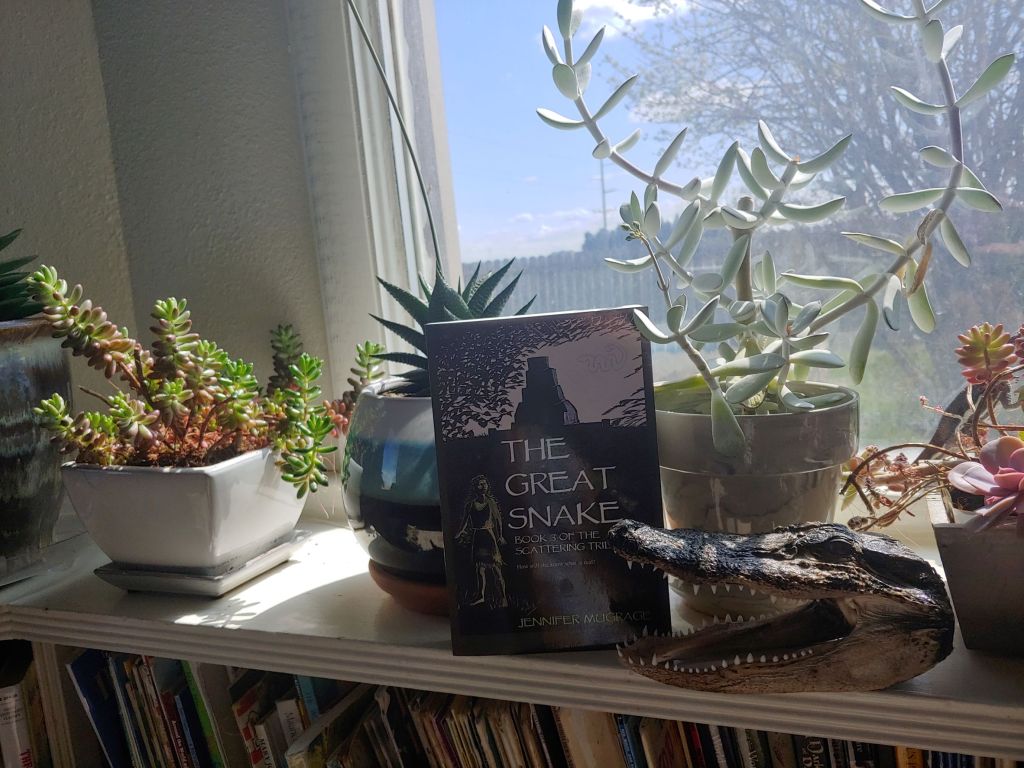
Here is the book in its natural environment.

As you can see, we are going for more of a subtropical vibe here, with succulents and a mini gator’s head from Florida.

Here’s the back cover copy:

As a child, Klee crossed the Land Bridge with her tribe, and she grew to womanhood in ancient North America. Once a teenager, she makes the shattering discovery that she isn’t who she thought she was. The people who raised her are not her real parents, and her birth father, a charismatic, maimed man, wants her to go with him to found a city dedicated to his snake god. After what she has just discovered, how can Klee know whom to trust?

The Great Snake takes up the epic journey that began in The Long Guest, continued through The Strange Land and now wends its way to the evocative and shocking conclusion of the Scattering Trilogy.

Let’s Learn World Building with Thomas Sowell

This is a brief review of the book Black Rednecks and White Liberals, by Thomas Sowell. Full disclosure: I am writing the review before I’m finished with the book. But given that it’s a series of historical essays rather than a novel, I doubt there’s going to be a twist at the end.

Contrary to what you might expect, not the entire book is about Black Rednecks and White Liberals. The book consists of five essays:

  • Black Rednecks and White Liberals
  • Are Jews Generic?
  • The Real History of Slavery
  • Germans and History
  • Black Education: Achievements, Myths and Tragedies
  • History versus Visions

As you can see from the titles, Sowell pokes directly at the eyes of all the sacred cows he can find. Like every Sowell book I’ve read so far, the essays in this book destroy popular misconceptions with facts and logic. But by “facts and logic” I don’t just mean bon mots and statistics from the last ten years. These essays offer detailed history lessons that cover social phenomena from around the world. As someone with an interest in anthropology, I am finding them fascinating. Sowell has drawn from the literature (he has 63 pages of endnotes), but he had also done some research in person. At one point, he mentions in passing something someone said to him “When I was traveling to research the economic conditions of different ethnic groups around the world.”

I’m not going to get in to the political and economic implications of these essays. Instead, I’m going to come at this like a fiction author.

I really recommend that anyone who wants to do worldbuilding for a fictional society read some or all of the essays in this book.

For example, the essay “Are Jews Generic?”. Kind of a weird title, but it turns out that what the piece is about, is economic middlemen. Sowell starts out talking about how, in WWII P.O.W. camps, a black market would immediately spring up around goods that people had saved from their Red Cross packages, such as cigarettes, jam, etc. Some people consumed these right away; others didn’t. Some people were nonsmokers. They needed to be able to barter things. And, just as quickly, up sprang economic middlemen. They knew who had what, and they could help the parties communicate and broker trades. And, they took their cut, which led the other prisoners to look on them as parasites who weren’t producing anything of value, even though they were clearly providing a service that was needed.

It turns out that there have been people, and groups, that fill this economic role in many places in the world throughout history. The Milesians in the ancient Levant, the Armenians in the Ottoman Empire, the Lebanese in Sierra Leone, the Igbo in Nigeria, the Chinese in Southeast Asia, Koreans in inner-city America … and the Jews in Eastern Europe.

Middleman groups have a lot in common. They tend to be more enterprising than the population around them; they start small, in businesses that don’t require a lot of initial capital, and work their way up; they make great sacrifices to get their children educated; they tend to be clannish, as they must be in order to maintain the distinctive cultural characteristics that make them so well suited for the middleman role. They also tend to be hated: accused of corruption (often true, especially in countries where one must be corrupt to survive in business) and of extortion and hogging resources (often not true, as usually they started out very poor and rose to middle class). Interestingly, middlemen tend to be most hated in economic situations where their role is most vital. Sometimes they are driven out or genocided, which then causes the local economy to suffer because that vital middleman role is not being filled, or is being filled poorly.

Hence, the title “Are Jews Generic?” asks the question whether Jews are hated because they are Jews, or because they are, in a way, the ultimate example of an economic middleman ethnic group, whose intelligence, diligence, and drive tend to arouse the envy of others.

If all this isn’t useful for worldbuilding, I don’t know what is.

Readers will also benefit from this historical perspective. If a fantasy writer includes an economic middleman character who is clannish, a sharp bargainer, and very frugal, for example, it does not follow that the writer is employing a transparent stereotype of a Jew and that the book or movie is therefore anti-Semitic. There have been characters like this all over the world and all throughout history. It is good for readers and viewers to be aware of this.

As always, Thomas Sowell comes highly recommended.

Shaking My Head

… and laughing at human nature.

The close ties within middleman minorities have led some to imagine a wider web of loyalties than has actually existed. Such phrases as “Jews all stick together” confuse intense loyalties within particular subsets of Jews –or other middleman minorities– with a solidarity encompassing the whole population of the group. However, when Eastern European Jews began arriving in the United States in the late nineteenth and early twentieth centuries, the predominantly German Jewish community viewed their arrival with alarm. The Jewish press, which was largely controlled by German Jews at the time, characterized the new immigrants as “slovenly in dress, loud in manners, and vulgar in discourse,” speaking “a piggish jargon” –that is, Yiddish.

German Jews were willing to employ Eastern European Jews but living near them was something else … Hungarian Jews had their own enclaves, separate from the enclaves of Russian or Polish Jews. There was a “low intermarriage rate” among these various subgroups of Eastern European Jews and a “mutual incomprehension and intolerance that kept Jews apart.”

Among the Lebanese who settled in Australia, “their regional loyalties seldom extended beyond that of the village” in Lebanon from which they had come. A history of bitter and lethal intergroup violence in Lebanon and Syria, taking thousands of lives at a time, was part of the legacy that Lebanese took to other countries in which they settled. Even in a small country like Sierra Leone, the many internal disputes among various Lebanese factions, which spilled over into courts and involved political authorities, proved too baffling for either Europeans or Africans to understand –much less settle– during the colonial era. Indeed, one of the main tasks of the diplomatic representatives from Lebanon in Sierra Leone after independence was to arbitrate these internal disputes among various Lebanese factions there.

Thomas Sowell, “Are Jews Generic?”, in the book Black Rednecks and White Liberals, pp. 90 – 92