The Unseen Realm by Michael S. Heiser

Photo by sk on Pexels.com

This review will bring a number of threads together, but it won’t give you a comprehensive sense of everything discussed in this book, because it is a long, complex book with lots of things to chew on.

The Unseen Realm is a theological book written at a popular level, but with lots of footnotes. I would say it is for serious lay students of the Bible. It frequently refers to the Septuagint (the Greek Translation of the Old Testament that was in popular use in New Testament Times), and to other different ancient manuscripts of various Bible passages, some of which have slightly different wording that can be key for Heiser’s arguments. The scholarship on the many topics that this book encompasses is voluminous, so much so that there is a companion web site with additional articles for all the things that this book can’t get into in detail.

All of that said, it is not boring, at least not if you are interested in its main idea, which is that of a divine council of “gods” being present not only in other ancient mythologies but throughout the pages of the Bible. I came to this book for my research into future fiction projects that I may or may not be working on (ooo so mysterious!). I found out less detail than I had hoped to about the divine council, but even when we don’t learn something, we learn something. In this case, I learned that the Bible does not give us a lot of detail about this divine council, its members, or how it supposedly operates. We can assume this is on purpose.

The Main Idea: the Divine Council

It was very common in the Ancient Near East to believe that there was a council of gods or divine beings which would meet, typically on a mountain far away, and decide the affairs of men. That’s why you will often hear the title “Most High God.” Heiser’s contention is that the ancient Israelites shared this view, and that in fact the Bible endorses it. It starts very early, with God saying, “Let us make man in our image.” Though some people see this as evidence for the Trinity, Heiser contends that what is being evoked here is that God is addressing a group of beings which have already been made in His image, but are not humans. God then, all by Himself, makes man in His image, with the other beings presumably just watching.

The flagship Bible passages for Heiser’s thesis are Psalm 82 and Deuteronomy 32:8 – 9. In the latter, it asserts that God “divided up mankind [and] fixed the borders of the peoples according the number of the sons of God. But the LORD’s portion is His people, Jacob his inheritance.” The idea is that God assigned each “son of God” (divine being) a nation to rule over, but He took the Israelites as His own nation. Psalm 82 shows God reaming out the gods for not having done a good job ruling over the nations, promising them that “they will die like mere men” and that “all the nations” will become God’s inheritance.

These are the two most obvious passages that indicate this idea, and even they are often translated to so as to hide the fact that the original authors assumed that divine beings existed and ruled over the nations. My NIV, for example, translates Deut. 32:8 as “… according to the number of the sons of Israel.” It also puts scare quotes around the word “gods” in Ps. 82.

Ugarit

Ugaritic is the ancient Semitic language most closely related to Hebrew. In Ugaritic cosmology, the chief deity was El. He had a divine council that met in a lush garden or on a mountain. He had seventy “sons of El” who made up his council, and he had a coruler, Baal (which means “lord”). Much of the imagery, vocabulary, and cosmology of Ugarit is echoed or riffed off of in the Old Testament, always making the point that Yahweh is the true Most High God, the one who sits on a throne over what looks like a sea of glass, that His garden is the true garden and His mountain is the true mountain. The Israelites, though, did not quarrel with the idea that there were seventy lesser divine beings who served God. This seems to have been accepted cosmology, sort of like we accept heliocentrism. The Bible does not come out and say this directly, because it was common background knowledge in the Ancient Near East.

The Table of Nations, in Genesis 10, shows 70 nations branching off from Noah’s three sons. The idea was that subsequent to Babel, each of these nations was assigned to a son of El – a lesser god. The Most High was done with them. He would no longer be their God directly. Of course, some day the lesser gods, who did not do a good job with their people, would be demoted. Yahweh had plans to bring all the nations of the earth back and make them His own people once again.

The Divine Council in the Redemption Story

Heiser spends the rest of the book tracing this idea of the divine council, of Yahweh as the true God, and of the disinheritance and re-gathering of the nations, throughout the Bible, seeing how it plays in to the big redemption story. He gets into discussions about whether idols are nothing at all or whether they represent something more, and whether the word demon (shadim) means just a supernatural being or something evil. He gets to the giants. He gets to Jesus putting the local gods on notice when He starts crashing around Galilee. He visits the miracle of the tongues of fire at Pentecost. It’s all really interesting, really intricate, with a lot of scholarship.

Some of the ideas in this book were truly mind-blowing. For example, I had never before heard the term Monotheistic Binitarianism. (Wild!!!) “The startling reality is that long before Jesus and the New Testament, careful readers of the Old Testament would not have been troubled by the notion of, essentially, two Yahwehs — one invisible and in heaven, the other manifest on earth in a variety of visible forms, including that of a man. In some instances the two Yahweh figures are found together in the same scene. In this and the chapter that follows, we’ll see that the ‘Word’ was just one expression of a visible Yahweh in human form” (page 134). This is a consequence of mysterious Old Testament passages where Yahweh will appear to, say, Abraham in human form … but sometimes there are two or even three human figures, and the passages seem to be intentionally ambiguous about their identity or how many are there at any given time. There are not just a few of these instances either. Heiser says that this idea of “two powers in heaven” was “endorsed within Judaism until the second century A.D.” (135, footnote). It was the background to the famous passage in John 1: “In the beginning was the Word, and the Word was with God, and the Word was God. He was with God in the beginning …”

Other ideas, if I may venture, were less mind-blowing than Heiser seemed to expect them to be. Perhaps this is because I have been studying what you might call the weirder aspects of the Old Testament for some time, but even for someone who had never heard this idea, I sometimes got the feeling that Heiser was writing to a straw man. For example, he has a whole chapter about how God’s plan for a Messiah was hidden in the Old Testament, in hints that couldn’t be pieced together beforehand, but only made sense in retrospect, types and shadows. This is pretty standard Christian teaching, at least in the Reformed circles I move in, but Heiser seems to think that his readers have been given the impression that God’s whole plan of salvation was spelled out super clearly in the Old Testament. “Chances are good that you’ve heard the New Testament mistakenly read back into the Old hundreds of times. Therefore you might be surprised to hear me say that the Old Testament profile of the Messiah was deliberately veiled” (241). In the rest of the chapter, he proceeds to read the New Testament back into the Old. “It couldn’t be emblazoned across the Old Testament in transparent statements.” Yes, we know. After Jesus rose, He said, “These are my words that I spoke to you while I was still with you, that everything that is written about me in the law of Moses and the prophets and psalms must be fulfilled.” Then he opened their minds to understand the scriptures. (Luke 24:44 – 45, quoted by Heiser on page 242) Yes, we know. The New Testament Christians could not see the significance of the Old Testament passages until Jesus (and, later the Holy Spirit) opened their eyes to see it. In fact, they spent the rest of their lives making “So that’s what that was about!” discoveries. Perhaps some modern Christians don’t realize this, but I think most people do who have spent years doing Bible study. In fact, many of the doctrines that we take for granted had to be worked out by the church through history.

Similarly, Heiser has a whole chapter about why God’s plan included making beings with free will and how this necessitated evil and how He couldn’t just erase everything and start over as soon as we messed up. Heiser is not a fan of Calvinism. Like most Arminian arguments, he seems to have a shallow understanding of what “free will” means and a shallow understanding of Calvinism as a sort of dystopian vision wherein people (and gods) are mere sock puppets directly controlled by God. I am willing to accept that God is sovereign, and that beings other than Him exist in the universe (human and supernatural), which make real choices that are in some sense free. I get that these two things should not go together, but that we have good evidence for both. So it is a paradox. I don’t need to choose between sovereignty or free will to understand the idea of a divine council.

What We’re Not Told

After reading Heiser, I am convinced that it is a biblical idea that there are spiritual “divine” beings that exist in an unseen realm. (Heiser points out that the word for these beings, elohim, is a place-of-residence word. They live in the unseen realm, therefore they are elohim. The word itself says nothing about their moral status.) Their existence plays a role, though I would still say not the major role, in God’s plan of salvation for humankind. In some ways, they are relevant, especially in their role as rogue gods of the nations. In other ways, a lot of what goes on in the unseen realm is none of humankind’s business.

Perhaps this is why the Bible does not tell us — and thus, Heiser does not tell us — the sort of details about the elohim that a researching novelist would naturally want to know. Here are a few unanswered questions:

  • Are there really only seventy of them? What happened when the seventy nations multiplied into many more?
  • There appears to be a hierarchy in the unseen realm, but what is it like? How many levels?
  • Are the beings on the different levels different species/different in appearance (if that question even means anything)? Does the unseen realm have the equivalent of animals?
  • We know some elohim rebelled against God, but how many? When? Was there more than one rebellion? Are all the rebel spirits organized under Satan, or are there rogues and factions?
  • How does or did this divine council even work? In almost all of the glimpses we are given of it, it’s basically just God announcing His intentions and the council members just watching.
  • There is a well-established association between the gods and the stars or constellations, but how does this work? Are they the same or symbolic? Is it a one-to-one correspondence?

This is the kind of thing that a really good novelist would get all nailed down before writing a book like, say, This Present Darkness … but it’s impossible to nail down because we are not told this stuff. Again, this is probably because it is none of our business. So if you are going to write a novel that includes gods, I would recommend you just delve into the mythology of one particular nation (Ugarit, say, or Greece as many authors have done to great success), accepting that you are riffing off of one particular nation’s interpretation of all of this, an interpretation that is based on something real, but is definitely not going to be accurate in all its details.
Quotes from a Book I Binged

The book is Before the Ruins, 2020, by Victoria Gosling.

It’s been a while since I binged a book, but I finished this one in just a few days. It is so well-written that it’s almost like unrhymed poetry. Almost every page has something quotable, even when the quotes are ones I disagree with, like the following …

I remember Peter’s father in the church telling the story of Jesus and Pilate, and jesting Pilate asking Jesus what the truth was but then not staying for an answer, and so we never got to find out, not any of us, not ever. I was so disappointed and on our way back to the vicarage, hell-bent on my share of the roast dinner — chicken, chicken, let it be chicken! — I pestered the vicar, “But why didn’t the disciples ask him instead? There he was on the cross, it’s not like he was going anywhere. Why didn’t they ask him?” With his hand on the gate, he turned. A watery smile. “Sometimes, Andy, I think you are the only one who is listening.” Which, of course, was no answer at all.

Nor was there anything in the Gospels that shed light on what Jesus would have said about [my abuser]. I don’t remember anywhere in the Bible Jesus meeting a truly wicked man.

Before the Ruins, p. 114

*pinches brow*

No, Jesus never met a truly wicked man … except the ones who hunted, slandered, gaslit, and betrayed Him. And then tortured Him to death. Except the majority of people he met. Except those.

He never said anything about child abusers … though there were certain passages about the sea and millstones and whitewashed graves and the fires of hell.

His disciples never asked Him “What is truth?” … except all those times they did, and He said “I am the truth,” and the time Philip said to Him, “Show us the Father,” and Jesus said, “Don’t you know me, Philip, even after I have been with you for such a long time? Anyone who has seen me, has seen the Father.”

It’s interesting, because a big theme of Before the Ruins is how difficult it is to really know people, even people you love very much. And how difficult it is to let people know you, even if you really want to.

When not on the subject of the Gospels, the book has a lot of insight and achingly evocative passages about childhood and growing up. Passages like that will break your heart. Passages like this one:

It made me aware of how dormant I was most of the time. How my life — my job, my screens — made it easy to be occupied every waking moment, hurrying, distracted, and equally, on some level almost entirely asleep, comforted by dreams of effortless transformation.

But I was not Cinderella. Instead, there was another story Peter and I had often found in the books of our childhood. It came in different disguises. It was the one about the traveler who arrives at an island, or a castle, or a secret door into the side of a mountain. There, welcomed, the traveler stays, perhaps against their instincts. Often they eat or drink — strange fruit, or wine from a goblet. There is always something they should be doing, an important task for them to fulfill, but they forget it, they are waylaid, and if they ever remember, their companions, if there are any, distract them with promises, or songs, or riddles to ponder.

Often the traveler sleeps, sometimes they dream, always they are nagged by the sense that there is something they are forgetting, something they must do. Their true love is waiting, or their aged parents. There is a sick child they must bring herbs to, a kingdom for them to inherit. But they do nothing; they are paralyzed. And when they wake, if they ever get away, once back in the world they find that centuries have passed, that they are too late, too late for everything, and that all that they loved, everything that truly mattered, is lost forever.

To sleep on? Or to wake? This was the question facing me. To sleep, or to wake and face the reckoning, to find out what had been lost.

Before the Ruins, p. 181

Interesting Tidbit on the Venuses

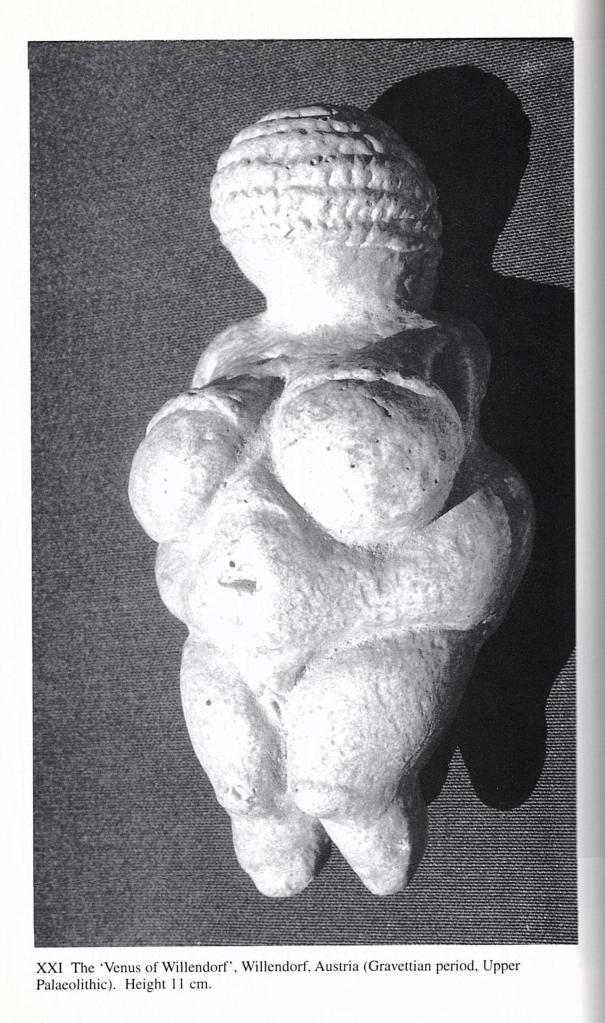
The “Venuses” are those little prehistoric sculptures of naked ladies found all over Europe.

You might not want to read this article, as it features both the phrases “obesity” and “climate change.” But long story short, it seems that the closer the Venuses were to the glaciers, the fatter they were. The assumption is that, the harder food was to come by, the fatter the ideal mama became.

Painting Inspired by Knitting

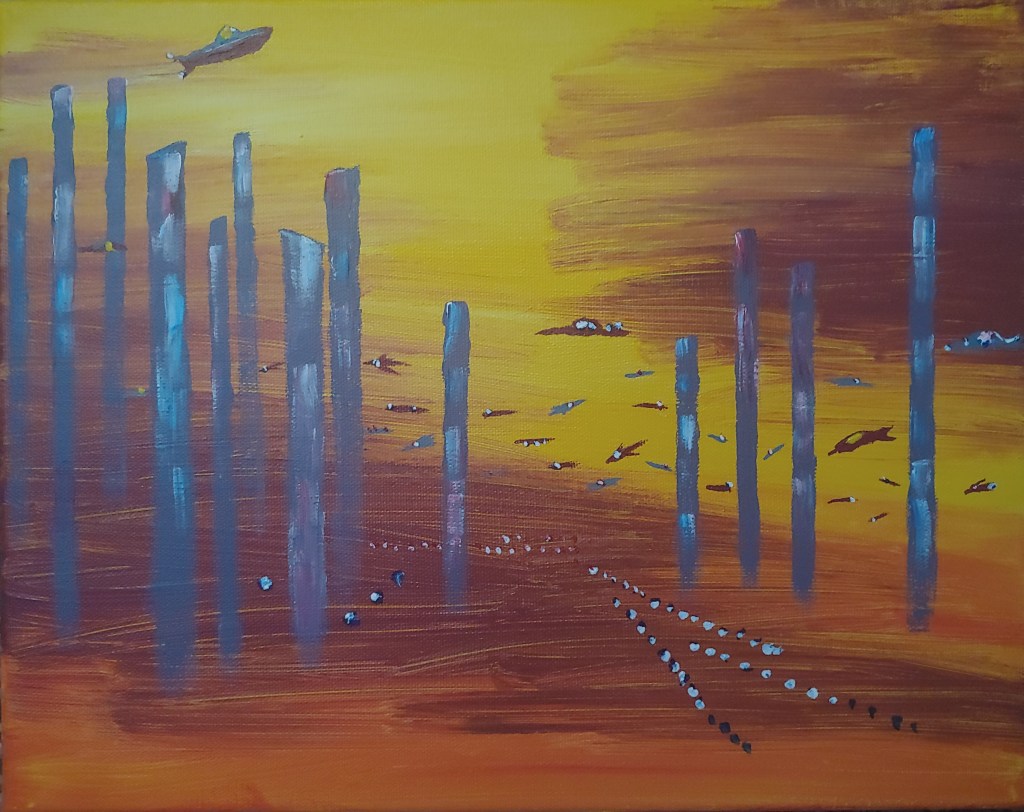
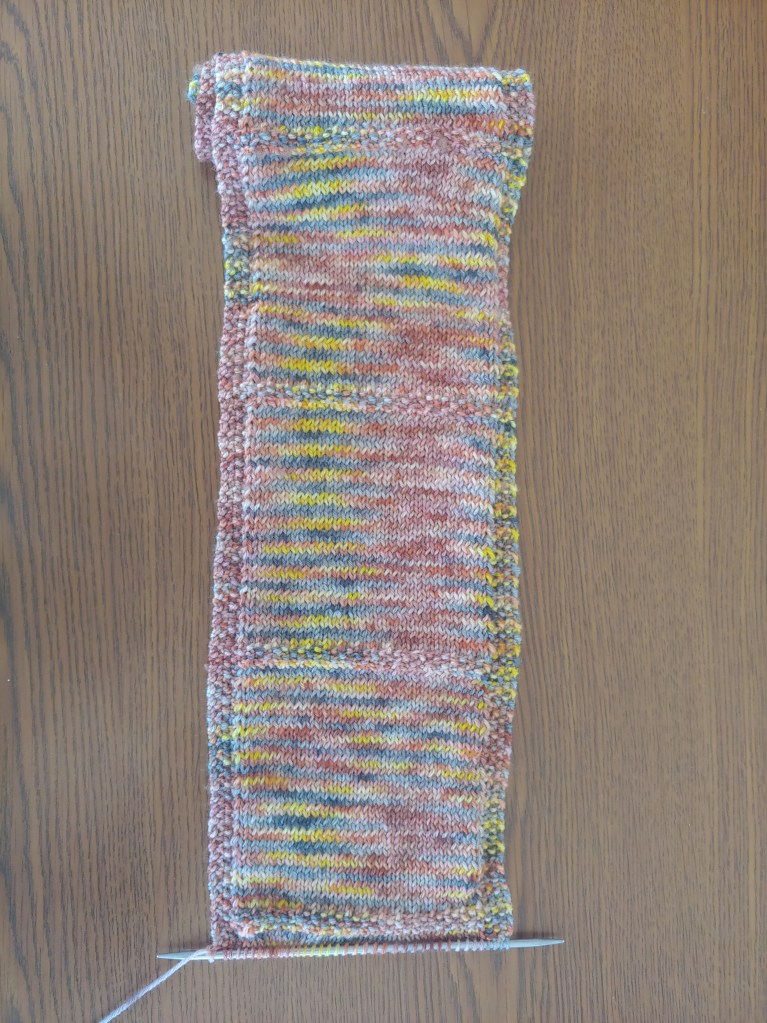
I’m in the process of knitting the scarf for a specific person. I picked the colors of the hand-dyed wool based on the intended beneficiary’s coloring, and the colors of the clothing they usually wear. Little did I know that when it knit up, it would portray a futuristic, sci-fi-book-cover type of scene.

Don’t see it? Look closer …

Now zoom out a little …

… and, all the way out …

There it is.

I Feel Like It’s Time I Re-posted This Quote

Originally posted this in July of 2020. Now it has become relevant again.

More than one side can be the bad guys at once.

“What I know about Mendoza,” Palmer said slowly after a while, “is that he’s a petty gangster who enjoys pushing people around. I’ve already told you what I think of Cobar: a psycho killer.”

“But in his book –“

“I know,” Palmer said, lifting a hand. “But a killer who writes a book is still a killer — even if it’s a book about peace and justice. A thug with a lot of high-blown political ideas is still just a thug in the end.”

“But he’s at war with a brutal government …”

“Gangsters get in wars with each other all the time,” said Palmer. “That doesn’t make one side good and the other bad. And it doesn’t mean I have to care which bunch of bullies and thugs wins the day. You think the people in this village will be any better off when it’s Cobar’s government murdering them instead of the government they had before? The only one who’ll feel better about it is you, because you’ll think it’s all for some higher cause — fairness or justice or whatever they’re calling it nowadays. Whatever they do call it, it always translates to the same thing in the end: obey the man with the gun or he’ll kill you. The truth is, Professor, there’s only one higher cause I know of. That’s the right of every man to go his own way and spend his own money and speak his own mind and find his own salvation. You show me the side that stands for that and I’ll fight for them.”

If We Survive, YA book by Andrew Klavan, pp. 218 – 219

Is That You, Auntie?

I call her “auntie” because …

  • she’s a Scythian, buried in a kurgan on the steppes of Asia.
  • General consensus is that the steppe-dwelling kurgan builders were the ancestors of the Indo-Europeans. (They later moved west into Europe and east into India.) So I could call her Grandma.
  • But, the specific group this burial is thought to be from, lived there from 800 B.C. to 300 A.D. That’s well after the dispersal of the Indo-Europeans to Europe, though some of them were still apparently hanging around in central Asia.
  • Hence, “auntie.”

Other things to love about this article …

  • She’s an older woman, about 50, buried with a toddler. Could have been Zillah from my books!
  • Her crescent pendant shows that archaeologists don’t know squat, and the headlines are even worse. The subheader says “a 50-year-old woman was buried with a unique ‘male’ pendant.” Reading down in the article, we find that “She was buried with this artifact that we had believed to be a sign of male burials,” because similarly shaped pendants had previously been found in men’s burials in kurgans in southern Siberia. So, because we had never found this type of pendant buried with a woman, we assumed it was a male artifact. We should be careful about making extrapolations based on what we haven’t yet found. And then putting them into headlines.
  • The Scythians are cool! Many of them were red-haired. When living in Asia, they made very tall hats out of felt (you can find reconstructions on Pinterest). Bill Cooper, in his book After the Flood, shows that the ancient Irish believed themselves to be descended from the Scythians, and that the word Scot comes from the same root (pp. 110 – 111).

Let’s Learn Lapine

Photo by Pixabay on Pexels.com

Lapine is rabbit language.

Yes, it’s made up. But it’s no less brilliant for that. Lest we forget, the entire Lord of the Rings cycle started with J.R.R. Tolkien learning to read Old Norse and reading the Elder Edda in it, and then making up several fictional languages based on Norse and Welsh. In the process, he discovered that “a language implies a mythology,” so then he had to make up a mythology to go with his fictional languages … and the rest is literary history.

But back to Lapine. My source here is the amazing, but dense and demanding, novel Watership Down by Richard Adams. The main characters in this book are rabbits. Their problems are rabbit problems. Their solutions are rabbit solutions. The book eases you in to learning rabbit culture, mythology, and yes, language. On the third page of the story, we meet a small rabbit, the runt of the litter, called Fiver, and we get this footnote:

Rabbits can count up to four. Any number above four is “hrair” — “a lot,” or “a thousand.” Thus they say U Hrair – “The Thousand” — to mean, collectively, all the enemies (or elil, as they call them) of rabbits — fox, stoat, weasel, cat, owl, man, etc. There were probably more than five rabbits in the litter when Fiver was born, but his name, Hrairoo, means “Little Thousand” — i.e., the little one of a lot or, as they say of pigs, “the runt.”

Watership Down, p. 13

Presto! We have already learned two rabbit words:

hrair = five, or a thousand

elil = enemies, predators

We’ve learned three words if you count u, which later will be used not only to mean “the,” but also like the vocative O.

In the next few pages, we learn that every warren has a leader, called a Threarah, and that he has a group of enforcers called the Owsla. Later, we will find out that the Threarah is addressed by adding -rah to his name, as in Hazel-rah.

Later still, we will learn some other words:

silflay = eat. Specifically, silflay is the event when rabbits go out at dawn and dusk to graze.

hraka = droppings

tharn = the state a frightened rabbit gets into, when they cannot move or think

Frith = the sun. Also, God in the rabbit cosmology

Ni-Frith = noon

Inle = the moon. In rabbit myths, the Black Rabbit of Inle is the embodiment of Death.

Fu Inle = moonrise

yona = hedgehog

homba = fox

hrududu = motor vehicle (I think this one is onomatopoetic.)

embleer = damned … O.K., I just checked the glossary, and it actually means “stinking, e.g. the smell of a fox.”

zorn = destroyed, desolate. Denotes a catastrophe.

All this vocabulary is taught as it comes up in the story, through footnotes that are just as fascinating as the story, and through words being used in context.

By the time we had almost finished the book, I and my son could immediately understand the untranslated line that Bigwig (Thlayli), a warrior rabbit, speaks in defiance of the leader of an enemy warren:

Silflay hraka, u embleer rah.”

After finishing, in the post-reading-a-really-good-epic glow, I belatedly discovered that the book has a glossary at the back. But by that time, we hardly needed it.

Dorothy Sayers on Sacrificing for your Work

To feel sacrifice consciously as self-sacrifice argues a failure in love. When a job is undertaken from necessity, or from a grim sense of disagreeable duty, the worker is self-consciously aware of the toils and pains he undergoes, and will say: “I have made such and such sacrifices for this.”

But when the job is a labor of love, the sacrifices will present themselves to the worker — strange as it may seem — in the guise of enjoyment.

Moralists, looking on at this, will always judge that the former kind of sacrifice is more admirable than the latter, because the moralist, whatever he may pretend, has far more respect for pride than for love.

I do not mean that there is no nobility in doing unpleasant things from a sense of duty, but only that there is more nobility in doing them gladly out of sheer love of the job. The Puritan thinks otherwise; he is inclined to say, “Of course, So-and-So works very hard and has given up a good deal for such-and-such a cause, but there’s no merit in that — he enjoys it.” The merit, of course, lies precisely in the enjoyment, and the nobility of So-and-So consists in the very fact that he is the kind of person to whom the doing of that piece of work is delightful.

Dorothy Sayers, The Mind of the Maker, pp. 134 – 135