
Just a reminder that the world is full of weird stuff …
Finishing Touches on the Back Cover Painting
In case you missed this reveal on LinkedIn, here it is.
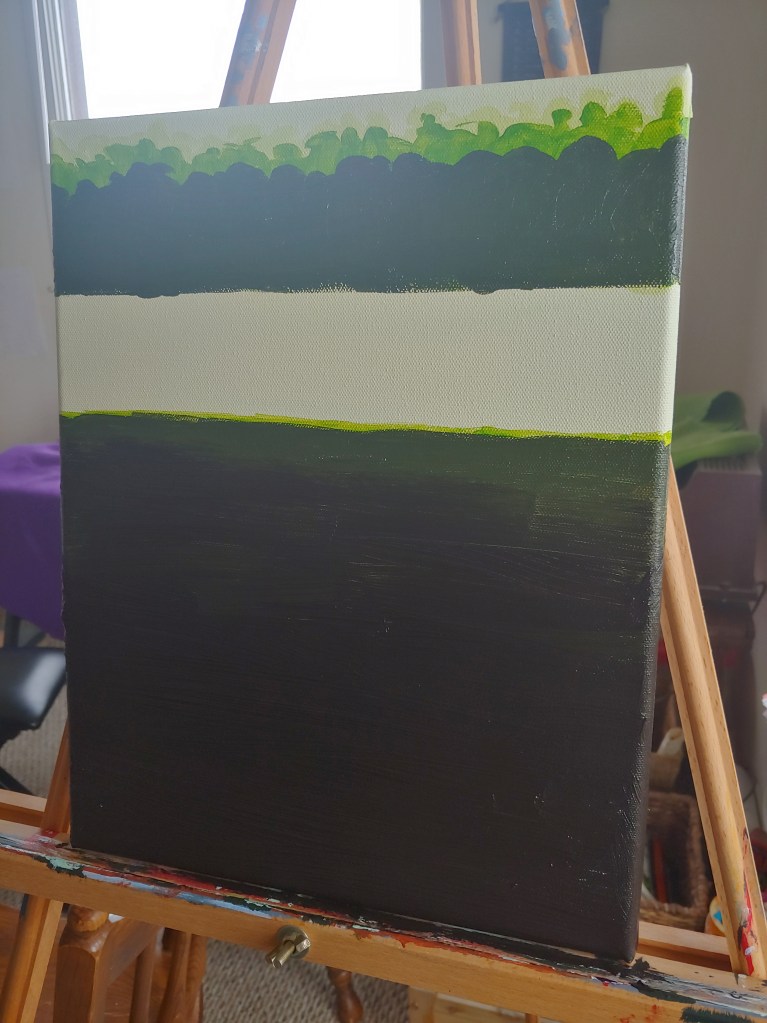
Let’s see, last week we left off here …


And then reflected light on the water.
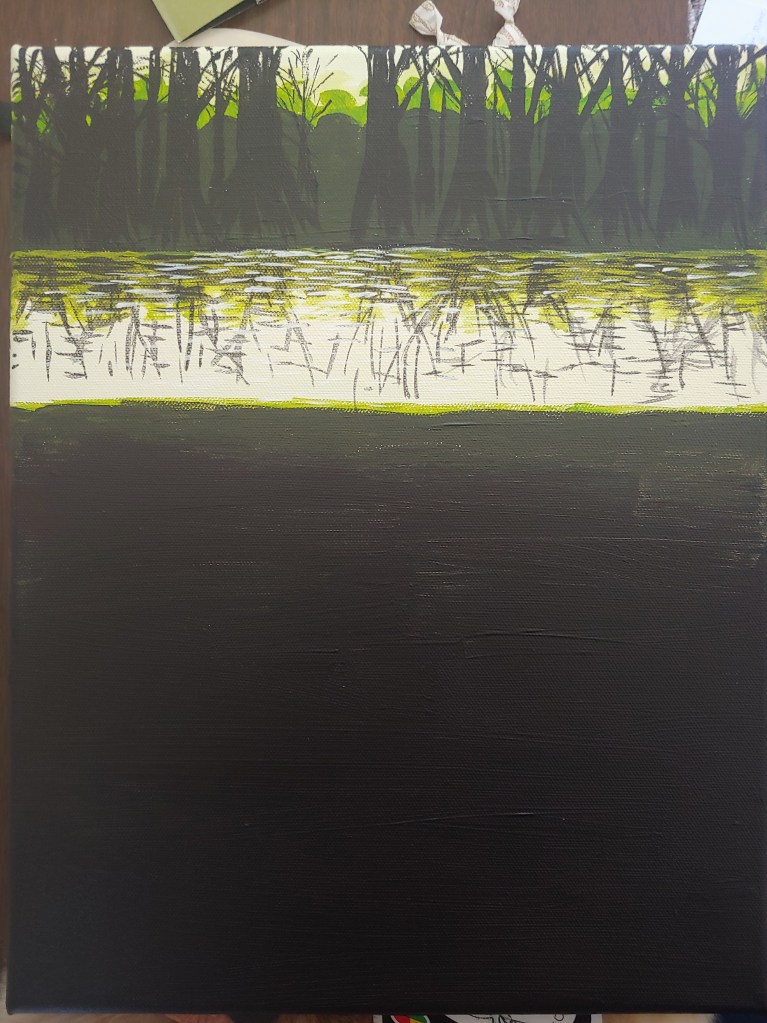
The text will go in the black area below.
I was going to add silhouettes of cattails between the viewer and the river, but then I thought that for a book back cover, simpler might be better. What do you think?
Definitely Not Political Post of the Week
Any resemblance to reality is entirely due to C.S. Lewis’s wisdom.
A little way off at the foot of a tree sat a merry party, a squirrel and his wife with their children and two satyrs and a dwarf and an old dog-fox, all on stools round a table. Edmund couldn’t quite see what they were eating, but it smelled lovely and there seemed to be decorations of holly and he wasn’t at all sure that he didn’t see something like a plum pudding. At the moment when the sledge stopped, the Fox, who was obviously the oldest person present, had just risen to its feet, holding a glass in its right paw as if it was going to say something. But when the whole party saw the sledge stopping and who was in it, all the gaiety went out of their faces.
“What is the meaning of this?” asked the Witch Queen. Nobody answered.
“Speak, vermin!” she said again. “Or do you want my dwarf to find you a tongue with his whip? What is the meaning of all this gluttony, this waste, this self-indulgence? Where did you get all these things?”
“Please, your Majesty,” said the Fox, “we were given them. And if I might make so bold as to drink your Majesty’s very good health –“
“Who gave them to you?” said the Witch.
“F-F-F-Father Christmas,” stammered the Fox.
“What?” roared the Witch, springing from the sledge and taking a few strides nearer to the terrified animals. “He has not been here! He cannot have been here! How dare you — but no. Say you have been lying and you shall even now be forgiven.”
At that moment one of the young squirrels lost its head completely.
“He has – he has – he has!” it squeaked, beating its little spoon on the table.
Edmund saw the Witch bite her lips so that a drop of blood appeared on her white cheek. Then she raised her wand.
“Oh, don’t, don’t, please don’t,” shouted Edmund, but even while he was shouting she had waved her wand and instantly where the merry party had been there were only statues of creatures (one with its stone fork fixed for ever halfway to its stone mouth) seated around a stone table on which there were stone plates and a stone plum pudding.
“As for you,” said the Witch, giving Edmund a stunning blow on the face as she re-mounted the sledge, “let that teach you to ask favour for spies and traitors. Drive on!”
C.S. Lewis, The Lion, the Witch, and the Wardrobe, Ch. 11
Familiar Situation of the Week
One nightfall a man travelling on horseback toward the sea reached an inn by the roadside. He dismounted, and confident in man and night like all riders toward the sea, he tied his horse to a tree beside the door and entered into the inn.
At midnight, when all were asleep, a thief came and stole the traveller’s horse.
In the morning the man awoke, and discovered that his horse was stolen. And he grieved for his horse, and that a man had found it in his heart to steal.
Then his fellow-lodgers came and stood around him and began to talk.
And the first man said, “How foolish of you to tie your horse outside the stable.”
And the second said, “Still more foolish, without even hobbling the horse!”
And the third man said, “It is stupid at best to travel to the sea on horseback.”
And the fourth said, “Only the indolent and slow of foot own horses.”
Then the traveller was much astonished. At last he cried, “My friends, because my horse is stolen, you have hastened one and all to tell me my faults and shortcomings. But strange, not one word of reproach have you uttered about the man who stole my horse.”
Kahlil Gibran, The Forerunner, 1920, pp. 33 – 34
I Have a Theory about Brontosauruses.
Y’see, they are very small on one end …
Very laaarge in the middle …
… and very small at the other end.
Incense of the West
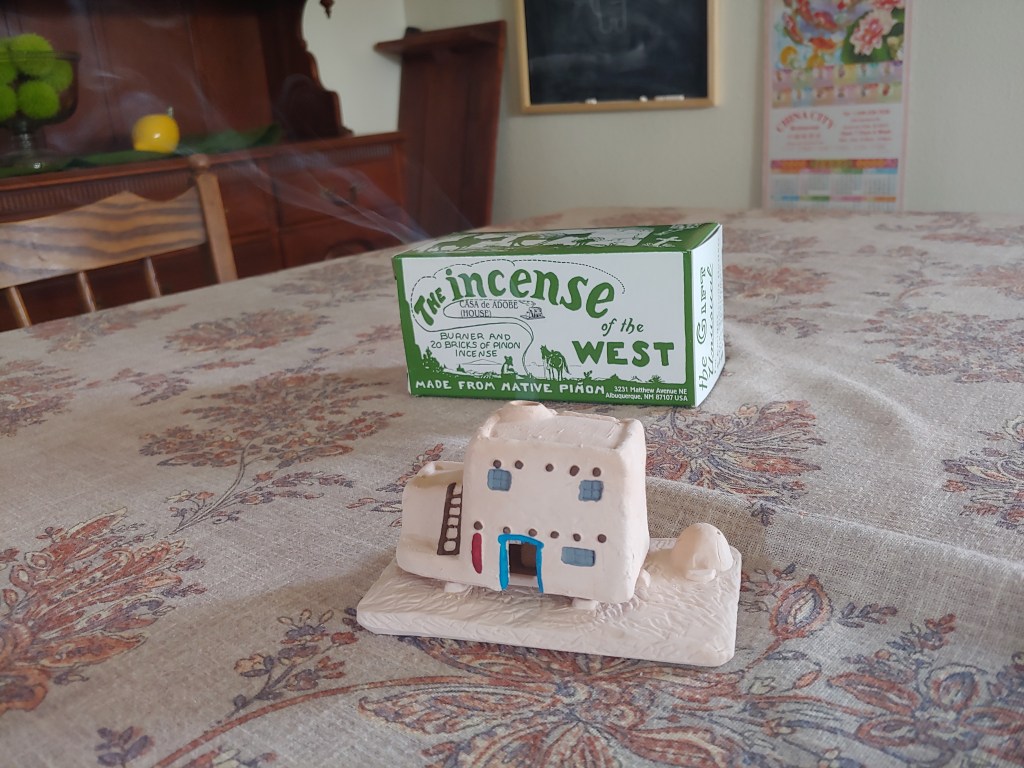
My hubby got me this as a gift on his travels. Thereby hangs a tale.
My husband has had one of these miniature adobe houses in his childhood room for decades. The set comes in two parts. You light a little brick of “incense” (in this case, pin͂on scented), put it upright on the house’s foundation, and then set the house itself over it. The incense burns down in about half an hour, and meanwhile the smoke comes out of the house’s smoke hole. It makes the whole room smell like you are burning a woodfire.
Now, looking at this little thing, and especially the extremely retro style of packaging, you might think this is the sort of hard-to-find item that might appear on the Antiques Road Show as a piece of 1960s memorabilia. But no! They are still being sold, and quite affordably. Nevertheless, when I look at this thing, I can’t help feeling that I have been given a piece of kitsch from a world that is vanishing.
My man got this for me because he knows I like the Southwest, and enjoy Tony Hillerman novels and books about the Anasazi. It looks really good sitting among my potted cacti.





We Are the-Book-as-Read
This threefoldness in the reader’s mind corresponds to the threefoldness of the work (Book-as-Thought, Book-as-Written, Book-as-Read), and that again to the original threefoldness in the mind of the writer (Idea, Energy, Power). It is bound to be so, because that is the structure of the creative mind. When, therefore, we consider Trinitarian doctrine about the universal Creator, this is what we are driving at. We are arguing on the analogy of something perfectly familiar to our experience. The implication is that we find three-fold structure in ourselves (who are the Book-as-Read), because that is the actual structure of the universe (which is the Book-as-Written), and that it is in the universe because it is in God’s Idea about the universe (the Book-as-Thought). Further, that this structure is in God’s Idea because it is the structure of God’s mind.
There is nothing mythological about Christian Trinitarian doctrine: it is analogical.
Dorothy Sayers, The Mind of the Maker, pp. 122 – 123
I’m Reading a Horror Story …
… I sure hope it ends well.
But I don’t think it will.
Because I wrote it.
I recently got the third book in my trilogy, The Great Snake, back from my editor. The next step for me is to go through it, noting all her comments, making all the changes that are called for.
I am having a grand old time. I was really unsure about this book during, and even after, writing it, perhaps because, to paraphrase Jordan Peterson, “The artist should not know exactly what it is that he is doing.” Now, reading through it with fresh eyes after an absence of several months, things are clicking in to place. I feel that what this book has done is right.
I think you all are going to like it.
Meanwhile, we have a brand-new war raging somewhere in the world. Women my age, with children the age of my children, are being forced to flee their homes or hunker down in their basements. Grandmothers are preparing to do first aid. War-fever is sweeping my own country. People are going bananas with demonizing the bad guys, and talking about WWIII.
That doesn’t count the crises we have long been praying about, which still have not abated, notably the Uyghurs being imprisoned in concentration camps, but there are a lot of others too.
Real life is a horror story.
Which raises the question: Do I have any right to enjoy myself reading over my little story of fictional horrors? Do I have any right to post about it, and about paintings and sunsets, or about anything at all except the current crisis?
It is time for me to pull out again C.S. Lewis’s wonderful speech “Learning In War-Time,” which addresses these very questions. I posted a quote from it, and a link to it, almost exactly two years ago. Here they are again:
[We] must ask [ourselves] how it is right, or even psychologically possible, for creatures who are every moment advancing either to heaven or to hell, to spend any fraction of the little time allowed them in this world on such comparative trivialities as literature or art, mathematics or biology. If human culture can stand up to that, it can stand up to anything. To admit that we can retain our interest in learning under the shadow of these eternal issues, but not under the shadow of a European war, would be to admit that our ears are closed to the voice of reason and very wide open to the voice of our nerves and our mass emotions.
I think it important to try to see the present calamity in a true perspective. The war creates no absolutely new situation: it simply aggravates the permanent human situation so that we can no longer ignore it. Human life has always been lived on the edge of a precipice. Human culture has always had to exist under the shadow of something infinitely more important than itself. If men had postponed the search for knowledge and beauty until they were secure, the search would never have begun. We are mistaken when we compare war with “normal life.” Life has never been normal.
The insects have chosen a different line: they have sought first the material welfare and security of the hive, and presumably they have their reward. Men are different. They propound mathematical theorems in beleaguered cities, conduct metaphysical arguments in condemned cells, make jokes on the scaffold, discuss the last new poem while advancing to the walls of Quebec, and comb their hair at Thermopylae. This is not panache; it is our nature.
C.S. Lewis, “Learning in War-time,” a speech given in Oxford in autumn of 1939
Read the whole thing here.
Long story short? You bet I have a right to post about art and literature and knitting and all the rest of it. Because when you get right down to it, all my posts are in some sense posts about Jesus. And He is exactly what we need, in this current crisis and in every crisis. He is wonderful. He really is.
 Out of Babel Books