
If you believe in any version of a young earth, you have to consider that this 2.63-meter millipede may have been alive contemporaneous with humans.
My Bucket List as it Currently Stands
- tour the Yucatan Peninsula, visit Mayan ruins
- visit the Burgess Shale beds in Canada, see the fossils
- learn Dineh (Navajo)
- do some plein-air painting in southern Utah and Arizona
Those are things that I might actually have a chance of doing. Now, here are some wilder fantasies:
- visit Mongolia
- visit the Holy Land, tour archaeological sites
- visit Gobekli Tepe in Turkey
- visit Ireland, Scotland, and the Faroes with special attention paid to sites such as old forts, caves, Pictish stones, and crannogs
- visit amazing megalithic Incan and pre-Incan ruins in the Andes
People whose hands I’d like to shake:
- Douglas Murray
- Andrew Klavan
- James Lindsay
- Nancy Pearcey
- Dr. Kurt Wise
If you can set any of this stuff up for me, let me know.
And yes, I know I could probably get online and at least get a start on Dineh.

Ikash Gets Digital
… that is to say, The Strange Land, the second book in my trilogy, is now available in a Kindle edition.

Scots Gettin’ Sentimental

Should auld acquaintance be forgot, And never brought to mind?
Should auld acquaintance be forgot, And days o’auld lang syne?
We twa hae paidelt in the burn Frae mornin’-sun till dine;
But seas between us braid hae roar’d Sin’ auld lang syne.
We twa hae run about the braes, And pu’d the gowans fine;
We’ve wander’d mony a weary foot, Sin’ auld lang syne.
And here’s a hand, my trusty fere, And gi’es a hand o’ thine;
We’ll tak’ a richt gude willie waught For auld lang syne.
And surely ye’ll be your pint-stoup, And surely I’ll be mine,
We’ll tak’ a cup o’ kindness yet For the sake o’ auld lang syne.
For auld lang syne my dear, For auld lang syne,
We’ll tak’ a cup o’ kindness yet, For auld lang syne.
Seventy Scottish Songs, ed. Helen Hopekirk, 1992. pp. 128 – 131
And the translation (done with the help of the source’s glossary):
Should our old friends be forgot, and never remembered?
Should our old friends be forgot, and the good old days?
The two of us used to paddle in the brook from dawn until dinner-time,
But the wide seas have come between us since those good old times.
The two of us used to run all over the hills and pick all the daisies,
[But] we have wandered much farther than that, since those good old times.
Now take my hand, my trusty comrade, and give me your hand too;
We’ll take a draught to show our good will for [each other and] those good old times.
And surely you’ll [drink out of] your pint-flagon, and I’ll [drink out of] mine,
We’ll take a cup of kindness yet for the sake of those good old times.
Links are Back!
And this one is about Peru.
Things I noticed:
- Conquest was going on apace before the conquistadores ever got there.
- That is a really big citadel, and two-meter walls are really high.
Happy New Year! We are not going to die in a flood.
On New Year’s morning, my son and I looked out our window to the East, and this is what we saw …

In just a few minutes, the sun dog had stretched or sprung upward …

… forming what was obviously one foot of a very large rainbow, the other foot of which was visible out our window to the South:
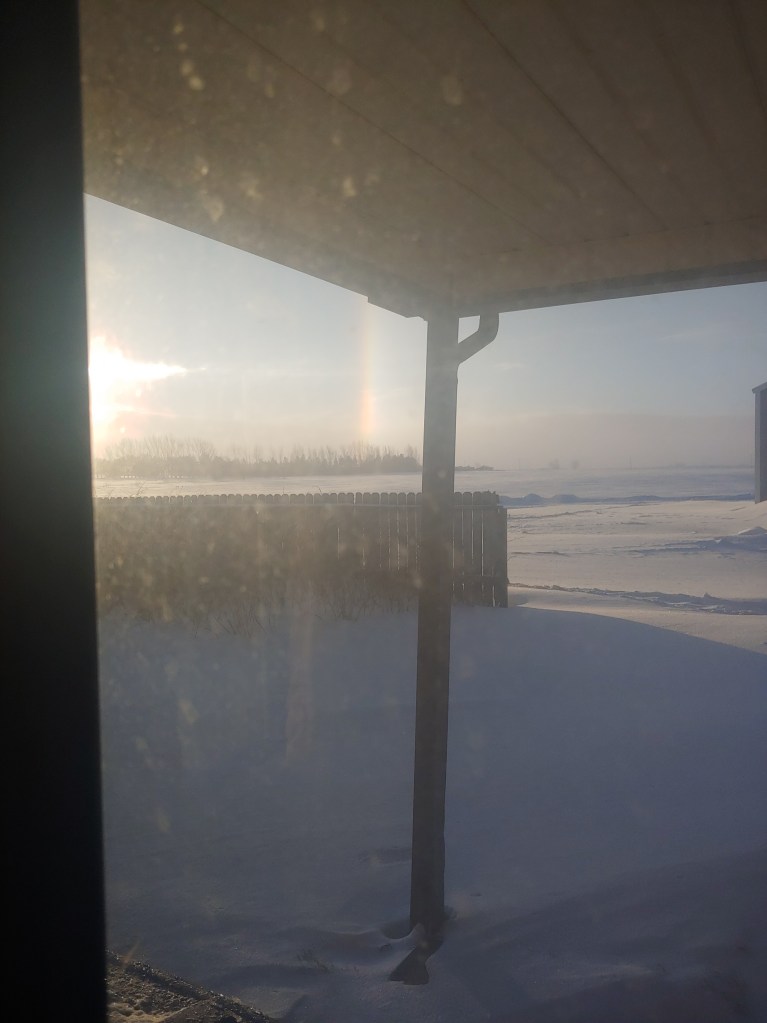
If you’ll notice, they are bending not inward but outward, which means that the bulk of the circle is above the earth.
Now technically, technically, the proximate cause of these rainbows was that there were a lot of ice crystals in the air on New Year’s morning. Someone sent me this picture, taken apparently before dawn, about an hour north of us:

So, yes, ice crystals.
But given that God is in control of all proximate causes, including atmospheric conditions, and given that atmospheric conditions do not always form a rainbow on New Year’s Day, I take this as a hopeful sign. From our house, the rainbow appeared to be stretching from the Shoshone-Bannock reservation north of Pocatello; over Pocatello; over the Snake River reservoir and several other small communities in our region. The rainbow was originally given as a promise to withhold a certain particular kind of judgement.
And God said, “This is the sign of the covenant that I make between me and you and every living creature that is with you, for all future generations (!): I have set my bow in the cloud, and it shall be a sign of the covenant between me and the earth. When I bring clouds over the earth and the bow is seen in the clouds, I will remember my covenant that is between me and you and every living creature of all flesh. And the waters shall never again become a flood to destroy all flesh. When the bow is set in the clouds, I will see it and remember the everlasting covenant between God and every living creature of all flesh that is on the earth.”
Genesis 9:12 – 16
Repetitive? You bet. God repeats important things.
So, thank you, Lord, for once again sending this sign. You know that our whole region desperately needs Your mercy, as does every region on the earth. I pray that You will continue to extend your mercy to Southeast Idaho in 2022, and in fact that You would pour it out more than ever before.
The Five Points of Calvinism Book Tag
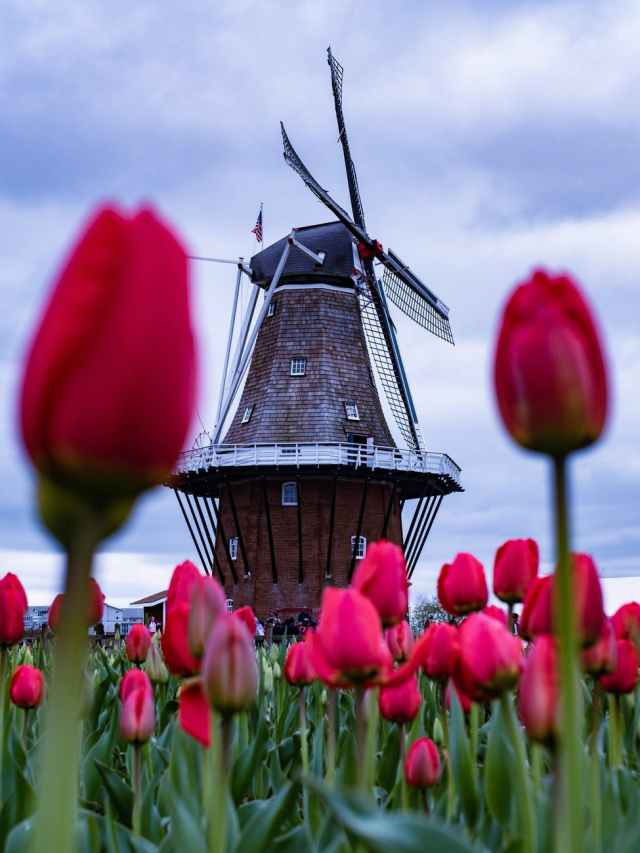
Back in 2017 (or, you might say, in “eternity past”), Bookstooge put up a request for a “serious” book tag. At that time, I did not even know that Bookstooge existed (hard as that is to imagine). But in the providence of God, I stumbled upon that forlorn request recently, and this is the result.
The Five Points of Calvinism
These five points are not all of Christian theology, or even all of Reformed theology. There is a lot more to it, and it’s all good stuff. These five topics are simply things that Jacob Arminius and his followers disputed in the early 1600s, after the Reformation was well under way and John Calvin had been writing for some time. All of this caused a huge kerfuffle in the Dutch Reformed churches, and eventually, in 1619, the Synod of Dort adopted the Canons of Dort which answered the Arminians’ objections point by point. So, though these five points are not the whole of Reformed theology, they do represent some of the doctrines that people are most likely to have issues with, as demonstrated by Arminius, his followers, and in fact most people down to this day.
Due to their Dutch character, the five points, if put in terms that are somewhat misleading, can be shoehorned into the acrostic TULIP:
T – Total Depravity
U – Unconditional Election
L – Limited Atonement
I – Irresistible Grace
P – Perseverance of the Saints
Because this is a tag, I’m not going to parse or defend these points deeply. I’ll just explain each one in a short paragraph, then apply it to a book tag purpose. Since these things deal with the nature of man and God, they turn out to be fruitful for reminding us of our literary experiences.
T – Total Depravity
Arminius taught that people are free in their will to choose God or reject him. The doctrine of total depravity (or “sin nature”) holds instead that people, if left to themselves, are spiritually dead and will never voluntarily seek God. (Dead people cannot choose things.)
Name a book or a series that you appreciate for its jaundiced or realistic portrayal of human nature.
U – Unconditional Election
Election means that God chooses to draw some people to Himself, making alive their hearts so that they are then able to seek, hear, and trust in Him. Arminians taught that God elects people for salvation in this way on the basis of some quality in them, such as humility, faith, “responding to the light they have,” etc. The doctrine of unconditional election holds that God does not choose people because they are better than other people. He chooses them just because He wants to.
Name a book where someone chooses someone else unconditionally.
L – Limited Atonement
The most confusing of the five points as far as I am concerned, Limited Atonement means that Christ’s death was actually just for “his people” – those God chose to elect – not for everyone generally. If it were for everyone generally, and some people rejected salvation, that would mean that God’s work in salvation was ineffective in some cases, which would throw the determining factor back onto the individual.
This point is confusing for two reasons: 1) Since we don’t know who is going to be saved, we are commanded to proclaim the good news to everyone as if they were all elect. 2) We know that the number of those who believe will be a very great number, enough that Christ can be said to have saved “the whole world.” So, “limited” does not mean a small number of people.
This is one of those fine distinctions that is kind of hard to squeeze down into a two-word phrase, which then fits into a flower acrostic.
Name a book that has a complex, confusing, or seemingly unworkable philosophy behind its worldbuilding.
I – Irresistible Grace
When God chooses someone, He works on their heart, giving them a new heart with a will that is now able to choose Him. This also frees their mind to be able to hear and understand His word (since, as we know, our intellect is embarrassingly tied up with our will). When this happens, they freely choose Him, now that their will has been freed from the sin that bound it. It is never the case that God gives someone a new heart, and they then reject Him. His grace is irresistible.
What book did you find irresistible?
P – Perseverance of the Saints
This doctrine means that once someone has been regenerated, heard God’s word, and begun to believe, they will not ultimately, or permanently, fall away. You cannot “lose your salvation.” This is a very comforting doctrine, for without it, we tend to panic every time we fall into sin (or have some previously unnoticed sin revealed to us that, unfortunately, has been with us all along).
Name one of your favorite redemption arcs in a book or movie.
Go and Read Some More!
I tag Bookstooge (hope this is serious enough for you, Booksty!), and Colin cause I know he digs Reformed theology. Anyone else can do it if they want to.
Misanthropic Quote of the Week, from a Cat
This is mad, thought Maurice as his listened to a story about wild woods and fresh bubbling streams, being read to one rat by another rat while they sat beside a drain … Everything’s going down the drain, and they have this little picture in their heads about how nice things could be …
The Amazing Maurice and His Educated Rodents, by Terry Pratchett, p. 175
Can’t … Stop … Posting … Isaiah
As a woman with child and about to give birth writhes and cries out in her pain,
so were we in your presence, O LORD.
We were with child, we writhed in pain,
but we gave birth to wind.
We have not brought salvation to the earth;
we have not given birth to people of the world.
But your dead will live; their bodies will rise.
You who dwell in the dust, wake up and shout for joy.
Your dew is like the dew of the morning;
the earth will give birth to her dead.
Go, my people, enter your rooms and shut the doors behind you;
hide yourselves for a little while until his wrath has passed by.
See, the LORD is coming out of his dwelling
to punish the people of the earth for their sins.
The earth will disclose the blood shed upon her;
she will conceal her slain no longer.
Isaiah 26:17 – 21
 Out of Babel Books