Excerpt from a Rabbit Myth

(Frith = the sun, whom the rabbits identify as the creator

El-ahrairah = the father of all rabbits)

So Frith said, “Then come out of that hole and I will bless you.”

“No, I cannot,” said El-ahrairah, “I am busy. The fox and the weasel are coming. If you want to bless me you can bless my bottom, for it is sticking out of the hole.”

Then Frith felt himself in friendship with El-ahrairah, who would not give up even when he thought the fox and the weasel were coming. And he said, “Very well, I will bless your bottom as it sticks out of the hole. Bottom, be strength and warning and speed forever and save the life of your master. Be it so!”

And as he spoke, El-ahrairah’s tail grew shining white and flashed like a star: and his back legs grew long and powerful and he thumped the hillside until the very beetles fell off the grass stems. He came out of the hole and tore across the hill faster than any creature in the world. And Frith called after him,

“El-ahrairah, your people cannot rule the world, for I will not have it so. All the world will be your enemy, Prince with a Thousand Enemies, and whenever they catch you, they will kill you. But first they must catch you, digger, listener, runner, prince with the swift warning. Be cunning and full of tricks and your people shall never be destroyed.”

Watership Down, by Richard Adams, pp. 36 – 37

Isaiah Quote of the Week

See, the Lord, the LORD Almighty, will lop off the boughs with great power.

The lofty trees will be felled, the tall ones will be brought low.

He will cut down the forest thickets with an ax;

Lebanon will fall before the Mighty One.

A shoot will come up from the stump of Jesse;

from his roots a branch will bear fruit.

The spirit of the LORD will rest upon him —

the spirit of wisdom and of understanding,

the spirit of counsel and of power,

the spirit of knowledge and of the fear of the LORD —

and he will delight in the fear of the LORD.

He will not judge by what he sees with his eyes,

or decide by what he hears with his ears;

but with righteousness he will judge the needy,

with justice he will give decisions for the poor of the earth.

He will strike the earth with the rod of his mouth;

with the breath of his lips he will slay the wicked.

Righteousness will be his belt and faithfulness the sash around his waist.

The wolf will live with the lamb,

the leopard will lie down with the goat;

the calf and the lion and the yearling together;

and a little child will lead them.

The cow will feed with the bear,

their young will lie down together,

and the lion will eat straw like the ox.

The infant will play near the hole of the cobra,

and the young child put his hand into the viper’s nest.

They will neither harm nor destroy on all my holy mountain,

for the earth will be full of the knowledge of the LORD

as the waters cover the sea.

Isaiah 10:33 – 11:9

Cortes and the Aztec Conquest

Photo by NEOSiAM 2020 on Pexels.com

by Irwin R. Blacker, 1965. A book review.

I picked this book up from our local library. “Oh, I only know the outlines of this period of history. I need to know more.” Then I let it sit around for several weeks. As a history book, it is probably boring, right?

Wrong.

Honestly, I would not put any of this stuff in a novel, because no one would believe it. In the first few chapters, at least once per chapter there was an “I can’t believe that just happened” moment. In the second half of the book, there is such a moment every one or two pages.

This book doesn’t pick heroes or villains. It’s a fairly simple, straightforward account of what happened, from Cortez sailing from Cuba, until the fall of Tenochtitlan. Also, perhaps because this book was published in 1965, it does not go in for the excessively dry, boring writing that academic history sometimes strives for. The writing is matter-of-fact, not sensationalist, and moves along quickly.

History is Full of Surprises

I went in to this with certain pre-conceptions. The general impression I had received from my previous exposure to this topic was that Cortez was awful, and the Aztecs were awful, and they deserved each other. I expected to read a story populated by a bunch of scoundrels, and that was what I got. However, as the book progressed I found myself more and more sympathizing with Cortez, because he is the underdog for literally the entire book. (The harsh ruling and enslaving the Indians stuff came later.) In every battle (not just with the Aztecs, but with the Tabascans, and then the Tlaxcalans), he is outnumbered tens of thousands to hundreds. Many of the I can’t believe this moments were caused by How did the Spaniards not die? and by watching Indian lords and generals snatch defeat from the jaws of victory.

Here are a few of the things that surprised me, and might surprise you too:

  • Though the Spaniards had a very early version of a gun (the harquebus), a few light cannon designed for ships, and a handful of horses, these things did not allow them to just roll in and conquer Mexico through overwhelming force of technology. They had only about 16 guns and horses, and about the same number of cannons. The horses were surprising at first to the Indians, but they did lose their shock value. The horses and cannons were difficult to transport through the swamps and mountains, and in every battle, as I said, the Spaniards were outnumbered about 100 to 1. The Mexican armor, which was made of padded and starched cotton, was almost as effective as the Spanish armor, and much lighter and cooler. The Aztecs and the other groups were experienced, hardened warriors.
  • With literally every people group Cortez encountered (whether they were allied with Montezuma or not), Cortez initially tried to parley and trade, and they insisted on going to battle. This is not to say that Cortez was there only to trade, merely that this, his opening move, never got past the first step. As he progresses through Mexico toward Tenochtitlan, we see him again and again forced into battles. Finally, after he defeats the very persistent Tlaxcalan Indians, they ask him to ally with them against Montezuma.
  • As per human nature, both sides were internally divided. The Tlaxcalan army, which had been holding out for years against Montezuma, lost to Cortez because their military captains would not co-operate with each other. Cortez, meanwhile, had left on his expedition without the approval of Velasquez, the governor of Cuba. He had some of Velasquez’s relatives in his fighting force, and had to worry about them fomenting mutiny. At one point, he had to leave Tenochtitlan and go fight a battle against an army representing Velasquez that had landed on the coast. With constantly shifting alliances among both the Spaniards and the Indians, this book read like a spy novel.
  • Cortez did not immediately attack Tenochtitlan, Montezuma’s capital city. He first approached as a visitor, and there was a weird period of several weeks when the Spaniards stayed there as guests? Or prisoners? Montezuma, for his part, was divided in his mind. He was not as confident in his role as priest as he had been in his youth, as a warrior. He wasn’t sure what his gods wanted him to do. Thus, he kept giving Cortez evasive answers, but also ended up giving Cortez much more leeway than he should have. He missed many good opportunities to have the Spaniard killed.
  • The great city of Tenochtitlan makes an amazingly interesting setting for a battle. It was built out over the middle of a shallow, salt lake (deep enough to drown in, however), and was approached from other lakeside cities by four long causeways, each of which had bridges that could be taken up, leaving wide gaps that were impassable for an attacking or fleeing force. These tiled causeways were also slippery and disorienting for horses, and anyone caught on them could be attacked by war canoes. Inside the city, the sections were divided by canals which could also be used to seal off the different sections of the city. There were high rooftops, leading up to the temple at the top, from which defenders could spot approaching or fleeing attackers, rain down missiles, and sound the alarm with conch shells and drums.
  • When the Spaniards finally did destroy Tenochtitlan, it was their Tlaxcalan allies who wanted to commit atrocities on the civilians there. “The Spaniards were too few to control their allies” (page 142).
  • Cortez was accompanied throughout by a young woman whom the Spaniards called Dona Marina. “She was a young, highly intelligent princess who had been sold into slavery by her parents” (page 34) and given to Cortez by the Tabascans after he defeated them. Dona Marina spoke both coastal Mayan and Nahuatl (the Aztec language), and she served as an interpreter. Amazingly, Dona Marina survived the entire conquest.

A True First-Contact Story

For me, the overall impression is that what we have here is the meeting of an Ancient Near Eastern style culture, with city-states, bureaucracies, temples, human sacrifice, and a tyrannical priest-king, with a late medieval/early exploration-age Western European culture. This could not be a purer first contact story if Cortez had gotten hold of a time machine and attempted to loot Babylon.

I would recommend this book to anyone who is interested in military history.

“Our gods are good”

Taking almost all his men and horses, Cortes rode out to meet his host at the great temple. When the Spaniards arrived, Montezuma was at the top of the temple making human sacrifices. Several Aztecs came forward to help Cortes to the top, but the Spanish captain general brushed them aside and mounted the 114 steps unaided.

At the top of the temple, Cortes and his companions were horrified to find the Aztec idols spattered with flesh and blood. The whole place reeked, and on the floor there was more blood, encrusted and black. Shocked and repelled by what he saw, Cortes tried to explain to the emperor-priest that these idols were no more than devils and that the sacrifice of humans was blasphemous.

The mighty Aztec, injured by the Spaniard’s remarks, said that his gods were good and that he regretted having allowed the Spaniards to visit the temple at all. Seeing that his host was angry, Cortes quickly made overtures to pacify the emperor and then departed.

Cortes and the Aztec Conquest, by Irwin R. Blacker, p. 68

Links? Nope, Isaiah

Photo by Rahul on Pexels.com

Hi all! So, cool as they are, I’m a little tired of posting links to archaeology-related articles. So, for the month of Advent, I’ll be posting quotes on Wednesday from an actual ancient document: the Book of Isaiah. That’s right, we are going to have double quotes for the next few weeks.

“Isaiah wrote during the stormy period marking the expansion of the Assyrian empire and the decline of Israel (late 700s B.C.). Although the fall of Jerusalem would not take place until 586 B.C., Isaiah assumes the demise of Judah and proceeds to predict the restoration of the people from captivity. Isaiah predicts the rise of Cyrus the Persian, who would unite the Medes and Persians and conquer Babylon in 539. The decree of Cyrus would allow the Jews to return home in 538, a deliverance that prefigured the greater salvation from sin through Christ.” (my NIV study Bible, p. 1008)

The book of Isaiah sees a lot of traffic around Christmas time, and you will soon see why.

The LORD spoke to me with his strong hand upon me, warning me not to follow the way of this people. He said:

‘Do not call conspiracy everything that these people call conspiracy;/do not fear what they fear, and do not dread it./The LORD Almighty is the one you are to regard as holy,/he is the one you are to fear,/he is the one you are to dread,/and he will be a sanctuary,/but for both houses of Israel he will be/a stone that causes men to stumble/and a rock that makes them fall./And for the people of Jerusalem he will be/a trap and a snare.’

I will wait for the Lord, who is hiding his face from the house of Jacob./I will put my trust in him.

Isaiah 8:11 – 14, 17

Theology Friday

I just finished reading the book of Job. Again. I swear, it is so amazing. Here’s what G.K. Chesterton had to say about it:

The Jews were unpopular … [but] … They had one of the colossal corner-stones of the world: the Book of Job. It obviously stands over against the Iliad and the Greek tragedies; and even more than they it was an early meeting and parting of poetry and philosophy in the morning of the world. … But this mighty monotheistic poem remained unremarked by the whole world of antiquity … It is a sign of the way in which the Jews stood apart and kept their tradition unshaken and unshared, that they should have kept a thing like the Book of Job out of the whole intellectual world of antiquity. It is as if the Egyptians had modestly concealed the Great Pyramid.

G.K. Chesterton, The Everlasting Man, chapter IV: ‘God and Comparative Religion’

Job is Not Just About One Thing

So what makes the book of Job so great? There are so many things, and there is so much going on in it. This makes it kind of difficult to follow, especially on a first reading, especially if you are looking for one overarching theme that is easily discovered. Everybody has their say in Job, and the reader just kind of has to go along for the ride.

And, continuing with the perhaps rather inappropriate metaphor of a long, twisty water-slide, everybody talks about the big waterfall at the end, but maybe this time you almost drowned in the innocent-looking swirly pool, or you thought you were going to tip off when going around that one curve right at the top. Different parts of the book of Job jump-scare you on each separate ride through it.

So what jump-scared me this time?

On Being Gaslighted

Being gaslighted puts people in a terrible spot really. It might not bother a sociopath, because such a person does not have any self-doubt, any respect for the opinions of others, or any sense that it is wise to consider the possibility that we may be wrong. But for a person with a modicum of humility and self-awareness, the natural response to being gaslighted is to turn the spotlight inward and ask yourself, “Am I in fact wrong?”

Then, when careful examination assures you that you are not mistaken, yet the gaslighter is still insisting that you are, you have to betray one of two moral values. You have to either stand up for your own perspective, thus betraying the principle of humble and prudent self-doubt, or you have to betray the idea of truth. The longer the gaslighting goes on, the more frustrating this pinch becomes.

As surely as God lives, who has denied me justice,

the Almighty, who has made me taste bitterness of soul,

as long as I have life within me,

the breath of God in my nostrils,

my lips will not speak wickedness,

and my tongue will utter no deceit.

I will never admit that you are in the right;

till I die, I will not deny my integrity.

I will maintain my righteousness and never let go of it;

my conscience will not reproach me as long as I live.

Job 27:2 – 6

Now, despite the words “righteousness” and “conscience” here, I do not think that Job is making an arrogant claim to be currently sinless and never going to sin as long as he lives. In other verses, he has shown that he is aware he is sinful. For example, in 13:26 he addresses God, “You write down bitter things against me and make me inherit the sins of my youth.” In 14:16 – 17 he says, “Surely then You will count my steps but not keep track of my sin. My offenses will be sealed up in a bag; you will cover over my sin.” He is aware that “no one living can be righteous before God,” and he portrays God as watching him every moment, waiting for him to make a misstep (10:13 – 14), which is technically within God’s rights but, as Job points out, no one can withstand.

In other passages, Job indicates that if his friends were to rightly point out something that he had done wrong, he would submit to it. But what he’s not willing to do is allow them to accuse him of a bunch of things he knows he has not done: oppressing the poor, living a careless, selfish life, defying God, etc., etc. This has not been Job’s lifestyle, and he knows it.

So I think that when Job uses the word integrity in the passage above, he is talking about epistemology. He will not deny his integrity by “admitting they are right,” not because he’s an arrogant blowhard who won’t take correction, but because he has done self-examination — a lot of it — and the things they are saying are just not true. It might be easier in some ways to just go ahead and “admit” to all the things his friends are accusing him of, but that would be to throw out his entire epistemology, which includes the assumption that certain things are true, and that Job is capable of perceiving and remembering them. Giving up the epistemological point that truth is discoverable and that Job is not delusional, would be to betray his integrity. I believe that in the lines below, he is using “righteousness” and “conscience” as synonyms for “integrity” in the sense of epistemological integrity. I believe that in the lines above, when he says he will “speak no wickedness” and “utter no deceit,” he is saying he will not give up on his idea of the truth being a real thing and his own mind being a reliable guide to it, which he would be doing if he were to agree with all that his friends have been saying about him.

Obviously, admitting you are wrong is not a betrayal of the value of truth in every case. In many cases, valuing truth can lead us to admit we are wrong. But Job has examined their claims for 24 chapters now, and he has realized he is being gaslighted. He even realizes that, following their logic, his not being an evil oppressor creates a logical inconsistency with the idea that God is just. He is willing to take the puzzle rather than deny what he knows to be true. He is also not worried about looking like an arrogant blowhard. They have already called him that and worse. He’s just not willing to give up this last shred of dignity, that he knows what his lifestyle has been like and it has not been one of habitual wickedness.

I’ll let you make your own applications of all of this. The words of Jen are ended.

The 1600s: A Fun Century to Illustrate

Pilgrim’s family climb over the stile to call him back. From Dangerous Journey.

This is why I love home schooling. I learn so much.

I can’t say the 1600s (also known as the Seventeenth Century) were covered very well in my own education. I heard, dimly, of one or two events, like the First Thanksgiving and the Salem Witch Trials (which took place near the end of the century, 1692). I was exposed to a kids’ version of Pilgrim’s Progress. In other contexts, unconnected from history lessons, I heard the names of a few notables from the century such as Bach, and saw a picture of a Cavalier or two. But all these things were floating around without any context. I had no idea of how they were connected to each other, or even that they were happening around the same time. They were, frankly, all mixed up with things from the following century.

Now [this post written in 2019], studying it in chronological order with my kids, I have to say that I like learning about the 1600s. A lot of really horrible things happened, like the beginnings of colonization and of the Atlantic slave trade. But many really interesting things were happening too. Some of them, like the English Civil War, I had barely heard of. Also, this was an amazing century for music and art.

And the clothes. My goodness, the clothes! Long curly wigs, big white collars, hundreds of buttons! They must have been so inconvenient to wear (and to wash. Especially in brackish water. After you’d been on the Mayflower and hadn’t washed for three months). But they look so cool, so dignified, in illustrations! And there is the contrast between the colorful, swashbuckling Cavalier look and the restrained, clean-lined, monochromatic Puritan Sunday best.

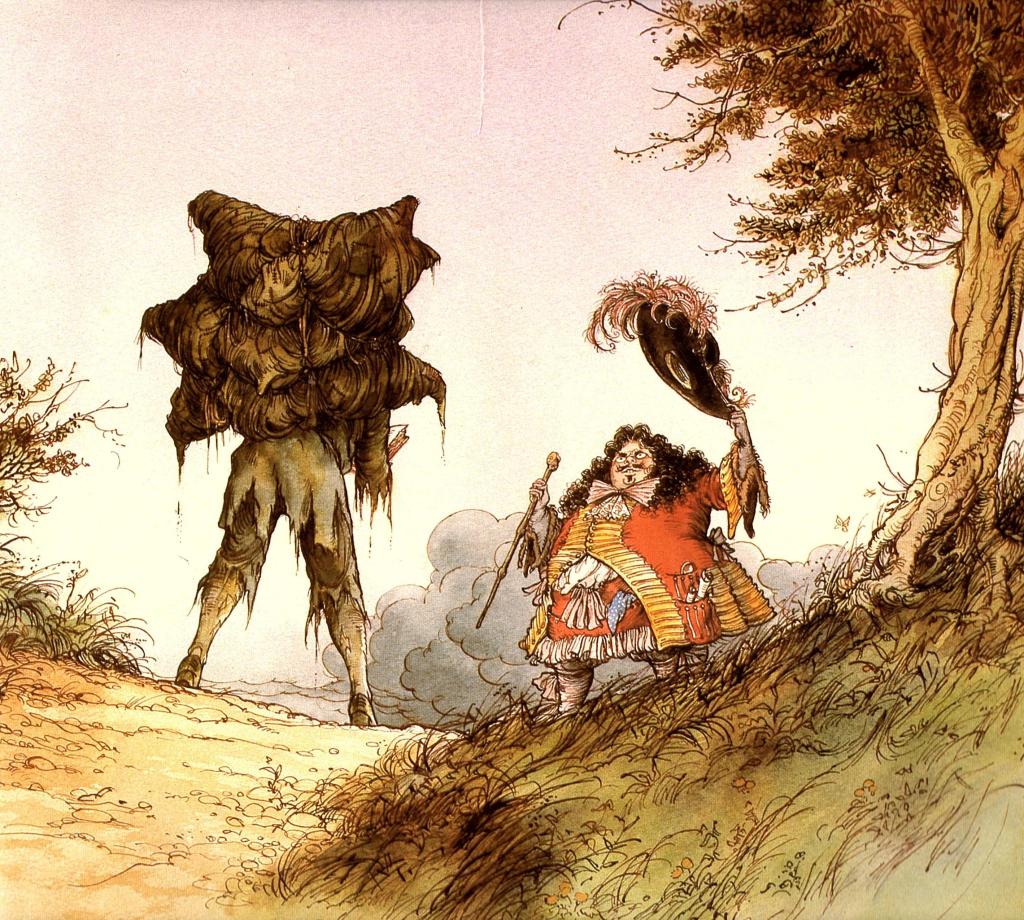
The pictures in this post are taken from Alan Parry’s 1985 illustrations of Pilgrim’s Progress in the children’s book Dangerous Journey. I love the 17th-century clothing and the way that the illustrations suggest etchings, which were being done in the 17th century by the likes of Rembrandt.

Pilgrim, still wearing the burden on his back, meets Mr. Worldly Wise.

A few highlights of the 17th Century:

  • The founding of Jamestown, Virginia (1607). Jamestown was first run along communist lines, and it was a disaster. In order to get the ne’er-do-wells there to actually build a fort, grow their own food, etc., they needed John Smith to whip them into shape, plus a boatload of mail-order brides (really!), plus allowing private property.
  • The founding of Plymouth, Massachusetts (1620). Interestingly, the Massachusetts colony also tried communism. Their contract with the London Company stipulated that for seven years, the products of the colony were to be put in a common fund to be shared by all the colonists. But after only three years they had to stop this arrangement and give each family their own plot of farm land.
  • The English Civil War (1642 – 1651). Cavaliers (Royalists) vs. Roundheads (Parliamentarians). The English got rid of their tyrant (Charles I), only to have him replaced by an ideologue (Oliver Cromwell). When Cromwell died, they were relieved to go back to just a regular tyrant (Charles II).
  • John Bunyan (1628 – 1688). Bunyan was a traveling tinker, yet he wrote one of the world’s top best sellers, Pilgrim’s Progress. He also wrote his spiritual autobiography, Grace Abounding to the Chief of Sinners. (Is that a great title for an autobiography, or what?)
  • The Great Fire of London (1666). It burned for three days. Four-fifths of London burned down. “Hundreds of people fled to St. Paul’s Cathedral. But the flames swept up the walls, burning timbers and melting the lead in the roof until it ran down toward the river like molten lava. The stones in the walls themselves began to explode from the heat!” (Wise Bauer 126).
  • Rembrandt van Rijn (1606 – 1669). Art!
  • Vivaldi (1678 – 1741), Bach (1685 – 1750), and Handel (1685 – 1759). I might be sort of cheating, including Bach and Handel in this century, since they were only 15 when it closed. But both these geniuses were born and educated during the 1600s.

Sources

Bauer, Susan Wise. The Story of the World: History for the Classical Child, vol. 3: Early Modern Times: from Elizabeth the First to the Forty-Niners. Well-Trained Mind Press, 2004.

Demar, Gary, et. al. Building a City on a Hill. American Vision, 1997, 2005.

Hannula, Richard. Trial and Triumph: Stories from Church History. Canon Press, 1999. “Chapter 30: John Bunyan,” p. 181 ff.

Hunkin, Oliver, ed., & Alan Parry, illustrator. Dangerous Journey. Text copyright 1985 Yorkshire Television Ltd.. Worldwide coedition by Lion Hudson plc, Mayfield House, Oxford. US edition by Eerdmans, Grand Rapids, MI, 2012.

Stebbing, Barry. God & the History of Art I. How Great Thou ART Publications. “Rembrandt van Rijn: A Man of Sorrows,” p. 65 ff.