
Listen to me talk Reformed Theology with the author of The Resolve of Immortal Flesh, for two hours.
NW Reads a How-To Book

This book, the first in the Crossroads trilogy, takes place 850,000 years ago. I read it because it’s in my genre (sort of), and we indie authors writing about super-ancient times gotta stick together.
In my persona as a cave woman, I was hoping to pick up some tips on raw survival. One main strategy employed by Xhosa’s tribe seems to be Running Away. Me approve, as I am a master at this and so are the characters in my own books.
In Survival of the Fittest, Xhosa and her tribe travel from somewhere in the interior of Africa, north, crossing the Great Rift Valley and then (I think?) the Red Sea, or whatever that used to be 848,000 years ago. Once in the Levant (the Arabian Peninsula? Or did such exist back then?), they meet up with another tribe that is already successfully living there, plus a pair of young misfits, accompanied by their pet wolf, who have come all the way from what is now China.
The book moves fast, covering a lot of territory, both literally and metaphorically. It never really took off for me. There were lots of different episodes, each of which could easily have been its own book. The narrative moved back and forth between different groups quite a bit. With Big Idea novels like this one (and like my own books), the reader has to be at least intrigued by the theory of history that the author is exploring, so perhaps my problem was that this element was missing for me.
Another thing that harmed the verisimilitude for me was what appeared to be inconsistencies in the language. On the one hand, the characters don’t have enough abstract thought to count other than saying, “One, another, another …” On the other hand, they can describe to one another things that the hearer has never seen, such as the sea. They call the Cro-Magnon people Big Heads (which seems fair enough), but occasionally they will talk about things using modern terms, like Lucy (yes, the Lucy) or “tsunami,” which seems like an anachronism to this linguist. To be fair, any time we are writing about people in an ancient time, we are writing in translation, so the modern writer has to decide when to use a “free translation” (using words that modern readers will recognize) and when to use more literal glosses on the characters’ vocabulary, which gives a more atmospheric feel but is also harder for the reader to understand.
However, the author does lay some land mines that I presume will be stepped on in the next book, notably the obvious danger posed by Xhosa’s ambitious head warrior, Nightshade. If you believe that people evolved about a million years ago, started out not wearing clothes or counting past one, and you’re fascinated by what life might have been like during that time, then this series is for you.
There are lot of notes about terminology and the different humanoid groups at the beginning, which were helpful, but one thing I really, really wanted was a map. I tried to picture the characters’ routes, and I was checking modern maps of Africa, but realizing that the land has probably changed a lot since the time this book is set. I wanted to know exactly where they crossed the Great Rift Valley (which is pretty large, after all); what body of water they were crossing; and exactly where in the Levant they ended up. If there had been a map at the beginning of the book, I would have been flipping back and forth to that puppy every few pages, and perhaps would have been more engrossed in the story.
Quote of the Week: When You’re Home Schooling, the Fun Never Stops
What do chemists do when they have a gas they don’t know anything about?
Science in the Atomic Age, by Dr. Jay L. Wile, p. 48
You can imagine the jokes.
Falkland Islands Inhabited 1,000 Years Ago
The people were apparently called the Yaghan, and they “kept foxes as companions.” More precisely, it was the warrah, a.k.a. the Falkland Islands wolf.
Somebody write this novel.
Knitted Stuff: Ponchos
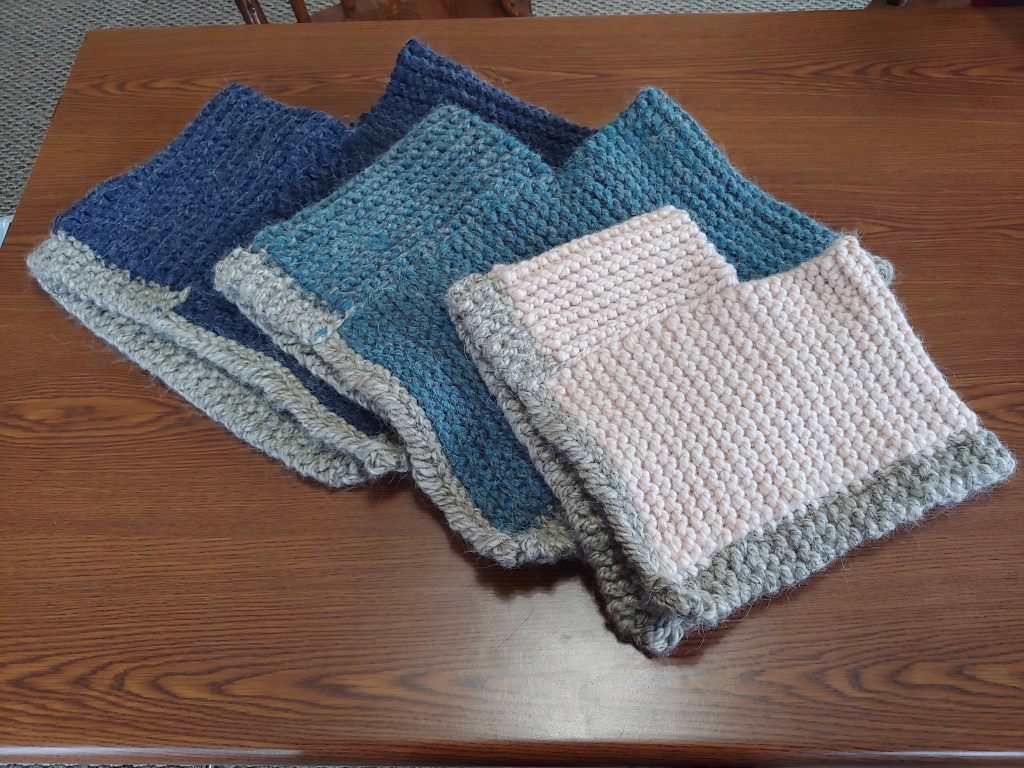
My knitting is not to be compared to some of my fellow knitting/book bloggers, like BookWyrmKnits. The stuff she posts is just jaw-dropping.
This knitting project, on the other hand, is about the easiest gift you can make for a little girl (or three) if you just have basic knitting skills. For each poncho, I simply knit two identical rectangles, then sewed them together in the poncho shape. I used super-chunky yarn, large needles, and cast on 25 stitches for the larger ponchos (which fit a school-aged child) and 20 stitches for the smaller poncho (which I hope will be the right size for a preschooler). They are in garter stitch, which means I knit on the right side and the wrong side, instead of purling on the wrong side, which would have produced stocking stitch. The only thing I did that was slightly challenging was to use a different color of yarn for the border.
Ponchos are pretty forgiving (no tailoring), and if you have mastered the mechanics of knitting well enough to make a scarf, then you can also knit a poncho. You can add tassels to the corners (or the entire edge) using a crochet hook, but for this project, I didn’t feel the need.
Knitting Project: Mongolian-Style Hat
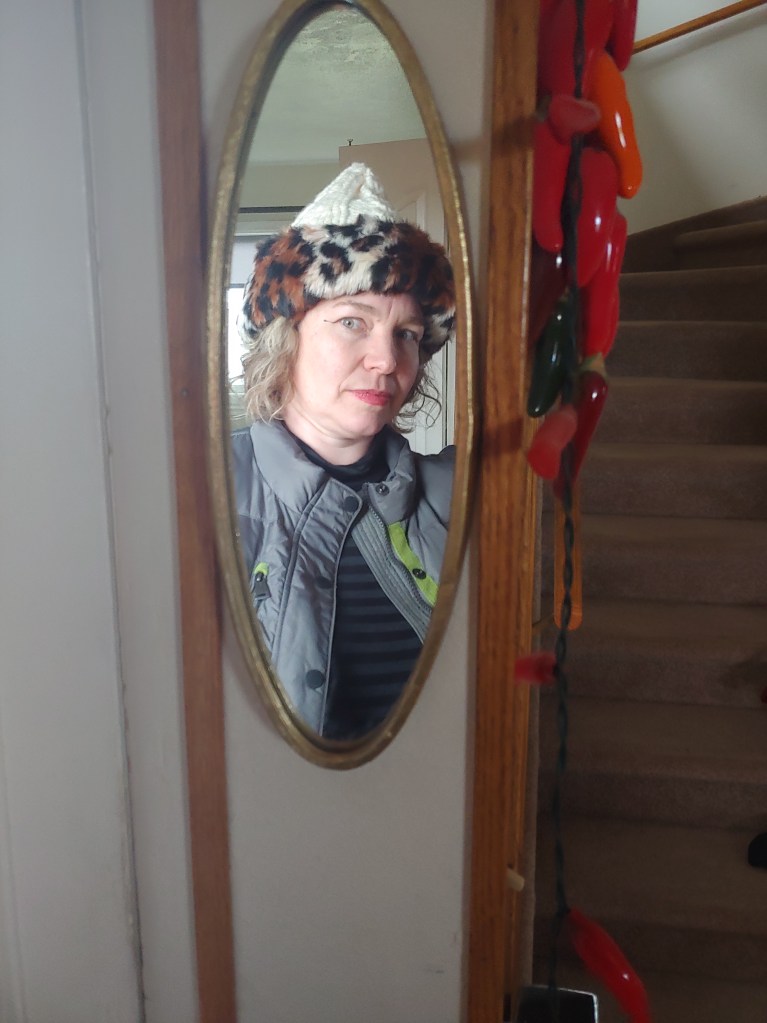
So, I’m going a little crazy with the animal print this winter.
I had so much left over after making my cave-woman costume. Counting the costume, handbag, and now this, I have done three projects with the same “fur.”
I wanted a hat that would feature this animal print, and would feature a knit using cream-colored yarn. When I started imagining the hat, I pictured it with a slight point on top, probably owing to all that time I had spent on Pinterest looking at pictures of traditional Mongolian, Tibetan, and Scythian costumes.
For this hat, I started with a basic ribbed beanie pattern, casting on 72 stitches. I worked 4 inches of 1×1 rib, then switched to a cable pattern for a few more inches. Then I started doing regular decreases, adapted from a pointy elf hat pattern. When finished, I sewed the fake fur to the underside of the four inches of ribbing. You turn up the brim to reveal the fur.
And here I am, standing in a chilly, windy, high-altitude place that is not so different environmentally from Mongolia. To look really authentic, I’d need long black braids coming out from the under the hat to complete the picture.
My whole life is about crushing on different ancient cultures, making costumes inspired by them, and then writing novels so you, too, can visit. You’re welcome.
Highly Autumnal Quote of the Week
The moon is coming up behind the aspens. It is as big as a pumpkin and as orange. The winds are cool, the stars are like electric light bulbs. I am just inside the doorway, with my turtle-shell lamp burning so that I can see to write this.
Something is moving beyond the second hemlock. [My hawk] Frightful is very alert, as if there are things moving all around us. Halloween was over at midnight last night, but for us it is just beginning. That’s how I feel, anyhow …
My Side of the Mountain, by Jean Craighead George, p. 97
More about Ancient Mesoamerican Urbanism
We knew about the Olmec and Maya, but their sites were hard to spot and hard to study because of the jungle. Now, we keep learning more and more.
A train project on the Yucatan Peninsula is uncovering hundreds of Mayan settlements, proving that the area was more densely populated than once thought, as archaeologists have been beginning to suspect.
Meanwhile, Lidar technology is able to peer through the jungle and reveal not only more and more ceremonial sites stretching over the Olmec and Mayan culture areas, but also common layouts that seem to indicate a broad shared cultural (or at least, architectural) tradition dating back to 3,400 years ago.
It looks to me like what we have here is a Central American version of the Sumerian urban/bureaucratic/temple-based civilization, giving rise to a series of civilizations that followed the same model: Akkadian, then Babylonian, and so on. And, if we believe the 3,400 YA date, the same thing in Central America was happening at almost the same time. It’s almost as if people tend to set up hierarchical city-states with temples wherever they settle, almost as soon as they settle there, whenever circumstances permit. Almost as if they were dispersing, and remembering something.
The OOB Research Team Strikes Again
Yes, Out of Babel when shortened is OOB. Is that appropriate or what?
Here’s a video sent to me by the Research Team. Philosopher William Lane Craig agrees with me about Neanderthals.
Two Book Signing Events

The Strange Land came out this spring. It features bears, and a people group hunting and gathering their way to the chilly Land Bridge. Hence this marble bear lying on some fur.
Now, you can get The Strange Land signed — or buy a copy from me personally — if you can make it to Utah on the second weekend in December.
I will be having a book sale/signing at Eborn Books in the New Gate Mall in Odgen on Friday, Dec. 10. (I’ll be selling copies of The Long Guest, too.) The address is:
Eborn Books – New Gate Mall Ogden
3651 Wall Avenue
Ogden, Utah 84405
time: early to late afternoon (starting about 1 p.m.? Maybe? Details still being hammered out)
and the location looks something like this:

Besides my books, they have a wonderful selection of used sci-fi and fantasy; and, as you can see, children’s books.
On Saturday, Dec. 11, 2021, I’ll have a signing/sale at another Eborn books location:
Eborn Books – Layton Hills Mall
1201 N Hill Field Rd
Level 1, #1052 (Next to JC Penny)
Layton, UT 84041
time: morning, so I can get back home that evening

If you live anywhere nearby – or find yourself traveling to Utah for some Christmastime skiing or anything like that – bring your friends! I’d love to see you!

Here are the books I’ll be bringing to sell! I’m so excited! Especially since prices are going to go up starting November 5.
 Out of Babel Books