The 1600s: A Fun Century to Illustrate

Pilgrim’s family climb over the stile to call him back. From Dangerous Journey.

This is why I love home schooling. I learn so much.

I can’t say the 1600s (also known as the Seventeenth Century) were covered very well in my own education. I heard, dimly, of one or two events, like the First Thanksgiving and the Salem Witch Trials (which took place near the end of the century, 1692). I was exposed to a kids’ version of Pilgrim’s Progress. In other contexts, unconnected from history lessons, I heard the names of a few notables from the century such as Bach, and saw a picture of a Cavalier or two. But all these things were floating around without any context. I had no idea of how they were connected to each other, or even that they were happening around the same time. They were, frankly, all mixed up with things from the following century.

Now [this post written in 2019], studying it in chronological order with my kids, I have to say that I like learning about the 1600s. A lot of really horrible things happened, like the beginnings of colonization and of the Atlantic slave trade. But many really interesting things were happening too. Some of them, like the English Civil War, I had barely heard of. Also, this was an amazing century for music and art.

And the clothes. My goodness, the clothes! Long curly wigs, big white collars, hundreds of buttons! They must have been so inconvenient to wear (and to wash. Especially in brackish water. After you’d been on the Mayflower and hadn’t washed for three months). But they look so cool, so dignified, in illustrations! And there is the contrast between the colorful, swashbuckling Cavalier look and the restrained, clean-lined, monochromatic Puritan Sunday best.

The pictures in this post are taken from Alan Parry’s 1985 illustrations of Pilgrim’s Progress in the children’s book Dangerous Journey. I love the 17th-century clothing and the way that the illustrations suggest etchings, which were being done in the 17th century by the likes of Rembrandt.
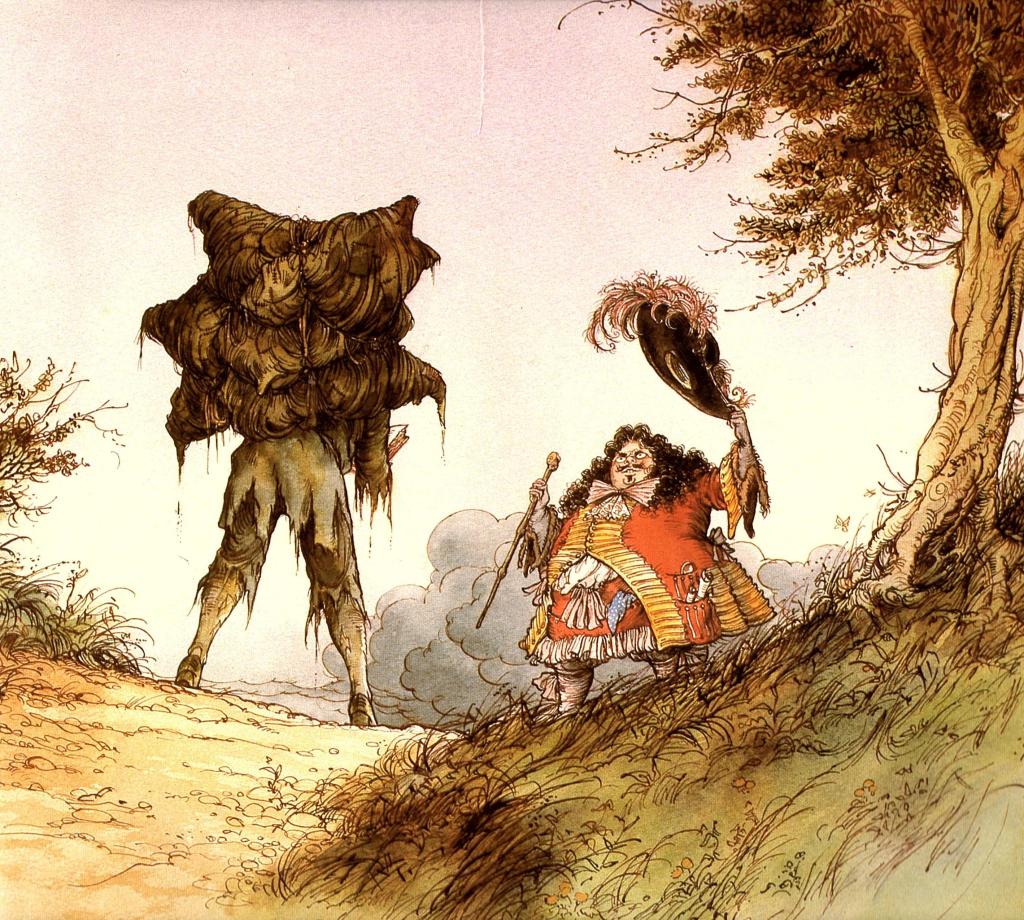
Pilgrim, still wearing the burden on his back, meets Mr. Worldly Wise.

A few highlights of the 17th Century:

  • The founding of Jamestown, Virginia (1607). Jamestown was first run along communist lines, and it was a disaster. In order to get the ne’er-do-wells there to actually build a fort, grow their own food, etc., they needed John Smith to whip them into shape, plus a boatload of mail-order brides (really!), plus allowing private property.
  • The founding of Plymouth, Massachusetts (1620). Interestingly, the Massachusetts colony also tried communism. Their contract with the London Company stipulated that for seven years, the products of the colony were to be put in a common fund to be shared by all the colonists. But after only three years they had to stop this arrangement and give each family their own plot of farm land.
  • The English Civil War (1642 – 1651). Cavaliers (Royalists) vs. Roundheads (Parliamentarians). The English got rid of their tyrant (Charles I), only to have him replaced by an ideologue (Oliver Cromwell). When Cromwell died, they were relieved to go back to just a regular tyrant (Charles II).
  • John Bunyan (1628 – 1688). Bunyan was a traveling tinker, yet he wrote one of the world’s top best sellers, Pilgrim’s Progress. He also wrote his spiritual autobiography, Grace Abounding to the Chief of Sinners. (Is that a great title for an autobiography, or what?)
  • The Great Fire of London (1666). It burned for three days. Four-fifths of London burned down. “Hundreds of people fled to St. Paul’s Cathedral. But the flames swept up the walls, burning timbers and melting the lead in the roof until it ran down toward the river like molten lava. The stones in the walls themselves began to explode from the heat!” (Wise Bauer 126).
  • Rembrandt van Rijn (1606 – 1669). Art!
  • Vivaldi (1678 – 1741), Bach (1685 – 1750), and Handel (1685 – 1759). I might be sort of cheating, including Bach and Handel in this century, since they were only 15 when it closed. But both these geniuses were born and educated during the 1600s.

Sources

Bauer, Susan Wise. The Story of the World: History for the Classical Child, vol. 3: Early Modern Times: from Elizabeth the First to the Forty-Niners. Well-Trained Mind Press, 2004.

Demar, Gary, et. al. Building a City on a Hill. American Vision, 1997, 2005.

Hannula, Richard. Trial and Triumph: Stories from Church History. Canon Press, 1999. “Chapter 30: John Bunyan,” p. 181 ff.

Hunkin, Oliver, ed., & Alan Parry, illustrator. Dangerous Journey. Text copyright 1985 Yorkshire Television Ltd.. Worldwide coedition by Lion Hudson plc, Mayfield House, Oxford. US edition by Eerdmans, Grand Rapids, MI, 2012.

Stebbing, Barry. God & the History of Art I. How Great Thou ART Publications. “Rembrandt van Rijn: A Man of Sorrows,” p. 65 ff.

NW Reads a How-To Book

This book, the first in the Crossroads trilogy, takes place 850,000 years ago. I read it because it’s in my genre (sort of), and we indie authors writing about super-ancient times gotta stick together.

In my persona as a cave woman, I was hoping to pick up some tips on raw survival. One main strategy employed by Xhosa’s tribe seems to be Running Away. Me approve, as I am a master at this and so are the characters in my own books.

In Survival of the Fittest, Xhosa and her tribe travel from somewhere in the interior of Africa, north, crossing the Great Rift Valley and then (I think?) the Red Sea, or whatever that used to be 848,000 years ago. Once in the Levant (the Arabian Peninsula? Or did such exist back then?), they meet up with another tribe that is already successfully living there, plus a pair of young misfits, accompanied by their pet wolf, who have come all the way from what is now China.

The book moves fast, covering a lot of territory, both literally and metaphorically. It never really took off for me. There were lots of different episodes, each of which could easily have been its own book. The narrative moved back and forth between different groups quite a bit. With Big Idea novels like this one (and like my own books), the reader has to be at least intrigued by the theory of history that the author is exploring, so perhaps my problem was that this element was missing for me.

Another thing that harmed the verisimilitude for me was what appeared to be inconsistencies in the language. On the one hand, the characters don’t have enough abstract thought to count other than saying, “One, another, another …” On the other hand, they can describe to one another things that the hearer has never seen, such as the sea. They call the Cro-Magnon people Big Heads (which seems fair enough), but occasionally they will talk about things using modern terms, like Lucy (yes, the Lucy) or “tsunami,” which seems like an anachronism to this linguist. To be fair, any time we are writing about people in an ancient time, we are writing in translation, so the modern writer has to decide when to use a “free translation” (using words that modern readers will recognize) and when to use more literal glosses on the characters’ vocabulary, which gives a more atmospheric feel but is also harder for the reader to understand.

However, the author does lay some land mines that I presume will be stepped on in the next book, notably the obvious danger posed by Xhosa’s ambitious head warrior, Nightshade. If you believe that people evolved about a million years ago, started out not wearing clothes or counting past one, and you’re fascinated by what life might have been like during that time, then this series is for you.

There are lot of notes about terminology and the different humanoid groups at the beginning, which were helpful, but one thing I really, really wanted was a map. I tried to picture the characters’ routes, and I was checking modern maps of Africa, but realizing that the land has probably changed a lot since the time this book is set. I wanted to know exactly where they crossed the Great Rift Valley (which is pretty large, after all); what body of water they were crossing; and exactly where in the Levant they ended up. If there had been a map at the beginning of the book, I would have been flipping back and forth to that puppy every few pages, and perhaps would have been more engrossed in the story.

Knitted Stuff: Ponchos

My knitting is not to be compared to some of my fellow knitting/book bloggers, like BookWyrmKnits. The stuff she posts is just jaw-dropping.

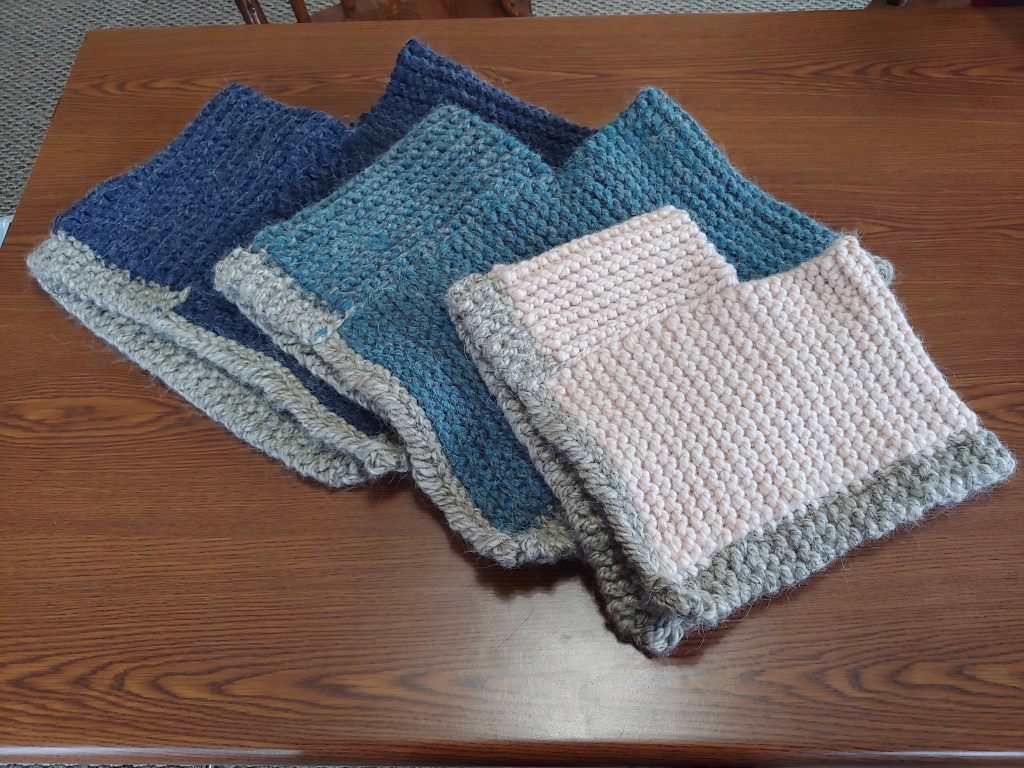
This knitting project, on the other hand, is about the easiest gift you can make for a little girl (or three) if you just have basic knitting skills. For each poncho, I simply knit two identical rectangles, then sewed them together in the poncho shape. I used super-chunky yarn, large needles, and cast on 25 stitches for the larger ponchos (which fit a school-aged child) and 20 stitches for the smaller poncho (which I hope will be the right size for a preschooler). They are in garter stitch, which means I knit on the right side and the wrong side, instead of purling on the wrong side, which would have produced stocking stitch. The only thing I did that was slightly challenging was to use a different color of yarn for the border.

Ponchos are pretty forgiving (no tailoring), and if you have mastered the mechanics of knitting well enough to make a scarf, then you can also knit a poncho. You can add tassels to the corners (or the entire edge) using a crochet hook, but for this project, I didn’t feel the need.

Knitting Project: Mongolian-Style Hat

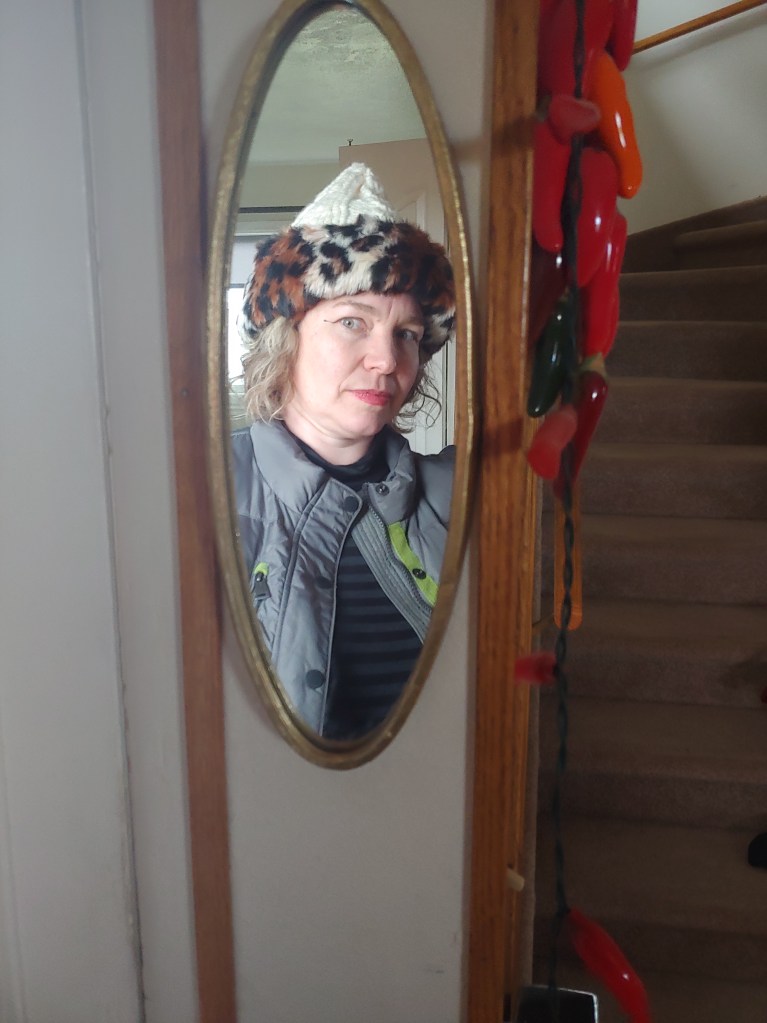
So, I’m going a little crazy with the animal print this winter.

I had so much left over after making my cave-woman costume. Counting the costume, handbag, and now this, I have done three projects with the same “fur.”

I wanted a hat that would feature this animal print, and would feature a knit using cream-colored yarn. When I started imagining the hat, I pictured it with a slight point on top, probably owing to all that time I had spent on Pinterest looking at pictures of traditional Mongolian, Tibetan, and Scythian costumes.

For this hat, I started with a basic ribbed beanie pattern, casting on 72 stitches. I worked 4 inches of 1×1 rib, then switched to a cable pattern for a few more inches. Then I started doing regular decreases, adapted from a pointy elf hat pattern. When finished, I sewed the fake fur to the underside of the four inches of ribbing. You turn up the brim to reveal the fur.

And here I am, standing in a chilly, windy, high-altitude place that is not so different environmentally from Mongolia. To look really authentic, I’d need long black braids coming out from the under the hat to complete the picture.

My whole life is about crushing on different ancient cultures, making costumes inspired by them, and then writing novels so you, too, can visit. You’re welcome.

Highly Autumnal Quote of the Week

The moon is coming up behind the aspens. It is as big as a pumpkin and as orange. The winds are cool, the stars are like electric light bulbs. I am just inside the doorway, with my turtle-shell lamp burning so that I can see to write this.

Something is moving beyond the second hemlock. [My hawk] Frightful is very alert, as if there are things moving all around us. Halloween was over at midnight last night, but for us it is just beginning. That’s how I feel, anyhow …

My Side of the Mountain, by Jean Craighead George, p. 97

More about Ancient Mesoamerican Urbanism

We knew about the Olmec and Maya, but their sites were hard to spot and hard to study because of the jungle. Now, we keep learning more and more.

A train project on the Yucatan Peninsula is uncovering hundreds of Mayan settlements, proving that the area was more densely populated than once thought, as archaeologists have been beginning to suspect.

Meanwhile, Lidar technology is able to peer through the jungle and reveal not only more and more ceremonial sites stretching over the Olmec and Mayan culture areas, but also common layouts that seem to indicate a broad shared cultural (or at least, architectural) tradition dating back to 3,400 years ago.

It looks to me like what we have here is a Central American version of the Sumerian urban/bureaucratic/temple-based civilization, giving rise to a series of civilizations that followed the same model: Akkadian, then Babylonian, and so on. And, if we believe the 3,400 YA date, the same thing in Central America was happening at almost the same time. It’s almost as if people tend to set up hierarchical city-states with temples wherever they settle, almost as soon as they settle there, whenever circumstances permit. Almost as if they were dispersing, and remembering something.