
All his gifts were extended. All his instincts had crawled out to the skinny branches to see what was coming down the road.
Evangellyfish, by Douglas Wilson, p. 35
Don’t Throw Your Fossils in the Garbage
“Shark Teeth Found in City of David Baffle Archaeologists“
“[S]omebody in ancient Jerusalem, shortly after the legendary reign of King Solomon, collected mineralized shark dentition from the time of the dinosaurs” … and then threw them in the trash.
Found: More Prehistoric Stuff

This is at the Eastern Idaho State Fair.
I swear, I just lucked into this. It’s serendipity.
Note the pterodactyl is now a terradacdyl. And the mammoth is a mamouth. That’s O.K., its was prehistory; the spellings had not stabilized yet. Nor had the earth’s crust …
Poverty Point: Star of My Show
Near Bayou Macon, Louisiana, is an archaeological site called Poverty Point. I am drawing for information about Poverty Point primarily on the book Mysteries of the Ancient Americas, 1986, by the The Reader’s Digest Association Inc., but here is the official Poverty Point web site. It is now a World Heritage Site. Here is a recent article about an archaeological project done at Poverty Point.
First, the Obligatory Eye-Rolling at Mainstream Archaeology
Like many North American sites, Poverty Point was hard to spot because it consists of earthworks that had been overgrown with forest. (And not only North American sites. Radar technology is revealing that the Mayan civilization was much more extensive than first thought — because the jungle took over so quickly — and is also revealing old settlements in what was hitherto thought to be never-before-settled Amazon rainforest.)
Earthworks are basically impossible to date, but for other reasons, Poverty Point is thought to be about 3,000 years old (i.e. about 1,000 B.C.). However, it helps to remember that when dealing with paleontology and even archaeology, dates are often basically just made up — i.e. reached through dead reckoning based on a shaky framework of background assumptions. But let’s accept 1,000 B.C. for now.
Mysteries, which again, was published in 1986, also makes several more or less dubious claims about the builders of Poverty Point. Here’s a sampling:
“[S]cholars think it is doubtful that societies on the chiefdom level existed in North America 3,000 years ago.” (page 111)
“[This civilization] had no writing, no true agriculture, and no architecture except for its earthworks. Its weapons were simple: the spear, the atlatl, the dart, the knife, and possibly the bola. Even the bow and arrow was unknown to these people.” (page 112)
“Considering the massiveness of Poverty Point’s ridges and mounds, one naturally assumes that they were built over many generations or even centuries.” (page 112)
Mysteries of the Ancient Americas
The first of these quotes is 100% pure assumption, based on the noble savage mythology so beloved of modern academics.
The second is also pure assumption. A better way to put it would be that we have found no evidence of writing, agriculture, etc., so far. The findings reported at the first link above seem to confirm that agriculture was not a big thing at Poverty Point, based on the remains of the peoples’ diet, but this could have been simply because the fishing and foraging was so abundant. It does not necessarily mean they were “only hunter-gatherers” who had not “advanced” to the level of agriculture. C.f. similar claims being made about Gobekli Tepe. As for the bow and arrow, I take it that remnants of all these other weapons have been found, but not bows. Even that, I take with a grain of salt, as it seems that almost every week, something is discovered that we had thought this or that ancient group didn’t have. (Here’s the latest example, which even refers to ancient humans as not particularly ‘smart,’ with ‘smart’ in scare quotes.) But even if the Poverty Point people did not use bows and arrows, this does not necessarily mean the weapon was “unknown” to them. Perhaps they had specialized in other weapons instead. Not everybody in the Middle Ages was an English longbowman, but boy oh boy did they know about them!
Finally, the third claim made in the Mysteries quote box (which they at least had the grace to call an assumption), appears to have been possibly disproven by the second link above. “New radiocarbon dating, microscopic analysis of soil, and magnetic measurements of soils at Ridge West 3 found no evidence of weathering between layers of soil, suggesting that the earthwork had been built rapidly.”
Now, the Site Itself

It’s easier to just show you guys this diagram than to try to describe it, but buckle up, here comes the description. The Poverty Point site consists of earthen ridges set concentrically inside each other, in what looks like a C-shape from the air. “The two central aisles point toward the setting sun at solstice” (ibid). Directly to the west of all this is a large man-made mound (Mound A), while a ways farther north there is a smaller mound (Mound B), which seems to be a burial mound. Bayou Macon, directly to the east, cuts through the eastern side of this whole complex. Was this whole thing originally C-shaped, or was it a circle? Probably a C shape, because there are similar, smaller sites around this region which tend to be “constructed in a semicircle or semioval pattern with the open side facing the water and with one or more mounds located nearby.” (ibid)
The book uses the word “ceremonial” a lot, and honestly I can’t fault them. This complex was constructed by human beings, and now, millennia (?) later, more human beings come and look at it and say, “This looks like it was clearly designed for ceremonial purposes.” That’s a valid argument. The architecture is having a certain effect on us, and we can assume that it had that same effect on our long-lost fellows, and was designed to.
Poverty-Point-related sites have yielded thousands of little decorated clay balls, called Poverty Point objects, that we think were used for cooking. There are also little clay sculptures of female torsos (with or without heads), reminiscent of the Venuses found around ancient Europe. There are also “myriads of stone tools,” including drills, awls, and needles, made both from local stone and from flint imported from as far away as Indiana. They made “plummets,” perhaps as bola weights or perhaps as weights for fishnets, “most often of hematite in graceful teardrop or oval shapes [and] often decorated with beautifully executed stylized designs representing serpents, owls, and human figures.” (ibid, p. 115)
But it is in lapidary work that the Poverty Point people excelled. Pendants, buttons, beads, and small tablets are worked in an array of such colored or translucent stones as red jasper, amethyst, feldspar, red and green talc, galena, quartz, and limonite. Most of these stones were obtained by far-flung trade. Among the pendants are a number of bird effigies — red jasper owls and parakeets, and bird heads worked in polished jasper and brown and black stones. There are also representations of a human face, a turtle, claws, and rattles, and stubby but carefully made tubular pipes.
Mysteries of the Ancient Americas, p. 115
O.K., I’ve changed my mind. Perhaps this C-shaped complex was not ceremonial, it was a lapidary factory.
Regardless, the Poverty Point “hunter-gatherers” have once again made my point for me: that wherever human beings go, they start up civilization and display mathematics, art, and craftsmanship.
The Snake City
I guess there have been a lot of “snake cities” throughout history. In my third novel, The Great Snake (upcoming, hopefully in 2022), Snake City is founded by a small group who break off from our main group of characters. Their city is like a smaller, less populous version of Poverty Point.

As you can see, our city is much smaller. It overlooks the Mississippi River itself, rather than a bayou. The temple is built not on a man-made mound, but on a natural hill. The people actually live on top of the ridges. They aren’t lapidary craftspeople (at least, not as of the end of the novel). And, finally, this city is about 7,000 years earlier in time than Poverty Point. Other than that, though, it’s exactly the same.
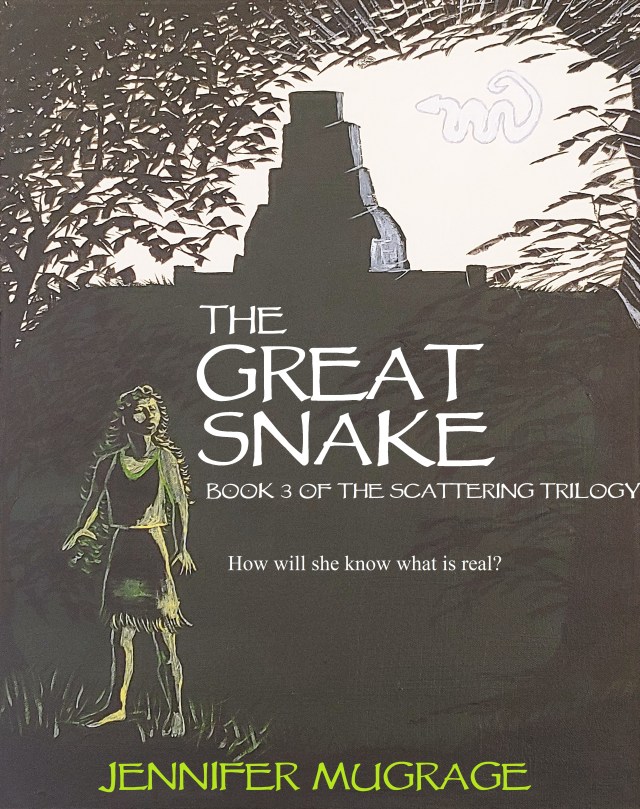
In the cover image, Klee is standing on the lower hill that houses the women’s complex. Behind her, the temple looms over her from atop the hill. It has a Mayan-style roof comb that is facing away from the viewer. In this view, the snake is either hovering in the air just east of the temple, or possibly it is out over the river.
Quote: Survive!
One’s own order to oneself, “Survive!”, is the natural splash of a living person. Who does not wish to survive? Who does not have the right to survive? Straining all the strength of our body! An order to all our cells: Survive! …
They lead thirty emaciated but wiry zeks [=prisoners] three miles across the Arctic ice to a bathhouse. The bath is not worth even a warm word. Six men at a time wash themselves in five shifts, and the door opens straight into the subzero temperature, and four shifts are obliged to stand there before or after bathing — because they cannot be left without convoy. And not only does none of them get pneumonia. They don’t even catch cold. (And for ten years one old man had his bath just like that, serving out his term from age fifty to sixty. But then he was released, he was at home. Warm and cared for, he burned up in one month’s time. That order — “Survive!” — was not there. …)
But simply “to survive” does not yet mean “at any price.” “At any price” means : at the price of someone else.
The Gulag Archipelago, by Aleksandr Solzhenitsyn, p. 302
My Prayer Life is Like Whack-A-Mole Lately: Report
I mean, it’s not people I am whacking. It’s crises.
I’ll bet you all can relate.

Cattail Bonanza!
How do I love thee, cattails? Let me count the ways.

I didn’t actually love thee, not at first.
I was just writing this story, see, and in it there’s a young Native woman living all by herself near a stream. And she has a guest come to visit, and I know she’s eating game, but I wondered what she could serve him for a vegetable. Had a vague memory that maybe you could eat cattails. Put down “cattail roots” with an asterixis that let me know I needed to look it up later.
And when I did … boy howdy! My young lady had just hit the jackpot!
According to this article, cattails can provide nearly everything that a human being might need.
First of all, yes, you can eat them.
In spring and summer the young shoots can be picked, stripped of the outer leaves and eaten cooked or as a raw vegetable. The green immature flower stalks can be boiled and eaten like corn on the cob. Later in the summer months, pollen from the brown mature flowering stalks provide a nutritious flour supplement for cakes and flat breads. During fall and winter when there is no longer any foliage the roots may be boiled down for a starchy broth rich in carbohydrates. Cattail is very low in Saturated Fat. It is a good source of Iron and Phosphorus, and a great source of Fiber, Vitamin K, B6, Calcium, Magnesium, Potassium and Manganese.
“Cattail,” by Henry Holly in the The Northwest Forager, ibid
Secondly, first aid. “Ash from the burned leaves [is an] antiseptic,” and the roots and sap have also been used in first aid. Now, my character did not need any first aid, at least not at that point in the story.
Thirdly, shelter. The leaves can be woven to make such things as hats, rain cloaks, baskets, mats, and for rain runoff on a roof. (This is similar to how coconut-palm fronds are used in Southeast Asia.) And – get this! – the “seed fluff” can be used for pillows, bedding, insulation inside moccasins, wound dressing, and even … diapers. Wow! My girl’s little shelter just turned into a palace with a water-shedding roof and a comfortable bed made of a cattail mat over cattail fluff. Bonanza!
Of course, having learned all this stuff, I had to try it. As you know, I’m a Luddite, although most of the time just a pretend one.
We have plenty of cattails here in Idaho. Here is some proof, with cattails growing along an irrigation canal and the mountains in the background:

According to this article, the cattail roots can absorb pollutants in the water. Also, digging up the roots, drying and roasting them, and pounding them into flour sounded like a lot of work for someone who’s only a Luddite part-time. Actually, even digging up the shoots sounds like it would involve getting my feet wet. All in all, the simplest project for a beginning cattail forager sounds like it would be using the seed fluff. Even I can find the seed heads. Here they are:
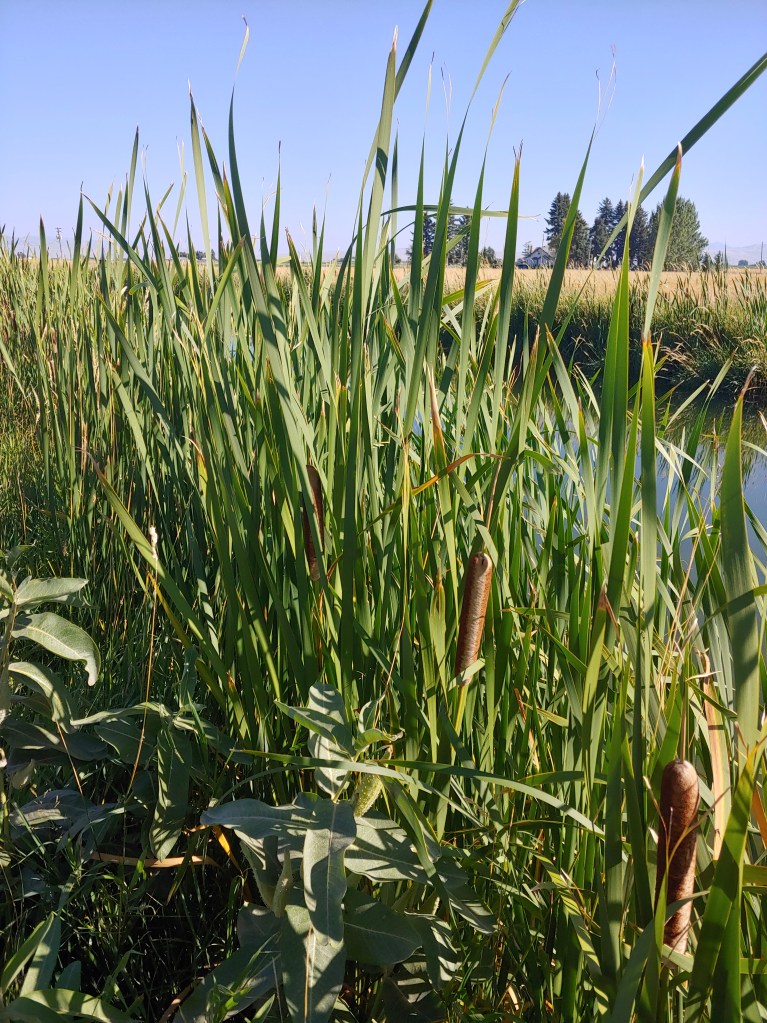
I cut a few off with my garden clippers, and soon had a small basket full.

That ought to be enough for at least one diaper, right?
Then it was time to pull apart the seed heads. This is easy, though messy.

Luckily, the seed fluff didn’t cause any itchy symptoms. (I guess it wouldn’t be so useful if it did.) In the end, those dozen or so seed heads gave me a pile of fluff that looked like this:

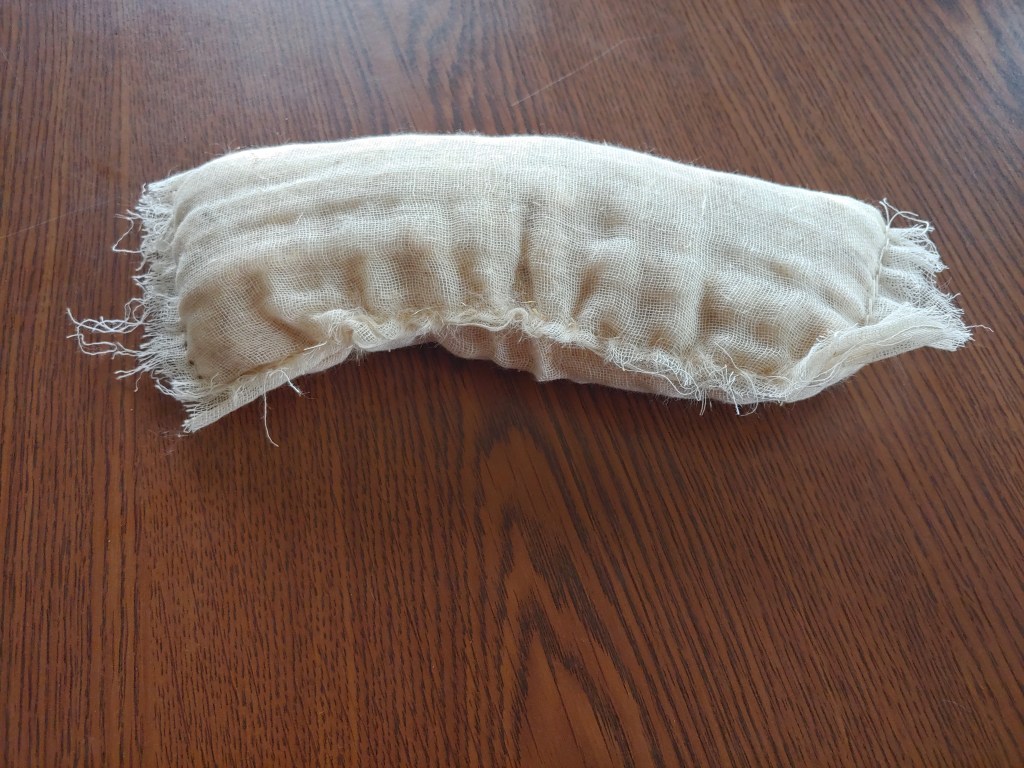
The sewing part only took me about 20 minutes. It would have taken less if I had ironed the cheesecloth first. I still had enough fluff left that I decided to make a small pillow. Out came the scrap cotton, and when the pillow was done, I stuffed it.
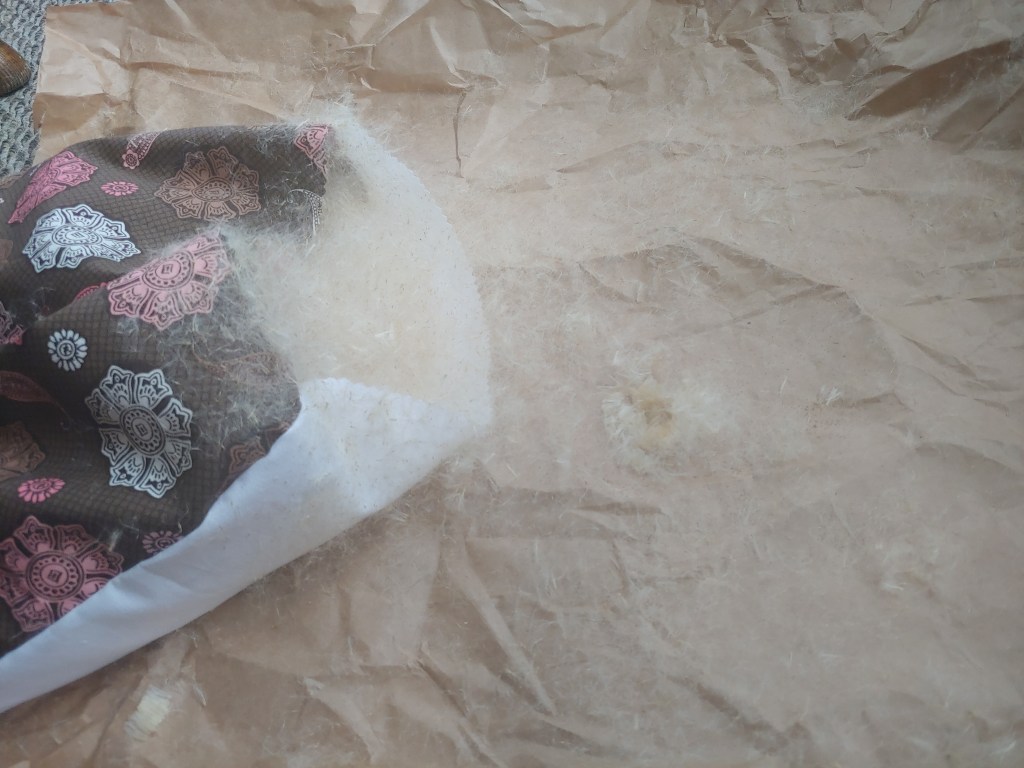
The seed fluff really tends to fly up in the air and then stick to stuff (that’s what it’s designed to do, after all). The pillow, once stuffed and pinned shut, ended up looking like this:

I used a lot of tape to get all the cattail lint off it.
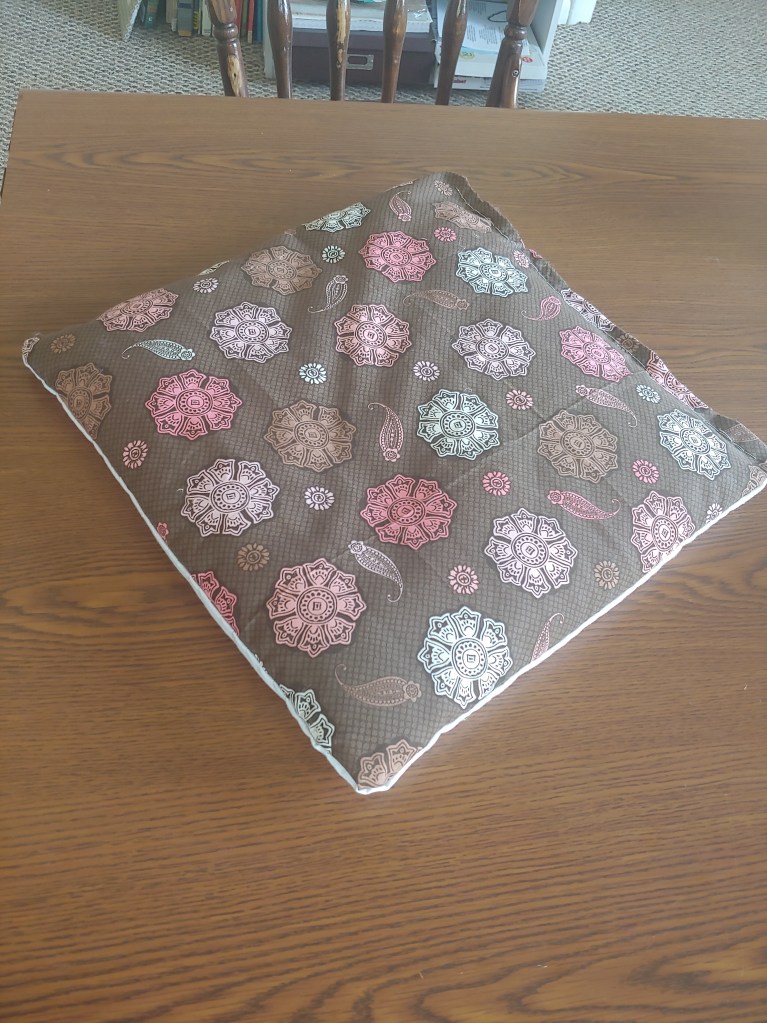
And here is the finished product. Not super high, but a definite pillow. We’ll see how long the fluff lasts or whether it compacts a lot over time. Luckily, there is more where that came from!
This has been “researching books and pretending to be a forager” with Jen.
Cynical Quote of the Week
They knew he was innocent because they were as guilty as he was.
Evangellyfish, by Douglas Wilson, p. 31
 Out of Babel Books