
Tag: American West
Two Book Signing Events

The Strange Land came out this spring. It features bears, and a people group hunting and gathering their way to the chilly Land Bridge. Hence this marble bear lying on some fur.
Now, you can get The Strange Land signed — or buy a copy from me personally — if you can make it to Utah on the second weekend in December.
I will be having a book sale/signing at Eborn Books in the New Gate Mall in Odgen on Friday, Dec. 10. (I’ll be selling copies of The Long Guest, too.) The address is:
Eborn Books – New Gate Mall Ogden
3651 Wall Avenue
Ogden, Utah 84405
time: early to late afternoon (starting about 1 p.m.? Maybe? Details still being hammered out)
and the location looks something like this:
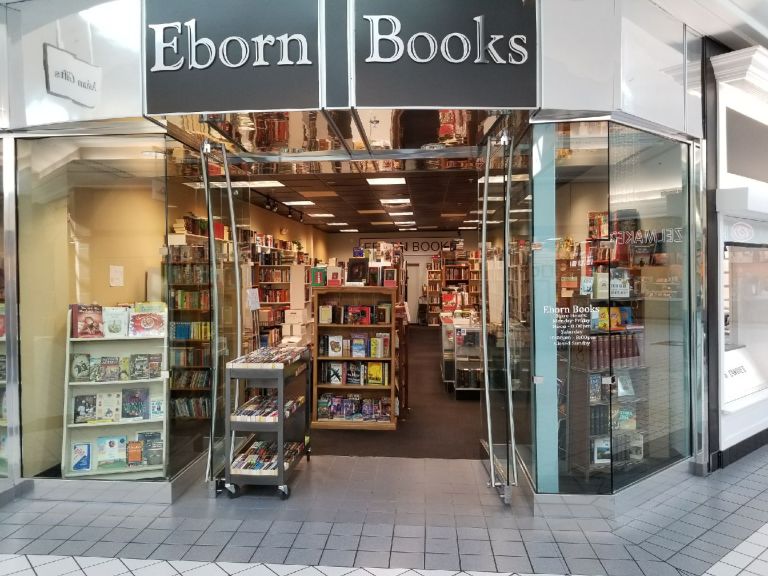
Besides my books, they have a wonderful selection of used sci-fi and fantasy; and, as you can see, children’s books.
On Saturday, Dec. 11, 2021, I’ll have a signing/sale at another Eborn books location:
Eborn Books – Layton Hills Mall
1201 N Hill Field Rd
Level 1, #1052 (Next to JC Penny)
Layton, UT 84041
time: morning, so I can get back home that evening

If you live anywhere nearby – or find yourself traveling to Utah for some Christmastime skiing or anything like that – bring your friends! I’d love to see you!

Here are the books I’ll be bringing to sell! I’m so excited! Especially since prices are going to go up starting November 5.
Corn Cobs as Fuel
I wanted to know whether I could use the few pitiful dried corn stalks left over from my garden as a fire-starter. Poking around on the Internet, I stumbled across this blog post about burning corn cobs, which has a ton of fascinating historical information. My favorite part is the picture of a North Dakota housewife feeding corn cobs into her kitchen stove, with the baby in a high chair in the background, in 1940.
Winter

Don’t see the mountains on the horizon yet? … Look closer …
Cattail Bonanza!
How do I love thee, cattails? Let me count the ways.

I didn’t actually love thee, not at first.
I was just writing this story, see, and in it there’s a young Native woman living all by herself near a stream. And she has a guest come to visit, and I know she’s eating game, but I wondered what she could serve him for a vegetable. Had a vague memory that maybe you could eat cattails. Put down “cattail roots” with an asterixis that let me know I needed to look it up later.
And when I did … boy howdy! My young lady had just hit the jackpot!
According to this article, cattails can provide nearly everything that a human being might need.
First of all, yes, you can eat them.
In spring and summer the young shoots can be picked, stripped of the outer leaves and eaten cooked or as a raw vegetable. The green immature flower stalks can be boiled and eaten like corn on the cob. Later in the summer months, pollen from the brown mature flowering stalks provide a nutritious flour supplement for cakes and flat breads. During fall and winter when there is no longer any foliage the roots may be boiled down for a starchy broth rich in carbohydrates. Cattail is very low in Saturated Fat. It is a good source of Iron and Phosphorus, and a great source of Fiber, Vitamin K, B6, Calcium, Magnesium, Potassium and Manganese.
“Cattail,” by Henry Holly in the The Northwest Forager, ibid
Secondly, first aid. “Ash from the burned leaves [is an] antiseptic,” and the roots and sap have also been used in first aid. Now, my character did not need any first aid, at least not at that point in the story.
Thirdly, shelter. The leaves can be woven to make such things as hats, rain cloaks, baskets, mats, and for rain runoff on a roof. (This is similar to how coconut-palm fronds are used in Southeast Asia.) And – get this! – the “seed fluff” can be used for pillows, bedding, insulation inside moccasins, wound dressing, and even … diapers. Wow! My girl’s little shelter just turned into a palace with a water-shedding roof and a comfortable bed made of a cattail mat over cattail fluff. Bonanza!
Of course, having learned all this stuff, I had to try it. As you know, I’m a Luddite, although most of the time just a pretend one.
We have plenty of cattails here in Idaho. Here is some proof, with cattails growing along an irrigation canal and the mountains in the background:

According to this article, the cattail roots can absorb pollutants in the water. Also, digging up the roots, drying and roasting them, and pounding them into flour sounded like a lot of work for someone who’s only a Luddite part-time. Actually, even digging up the shoots sounds like it would involve getting my feet wet. All in all, the simplest project for a beginning cattail forager sounds like it would be using the seed fluff. Even I can find the seed heads. Here they are:
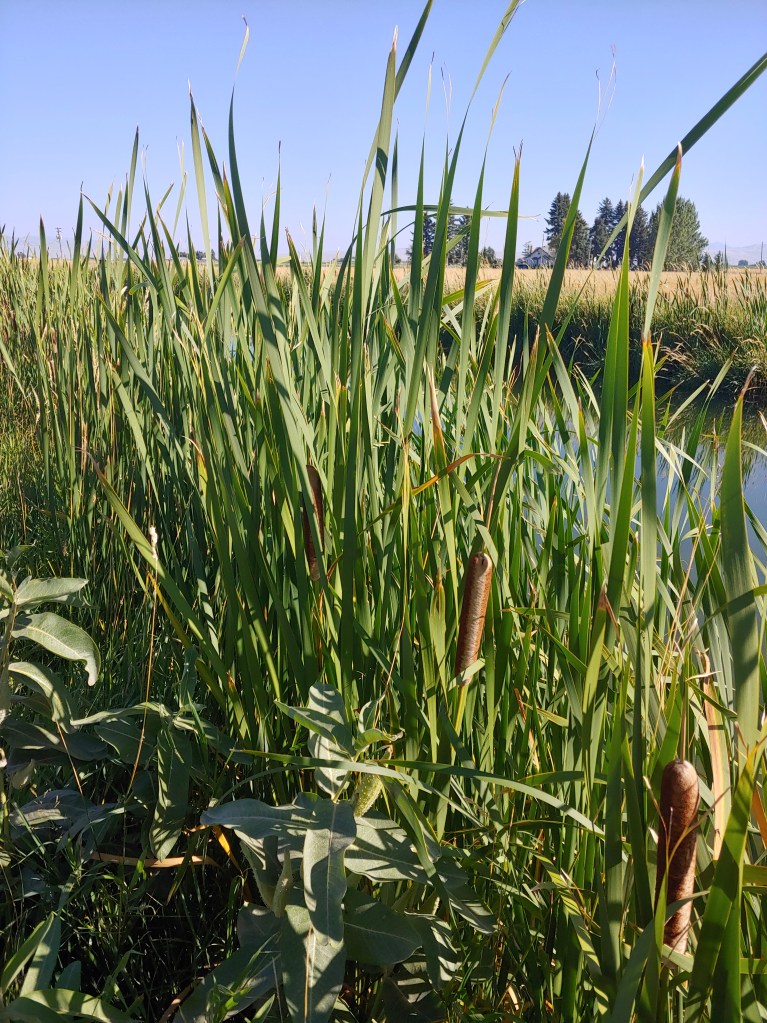
I cut a few off with my garden clippers, and soon had a small basket full.

That ought to be enough for at least one diaper, right?
Then it was time to pull apart the seed heads. This is easy, though messy.

Luckily, the seed fluff didn’t cause any itchy symptoms. (I guess it wouldn’t be so useful if it did.) In the end, those dozen or so seed heads gave me a pile of fluff that looked like this:

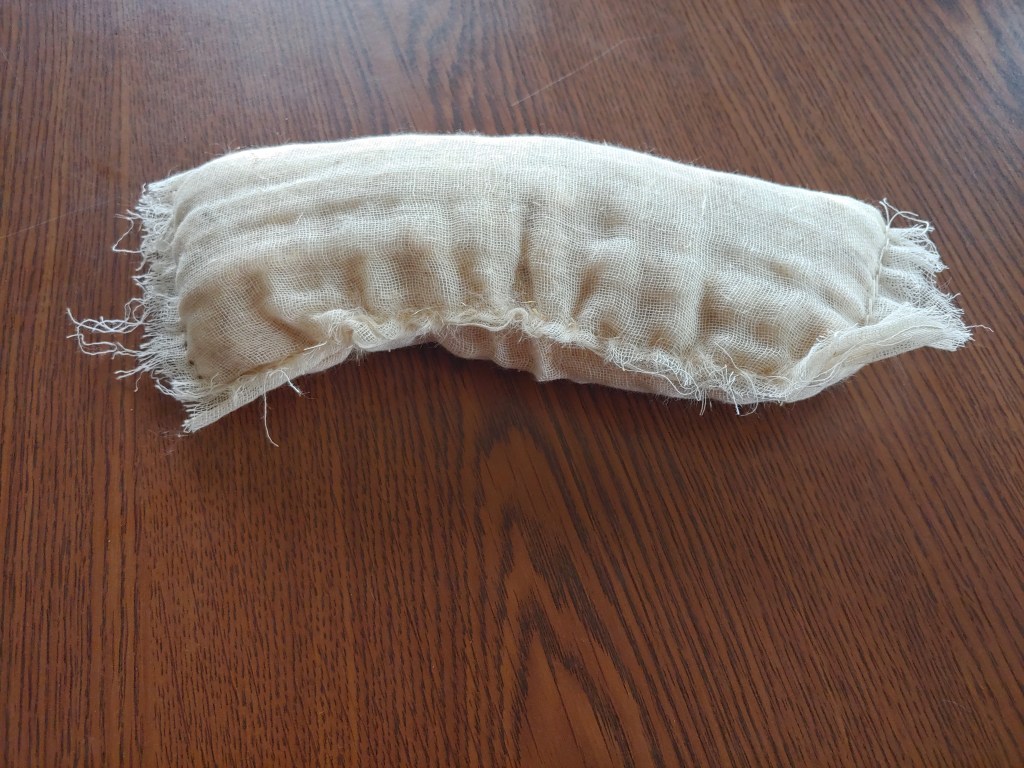
The sewing part only took me about 20 minutes. It would have taken less if I had ironed the cheesecloth first. I still had enough fluff left that I decided to make a small pillow. Out came the scrap cotton, and when the pillow was done, I stuffed it.
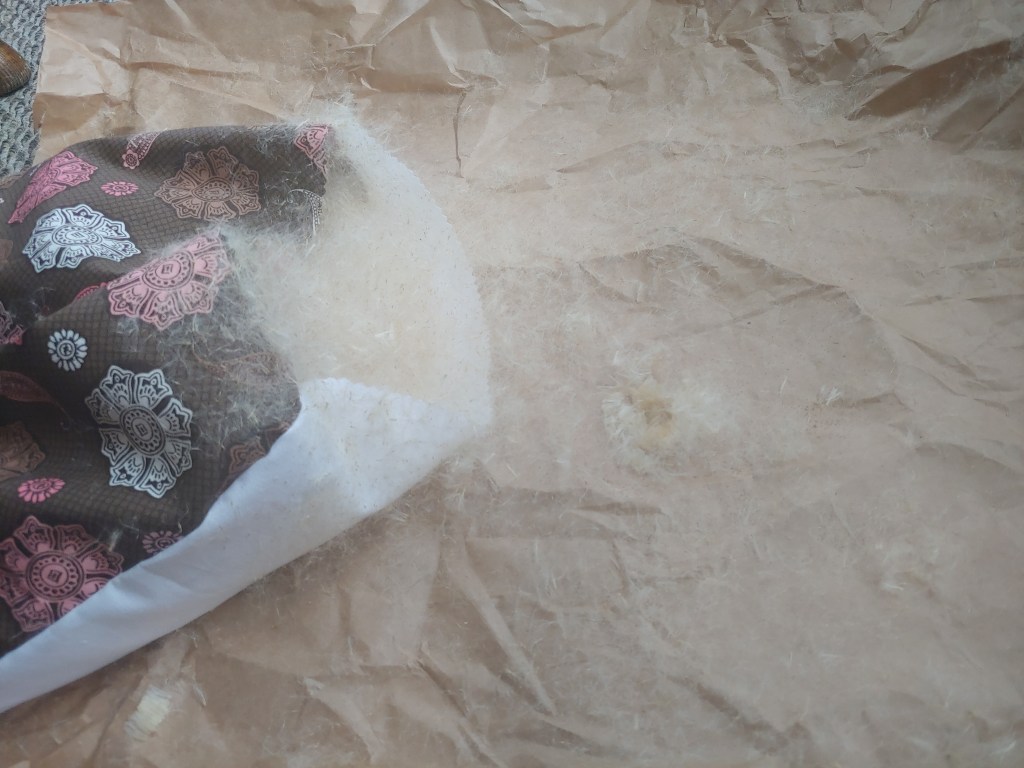
The seed fluff really tends to fly up in the air and then stick to stuff (that’s what it’s designed to do, after all). The pillow, once stuffed and pinned shut, ended up looking like this:

I used a lot of tape to get all the cattail lint off it.
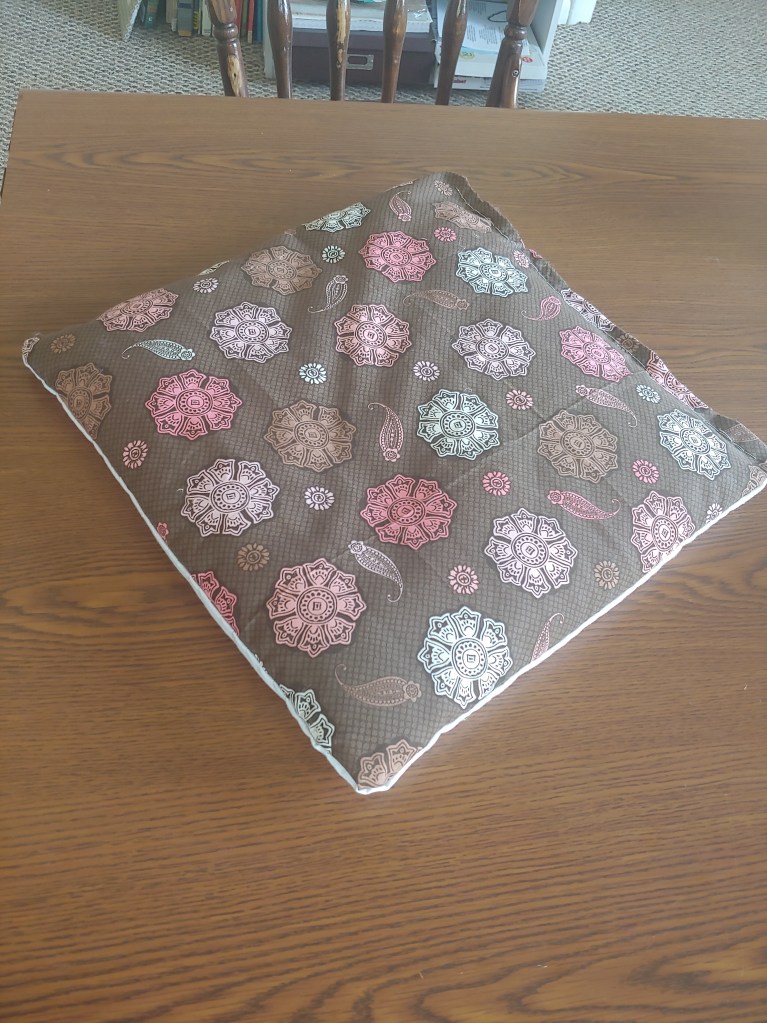
And here is the finished product. Not super high, but a definite pillow. We’ll see how long the fluff lasts or whether it compacts a lot over time. Luckily, there is more where that came from!
This has been “researching books and pretending to be a forager” with Jen.
An Arizona Bigfoot
So, it turns out that Arizona has its own version of Sasquatch. The Mogollon Monster got my attention because the Mogollon are a tribe that plays a major role in the plot of People of the Silence, helping to bring down the civilization centered in Chaco Canyon. MM, however, does not feature in that book.
Botany: Lupine
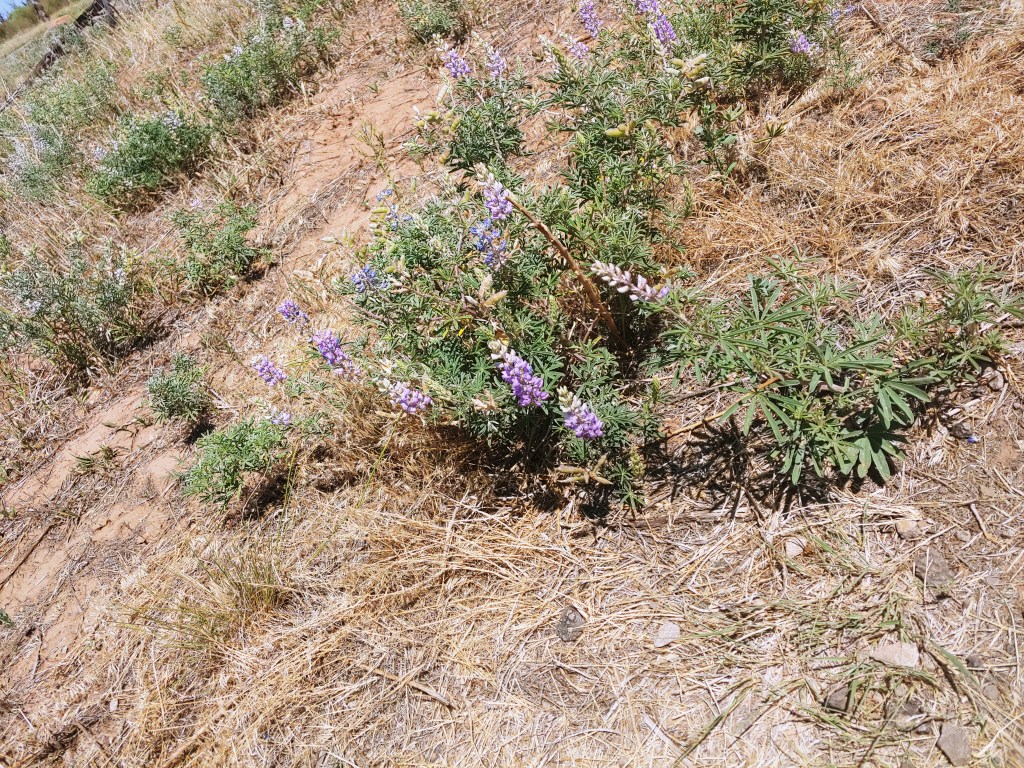
Here is some Silvery Lupine (Lupinus argenteus) I photographed while hiking atop Wetherill Mesa in Mesa Verde, Colorado. It is probably so named “because of the silvery sheen to the leaves in a certain light.”
I noticed that it bears bean pods:
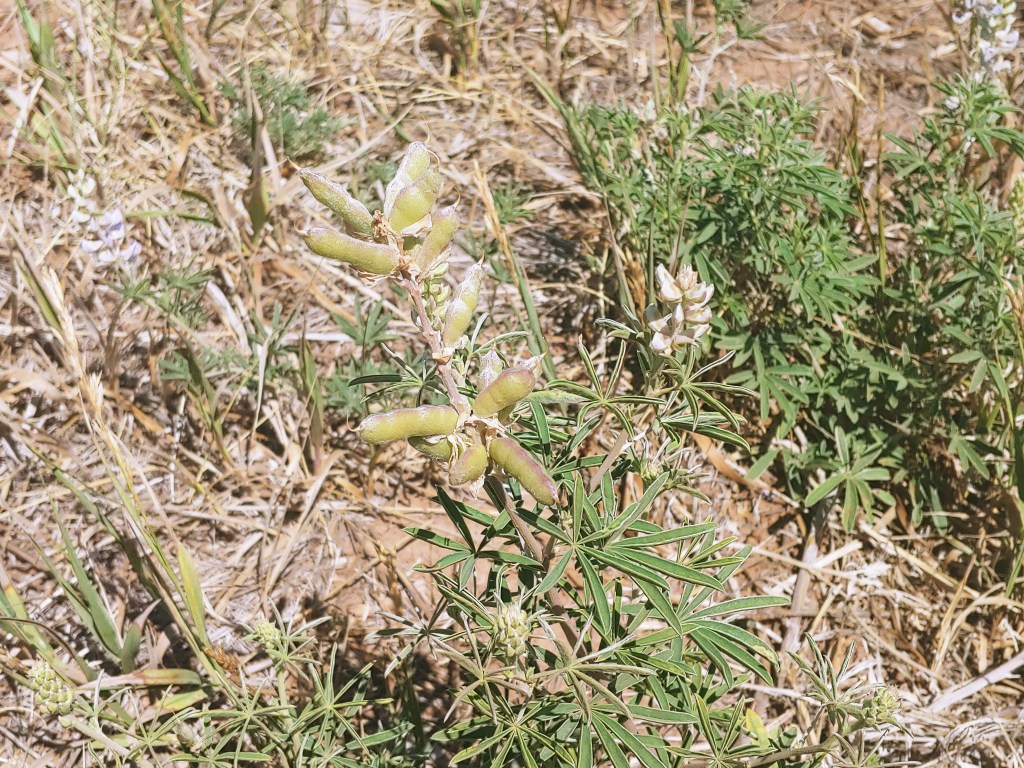
Good thing I didn’t try to eat these, because according to FalconGuides’ Central Rocky Mountain Wildflowers, “Lupines have poisonous alkaloids concentrated in their seeds.” (page 32)
 Out of Babel Books