
Tag: American West
Megalithic Ruins in Montana
Deep in Montana’s remote wilderness lies the Sage Wall, a stunning megalithic structure composed of massive granite blocks intricately stacked in a straight line extending 275 feet (84 meters). Reaching up to 25 feet (8 meters) high, with some blocks weighing 91 tons, it is believed that the wall continues an additional 15 feet underground. This unique formation appears to have precise, interlocking stones resembling ancient masonry found worldwide.
Despite its remarkable features, the Sage Wall remained hidden for centuries, covered by dense foliage on private land owned by Christopher Borton and Linda Welsh. Its discovery occurred when the landowners cleared their heavily forested property, revealing the wall and sparking scientific interest.
These paragraphs are taken from the article linked below:
It turns out that I have been sitting practically on the doorstep of a potential bucket list item!
If I had money and could travel, my destinations would be all the remarkable archeological sites in the world, particularly the ones that seem to partake of what appears to have been a worldwide megalithic culture. As I have pointed out before on this very blog, new examples of these are discovered almost yearly. Anyway, this site in Montana is one that I could actually be in a position to check out.
There are other sites in Montana that some believe are intentionally erected dolmens, and others believe are natural rock formations. Sage Wall, if it really is as it appears in the picture above, looks suspiciously manmade and highly similar to sites such as Sacsayhuaman in Peru. However, I realize that anyone who takes it as a given that there was never an ancient megalithic culture in North America will argue that Sage Wall is just a natural formation, and that rock does sometimes tend to fracture this way, as demonstrated by formations like Sage Wall.
The best way to deal with this is to see it in person.
Here’s how you do that:
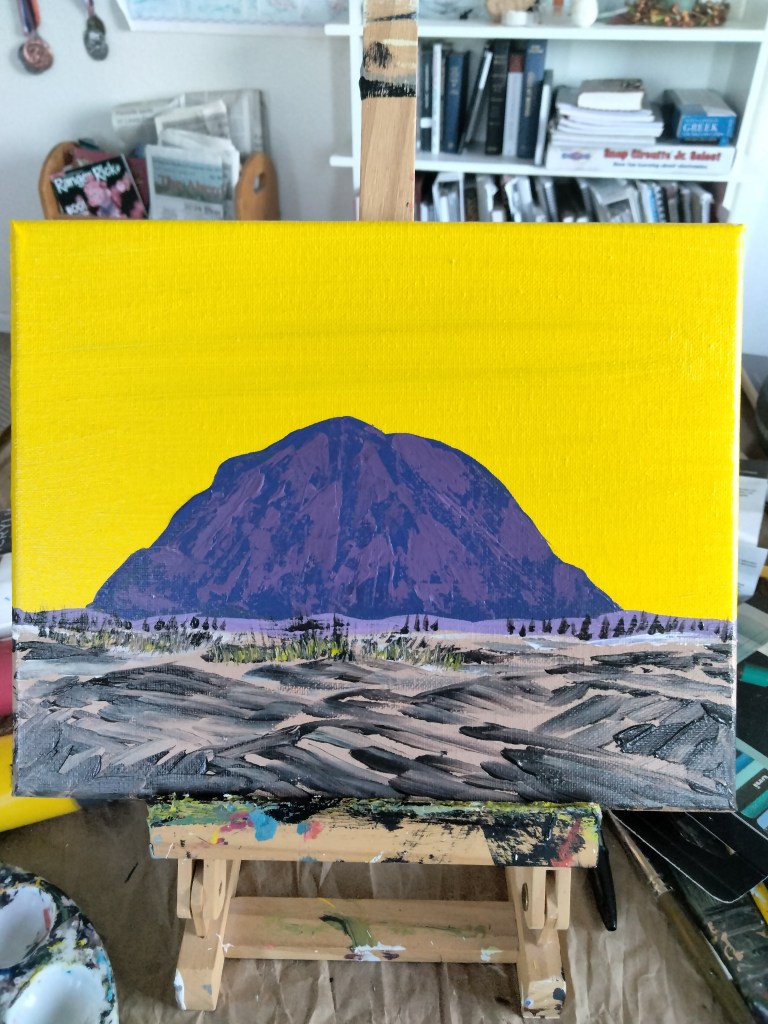
The Predawn Walk to the Chicken Coop Painting II

Here it is with its predecessor:

Wooly Mullein at Lava Hot Springs
A few hours’ drive from my house, in the mountains of southern Idaho, we have a hot springs attraction. The pools are tucked into a niche between the town on one side and the highway on the other.

The photograph above was taken from the east end of the little canyon. Behind me, as I took this photograph, was something called “The Grotto.” It consists of paths and small garden areas winding along the lava-rock hillside. The rocks are basalt, but covered with mineral deposits from the days when the springs gushed out over here.
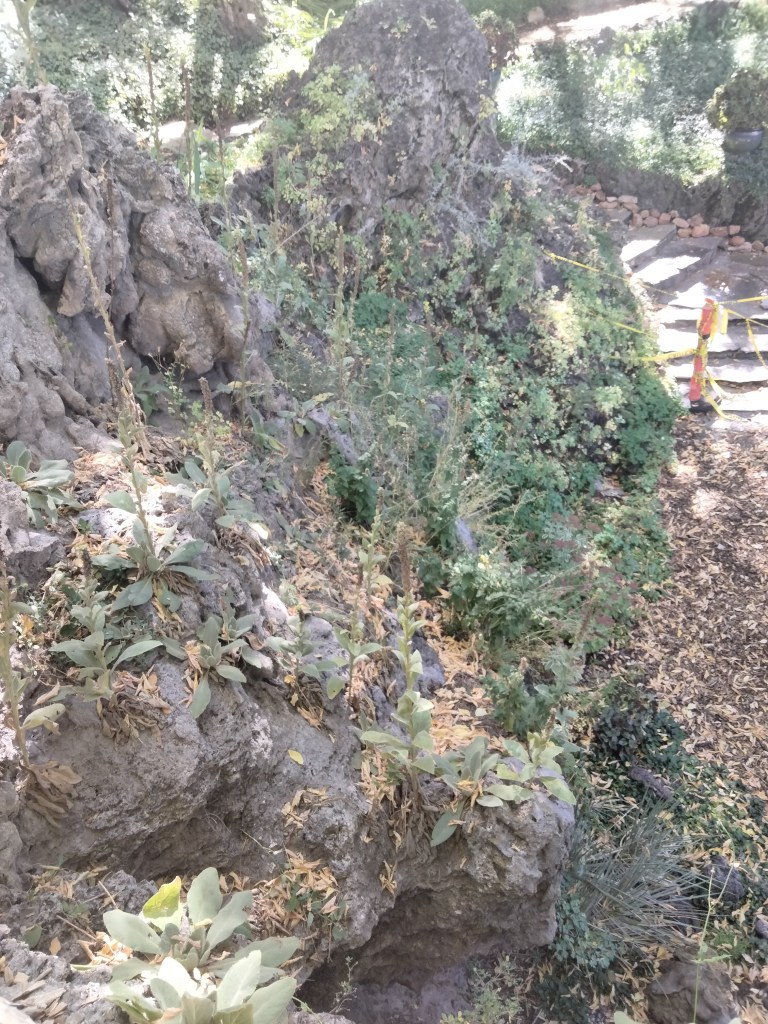
My husband and I went to the town of Lava, which is very touristy and has a lot of old-timey, cowboy-themed restos and hotels, back in September. I had never walked in The Grotto before. (Usually, I’m just either going in the hot springs or not going in the hot springs.)
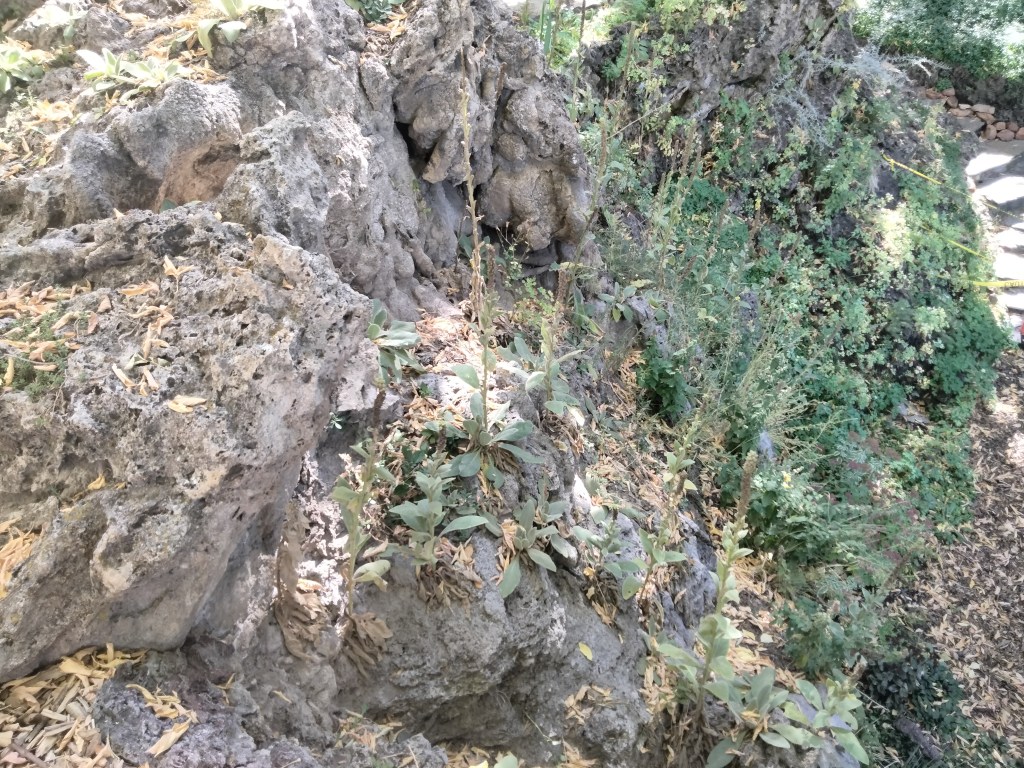
But on this particular September, The Grotto was simply alive with the most Wooly Mullein I had ever seen in one place! Wooly Mullein are those plants you see with broad, pale-green, pillowy-looking basal leaves and (in some cases, not all) a tall spike of a flower.

I blogged about these plants a few years ago, when I had photographed one growing in a farmer’s field near my house. According to Central Rocky Mountain Wildflowers, “They are biennial plants, growing the first year as a round cluster of large radiating basal leaves covered with thick, woolly hair. The second year, they rapidly grow a 1 – 6′ tall stalk, crowded with yellow flowers in a spike arrangement. Then, with all its energy expended, the plant dies.” (p. 157)

“This introduced weed colonizes disturbed places from the valleys and plains to montane forests.” (ibid) Look at how many of them there are! They must love the dry climate.

But Wooly Mullein is not just a weed. “Dioscorides, the Greek physician to the Roman armies in the first century, used mullein to treat coughs, scorpion stings, eye problems, tonsillitis, and toothache. Today, herbalists value it as a medicinal herb for asthma, bronchitis, coughs, throat inflammation, earache, and various other respiratory complaints.” (ibid) My copy of Prepper’s Natural Medicine confirms this.
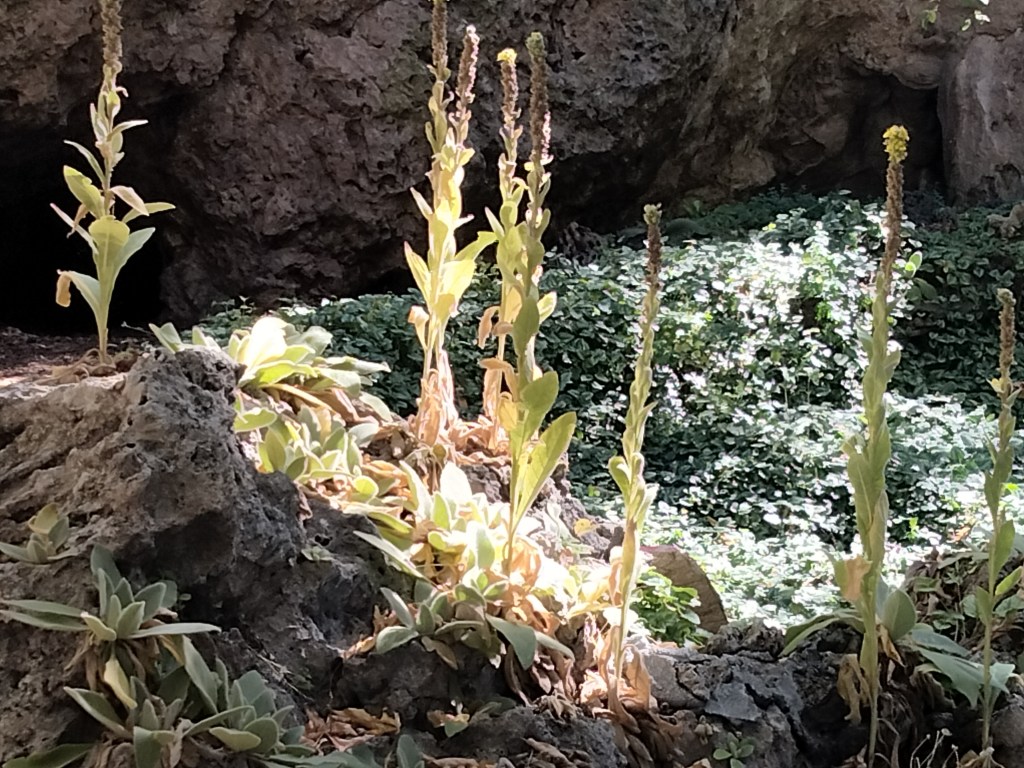
Hence, Lava is really the place to come if you’re ill in apocalypse situation! The Shoshoni Indians would bathe in and drink the hot-spring water to cure illnesses, plus there is all this mullein here. Still, it might be better to plan ahead.
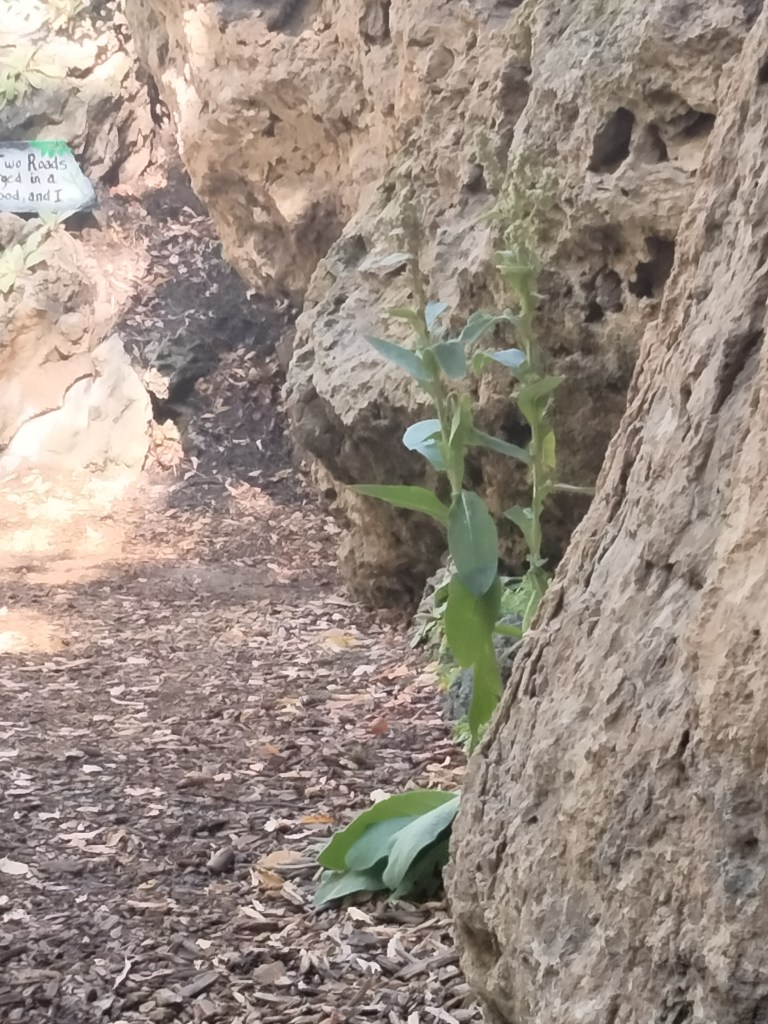
I walked down this path and sat on a bench set into the rock wall. Lo and behold, up in a niche was Spiderman watching over me! Lava truly does have everything you might need!

Grasses by the Canal
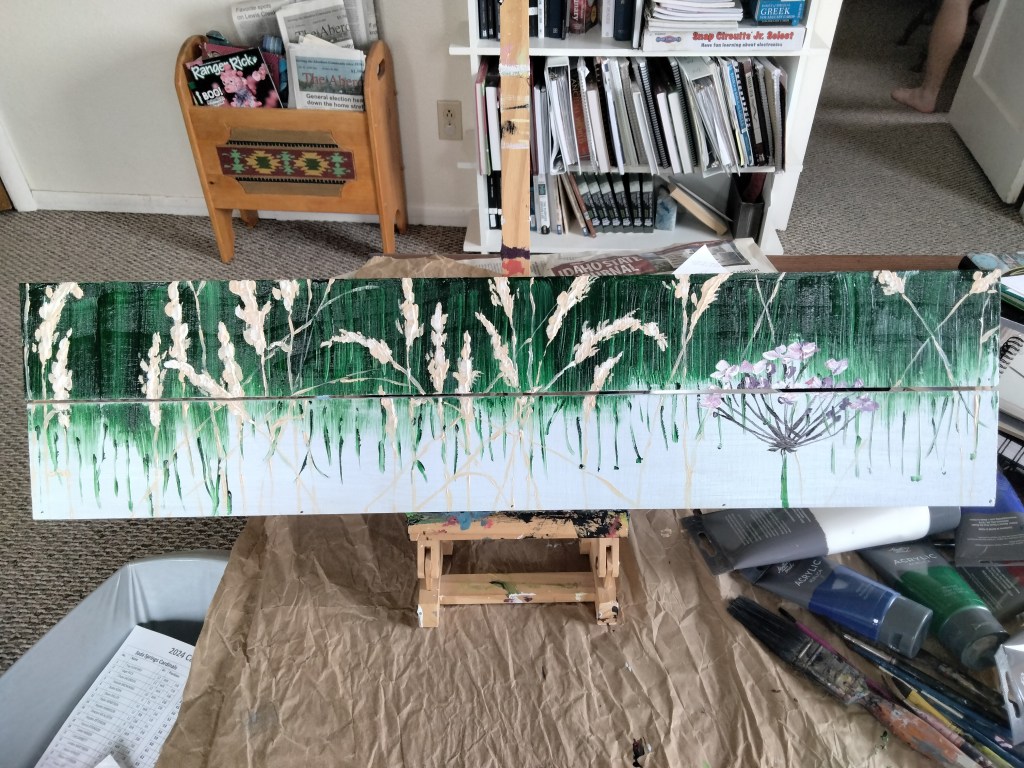
This is, obviously, a picture left over from my Summer 2024 period.
It’s not for sale, unfortunately. I already know who I’m going to give it to.
Video: Chickens taking dust baths in the elm leaves
Smart girls, they figured out that right beside the quonset hut there is a good place for a dust bath.
Paintings of the Drive Home

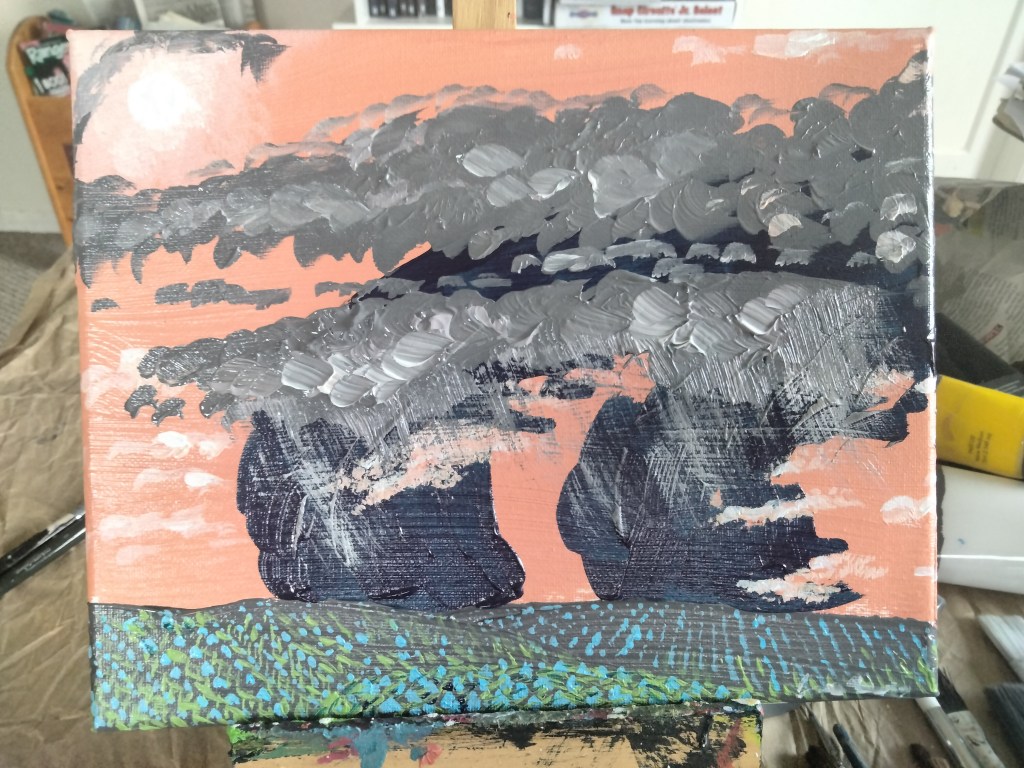
I’m continuing with the “quantity over quality” approach. This is partly inspired by an artist whose work I found on Pinterest, often with the tag “a sunset a day.” He does lovely impressionistic cloud paintings. However, I think he may be putting more time into them than I am.
What I do is, notice the sky around 3 or 4 p.m. when I’m driving myself and my offspring home from school across the windswept Idaho plains, take a mental picture, and do my best to reproduce that mental picture over the next few days.
Both of these are 8×10.
The one on the top is cornfields; the one on the bottom features fields that have been harvested, then harrowed, then planted with something green again before the winter.
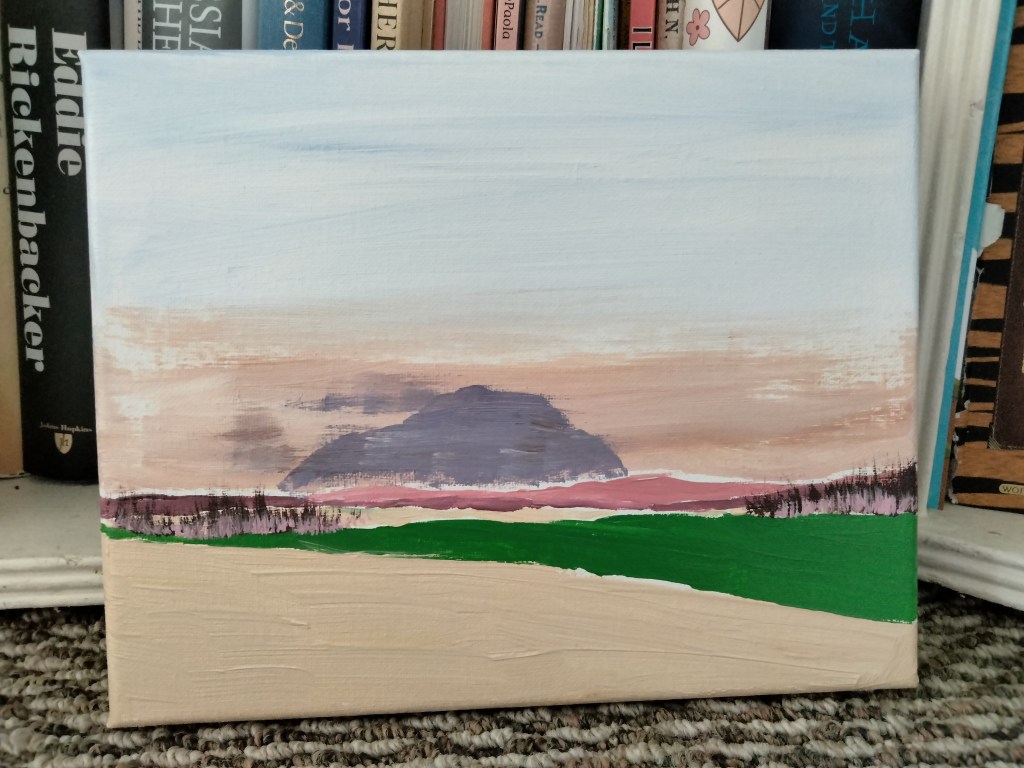
Another 8×10: Big Southern Butte in a dirty sky.
Life in America: Unrhymed Sketches
I love the little houses:
trailer,
double-wide,
double-long,
saltbox,
shotgun shack,
ranch,
unconverted farmhouse.
Dogs that come out and terrify you
from behind a far too flimsy fence.
***
Castor oil, ginger,
apple cider vinegar,
put half an onion on a sill and see how it behaves.
Honey’s good for cough and cold,
pine-needle for the hard-core.
Lots of garlic helps to chase the stomach bugs away.
Epsom salts and menthol rub,
basil, thyme, and black cohosh.
Herbs that our great-grandmothers
used to keep in stash.
Tinctures, teas, and poultices,
but we don’t say Hail Marys ’cause
we’re Protestants.
***
At first, it will seem intrusive.
If outdoors, you’ll want to stop what you are doing and watch it glide by,
noting its three or four engines,
its well-executed graffiti,
its rhythmic clicks.
If indoors, you’ll want to stop speaking
when you feel its rumble.
But after a while, it will become part of the necessary sounds of life:
water running, the heat kicking on, children singing, your own breathing,
and the train.
This process will take less time than you expect.
In weeks, not months,
you will feel uneasy if it does not come on time:
your motherland’s lullabye
rocking you through your days.
Bears! The Blondes Have More Fun Edition

The following article appeared in my local hometown newspaper a few weeks ago. It has everything you could possibly want in a bear story:
Recently a local family had the experience of finding a bear in the woods. Those woods happened to be on the [redacted] property four miles north of [town name]. Apparently she sniffed out the bee hives near the [family name] place and found herself in the trees.
After observing the trails cams, [the family] found her among the trees sitting on the ground and called Fish and Game to come take her to a safe place so she would not be killed. The Fish and Game were able to dart her as she was sitting on the ground. She apparently was not aggressive and seemed content where she was.
They said according to the biologist she was an older black bear by the wear on her teeth. They thought at first she may have been a grizzly cub because of her unusual blond coloring … The biologist was also excited about the coloring of her fur because it was so blonde, being a black bear.
The Fish and Game have no idea where she may have come from, but speculated over by Sun Valley, and it is not uncommon to have bears on the desert when the water becomes scarce in the mountains.
The bear was tranquilized and put in a transport cage and taken away, but not before everyone involved had a photo-op with the “sleeping bear.” The bear was transported to the Bear Lake area.
Our hometown paper, vol. 27
Really, I can’t add anything to this. The last line says it all.

Our Week Last Week

Thursday
Saturday
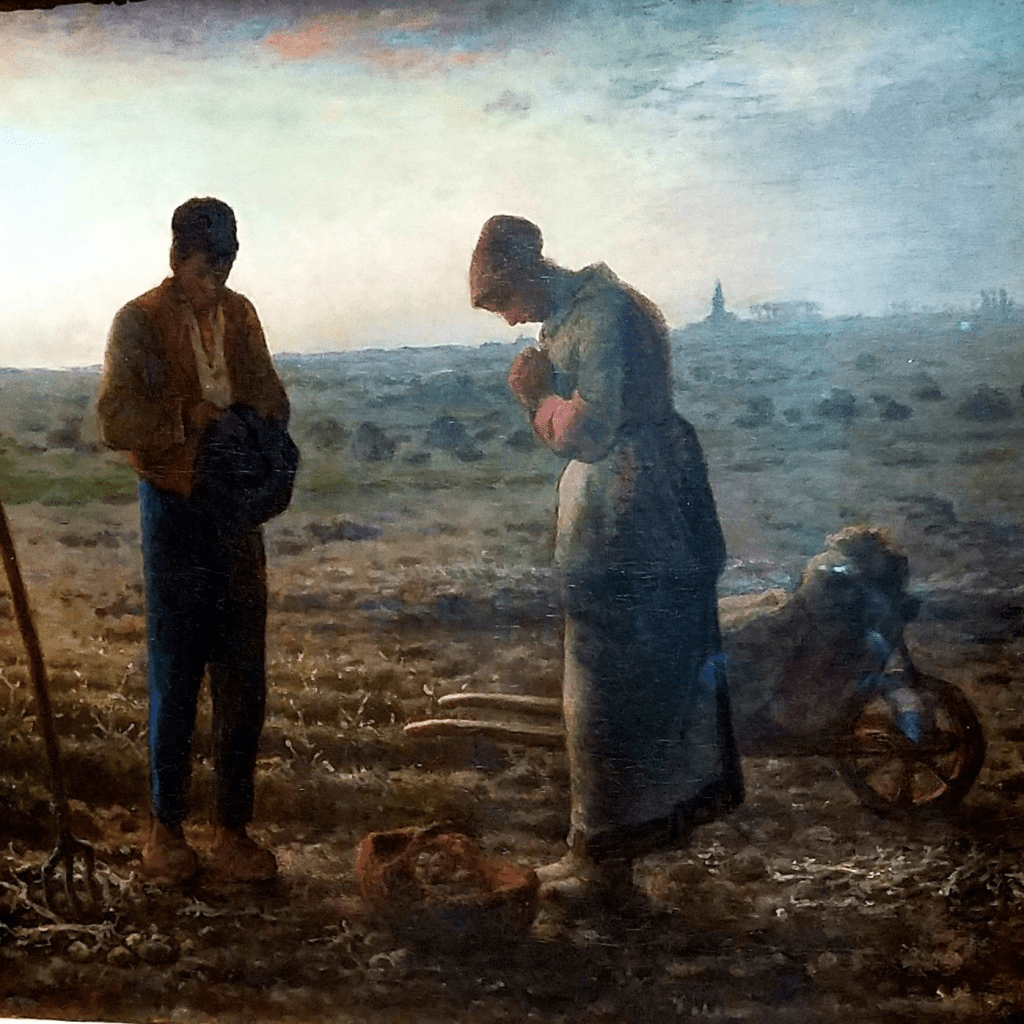
Explanation: On Thursday night, we attended a community dance where we danced the Jitterbug, the Foxtrot, a polka and the Virginia Reel. By Saturday morning, we found ourselves standing at the edge of a field, praying over the grave of my son’s pet rabbit who had escaped his hutch and mysteriously perished without a mark on him.

