
This lady is a kindred spirit!
Tag: ancient world
The John Day Fossil Beds in Oregon
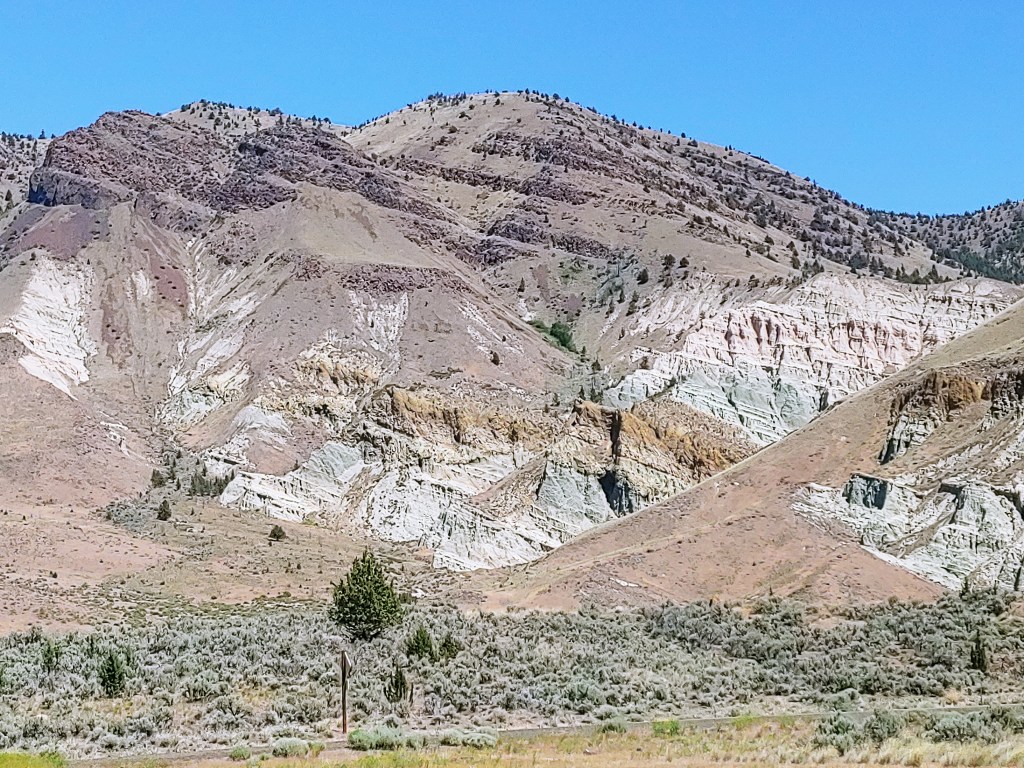
You may remember, a few weeks ago, seeing a picture of Neanderthal Woman standing in front of these green clay layers.
N.W., my kids, and I encountered this site as we were driving through central Oregon. Actually, we had to go a bit out of our way to get to it.
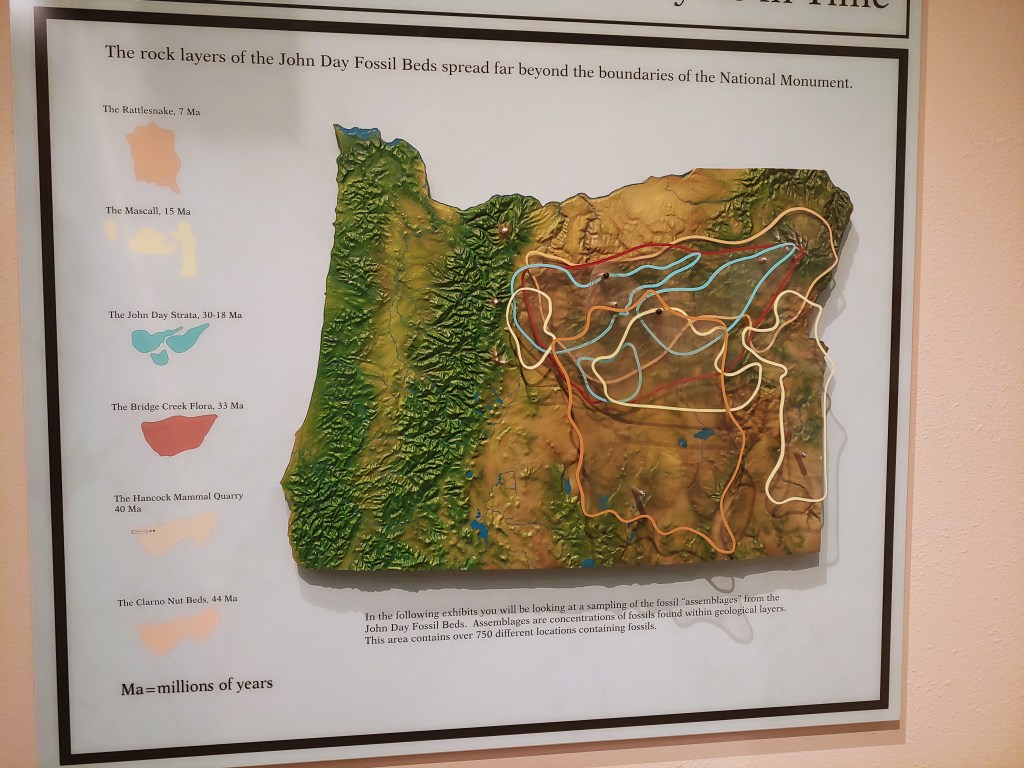
Look at that! We’d been driving over fossil beds all day, ever since we crossed the border!
At one time, this whole area was a semi-tropical rainforest. Then, the whole thing was buried in a massive flow of mud. Supposedly, this happened in stages, starting about 50 million years ago, but let’s not quibble about exactly when. The point is, this forest is now preserved. It’s kind of sad to look up at those interesting-looking hills and imagine all the animal skeletons there, smooshed and squished and smothered in mud, just waiting to be dug out.
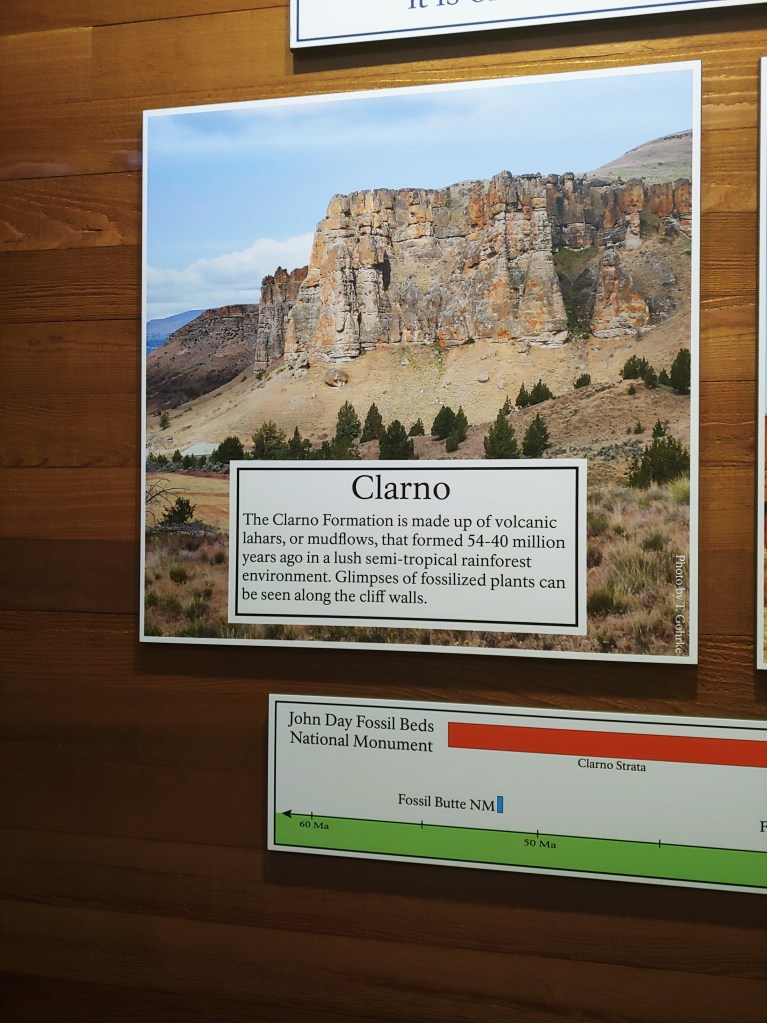
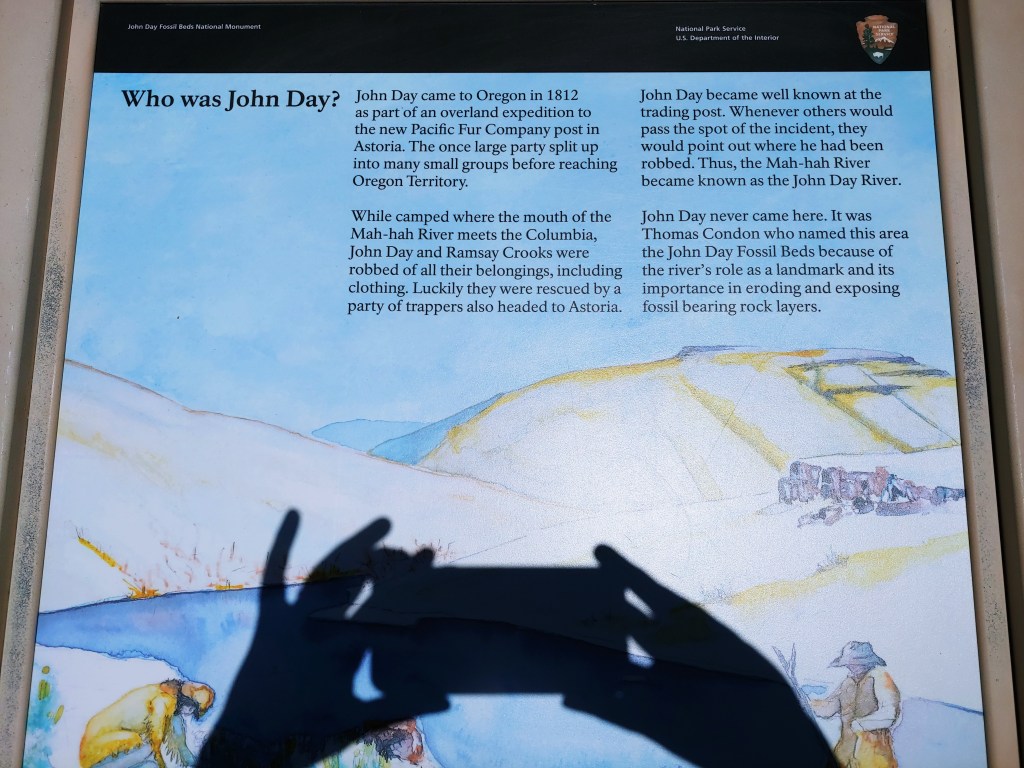
There is a small museum at the site, the Thomas Condon Paleontology Center, where we took refuge from the heat. Here is my son drawing an ancient horse skull.

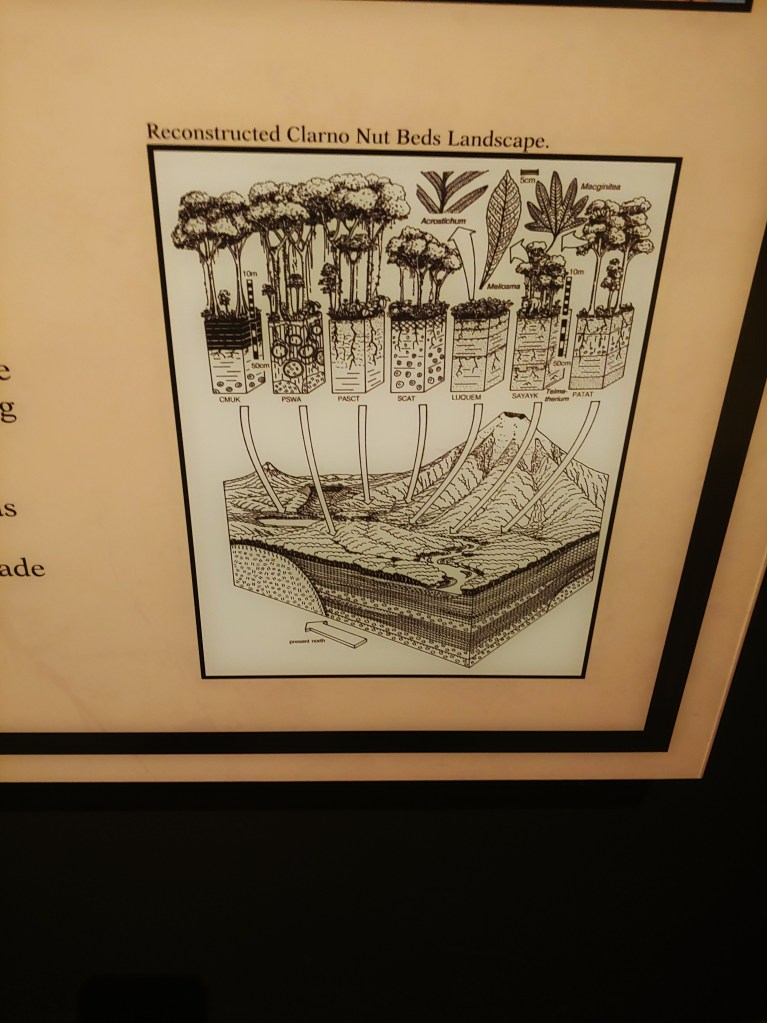
The forest primeval, reconstructed here, left a lot of petrified wood, like this chunk of sycamore …
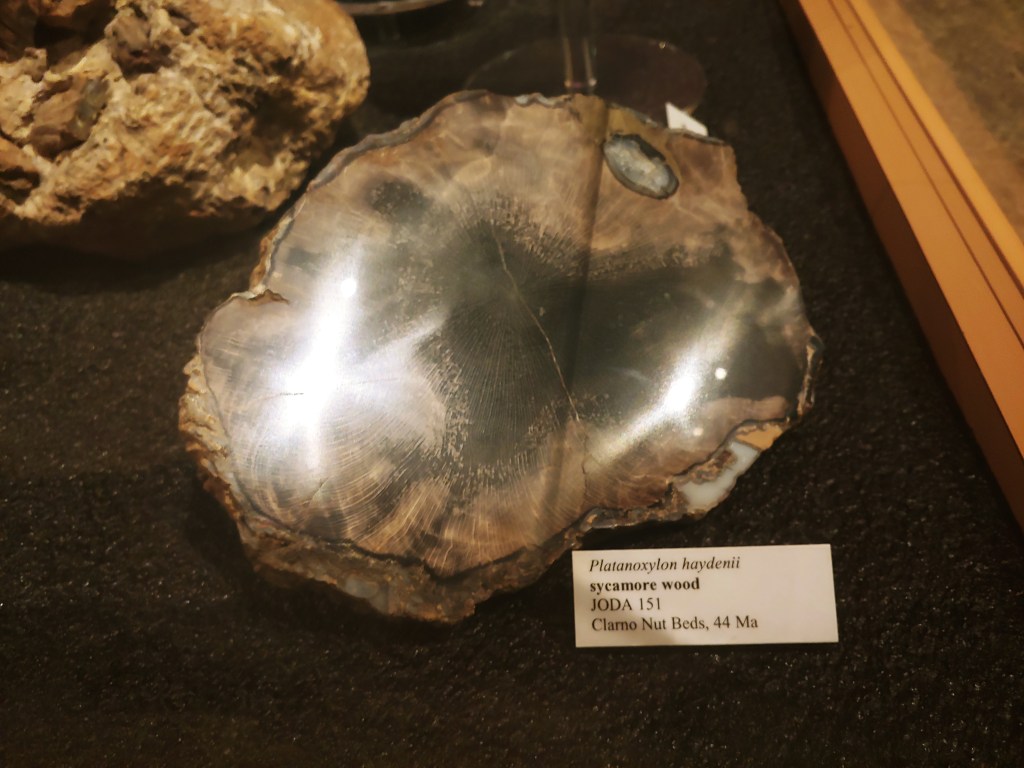
And Oregon’s state fossil, the Metasequoia, which was later discovered to be alive and well in China.
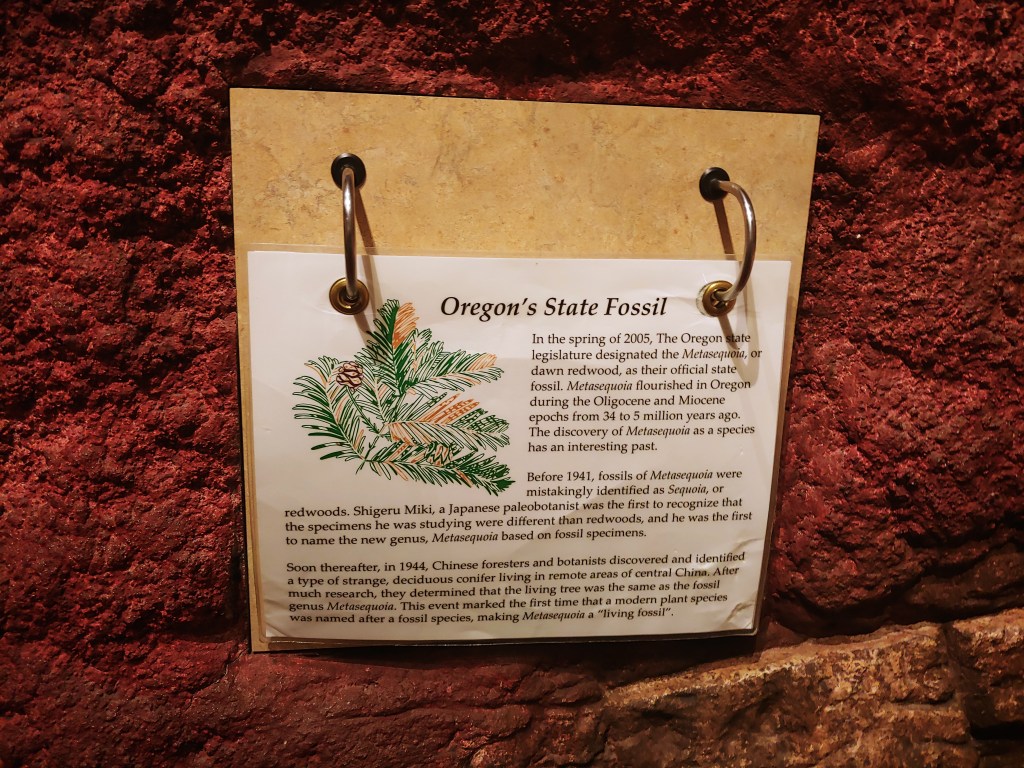
There were also all kinds of interesting and bizarre ancient mammals, such as tiny early horses, giant rodents, and the “bear-dog” (which, as far as I can tell, was basically a wolverine). The crown jewel of the John Day mammal fossils, however, has to be the entelodont.
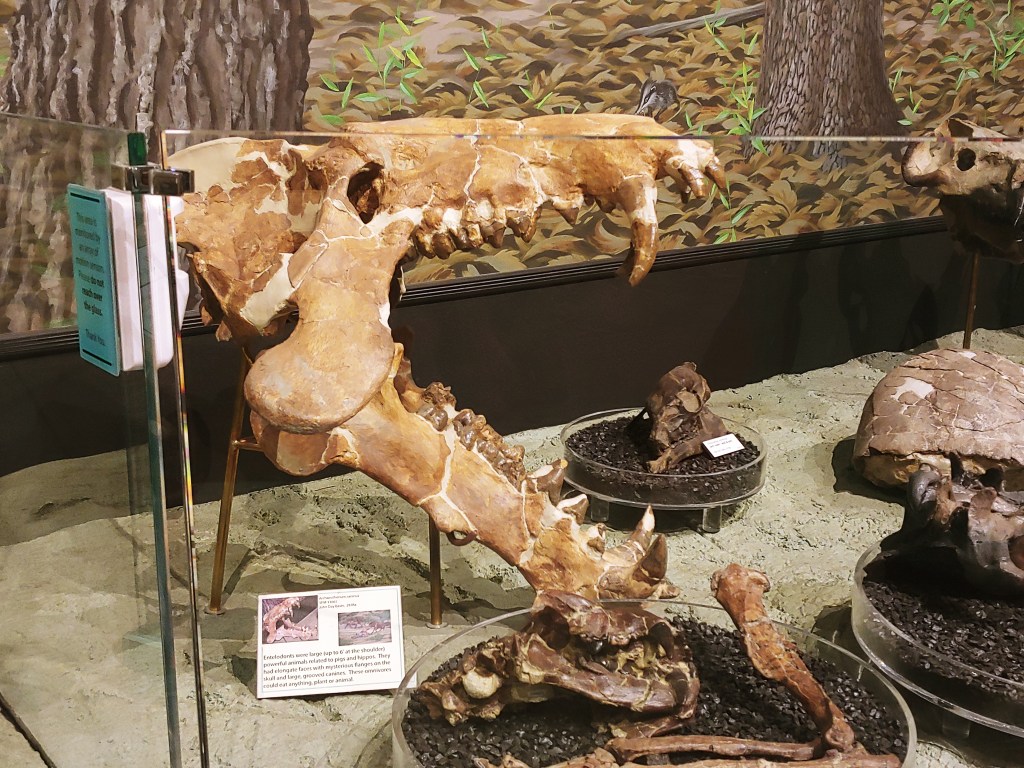
It is described as a carnivorous pig/hippo, six feet high at the shoulder. Not a creature you want to mess with. An artist’s speculative illustration showed one devouring a small triceratops.
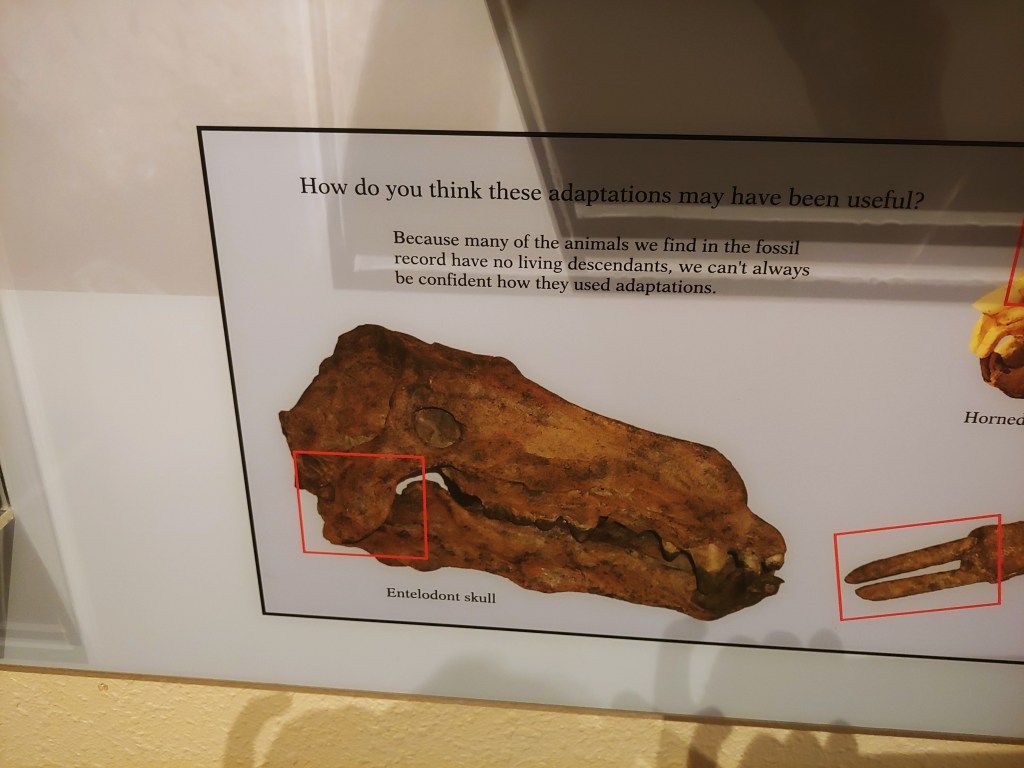
The entelodont is not perfectly understood, however. As this display points out, nobody knows exactly what these strange bone flages on either side of its head were used for. Consequently, I suppose, we also don’t really know what it looked like.
Speaking of puzzling body parts, have you ever heard of a “horned rodent”?
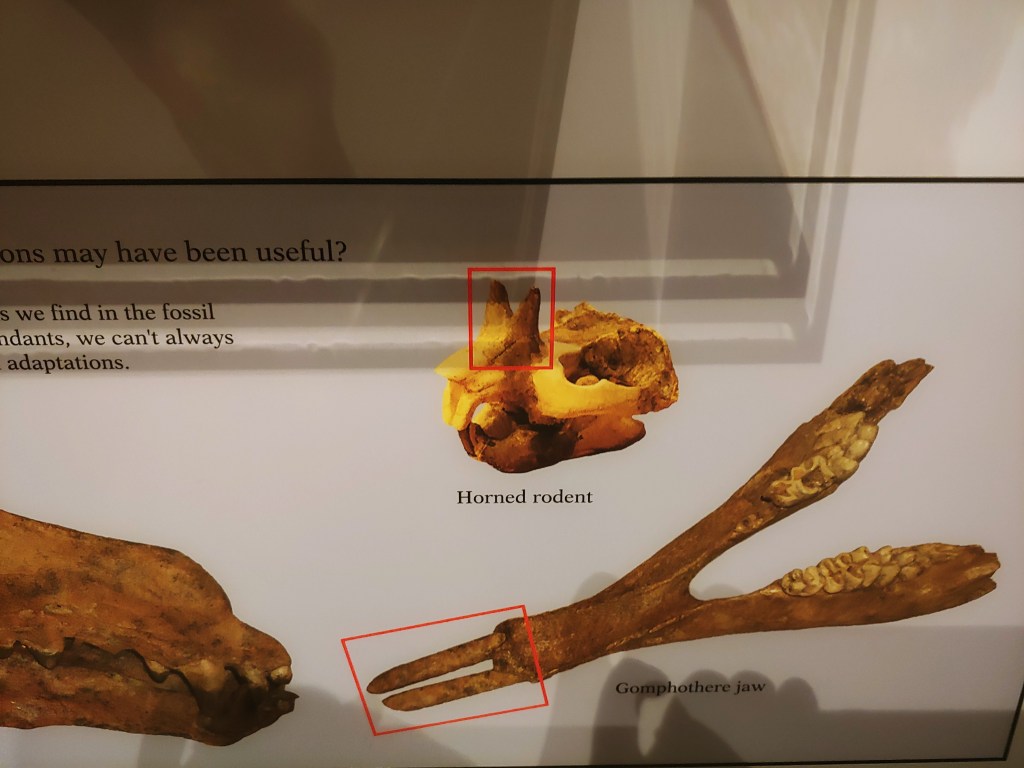
Even the squirrels were scarier back then!
That Feeling When You Lose Your Candlebox …
… in a glacier when something interrupts your seterbruk in A.D. 1500.
And it was brand new, too.
NW Visits the John Day Fossil Beds
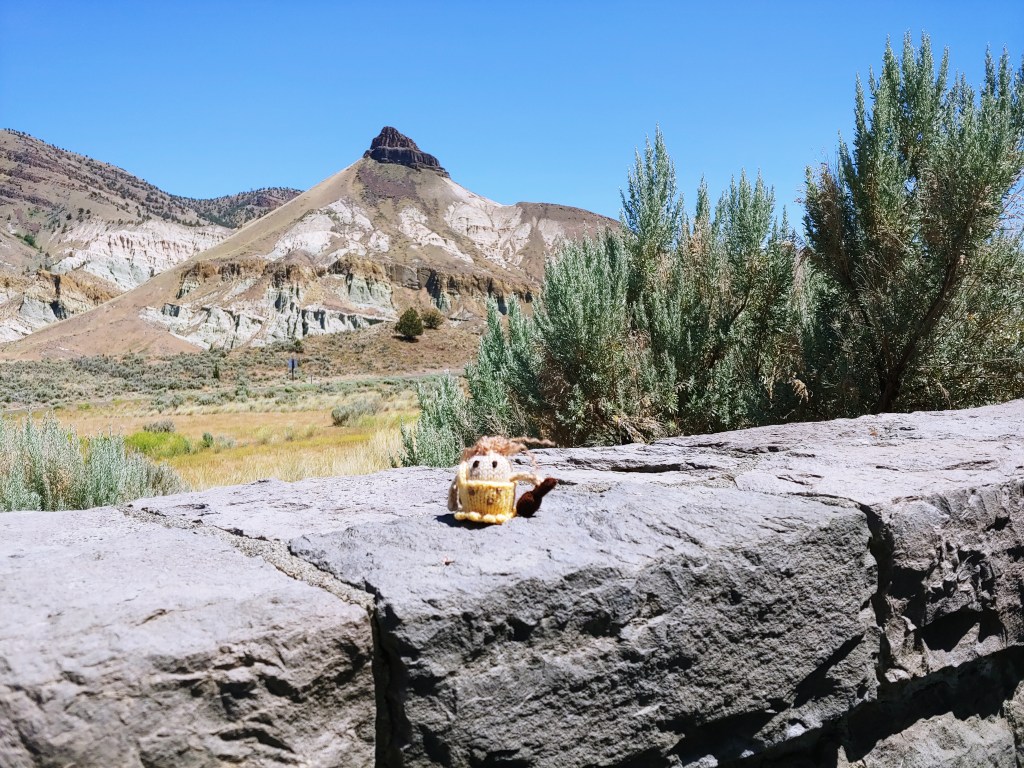
That’s Sheep Rock in the background. Let’s zoom in:
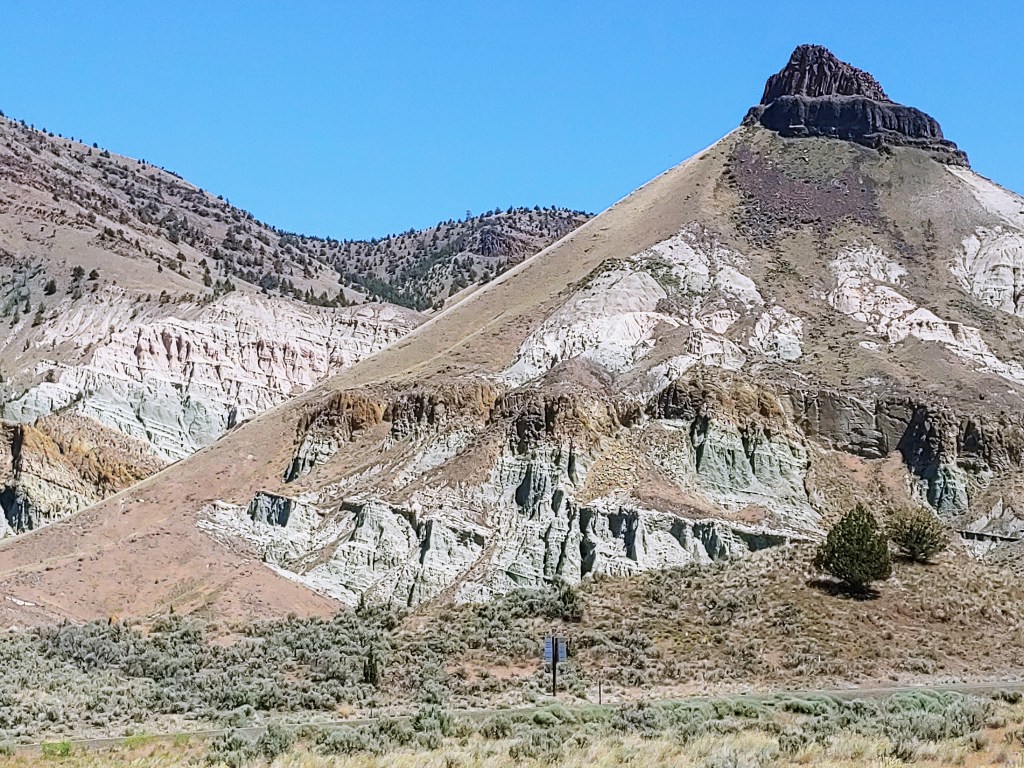
See the “green clay” strata?
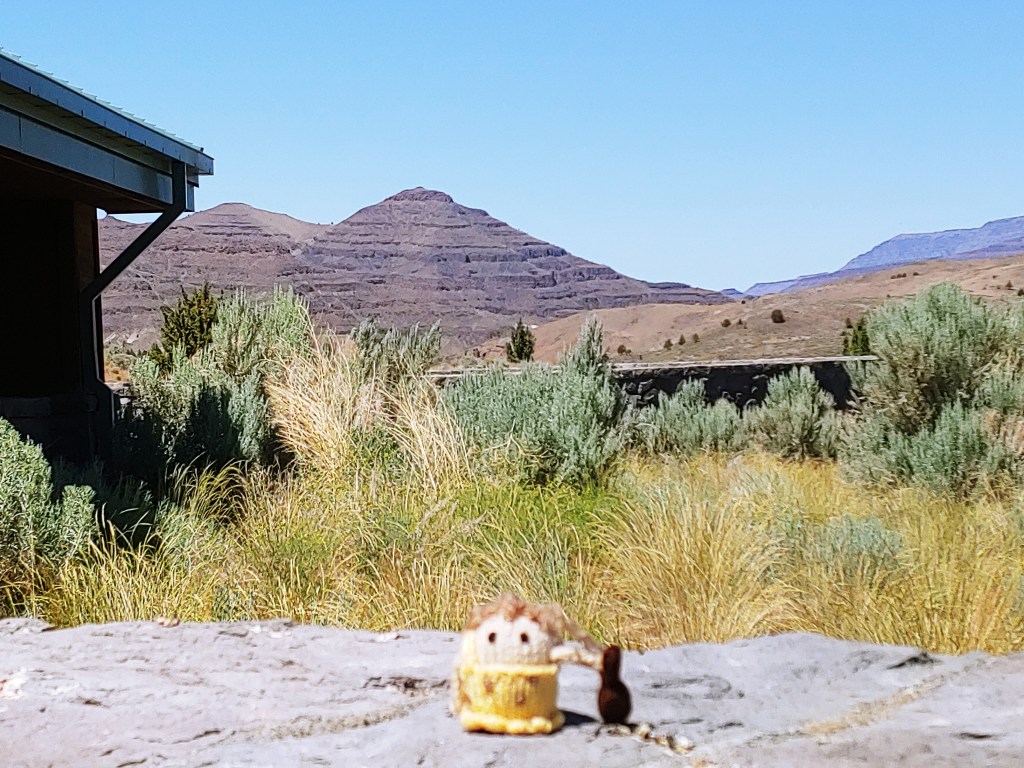
Don’t that take you back?
More about this site when I get back from my vacation.
NW Conquers a Petrified Log
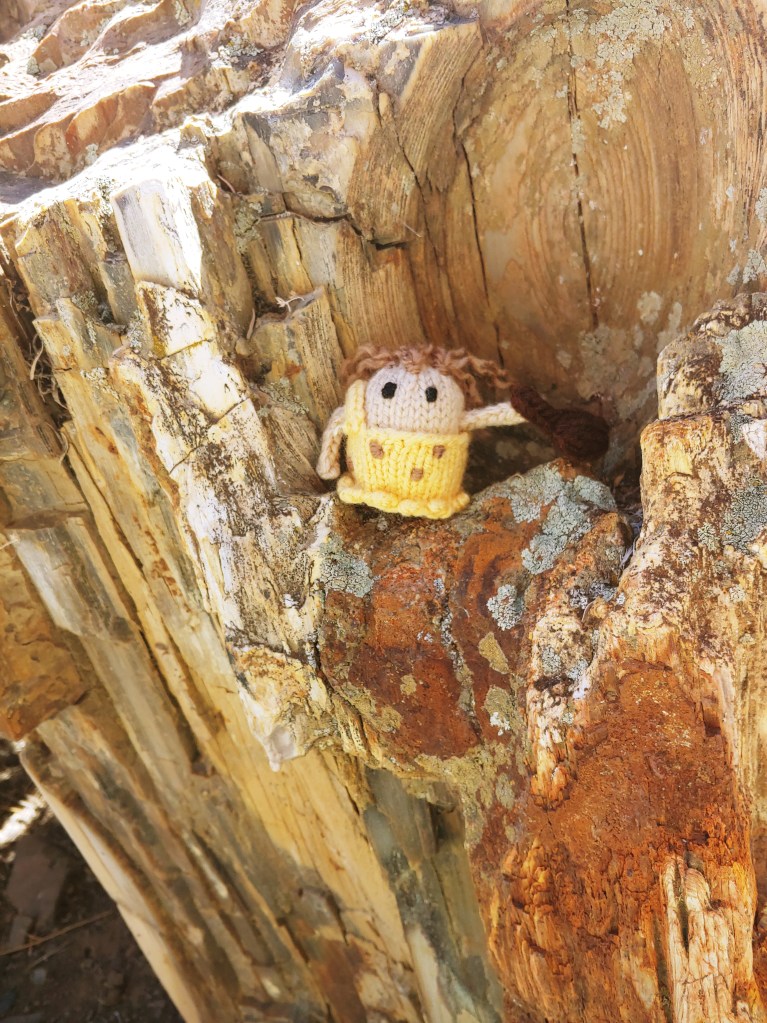
Isn’t it beautiful? It looks exactly like wood from a distance, but I have touched it and I assure you it’s stone.
This is at the Thomas Condon Paleontology Center at the John Day Fossil Beds in central Oregon.

A Very Big Cat
Stinkin’ huge saber-toothed tiger native to North America.
The People in my books call these the Great Lion.
A Weird Post (Because Aliens)
You’ve been warned, friends. If you don’t want to read a post about possible space aliens, you are welcome to leave the room with no hard feelings. Goodbye, and I’ll see you back here next week!
Finally Facing the News
You guys may have noticed, there has been a spate of news articles and videos about U.S. Navy pilots sighting what appear to be UFOs.
U.S. Navy videos declassified last year
60 Minutes interview with Navy pilots
Former head of the Pentagon’s UFO program says they have “exotic material” … what???
I’ve ignored these news items for a long time, mostly because I didn’t know what to do with them. Now I’m ready to give my analysis. It will be just as expert as anyone else’s, and no more expert than any comments you may leave.
Problems with all the Possible Theories
- This is all just a big hoax by our government, to distract us from the attempted power grab by [fill in your favorite villains]. The problems: First of all, it’s not working if that was indeed the plan. The media have not camped on this nearly as hard as on some other, less sensational things, and even when they have run stories, the public (including me, I might add) seem much more interested in their own problems. The government and media are not using these reports to whip up fear or preparations for an intergalactic war, nor are they trying to turn this into a scandal about past administrations’ lack of preparedness on the space alien issue. They have just kind of thrown out all this newly declassified information with a clunk, a shrug, and a big trombone slide. Secondly, the pilots who were interviewed seemed like sane, professional people. They did not seem like people who “want to believe” in space aliens. Thirdly, some of these reports and videos go back for decades.
- These aircraft belong to another world power, such as China, which has developed technology far more advanced than we suspected. Possible but implausible, because again, these sightings go back for decades. It’s hard to imagine a geopolitical rival having advanced millennia beyond us in terms of their technology, and not having already used it to conquer us. Regular earth people don’t have that kind of self-control.
- The aircraft belong to a private, independently wealthy genius, like Elon Musk, who does not want to take over the world but just zips over the Pacific Ocean as a hobby. Possible. Very possible. Although again, it would take phenomenal humility and self-control for a private organization to have these capabilities and not try to leverage them for whatever their own pet project is: fame, space travel, stopping perceived climate change, etc.
- The aircraft belong to an advanced civilization of space aliens. The first problem with this is that, if this is an invading force, they are taking their time. At the risk of repeating myself: these sightings go back decades. So if these are space aliens, they frankly don’t seem super interested in us. Perhaps they are just here as tourists. The Pacific Ocean would certainly be a worthy destination for tourism, and perhaps it is more interesting to them than humans. But there is another huge problem with the space alien theory; that is, if we are imagining these space aliens as they are usually conceived of: physical beings, designed to live in three dimensions, like us, physically inhabiting a very different ecosystem on a distant planet or planets in a distant solar system. The problem is this: any possible life-supporting planets in our universe are prohibitively distant for vehicles traveling at normal speeds. The time (and, if I may say so, the risks) involved are not at all practical for tourism or warfare, or even for beings not designed for space to survive the journey probably. Of course, there is a that hoary sci-fi trope of hyperspace (going faster than the speed of light). But everything I’ve ever heard about this indicates it’s either not possible, or would almost certainly destroy any object that accelerated to that speed, and would certainly kill any physical being, designed to live in three dimensions, that tried it. All of this makes it impossible for me to swallow a Star Wars or Avatar-like scenario where there are physical aliens living galaxies away, who have traveled through hyperspace to get to Earth. But there is another possibility.
Interdimensional Beings
In the short satirical novel Flatland, the protagonist is a square who lives in a two-dimensional world of geometric beings. These two-dimensional beings are visited by a sphere. The sphere shows himself to them by intersecting his body with the plane of their universe. The way this looks to the two-dimensional beings is that a point appears out of nowhere, then becomes a rapidly growing circle as the sphere inserts more of his diameter into their plane of existence. When he wishes to, the sphere can move out the other side. This looks to the two-dimensional shapes as if the circle shrinks and then vanishes. The sphere can then move to somewhere else on the two-dimensional plane and appear there, again giving the impression that he has appeared out of nowhere. Later, the sphere takes the square on a mystical journey to observe lower dimensions, so as to give him an idea of how higher dimensions might exist. There is a one-dimensional world (a line) where the inhabitants are all line segments. Each can only see the end of his neighbor (he or she looks like a point), but they can hear one another and communicate by harmonizing. The square is also shown a universe that consists of a single point. This point is the only being in its universe and thinks it is God. It is impossible to communicate with this point. If it hears a voice not coming from within its own universe, it imagines that it must be having auditory hallucinations.
Returning to the vehicles in the section above, I’m sure you can see where I’m going with this. If these mysterious vehicles turn out to be piloted by nonhuman beings, it seems most probable to me that they would be creatures designed to live in more dimensions than we do. Creatures in a higher dimension can do things that appear miraculous in lower dimensions, such vanishing abruptly or appearing to defy the laws of physics. Though wild, the “higher-dimensional beings” theory seems to me more plausible than the idea of three-dimensional beings who are subject to the same laws of physics that we are, yet somehow have managed to pull off intergalactic travel and vanishing through “technology.”
And, by the way, notice your own reaction to this. Did you breathe a sigh of relief? Does the phrase “interdimensional beings” sound way more intelligent than “space aliens” or “angels”? I confess it rolls off my tongue much more smoothly. (More syllables = better?) Some people might say that interdimensional beings was what they meant all along by “aliens,” and moving through multiple higher dimensions was what they meant by “technology.” O.K., that’s fair. Such beings would certainly be alien to us. Still, I think it’s a helpful distinction to make, because I don’t think “creatures designed to live in a higher dimension” is the first thing that comes to most people’s minds when they hear “aliens,” or especially “space aliens.” We might think of aliens as having the ability to mess with higher dimensions than we can, but I think most people think of that as a sort of extra, while conceiving of the aliens as primarily creatures like us (perhaps smarter and uglier), who make their primary home on a physical planet and are anchored in the three dimensions (four if you count time).
The Third Circle of Weird
Ready to get even stranger with me? Let’s go.
On this blog, I have in the past reviewed the excellent, very odd, very mind-blowing Collision Series, which consists of the books The Resolve of Immortal Flesh and The Formulacrum. That series is a lot of things, including a hilarious, Hitchhiker’s Guide-style romp … but more than anything it’s an extended exploration of this idea of interdimensional beings. Human characters in the series get ahold of a vehicle that can travel in higher dimensions. They exploit their access to higher dimensions to move through walls, travel the depths of the sea, and vanish when there’s trouble, and they do it a lot. Of course, the convenience of this is limited by the fact that throughout the books, the human protagonists are at different times being hunted by beings who also have access to these higher dimensions.
A major thesis of these books is that the beings we are used to referring to as angels and demons are actually interdimensional beings whose goals intersect with human life in complex ways. One interesting thing that comes up is that humans do in fact move through some of these higher dimensions, but we do so without knowing it. We experience our interdimensional blunders as intuitions, insights, creepy feelings, etc. This makes sense. After all, in theory there’s nothing to stop a two-dimensional creature from blundering through the body of a three-dimensional creature, right? Anyway, that’s an interesting detail but I’m getting off track here.
Helped by Rich Colburn, the author of The Formulacrum, I am now ready to cap off the weirdness by integrating this interdimensional beings idea into the world view of my own book series.
The Long Guest and The Strange Land both proceed on the premise, taken from Genesis 6, that in ancient times “the sons of God” (interdimensional beings?) walked the earth in some kind of physical form that allowed them somehow to reproduce with human women, thus producing a race of monsters. The resulting chaos was in fact the main reason for the Flood: God was doing triage to save the human race as originally created. This horrifying period in history was also the source of the all the legends and origin stories about gods, giants, and monsters that we find in cultures worldwide. For more on this theory, see my post, here, or the book Giants: sons of the gods by Douglas Van Dorn.
So, yes, strange as it sounds, I am speculating that your “aliens” might be what the ancient world called “gods” … but only if we specify that they were not regular “space aliens” but interdimensional beings who could probably appear as people or animals or whatever they wanted to look like (hat tip to the Greek myths).
So, Why Am I Not Terrified?
I’m not terrified because the gods ain’t what they used to be.
I see the “gods” as having less influence on human life now than ever before. I basically see three phases of this. In the first phase, they were actually here, manifesting physically, demanding worship in person. God put a stop to that with the Flood.
After the Flood, people still remembered the gods, and they seem to have continued to be pretty active on earth, but unable to manifest physically. So, each nation had a god that was responsible for it (or that it was responsible to). They built altars to these gods, identified them with different stars and constellations, and kept trying to get in touch with them physically even though that door had now been closed. “In the past,” Paul says, “God let all nations go their own way.” He picked one people and told them not to worship false gods (gods which were not the Creator and which, in many cases, didn’t even try to hide the fact that they were evil). If we look at legends and even recorded history, it seems to me that often these gods were actual spiritual presences who, though they could no longer manifest physically, could have quite an influence on human life through things like visions, possessions, illnesses, and disasters. For example, in Palestine in Jesus’ day we see many cases, unironically reported, of people being possessed by “unclean spirits.” This is in a region that had been heavily Hellenized, and where people were definitely still worshipping the Roman gods, the Greek gods, and the pre-Hellenistic local deities such as Artemis of the Ephesians. In this second phase, it was truly a dangerous thing to turn from your local deity to worship “the living God,” the God of Israel. Local deities perhaps could actually harm people they took a hate-on to. God spends a lot of time in the Old Testament reassuring the people that if they forsake the fertility and rain gods, and worship Him, He will bless their households and crops and will take care of them.
So, in phase two, God has set some limits on the interdimensional beings but there are still lots of manifestations from other dimensions and lots of communication (or attempts at such) between them and humans.
In phase three, we get Jesus. He opens the way for all human beings to relate directly to the living God. When people turn to Him, they turn away from the worship of the lesser gods. And when people do this in large numbers, a funny thing happens. Paganism no longer works any more. It’s as if the lesser gods have been banished — not partially, but completely now — from their traditional territories. In the Christian era, as worship of the true God spreads slowly but surely throughout the world like leaven, the world becomes less and less spooky. Now, 2000 years later, in many parts of the world, interdimensional/spooky/spiritual manifestations are so rare that we do not have to worry about them and many people don’t even believe that they exist or ever did. If we see a weird thing, we have to find some kind of physical explanation for it, whether it’s a hallucination caused by chemicals in our brain or physical, three-dimensional beings from somewhere else in our physical galaxy.
I’m OK with this change, frankly. It might make the world a little more boring … but, my gosh, it makes it so much less scary! It even means that, if these tic-tac-shaped spacecraft are being driven by interdimensional beings, we probably don’t have to worry. Probably the reason they have not used their capabilities to enslave us is that they aren’t allowed to interact with us in any significant way. Zip around a little, make us scratch our heads, yes. Manifest, show their power, attack us, no. Those days are gone. Christ is the victor. We can all breathe a sigh of relief.
“We Are Human Like You”

Today I want to share a passage from Acts chapter 14.
This incident took place in the town of Lystra, in what today is Turkey. For context, this means it’s in the same general culture area as Troy, Gobekli Tepe, and according to the map in my NIV study Bible, it is just about 150 miles inland from Tarsus, the town where Paul grew up. Of course, when he was growing up there, surrounded by Roman and Hellenistic and pre-Hellenistic paganism, Paul was Saul: good Jewish boy, overeducated, one of history’s geniuses, fire in his eyes, very purist about the Torah. Since his childhood in Tarsus, Paul has had a number of very formative experiences and is now a very different person. He is still familiar with the local pagan mindset, but now he has a much more inviting attitude towards them.
I post this passage because the appeal that Paul and Barnabas make to the people of Lystra about the Creator is similar to the attitude taken toward Him by Ki-Ki, the shaman in my book The Strange Land. What can you say about the Creator to a people who know nothing about Him except what they can glean from the human experience? Here it is.
[Paul and Barnabas] fled [Iconium] to the Lycaonian cities of Lystra and Derbe and the surrounding country, where they continued to preach the good news.
In Lystra there sat a man crippled in his feet, who was lame from birth and had never walked. He listened to Paul as he was speaking. Paul looked directly at him, saw that he had faith to be healed and called out, “Stand up on your feet!” At that, the man jumped up and began to walk.
When the crowd saw what Paul had done, they shouted in the Lycaonian language, “The gods have come down to us in human form!” Barnabas they called Zeus, and Paul they called Hermes because he was the chief speaker. The priest of Zeus, whose temple was just outside the city, brought bulls and wreaths to the city gates because he and the crowd wanted to offer sacrifices to them.
But when the apostles Barnabas and Paul heard of this, they tore their clothes and rushed out into the crowd, shouting: “Men, why are you doing this? We too are only men, human like you. We are bringing you good news, telling you to turn from these worthless things to the living God, who made heaven and earth and sea and everything in them. In the past, he let all nations go their own way. Yet he has not left himself without testimony: He has shown kindness by giving you rain from heaven and crops in their seasons; he provides you with plenty of food and fills your hearts with joy.” Even with these words, they had difficulty keeping the crowd from sacrificing to them.
Acts 14:6 – 18
Serpent Mound, Ohio
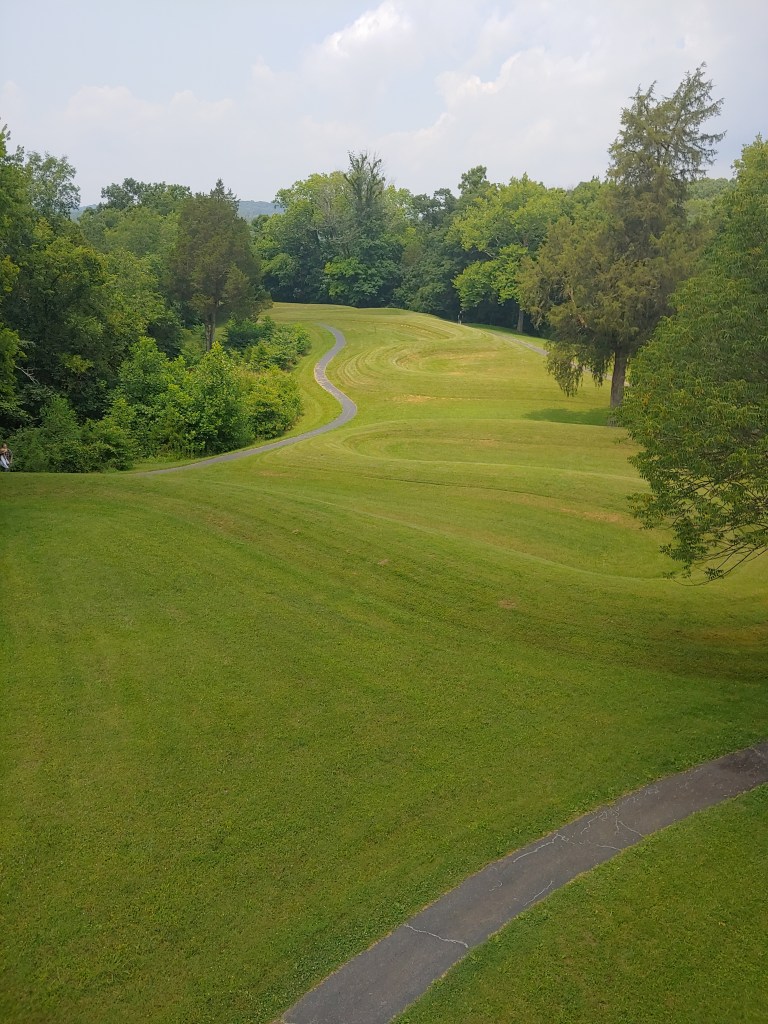
This post originally appeared on this site on July 19, 2019.
Ohio’s serpent mound was first discovered by white people in about 1846. It was difficult to survey or even to find due to being covered in trees and brush. When the brush was partly cleared, it became obvious that the mound, perched on a cliff at the confluence of a creek (which cliff itself resembles the head of a serpent), was a really remarkable earthwork and was designed to be visible from the nearby valley.
The following article will draw on the book The Serpent Mound by E.O. Randall, published in 1905, which is a compilation of maps, surveys, and speculation about the mound by archaeologists of the time; and on my own visit to the mound. One advantage in using these older sources is that we get a variety of voices, we can learn what the Mound looked like when it was first (re)-discovered, and we get an archaeological perspective that is different from the modern one. For example, one source in Randall’s book says the mound appears to be “not more than 1,000 years old, nor less than 350 years” (p.50). This is not very precise, but I actually prefer it to a super-confident proclamation about the mound’s age based on dating methods and assumptions that might be suspect. In fact, the uncertainty of this early source is echoed by the informational video in the mound’s museum. It features an archaeologist saying that we could get “a million different carbon dates” from the mound because the earth was that used to build it was already old and had been through multiple forest fires, etc. He adds that it’s basically impossible to carbon-date earthworks.
On the Road to Serpent Mound

To get to Serpent Mound (at least from where we are), you get in your car and head south over the Ohio highways. You leave behind the urban build-up and progress into farm country. Eventually, the landscape becomes less Midwestern and more Appalachian. Hills and hollers take the place of open farmland. Finally, after hopping from one rural route to another, you find yourself winding through thickly wooded hills in southern Ohio. You approach the Mound from the South. Though it stands on a bluff overlooking Brush Creek, the area is so heavily wooded that you can’t catch a glimpse of the Mound on your way in.
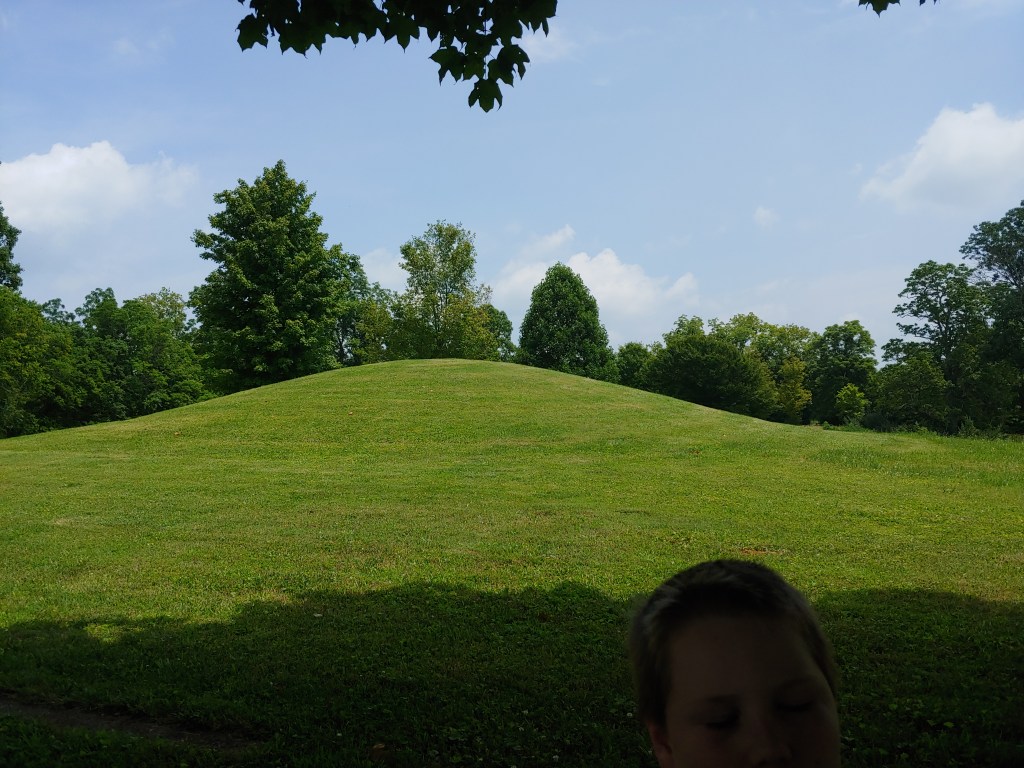
This land was purchased in 1885. At that time, the land was owned by a farmer and the Mound was “in a very neglected and deplorable condition” (Randall 106). To save the Mound from “inevitable destruction,” a Prof. F.W. Putnam arranged to have it bought by the Trustees of the Peabody Museum, Cambridge, where he was Chief of the Ethnological and Archaeological Department. Putnam later worked to have a law protecting it passed in Ohio, the first law of its kind in the United States (Randall 108). Today the Mound is a National Historical Landmark. Besides the Serpent itself, the area includes some additional burial mounds, a picnic shelter, and a tiny, log-cabin-style museum.
You disembark in the parking lot. The heat, the humidity, the strong sweetish green smells, and the variety of insect life remind you of your Appalachian childhood. They also remind you why you are planning to move out West.
The Serpent Mound Itself

Serpent Mound is difficult to describe in words, so please see the associated maps and photographs. It is 1335 feet long (winding over an area of about 500 feet), varies from three to six feet high, and slopes downward from the spiral tail to the jaws and egg which stand on the tip of the overlook. The head faces West towards the sunset at Summer Solstice. The body includes three bends which may sight towards the sunrises at Summer Solstice, Equinox, and Winter Solstice (short lines of sight and the gentle curves of the Serpent make it difficult to tell whether these alignments were intended for astronomical viewing).
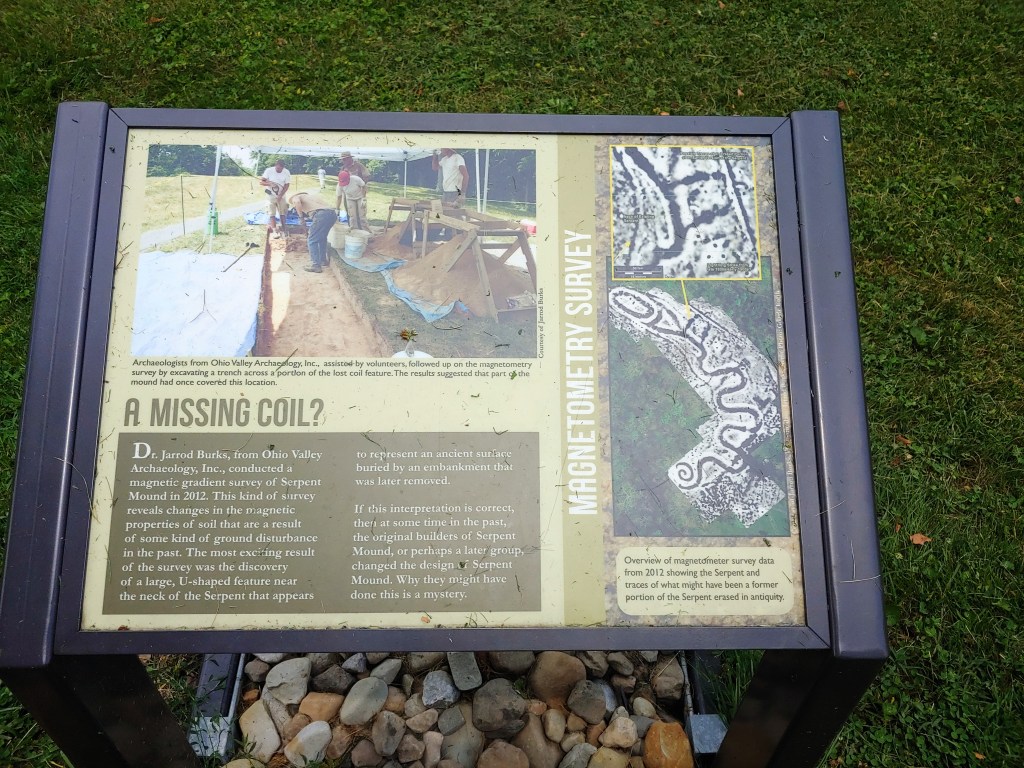
It was made apparently by hand on a base of clay, followed by rocks, more clay, dirt, and then sod. Though it cannot be carbon-dated, there is evidence that it is not as ancient as some megaliths elsewhere in the world. The bluff it sits on and the creeks that surround it cannot be older than the retreat of the glaciers. The burials near it date to the Adena period, which runs 600 B.C. to 100 A.D., though there is no way to tell if the burials are contemporaneous with the Serpent or were added later. There has even been speculation that the Mound could have been built by the Fort Ancient culture, which flourished around 1000 A.D.
The “egg” which the Serpent contains in its jaws (or, the Serpent’s eye) used to have in its center a stone altar which bore traces of fire. (In the largest burial, too, the corpse was placed on a bed of hot coals and then covered with clay while the coals were still smoldering.) We assume, then, that the Serpent was the site of ceremonies, but we have no way of knowing anything about their nature.
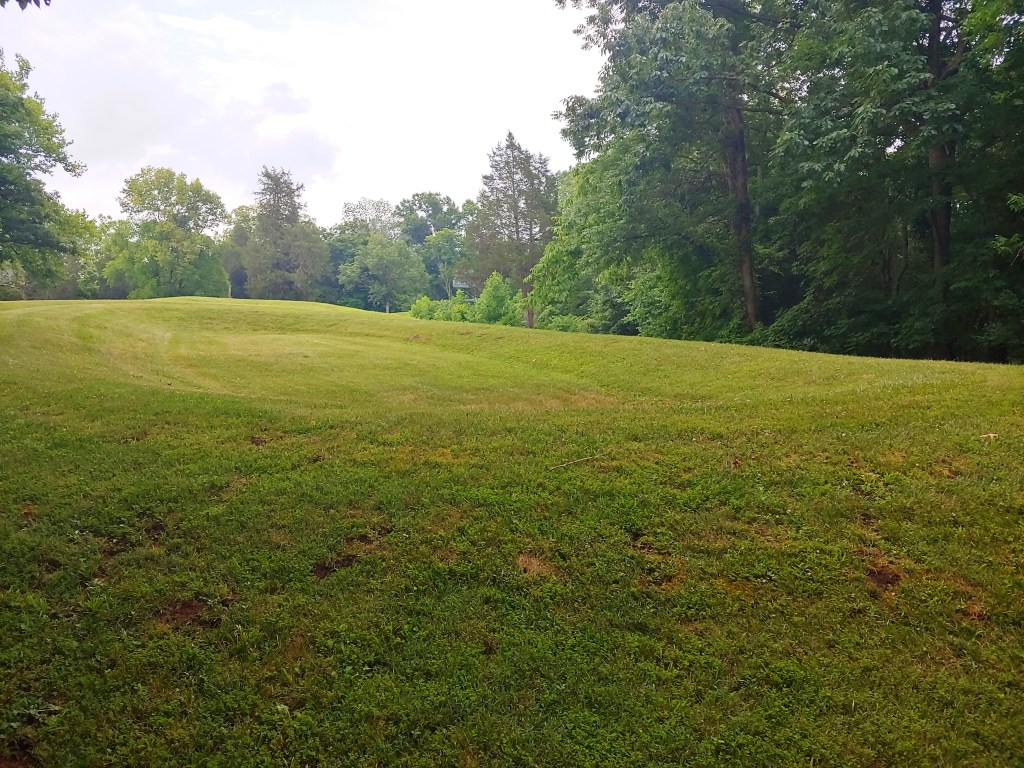
The Serpent, despite its name, does not give a spooky or “wrong” feeling. The scale of it is very human and does not overwhelm. The shapes and proportions of the curves are pleasing and give a sense of calm and beauty. The Serpent is, in fact, inviting to walk on. One is tempted to walk along the curves, climb down into the oval of the egg, step into the middle of the spiral tail. One cannot do this, of course, as it is strictly forbidden.
The only problem with Serpent aesthetically (if this is a problem) is that it’s impossible to view it all at once. This is mostly because of the bend in the tail. In modern times an understated observation tower has been placed next to the Serpent, right near the tailmost curve. But even from the top of this tower it is impossible to take in the entire Serpent with either eye or cellphone camera. Looking to the left, we get a view of the spiral tail. Looking to the right, we see the undulations stretching off into the distance and falling away with the slope of the hill, but even then we cannot see the entire head because it takes its own slight curve and is blocked by trees.
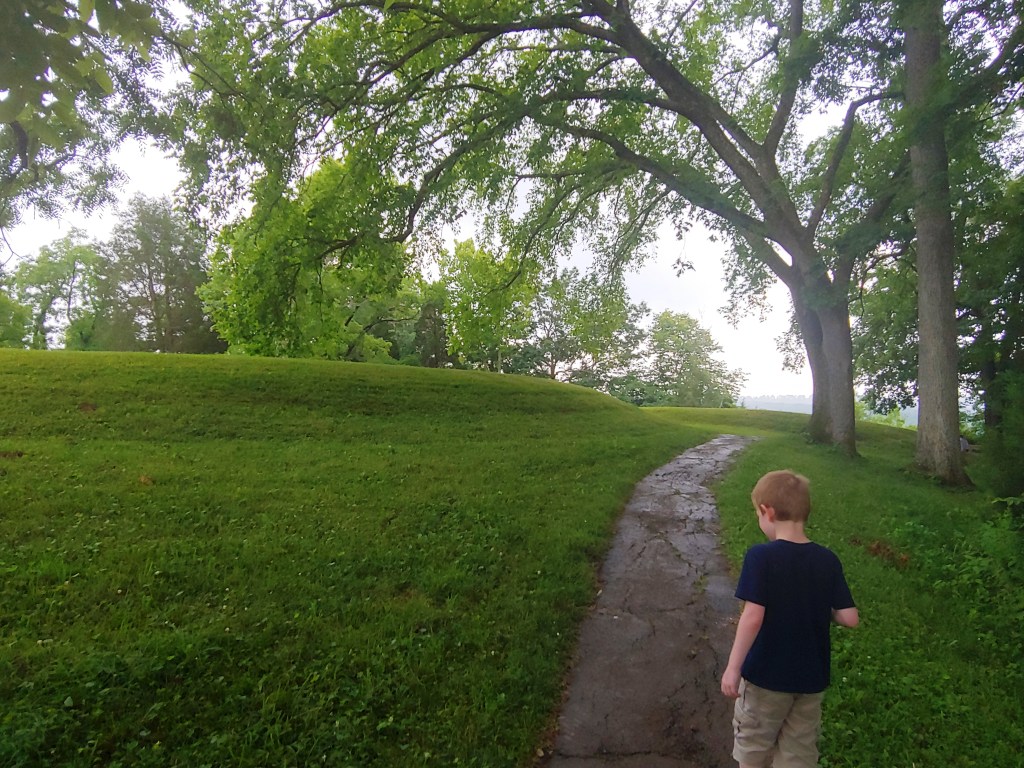
I can’t help but think this effect is intentional. This monument is not designed to be taken in all at once, looking along a line of sight, and to overwhelm the viewer. Instead, it’s apparently designed to draw us on, tantalizingly offering small charming vista after small charming vista. There is no one best place to view it. Perhaps the architects among us can explain what this says about the minds and intentions of the people who designed it.
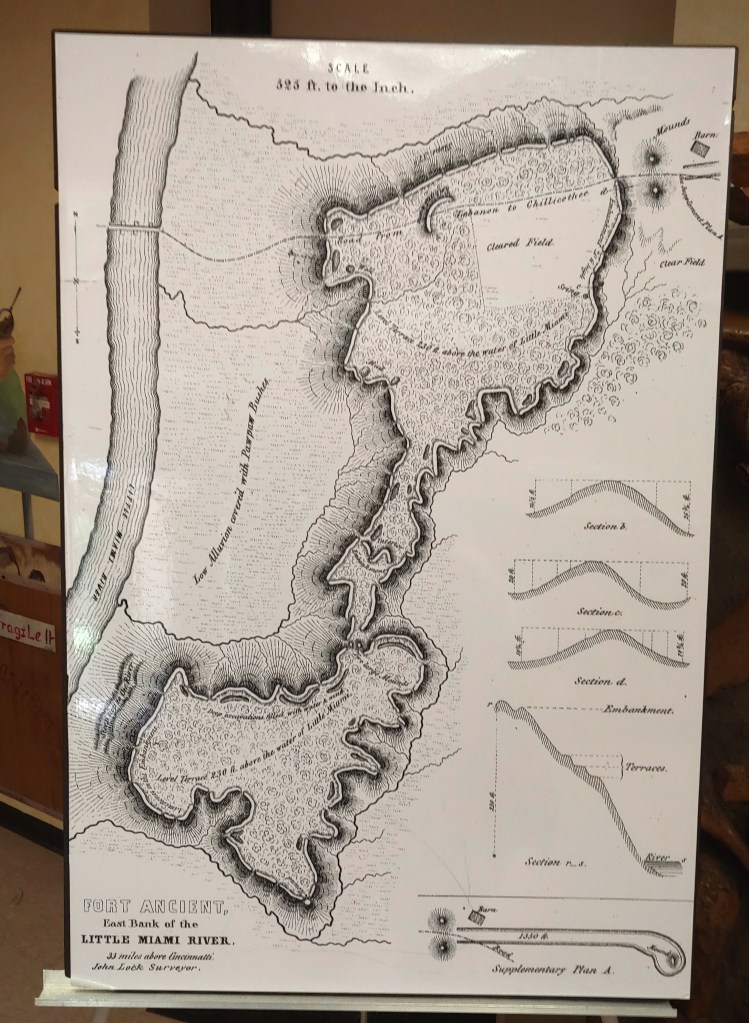
Fort Ancient, another hill-and-plateau complex in southern Ohio, is also sprawling, hard to view, and offers the same “please explore me” effect.
“Effigy Mounds” in North America
The Serpent is definitely not the only large animal-shaped mound in North America. There are many of them, called by archaeologists “effigy mounds” (not the usual meaning of the term effigy).
“The effigy mounds appear … in various parts of … the Mississippi Valley. They are found in many of the southern states; many appear in Illinois, but Wisconsin seems to have been their peculiar field. Hundreds of them were discovered in that state … In Wisconsin they represent innumerable animal forms: the moose, buffalo, bear, fox, deer, frog, eagle, hawk, panther, elephant, and various fishes, birds and even men and women. In a few instances, a snake. In Wisconsin the effigies were usually situated on high ridges along the rivers or on the elevated shores of the lake. Very few effigy mounds have been found in Ohio – though it is by far the richest field in other forms of mounds.” (Randall 31)
There are, of course, large animal-shaped terraforms in other parts of the world, such as the Uffington and Westbury White Horses in Britain and the Nazca Lines in Peru.
So Ohio’s serpent mound is not unique. It is, however, impressive and well-done, and tends to strike people as mysterious and significant.
The Serpent Mound is a Giant Rorschach Blot
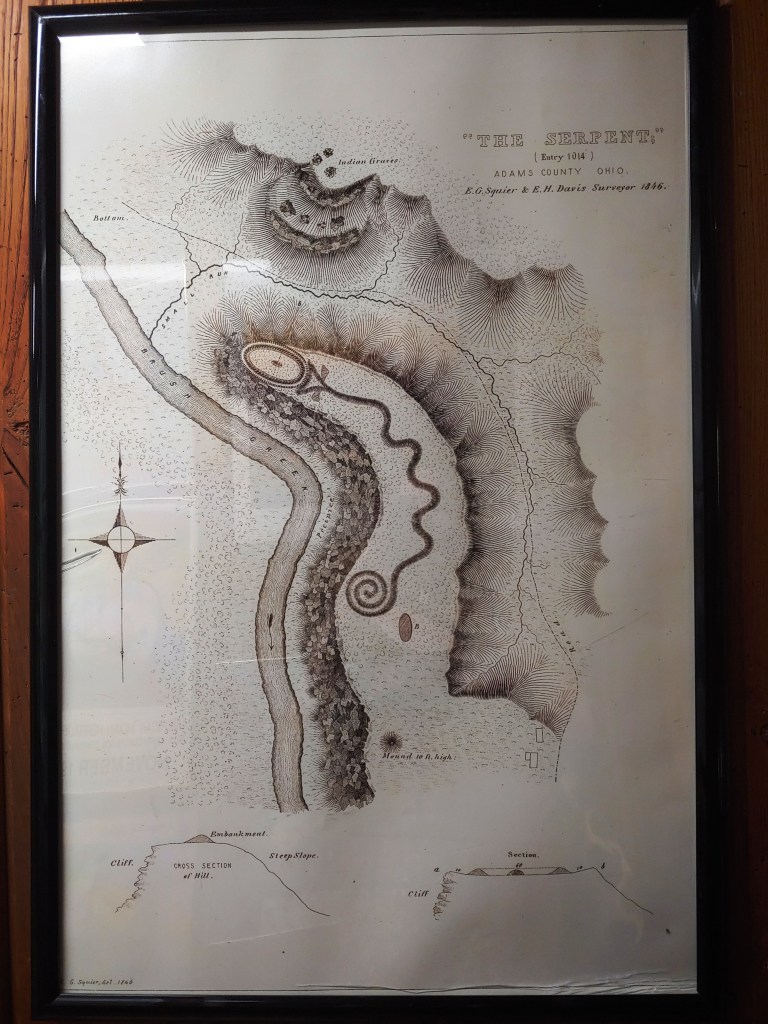
Whatever else it might be, the Serpent Mound reliably functions as a giant Rorschach blot. It appears significant but ambiguous. Everyone who is not content to admit that we don’t know its purpose tends to bring their own interpretation.
Here are four examples.
One example, roundly mocked in Randall’s book, is the “amusing and ridiculous” “Garden of Eden fancy” (p. 93). This theory, put forward by a Baptist minister of the day, is that the Mound was built by God Himself to commemorate the eating of the forbidden fruit and to warn mankind against the Serpent. The oval object, which many people take to be an egg, is on this view the forbidden fruit itself, which the Serpent is taking in its jaws as if to eat or offer. Furthermore, the three streams that come together nearby represent the Father, the Son, and the Holy Spirit. “Pain and death are shown by the convolutions of the serpent, just as a living animal would portray pain and death’s agony … America is, in fact, the land in which Eden was located” (pp 99, 101).
Now, here’s another interpretation, based on the accepted anthropology of the day: “Students of anthropology, ethnology and archaeology seem to agree that among the earliest of religious beliefs is that of animism or nature worship. Next to this in the rising scale is animal worship and following it is sun worship. Animism is the religion of the savage and wilder races, who are generally wanderers. Animal worship is more peculiarly the religion of the sedentary tribes … Sun worship is the religion of the village tribes and is peculiar to the stage which borders upon the civilized. ‘Now judging from the circumstances and signs,’ says Dr. Peet, ‘we should say that the emblematic mound builders were in a transition state between the conditions of savagery and barbarism and that they had reached the point where animal worship is very prevalent’” (pp. 37 – 38).
This theory of the slow development of man’s religion as they rise out of “savagery” into “barbarism” and finally into “civilization” is reported with much more respect than the Baptist pastor’s theory, but it is in fact just as fanciful. It is based on an overly neat-and-tidy and, frankly, snobby view of the history of religion that was popular for many years but that actual history does not support. But, again, Rorschach blot.
Many other observors have linked the Mound with its oval to the “egg and serpent” origin mythology that crops up in many places in the world, including Greece and India. This theory receives many pages in Randall’s book.

To take just one more out of many other examples, on this very blog we learned from a book review that Graham Hancock’s latest book prominently features the Serpent Mound as part of his latest theory that North America is, in fact, the source of the Atlantis legends. He believes that the Mound is meant to represent the constellation Draco and was built during an era when Draco was ascendant. Or something like that.
I, too, have taken the Serpent Mound Rorschach test and here is what I see. I see more evidence that serpent mythology (with or without eggs) and the strong motivation to build large, long-lasting religious monuments are both universal in human culture. I personally think that these things didn’t arise independently in every corner of the world but were carried distributively and that they represent distant memories of certain events in human history, which are hinted at but not fleshed out in the early chapters of Genesis. However, I am not fool enough to think that the existence of Serpent Mound “proves” any of this. It is, as I said, a Rorschach blot.
Other Serpent Mounds Around the World
Otonabee Serpent Mound sits on the north shore of Rice Lake, not far from the city of Toronto, Ontario (Randall 114). It is 189 feet long. The head faces “a few degrees north of east,” with an oval burial mound in front of the head which could represent an egg (115).
In Scotland, there is the stone serpent of Loch Nell:
“The mound is situated on a grassy plain. The tail of the serpent rests near the shore of Loch Nell, and the mound gradually rises seventeen to twenty feet in height and is continued for 300 feet, ‘forming a double curve like the letter S’ … the head lies at the western end [and] forms a circular cairn, on which [in 1871] there still remained some trace of an altar, which has since wholly disappeared, thanks to the cattle and herd boys. … The mound has been formed in such a position that worshippers, standing at the altar, would naturally look eastward, directly along the whole length of the great reptile, and across the dark lake to the triple peaks of Ben Chruachan. This position must have been carefully selected, as from no other point are the three peaks visible. General Forlong … says, ‘Here we have an earth-formed snake, emerging in the usual manner from dark water, at the base, as it were, of a triple cone – Scotland’s Mount Hermon, – just as we so frequently meet snakes and their shrines in the East.’” (Randall pp. 121 – 122)
Speaking of Mount Hermon. This large, lone mountain sits at the northern end of the Golan Heights in Israel. It is so high that it is home to a winter ski resort. In ancient times, this region was called Bashan. It was known for its large and vigorous animals (the “bulls of Bashan”), and for its humanoid giants. Down to Hellenistic times, Bashan was a center for pagan worship (the Greek god Pan had a sacred site there). And guess what else it has? A serpent mound.
“The serpent mound of Bashan has ruins on its head and tail. The ruins are square (altars?) on top of small circular mounds” (Van Dorn 144).

This serpent mound is less than mile from a stone circle called Gilgal Rephaim (“Wheel of the Giants”). (Stone circles, as sacred sites, are also found throughout the world.) “The Wheel contains some 42,000 tons of partly worked stone, built into a circle 156 meters in diameter and 8 feet high on the outer wall. It is aligned to the summer solstice. The area is littered with burial chambers … If you go due North of the Wheel, [sighting] through the serpentine mound [and proceed] for 28 miles, you will run straight into the summit of Mt. Hermon” (Van Dorn 145).
Serpent, altar, circle, and sacred mountain. I don’t know about you, but the site in Golan sounds a lot scarier to me than Ohio’s Serpent Mound. However, it also makes me wonder whether people in Ohio – and Scotland – were trying to re-create this arrangement.
Sources
Giants: Sons of the gods by Douglas Van Dorn, Waters of Creation Publishing, Erie, Colorado, 2013.
The Serpent Mound: Adams County, Ohio: Mystery of the Mound and History of the Serpent: Various Theories of the Effigy Mounds and the Mound Builders, by E.O. Randall (L.L., M., Secretary Ohio State Archeological and Historical Society; Reporter Ohio Supreme Court), Coachwhip Publications, Greenville Ohio, 2013. First published 1905. This book is a compilation: “The effort has been made not merely to give a description, indeed several descriptions, of Serpent Mound, but also to set forth a summary of the literature concerning the worship of the serpent. … It is hoped that this volume, while it may not solve the problem of the origin and purpose of the Serpent Mound, will at least add to its interest and give the reader such information as it is possible to obtain.” (page 5)
 Out of Babel Books