Do Your Part. Stop Eating, Going to the Bathroom, and Reproducing.

So, this might be a little bit of a rant.

Today we have this lovely article, the link for which was sent to me by my husband:

Hobbits and other early humans not ‘destructive agents’ of extinction, scientists find

I’ll give you a moment to click on the link and go read the article in all its awful glory.

Ah.

There. You back?

Let’s take a moment to appreciate everything going on with this article. First of all, the unironic use of “hobbits” in the headline. Waaay down in the article we get the explanation, “For example, on Flores in Indonesia, where the “Hobbits,” or Homo floresiensis, lived …” I kind of have an issue with naming an actual group of humans, “hobbits.” Granted, maybe they were short, like some people groups living in the Philippines, Australia, and Africa today. And at least, in the explanation, the term is put in quote marks. But when you use Hobbits with no quote marks in a headline, it gives the impression that you don’t know what you are talking about, sort of like some of the news articles that came out when the Lord of the Rings movies did, which incorrectly summarized the books.

Secondly, when we did start calling everyone hominins instead of hominids? That also looks like a typo. I’m guessing what it actually is, is some newfangled anthropological term that is meant to imply a class of beings that were somehow even less human than hominids. You all know my feelings on that. (Human rights for Neanderthals!)

Thirdly, as a not-too-dim layperson, I’ve got to say that the “findings” in this article strike me as a sort of rickety Tower of Babel of assumptions (see what I did there?), piled on top of one another, each one of which could possibly turn out to be bunkum. First, there is the difficulty and inconsistency of dating events millions of years in the past. Related to this is the uncertainty of determining, at this time depth, such things as exactly when and why a given species went extinct, and when a population actually arrived on an island.

Finally, the word “jerk.” I don’t mind this word; I use it when called for. In this article, all it takes to be a jerk, apparently, is to exist as a human and cause some kind of detectable change to the natural environment. This is coming out of the whole world view where humans are not part of any kind of design for the world and are not supposed to alter it in any way; hence any human-caused environmental change is by definition bad. I mean, I’m with you; I think the Mediterranean dwarf elephant was cute and it’s too bad if humans contributed to its demise. But when things pass away, we can mourn them even if it was their time to pass away.

Example: I recently heard the argument made that “the earth is fragile.” Evidence to back this up was that the Everglades, a unique swamp ecosystem in Florida, will vanish if sea levels rise. Now, that would be a shame. We would indeed lose many things if sea levels rose. But the Everglades are not the same as the earth. Sea levels have been lower in the past, as evidenced by many archaeological sites that we discover off the coasts. Sea levels rose, and those parts of the land were lost to us. But the earth went on. On the other hand, much of North America was once, I am told, a shallow inland sea. Now it’s plains, mountains, deserts, etc. Again, the ecosystems changed — a lot — but the event was more properly termed change than just purely destruction.

Assuming that the many premises in this article are actually true, and that they actually support the conclusion that ancient humany people had less of an impact on the natural environment than did people in the last 12,000 years or so, I can think of one major reason that would be the case: population density. Lower populations have less impact on their environment. They just do. You cannot eat all the mammoths when the mammoths outnumber the people. Also, if you have a teeny tiny village of just a few dozen people, even your sewage is not that big a deal. You can go and do your business back in the woods behind your garden. People don’t even really see the point of toilets until a certain population density is reached.

So, if a larger population means more environmental impact, and environmental impact means you are a “jerk,” then we have finally identified the problem. The problem, on this value system, is that there are too damn many of you. Put another way, the big problem with you is that you exist.

So, if you want to be morally upright according to this value system, but you don’t quite feel up to suicide, I suggest you that make like Harry Potter and “be in [your] room, being very quiet and pretending [you] don’t exist.”

Here are some practical ways to apply that.

Stop eating all the animals. (Ideally, stop eating.) Stop breathing out so much carbon dioxide. Try not to fart, of course, and also not to produce too much sewage. (That will be easier once you stop eating.) And whatever you do, for God’s earth’s sake don’t produce any more awful human beings! They will just go on eating and breathing and pooping and doing all those icky things that destroy the beautiful Everglades.

Misleading Archeology Headline of the Week

Pottery Shard May Be ‘Missing Link’ in the Alphabet’s Development

So, according to the article itself, here’s what is really going on:

“… the script represents a “missing link” connecting alphabetic inscriptions found in Egypt and Sinai with later writing from Canaan. The writing uses an early version of the alphabet in which letters bear a resemblance to the Egyptian hieroglyphs they evolved from. The finding appears to overturn a previous hypothesis that the alphabet only came to Canaan when Egypt ruled the area.”

OK, so instead of this particular alphabet being brought directly from Egypt through imperialism, it seeped over much earlier, through cultural influence. That’s a “missing link”? O.K.

Also, note that this shard has been dated to about 1450 B.C., which is much younger than some other systems of writing, including the Vinca signs.

But my favorite line from the article is this: “… the researchers have not definitively determined what the inscription says. Also unclear is whether the writing was meant to be read from left to right or right to left.” So, we don’t know whether to read it right to left, but we have come up with a tentative translation.

I Guess We’re Really Doing This, Book #2

Don’t you look handsome, Book #2!

Uploading you was tricky. It was a two-week ordeal that gave me fits. Now, that could have been because I am nearly computer illiterate, but I prefer to think it was Satan — a.k.a. Resistance — trying to keep you from being published. You know, because you are so important and all.

Anyway, here we are.

Hi Blog Readers! Soon You Can Buy My Second Book!

The Strange Land is set go on sale May 3, in honor of a certain dear older relative’s birthday. You should be able to pre-order it soon. I just checked, and it doesn’t appear to be on Amazon yet, but that’s probably because I only released it for publishing just a few hours ago. When I have a link, I will give you one on this very blog. I’m also updating the “buy my books” page.

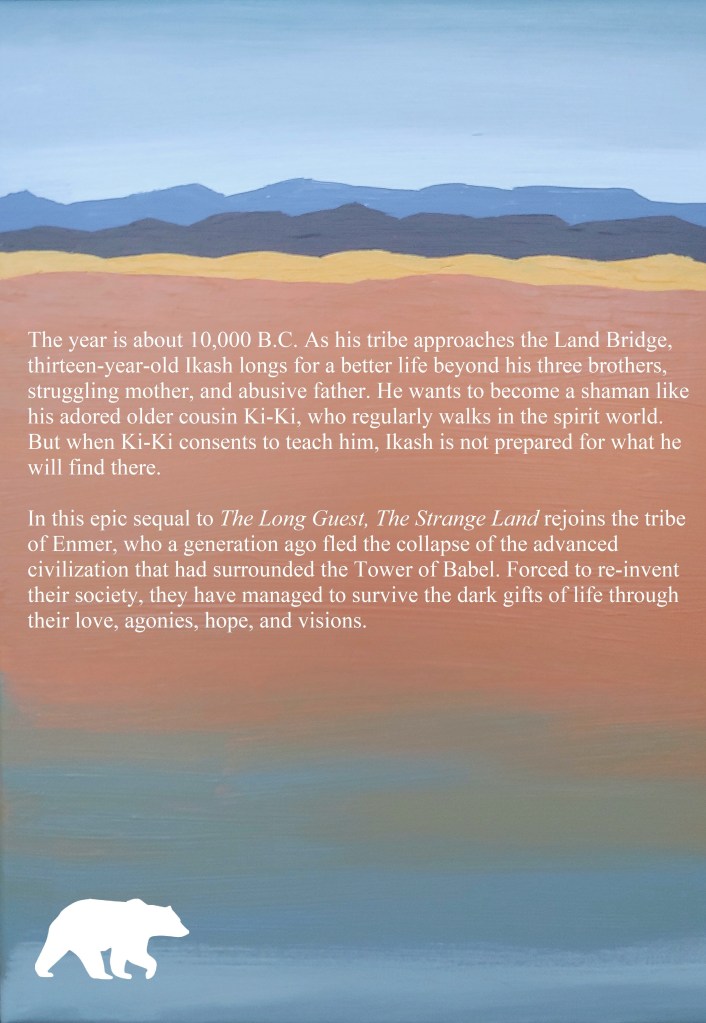
The Strange Land picks up more or less where The Long Guest left off and follows the second generation of Enmer’s family. Here is the back cover:

Aaand there it is … the one embarrassing typo.

And just for the thrill of it, here is the spine:

A sample print copy is on the way to my house. Let’s hope that by the time it arrives, the typo will have vanished!

Have a great week, all, and I will keep you updated.

Pre-order The Strange Land on Amazon.

More About the Antikythera Mechanism: An Ancient Greek Computer

It was sort of an i-phone, actually. We use ours to check Facebook.; they used theirs to check the position of the planets.

It was only about the size of a shoebox. It was found in a shipwreck. Because of the corrosion and the delicacy of it, reconstructing it has been the task of decades. They left us a puzzle; we are figuring it out. Here is an article about some of the latest discoveries about it. Here you can see a video about it.

There are still some questions. Like, did it do some things that we haven’t found yet (due to the damage to it)? How did they make it (since we don’t think they had lathes)? Given that they could make things like this, how come we haven’t found a lot more? In fact, are there more to be found in this very shipwreck? Why didn’t they make clocks? (Hint: maybe because you don’t really need clocks until you have electric lights and trains.) So many exciting questions! No sarcasm here. I really am excited.

This reminds me of what my Old Testament Backgrounds teacher once said about Babel: “If God hadn’t confused the languages, perhaps the industrial revolution could have happened right then.”

Archaeological Find: Yikes.

Archaeologists in Israel Unearth 3,800-Year-Old Skeleton of Baby Buried in Jar”

Ancient world, why oh why did you bury babies in jars? And why did you have myths about children being imprisoned in jars while still alive?

Maybe you had a good reason. The archaeologists in this article are giving you the benefit of the doubt, saying that you wanted to protect the body, or re-create a womb-like environment. That could be true. I hope it’s true.

But all I can say is that this creeps me out.

Let’s Go Way Back

Today, because yesterday was Valentine’s Day, I am posting a poem that I … ahem … love. No, it’s not by me, nor is it by G.K. Chesterton. (Though he did write some great poetry.) It’s by a rising star who happens to be a friend of mine … Benjamin Ledford.

The Normans came to England and they found the Saxons there.

The Saxons said “Go back to France! We’re first! This isn’t fair!”

But the Saxons came from Germany where they had lived before,

And came and found the Angles living on the English shores.

The Angles were from Denmark whence they came in viking raids,

And they conquered tidy towns and forts that Roman troops had made.

The Romans came from Rome, of course, that goes without much saying,

And when they invaded England it was Celts that they were slaying.

Some Celts had fled to Scotland as they hurried to escape,

But others were already there — the Picts for goodness’ sake!

And before the Picts or Celts or Brits or any of these others,

There was someone building Stonehenge in the south with giant boulders.

And those Stonehenge folks, well surely, they’re the oldest Englishmen.

But could it be, or do you wonder,

Was there someone there before them?

Ben Ledford, 2021

Now, go forth and read this to your history students!

I Know What You Want.

You want 30 hours of theology podcasts.

I mean, who wouldn’t want that?

So, here’s what this is. Christian novelist Brian Godawa has gotten his hands on a pre-release copy of a commentary on the book of Revelation, The Divorce of Israel, by Kenneth Gentry. The gist of it is that Gentry’s interpretation is preterist, i.e. coming from a point of view that most of the events in Revelation have already happened during the horrible years of Rome’s siege of Jerusalem in 70 A.D. In other words, they were not prophecies of the distant future when John gave them, but rather prophecies of the immediate future. That’s the reason for the frequent warnings that “these things will soon take place.”

But, you say, what about all the stuff in Revelation that definitely sounds like the end of the world: the stars falling, the sky rolling up like a scroll, Jesus coming in the clouds, etc., etc.? Godawa shows, following Gentry, that all of this “collapsing universe imagery” was conventionally used in the Old Testament to describe God’s judgements on nations, usually through a siege, military defeat, and the razing of the countryside.

In the videos linked to above (and the first one embedded below), Through the Black interviews Brian Godawa in a series of 16 videos that are 1 – 2 hours each. That’s how long it takes them to go through Revelation chapter by chapter (and also Matthew 24), answering all the “what about”s that are probably popping into your head if you have ever been exposed to the usual type of modern evangelical teaching on Revelation.

As the Through the Black host says many times on these podcasts, eschatology matters. It can even have life-and-death consequences. Just look at David Koresh. Even mentioning Revelation, outside of Christian circles, nowadays is enough to get you branded as a loon. Inside Christian circles, it can still cause people to run screaming from the room, and who could blame them? Preterism gives us a way to look at this book that is consistent with the rest of Scripture and which doesn’t force us to create elaborate, increasingly self-contradictory systems of thought that will drive us crazy. If you like to listen to podcasts, join me in working your way through this one.