I’ve mentioned before on this blog how archaeologists are constantly finding human cultural items that break records for “the oldest”: the oldest city, the oldest stone, temple, etc. Now here’s another one.
Two great things about this cave painting: it’s in Indonesia, and it’s of a pig.
“‘The people who made it were fully modern, they were just like us, they had all of the capacity and the tools to do any painting that they liked,’ [Aubert] added.”
Also, the painting is accompanied by stenciled hand prints that are made by placing your hand on the wall, filling your mouth with powdery dye, and blowing the dye onto your hand and the surrounding area. The last line of the article says that “the team are hoping to try to extract DNA samples from residual saliva.” Wouldn’t it be cool if they could do this and then sequence the DNA? And what if they were able to find a modern person who shares distinctive DNA with that unknown artist who made these hand stencils so many thousands of years ago? If they do, I think it’s a good guess they will find that person living right near the cave. That’s often how it works out. Modern-day relatives of the Ice Man were found living not far from where his body was discovered.
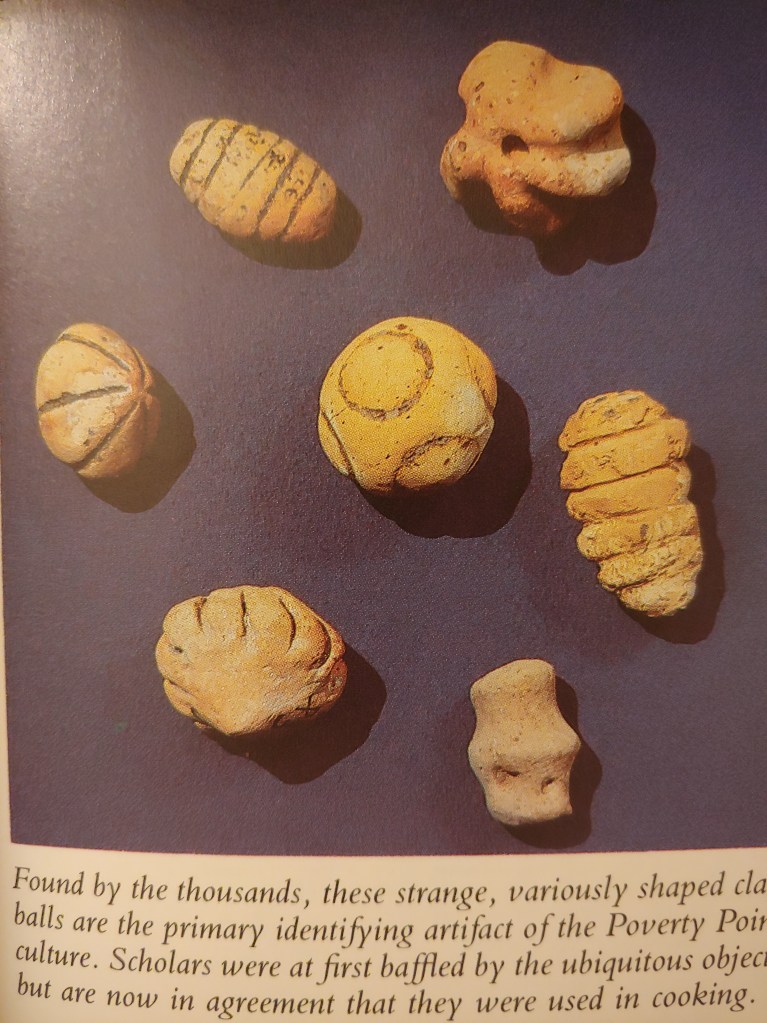
Clay “cooking balls” of the kind used in the Poverty Point culture in what in now Louisiana
Original title: “Cooking with Balls.” I didn’t have the … you know, courage … to go through with that one. But it’s not my fault! “Cooking Balls” is, I promise you, what they are called in the source material.
Although we know little about the Poverty Point people and their extraordinary center on Bayou Macon, we do know a great deal about their cooking habits. The most typical of all the artifacts is — surprisingly enough — a small baked clay ball, only one to two inches in diameter and two to three ounces in weight. The odd-looking balls, most often molded in melon, oblong, cylindrical, spiral, and biconical shapes, were used in cooking. Thousands of them have been unearthed so far. Indeed, so ubiquitous are these tiny finds that they are simply called Poverty Point objects.
The Poverty Point people used them not only more intensively than others [who cooked with heated stones], but also more innovatively, for a new style of cooking: pit-oven baking.
Mysteries of the Ancients Americas, The Reader’s Digest Asscn, Inc., pp. 113 – 114
The Poverty Point people, reconstructers think, would wrap fish, meat, or potatoes in wet leaves, place them on a bed of hot coals, and then cover them with a layer of hot clay balls. You know, they basically made what at camp we used to call a “hobo dinner.” Except we were always eating our hobo dinners half-raw, because we were not as patient as the people at Poverty Point.
In the Out of Babel blog tradition of writing about some ancient practice and then pretending that we are still doing it, I would like to show you my own cooking beads.
“Cooking balls” of the kind used by the modern mom
Not the greatest lighting on this photograph, but here they are, sitting in a nest of aluminum foil, on my ultramodern, convenient electric stove. The only modern use of clay cooking balls that I am aware of, is to make baked pie crust shells. If you bake the pie crust with nothing in it, it bubbles up, warps, and then it can’t hold the instant pudding later. You have to weight it down with something. You can use just two layers of aluminum foil, but heavier is better. For a while I was using uncooked lentils (per Martha Stewart). They worked OK, but they had a certain legume-y smell when baking and besides, clay cooking balls are so much cooler. I suppose that in a pinch, I could use them for pit cooking. Let’s hope it never comes to that.
According to archaeologists, the Poverty Point cooking balls “could be used about 10 times before they cracked apart.” And yet, they put so much effort into them, making pretty designs and everything! I can imagine that making these little items was a creative outlet as well as a chore. Whereas, my cooking beads are completely plain (and still look like they were a hassle to make in such quantity), and I expect them to last for years. Of course, I don’t use them daily, and certainly not for the two hours it apparently takes to pit-cook food.
As I heard a podcaster say, “The plural of anecdote is data.”
Wait. Are We Even Sure It Was Worldwide?
You can make a case that the account in Genesis 7 – 8 is not necessarily describing a global flood. This is because the same Hebrew word can be translated “world,” “earth,” or “land.” How we interpret it depends upon context. There is a case to be made, for example, that the whole book of Revelation is describing the devastation of the land of Israel during the destruction of Jerusalem in 70 A.D. (hence the frequent warnings that it is going to happen “soon”), and that lines like “one third of the people on the earth died” are better translated as “one third of the people in the land died.”
I have even seen people try to interpret the poetic descriptions of creation in Genesis 1 and 2 as happening from the perspective of a person standing on the surface of the earth, in the land of Israel.
However, getting back to the flood narrative, there are good reasons to think that the text is in fact describing a global flood. This passage is set in very ancient times, before the nation of Israel existed. It’s before Abram was called by God out of Ur. Before Abram was even born. Before the Table of Nations (Genesis 10). So, not only was there no nation of Israel at the time of flood narrative, but we can’t even be sure there was a land of Israel, given the dramatic damage that the flood did to the earth’s geography. (And by the way, yes, I have just revealed that I think the flood narrative was not composed by Moses — even under the inspiration of God — but was passed down to Moses from a much older source.)
Finally, it’s hard to imagine how a local flood could “cover the mountains to a depth of more than fifteen cubits” (Genesis 7:20) … especially for enough of a length of time for Noah and his sons to take soundings so as to estimate this depth.
So, given all this, I don’t think it’s straining the text to say that the flood account in Genesis is meant to be describing a global event.
Like so many sensational things in the Bible, the flood account sounds hard to believe, but the longer we look at it, the better it matches with the world we live in. Here are some features of the world we live, which are features we would expect if the dark millennia of our past concealed a worldwide flood.
Oral Flood Histories from Around the World
I have written before about Graham Hancock. I really enjoyed his book Fingerprints of the Gods, which posits an ancient period of cataclysms that included “earth crust slippage,” a geological upheaval so dramatic that it would have caused catastrophic floods among many other disasters. Hancock keeps changing his theories, and he has his own reasons for collecting the historical data that he does. However, here is some of the data that he conveniently collected about flood legends worldwide:
More than 500 deluge legends are known around the world and, in a survey of 86 of these (50 Asiatic, 3 European, 7 African, 46 American and 10 from Australia and the Pacific), the specialist researcher Dr. Richard Andree concluded that 62 were entirely independent of the Mesopotamian and Hebrew accounts.
Hancock, Fingerprints, p. 193
People Group
page in Fingerprints
summary
Aztec
98
“First Sun, Matlactli Atl: duration 4008 years. In this age lived the giants … The First Sun was destroyed by water in the sign Matlactli Atl (Ten Water). It was called Apachiohualiztli (flood, deluge), the art of sorcery of the permanent rain. Men were turned into fish. Some say that only one couple escaped, protected by an old tree living near the water. Others say there were seven couples who hid in a cave until the flood was over and the waters had gone down. They repopulated the earth and were worshipped as gods in their nations …”
Sumerian
188 – 189
The Noah figure is called Utnapishtim. He later tells his story to Gilgamesh. It almost exactly parallels the Genesis 7 account.
South American tribes
191 – 192
Hancock mentions flood accounts coming from the following tribes: Chibcas (Colombia); Canarians (Ecuador); Tupinamba (Brazil); Araucnaian (Chile); Yamana (Tierra del Fuego); Pehuenche (Tierra del Fuego); and numerous groups in Peru.
Inuit
192 – 193
“a terrible flood, accompanied by an earthquake, which swept so rapidly over the face of the earth that only a few people managed to escape in their canoes or take refuge on the tops of the highest mountains.”
“The planets altered their courses. The sky sank lower towards the north. The sun, moon, and stars changed their motions. The earth fell to pieces and the waters in its bosom rushed upwards with violence and overflowed the earth.”
Southeast Asia
194
Flood accounts in: Chewong (Malaysia); Laos and northern Thailand; Karen (Burma); Vietnam; tribes along the northern coast of Australia
Hawai’i
194
“The world was destroyed by a flood and later recreated by a god named Tangaloa.”
Samoa
194
The flood is survived by “two human beings who put to sea in a boat which eventually came to rest in the Samoan archipelago.”
Japan
194
The Pacific islands were formed after the deluge receded.
Greek (Hesiod)
195 – 196
After a series of races of gold and silver, there is a “bronze race” who “have the strength of giants, and mighty hands on their mighty limbs.” After Prometheus gets them into trouble, Zeus wipes out the bronze race with a flood. Deucalion and Pyrrha float over the sea in a box for nine days and finally land on Mt. Parnassus.
“Vedic India”
196 – 197
The Noah figure is named Manu. He rescues a fish, which in return warns him of a coming flood. Manu loads a ship with two of every living species and seeds of every plant. The fish turns out to be Vishnu, who pulls Manu’s ship through the flood.
Egypt (Book of the Dead)
197
Thoth says, “They have fought fights, they have upheld strifes, they have done evil, they have created hostilities, they have made slaughter, they have caused trouble and oppression … I am going to blot out everything which I have made. This earth shall enter into the watery abyss by means of a raging flood, and will become even as it was in primeval time.”
Mayan (Popol Vuh)
203
“It was cloudy and twilight all over the world … the faces of the sun and moon were covered … Sunlight did not return till the twenty-sixth year after the flood.”
Norse
204 – 205
An awful lot happens in this apocalyptic tale. First a “hideous winter,” then worldwide war, then Yggdrasil (the earth tree) is shaken, causing the earth to literally fall apart. Then, worldwide fire. And finally, a flood. “The earth sank beneath the sea … Yet not all men perished in the great catastrophe. Enclosed in the wood itself of the ash tree Yggdrasil — which the devouring flames of the universal conflagration had been unable to consume — the ancestors of the future race of men had escaped death. In this asylum they had found that their only nourishment had been the morning dew. Slowly the earth emerged from the waves. Mountains rose again …”
The charming thing about these origin tales is that couple who survive the flood usually end up landing on the local mountain, founding the nation that is currently telling the story, and not moving from that spot ever since. This is similar to how nearly every people group has a local landmark (usually a mountain, terrain permitting) that is believed to be the home of the gods or “the center of the world.”
This is what origin stories are supposed to do. They ground the local community in the great ancient story of the world, and they also give the ancient stories credibility by grounding them in local features “still seen to this day.” This is not to say, however, that origin stories are simply made up out of whole cloth. They are handed down the generations, and though they might get tailored to make human beings look better, and have bits of other interesting stories added to them, they ultimately have some kind of origin in actual events. (Especially since they often come with genealogies that are also handed down.) I can’t imagine the coincidence that would be required for hundreds of peoples all around the world to make up a traditional flood story.
Yes, But It Could Still Have Been Local, If …
… if all of these widely scattered people groups were descended from a small number of couples who were once all in one place and who experienced a catastrophic local flood together.
That is true. Could still be true. And, in fact, even if the entire world were experiencing earthquakes, uplifts and sinkings, tsunamis, etc., all at once, there wouldn’t necessarily have been a moment when water was covering all the land on earth all at the same time. On the other hand, there wouldn’t have to be, for events to satisfy the description given in these flood accounts, including the Genesis one. After all, the perspective from which these stories are told, is that of human beings experiencing the flood and associated disasters, not the perspective of an observer looking at the globe from outer space. The mental picture of the whole world sitting under a flat layer of water, while not impossible, is more of a Sunday School stylization of the account, than the actual claim being made.
Buried Beneath a Wave of Mud
In all of these accounts, the flood is sudden, dramatic, and overwhelming, whether or not it is accompanied by other disasters such as earthquake or fire. Even the Genesis account (often simplified to sound like just rain) says “on that day all the springs of the great deep burst forth, and the floodgates of the heavens were opened” (Genesis 7:11, NIV).
In a world in which this had happened, we should expect to find the remains of plants and animals that had been instantly buried under huge waves of mud and essentially frozen in time. And that is exactly what we do find. Here is the latest example, which was called to my attention by Google within the last month:
This poor dino mom, if she had been given any warning that she was about to be buried in an oxygen-free environment that would later prove convenient to future paleontologists, would probably have fled or tried to move her eggs to safety. OK, maybe she would have stayed to protect them. But we also find fossil dinos caught in the act of, say, eating prey. We find mammoths apparently flash-frozen with summer plants still in their mouths and/or stomachs. I can’t imagine how that could have come about, but it can’t have been gradual. (Although here are some fish who appear to be frozen in a wave, but the process was a quite different.)
Occasionally comparative linguists are able not only to reconstruct individual words in Indo-European, but also whole phrases … Probably the most famous such phrase is *klewos ndghwhitom, “imperishable fame.” The most ancient texts in Indo-European languages, such as the Vedic hymns of ancient India, the Homeric epics, the Germanic sagas, and Old Irish praise-poetry, all demonstrate that the perpetuation of the fame of a warrior or king was of critical importance to early Indo-European society. The preservation of their fame was in the hands of poets, highly skilled and highly paid professionals, who acted both as the repositors and the transmitters of the society’s oral culture.
The phrase *klewos ndghwhitom, (where *klewos is a noun built on the root kleu-, “to hear,” and can be thought of literally as “what is heard about someone, reputation”) was reconstructed on the basis of the exact equation of Greek kleos aphthiton and Sanskrit sravah aksitam. …
Not surprisingly, “fame” is a recurring element in Indo-European personal names. The name of the Greek poet Sophocles meant “famed for wisdom”; the German name Ludwig means “famed in battle”; and the Czech name Bohuslav means “having the fame (glory) of God.”
The American Heritage Dictionary of Indo-Europeans Roots, 3rd ed., p. 44
Now, let’s look at this same concept running strongly throughout Beowulf, an epic that is written in Anglo-Saxon, but set in Denmark before some of the Danes left there for England:
The Almighty granted him renown. Beowulf, son of Scyld, became famous in Denmark, and his fame spread everywhere. Thus, while still under his father’s protection, a young prince should by his goodness and generous gifts so manage affairs that later on his companions may give him support and his people their loyalty in time of war. For among all peoples it is only through those actions which merit praise that a man may prosper. (page 27)
Beowulf: “They tell me that in his vainglory the monster is contemptuous of weapons. Therefore, as I wish to keep the good opinion of my lord Hygelac, I propose to dispense with any kind of sword or shield during the combat. Foe against foe, I shall fight the fiend to the death with my bare hands. Whichever of us is killed must resign himself to the verdict of God. … If I am killed in combat, send to Hygelac the coat of mail which I am wearing. For it is the best corselet in the world, the work of Weland Smith, and an heirloom that once belonged to my grandfather Hrethel. Fate must decide.” (page 37)
By the close of that bloody fight the wish of all the Danes was fulfilled. It was thus that the resolute, cool-headed man who had come from a distant land purged Hrothgar’s hall and defended it from attack. The Geat prince rejoiced in his night’s work. For he had made good his boast to the Danes and put right their trouble … When the hero set up the talon, arm, and shoulder — Grendel’s entire grasp — under the great gables of Heorot, the evidence spoke for itself. (page 46)
Hrothgar to Beowulf: “By your exploits you have established your fame for ever. May God reward you with good fortune, and He has done up to now.” (page 49)
“Venerable king, do not grieve. It is better for a man to avenge his friend than to mourn him long. We must all expect an end to life in this world; let him who can win fame before death, because that is a dead man’s best memorial.” (page 60)
Much in this article is speculation, like the idea that there was an 8,000-year gap between people planting gardens and “full-blown agriculture” (whatever that is). Also, as always, the exact dates.
But this does seem to support the general picture that has been building … namely, that people got to the Americas a very long time ago, traversed them very quickly, and started gardening almost immediately … or perhaps already knew about agriculture before they got there, even if they had abandoned it for a generation or two while traveling. Or, as we like to say around here … (drumroll) … ancient people were already very sophisticated in the earliest records we find of them.
So, we’ve just come through a holiday season, and in the course of the last few months, I have acquired some items that would help me — or you — survive if we were suddenly plopped down in 10,000 BC. It is these that I will share with you today. And by “share with you,” I mean show you pictures. I will not actually give you my swag.
All of these items were gifts to me. (I now have my loved ones trained to give me cave man stuff.) I didn’t buy any of them myself, nor was I sent any of them in exchange for a promotion. Also, outofbabel not be held liable if you should find yourself in a prehistoric situation and these items fail to help you survive. It’s probably a “you” problem.
You Can Talk Good
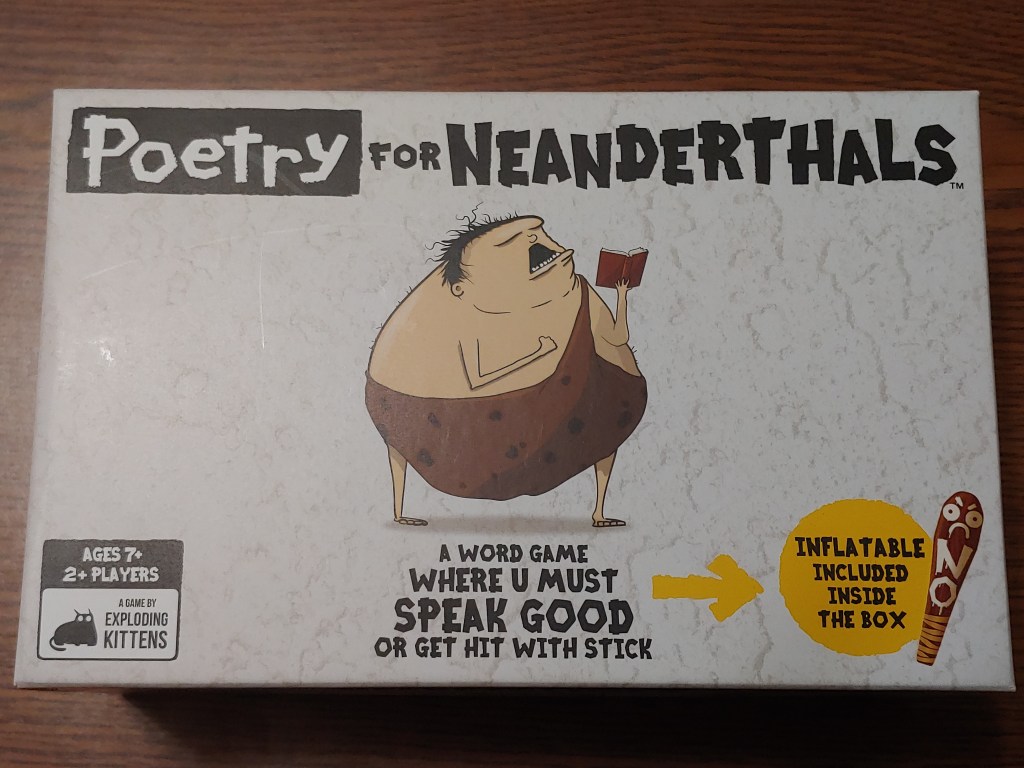
First of all, your most pressing need will be to communicate. This game will help you learn to speak like a Neanderthal. The rules are: words of one syllable only. So, you can say “Angst,” “Eat,” and “Id,” but not “Ego,” “person,” “animal,” or “democracy.”
It comes with a cute little caveman boy who, if you speak a word of more than one syllable, will hit you with the No Stick.
You Can Wear Shoes
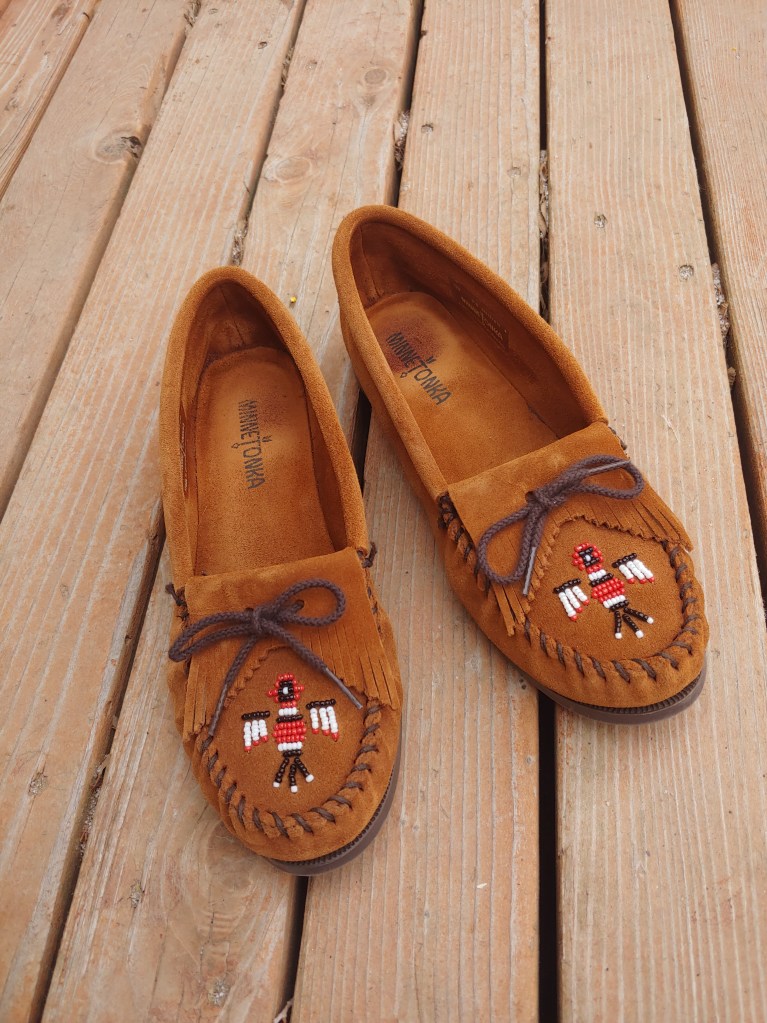
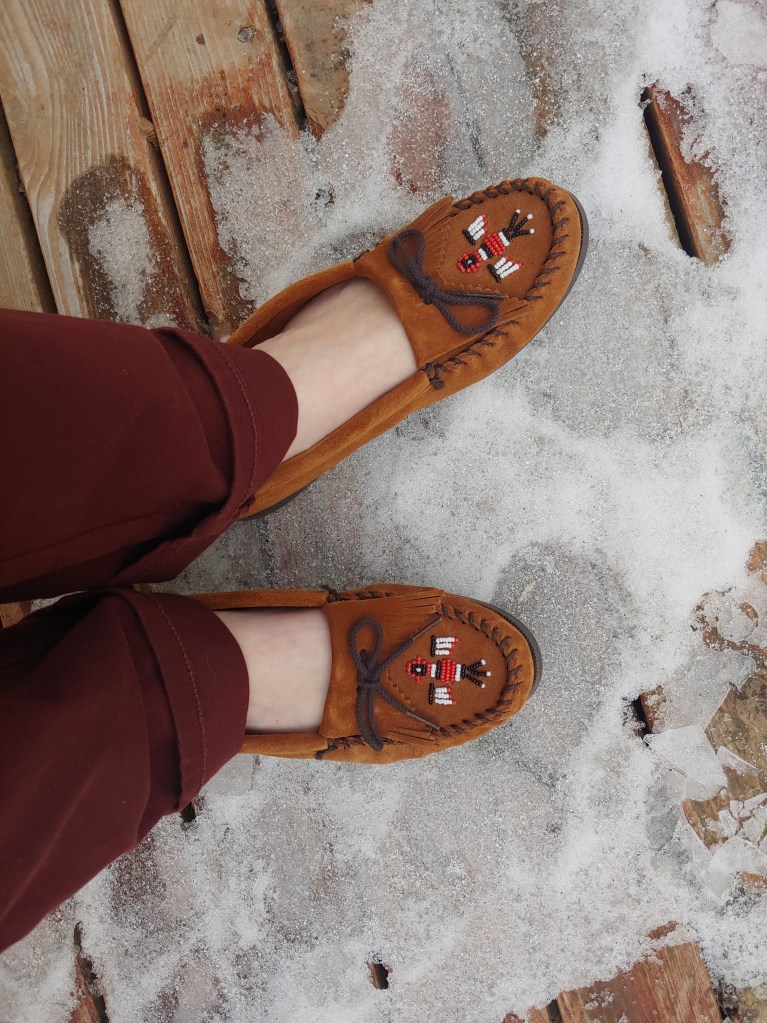
Minnetonka has been making wonderful moccasins for years now. They are modern mocs, suited to our need to be able to walk on pavement; they have rubber soles. Also, for the record, they are NOT as warm as boots on a snowy day!
Here is what they look like on.
You Can Visit Wyoming
This silver ring is supposed to represent the outline of the Tetons near Jackson, Wyoming, which, for the record, exists. It is by far the simplest looking of this gorgeous collection.
There is plenty of evidence that people have had pyrotechnology for many thousands of years.
You Can Drink UP!
Yes, that is exactly what it looks like.
It’s a drinking horn.
The packaging copy says, “GOAT STORY was inspired by the greatest discovery of all time — COFFEE! It was back in the 13th century when a flock of goats stumbled upon a bush of berries that made them go loco! Their obviously bored and adventure-seeking shepherd decided to brew the berries — and thank goats he did! Fast forward to the 21st century: that’s when we kick in. We decided to revolutionize coffee drinking and designed this one-of-a-kind coffee mug you’re holding now.”
I don’t know why we are randomly speaking Spanish (other than that it’s fun), and I’m not cool with the near blasphemy … but other than that, this copy was obviously written by a kindred spirit. I do love the “kick in” pun.
If you were to land unexpectedly in the very ancient world, you would be very very grateful to have with you one last, precious, cup of coffee. This item comes with a longer leather strap (not pictured) so that you can sling the hornful of life-giving liquid across your back and always be prepared lest you stumble upon a time portal.
I hope you are not tired of hearing me rant about pagan cultures and why Christians should not think of pagan cultural practices a contaminating substance. This topic may be starting to seem as if it’s relevant only to anthropology geeks like myself, who use their spare time to write anthropology-heavy novels about people who were pagan by default because they lived in a time when there was no other way to be.
But, on the contrary, I think it is very relevant to everyone. There are modern-day tribal people who would like to follow Christ without giving up their entire cultural identity. There are neo-pagans who, living in our technological, post-Christian world, turn to the religions of their ancestors (or a personalized version thereof) because they are looking for something that it appears neither secularism nor the modern evangelical church can offer.
There are Christians who, because of an incomplete understanding of these issues, put stumbling blocks in the path of both the aforesaid groups and in the path of their fellow believers who would like to have a whole, rounded culture. And finally, there are enemies of Christ who would like nothing better than to portray His followers as puritanical, culturally vacuous, colonizing Western imperialists. And who knows, perhaps they actually believe that they are.
All of these people could benefit from a deeper understanding of how formerly pagan practices carry meaning in the modern day. That’s why I have said that, although Christmas trees are not actually pagan, I would still have one if they were. And I will go farther. My kids and I make jack-o-lanterns too. Call, and raise you Hallowe’en. Also, I bake Christmas cookies, hide Easter eggs (!), say “bless you” when someone sneezes, and had bridesmaids at my wedding.
The following is a re-working of a book review I once wrote, which I hope will help to clarify some of the issues. Enjoy! Then go out and kiss under the mistletoe!
Review of Pagan Christianity? Exploring the Roots of Our Church Practices
by Frank Viola and George Barna, BarnaBooks/Tyndale, 2008
This book examines a variety of common church practices. It really needs to be reviewed chapter by chapter, because some of the chapters raise good questions about complex topics (for example the one about baptism), while others are just laughable (for example the one about why it’s a sin to dress up for church). But lacking the space for such a detailed approach, I would like to focus on a particular assumption that underlies this book and its scare-mongering cover: the idea that anything that started out as a pagan practice is unlawful for Christians. (The key word here is “started out.”)
In the acknowledgements, Frank Viola tells us the origin of this book: “I left the institutional church … I sought to understand how the Christian church ended up in its present state. For years I tried to get my hands on a documented book that traced the origin of every nonbiblical practice we Christians observe every week.” (xiii) Notice, Viola had already decided that institutional Christianity was thoroughly broken. He “knew” that most things most churches were doing, were unbiblical (they may be too, but not in the way Voila thinks). If these practices did not originate in the Bible, they must have come from somewhere else. Since Viola could not find the book he was looking for, he researched and wrote it himself. To his credit, he acknowledges the limits of his research and hopes that true scholars will pick up where he left off.
Viola’s experience is re-created within each chapter. First, we are told that whatever practice the chapter is treating (church buildings, sermons, etc.) is unbiblical. Then, there follows a brief historical survey of how such a practice developed from paganism. Then, we are given the real reasons the authors dislike the practice: arguments that it is undemocratic, unbiblical, or both. These later arguments are real arguments and deserve to be answered. But they are irrelevant to whether a given practice is pagan. If Jesus commands us to do something that the pagans also do (e.g., be shrewd in dealing with people – Luke 16:8 – 9), then that practice is biblical, right? A practice should stand or fall on its own merits, regardless of what it resembles or what it developed from. But in the authors’ minds, if they can show that something developed from a similar thing that was pagan, they have got at least halfway to proving it is unbiblical. And I fear that many American Christians would agree with them.
Interestingly, modern neopagans share this assumption. (You can find their articles on the Internet.) They delight in pointing out the similarities between Christian and pagan practices, and especially the borrowings. They assume that by pointing these out, they have proved that Christianity is not unique.
G.K. Chesterton, in his book The Everlasting Man, has blown this argument apart. He argues that human beings were created by God to do certain things. Human beings, wherever they live and whatever their religion, will do these things. They will have festivals and parties at certain times of the year. They will pray. They will make beautiful clothes and dress up sometimes. When circumstances permit, they will bake cakes. All this is part of the creation order and the cultural mandate, in addition to being lots of fun. The tragedy of pagans, Chesterton continues, is that they do not really have anything or anyone to do these things to or about. They are forever in search of an entity and an event that matches their huge, God-given, distinctively human capacity for celebration and worship. Eventually, it all falls through and degenerates into violence, or superstitious fear, or a sexual free for all.
But God does not command us to stop doing legitimate and lawful things when we leave the pagan gods to worship Christ. He redeems these things! For the first time, we do them for a good reason. So once, we baked hot cross buns unto the Spring Equinox. Now, we bake them unto Christ, and eat with even more joy in our hearts. Once we sang songs and made art unto our pagan gods. Now we sing and make them unto Christ!
Let me hasten to add that of course some pagan practices cannot be carried over into the Christian life. Worshipping other gods is out. So is temple prostitution, consulting the dead, divination, practicing magic, and making images to be worshipped. All of these are explicitly forbidden in the Bible, so we do not need to discuss their origins to see that they are unbiblical. Oh, and don’t let me forget a really big one:sacrificing our children to our gods, whatever those gods might be.
But there are a host of human activities that are not unlawful in themselves, are not condemned in Scripture, yet were certainly done by pagans before they were done by Christians (or even Jews). What I think the authors fail to realize (and what many of us in this modern age fail to realize) is that every human activity, good or bad, was originally done by pagans. Think about the wide range of things this encompasses. It includes cooking, medicine, self-defense, pregnancy and childbirth, coming of age, wedding ceremonies, engineering and construction. It is going to be awfully difficult to find one of these life passages that is not marked by practices that were once pagan.
Pagans are human beings, and they do everything that human beings do. So, art, formal clothing, dancing, and yes, sacred buildings, priests, and sermons are not necessarily forbidden to us just because pagans do them. We will have to find stronger arguments if we want to get rid of these things. What we cannot do is strengthen a weak argument against a practice by tacking the word “pagan” on it. This is dishonest, and frankly it is unfair to pagans. Why blame them for the fact that you don’t like liturgical robes?
(Someone sent me this link because the article’s reference to migrations reminded them of my book The Long Guest. I’m flattered.)
The Rant
If you think about this question for two seconds, the obvious answer is “no.” If people dispersed from wherever they arose (or were created), then we are all “immigrants” in the sense that our ancestors have moved from place to place. A lot.
Two thoughts about this.
I have never thought of the term “immigrant” as derogatory. The title of this article seems to imply that it is usually used derogatorily, and that the article is going to subvert that. And I have heard others speak as though “immigrant” is a slur. For the record, I have never thought of it as a slur and that is not how I use the word. In fourth grade, a school I attended did a whole unit on “immigrants.” It was a historical unit about the 19th- and 20th-century waves of immigration to America, first from Ireland and Italy, and then from Eastern Europe. I did a report about my Dutch ancestors emigrating to the United States. They are the ones I first think of when I hear the word “immigrant.” It’s a term of pride, encouraging us to think about our distinctive national origins, our families’ stories of assimilation, and how great it is that we can live in the United States and be Americans, while still retaining some of the distinctive traditions from our ancestors of two, three, or four generations back. I am also happy to think that the United States has often been a place for refugees to flee to. The prime example of this is people fleeing Europe during the 30s and 40s, but there are many more recent examples. Of course we cannot take in an infinite number of people, instantly and without limitations, just as no family, no matter how hospitable, can simultaneously host an unlimited number of house guests. But this does not mean I am “anti-immigration.” It is, in general, a positive thing. To new immigrants, my response would be along the lines of “welcome” and “I know assimilation is hard, but eventually I hope you like it here as much as I do.”
As the article points out, the history of humanity is a history of exploration and people movements. This means that it has also been a history of people assimilating, intermarrying, displacing, and engaging in conquest of other peoples. (I put that on a scale from least to most disruptive.) Obviously, the details of how this worked out in each case depended upon a lot of things, like the numbers involved, the natural resources possessed by one side or the other, cultural matches and clashes, technology, and other kinds of power. (See Thomas Sowell’s excellent Discrimination and Disparities for more on this.) But the point is, everybody’s ancestors were driven out of somewhere, and everybody’s ancestors at some point conquered or colonized somebody. Therefore, it makes no sense to go to people whose ancestors were recently (say, within the last few centuries) colonizers, and to tell them that they are living on stolen land. Nearly everyone is living on stolen land. Also, where are the former conquerors going to go when they vacate this land? Back to the place their ancestors came from? I think it’s a tad crowded now and they wouldn’t be welcome there either. Also, what about the many, many (probably the majority) of people in whose veins flows the blood of both conqueror and conquered, native and newcomer? It just doesn’t make sense.
Thank you. This has been a public service announcement.
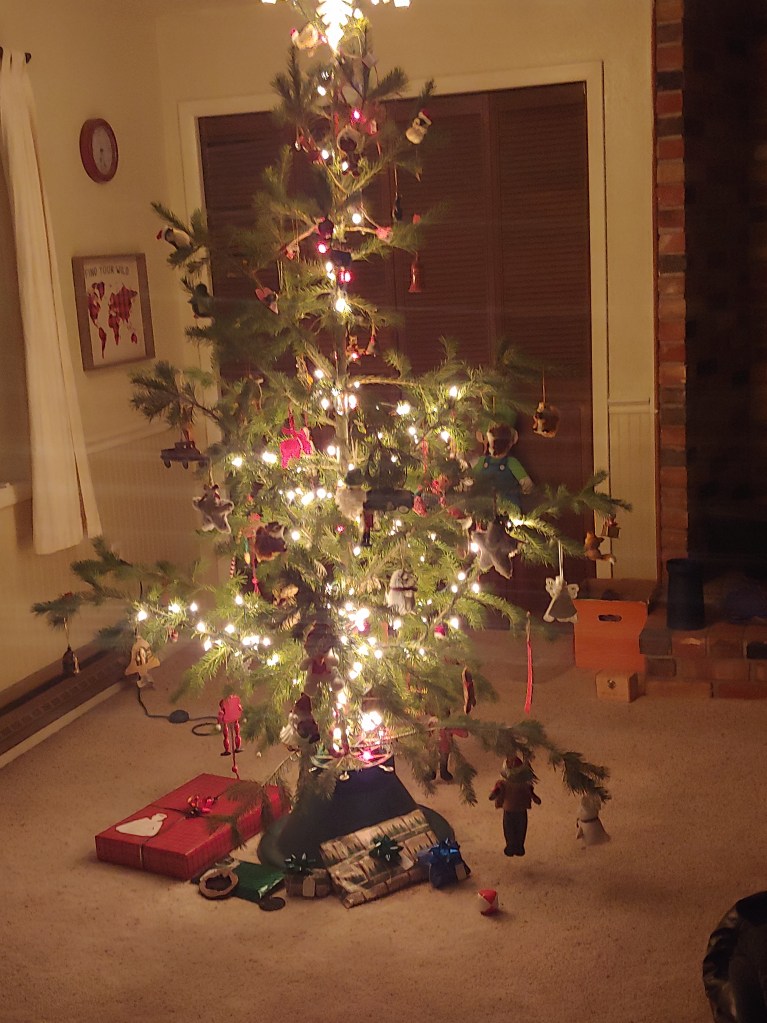
This post is about how we got our Christmas trees. For the record, I would probably still have a Christmas tree in the house even if it they were pagan in origin. (I’ll explain why in a different post, drawing on G.K. Chesterton.) But Christmas trees aren’t pagan. At least, not entirely.
My Barbarian Ancestors
Yes, I had barbarian ancestors, in Ireland, England, Friesland, and probably among the other Germanic tribes as well. Some of them were headhunters, if you go back far enough. (For example, pre-Roman Celts were.) All of us had barbarian ancestors, right? And we love them.
St. Boniface was a missionary during the 700s to pagan Germanic tribes such as the Hessians. At that time, oak trees were an important part of pagan worship all across Europe. You can trace this among the Greeks, for example, and, on the other side of the continent, among the Druids. These trees were felt to be mystical, were sacred to the more important local gods, whichever those were, and were the site of animal and in some cases human sacrifice.
God versus the false gods
St. Boniface famously cut down a huge oak tree on Mt. Gudenberg, which the Hessians held as sacred to Thor.
Now, I would like to note that marching in and destroying a culture’s most sacred symbol is not commonly accepted as good missionary practice. It is not generally the way to win hearts and minds, you might say.
The more preferred method is the one Paul took in the Areopagus, where he noticed that the Athenians had an altar “to an unknown god,” and began to talk to them about this unknown god as someone he could make known, even quoting their own poets to them (Acts 17:16 – 34). In other words, he understood the culture, knew how to speak to people in their own terms, and in these terms was able to explain the Gospel. In fact, a city clerk was able to testify, “These men have neither robbed temples nor blasphemed our goddess” (Acts 19:37). Later (for example, in Ephesus) we see pagan Greeks voluntarily burning their own spellbooks and magic charms when they convert to Christ (Acts 19:17 – 20). This is, in general, a much better way. (Although note that later in the chapter, it causes pushback from those who were losing money in the charm-and-idol trade.)
However, occasionally it is appropriate for a representative of the living God to challenge a local god directly. This is called a power encounter. Elijah, a prophet of ancient Israel, staged a power encounter when he challenged 450 priests of the pagan god Baal to get Baal to bring down fire on an animal sacrifice that had been prepared for him. When no fire came after they had chanted, prayed, and cut themselves all day, Elijah prayed to the God of Israel, who immediately sent fire that burned up not only the sacrifice that had been prepared for Him, but also the stones of the altar (I Kings chapter 18). So, there are times when a power encounter is called for.
A wise missionary who had traveled and talked to Christians all over the world once told me, during a class on the subject, that power encounters tend to be successful in the sense of winning people’s hearts only when they arise naturally. If an outsider comes in and tries to force a power encounter, “It usually just damages relationships.” But people are ready when, say, there had been disagreement in the village or nation about which god to follow, and someone in authority says, “O.K. We are going to settle this once and for all.”
That appears to be the kind of power encounter that Elijah had. Israel was ostensibly supposed to be serving their God, but the king, Ahab, had married a pagan princess and was serving her gods as well. In fact, Ahab had been waffling for years. There had been a drought (which Ahab knew that Elijah — read God — was causing). Everyone was sick of the starvation and the uncertainty. Before calling down the fire, Elijah prays, “Answer me, O LORD, answer me, so these people will know that you, O LORD, are God, and that you are turning their hearts back again.” (I Kings 18:37)
Similar circumstances appear to have been behind Boniface’s decision to cut down the great oak tree. In one of the sources I cite below, Boniface is surrounded by a crowd of bearded, long-haired Hessian chiefs and warriors, who are watching him cut down the oak and waiting for Thor to strike him down. When he is able successfully to cut down the oak, they are shaken. “If our gods are powerless to protect their own holy places, then they are nothing” (Hannula p. 62). Clearly, Boniface had been among them for some time, and the Hessians were already beginning to have doubts and questions, before the oak was felled.
Also note that, just as with Elijah, Boniface was not a colonizer coming in with superior technological power to bulldoze the Hessians’ culture. They could have killed him, just as Ahab could have had Elijah killed. A colonizer coming in with gunboats to destroy a sacred site is not a good look, and it’s not really a power encounter either, because what is being brought to bear in such a case is man’s power and not God’s.
And, Voila! a Christmas Tree
In some versions of this story, Boniface “gives” the Hessians a fir tree to replace the oak he cut down. (In some versions, it miraculously sprouts from the spot.) Instead of celebrating Winter Solstice at the oak tree, they would now celebrate Christ-mass (during Winter Solstice, because everyone needs a holiday around that time) at the fir tree. So, yes, it’s a Christian symbol.
Now, every holiday tradition, laden with symbols and accretions, draws from all kinds of streams. So let me hasten to say that St. Boniface was not the only contributor to the Christmas tree. People have been using trees as objects of decoration, celebration, and well-placed or mis-placed worship, all through history. Some of our Christmas traditions, such as decorating our houses with evergreen and holly boughs, giving gifts, and even pointed red caps, come from the Roman festival of Saturnalia. This is what holidays are like. This is what symbols are like. This is what it is like to be human.
Still, I’d like to say thanks to St. Boniface for getting some of my ancestors started on the tradition of the Christmas tree.








 Out of Babel Books