Guess when they are believed to have settled there? 10,000 years ago!
Follow the link, if not to read the article, then at least to see the panoramic picture at the top of the article that shows the region where these settlements were found.
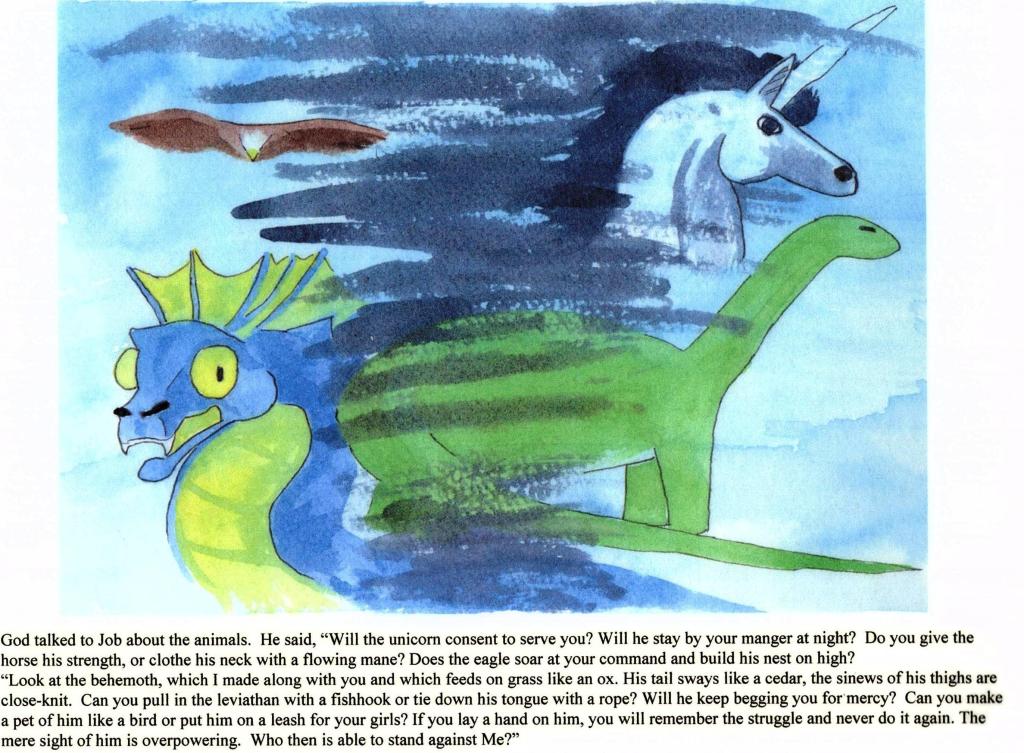
Some time ago, Rachael requested in the Comments section of my Dinosaurs post that I post a picture of the Leviathan. At the time, I thought that I didn’t have time to do one. (I’ve gotten away from drawing and painting in favor of home schooling, knitting, and a writing career.) But then I realized I had on hand a watercolor that I had done years ago which includes the Leviathan.
The image below is from a version of the Book of Job that I did for my kids when they were little. I made it because there simply were no children’s books that accurately summarized the Book of Job. It’s not a popular topic in the first place, and even when it is dealt with, it tends to be handled very moralistically as being all about Job’s patience and righteousness. But that’s a rant for another day.
The reason the animals are portrayed as being in a tornado is that God “spoke to Job out of the whirlwind.” My son, at the time, was equal parts fascinated and terrified by the idea of tornadoes. The animals shown are unicorn, eagle, behemoth (the sauropod) and, in the lower left corner, Leviathan. (I include a unicorn because the Septuagint, the Greek translation of the Old Testament, mentions “monoceros” or “unicorn” where some English translations render “wild donkey” or “wild ox.”)
I must admit this Leviathan owes more to C.S. Lewis’s description of the sea monster in The Voyage of the Dawn Treader. I’ve portrayed it as a deep-sea creature. There is no hint of fire breathing or scales bumpy enough to leave an impression in the mud. Sorry, folks.
On my shelf is a 2009 book called First Peoples in a New World by
archaeologist David J. Meltzer. I have learned many things from this book, not
least of which is that North American archaeology is really, really contentious. (I may post about this later.)
On pages 55 – 58, right in the
middle of a discussion of the causes of the Younger Dryas, is a long callout
box in which Meltzer goes on a delightful rant:
In 2001 the Mammoth Trumpet, a newsletter for a lay audience … carried an unusually long, highly technical article declaring there’d been a Pleistocene doomsday. A supernova-caused neutron bombardment centered over the Great Lakes had fried the earth 12,500 years ago … heated the atmosphere to over 1,800˚ Fahrenheit, and radiated plants and animals at the equivalent dose of “a 5-megawatt reactor for more than 100 seconds” … and so spiked atmospheric radiocarbon concentrations that ages on Paleoindian sites were thrown off by up to 40,000 years. … [In 2007] the supposed Pleistocene extraterrestrial catastrophe was hyped as fact from FOX News to The Economist.
Meltzer pp 55 – 56
The Younger Dryas Impact Hypothesis
This claim is now called the Younger Dryas Impact Hypothesis. The supposed comet impact or impacts are alleged to explain a number of phenomena:
Just as the last Ice Age was ending, right in the middle of a warming period, the climate unaccountably got cooler again for about 1000 years. This glacial encore is called the Younger Dryas. The idea is that a comet impact could have caused a bunch of glacial ice and water suddenly to be dumped into the North Atlantic, cooling temperatures there and interrupting the warming cycle.
The approximate date for the impact is around the same time that North America’s megafauna (mammoths, giant sloths) were dying out. Paleontologists are not sure why they died out, because it’s very difficult to get an accurate sense of numbers or of how quickly the extinctions happened. But if there was a comet impact, that would obviously be the #1 suspect in their demise.
Also around this time (about 10,800 BC) there is a geologic layer called the Black Mat, a carbon-rich layer that might be burned organic material or might be peat, as from the bottom of a pond. In some places, it contains nanodiamonds and other unique mineral things that are usually only formed with high heat and pressure.
This is also the time period in which some archaeologists think the Clovis culture (of humans) was dying out in North America, though this die-off too is controversial.
Impact, Schmimpact
Meltzer, in his 2009 book, is scathing: “The claim was so far out literally and figuratively … it was met with bemusement, or simply ignored.” He finds all kinds of evidentiary problems with the Younger Dryas Impact Hypothesis. He doesn’t think an asteroid impact is required to explain the Younger Dryas, for one thing. (The cooling cycle could have been kicked off by meltwater from the North American glaciers even without a super-hot space rock, since the glaciers were already melting.) Furthermore, Black Mat evidence is inconsistent. So is Clovis evidence. So is evidence about the megafauna. And, the biggest problem of all, in 2009 when his book was published, no one had found an impact crater.
Well, that has changed. A 31-kilometer-wide impact crater was recently discovered under Hiawatha Glacier in Greenland. And the proponents of the YDIH have also discovered what they say is additional evidence of impacts as far away as Chile. (See the links below for more information.)
In Conclusion, We Are Not Sure the World Actually Ended
So, did a huge comet – or multiple pieces of a comet – really hit earth about 12,800 years ago? Nobody really knows. But – and this is the only point of this article – how can we not know this? How can we not be sure whether an apocalyptic, species-killing, continent-setting-on-fire event even happened?
The fact there can be controversy about such a hard-to-miss event just illustrates how difficult it is to figure out anything that happened even a mere 12,000 years ago. Pause for a moment and allow your jaw to drop, as mine did when I first read this, over all … that we don’t … know.
Sources
Fernandez, Sonia. “The Day the World Burned: Geologic and paleontological evidence unearthed in southern Chile supports the theory that a major cosmic impact event occurred approximately 12,800 years ago” posted Friday, March 8, 2019 on UC Santa Barbara, https://www.news.ucsb.edu/2019/019375/day-world-burned
Haynes, C. Vance, Jr.“Younger Dryas ‘black mats’ and the Rancholabrean termination in North America” Proceedings of the National Academcy of Sciences of the United States of America, published online 2008 April 24, https://www.ncbi.nlm.nih.gov/pmc/articles/PMC2373324/
Here is a much more comprehensive article about the destruction of historic buildings: throughout history, but particularly, recently in the Middle East.
We have discussed in previous posts the idea that the people of the very ancient world were much smarter than we give them credit for, probably smarter than we are today. This post will explore the idea that genetic engineering may have been tried thousands of years ago. By the nature of the topic, the post will be highly speculative and will contain some stuff that is not for the squeamish.
Old Testament Laws Against Mixing Kinds
The Old Testament is famous for
puzzling and obscure laws. Here are a
few:
“Keep my decrees. Do not mate different kinds of animals. Do not plant your field with two kinds of
seed. Do not wear clothing woven of two
kinds of material.” Leviticus 19:19
At first glance these three rules seem arbitrary. But they may actually have been a prohibition on attempting to create genetic hybrids of animals or plants.
This verse comes in the midst of a passage that forbids the Israelites to do a number of different, mostly disgusting things that were part of contemporary pagan practice in Canaan, including child sacrifice, “divination,” self-mutilation, bestiality, and “eating meat with the blood still in it.” Translated into modern terms, all of these practices could potentially relate to genetic manipulation. They reflect an attitude towards people as disposable products (child sacrifice); a desire to carve up the human body and make it into whatever we desire (self-mutilation); a desire to find out hidden knowledge or secrets so as to take control of them (divination); and a desire to mix characteristics of humans and animals (bestiality, consuming blood). We know that these impulses were not confined to Canaan in the ancient world. See nearly every Greek myth ever recorded, but the particularly the story of the Minotaur.
Of course, we tend to think of
these practices as religious, and no doubt they were. But this doesn’t mean they were not also an
attempt to alter the nature of things in the physical world. Pagan religion is often a path to maintain
the agricultural cycle and prevent infertility.
These particular pagans took things one step further and sought to
“improve” these natural processes.
The Canaanites may even have had some success with their genetic experiments. Israelite spies managed to bring back from Canaan a single cluster of grapes so large that it had to be carried on a pole between two men (or possibly between two poles, depending on the translation, which would make it even bigger). (Numbers 13:23)
Genetic Engineering in Really Ancient Times
The Israelite conquest of Canaan took place about 1400 BC according to conventional dating. This is very recent compared to the dates this blog usually has in view. It is more than a thousand years after the Sumerians, well after the probable date of the Tower of Babel, and even farther after the speculated date for the Giza pyramids. Many of the hints of genetic engineering – both in the Bible in other historical sources – come from these even more ancient times.
Hints from the Bible
There is a strong emphasis in the
creation account in Genesis on all things reproducing themselves “according to
their kinds.” Almost every time a particular class of plant, bird, fish or
animal is mentioned, it is followed by the phrase “according to their kinds” or
“each according to its kind.” This was
the intended order of creation.
It was violated a mere six chapters (but possibly untold thousands of years) later, when the “sons of God” (some of kind spiritual or transdimensional beings) lusted after human women and “married any of them they chose.” (Genesis 6:1 – 3) Their hybrid offspring were the Nephilim, who were giants.
The speculation goes that these “sons of God” or their hybrid descendants may also have begun to violate animals, either sexually (ew!!!) or through some other, unknown means of genetic manipulation, and that people began to learn these techniques and the attendant values. The general picture is a slow obliteration of all “kinds.” There would have been creatures running around that were hybrid animals (chimeras perhaps?), other creatures that were part human and part “divine,” and perhaps “divine” animals and animal/people as well. The world was on its way to complete biological, sexual, and perhaps even dimensional chaos. Soon no one would be safe from any kind of sexual violence or grisly experiment. This was the world that, thousands of years later, the Canaanites were still trying to bring back.
“Now the earth was corrupt in God’s sight and was full of violence. God saw how corrupt the earth had become, for all the people on earth had corrupted their ways.” (Gen. 6:11 – 12) The word corrupt here may mean more than just morally corrupt. There had been some deep perversion of the natural order of things. So God decided to destroy all the people and birds and animals (verse 7). He chose Noah. My translation of verse 9 says that Noah was “blameless among the people of his time.” It is possible that a better translation of this phrase is “perfect in his generations.” That is, Noah was still 100% genetically human. His family line had not intermarried with the gods and had not been genetically manipulated (Van Dorn 36). God then asked Noah to gather “seven of every kind of clean animal, a male and its mate, and two of every kind of unclean animal, a male and its mate.” He was going to re-start the world using the originally created kinds.
It is possible that the secrets of genetic manipulation were not completely lost after the Flood. Around the time of the tower of Babel, we get the figure of Nimrod, “a mighty hunter before [or against] the Lord,” who founds a number of ancient cities and is later worshiped as a god by the Babylonians. Genesis 10:8 says in the NIV that Nimrod “grew to be a mighty warrior on the earth,” but the grammar allows for the translation “began to become a giant.” (Van Dorn 77) Perhaps he found a way to alter his own genetic code. That would certainly have made his city-building task easier, especially if he was planning to use megaliths.
Hints from Other Historical Sources
The general picture we have painted
of the world immediately pre-Flood is a terrifying one. It is also strikingly similar to the picture of mythological times found in
cultures worldwide.
Greek myths, as everyone knows, routinely
feature gods impregnating human women, giants, part-god “heroes” (often very
badly behaved themselves), and entities that mix characteristics of animal,
human, and/or divine. Not to mention
countless “monsters” created by the gods. It all adds up to a portrayal of a world that
is fascinating from a distance, but also chaotic and deeply unsettling. It is not a world that a sane person would
wish to live in.
But this is not confined to Greek mythology. Stories of giants are found everywhere. So are stories of human/divine intermarriage, and stories of people mating with various animals (or even inanimate objects such as stones), and producing monsters. It is a truism that these are common features of myth. All these very strange ideas are, no doubt, deep in the human mind. But perhaps there is a story behind the way they got there. Perhaps this was, in fact, the world that humankind lived in for some generations.
Finally, I give you a visual image that is not proof of anything, but that might be suggestive. It is the caduceus, a very ancient symbol that came to be associated with the Greek god Hermes in his capacity as a healer and as a patron of doctors. It is two snakes entwined around a winged pole. The symbolic association of snakes with healing in world mythology is too big a topic for a post that has already gone over 1,000 words. But, if you buy in to the idea that ancient people were very smart and may have engaged in genetic manipulation, it is interesting that this ancient medical symbol resembles a double helix, or DNA molecule.
Sources
Giants: Sons of the gods, by Douglas Van Dorn. Waters of Creation Publishing, 1614 Westin Drive, Erie, CO 80516, 2013. Van Dorn’s book was the source for all the original ideas in this post.
Dictionary of Native American Mythology, ed. Sam D. Gill & Irene F. Sullivan, Oxford University Press, 1992. The Dictionary contains many references to giants, monsters, and to sexual activity between people, animals, rocks, etc.
D’Aulaires’ Book of Greek Myths, by Ingri and Edgar Parin d’Aulaire. Scholastic, March 2010. First published 1962. This is a classic illustrated book for children that sanitizes the myths somewhat. Of course there are many other reference books for Greek myths. In addition to many other suggestive stories, D’Aulaires’ mentions that the smith god, Hephaestus, “built for himself two robots of gold and silver to help him about. They had mechanical brains and could think for themselves. They could even speak with their tongues of silver. They also served him as helpers in his workshop on Olympus.” (page 28) Here again we see at least the idea of very advanced technology in an ancient context in which we would not expect it.
I love to see an ancient source vindicated. This article concerns a detailed description by Herodotus of a certain style of boat building that was doubted because archaeologists never found any examples of it … until now.
That’s actually a fairly tame claim to have vindicated. Some of Herodotus’s descriptions of exotic peoples, for example, seem pretty hard to swallow. But pretty much all such descriptions sound hard to swallow out of their context. Take this classic anthropological-ese description of American hygiene and medical care. Read it for a laugh.
I realize we can’t just rubber-stamp every ancient account we like while discounting the ones we don’t like. We have to have some kind of standard of proof. Still, historical proof is not like scientific proof. There’s a slippery slope between “We have found no proof that this [whatever it is] existed” and “We have found proof that this didn’t exist.” Some people fall down it.
Like most sane people, I hate Internet debates. Love/hate, that is. Even in real life, I’ve always found it hard to let a debate go. I’ve sometimes stubbornly backed positions that later turned out to be false, and on the other end of the spectrum I’ve gotten scared by ad hominems and conceded stuff I didn’t need to concede. Almost no matter how the debate goes, I end up feeling like an idiot.
I don’t want this site to become a debating site. But a few weeks ago, I posted a wild historical theory and invited you guys to critique it. Benjamin did, in the comments, here. So, for the integrity of this site, I’ve got to respond to the critique found in the link. If you don’t like Internet debates, please please skip this post.
The link that Benjamin posted to is
to a site called Bad Archaeology. The
site has two guys’ names on it, but at appears to be mostly written by one guy.
(At least, he is the one who responds to comments.) Let’s call him KFM. I am not posting his full name here nor am I
linking to his web site, because I don’t want to attract his attention because
I hate Internet debates! However, you can easily find his site by
Googling it.
The site exists to debunk “Bad Archaeology” (caps in the original), which mostly means various wild theories like the ones we’ve been discussing about lost civilizations, aliens, etc. It calls proponents of these theories Bad Archaeologists and it fights them with facts, with mischaracterization of their positions, and sometimes with mockery. And by capitalizing its references to them. Always fun.
Summary of the Refutation
KFM’s main arguments against
Hancock’s idea that the Piri Reis, Orontius Finaeus, and Buache maps come from
an older source are as follows:
-Piri Reis SAID he got his data for
the New World part of his map from Columbus. This is confirmed because he faithfully
reproduces some of Columbus’s errors, such as
showing Cuba
as part of the mainland.
-Most Bad Archaeologists
consistently spell Orontius Finaeus’s name wrong. (Oronteus.)
This shows they don’t know what they’re talking about.
-There are major errors in Reis’s
and Finaeus’s depictions of Antarctica. So we cannot claim that a supposed older
source map was accurate. (More on this
in a second.)
-Only one version of Buache’s famous map exists that shows Antarctica. It is in the Library of Congress. Other versions of the same map just show a big blank space there.
-Buache was an accomplished geographer who had a theory that there must be a landmass at the bottom of the world. He also theorized that within it, there must be a large inland sea that was the source of icebergs. So, if the map he supposedly drew is not a hoax and was in fact drawn by him, then he just made it up out of pure speculation. In fact, he wrote “supposed” and “conjectured” all over it.
-He also shows ice and icebergs all
over it. This renders ridiculous the
idea that it is a map of Antarctica before the
continent was covered in ice.
-Buache’s and Finaeus’s maps don’t match Reis’s or each other, so clearly they cannot have come from a single source map, let alone an accurate one.
The Strong
KFM’s arguments look, at first glance, super convincing. Some of them are dead on.
The strongest part of KFM’s argument is this:
“[Charles]
Hapgood, [Hancock’s source for this theory], assumed that the original source
maps, which he believed derived from an ancient survey of Antarctica at a time
when it was free from ice, were extremely accurate. Because of this, he also
assumed that any difference between the Piri Re‘is map and modern maps were the
result of copying errors made by Piri. Starting from this position, it mattered
little to Hapgood if he adjusted the scales between stretches of coastline,
redrew ‘missing’ sections of coastline and altered the orientation of
landmasses to ‘correct errors’ on Piri’s map to match the hypothesised source
maps …. Hapgood found it necessary to redraw the map using four separate
grids, two of which are parallel, but offset by a few degrees and drawn on
different scales; a third has to be turned clockwise nearly 79 degrees from
these two, while the fourth is turned counterclockwise almost 40 degrees and drawn
on about half the scale of the main grid. Using this method, Hapgood identified
five separate equators.”
This is pretty damning to the theory. It’s not necessarily fatal to the idea that Reis used an obscure ancient source among the 20 that went into his map. After all, copying errors do happen, especially when we are trying to compile a bunch of maps from different eras of places we have never surveyed ourselves. But that’s an unfalsifiable claim, so let’s leave it. Regardless, Hapgood’s shenanigans certainly are fatal to the idea that this ancient map, if it existed, was astonishingly accurate in latitude and longitude.
The Not So Strong
But
alongside this excellent argument, KFM also includes a bunch of inconsistent
ones:
“All
in all, the Piri Re‘is map of 1513 is easily explained. It shows no unknown
lands, least of all Antarctica, and contained errors (such as Columbus’s
belief that Cuba
was an Asian peninsula) that ought not to have been present if it derived from
extremely accurate ancient originals. It also conforms to the prevalent
geographical theories of the early sixteenth century, including ideas about the
necessity of balancing landmasses in the north with others in the south to
prevent the earth from tipping over.”
So, the map does not show Antarctica, but one sentence
later it does show Antarctica, but Antarctica was only put there because contemporary
geographical theory demanded it. Also,
note the assumption that the ‘extremely accurate originals’ are supposed to
have included all of the Americas
as well as Antarctica. That’s not my understanding of Hancock’s
claim.
It’s also not clear whether KFM is claiming that all the data for Reis’s map came from Columbus. If he is, this inconsistent with both Hancock’s claim (and KFM’s own showing) that Reis said the map was compiled from 20 others, including among them a map whose source was Columbus.
Similarly, KFM shows errors on Orontius Finaeus’s map, although he admits that “There are fairly obvious similarities between the general depiction of the southern continent by Orontius Finaeus and modern maps of Antarctica.”
The Buache Map Shows an Archipelago
For the Buache map, KFM contends that Buache essentially made up the entire map to satisfy a geographical theory he had, namely that there must be a land mass at the bottom of the world to balance the land at the top (this was a popular theory at the time), and that it probably had a large inland lake in it with two major outlets leading to the sea (this was Buache’s own brilliant guess, and he thought this lake must be the source of the icebergs that navigators encountered in the southern sea).
I
take KFM’s word that Buache had this theory, and that his map shows ice and
icebergs on Antarctica, which KFM says “makes the claims that Buache’s map
shows an ice-free Antarctica all the more
bizarre.”
Well,
sort of. But actually, Hancock’s claim
is that the source map Buache used shows Antarctica
early in the process of icing over. Also, given Buache’s theory, it would not be
surprising if he had added ice and icebergs to any other data that he may have
had.
“Over several parts of the southern continent, Buache writes conjecturée (conjectured) and soupçonnée (suspected).” KFM thinks this is conclusive proof that Buache basically invented the interior of Antarctica on his map, based purely on his own theory. That could be. But I have to say, if it is, he did a great job! He does not just draw a round mass, attach the few islands and promontories that he knows about (New Zealand, which he took for a peninsula, and the Cape of the Circumcision), and then draw a lake in the middle. Instead, he has a waterway offset between two unequal land masses. It corresponds surprisingly well to the shapes of the ranges of mountains and low areas that we now know Antarctica has.
The “Well, I’ll Bet You Didn’t Know About … This!” Argument
Besides these arguments, KFM includes a lot of interesting history about the biographies of these cartographers. Almost half his page about Finaeus is taken up with the cartographer’s biography, even though it has little to do with claims about his map (beyond boosting his credentials, which I would think Hancock would also want to do). Similarly, with Buache we are given: “The claims of Bad Archaeologists about Buache’s map ignore a crucial fact: he was the foremost theoretical geographer of his generation, whose published works include hypotheses about the Antarctic continent.” I’m not sure why Buache’s eminence is supposed to be a devastating blow to any claims about his map, but again we are treated to a long and interesting biography before KFM finally gets to Buache’s theories about a southern continent.
This style of argument reminds me of people
who think they have shown the Bible is not divinely inspired merely because
they can show that it happened in a particular historical context and is
expressed in a particular historical idiom.
They will trot out some tidbit of historical context that they assume is
complete news to some Bible scholar who has been studying ANE history his whole
life. Their line of argument is based on
a misunderstanding of what divine inspiration is claimed to be. They assume that if something is claimed to
be the Word of God, it must have come to humanity in an abstract, context-free,
propositional and not literary or historical form. (They also assume that it must cover all
knowledge in the world, e.g. so that the discovery of North
America was supposed to somehow shake our faith in the Bible.)
KFM’s argument about these maps is exactly the same kind of argument. He gives a bunch of historical context about these cartographers and thinks that refutes Hancock’s claims. It’s as if Hancock had been arguing that Piri Reis, Finaeus, and Buache were born of virgins, went through life without interacting with anyone, and then one day, without any context whatsoever, this complete, easy-to-interpret map from an ancient civilization dropped out of the sky into their hands. Well, that certainly isn’t the argument that Hancock makes in his book. His argument is (or was; he has apparently retracted it) that there were several source maps, made over centuries or millienia, which traced the progressive growth of the Antarctic ice cap. He does not claim that these were complete, accurate world maps or even that they showed the Americas. “Someone who knew what they were doing once mapped Antarctica.” That’s the basic claim.
When We Think We Don’t Have Preconceptions
It turns out that there is a more than
coincidental similarity between the way KFM caricatures Hancock’s claims and
the way that some people caricature claims about the Bible. KFM, in fact, classes Biblical Archaeology as
a subset of Bad Archaeology. The
following quotes should give you a sense of his general attitude:
“Some Bad
Archaeology is just so outrageously Bad that it can only be examined charitably
by assuming that its proponents are slightly confused. How else can you explain
the complete lack of critical judgment, the belief in ancient fairy stories,
the utter absence of logical thought they display? Either that, or they have a
particular agenda, usually driven by a religious viewpoint.
Biblical Archaeology, which has
been described as excavation with a trowel in one hand and a Bible in the
other, is a specialised branch of archaeology that often seems to ignore the
rules and standards required of real archaeology. Conducted for the most part,
by people with an explicitly religious agenda (usually Christian or Jewish), it
is a battleground between fundamentalist zeal and evidence-based scholarship … If we can’t find evidence for Solomon’s
glorious empire, it must be that we’re not interpreting the archaeological data
correctly and that a big discovery is just around the corner (the ‘Jehoash
inscription’ leaps to mind in this context). If contemporary Roman documents
don’t mention Jesus of Nazareth, why here’s an ossuary that belongs to James,
his brother… It’s all very much centred around contentious objects,
poorly-dated sites and great interpretative leaps that the non-religious may
find astounding.”
Got that? If you believe in a historical Solomon or
even a historical Jesus, you’ve just been dubbed a Bad Archaeologist. Welcome to the club, friends.
I mention this attitude not because it’s off-putting, but because it tells us something about KFM’s mindset and about what it would take to convince him that something is “good” archaeology. I’m guessing that any evidence of advanced civilizations older than about 4,000 BC is going to be dismissed out of hand. As will any evidence showing that humanity might have declined, rather than slowly progressed, over our history.
Conclusion: Inconclusive
Going back to the maps, what has been shown here? I would say it’s inconclusive. The maps are less accurate than Hancock claims and far less accurate than I made them sound in my original post, because I was going over Hancock’s theory at treetop level and didn’t bother to get off into the weeds when he discusses the details of the maps. (As I still haven’t done in this post. I would like to, but my time is limited.)
On the other hand, I think the Finaeus and Buache maps especially are more accurate than we would expect of maps that had been drawn out of pure conjecture, without any source at all. It looks like more was known about Antarctica in the 16th century than we previously assumed, whatever the source of that knowledge.
So it’s not a case of “Lost civilization proven!” but neither is it “Nothing to see here.” The most we can say is that something strange is going on, but we don’t know what. To paraphrase Andrew Klavan, KFM isn’t wrong to think Hancock and Hapgood are wrong; but he is wrong to think that he himself is right.
About the theory of earth crust slippage, I feel the same way. On the one hand, it’s a pretty hard theory to swallow on geological grounds. (For example: if a big section of the earth’s crust pivoted around the North American plains – even granted that this could happen – shouldn’t there be some kind of seam where the edge was?) On the other hand, clearly something weird happened, or we wouldn’t have Siberia being ice-free when Canada was ice-covered. Nor would we have flash-frozen tropical plants and baby mammoths.
So, in conclusion, nobody knows
anything, boys and girls. Let us eat,
drink and be merry.
In this post I attempt to summarize Graham Hancock’s book Fingerprints of the Gods: The Evidence of Earth’s Lost Civilization (1995). This book influenced the background for my novels. It also, in my mind, dovetails with Douglas Van Dorn’s biblical/archaeological research on giants in ways that I am sure Hancock never intended or imagined.
This post is only a summary. It will naturally be much less convincing than the book itself. My copy of Fingerprints runs 578 pages counting the bibliography and index. Hancock builds up to his thesis slowly, presenting many different lines of evidence and dropping mysterious hints to keep the reader intrigued. He also has to get into some fairly technical topics, particularly when talking about astronomy. I can’t do any of that in a 1,000-word post. So, like a bucket of cold water in the face, you will be treated to Hancock’s thesis in all its bizarre and fascinating glory.
Incredibly Sophisticated, Incredibly Ancient Maps
Hancock’s first two chapters are dedicated to the details of a number of old maps drawn up during the 1500s which show parts of South America that were undiscovered by Europeans at that time. More intriguingly, they show the coast of Antarctica as it appears under the ice. (This was before modern man’s discovery of Antarctica, and before seismic surveys revealed what lay beneath the ice.) The best-known of these is the Piri Reis map (drawn up in A.D. 1513), but there are others, such as the Orontes Finaeus map, the Mercator map, and the Buache map. All these mapmakers drew on older maps, which they compiled. Piri Reis, for example, had access to the Imperial Library at Constantinople, which is probably where he got the sources for his map.
The other amazing thing about these old maps is they often show locations in South America, for example, at accurate longitude and latitude.
The lesson that Hancock draws from these maps is this. Whatever source maps Piri Reis and others used, must themselves have been drawn up by an advanced seafaring civilization that had explored the world and knew how to project longitude and latitude. Amazingly, these seafarer/mathematicians apparently charted Antarctica at a time when it was not yet completely covered in ice. That makes their civilization, how do you say? Very, very old.
Ancient Astronomer/Engineers Again
Hancock then turns to the sophisticated ancient buildings that have baffled us in previous posts. He dedicates ten chapters to the Incan and pre-Incan civilization: the Nazca Lines, the amazing complex at Lake Titicaca, and the tradition that connects these to a bearded culture-bringer (the Viracocha), who came from over the sea.
Eleven more chapters describe the Central American cultures: their obsession with numbers, with calculating exact dates in the distant past and future, with forestalling the apocalypse (including by human sacrifice). They were also sophisticated astronomers. The pyramid complex at Teotihuacan, for example, appears to have been laid out as a scale model of the solar system.
And then there is ancient Egypt. Seventeen chapters are dedicated to it. There are many things to notice. Here are just a few: ancient Egyptian civilization seems to have appeared suddenly as a high civilization, complete with myths, history, engineering, and an obsession with boats. Overall, its history is one of slow decline and loss of knowledge, rather than slow buildup. (Interestingly, the same point has been made about ancient Sumer.)
The pyramids at Giza do not match the pyramids that are supposed to have been built immediately before and immediately after them. They are far more durable and sophisticated than these others. If we accept the received chronology, the Egyptians built some relatively crummy pyramids, then a few generations later built some amazingly good ones, then turned around and went back to building relatively low-quality pyramids again. Hancock suggests that instead, the Giza pyramids are much older than commonly thought. They were built with knowledge or technology that was subsequently lost. The comparatively crummy pyramids are attempts to copy the ones at Giza.
Hancock writes, “Robert Bauval’s evidence showed that the three pyramids [at Giza] were an unbelievably precise terrestrial map of the three stars of Orion’s belt, accurately reflecting the angles between each of them and even (by their respective sizes) providing some indication of their individual magnitudes. Moreover, this map extended outwards to the north and south to encompass several other structures on the Giza plateau … the Giza monuments were so arranged as to provide a picture of the skies … as they had looked – and only as they had looked – around the year 10,450 BC.” (page 356)
The Great Pyramid at Giza has a ratio of 2pi between its original height and the circumference of its base. This strengthens the argument that it was meant to represent a star (a circle). The Pyramid of the Sun at Teotihuacan has a ratio of 4pi between height and base circumference. Both of these pyramids had to have an odd angle of slope to accomplish this (52 degrees for Giza; 43.5 degrees for Teotihuacan), so it seems to have been intentional. Pi was supposedly not calculated correctly until it was done by Archimedes in the third century BC, but apparently the ancient Egyptians and the ancient Mexicans were familiar with it.
Where Hancock is going with all this is that people on both sides of the Atlantic got their amazing engineering, mathematical, and astronomical knowledge from an older “source” civilization. He thinks it was the same seafaring civilization that apparently charted Antarctica. This impression is strengthened by the Egyptian obsession with boats and by the Incan legends that say all this knowledge came from over the sea.
Is Hancock Arguing for Aliens?
Not in this book.
He has written several books about ancient mysteries. I have not read them all. He has now started writing fiction, and in the one novel of his that I have read, it becomes apparent that his interest in all this is decidedly New Age in character. The novel features an angelic/earth mother spirit guide, telepathic Neanderthals, the whole nine yards. So, I can’t swear that aliens won’t show up at some point. But that is not the thesis of Fingerprints. Hancock is arguing that there was a very advanced civilization of people well before 10,000 BC. Whether these people were taught by aliens, spirits, or some other stuff like that, he does not say, thankfully. Because, luckily, this book relies heavily on evidence.
So the ancient cartographers were not aliens, not even according to Hancock. But still we have a problem: Where was this civilization located? You don’t normally get an advanced civilization until you have a critical mass of arable land. In short, a continent. Hancock believes he has solved this problem. He believes there was such a mass of land, but that it has since undergone a cataclysm. And now we come to the really wild part of his thesis.
It’s the End of the World As They Knew It
Mythology about a period of cataclysms in ancient times is universal. Hancock dedicates four chapters to this alone. Flood myths, for example, are very common. But most cultures also record things like earthquakes, fire falling from the sky, the sun not rising for some long period of time, or an endless winter. Hancock discusses myths like this in some detail from the following cultures: Aztec, Sumerian, Greek, Inuit, Chinese, Southeast Asian, Pacific, Indian, Egyptian, Mayan, and Norse. It should not be hard for the reader to track down these myths. Some cultures (the Aztecs and the Hopi, for example) believe that disasters come at regular intervals and that each one ushers in a new age of the world.
Hancock believes that these myths are actually historical records (with all the usual caveats about them becoming garbled, etc.) of a period of geologic upheaval that happened within human history. I’ll put it in his own words:
“This geological theory was formulated by Professor Charles Hapgood and supported by Albert Einstein. What it suggests is a complete slippage of our planet’s thirty-mile-thick lithosphere over its nearly 8000-mile-thick central core, forcing large parts of the western hemisphere southward towards the equator and thence to the Antarctic Circle. This movement is not seen as taking place along a due north-south meridian but on a swivelling course – pivoting, as it were, around the central plains of what is now the United States. The result is that the north-eastern segment of North America (in which the North Pole was formerly located in Hudson’s Bay) was dragged southwards out of the Arctic Circle along with large parts of Siberia [which were dragged into the Arctic Circle].
“In the southern hemisphere, Hapgood’s model shows the landmass that we now call Antarctica, much of which was previously at temperate or even warm latitudes, being shifted in its entirety inside the Antarctic Circle. The overall movement is seen as having been in the region of 30 degrees (approximately 2000 miles) and as having been concentrated, in the main, between the years 14,500 BC and 12,500 BC – but with massive aftershocks on a planetary scale continuing at widely-separated intervals down to about 9500 BC.” (page 471)
So that’s the thesis. Here are the things it explains:
Why North America was once covered with glaciers, centered around Hudson Bay, and why they suddenly started melting.
Why, during the same period of time, Siberia was apparently not covered in glaciers
Why there is evidence that the climate was once much warmer in parts of Siberia. We find flash-frozen mammoths with temperate or even tropical plants still in their mouths and stomachs. (Actually, I still don’t understand how mammoths could be flash-frozen even with Hancock’s thesis. But at least it offers some explanation.)
Why there is evidence that the climate was once much warmer in Antarctica as well.
Furthermore:
According to Hancock’s theory, the survivors of this advanced civilization that previously existed on what is now Antarctica fled their homeland, taking their science with them.
They settled in other parts of the world and tried to rebuild.
Hancock also thinks that they deliberately seeded myths and cults to preserve knowledge and to draw people’s attention to the processional cycle of the constellations because they wanted to warn them. They believed that geological disasters like this occurred cyclically in concert with celestial events. He believes this is why the pyramids were built, for example. A good chunk of his book is about this, but I don’t have time to relate it here.
What’s a Christian Writer to Do With All This?
First of all, it is not possible to integrate everything. It just isn’t.
To take just one example from above, if the earth’s crust took 2,000 years to slip, how did mammoths come to be flash frozen? I have no idea. I don’t think anybody does, whatever their theory.
To take another example, Hancock’s thesis requires that after the age of cataclysms, there were human survivors in scattered parts of the world. These were then visited by refugees from the mother civilization, who taught them things, and they remember these culture-bringers in their mythology. You cannot make this work perfectly with the idea that at one point there was a universal flood that wiped out all humankind except four couples, and that the flood myths are memories of that.
Every culture has stories of culture-bringers (human or divine) who taught them to do things that are basic to that culture. Most cultures with a flood myth have the survivors of the flood landing right in that culture’s homeland and becoming the direct ancestors of that culture. Most of them don’t have a section in there where the survivors land somewhere very far away, and then their descendants travel a really long way to get to the current homeland. Most peoples believe that they live at the mythic center of the world. So you have to take these things into account. Every origin myth cannot be true in all its details.
That said, here is what I, as a Christian, have attempted to do with Hancock’s thesis and more importantly with the evidence that inspired it.
What I appreciate about Hancock is his attempt to take seriously the many lines of evidence that human beings were familiar with advanced mathematics, engineering, and astronomy long ages before we are told that human civilization started. This fits in, far better than the received “cave man” picture, with the ancient world as it is hinted at in the early chapters of Genesis. There we see civilization taking off like rocket, apparently with writing and record-keeping, and flourishing until it is destroyed by the flood.
Hancock’s theory of earth crust slippage does not contradict the Genesis account either. It is not hard to imagine an age of cataclysms leading up to the great flood. We are not told that this happened, but then Genesis, with its laser focus on redemptive history, does not tell us a great many of the things we would like to know. If we imagine earth crust slippage culminating in a worldwide flood, we end up with almost the same picture as that painted in Fingerprints. The only difference is that the amazing monuments at Giza and other places could not have been built by refugees from a mother civilization. They would have to have been built by Noah’s descendants trying to recover lost knowledge … or by the almost-unknown-to-us civilizations before the flood.
Genesis: Even More Daring than Hancock
Genesis does not give us a complete picture of the antediluvian world. It tells us only a few major names and events with very little explanation or context. We are not told how long the antediluvian period lasted; what the world population was before the flood; what the people or animals looked like or their relative sizes; what kind of technology existed; whether there were cities. As a result, we tend to picture Noah and his family, almost all alone, out in the middle of a desert (inspired by the way the Middle East appears today), with a bunch of modern-day animals. But we aren’t told that’s how it was. We aren’t told much at all. In fact, we don’t have – anywhere – any reliable sources that can tell us much about the very ancient world.
Genesis does, however, tell us one very weird thing which fits in well with worldwide myths but which Hancock’s thesis basically ignores.
Interesting as I find Fingerprints of the Gods, it is of course not perfect. Among other problems, it fails to take seriously the universal testimony of human culture that there used to be “gods.” Hancock falls prey (at least in this book) to the materialist notion that anything attributed to gods must be explainable by smarter people with higher technology. Of course, this smuggles in the idea that most ancient humans were stupid and gullible and would apply the “gods” label to anything they didn’t understand. This kind of snobbery dogs Hancock. For example, he quotes with approval a source that wonders how the Mayans could have had such advanced calendars when they hadn’t even invented the wheel.
Genesis, on the other hand, does not patronize ancient humans. Shockingly, it vindicates their myths. It is recorded in Genesis chapter 6 that the “sons of God” (some kind of heavenly beings, members of the divine council) came down to earth and intermarried with human women, and that their offspring were giants.
Obviously, that is a stunning claim. I can’t blame you if you’re not convinced of it on first hearing. Some day I will deal with it in more detail in another post (one that summarizes Douglas Van Dorn’s book). For now, I just want to say a few things about this idea as it relates to Hancock’s thesis.
Every culture, worldwide, has myths about gods and giants. There is a huge body of mythology about this stuff, and it usually shows up in the form of origin stories and tales that purport to be about historical rulers. No doubt the ideas of gods and giants, and many other themes from mythology, are a deep part of the human mental furniture. But this does not necessarily mean they are not also memories of historical events. How and why did this particular furniture get in our particular living room? Perhaps people did not get these ideas just from plumbing the depths of the human psyche. We might want to take these stories seriously as memories of historical events, since we are taking seriously the stories of floods and cataclysms that show up in the same cultures, and often in the very same narratives.
And, if you are still with me, taking seriously the idea of gods and giants might also give us our answer as to how people managed to build incredibly sophisticated monuments out of megaliths. Imagine a world in which people typically live almost a thousand years (per the ages given in Genesis) … in which ten or twelve generations can be alive at the same time, so knowledge is not lost … in which people are smarter and healthier than we are now, since there has been less genetic decay … and in which some of these people are actual giants. All of a sudden it starts to sound … maybe … almost possible. Maybe you and I could build the Giza pyramids too, if we had a thousand years to do it in and if we had intelligent giants helping (even directing?) us.
Now it’s your turn. I am posting this 24 hours late (I usually post on Friday, not Saturday), and even with the extra time, I realize this post is loosely written. This is such a big topic, worthy of an essay weeks or months in the making … not to say years. I did not spend years, months or even weeks on this post (although I have spent a few years thinking about all this stuff). My goal is not to make a watertight argument, just to sketch out some intriguing possibilities. Still, if you find problems with the post, point them out in the comments section (alongside your laudatory comments, of course) and I’ll do my best to tighten and polish it.
Why is it that every book about ancient mysteries has to do one of two things …
Follow a present-day character hot on the trail of The Truth, who is all the while being chased by some Shadowy Organization, such that every chapter ends in a cliffhanger?
Overturn Everything We Think We Know about … God, Christianity, and/or our identity as human beings?
And usually it does both of these at once.
The classic example is, of course, The DaVinci Code. But I have read a few others in the same genre. (What’s that you say? Why do I keep picking them up, if I dislike them so much? Well, durnit, I just love a good ancient mystery. Sometimes I can’t resist the promise that All Will Be Revealed. And it will be More Horrible Than We Can Imagine. … Garr! I fell for it again!)
So, I just finished another book in the same genre. But it is, I must say, much better done than The DaVinci Code. (Hence the title of this post.) The mystery was creepier and more ancient. The action was tense but not juvenile. The psychology was sound. The travel-writing aspect of it was terrific. Vivid physical and cultural descriptions made me feel I was really there, whether the setting was Sanliurfa, Turkey, or the Isle of Man. Also, although it does end with a supposed debunking of Genesis, I did not get the idea that this was the author’s goal. Instead, I got the idea that the author was interested in the actual … mystery.
The Genesis Secret (2009), by Tom Knox, follows the adventures of Rob Luttrell (coincidentally, a London-based journalist just like Knox), who is sent to investigate the archaeological dig at Gobekli Tepe in southeastern Turkey. Gobekli Tepe dates to 10,000 BC, which according to received archaeological theory makes it the oldest known human structure (apart from inhabited caves). Naturally, things get spooky. Secret societies happen. Bloodshed follows.
The Shadowy Organization, in this book, is headed by a sociopath who is very, very interested in all the creative methods of human sacrifice practiced around the world by the ancients. I skipped one scene in the book, and there were others that I probably should have skipped. Even more hair-raising, because they actually happened, are the historical descriptions of what used to be done in service to various gods. (Go out and learn about Moloch, the Blood Eagle, or the Flayed Lord. Or, better yet, don’t.)
But the reason this book is appearing on this blog is that Knox explores some of the same questions we are interested in … How did the hunter-gatherers at Gobekli Tepe create this amazing stone temple complex, when they “didn’t have agriculture” and “didn’t have pottery”? He gets fairly deeply into the tale of gods intermarrying with people and producing giants, which is sketched out lightly in Genesis and is greatly expanded upon in the Book of Enoch. He also raises questions like, Where did humankind get this idea of sacrifice? Why do the strongest and most inspirational leaders also turn out to be the cruelest and most violent?
His answers are decidedly humanistic. For example, the idea of gruesome human sacrifice is linked to … belief in God. (That’s right. Not false gods.) He even credits “the ancient Israelites” for child sacrifices to Moloch … all but ignoring the fact that this was a CANAANITE custom which Israel’s God told them REPEATEDLY not to do and which He NEVER commanded.
Nevertheless, The Genesis Secret contains lots of great research that is capably handled with chilling hints, spooky moments, and a mostly satisfying, mostly slow reveal. I recommend this book if you have a strong stomach and are interested in the ancient mysteries genre. Meanwhile, the world will have to wait a little longer for novels about ancient mysteries that actually take place in the ancient, mysterious times, and that lead us closer to God instead of making Him disappear.



 Out of Babel Books