Occam’s Razor and ‘Chariots of the Gods’

Photo by Pixabay on Pexels.com

My First Brush with Occam’s Razor

Occam’s Razor is the logical principle that states that, when there are two competing explanations for a given phenomenon, we should choose the explanation that is simpler – i.e., is less elaborate, introduces fewer hypotheticals, conditions, or “assumptions.”

We all use this principle without realizing it (more on this later), but the first time I remember consciously applying it was in high school.

I was given an assignment to write a research paper on anything I wanted.  What I wanted was to write about this thing I had vaguely heard of, which I called “weird science.”  By this I meant wild, speculative theories, research into cryptids, and things like that.  In practice, my “weird science” paper turned out to be, basically, a book report on Chariots of the Gods

The Ancient Aliens Theory

Chariots of the Gods was published in 1968 and written by Erich von Däniken.  It advanced the theory that superintelligent extraterrestrials colonized earth long ago and were responsible for various mysterious or hard-to-explain structures built by ancient people, such as the pyramids at Giza, the pyramid/observatories throughout MesoAmerica, the Nazca Lines, etc. 

Since the publication of Chariots, this idea has made it into fiction numerous times.  There was the movie Stargate (1994), which focused on ancient Egypt, and which I love because its hero is a linguist.  (On first contact with a group of strangers, a military officer shoves him forward and says, “You’re a linguist, aren’t you?  Go talk to them.”) More recently there was Indiana Jones and the Kingdom of the Crystal Skull (2008).  (Spoiler: it’s an alien skull).  These ideas have now been made into a TV series (Ancient Aliens), and in fact there is a whole ancient aliens interest crowd out there now.

I Knew Better, But Couldn’t Explain Why

But reading through Chariots of the Gods was my first time to stare these ideas straight in the face, as it were.  And of course, I thought they were cool, even if some of the evidence was a little weak.  Von Däniken made much of a particular Mayan sarcophagos engraving that he said “clearly” showed an astronaut reclining inside a small spaceship, complete with controls, microphone, et al.  If you’ve seen the panel, it’s really kind of hard to tell what the heck it is, beyond a human seated in an awkward position.  See this article, by a fellow WordPress blogger. There you will see a picture of the original panel, a copy of Von Däniken’s diagram and “explanation” of it, plus a convincing argument that the whole thing is far better explained by Mayan cosmology.

Things like the Nazca lines were a little harder to explain (or at least to guess the purpose of), given that it is literally impossible to tell what they portray without viewing them from an airplane.

Anyway, weak evidence or not, I thought von Däniken made a compelling case.  Compelling, but not plausible.  In other words, there was actually no way to falsify the claims.  The theory was logically consistent.  But it was also, how do you say it, a little bit … elaborate.  (Or, as Bertie Wooster describes it, “A word that begins with an e and means being a damn sight too clever.”)   It was fun to think about as a theory, but didn’t seem terribly likely from the point of view of wanting to find out what actually happened.

The Razor to the Rescue!

This was where Occam’s Razor came in.  I was relieved to learn that I didn’t have to accept Chariots’ premise just because I couldn’t find a logical inconsistency.  Occam’s Razor to the rescue!  One theory to explain ancient structures required an entire extraterrestrial civilization capable of space travel; another, equally logical, only required me to believe that ancient human beings were smarter than we give them credit for.  Problem solved.  I wrote the book report and went on my merry way.

The Razor Left some Loose Ends

Except that the problem was only sort of solved.  The overly elaborate explanation didn’t ring true, but my simpler one left an awful lot of questions unanswered.

It didn’t tell us anything about how the ancient people managed to make the pyramids at Giza; the jigsaw-puzzle fitted megaliths at Machu Picchu and Saksaywaman; the 1,000-ton megaliths at Baalbek, Lebanon; the heads at Easter Island, etc.  Whatever techniques they used, we couldn’t get the same results today. And why would anyone choose to use huge megaliths in any building project, assuming that handling megaliths was as difficult back then as it is today?   Saying “they were smarter than we are” might be true, but it just passes the mystery of how it was done from E.T. back to ancient people again, sort of like a hot potato, without really clearing anything up.

Why were ancient people so interested in astronomy?  Why did they build giant drawings that are best viewed from above?  For the “gods” to see, perhaps.  But where did they get this idea of “gods” who might actually visit?  (No, I am not going back to the aliens.  Hang on.)  Were they smart enough to lay out perfect geometrical structures that covered miles, yet dumb enough to believe in “gods” on zero evidence (assuming their evidence was the same as we have today)?

These questions are not going to go away, because the structures themselves are there.  This is not like an unconfirmed UFO sighting.  Anyone can go and look at these structures, marvel at the mathematical and engineering ability that went into them, and confirm that, in some of the cases, to this day we don’t know how the heck it was done.

Whatever theory we come up with to answer these questions is likely to sound just as implausible as a race of aliens.

When the Razor Cuts Off Too Much

And here we come up against a limitation of Occam’s Razor.  The Razor, useful as it is and cool as its name undoubtedly sounds, does not help us distinguish between plausible and implausible assumptions.  Our sense of which theory is “simpler” depends to a large extent on our sense of which theory sounds more likely.  In other words, there’s a short, slippery slope sometimes from Occam’s Razor to Confirmation Bias.

What is more plausible: that aliens visited earth thousands of years ago, or that ancient humans were at least twice as smart as we are today?  Whichever sounds more likely will look like the “simpler” explanation.  (Of course, given those options, we might start casting desperately about for a third one.)

If it is an article of faith with … someone … (I name no names) that human beings started out as, essentially, animals, and that throughout all of history, humans have been getting steadily smarter and more technologically advanced, then, in a minute … that person … might find themselves invoking aliens.  Because when confronted with the amazing engineering feats of the distant past, aliens are going to seem like a more likely culprit than those people that we think of as cave people.

There is another view of history that goes at least some of the way toward explaining these ancient mysteries without invoking aliens at all.  I’ll write about it in a later post.

Dinosaurs in History

Readers of The Long Guest have noticed that it features some “dragons.”

These are not the kind that breathe fire, collect treasure, talk in riddles, and sail through the sky on golden wings. Lord knows, I’ve got nothing against that kind. But The Long Guest is not that sort of story. It’s a speculative novel about what life might have been like in the very ancient world. Its “dragons” are basically animals, part of the milieu through which the characters move as they leave Babel.

They are, of course, dinosaurs. Below is some of the research that prompted me to include them.

Wait, ‘Dragons’ Are Dinosaurs?

The evidence from paleontology is complex, incomplete, hotly debated and far, far beyond the scope of this article. But there is plenty of historical evidence that human beings occasionally saw, and even might have interacted with, various kinds of dinosaur. Often they called them “dragons.”

Dragon ‘legends’ exist all over the world. For example, when my husband and I lived in Borneo, there were stories of a long, skinny water dragon (‘naga’) that lived in the rivers. This dragon was part of the local mythology, but it was also believed to be an actual animal. After all, the other prominent animal in the local mythology was the hornbill (a bird similar to a toucan), which still lives in the interior of Borneo in great numbers.

Dinosaurs in Premodern Art

Let’s start with depictions of dinosaurs in premodern art. All the examples I am going to give below appear in the context of art that features many other animals found in the natural world.

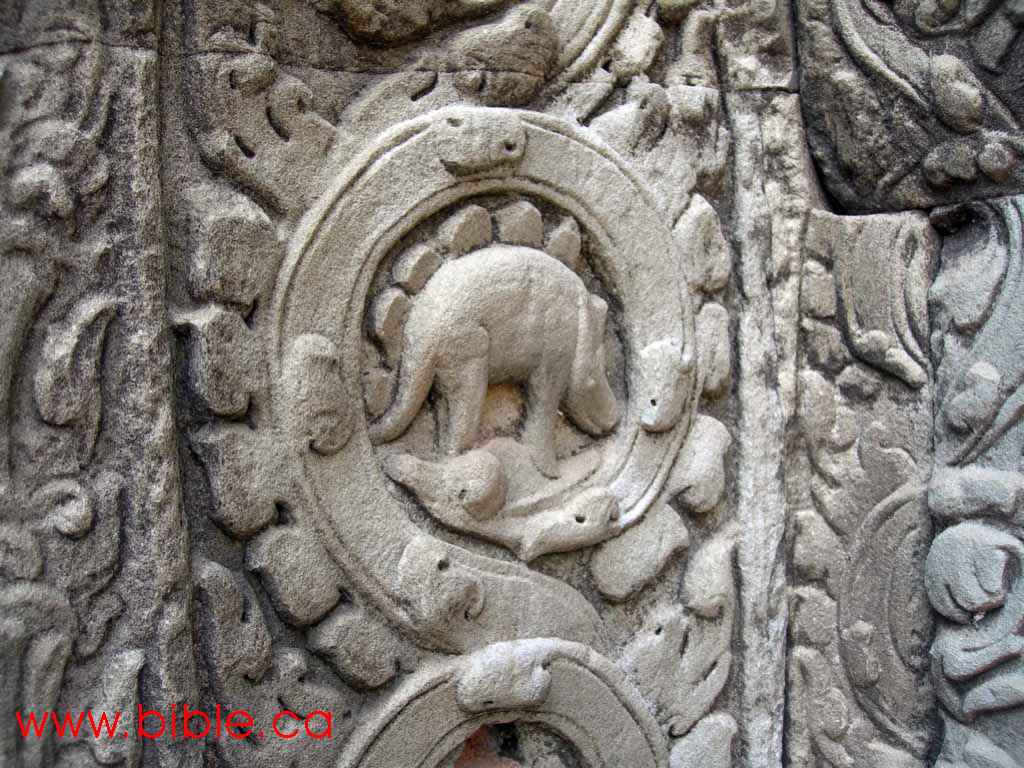
On Ta Prohm temple in Cambodia, there is an image that appears to be a stegosaurus alongside depictions of a monkey, deer, and parrots. On Kachina Bridge in Utah, the Anasazi petroglyphs include an animal that looks like an Apatosaurus. Among the petroglyphs at Havai Supai Canyon, near the Grand Canyon, is an image that appears to be a dinosaur with a long neck, standing upright and balancing on its tail.

Then there are the tens of thousands of small handmade clay sculptures that have been dug out of the ground near the foot of El Toro mountain in Acambaro, Mexico. Besides sculptures of people, musical instruments, idols, and so on, there are – you guessed it – hundreds of recognizable dinosaurs.

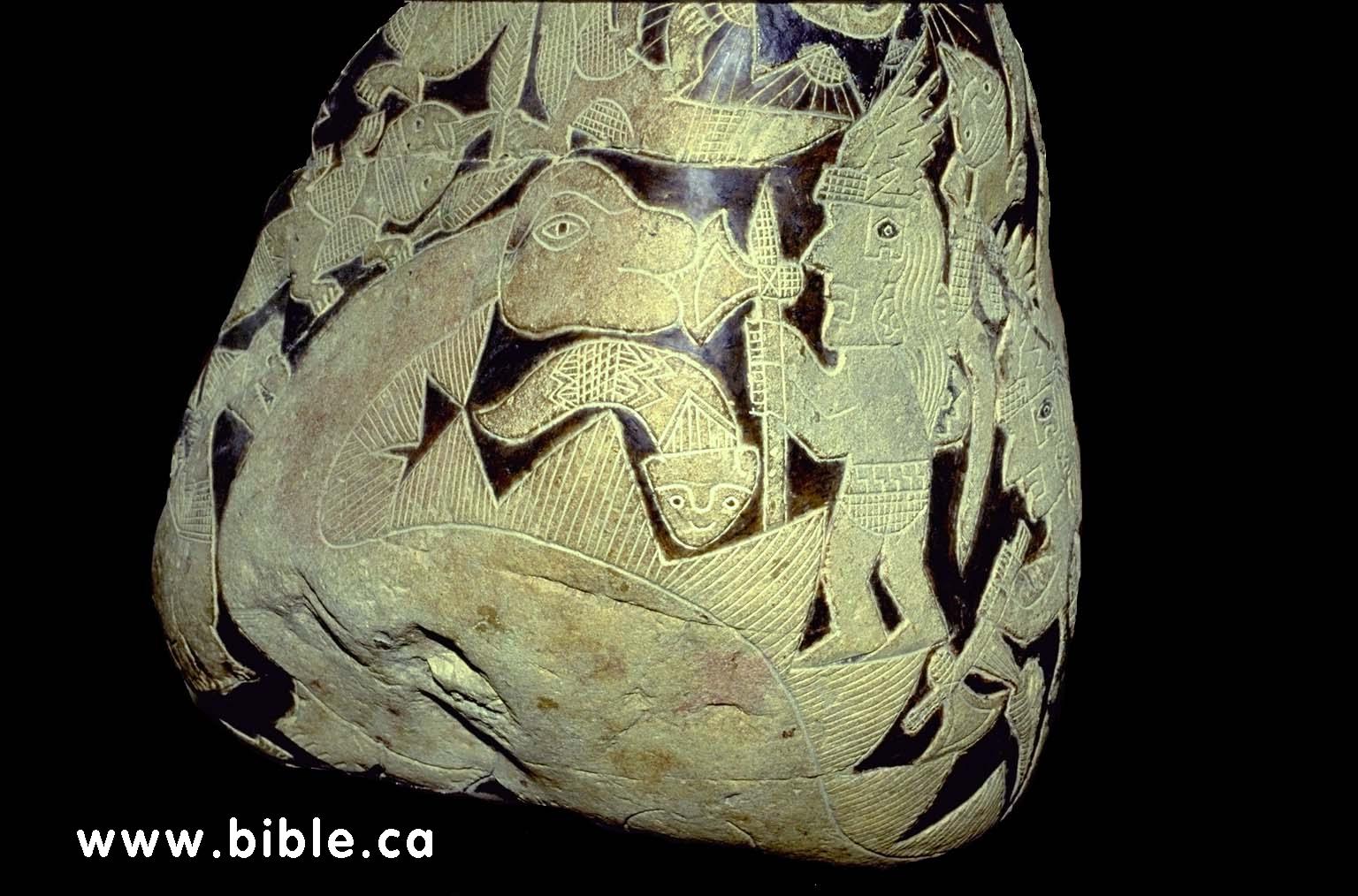
Finally, we have the Ica burial stones of Peru. These have images incised on them, including lots of dinosaur images. Interestingly, they show sauropod-like creatures with spikes on their backs. When I was a kid, sauropods were shown as large, grey, slow, and reptilian, with smooth backs. But apparently, in 1992 we moderns figured out that sauropods had “dermal spines.”

Visual images, especially petroglyphs, can be hard to interpret. As you might expect, the sculptures and images above are beloved of creation scientists and have been the subject of debunking by those who hold that dinosaurs did not survive to overlap with people. Sometimes the debunking takes the form of “That’s not really a dinosaur”; other times, as in the case of the Acambaro sculptures, the refrain is, “It must be a recent hoax.”

In the links above, I have tried to include a mix of both sympathetic and skeptical sources. I wanted you to be able to see the images; when possible, I took you to a skeptical source so that you can verify that the image in fact exists. Using the links above, the curious can find out more about the controversies (and with prehistory, the controversies never end).

But now we turn from visual images to less ambiguous accounts in the form of writing.

Historical Evidence for Dinosaurs

Once we start taking dragon ‘legends’ seriously as possible historical accounts of dinosaurs, we start seeing that there are a lot of accounts to consider. Here are just four:

The ancient Chinese, of course, had a whole cosmology built around different kinds of dragons. So much could be said, but I just want to note two things here. First, Chinese dragons are strongly associated with the Emperor because, among other reasons, of a legend of an early emperor, Xia Yu, who was helped by a wise dragon. (Note in the link above that Xia Yu’s story has other features common to the early chapters of Genesis. He lives hundreds of years; he is a founder and a culture bringer; he helps tame the dangerous floods. He is also an ancestor and founder who is later worshiped as a deity, as seems to have been the case with Nimrod.)

Secondly, Chinese dragons differ from Western dragons because they tend to be bearded. Some depictions even have a mane similar to a lion’s. This could be a case of combining characteristics of different animals, which is explicitly done in Chinese dragon mythology, but — just a thought — it could also be a depiction of hair-like feathers. “Hairy” dragons made no sense as dinosaurs until a few years ago, when we started discovering that many dinosaurs had quills or even feathers. See the following links: First Dinosaur Tail Found Preserved in Amber; Top 10 Dinosaurs that Aren’t What They Were; Fossils found in Siberia suggest all Dinosaurs had feathers.

Speaking of feathered dinosaurs: myths about, and worship of, a feathered serpent go way back in a variety of Mesoamerican cultures. This feathered serpent is called Kukulkan in Mayan, but is better known by his Nahuatl name of Quetzalcoatl. He even has a pterosaur named after him, though in reconstructions it looks more like a big bird than like a winged snake. (But compare this myth to the Hebrew “seraph serpents.”)

Continuing with the ancient Hebrew, here is a passage from the book of Job: “Look at the behemoth, which I [God] made along with you [Job] and which feeds on grass like an ox. What strength he has in his loins, what power in the muscles of his belly! His tail sways like a cedar (!); the sinews of his thighs are close-knit. His bones are tubes of bronze, his limbs like rods of iron. … Under the lotus plants he lies, hidden among the reeds in the marsh. … When the river rages, he is not alarmed …” (Job 40:15-23)

This description, particularly the tail swaying like a cedar, sounds like some kind of sauropod. For comparison, in the chapter before this God has given some poetic, but accurate, descriptions of the behavior of mountain goats; does; wild donkeys; wild oxen; ostriches; war horses, hawks, and eagles.

Job, by the way, apparently lived in the Ancient Near East not too long after Babel, if we go by his lifespan. According to the book of Job, he lived another 140 years after the events he is famous for. In Genesis 11, we see life spans of roughly 200 years becoming commonplace some time between Babel and Abraham. This is also the time period in which my book is set.

And now, we come to my favorite: dinosaurs in Beowulf. For this analysis, I owe Bill Cooper, author of After the Flood (1995).   His book has an entire chapter devoted to zoological terms in Beowulf. Among many other rich ethnological and linguistic details, Cooper points out that in the original Anglo-Saxon, Grendel is nowhere referred to as a “troll.” In fact, ‘Grendel’ appears to be not a personal name but a name for a species: there are place-names in England such as “Grendeles Mere” (Grendel’s Lake), Grindles Bec, and Grendeles Pyt. There is even Grindelwald (“Grendelwood”) in Switzerland. (!)

Looking at the characteristics of Grendel as described in Beowulf:

  • He is in “the shape of a man, though twisted” and “more huge than any human being.” In other words, large and bipedal.
  • He is a “mearcstapa” (a marsh-stepper), who stalks the marshes.
  • He is a nocturnal predator (a “sceadugenga” — shadow-goer).
  • He is a “muthbona,” one who slays with his mouth. He is able quickly to devour human beings (once, 15 in one night). This would be difficult if he had a humanoid type of head and jaw.
  • Hrothgar’s warriors have been unable to kill Grendel for 12 years, and he is said to be invulnerable to ordinary weapons.
  • The way Beowulf kills him is to grip him by his “claws,” at which point Grendel, realizing he is in trouble, tries to get away. But Beowulf twists Grendel’s arm off at the shoulder and Grendel runs off to bleed to death.
  • Later, when Beowulf beheads Grendel’s corpse, it takes four men to carry the head home on a spear (this is my own observation, not Cooper’s).
  • And another of my own: Grendel and his mother are both referred to as having “locks,” but see the discussion above about feathers or spines.

After offering all this evidence, Cooper doesn’t even bother to name the dinosaur. “Is there a predatory animal from the fossil record known to us, who had two massive hindlegs and two comparatively puny forelimbs? There are several such species.” (page 159)

Thus, four different streams of historical record that I think may be more than myth.

I am not suggesting that every story of a dragon is to be taken seriously as a sober historical record of a dinosaur encounter. Fables have been invented about dragons, just as fables have been invented about other animals that have captured the human imagination (i.e., nearly all of them). But this does not invalidate every historical account. No one thinks that foxes do not exist because of Aesop’s story of the fox and the grapes. No one thinks that whales do not exist because of Moby Dick or Pinocchio.

But Do They Breathe Fire?

The “dragons” in my books do not breathe fire. However, I have nothing in principle against the idea of an animal that could. After all, this world of ours contains the electric eel, the bombardier beetle, bat radar, bio-luminescent beaches, and the platypus, which apparently is able with its bill to detect electric fields put off by living things and so home in on its prey. Since all these things are possible, surely an animal could have existed that could expel superheated liquid, gas, or even – who knows? – actual fire. The process that allowed it to do this would likely be chemically based and so perhaps not visible in a fossil.

Dragons in The Long Guest

Dragons in my first book appear as part of the milieu, not as characters. Since they do not play a major role, I can mention them without spoilers.

Early in the book, two of the men go on a hunting/scouting trip. They observe a duckbill-type dragon with a crest with pink coloring. On the way back, they have an encounter with another dragon of the raptor type, which is hunting a wild boar that they are also hunting.

Much later in the book, the tribe has crossed Mongolia and has almost reached what is now the Liao River (home of the “pig dragon” artifacts). There they have a friendly encounter with a group of strangers who are capturing a dragon to take home to their king. The “dragon” in this scene is a Triceratops-like creature that sports dermal spines, blue-and-gold feathers on its crest (because why not?), and smooth feathers over the rest of its body. (My day was made, once about ten years ago, when I read in a newspaper that a Triceratops had been found covered in feathers. I now can’t track down the source … but it’s too late. Feathered triceratops/Chinese pig dragon has already made it into the book.)

Loosely Related Update

A long time ago, Antarctica had a temperate or tropical climate, lots of animal life, and this cute little reptile.

Sources

Butt, Kyle and Eric Lyons. Dinosaurs Unleashed: The True Story About Dinosaurs and Humans. Apologetics Press, Inc., 230 Landmark Drive, Montgomery, Alabama, 1st ed. 2004, 2nd ed. 2008.

Cooper, Bill. After the Flood: The early post-flood history of Europe traced back to Noah. New Wine Press, PO Box 17, Chichester, West Sussex, England, 1995. The creatures in Beowulf are discussed in Chapter 11, p.146 ff.

Kleeman, Terry & Barrett, Tracey.  The Ancient Chinese World.  New York: Oxford University Press, 2005.

The Sumerians

Photo by Digital Buggu on Pexels.com

I was taught in school that the Sumerians were the world’s first civilization.  What this actually meant was that they were the earliest civilization with writing that we knew of.  I’m not sure this is true any more.  It seems we keep finding earlier and earlier evidence of civilizations, and even of writing, from all over the world.  Look here for example.

The Sumerians flourished in Mesopotamia around 3000 BC.  (Obviously, they must have started earlier than this, since this is the approximate date of the earliest records that we have found.  They could have started much earlier.)   Their language is not clearly related to any known language families that are around today.   Indeed, we only know how to translate their language because the Akkadians later adapted the Sumerian writing system and continued to use Sumerian as a classical language long after it had died out as a living language. 

It is a pretty language (my completely objective opinion).  In The Long Guest, the names Nimri, Ninna, Ninshi, Shulgi, and Enmer are composed of syllables taken from the – usually much longer – Sumerian names.  Some examples of Sumerian names: Shu-Sin, Shulgi, Inanna, Enlil, Ningal, Ninurta.  

I drew on Sumerian because it is a very early language in approximately the same part of the world as the tower of Babel, with the same highly centralized urban/religious social structure that we see clearly in the story of Babel. 

One last note about the Sumerians.  There is a strong possibility that they were black.  It is hard to tell what ancient peoples looked like, because they did not leave us color pictures, but apparently the Sumerians refer to themselves in their documents as “the black-headed ones.” For more information, see this article by Arthur C. Custance.

Sources:

“Cucuteni-Trypillia culture,” from Wikipedia, https://en.wikipedia.org/wiki/Cucuteni-Trypillia_culture . This is where I learned about the Vinca-Turdas script.

Ostler, Nicholas.  Empires of the Word: A Language History of the World. HarperCollins Publishers Inc., 10 East 53rd Street, New York, NY 10022, 2005.  615 pages.  (Sumerian, p. 49 – 58.)