
His slaves carried his litter behind him, acting as a bodyguard, but he was not afraid of Pompeii after dark. He knew every stone of the town, every hump and hollow in the road, every storefront, every drain. The vast full moon and the occasional streetlight–another of his innovations–showed him the way home clearly enough. But it was not just Pompeii’s buildings he knew. It was its people, and the mysterious workings of its soul, especially at elections…
Pompeii, p. 207
Tag: ancient world
Farmlands and Paganism

Besides growing up around farms and reading a lot of literature set there, I’ve always kind of craved traditions, folk costumes, and folk practices. It’s not because I like being circumscribed in everything I do–I’m kind of a free spirit actually–but because I sensed these traditions and customs and bits of folk wisdom represented a thick culture, rooted in the distant past, that I as an American lacked. Traditional ways, whatever they were and wherever I read about them, seemed at the same time intriguingly exotic, and almost familiar.
In eastern Pennsylvania, where I spent my earliest years, many of the farmers were Pennsylvania Dutch–i.e., German immigrants. They had their own language, a dialect of German that my dad was able to pick up due to having majored in German. They had their own foods, like shoefly pie and scrapple. And they had a little, tiny bit of superstition: hex signs painted on barns. As a kid, I knew that these pretty little designs were called hex signs, but I had no idea of the connection between the word hex and spells or witches.
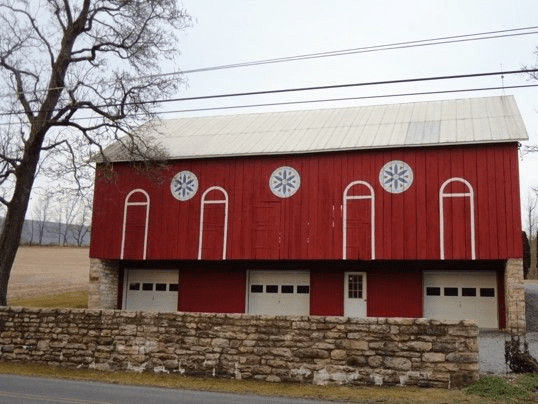
The Pennsylvania Dutch were nominally Christian, though I understand from my dad that they, like the Amish, often had a shallow and moralistic understanding of the Bible, and in fact sometimes didn’t have a Bible in a language they could read.
Despite their attractions, the Germans were to me among the least interesting of pagan farmers. I was more interested in British, Scots, and Irish folklore. It seemed warmer and more colorful somehow, and we had plenty of that around too, being in the Appalachians. It was also readily available in literature.
The connections between farming, weather-watching, astronomy, and European pagan religion are ancient and obvious. Here is Will Durant on Roman practices:
When [the Roman peasant] left the house he found himself again and everywhere in the presence of the gods. The earth itself was a deity: sometimes Tellus, or Terra Mater–Mother Earth; sometimes Mars as the very soil he trod, and its divine fertility; sometimes Bona Dea, the Good Goddess who gave rich wombs to women and fields. On the farm there was a helping god for every task or spot: Pomona for orchards, Faunus for cattle, Pales for pasturage, Sterculus for manure heaps, Saturn for sowing, Ceres for crops, Fornax for baking corn in the oven, Vulcan for making fire. Over the boundaries presided the great god Terminus, imaged and worshiped in the stones or trees that marked the limits of the farm. … Every December the Lares of the soil were worshiped in the joyful Feast of the Crossroads, or Compitalia; every January rich gifts sought the favor of Tellus for all planted things; every May the priests of the Arval (or Plowing) Brotherhood led a chanting procession along the boundaries of adjoining farms, garlanded the stones with flowers, sprinkled them with the blood of sacrificial victims, and prayed to Mars (the earth) to bear generous fruit.
Caesar and Christ, p. 59
Farming is so labor-intensive, so high-stakes, so heartbreaking, so subject to factors beyond human control, that it tends to produce nervous and conservative people. It would be impossible to engage in it for generations without coming to a profound humility before whatever entity you have been led to believe determines whether your whole year of work will be wiped out within a few days. For Christian farmers, that entity is the One who owns the cattle on a thousand hills. For post-Christian farmers, such as Wendell Berry, it’s the earth itself, I suppose, the environment. For pagans, it’s not hard to understand why they might be reluctant to let go of all the little rituals that stand between them and disaster.
Thus, paganism hangs on longer among country folk than in the city. If you want your eyeballs to be assaulted with an astonishing variety of pagan superstitions still proudly held by modern Americans, go get yourself a Farmer’s Almanac and look in the classifieds section.
“But modern Americans are returning to paganism!” you say. “It’s part of the New Age. It’s trendy, not traditional.”
Don’t I know it. I have met a few neopagans in my day. The one I knew best, was raised in a nominally Roman Catholic home. She was innovating with her paganism, part of the modern self-worshipping, I’ll-make-it-up-as-I-go ethos. The neopagans in the back pages of The Farmer’s Almanac don’t give me that vibe. I could be wrong, but it seems like they never left.
Where is the line between weather-watching, paying attention to the phases of the moon when you plant, following the zodiac along with the yearly calendar, hiring a water-witch, hanging a horseshoe over your door to protect your entryway with iron, and full-on pagan worship? How much of it is science, and how much is just doing things the way your mother did them? And how many “mindlessly followed” folk traditions turn out to have a sound scientific basis?
I’m guessing that Christian farmers in the modern age may have given up some valuable folk knowledge in an effort to avoid idolatry. Idolatry is a deadly poison, though, so no doubt, the sacrifice is worth it. If your eye cause you to sin, pluck it out. I hope that, as the generations roll by, we can build a culture that’s even richer than the pagan one we left behind.
3D Map of the Mediterranean

Get a white signboard from Hobby Lobby.
Freehand the coastlines in pencil while looking at a map for reference. Paint the seas, using Duckduckgo to find out relative depths. Start adding topography using plaster-of-Paris coated gauze strips.
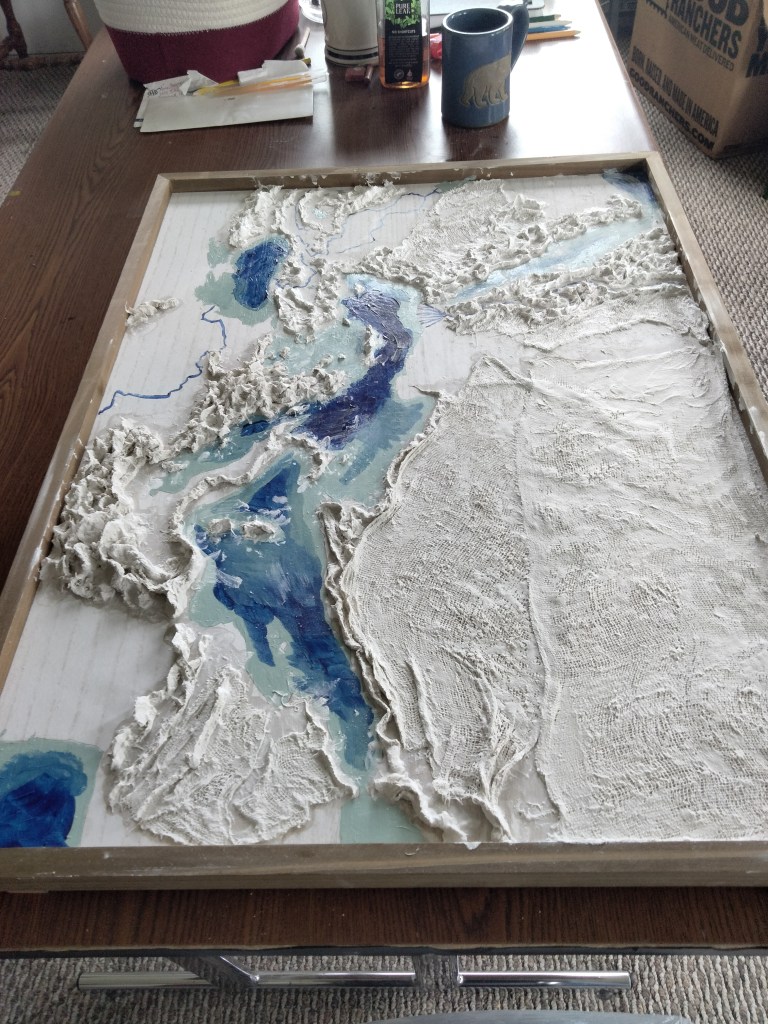
Continue adding topography.
Some of these mountainous areas threatened to come loose after they dried. I simply applied some Elmer’s glue under them.
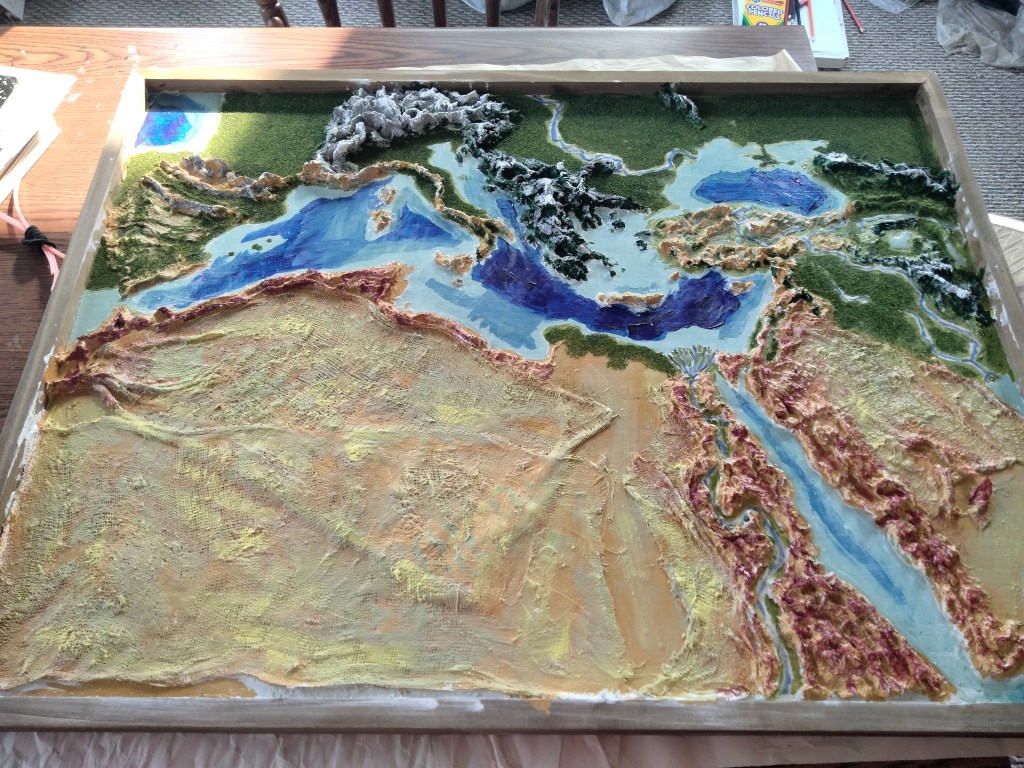
Paint as desired. I protected some of the smaller bodies of water by squeezing a thick layer of Elmer’s on top of them.
When dry, paint grassy areas with craft glue and sprinkle on “grass” that you can get in the model railroads aisle. Let dry, then vacuum up loose “grass.”
Show to 3rd, 4th, and 5th graders.
Pompeii: A Masterclass in How to Write Historical Fiction
Pompeii by Robert Harris, pub. 2003
Dear Robert Harris,
I am sorry. I am sorry that I left your book, Pompeii, moldering on my bedside bookshelf for … I don’t know … several years after I got it … I don’t know … from my husband’s trucker friend, from the library sale shelf, somewhere like that. I should have picked it up and read it immediately. I thought it was going to be demanding and … you know … educational. I didn’t know it was going to be educational. Or gripping. Or The Perfect Historical Novel.
Spoiler: Vesuvius Blows
I don’t know, reader, whether you would pick up a novel about Pompeii. Perhaps you would worry that the tension would be somewhat lacking, given how everyone knows that the mountain explodes and buries the town. It would be, you might think, sort of like reading a novel called John Dies at the End.
Harris, of course, uses the volcanic eruption’s very fame to his advantage. The people in Pompeii, and Herculaneum, and in the other towns around the bay of Neapolis, don’t know what is about to happen to them. This gives the opportunity for an infinite number of ironic quotes and thematic moments, such as the line, “I ought to die and come back to life more often,” when a narrow escape from death causes a character to be met with newfound respect. You spend much of the book wondering which, if any, of these people are going to survive.
The Historical Background
No, I am not going to sketch all the historical background here. I’ll just tell you that an awful lot is known about Roman society of this period, both general things about the culture, diet, and technology, and specific things about individuals like Pliny the Elder. (And Nero. Nero had a favorite moray eel, did you know that?) Harris makes excellent use of all this research to build a story that grows organically out of the who the characters are and what they value.
At the beginning of the book is a nice clear map of the Bay of Neapolis and surrounding regions, which is critical to visualizing the action of the book. Special attention is given to the Aqua Agusta, an aqueduct which runs from the Apenine Mountains, past all the towns in the region, with spurs providing water to Pompeii, Herculaneum, and so on, until it terminates at the naval base of Misenum, in a reservoir called the Piscina Mirabilis, “Miracle Pool.” When you see how close the Aqua Agusta runs to Vesuvius, you can see that an imminent eruption might well cause problems for the region’s water system.
The Hero
Marcus Attilius, the “aquarius,” comes from a family of men who build and maintain the empire’s aqueducts (which, by the way, like the Aqua Agusta, are often not elevated but rather are underground pipes). He was sent from Rome to Misenum two weeks ago after his predecessor, Exomnius, mysteriously disappeared. When the water running into Misenum first turns sulfurous and then starts to lose pressure, everyone is ready to blame Attilius for not having foreseen or prevented this.
Attilius, realizing the gravity of the situation, orders the city’s water supply to be shut off. There is enough in the Piscina Mirabilis to last Misenum two days with rationing. Attilius, based on which towns have lost water and which haven’t, thinks he knows approximately where the break in the aqueduct is. By pressing very hard, he hopes in two days to sail to Pompeii, send a team inland to find the exact source of the leak, send another team to re-direct the water farther upstream, buy supplies, and work through the night with a team of slaves to fix the blockage. In this way, he hopes to prevent riots and death in the towns without water. The reader knows that Attilius is also racing against time to find the reason the aqueduct broke.
We learn a lot about the Romans’ amazing aqueduct system. All the cities had, essentially, free water as a gift from the Empire. The underground pipe was six feet in diameter, with a three-foot thickness on either side made of the famous Roman cement, made with seawater, which could dry underwater and which got harder with time. There are maintenance manholes at regular intervals, and water sinks along the route which allow the water to drop rocks and silt it’s been carrying. These are then used for gravel.
The great Roman roads went crashing through nature in a straight line, brooking no opposition. But the aqueducts, which had to drop the width of a finger every hundred yards–any more and the flow would rupture the walls; any less and the water would lie stagnant–they were obliged to follow the contours of the ground. Their greatest glories, such as the triple-tiered bridge in southern Gaul, the highest in the world, that carried the aqueduct of Nemausus, were frequently far from human view.
page 181
The Villain
Ampliatus is a former slave. His master, who used him as a toy (yes, the Romans were horrible people), set him free in his will at the age of twenty. Ampliatus, by this time a ruthless social climber, began to amass wealth by buying real estate around Pompeii. Several years before the book opens, the city suffered an earthquake. Most of the aristocrats fled, but Ampliatus is unendingly proud of himself because he stayed, bought up a bunch of buildings on the cheap, fixed them up, and became the nouveau riche. By the time the book opens, he has bought his former master’s estate. His bedroom is the one where he used to be molested. He has gotten his former master’s son in debt to him, and is persuading him to marry Ampliatus’s daughter. He is building an ambitious bathhouse in the middle of the city. As Ampliatus says to the aquarius when he’s trying to corrupt him, water is key to civilization.
As a former slave, Ampliatus outdoes the aristocrats he imitates in both cruelty and ostentatiousness. There is a memorable scene of a feast Ampliatus gives, of the kind that historians would probably call sumptuous. It’s held in Ampliatus’ triclinium (dining room) on a swelteringly hot August night, and no one but Ampliatus wants to be there.
And the food! Did Ampliatus not understand that hot weather called for simple, cold dishes … then had come lobster, sea urchins, and, finally, mice rolled in honey and poppy seeds. … Sow’s udder stuffed with kidneys, with the sow’s vulva served as a side dish … Roast wild boar filled with live thrushes that flapped helplessly across the table as the belly was carved open … Then the delicacies: the tongues of storks and flamingoes (not too bad), but the tongue of a talking parrot had always looked to Popidius like nothing so much as a maggot. Then a stew of nightingales’ livers …
pp. 146 – 147
Reader, I have spared you the most disgusting parts of this dinner.
Ampliatus has commissioned a positive prophecy about the city of Pompeii from a sybil–an older female seer–and is keeping it in readiness for the next time he needs to get the people all excited … probably in order to ensure the election to public office of an aristocrat he has in his pocket. And here is what the sybil has said: Pompeii is going to be famous all over the world. Long after the Caesars’ power has faded, people from all over the world will walk Pompeii’s streets and marvel at its buildings. Ampliatus takes this as a very good sign.
The Scholar
Pliny the Elder, an actual historical person, makes an appearance as a prominent side character. Pliny was stationed as a peacetime admiral at Misenum. When Vesuvius started erupting, it was clearly visible across the bay. Pliny, who had written a whole encyclopedia about the natural world, received a message from an older female aristocrat in Herculaneum, begging him to come and save her library. (In Pompeii, this message is delivered by Attilius.) Pliny launched the navy without imperial permission, intending to save the library and also evacuate the towns near the eruption. But pumice falling from the sky, floating on the water, and clogging the bay prevented the ships from approaching the coast. Pliny and his crew were forced to take refuge belowdecks, and their ship was driven across the bay to Stabiae, where they took refuge overnight. Eventually, they had to evacuate on foot, but Pliny, who was fat and was perhaps suffering from congestive heart failure, chose to stay, and ended up dying in the gaseous cloud that swept along the coast.
The remarkable thing is that during this entire time, Pliny had his scribe with him, and he was dictating his observations about the “manifestation.” His notes were saved. It occurs to me that the stereotype of the British absentminded professor who is never rattled by anything, and always keeps his cool and approaches everything with perfect manners and scientific curiosity (and is an incurable snob), may have roots deeper than England itself.
Go read this book right now!
Despite the large amount of detail in this review, I assure you that I have merely scratched the surface and that this review contains very few spoilers for the novel. I really can’t say anything better about it than that it is, in my estimation, the perfect historical novel. Please go read it if you have any interest at all in the genre.
When Did We Stop Marrying Our Siblings?
… and why do I care?
I might be in the process of drafting a book that takes place before the Flood. So that is forcing me to tackle this issue. Besides needing to get it settled in my own mind, this post is meant to test the waters and see how you, my readers, react to this concept. If I even bring it up, will I be kicked out of polite society?
So, this post is a historical survey of sister-marrying. And it starts in Egypt.
Royals did it
Marrying one’s sister, or half-sister, was not unheard of in the royal families of Ancient Near Eastern cultures. See the following two links for some hair-raising proof that it happened in ancient Egypt:
https://www.historyskills.com/classroom/ancient-history/egypt-brother-sister-marriage/
The practice of royal inbreeding continued so long in Egypt that, by the time we get to Tut-ankh-amen, he has a myriad of health problems and is rather strange-looking.
This was such an established part of married love, at least among royals, in the Ancient Near East that calling someone “my sister” became a conventional endearment. Here, for example, is Solomon:
You have stolen my heart, my sister, my bride,
you have stolen my heart with one glance of your eyes,
with one jewel of your necklace.
Song of Solomon 4:9
And why did they do it? The obvious answer is to keep the royal bloodline pure. Most ANE cultures tended to believe that their royal family was descended from the gods (see my post Genetic Engineering in the Ancient World), and to add another layer to this, their myths about the gods also often featured sibling-marriage. Typically, you’d have gods and goddesses all being descended from the same being (Father Sky and Mother Earth, say), and then reproducing with each other to produce all the typically observed features of the cosmos. (Please, for the love of God, take my word for this and don’t read the Sumerian creation myths. I’m begging you–don’t!)
Speaking of Sumerians, here is an article that argues that Abram married his half-sister Sarai (whose name means princess) for the same reason: because their family was some kind of royalty in Mesopotamia before he left on his journey.
https://biblicalanthropology.blogspot.com/2011/03/sister-wives-and-cousin-wives.html
My question, however, is this. Did this practice of royals marrying their sisters represent breaking an established taboo for a “good” reason, or was it a case of carrying on a common practice a little longer than most people? My contention is that it’s the latter.
Let’s Go to Genesis
Genesis is, as I have often said, my favorite ancient history book. The more I study all of this, the more I realize that it is by far the most accurate written record we have of really ancient history, and of course it’s the only written record we have for some events that are, nevertheless, corroborated indirectly by archaeology, genetics, and historical traditions from around the world.
So, in Genesis, we have humanity starting out with one single couple. If we take this seriously, we have to conclude that the first generation would have had to marry their brothers and sisters, because there was nobody else around.
Nowadays, this would be an impossible genetic problem, besides being taboo. However, clearly it wasn’t taboo at the time. By producing families, people were obeying God’s command to “be fruitful and multiply, fill the earth, and subdue it.” (Gen. 1:28) Based on the extremely long lifespans recorded in Genesis, we can infer that the newly created people were much healthier than we are, with a much more varied and robust genetic code. They would have had few diseases as yet, and almost no harmful mutations to inherit. Adam and Eve, who didn’t die until they were into their 900s, could have had literally a hundred or more children in that first generation. Furthermore, these children need not all have looked alike, except in the sense of being human. We have to remember that Adam and Eve had within them the potential to produce every genetic variation we see today (and actually more, since most of the variety was lost during the Flood).
By the time Cain kills Abel, there are enough people in the earth that Cain can complain, “I will be a restless wanderer on the earth, and whoever finds me will kill me.” These other people that he is worried about would have been his siblings, nephews and nieces, grandnephews and -nieces, and so forth. If we figure that Seth was born not long after the murder of Abel, then the murder of Abel took place just under 130 years after the Fall. (Genesis 4:25 – 5:3) Apparently, that was enough time for the world to be populated.
In this video, starting at about 20:00, geneticist Nathaniel T. Jeansen discusses how our ancestors had to have been more closely related “than we are usually comfortable with.”
A Detour into Evolutionary Theory
“But wait!” you may say. “All this is nonsense. People didn’t all come from one founding couple, we evolved from several different but related species of hominids.”
Actually, if you think that way, you probably stopped reading this article before you got to this section. But let’s dip a toe into natural selection, just in case there is anyone hate-reading or any readers who are intrigued by what I’m saying about history, but are bothered by the science side of things.
Natural selection, in order to work as a mechanism, has to have a population of creatures already in place, with some genetic variation already in their genome. And–this is critical–they have to be already reproducing. That way, natural selection can operate on the subsequent generations of the population, encouraging variety here, stamping it out there, etc.
This creates a big problem if you want to argue that people evolved from (ultimately) one-celled animals. Now, how one-celled animals reproduce is itself a beautiful, complex mystery, but it’s basically by subdividing, producing clones of themselves. In other words, it’s not sexual reproduction.
How did sexual reproduction come about through natural selection? It would call for a wildly improbable series of (already vanishingly rare) beneficial mutations to the genetic code of two different creatures of the same species, such that one ended up male and one ended up female, with their systems perfectly corresponding to each other for reproduction. And it would have to work perfectly the first time.
If you want several different populations of human species, then you need this miracle to happen not once but several times, in different places. If it only happens once, then you’re back to what Genesis describes, which is just one founding couple.
What I’m saying is that introducing evolutionary theory doesn’t make the believability problem smaller, it makes it bigger.
Stephen Meyer explains why beneficial mutations are mathematically impossible.
Back to Genesis Again
We’ve established that in the pre-Flood world, there was no taboo on marrying one’s sibling (or probably, cousin or niece either), and also no health cost to doing so. Also (probably) it would not necessarily mean marrying someone you had grown up in close proximity with, given the size of the families we are talking about.
Then we get the Flood, in Genesis 6 – 9 and also attested in numerous local histories worldwide. At the Flood, the human population of the earth, previously vast in genetic diversity, gets culled down to just four couples, and the men of these couples are all related to each other. It’s from these four couples (perhaps just three of them?) that all of us today are descended. (We are literally just one big family!)
Think about the implications of this. The most distant relationship that any of Noah’s grandchildren would have had to each other would have been cousin during that first generation. Perhaps they married their cousins, and then their second cousins and so forth, but there is nothing to indicate that the possibility of marrying siblings had been closed to them. In Gen. 9:1 -17, God makes a new covenant with Noah and his sons. He reiterates the command to increase in number and fill the earth. He gives them the animals to eat, institutes the death penalty for murder of humans, and promises never to send another worldwide flood. He does not mention any new rules about not marrying your sister.
Next, in Genesis 11 and 10 respectively, we get the Tower of Babel and the Table of Nations. Though the Table of Nations comes before the account of Babel, the fact that we are told which geographical areas these nations settled in hints that the Table of Nations is at least a partial elaboration of where people went when “the LORD scattered them over the face of the earth.”
In the Table of Nations, the peoples are sorted by father. We see the descendants of Shem, Ham, and Japeth listed by a paternal line, and we see them scattering to found cities, kingdoms, and peoples. This implies, though it does not directly say, that they were having a lot of children per family, and that they were practicing in-group marriage.
Now we get to Abram, who was a Sumerian basically, or was living in that region of the world and in that culture area. As has been covered, he married his half-sister Sarai, whether because theirs was an aristocratic family or because it was still common practice in Mesopotamia at the time. Later, on two separate occasions (Gen. 12:10 – 20 and 20:1 – 18), he “lies” by telling a local ruler that Sarai is his sister. On both occasions, the local king understands this to mean that Sarai is not Abram’s wife and is fair game for his harem. This shows that, probably, most wives were not sisters at the time, at least in Egypt (Gen. 12) and southern Palestine (Gen. 20).
This would be about 2,000 B.C.
In Genesis 24, Abraham asks his servant to get a wife for Isaac from among “my own relatives.” The servant, guided by the LORD (!), finds Rebekah, the daughter of Abraham’s niece (Gen. 24:15). One generation later, Rebekah herself encourages Jacob to marry one of his cousins, daughters of her brother Laban. So by this time, we are practicing in-group marriage, but with cousins, not siblings.
Some groups still do this. See my post on The Iroquois Kinship System.
Finally, A Taboo in Leviticus 18!
Finally, in Leviticus 18, we get an explicit prohibition on marrying your sister.
Leviticus comprises the details of the giving of the Law, right after the exodus from Egypt, so about 1400 B.C. If you plop your finger onto Leviticus, it looks really early in the Bible. However, it’s 600 years after Abraham and a couple of thousand years after the Flood, so it is coming rather late from this blog’s perspective on ancient history.
The intended recipients of Leviticus are a large population of tribes who have just spent 400 years becoming culturally Egyptian. Since Moses’ parents were both from the tribe of Levi (Exodus 2:1), we can infer that they are still practicing in-group marriage.
Leviticus chapter 18 begins this way:
The LORD said to Moses: “Speak to the Israelites and say to them: ‘I am the LORD your God. You must not do as they do in Egypt, where you used to live, and you must not do as they do in the land of Canaan, where I am bringing you. Do not follow their practices. You must obey my laws and be careful to follow my decrees. I am the LORD your God. Keep my decrees and laws, for the man who obeys them will live [i.e. find life] by them. I am the LORD.
“No one is to approach any close relative to have sexual relations. I am the LORD.”
Lev. 18:1 – 6
There follows a very comprehensive list of close relatives who are off-limits. This list includes everything you can think of, and some things that you perhaps haven’t. It ranges from very sick perversions, to this:
“‘Do not have sexual relations with your sister, either your father’s daughter or your mother’s daughter, whether she was born in the same home or elsewhere. (v. 9)
“‘Do not take your wife’s sister as a rival wife and have sexual relations with her while your wife is living.'” (v. 17)
Verse 9 gives us a clue of what types of family arrangements were possible among the Israelites of 1400 B.C. You might have a half-sister who was raised in a separate household. Verse 17 describes a behavior that Jacob famously engaged in with Rachael and Leah (additionally, both women were his cousins). In fact, the two women’s rivalry was how we got the twelve tribes of Israel. Marrying two sisters at the same time (not to mention their respective maidservants) was apparently something that was normal in the age of the patriarchs, but now, giving the Law 600 years later, God forbids it.
Leviticus 18:24 – 29 makes it clear that “all these things were done by the people who lived in the land before you,” but God considers them to be things that defile a land. I gather that this means the wide variety of disordered sexual relationships described in Leviticus 18 were not unheard-of, probably not just among the Egyptians and Canaanites, but among many or all of the many tribes in the surrounding areas.
We have God to thank for this taboo
So, now we know approximately when marrying your sister became taboo. 1400 B.C. And people didn’t come up with this on their own; God had to enforce it.
The overall picture is one where we start off with is marriages taking place among close family, in sort of a wholesome way, before and immediately after the Flood. Then, instead of branching out and marrying more and more distantly related people as the earth’s population increases, we see cultures in the Ancient Near East curving back in on themselves and coming up with more and more perverse ways to approach this. I gather from Lev. 18 that, once an ANE man had bagged a wife, he seemed to feel entitled, or at least have an eye out for the opportunity, for sexual rights to everyone related to her.
The time of the Israelite patriarchs, enslavement in Egypt, and Exodus also overlaps with the Minoan civilization on Crete, which gave us the legend (?) of the Minotaur, the offspring (allegedly) of Queen Pasiphae and a white bull. That gives us a clue that such horrifying practices were not confined to the Levant. “Do not defile yourselves in any of these ways, because this is how that nations that I am going to drive out before you became defiled.”
Megalithic Ruins in Montana II: Sage Wall, near Butte

Here I am at Sage Wall, to give you some idea of the scale.
Sage Wall is a possible megalithic site near Butte, Montana. In this post, I am going to thoroughly embarrass my geologist husband by saying that Sage Wall looks manmade to me. But first, how did I come to visit Sage Wall in person?
Getting to Sage Wall
It’s on my bucket list to visit as many archeological sites as a I can, the older the better. Sage Wall was a no-brainer because it’s only a half a day’s drive from my house. It is also a good candidate to visit because looking at photos is kind of ambiguous. To really get a sense of whether it seems manmade or like a natural formation, I felt I had to be there in person.
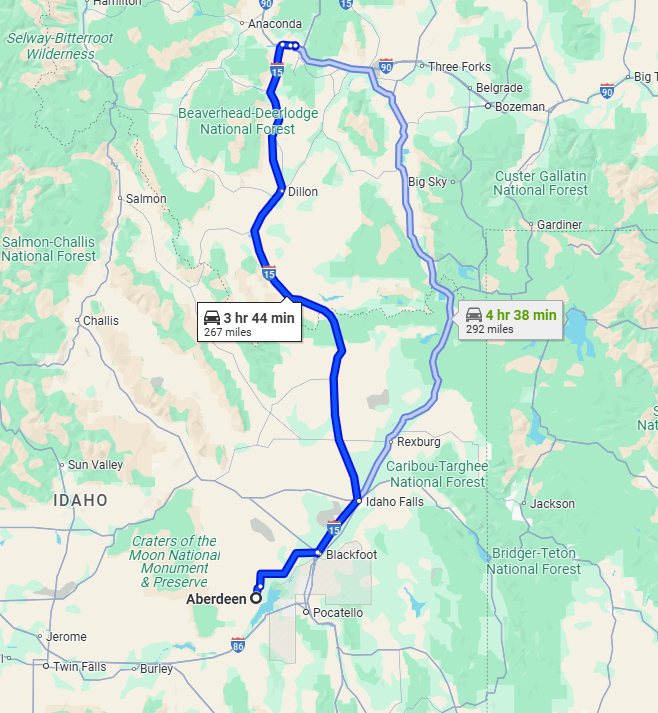
We drove up into the beautiful Montanan Pioneer Mountains (Idaho has some as well), stayed the night in Butte, and the next day, made our way to Sage Mountain Center, where I had a reservation. We could not have asked for a more beautiful day, weather-wise. Early June in the Butte area is still basically Spring.
Chris and Linda are the property owners at Sage Mountain. About three decades ago, they wanted to move out to the middle of nowhere and build a sustainable house and retreat center. They were not looking for megaliths. Linda stumbled upon the wall on a hike one day, and Chris, who has a background in building, looked at it, said, “Yep. That doesn’t look natural. Well, let’s get back to our projects.” It wasn’t until years later, when they had established a sustainability-themed retreat center and had started to create some hiking trails for their guests, that other people started noticing the wall. Chris and Linda cleared the brush around the wall, roped it off, and had it examined by LIDAR and ground-penetrating radar.
Now, many people are coming to see the wall, seemingly to a point where it is almost becoming a problem. Sage Mountain Center is still on a wind-y, washboard-y dirt road, but now many people, seeking to get away from it all, have built new houses and cabins along that same road. Chris asked us, as we drove out, not to “go too fast past our neighbors. We’re trying not to bother them.” I got the impression that his main desire is still to just run a sustainability B&B in peace, but he’s been saddled with this danged wall.
What Would a Skeptic Say?
I want to give the skeptical geologists their due here. I think what they would say is this: “All these people who are saying Sage Wall is amazing megalithic structure are forgetting one thing: It is right in the middle of the Boulder Batholith! There are big granite rocks everywhere!”

source: formontana.net
They are not wrong. The mountains to the east of Butte, where Sage Mountain Center is located, are strewn with large granite boulders and outcroppings. These tend to fracture into shapes resembling worked blocks of stone.
Here are some pictures I took, on the way in, of natural granite outcroppings so you can see how they normally look and how they tend to fracture:
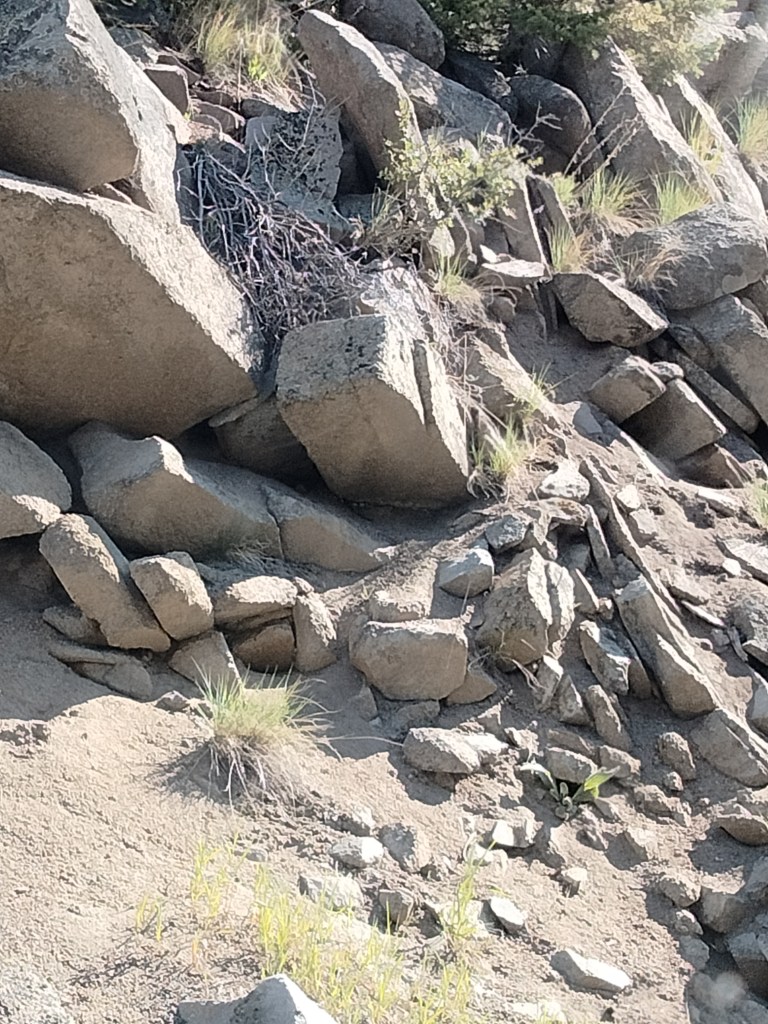

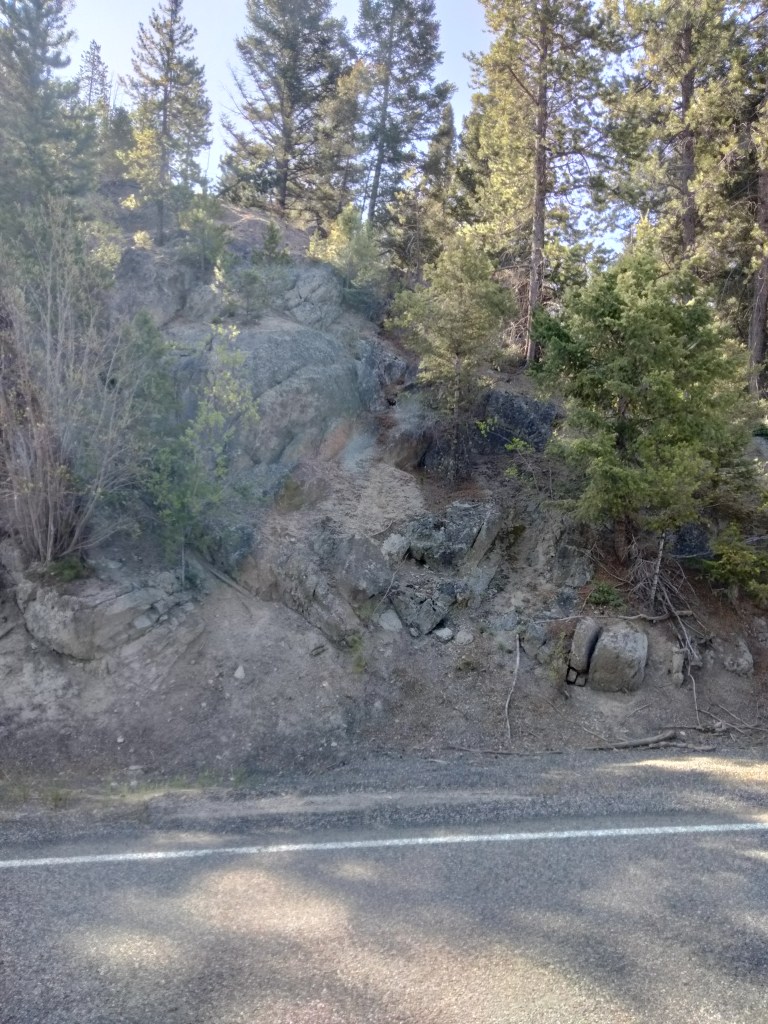
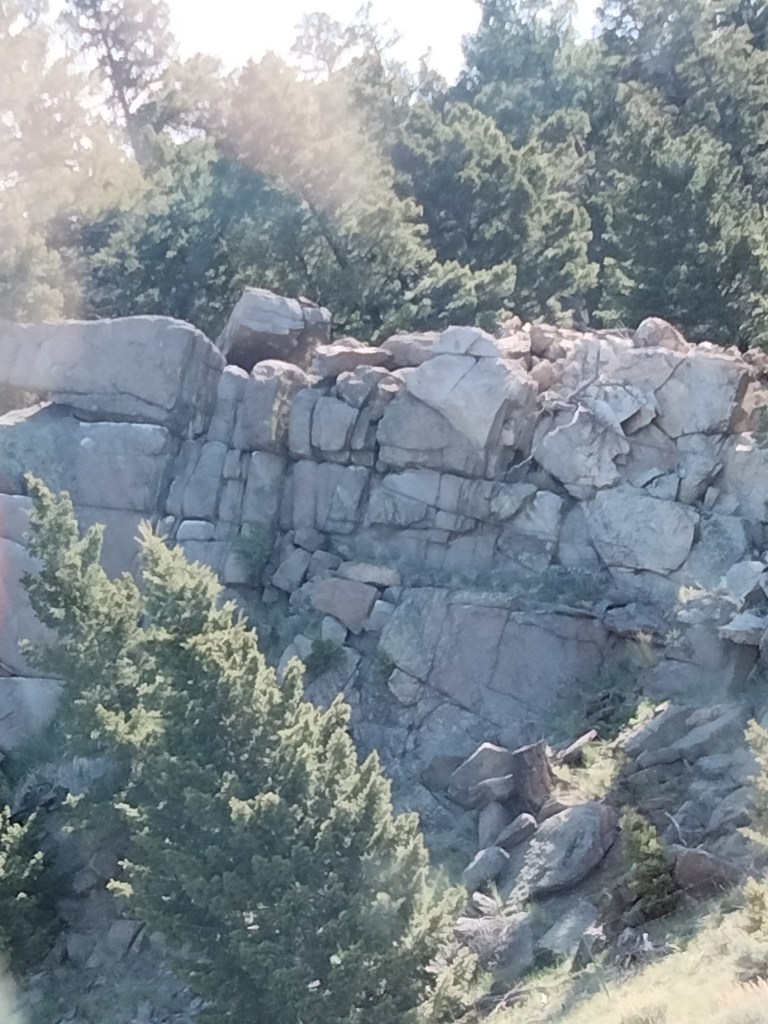
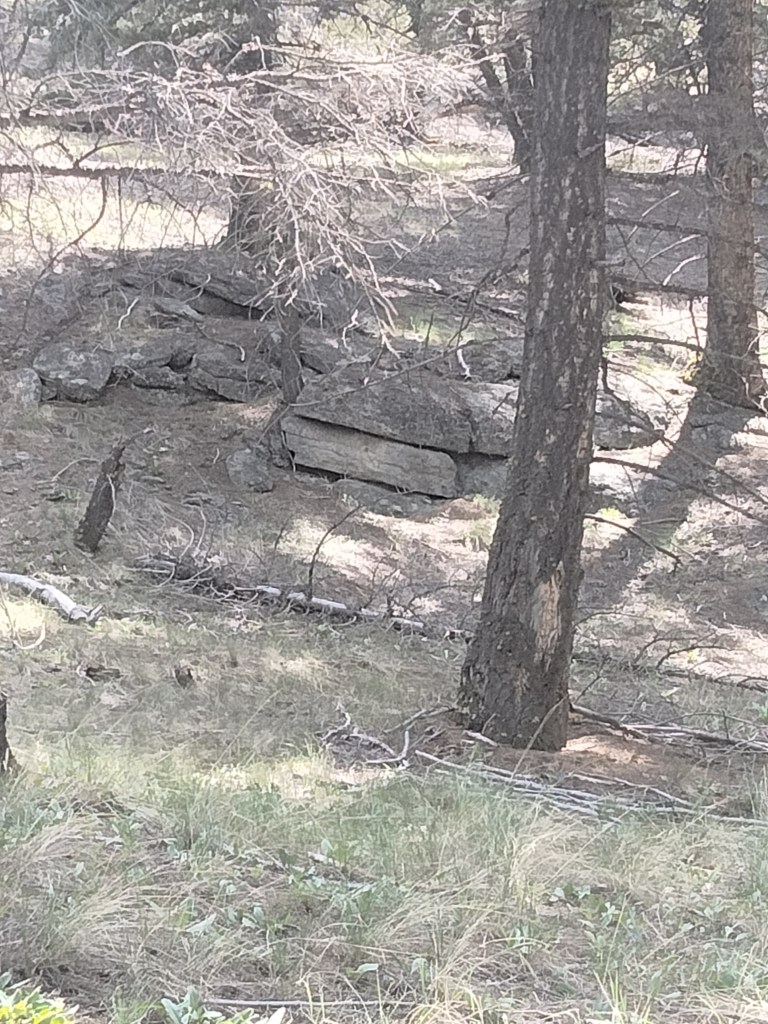
You can see that the fractures are often horizontal and strikingly block-like.
We also saw some pieces of granite that had very large quartz crystals formed in them, which stuck out like chips in a chocolate chip cookie:

And, just for fun, here’s a balanced rock:
I’m not sure whether this balanced rock is natural, but I’m leaning towards no. I’m thinking it was put there to mark the trail.
Anyway, the skeptics are correct that the presence of big, blocky rocks does not an ancient megalithic structure make. This is part of the reason I wanted to see Sage Wall myself. I did not take any videos of it, because I’m not good with video and didn’t have a script ready. But there are now many videos of Sage Wall online, including drone videos. I’ll try to embed some of them at the end of this post.
Why Sage Wall is Likely Man-Made in my Amateur Opinion
So no, the claim is not that this must be a megalithic structure because it is located somewhere that we would not expect rocks. It is definitely surrounded by rocks. However, it looks distinctly different from the more random rock outcroppings around it.
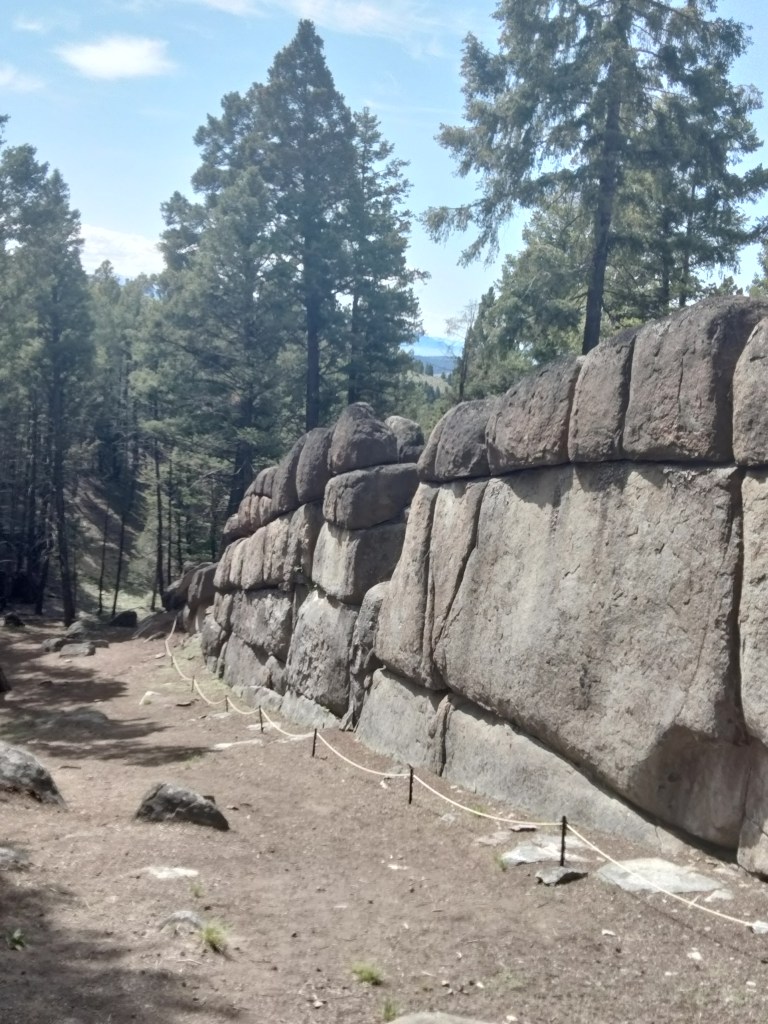
It is very long, and very straight. (The wall extends past the Sage Mountain Center property, but only their section of it has been cleared.)
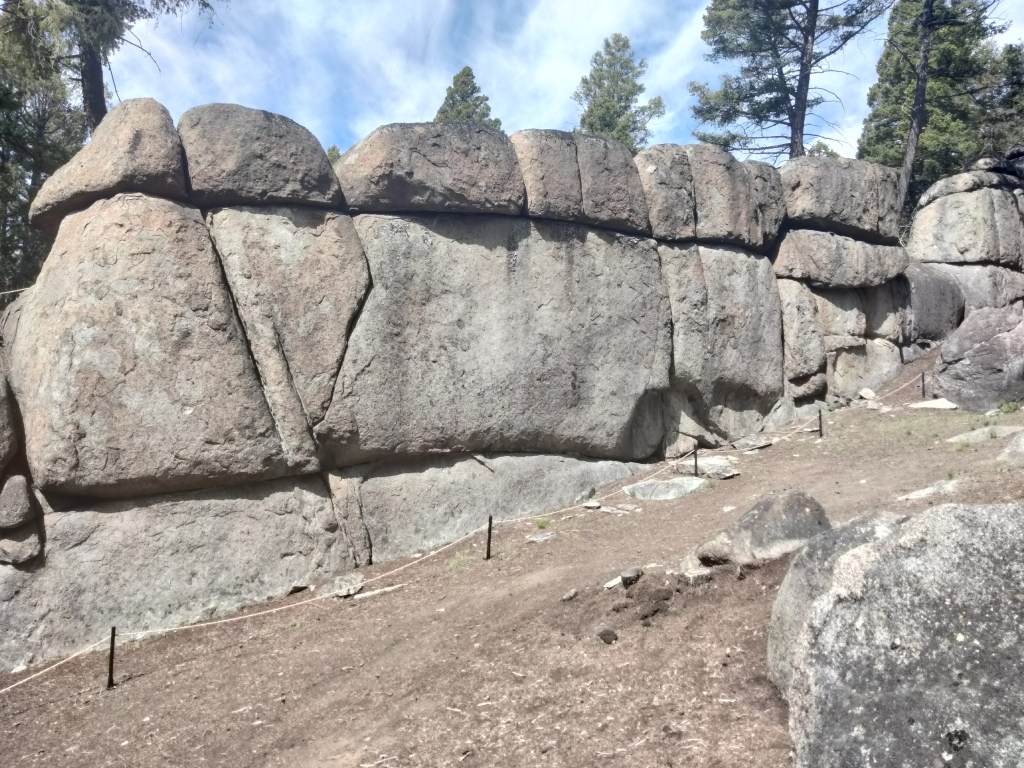
Unlike what we see with other fracturing patterns, the wall consist of very big blocks laid out in what appear to be courses. To my (again, amateur) eye, when we see natural fracturing the blocks tend to fracture into smaller pieces where they are exposed.
In the pictures above (and in the one where I’m posing), you can see a hollow lower down in the wall where a block obviously fell out.

At three different places in the exposed section of the wall, there are gaps in the top similar to doors. Chris told us there had been a lot of speculation about these before researchers realized that they were simply places where boulders had fallen out. In fact, you can see the boulders below them, almost completely buried in dirt and pine duff.
On the picture above, you can also see the remains of a triangular shape. The left side of the triangle is made with shaped blocks, and the right side is incised into the megalith. The triangle happens to frame the gap where a block fell out.
According to Chris, the geophysicist who examined the wall with ground-penetrating radar found that it goes down into the ground about another 20 feet. At the bottom was something that reflected the radar, as it might be a floor or stone foundation.
All of this research is shortly to be posted on the wall’s website, here or possibly here.

Parallel to the wall are the fallen remains of what appears to be another wall. You can see that it is “fractured” in the same way, and these other blocks also have some of the nub and cup features that we’ll talk about below.

Here’s a bit of the second wall, seen end-on.
Behind the Wall
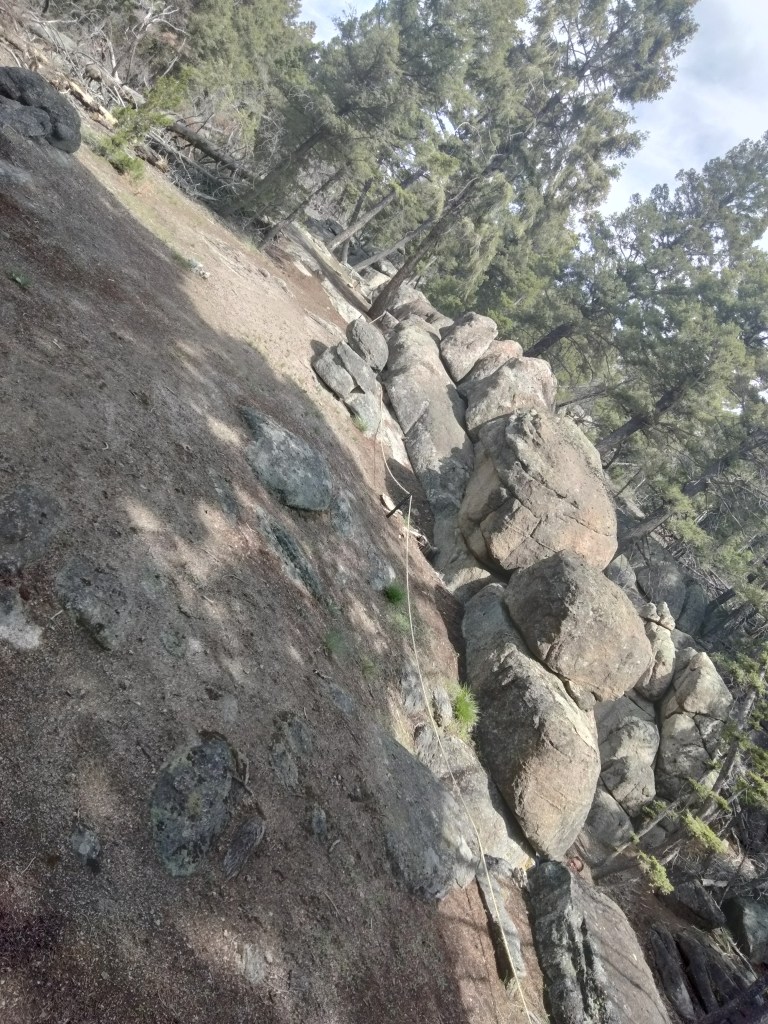
Here’ a view behind the more intact wall. Chris and Linda have installed a rope that allows visitors to climb up behind the wall. As you can see, the wall is not just part of a cliffside, but it does have earth and rocks filled in behind, either as terraces/a retaining wall, or the ravages of time.
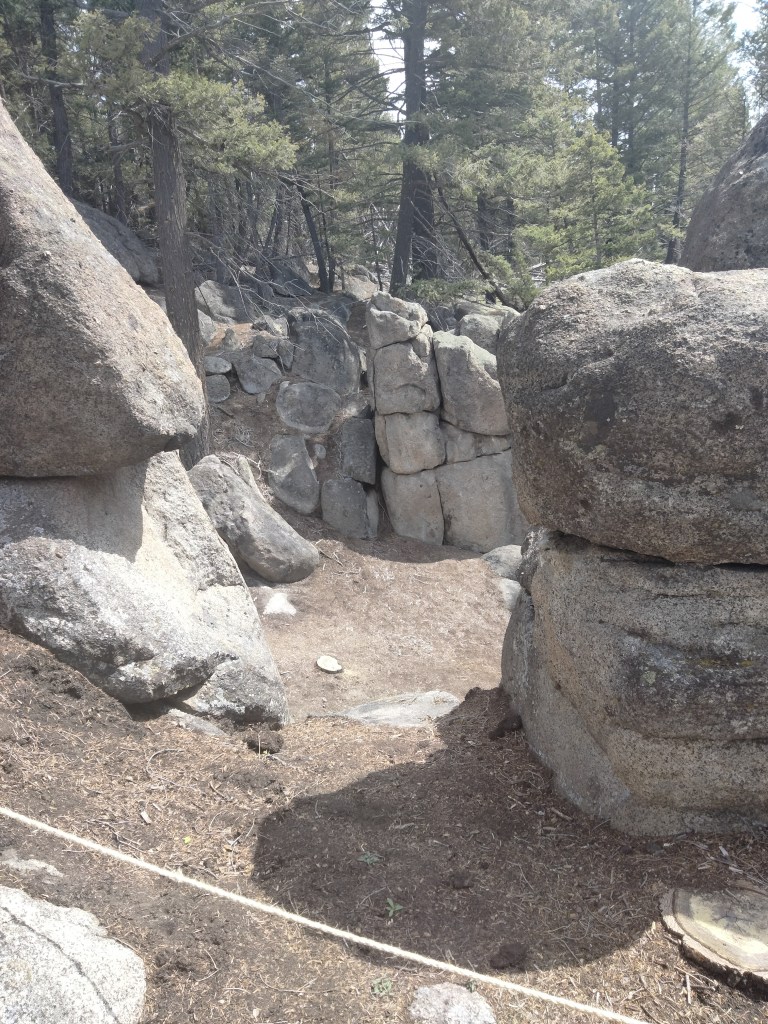
From behind the wall, we look out through a gap left by a fallen stone across the avenue at the remains of the second wall.
Getting close to the top of the wall allows us to see what might be nubs and cups.
Nubs and Cups
Stone nubs and cups (not necessarily corresponding to each other) are sometimes features of megalithic architecture in other parts of the world.
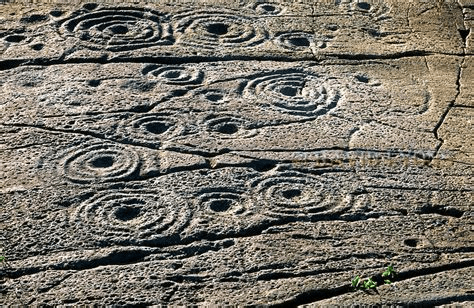
“Cup and ring” markings are apparently found all over the world, but especially in Northern Europe. Here are two articles about them.
Stone nubs or knobs are also found, especially in Incan or pre-Incan megalithic architecture.
Here are some nubs found on top of the intact wall.
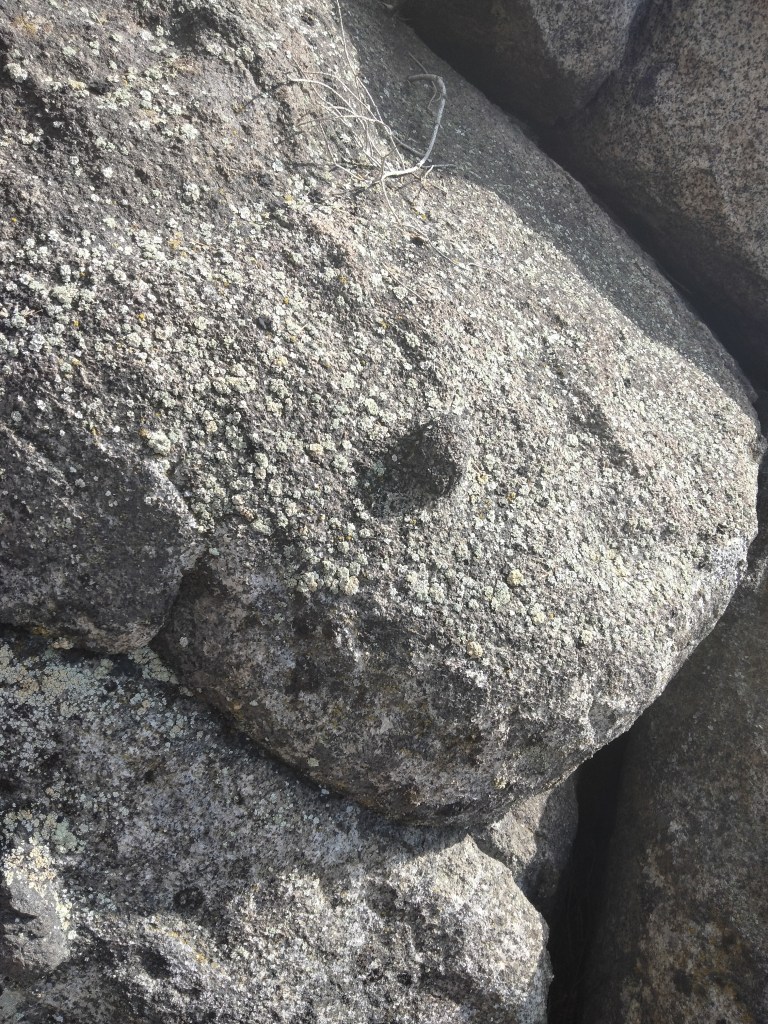
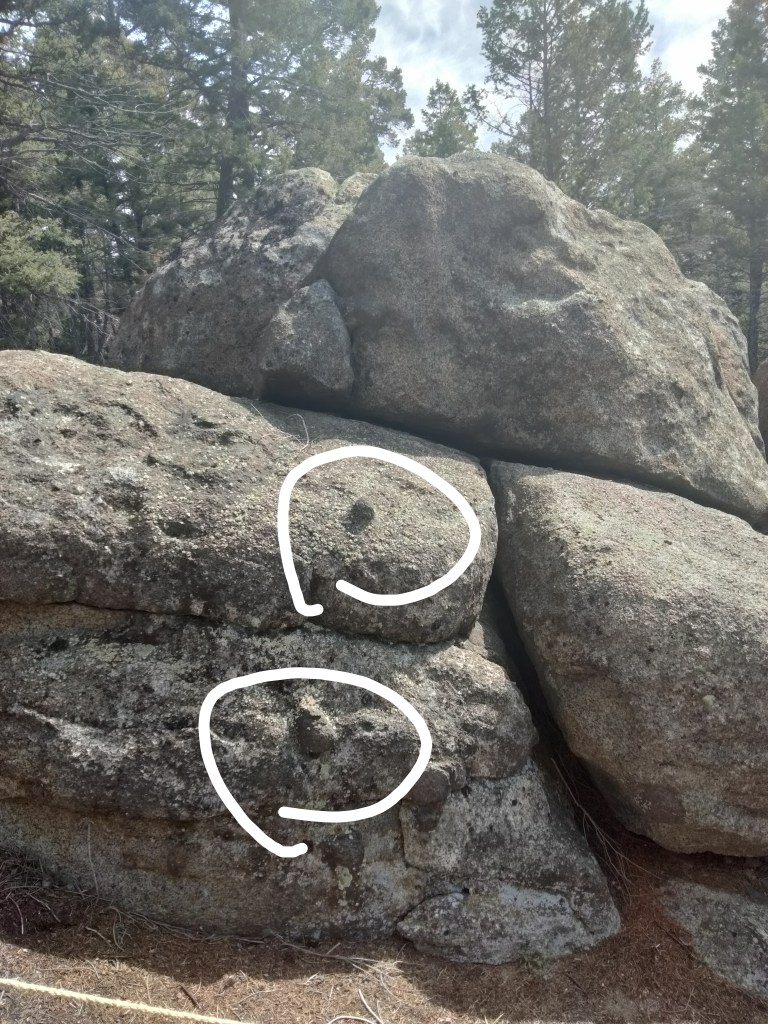

They are not the same as the pieces of quartz sticking out of the natural stone that we photographed earlier.
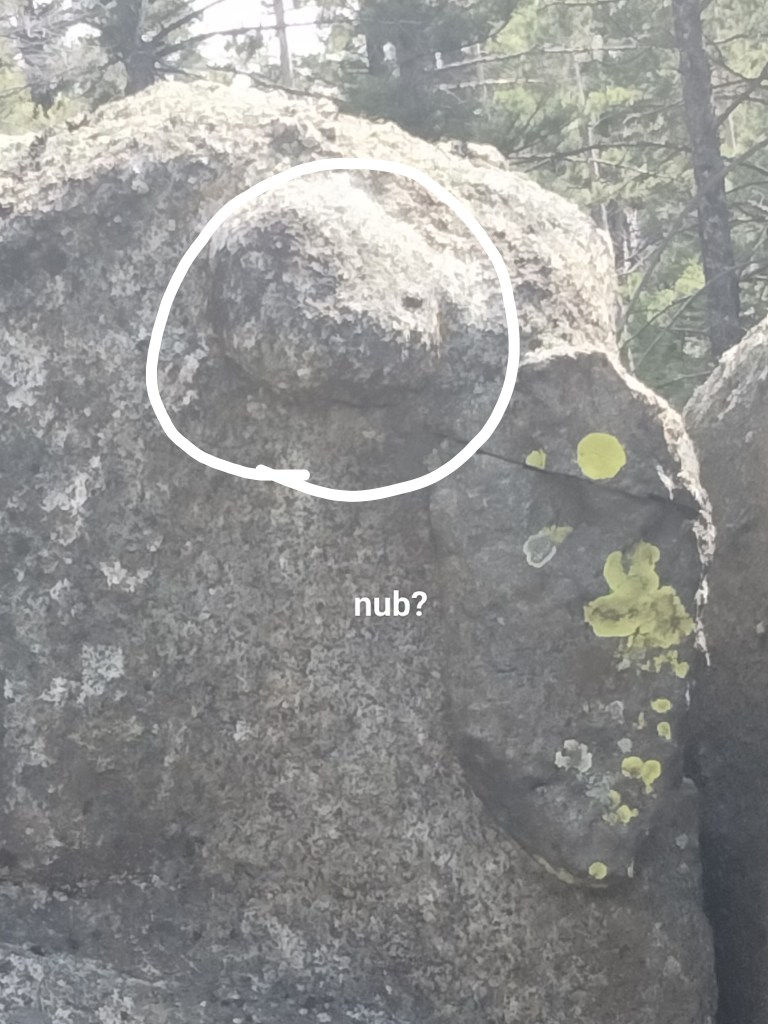
Because the wall is so weathered, some of them are not certain.
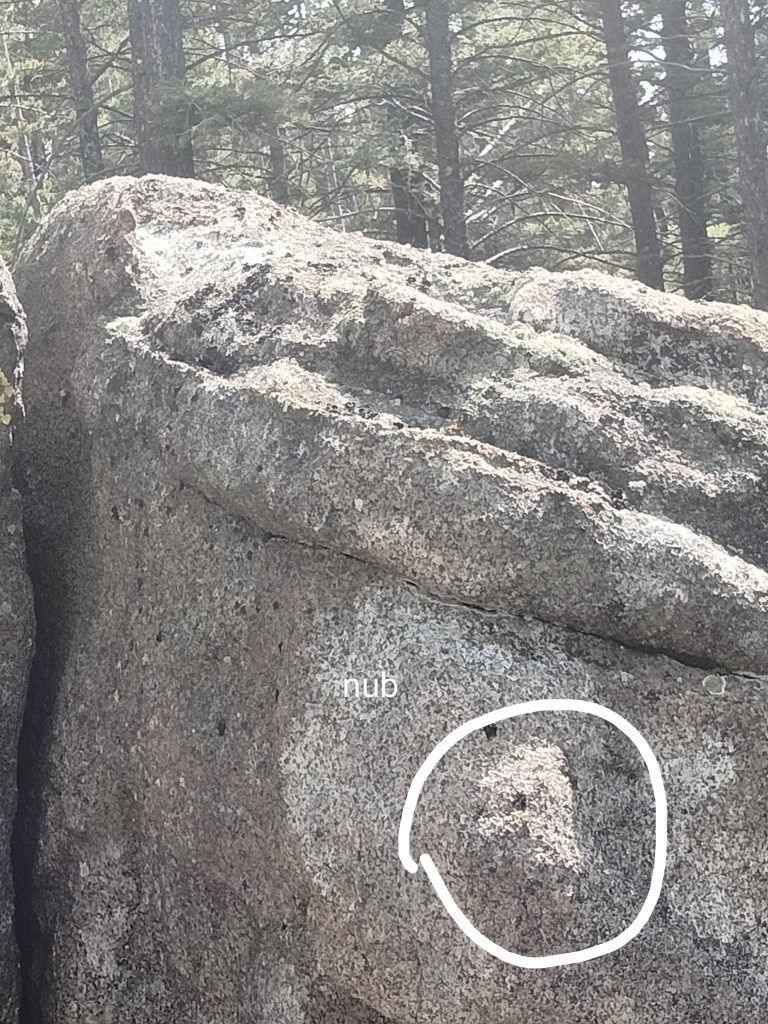
Note the possible incised lines above this last nub.
Here are some other things we saw on the back of the wall:


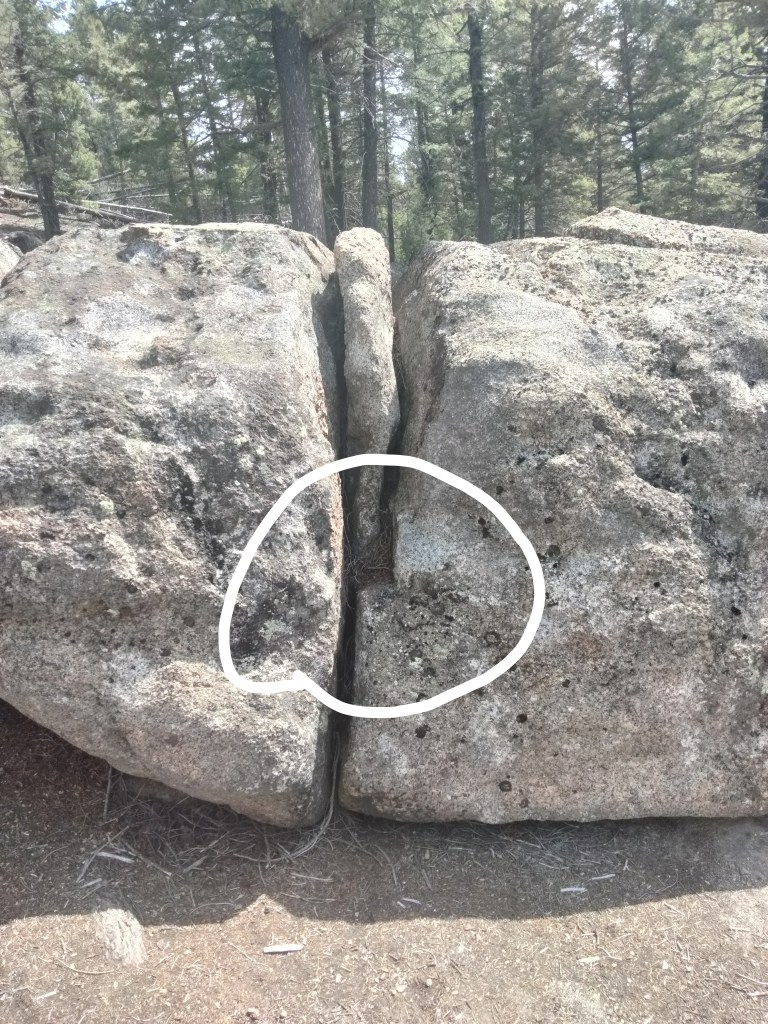
Suspiciously square fracture line
On the fallen wall as well, we found some things that look like nubs, and some possible cups. As a nod to the skeptics, yes, these “cups” do look like they could have been caused by water erosion. This would be especially true if they were found under a waterfall or a persistent drip, which they are not, as far as I can see. Some of them are also suspiciously round.

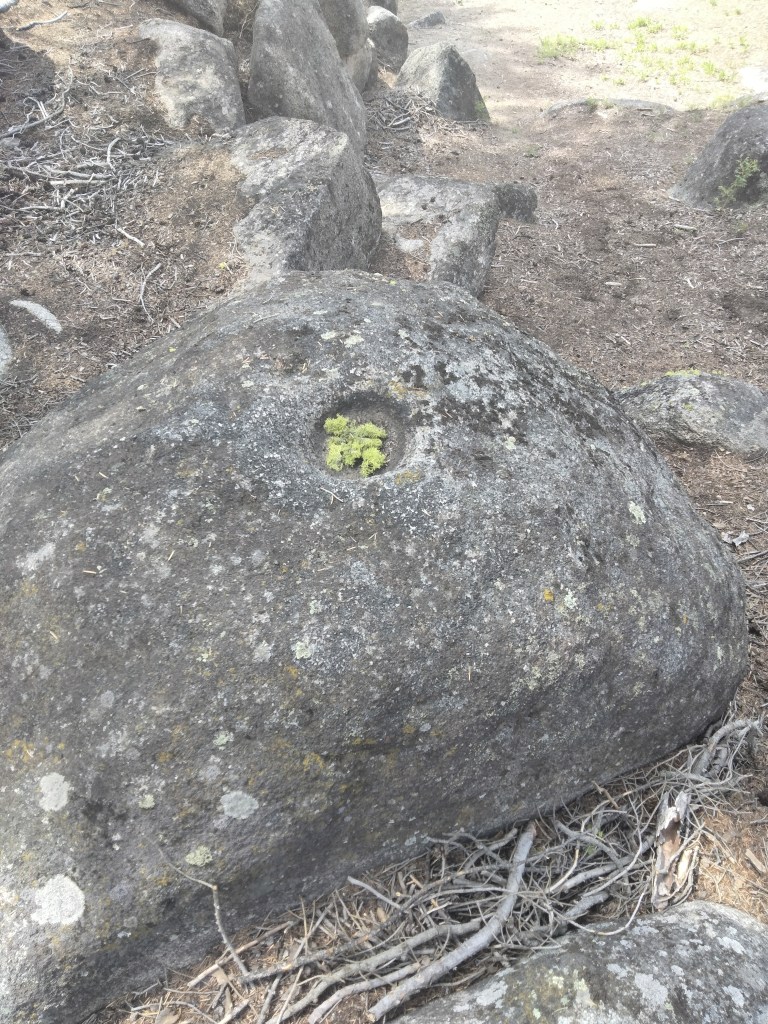
Some also have very straight lines incised near them. My son suggested they could be a water feature.

Looks like a cup with a spout
False Nub Alarm? Or Another Part of the Complex?
As we hiked away from Sage Wall, I took care to photograph natural rock formations for comparison. Not very far from the walls, I saw something that also looked like nubs.
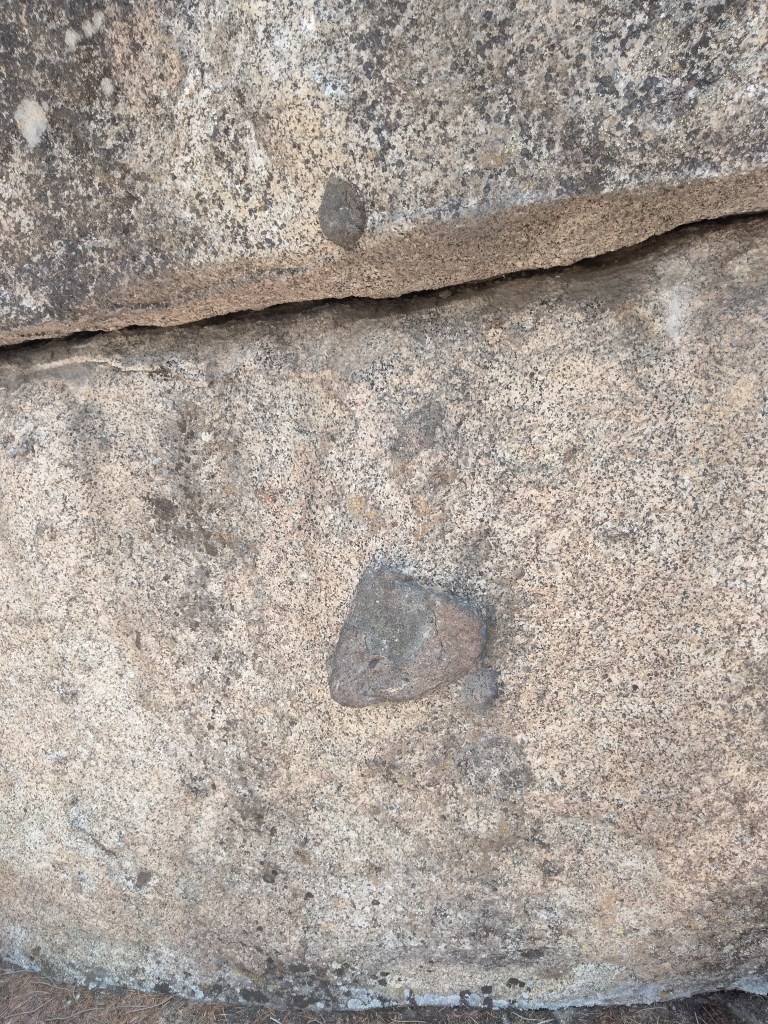
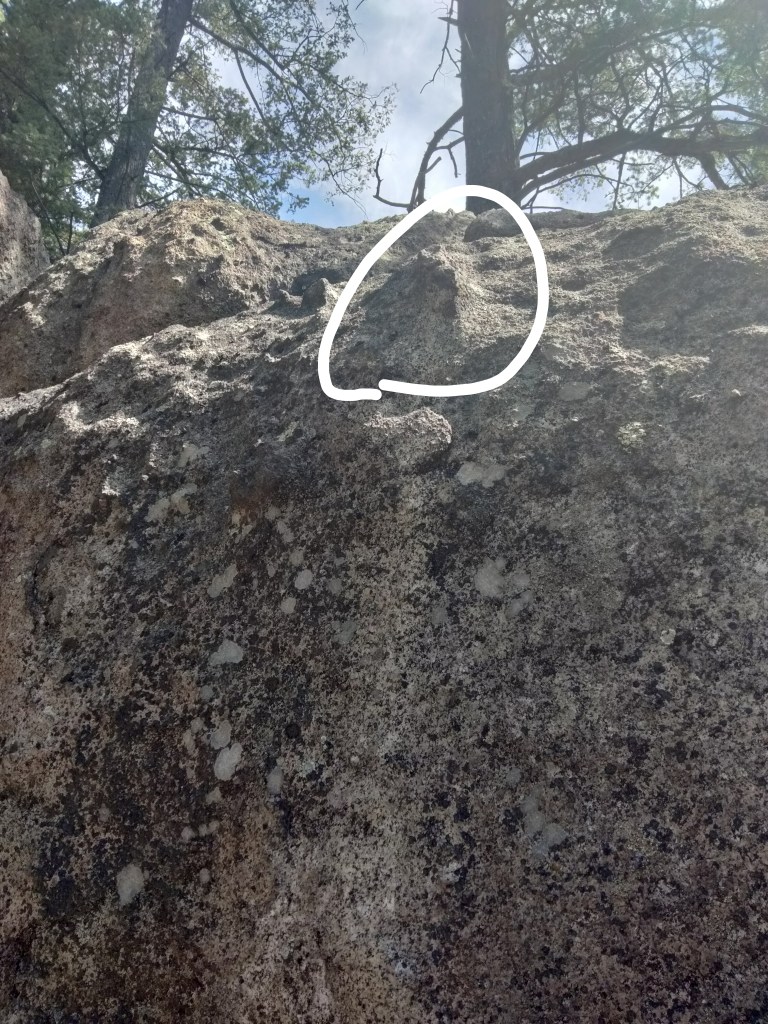
Did this mean that such nubs are a natural feature of the way granite weathers? Or could this be another part of the same complex as the wall? The formation on which I spotted these nubs certainly looks like the remains of a constructed passage.

A Post-Flood Megalithic Culture
After I left Sage Wall, my husband asked, humoring me, what I thought its purpose had been. My answer is that I have no idea. It is way too old, weathered, and partially buried for me to speculate. (This does not bother Julie Ryder over at Montana Megaliths, so if you want to see some people speculate very confidently, you can visit there.)
What I can say is that, granted this is not a natural formation, it most reminds me of Sacsahuayman and other sites in Peru. You have the same dry stone construction with megalithic blocks that are shaped, but are not in uniform sizes or in a regular pattern. And, of course, you have the nubs. As for scale, it appears that if Sage Wall were excavated down to its foundation, it would be thirty or forty feet high.
Another similarity is that both Sage Wall and the Incan or pre-Incan complexes are built at very high elevations (the Continental Divide runs near Butte).
This suggests to me that they partake of the same culture area.
Sage Wall, of course, has been abandoned much longer than any of the impressive Incan complexes, some of which Europeans got to witness still in use. Consequently, it’s much more weathered, run down, and filled in. But it looks like the same sort of thing.
So, it appears that Sage Wall and any other structures we might find in association with it were built by a group of people who knew how to build with megaliths, and who then had to abandon this site for some reason. It was before recorded history in North America, but that doesn’t mean it was before recorded history was happening elsewhere. Then, they or their descendants or people who partook of the same megalithic culture, moved on towards South America and continued their building there.
I believe there is plenty of evidence–not from Sage Wall, but from other sources–that human dispersion happened very quickly after the Flood, and that when people spread out, they took a megalithic culture with them. Dolmens, pyramids, cities, and inexplicable megaliths have been discovered all over the world. In many cases, as with the Bosnian pyramids, they have been abandoned for so long that they are not immediately recognizable as the work of human hands. You have to know what you are looking at before you can see it. The Bosnian pyramids, first thought to be extremely regular hills, were confirmed as artifacts only when a team dug into them and found tunnels. It looks like something similar happened with Sage Wall.
Immediately after the Flood, the earth would have entered an Ice Age. The climate was in a tailspin: temperatures were low, precipitation at an all-time high. Much of that precipitation quickly got locked up in glaciers. Sea levels fell around the newly configured continents. There were land bridges all over: in Beringia, in Doggerland, in Sundaland. People took advantage of all this newly revealed, very humid land and scattered. But the Ice Age was short, and as glaciers melted, there were sudden catastrophic local floods. People had to abandon their sites. Many of their cities, camps, and settlements are now hidden under water along our coasts. In some cases, such as Gobeklitepe and the Vinca cities, they burned, buried, or otherwise destroyed their sites before moving on. Some of these sites might have been built very quickly and inhabited for only a short time before they were abandoned. Other things being equal, archaeologists tend to overestimate how long it took to build something, and how long ago it appeared. But even very recent sites can be quite mysterious. They have had trouble re-constructing Woodstock, for example.
How Did They Build It?
I don’t know. Obviously they were purty smart. Probably an argument is going to be made that Sage Wall must be a natural formation because “we know” that people in the Stone Age didn’t have the ability to make things like this, despite constant evidence being discovered to the contrary. Or they will argue that “we know” that there were no advanced civilizations in North America, despite Sage Wall itself. Such arguments tend to be self-re-enforcing.
I do know that we do not, currently, have the ability to build with megaliths … at least, not so easily that we consider them our first choice in building material. We might make a monument or a gravestone, but we wouldn’t attempt to build an entire house or city out of megaliths. The effort would just not be worth it. This suggests that the ancients may have had ways that were easier than our current methods.
It is worth noting that there is a well-established oral tradition of giants living in North America. There have also been giant skeletons discovered. In Peru, meanwhile, there is the tradition of the Viracochas, bearded, godlike culture-bringers. No, I’m not suggesting aliens. I do think we should take a closer look at the worldwide oral traditions of apocalypses, floods, gods, and giants, and that we should pay attention to myths that suggest that civilizations were “advanced” right from the beginning. If you want to dig into this more than you already have (and if you are reading this, I assume you already have!), please feel free to look at my page The Research Behind the Books for a suggested reading list.
Embedded YouTube Video about Sage Wall
Quote of the Week: Teenaged Hunter-Gatherer
Grandmother Zillah had apparently come by for a private word with Ikash’s father.
“Not forever, my son,” he heard her say. “Surely you and the boys can shift for yourselves for one winter.”
Ikash did not want to hear this conversation, but now he was trapped in the bunk while it was going on. He pulled a blanket over his head and tried to go back to sleep. He found his mind skipping over the actual content of his father’s words (this was a tactic that had often helped him to stay sane), but focusing in curiously on the words of Zillah. Had she really said something about Mother going away for the winter? Where could she possibly go?
He heard her say “You remember all the trouble that Ninna had,” and “Sari loves to cook.”
“She’ll bungle it up,” said his father. “She always does.”
“Always?” said Zillah. “No one is perfect, you know.”
“You were, Mother. I remember.”
“I had servants helping me, foolish boy! I had Shufer and Shulgi to help me clean and cook, and a whole farm to supply our house in the city.”
About half these words were unknown to Ikash. “Servants,” “city,” and even “farm” carried only the vaguest meanings in his mind.
The Strange Land, by me, p. 36
The Strange Land will be 99 cents on Kindle this Saturday

Lord willing an’ the creek don’t rise.
I agreed with onlinebookclub.org to make TSL Book of the Day on June 14, but only on the condition that it was free on Kindle. As of drafting this post, I’m still communicating with my publisher to make the durn thing free. As John Piper might say, Brothers, We Are Not Professionals. I’m certainly not. But, with plenty of prayer, I trust that TSL will be free on this Saturday and will of course, with plenty of prayer, rocket into the stratosphere due to large numbers of positive reviews.
Edit: 99 cents was the best I could do. I have made arrangements with onlinebookclub. It will be 99 cents.
The Strange Land is a family saga that takes place in Beringia, the vast plain that used to exist where the Bering Strait now is, in approximately 10,000 B.C. Please go out and get it, if that’s just what you were looking for in your summer reading! Thanks in advance.
La Dama de Elche / The Lady of Elche
Disclaimer: None of these pictures are mine. I found them on the Internet. If any of them are yours, and you don’t like them being used in this post, contact me and I’ll be happy to take them down.
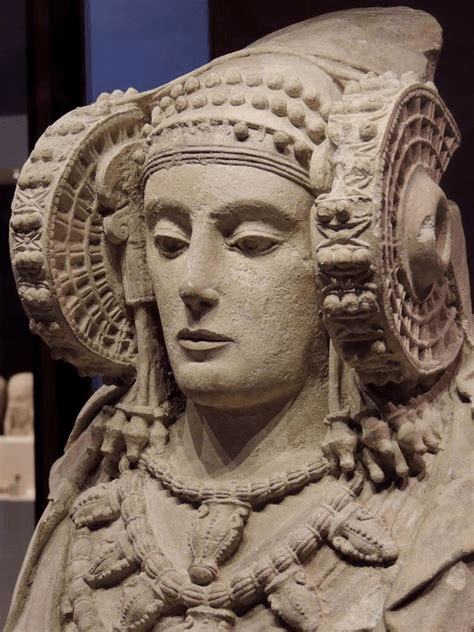
This is the Lady of Elche, Spain.

As you can see, her shoulders are hunched up. Some people describe her as having an “elongated head,” but it could just be the hat. Or it could be a hat meant to imitate elongated heads, as we see in many other cultures, but especially Egypt and MesoAmerica, where there was also head binding.
The following two links are my bibliography. You can follow them to check what I’m about to tell you about the Lady.
https://www.ancient-origins.net/news-history-archaeology/lady-of-elche-002305
https://www.atlasobscura.com/places/the-lady-of-elche
When I first heard that this Lady had been found buried in Iberia, it freaked me out. That’s because my understanding of pre-Roman Iberia was that it was basically Celtic. I was prepared to find Celtic- or Scythian-style artifacts there, such as images of people with narrow chins, large eyes, and moustaches; men with deer antlers; horses, and spirals, perhaps worked in silver, wood, stone, or even gold.
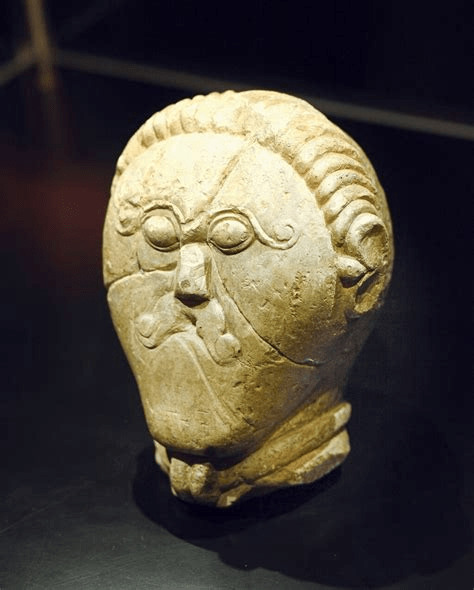
Celtic portrait, with torque necklace

Kurgan stelae in Kyrgyzstan, closer to the probable homeland of the Celts/Indo-Europeans
That’s what I expected to find in Spain. Or maybe something that looked like Etrusacan art, or like statues from the Archaic period of Greece.
I was not prepared for a massive, highly realistic stone statue that looked more classical Greo-Roman in style and featured attire more reminiscent of … I don’t know. Ancient Mesopotamia? Peru? The Lady of Elche freaked me out because it seemed to suggest a whole different style of civilization in Iberia, previously unknown. I was thinking Stone Age or pre-Flood.
Then, I heard that the Lady was believed to be Carthaginian. She instantly became less mysterious, but no less horrifying.
Carthage was a colony of Phoenicians. Phoenicia was an advanced civilization from the Levant. They inhabited the port cities of Tyre and Sidon, near ancient Israel. This explains why the Lady seems to be dressed like someone from the Ancient Near East. The Phoenicians had a shipping empire, so not surprisingly, they started a colony in North Africa. Carthage was here:

As you can see, they are very close to Europe, including territories in Spain. That explains how the Lady of Elche could have Western European facial features and Carthaginian dress.
Like most advanced civilizations of the Ancient Near East, the Phoenicians practiced atrocities in their pagan worship. This was the group that had the god Molech, to whom babies were sacrificed in the fire.

They were dropped down into, or placed in niches in, the red-hot statue. Drums and horns covered the sound of the infants’ screams. Incredibly, Israelites kept taking part in this practice and God had to keep telling them to stop. There was even an Israelite king who “made his son pass through the fire.”
Given that Carthage was part of an advanced, baby-killing empire, the Lady of Elche at once becomes more horrifying. The blank look on the woman’s face becomes more sinister. Is this just a death mask? Or is it because she is cruel? Or mindwiped by all that she had seen and done?
I don’t have any historical reference for this, but an anonymous commenter on the Internet has asserted that the “ear covers” were worn by priests and priestesses to block out the screams of the victims of more gruesome rituals. The bigger the ear muffs, the worse the ritual. I’d like to pooh-pooh that, but it fits with everything else we know about the ancient world. Christ conquering the nations suddenly sounds much less like a step in oppression and more like a relief. If you know more about the earmuff question, I’d love to hear it I wouldn’t exactly love to hear about it, but I’m curious and please send me your information.
If you know how to indicate your interest in the Lady to the algorithm, you may find people dressed in historical re-constructions of the Lady of Elche’s garb, like these:
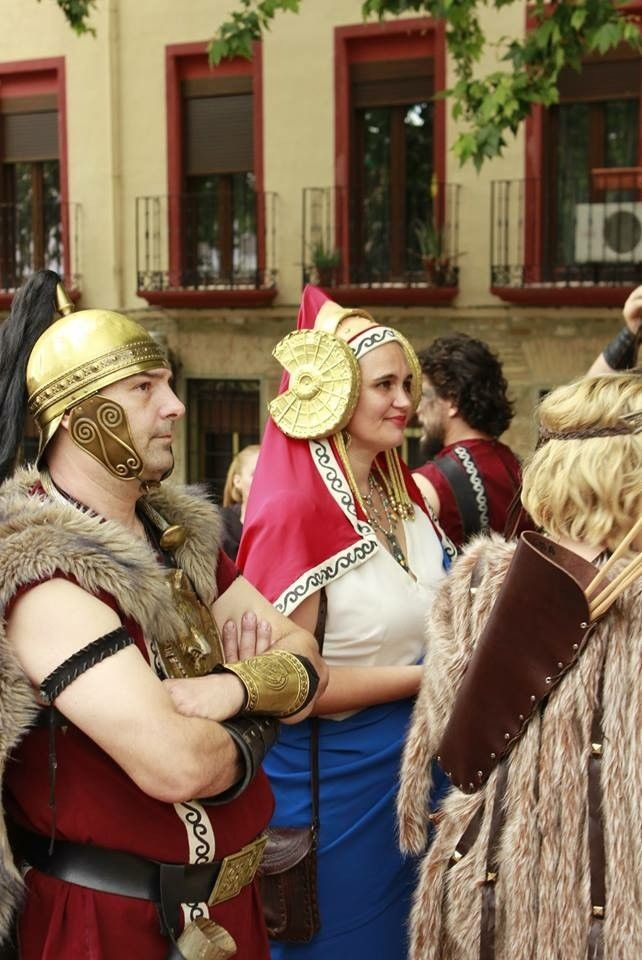
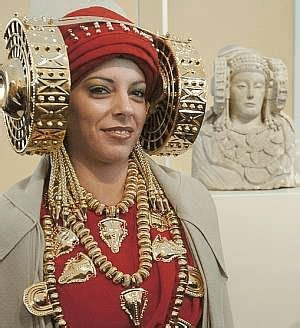

These ladies all look significantly happier than the original Lady.
The Adjective Noun, a Novel by Me
Setting: a really long time ago
Characters: Super smart, but not as smart as actual ancient people because novel written by me
Plot: Tragic, but not as tragic as real life
thank you
 Out of Babel Books