Themes in The King Must Die: Hellenes vs. ‘Shore People’

source: https://external-content.duckduckgo.com/iu/?u=http%3A%2F%2Farthistoryresources.net%2Fgreek-art-archaeology-2016%2Fgreek-art-archaeology-images%2Fmycenaefemalehead.jpg&f=1&nofb=1&ipt=7f3ec109d2b5fa5fc8a646dec84f0413e7fff54487f710be3ff027785a877590

As part of my ongoing, yearlong foray into fiction set in the ancient Mediterranean, I am now re-reading Mary Renault’s The King Must Die. There is so much history and speculation packed into this book, that I make free to do a series of posts on different topics from it, en route to the final book review. So, buckle up! I hope you like ancient historical fiction! (And, since you are visiting Out of Babel Books, I assume you at least don’t hate it!) Today’s topic is Renault’s theme of the two conflicting cultures of Hellenes vs. what they call the “Shore People.”

On the timing of the Theseus story

I have always had the impression that the story of Theseus was one of the older historical myths. It happens when Knossos, on Crete, is still a thriving city. So, in my mind, I put it a few generations before the Iliad. Madeline Miller, author of Circe, seems to agree. In her book, Circe hears of Theseus having killed the Minotaur well before Odysseus comes to land on her island.

If you do the math, Theseus living before the Odyssey would also put him living before Agamemnon returns from the war at Troy and is slaughtered in his bath by his wife, Clytemnestra. In the play Agamemnon (written, of course, much later), Clytemnestra kills her husband in revenge for his having sacrificed their thirteen-year-old daughter before he sailed for Troy, in addition to a couple of other grudges. Like most women, I find it hard not to think Clytemnestra has a case.

Renault, however, takes a different tack. She has a teenaged Theseus hear the following story from a bard:

The song he gave us was the Lay of Mycenae: how Agamemnon the first High King took the land from the Shore Folk, and married their Queen. But while he was at war she brought back the old religion, and chose another king; and when her lord came home she sacrificed him, though he had not consented. Their son, who had been hidden by the Hellenes, came back when he was a man, to restore the Sky Gods’ worship and avenge the dead. But in his blood was the old religion, to which nothing is holier than a mother. So, when he had done justice, horror sent him mad, and the Night’s Daughters chased him half over the world.

ibid, p. 40 in my copy

So here we have Agamemnon, Clytemnestra, their son Orestes, and the Furies. At the same time, this passage raises some questions.

The Shore People and Their Appearance

The Shore People make their appearance on the very first page of The King Must Die.

Our house is Hellene, sprung from the seed of Ever-Living Zeus. We worship the Sky Gods before Mother Dia and the gods of the earth. And we have never mixed our blood with the blood of the Shore People, who had the land before us.

-ibid, p. 1

As the story progresses, it rapidly becomes obvious that the Hellenes have, in fact, mixed their blood with the blood of the Shore People. There is the story of Agamemnon, above; Theseus is said to be “blonde and blue-eyed like the Hellenes, but small and wiry like the Shore People,” and Theseus, who is very promiscuous, even has a child who “came out small and dark, but so was [his mother’s] brother.”

So we have two populations, one that is native to the Greek coastlands (or at least has been there a long time), and one that came there from the steppes. Theseus’s grandfather explains to him their ethnic history, which he got from his own grandfather:

“Long ago, he said, our people lived in the northland, beyond Olympos. He said, and he was angry when I doubted it, that they never saw the sea. Instead of water they had a sea of grass, which stretched as far as the swallow flies, from the rising to the setting sun. They lived by the increase of their herds, and built no cities; when the grass was eaten, they moved where there was more. … When they journeyed, the barons in their chariots rode round about, guarding the flocks and the women … [Lord Poseidon] told the King Horse, and the King Horse led them. When they needed new pastures, they let him loose; and he, taking care of the people as the god advised him, would smell the air seeking food and water. The barons followed him, to give battle if his passage was disputed; but only the god told him where to go.”

ibid, pp. 16 – 17

This is a description of the Indo-European lifestyle and homeland. The Indo-Europeans took their reverence for the horse, and their wheeled carts and chariots, with them wherever they went, including to Scandinavia. So the Hellenes are Indo-European, and the Shore People, presumably, Hamitic or Semitic.

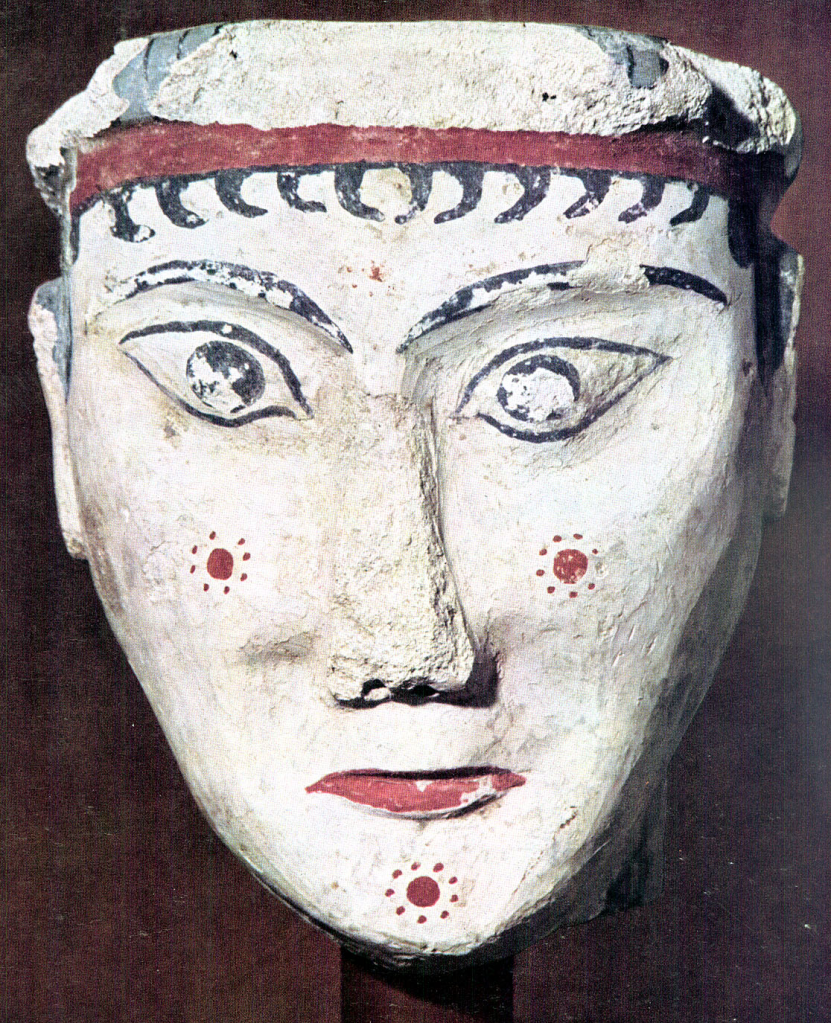
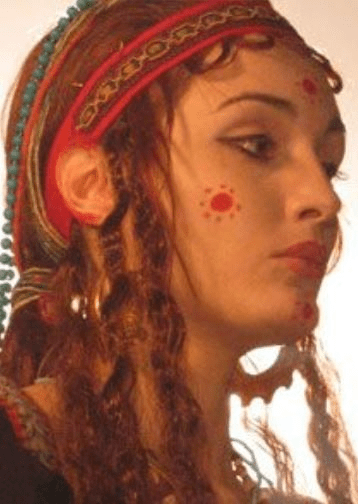
The mask at the top of this post is Mycenaean. Mycenae is located in the Peloponnesian Peninsula, which is also the location of Troizen, Theseus’s home. The ancient Mycenaean culture, older than classical Greece, took its cues from the Cretan urban culture of the time. In later Greece, you get men wearing himations and women wearing finely woven chitons. This is usually how Helen of Troy, for example, is illustrated. However, she probably looked more like the Mycenaean and Cretan women. Here is someone’s attempt to reconstruct the probable hairstyle and costume of the most beautiful woman in the world:
source: https://external-content.duckduckgo.com/iu/?u=https%3A%2F%2Fi.pinimg.com%2Foriginals%2F7d%2F29%2F38%2F7d293880174568ffd506b49b1f90aefd.jpg&f=1&nofb=1&ipt=500d8b11965e5cbdcd1de9286836a9a6b69ab9fcdb46f8991655a2c6648b4ab5

Notice the Egyptian-style, kohl-lined eyes, and the red suns for makeup. Helen might have been blonde, being a Hellene, but her clothing was perhaps more like this.

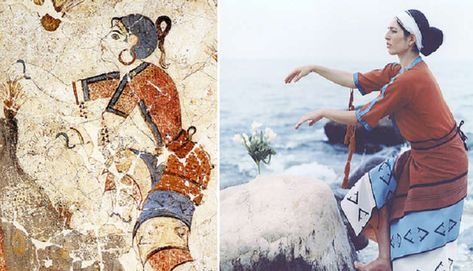
Here is someone else, reconstructing a traditional Mycenean costume and pose:
source: https://external-content.duckduckgo.com/iu/?u=https%3A%2F%2Fi.pinimg.com%2F474x%2Fcf%2F30%2Fde%2Fcf30de47e8298251f9d3ecc2976996ec.jpg&f=1&nofb=1&ipt=64a6c835ea102cac25d991e173ec53081fe8af0a6bd70db48b6d80c562988c33

I’m guessing these fashion choices came from the Shore People.

Theseus’s mother is described as wearing this ancient Mycenaean style. She wears a tiered, flounced skirt hung with charms, exposed breasts (what was going on, Crete and Mycenae?) and hair that is curled by the use of “crimping braids” (probably to attain a very curly look for those who do not, like the Shore People, have it naturally). Though a blonde Hellene, she is a priestess of the mother goddess, and so she takes some of her cues from the Shore People, and here is where we find the tension.

The Shore People and Their Religion

Both the Hellenes and the Shore People practice the sacrifice of their kings. However, there is a difference. For the Hellenes, it does not come on a regular schedule. Theseus’s grandfather explains:

“When the work of the King Horse was done, he was given to the god … And in those days, said my great-grandfather, as with the King Horse, so with the King. When the king was dedicated, he knew his moira [i.e. doom]. In three years, or seven, or nine, or whenever the custom was, his term would end and the god would call him. And he went consenting, or else he was no king, and no power would fall on him to lead the people. And the custom changes, Theseus, but the token never. … Later the custom altered. They ceased to offer the King at a set time. They kept him for the extreme sacrifice … And it was no one’s place to say to him, ‘It is time to make the offering.’ He was the nearest to the god, because he had consented to his moira; and he himself received the god’s commandment. And so it is still, Theseus. We know our time. … It is not the sacrifice … it is not the bloodletting that calls down power. It is the consenting, Theseus. The readiness is all.”

ibid. pp. 18 – 19

This might explain why so many kurgan burials are of high-born individuals who seem not to have died of old age.

It also, of course, explains the title of the book.

Meanwhile, it has been established that the Shore People do things a different way: “old laments have come down from the Shore People, of young heroes who love a goddess for a year, and foreknow their deaths” (p. 37). In other words, the Shore People treat their king primarily as the goddess or priestess’s consort, and kill him after just a year.

Marija Gimbutas has tried to make the case that the Shore People practiced a gentle, feminine, goddess-worshipping religion, and that they were cruelly exterminated by the warlike, sky-god worshipping evil Indo-Europeans. Renault is not going to paint with such a broad brush. Realistically, she shows both groups living next to one another and influencing each other. Also, throughout the course of the story, she is going to show by increasingly vivid illustrations that these two cultural systems are absolutely incompatible with each other. And that the mother-worship, in the end, is at least as bloody as the worship of Zeus.

Renault’s take on the story of Agamemnon is a great illustration of this. She interprets the story as a conflict between Clytemnestra’s mother-goddess culture and Agamemnon’s sky-father culture. When Clytemnestra brings back the “old religion,” it means that Agamemnon must die–not in battle, not some day, but now, and actually, yesterday. It means that Orestes is doubly cursed. He has loyalty to both religions, with their incompatible demands, and he is put at the mercy of the furies, the representatives of the goddess-religion. They chase him because he killed his mother, but if we string out the implications, even if he had not, they would probably be chasing him anyway. After all, he is a male heir to the throne, so his days are definitely numbered. Behold, the kindness of the religion of the goddess.

Obviously, there are some universal truths and some redemptive metaphors here, hidden under a thick layer of occultism, war between the sexes, and general pain and suffering for everyone. It is going to take a much greater King than Theseus to cut this difficult knot.

Seasonal Postscript

Oh, and Happy Valentine’s Day to everyone! Such a romantic post, I realize.
Quote: A Typical Roman, for Good or Ill

In summary, the typical educated Roman of this age was orderly, conservative, loyal, sober, reverent, tenacious, severe, practical. He enjoyed discipline, and would have no nonsense about liberty. He distrusted individuality and genius. He had none of the charm, vivacity, and unstable fluency of the Attic Greek. He admired character and will as the Greek admired freedom and intellect; and organization was his forte. He lacked imagination, even to make a mythology of his own. He could with some effort love beauty, but he could seldom create it. He had no use for pure science, and was suspicious of philosophy as a devilish dissolvent of ancient beliefs and ways. He could not, for the life of him, understand Plato, or Archimedes, or Christ. He could only rule the world.

–Caesar and Christ, by Will Durant, pp. 71 – 72

Greco-Fiction: Circe

About the Greco-Fiction

This year, I decided that my fiction focus would be novels inspired by ancient Greek myths. I don’t always pick a fiction focus, but this year, things just coalesced.

In the classical Christian school where I teach, we follow a 4-year “history cycle.” Ancient World, Medieval World, Exploration/Renaissance, Modern World. This year, we are cycling through Ancient, so I have been immersed in the Flood, the Sumerians, Abraham, Egypt, and the Iliad and Odyssey. (Somewhat immersed, of course. We could always immerse ourselves more.)

Revisiting Mycenae and Crete, I remembered that back in university (in the last millennium!) I read what I thought was a fantastic book that was a re-telling of Theseus. Looked it up, and it turns out it was The King Must Die by Mary Renault. And it turns out that Renault has a bunch of other books that I’ve never read. (Back in the last millennium, the way we found books was we stumbled upon them in the library.) So, onto the list went at least a re-read of The King Must Die and its sequel, The Bull from the Sea. I bought myself copies of these for Christmas using my husband’s money, so technically he bought me the copies for Christmas.

Meanwhile, years ago I had won a copy of Circe, and had been waiting to read it until I was ready to stick my head back in the ancient Mediterranean. I’m also aware that Madeline Miller has at least one more book, The Song of Achilles, which is from Patroclos’s point of view. Gay, of course (and that is historically accurate). I decided I might read that, depending upon how I enjoyed or didn’t enjoy Circe. You can write about ancient Greek events from a hard-core feminist/queer perspective, or you can not. I wanted to know first what approach Miller was taking.

Finally, some of my students have been reading Percy Jackson, with the result that they are already quite familiar with the Greek pantheon. I’d known that the Jackson books were out there, so perhaps now is the year when I read at least a few of them. Jackson went onto the list.

Then there are the rereads. Til We Have Faces is C.S. Lewis’s masterpiece, set probably in Scythia or the Caucasus, near the Greeks but not too near. Moving farther from Greece, we have Taliesin, Merlin, and Arthur by Steven R. Lawhead. I read Taliesin in high school. It’s Celtic, not Greek, except that about half the book takes place on Atlantis, with bull dancing and stuff, so I figure that counts. Now, the Daily Wire has made a TV series based on these books. The events of Taliesin take up about an episode and a half. So, if I have time, I’ll reread/read Steven R. Lawhead.

So, here is the list as it stands …

  • Circe
  • The Song of Achilles?
  • The King Must Die
  • The Bull from the Sea
  • other books by Renault?
  • Til We Have Faces
  • at least a couple of Percy Jackson books
  • Taliesin
  • Merlin?
  • Arthur?

This should fulfill the twelve books that I told Goodreads I’m planning on, this year.

In the course of my teaching year, I have already read The Cat of Bubastes with my students, and am now reading Hittite Warrior, which is also very good. Also on the docket is The Young Carthaginian.

So, how was Circe?

I loved this book. It is exactly the genre I like. Miller did a fantastic job keeping track of all the gods, titans, and nymphs, their little feuds, and their family relations to one another.

Circe, in The Odyssey, is a “witch” whom Odysseus and his men encounter on the island of Aiaia (Corsica or Sardinia … I was imagining Corsica). She turns some of them into pigs, but Odysseus convinces her to change them back. She becomes a sort of ambiguous ally, giving him advice about how to handle the Moving Rocks, the Sirens, and Charybdis and Scylla.

Of course, there is always more detail to the story. Miller has researched this deeply, and I appreciate her portrait of where Circe came from. Circe is the daughter of the sun, Helios, who is a titan, and his one legitimate wife. This makes her the sister of Pasiphaë, wife of King Minos (ahem), and also of Aeetes, father of the witch Madea.

Given that she is divine, Circe gets a front-row seat to nearly all the earliest myths. She meets Prometheus in person. She watches the whole ugly episode with Minotaur go down (this is centuries before Odysseus). Time passes quickly for her. At the same time, she is sort of fascinated by mortals. On the plus side, this means she does not view them as disposable, as most of her relatives do. On the down side, she at first fails to see them as a threat.

Near the end of the book, she has this to say.

I thought once that gods are the opposite of death, but I see now they are more dead than anything, for they are unchanging, and can hold nothing in their hands.

p. 385

Though a page-turner, Circe was a heavy read emotionally. As you might expect, it really stinks to be an ancient Greek god or Titan. You are likely to have horrible parents, for example. The hardest part for me was finding out what we might have suspected by reading between the lines: that Odysseus was actually a real [censored], and that things did not go happily after he made it home to Ithaka. Thankfully, Miller does not leave us there but introduces at least one good man and gives the book’s ending a faint note of redemption.

Based on this read, I think I will try The Song of Achilles if I come across it. Miller’s writing is not ideological. It is extremely tragic, with heartbreaking near misses and so forth, but that is actually how these ancient stories go.

Why Jupiter is not just another name for Zeus

Among these original national gods Jupiter or Jove was the favorite … In the early centuries of Rome he was still a half-impersonal force–the bright expanse of the sky, the light of the sun and moon, a bolt of thunder, or (as Jupiter Pluvius) a shower of fertilizing rain; even Virgil and Horace occasionally use “Jove” as a synonym for rain or sky. In time of drought the richest ladies of Rome walked in barefoot procession up the Capitoline hill to the Temple of Jupiter Tonans–Jove the Thunderer–to pray for rain. Probably his name was a corruption of Diuspater, or Diespiter, Father of the Sky.

–Caesar and Christ, by Will Durant, p. 61

… and when the Romans encountered Zeus, they said, “Hmm, seems to be Jupiter.”

Oh, Rats!

You can read the incident that this is a reference to, in I Samuel chapters 4 – 6.

The Philistines were a culturally Aegean/Mycenaean people who had settled along the coast of Canaan. Though culturally Greek, they spoke a Semitic language. Their god, Dagon, was a man/fish god who had antecedents going all the way back to Sumeria.

The genre of these particular chapters of Scripture might be described as dark comedy. It’s a unique story, because it presents the reaction of an Aegean people when confronted with the God of Israel. The story is told in a Hebrew historical record, but the amount of detail means that the Hebrew chronicler must have had spies or eyewitness accounts.

The Philistines, though, or perhaps because, they are pagans, are pretty canny. They start out thinking they have won a victory over the Israelites by capturing their god, but it doesn’t take them too long to figure out that this God is trouble, and to ascertain, by process of elimination, what He wants.

Or you could say that God is very adept at communicating with the Philistines.

Roman Priests: the Original Lawyers

Before [the Twelve Tables of the Decemvirs], Roman law had been a mixture of tribal customs, royal edicts, and priestly commands. “Mos maiorum“–the way of the ancients–remained the exemplar of morals and a source of law … early Roman law was a priestly rule, a branch of religion, surrounded with sacred sanctions and solemn rites. The priests declared what was right and wrong (“fas et nefas“), on what days the courts might open and assemblies meet. All questions regarding marriage or divorce, celibacy or incest, wills or transfers, or the rights of children, required the priest as now so many of them require the lawyer. Only the priests knew the formulas without which hardly anything could be legally done. The laws were recorded in their books, and these volumes were so securely guarded from the plebs that suspicion charged the priests with altering the texts, on occasion, to suit ecclesiastical or aristocratic ends.

The Twelve Tables effected a double juristic revolution: the publication and secularization of Roman law.

–Caesar and Christ, by Will Durant, p. 31

Theological Question: Did Paganism do Romans Any Good?

Did this religion help Roman morals? In some ways it was immoral; its stress on ritual suggested that the gods rewarded not goodness but gifts and formulas; and its prayers were nearly always for material goods or martial victory. The gods were, with some exceptions, awesome spirits without moral aspect or nobility.

Nevertheless, the old religion made for morality, for order and strength in the individual, the family, and the state. Before the child could learn to doubt, faith molded its character into discipline, duty and decency. Religion gave divine sanctions and support to the family; it instilled in parents and children a mutual respect and piety never surpassed, it gave sacramental significance and dignity to birth and death, encouraged fidelity to the marriage vow, and promoted fertility by making parentage indispensable to the peace of the dead soul. By ceremonies sedulously performed before each campaign and battle it raised the soldier’s morale, and led him to believe that supernatural powers were fighting on his side. It invested every phase of public life with religious solemnity, prefaced every act of government with ritual and prayer, and fused the state into such intimate union with the gods that piety and patriotism became one, and love of country rose to a passion stronger than in any other society known to history. Religion shared with the family the honor and responsibility of forming that iron character which was the secret of Rome’s mastery of the world.

–Caesar and Christ, by Will Durant, p. 67

… In other words, it wasn’t enough to hold back the tide of human wickedness, but it was a good preparation for the Gospel.

Quote: What Was so Great about the Roman Senate?

The Senate of the Republic [508 – 49 B.C.] often abused its authority, defended corrupt officials, waged war ruthlessly, exploited conquered provinces greedily, and suppressed the aspirations of the people for a larger share in the prosperity of Rome. But never elsewhere … have so much energy, wisdom, and skill been applied to statesmanship; and never elsewhere has the idea of service to the state so dominated a government or a people. These senators were not supermen; they made serious mistakes … But most of them had been magistrates, administrators, and commanders; some of them, as proconsuls, had ruled provinces as large as kingdoms … it was impossible that a body made up of such men should escape some measure of excellence. The Senate was at its worst in victory, at its best in defeat. It could carry forward policies that spanned generations and centuries; it could begin a war in 264 and end it in 146 B.C.

–Caesar and Christ, by Will Durant, p. 28

Amusingly Misanthropic Quote on Etruscan Pottery

The most renowned of Etruria’s products is its pottery. Every museum abounds in it, setting the weary navigator of ceramic halls to wonder what unseen perfection exonerates these stores. Etruscan vases, when they are not clearly copies of Greek forms, are mediocre in design, crude in execution, barbarous in ornament. No other art has produced so many distortions of the human frame, so many hideous masks, uncouth animals, monstrous demons, and terrifying gods. … All in all, the robbers were justified who, when they rifled Etruscan tombs, left so much of the pottery.

–Caesar and Christ, by Will Durant, p. 9