Whenever I see “Calendar Girls” I think of the hilarious British movie by that name, but in this case, it means a group of (girl?) book bloggers who treat a different bookish theme during each month of the calendar. (So we will not be posing. I am sure you are relieved.) And this month, December, I was actually able to think of a book that fulfills the theme!
Calendar Girls is hosted by NeverNotReading, who says of this month’s theme, “What I really like about this theme is it allows you to interpret diversity in whatever way is meaningful to you. Racial or ethnic representation, LGBTQ diversity, neurodiversity, whatever you’re passionate about, we want to read it too!”
Picking a book with a diverse cast felt somewhat arbitrary because so many of my faves have casts that are diverse in one way or another. Pearl Buck’s Pavilion of Women springs to mind, as do Ursula le Guin’s novellas set on the planet of Yeowe (navy-blue colored upper class, grey-blue colored underclass, red-brown foreigners with a very different culture coming from distant Hain). Even the very Nordic Lord of the Rings has a main cast of four different species and minor characters that are even more diverse (Ents, anyone?). And then there’s Clan of the Cave Bear, which features Neanderthals as main characters.
But here is the book I have settled on: Sacred Clowns by Tony Hillerman.
Clowns is part of Hillerman’s Jim Chee and Joe Leaphorn series. It’s a mystery/police procedural series set in Dinetah, the Navajo homeland, which straddles the Four Corners region of the American Southwest. Chee and Leaphorn both work for the Navajo Tribal police. Because of the way jurisdiction on Indian reservations is handled, they frequently have to work on their cases with Arizona, New Mexico, Colorado or Utah State police and/or with the FBI.
Books in this series usually take place on the Navajo reservations and the plot often turns on Navajo culture. That’s already “diverse” to an outsider like me. But it quickly gets deeper. Chee and Leaphorn have each had a different experience of being Navajo. Leaphorn was of the generation that was sent away to boarding schools right around the time their adult vocabulary would have been developing. Consequently, his grasp on the Navajo language is a little shaky, and he thinks like a modern, secular white man. He doesn’t, in his bones, believe in Navajo cosmology. Chee, a younger man, was raised at home and enculturated, as per tradition, by his mother’s brother. He is a fully spiritual Navajo and wants to become a haatalii, or traditional healer, like his uncle (though Leaphorn, and others, feel the demands of being a hataalii would not mix well with a policeman’s schedule).
Sacred Clowns is even more diverse than the average Leaphorn and Chee book because in this case, the mystery takes place in Hopi culture, which is different from Navajo culture. (For example, Navajos tend to invite everyone to their religious ceremonies, whereas Hopi ceremonies are held in secret and never talked about.) In the opening scene, Chee is attending a Hopi cultural event that features clowns, which are supposed to show people their own folly. At one point, a Hopi clown mimes selling cultural artifacts to an outsider for a lot of money. He is clearly criticizing this practice, but Chee senses “there’s something I’m missing.” When the clown first drags his little wagon of artifacts out into the middle of the square, the Hopi crowd falls silent. Chee wants to find out why, and this will get him digging into local politics and ultimately solving the case.
Chee isn’t at the top of his game
during the event, however, because he is also there sort of on a date with Janet
Pete. Janet’s father was Navajo, but she was raised on the East Coast by her
Scottish-American mother. Chee really likes Janet, and he spends most of the
book trying to find out whether it would be OK for him to get involved with
her. The Navajo have an elaborate system of incest laws which prohibit you from
marrying anyone whose clans have a historical connection to your own clans. Janet
doesn’t know her father’s clans, and anyway the maternal clans are considered
more important.
Meanwhile, Leaphorn, a widower, is planning a trip to China with his lady friend, who is a white anthropologist (Lousia Bourbonette – a French name: more diversity, and a romance between older people!). He wants to visit Mongolia, because he’s read that his ancestors probably originated there.
And cramming in as many cultures as
possible, there is another tribal cop, Harold Blizzard, who is Cheyenne. About halfway through the book there’s a great
scene where Chee and Janet Pete are at a drive-in movie, and Blizzard is there,
sort of as a third wheel. The movie is an old Western called Cheyenne Autumn, which is a cult classic
among the Navajo because the “Cheyenne”
characters in the movie were actually played by Navajos. When they are
supposedly speaking Cheyenne
in the movie, they are actually speaking Navajo, and of course saying crude and
saracastic things that were not in the script. Chee, as the only person in the car who speaks
Navajo, has to translate for Janet and Harold so they can understand why certain
supposedly solemn lines are funny and why all the other (Navajo) moviegoers are
laughing and honking their car horns. It’s this experience that gets Chee thinking
about how much outsiders to a culture miss, and wondering what he was missing at
the Hopi gathering.
Finally, when Chee consults some
elders about Janet’s father’s clans, he gets an earful from them about how
young people aren’t traditional enough. They are referring to the way that hataalii of Chee’s generation will sometimes
break up the weeklong Navajo healing ceremonies over a couple of weekends so that
people who work 9-to-5 jobs can attend them. According to the elders, this is
not acceptable, but Chee will probably have to do it if he becomes a healer. He
must struggle with how much he can adapt his ancestors’ culture and still
remain Navajo.
All of Hillerman’s books do a great job exploring themes of culture and identity, but in this book he really outdoes himself.
I am Dutch-American. What I got out of it was good bone structure, “Kraklen” cookies (sogood!), a fondness for black licorice, a few mild swear words such as swatakat (translation: “black cat”), curly hair (more on that later), and the phrase, “If you’re not Dutch, you’re not much.”
That last one is tongue-in-cheek, of course. After all, we are Dutch American. But if you look at history, it does neatly encapsulate the national attitude.
One Cheer for the Dutch
The Dutch had their national moment, as it were, during the seventeenth century (1600s). They provided a refuge of religious freedom for the Pilgrims, mostly because at that time the Dutch didn’t care about separatism nearly as much as King James did.
In North America, they set up a trading post at New Amsterdam (Manhattan Island), but made the mistake of fixing upon a feudal-style system where only Dutch West India Company members could own land, and their serfs were forbidden by law from leaving. This did not encourage growth, and the place struggled until the English conquered it, re-named it New York, and allowed English things like local control of government, free immigration and trade, and land ownership for everyone. After that it really took off, and … well, you see it today.
Meanwhile,
the Dutch East India Company was distinguishing itself in
Indonesia, where in order to ensure its own access to spices, it
would eventually become a harsh colonial power and rule for
centuries, until its grip was weakened by Japan (on-site) and Hitler
(back home).
While
in Indonesia, the Dutch did manage to get a monkey named after them.
The Indonesians called the proboscis monkey kera Belanda, i.e.
“Dutch monkey,” because of its big nose and reddish skin.
Photo by Pixabay on Pexels.com Good bone structure!
I
don’t think the Dutch sent their nicest people to Indonesia. Or to
Manhattan. But, during this same period, Holland did have some
amazing citizens. For example, they had Rembrandt.
“Rembrandt van Rijn was born in Leyden, Holland [the same city where the Pilgrims took refuge] in 1606. He was one of nine children and the son of a miller [and so they probably had a windmill!]. His family was Calvinist by faith … Rembrandt married Saskia, a Dutch woman whom he dearly loved. For a short period they enjoyed a life of happiness and prosperity and many were acclaiming him to be the greatest artist of the century. But Rembrandt never displayed an exalted opinion of himself… During the early years of success, he obtained a studio in the ghetto where he spent much of his time painting the impoverished people of Amsterdam. The ghetto was where he found his characters for biblical paintings, such as Abraham, Isaac, and many of the old prophets. Meanwhile, Saskia enjoyed the luxury that came with her husband’s success. Unfortunately, all this was short lived.
“They
would have two daughters who died during infancy. Then, there was
good news as they gave birth to a healthy son whom they named Titus.
Shortly thereafter, Saskia fell ill and died. Rembrandt was greatly
grieved by these family losses, and never remarried. It wasn’t long
after these tragedies that he had to declare bankruptcy, losing
everything he owned, including his great art collection. All that was
spared him were his paints and brushes. Then, one year before his own
death, the only remaining member of his family, Titus, died at the
age of 27.
“Truly Rembrandt was a man of sorrows. But none of his emotions or energy went for naught, as he continued to paint with all the fervor of his youth. During his deep moments of suffering, he would always revert back to doing paintings of Jesus Christ. These biblical stories were done more for his own satisfaction [than for sale], as there were over seventy biblical paintings in his possession just a few years before his death.” (God & the History of Art, pp. 65 – 68)
Rembrandt’s Self-Portraits
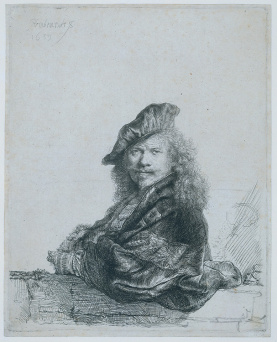
Rembrandt did approximately 100 self-portraits, which brings me to what this Dutch-American blogger has in common with him besides the national origin and, of course, the crazy talent. If you want to see a few of them (and they are delightful), follow this link to the Human Pages site.
Of course there are so many things to love about these portraits, especially the Impressionist-looking one where an aged Rembrandt is smiling at the camera. (That must have been fun to paint.) But one thing that struck me about them was the curly hair. Look at that curly hair! In the very young self-portrait, it shades his face in a hood of frizz. Perhaps he had just washed it.
I have hair of about the same texture. When treated well (i.e. not washed for while), it settles into loose curls. When treated poorly, it frizzes. I got this curly hair from my Dutch American grandfather. Never got to see it on his head, because he went bald before I was born, so I didn’t know what was coming. But the hair lives on in me and in several other members of my family. It wasn’t until I saw these self-portraits of Rembrandt that I realized these are genuine, trademark Dutch curls.
Every nationality has things to be ashamed of and things to be proud of. I am proud of Rembrandt (though I can’t take any credit for him), and I am happy to share, if nothing else, his hair.
Sources
DeMar,
Gary, et. al. Building a City on a Hill. American Vision,
Inc., 1997, rev. ed. 2005. Chapter 25: “New Netherland Becomes New
York,” p. 289 ff.
Stebbing,
Barry. God & the History of Art I, 2nd ed. How
Great Thou ART publications, 2001.
G.K. Chesterton has addressed the important question of what paganism really is and how it relates to being human in his book The Everlasting Man. So I was going to do a brand-new post about paganism drawing on that book. I was going to discuss how not everything in pagan practice is what we would strictly call religion, because it includes local history, genealogy, cosmology, entertainment, medicine, etc., etc. I was going to mention that all human beings need rituals, ways of dealing with illness, ways to mark the seasons, times of mourning and times of play, that literally every human practice was developed first by pagans and blah blah blah.
But I wasn’t able to get access to G.K. Chesterton’s book so as to write a brand-new post on all of this. Besides, conveniently, I have already written one.
I’ve posted a link to this article before, but I know you guys. I know you don’t usually click on links. So here it is again: Pagan Origins: Should Christians Worry?
The rule is, your Hallowe’en costume should be either be a horror creature, or else something clever and funny and preferably inanimate. Be a deer or a demon or an avocado or a donut or a steak. Don’t dress up as any kind of a person.
The only time you may dress up as a person is when you already look exactly like that kind of person, in which case, depending on the circumstances, it may or may not be much of a costume, but I digress.
A year ago I broke this rule and
here’s what happened.
I am a middle-aged blond woman. I went as Mario from Super Mario Bros. My costume consisted of a fake black mustache and the trademark Mario hat. (It was a costume of convenience. My kids had developed an interest in Mario and Luigi, and had already acquired the props.) It was a not terribly convincing costume, since with my shocking white skin and light-colored, curly hair poking out from under the hat, there was no disguising that I was a lady of Dutch ancestry. Also, I don’t own any blue coveralls.
Trick-or-treating in our then neighborhood was the most fun I’ve ever had trick-or-treating. People decorate their houses, come outside, and sit in lawn chairs in costume, holding bowls of candy, sometimes flanked by a glowing brazier or a bowl of dry ice. The streets throng with families. All the little kids and many of the parents are excitedly complimenting one another’s costumes. Cars, if they venture out at all, drive at 2 mph. Everyone is feeling happy and excited. No one is drunk, but their inhibitions are down. It’s a real party atmosphere.
(The year my one son was two, he was so cute that people kept giving him extra candy. After an hour, his trick-or-treat bucket was so heavy that he couldn’t carry it. But I’m digressing again.)
When I showed up in my Mario costume, it was immediately recognized by a mustachioed, curly-haired man about my own age. He pointed at me and yelled at the top of his voice,
“Look! It’s an older Greek woman!”
Then as I doubled over in laughter, he added, “That’s how we tease our Grandmas.”
Darn. I was trying to appropriate Italian culture.
Several years ago now, I found
myself sitting in a house in a jungle somewhere in Southeast Asia, among a
small ethnic group whose name has been redacted so I can write about them. Although I knew Christian believers in that
group, on this night I was sitting across from a devotee of the local
religion.
We sat cross-legged on the ironwood floor, and he had a cigarette pack on the floor in front of him. He was very passionate about our topic of discussion. He didn’t raise his voice, but I could tell he was worked up. Whenever he was making an especially important point, he would pick up the cigarette pack and slam it down again.
He spoke thus:
“Don’t ever let anyone tell you
that we [of this local religion] don’t believe in God. That’s a slander. We do
(slam) believe in God. But we also
(slam) believe in (slam) His bureaucrats.”
This is a very Southeast Asian view of the spiritual world: the heavenly bureaucracy. You can see it presented visually in some Hindu temples that resemble a tall, pointy mountain, and this mountain is covered with little niches, and in each niche is a statue of a divine being. They are not placed in there randomly. There is a place for each of them, and each in its place.
This view is also reflected in the
governing structure of the country in which I was sitting at the time. At the
top is the President. Below him (or her) are the governors of the provinces.
Below these, in descending order, are five or six additional ranks, each
responsible over a smaller geographical area, until you get down to Village
Head (or mayor). And below him, in each village, are the heads of families.
It’s an elaborate bureaucratic system, but everyone knows the names of all the
ranks. They have to deal with them daily. And of course, you always show
respect to anyone with a rank anywhere above your own.
My pagan friend went on,
“Think about it. You wouldn’t expect
the President to attend your wedding. Maybe not even the Governor. But you
might get [the next rank down], or [the rank below that]. Now think about how
many weddings must take place on a given day, all over the world. God can’t possibly
be at all of them. He would send His bureaucrats.”
His point was that showing
disrespect to the local spiritual “bureaucrats” would be akin to dishonoring
God.
Now, clearly this person’s concept of God was anthropomorphic. He thought of Him as a big President in the sky, not omnipresent, not capable of (or even probably interested in) attending all the weddings. However, my main point with this story is that this person, out in the jungle, subscribing to a spiritual view of the world that most readers of this blog might find strange or even comical, had a concept of God as distinct from lesser gods. As he would be the first to tell you, he knew about and honored God.
This people group had no problem grasping the concept of “the Creator.” They had a beautiful, polysyllabic name for Him [again, redacted in exchange for the privilege of writing about these folks]. When individuals from this ethnic group became Christians, that name was the name they used in their prayers.
Local Religions Ground but also Divide
I have a lot of sympathy for local deities and mythologies. It is good for people to have their own culture and mythology, to feel grounded in something to which they legitimately belong. But in a cosmopolitan culture (and we are not the first cosmopolitan culture to discover this) there is a problem with just following our ancestors’ lead for the totality of our religion. The problem is that ancestral religion and identity politics don’t mix. I probably don’t need to elaborate on this. You can find your own examples of the impossible dilemmas it creates. The world is bristling with them.
United by One God
I could probably write another
1,000 words about this problem and cast no more light on it. So instead, listen to the words of Paul,
Apostle to the Gentiles, as he spoke to a group of sophisticated pagan
philosophers:
“People of Athens, I see that you are very religious.
For as I walked around and looked carefully at your objects of worship, I even
found an altar with this inscription: ‘To an Unknown God.’ Now what you worship
as something unknown I am going to proclaim to you.
“The God who made the world and
everything in it is the Lord of heaven and earth and does not live in temples
built by hands. And He is not served by human hands, as if He needed anything,
because He Himself gives all men life and breath and everything else. From one
man He made every nation of men, that they should inhabit the whole earth; and
He determined the times set for them and the exact places where they should
live.”
(You wouldn’t think “He determined
the exact places where they would live” is very surprising, but I have heard
that it brought one group of native translators to tears. They had thought that
no one, human or divine, cared about them; that they had been forgotten.)
“God did this so that people would
seek Him and perhaps reach out and find Him, though He is not far from each one
of us. For in Him we live and move and have our being. As some of your own
poets have said, ‘We are His offspring.’”
(By the way, notice how he alludes to the
wisdom already found in their own culture. But Paul, who was bi-cultural, isn’t
finished. Now he is going to call them to a purer, more direct worship of the
Creator.)
“Therefore since we are God’s offspring, we should not think that the divine being is like gold or silver or stone – an image made by human design and skill. In the past God overlooked such ignorance, but now He commands all people everywhere to repent. For He has set a day when He will judge the world with justice by the man he has appointed. He has given proof of this to all people by raising him from the dead.”
Men of Athens, I see that in every way you are very religious. For as I walked around and looked carefully at your objects of worship, I even found an altar with this inscription: ‘to an unknown god.’ Now what you worship as something unknown I am going to proclaim to you.
The God who made the world and everything in it is the Lord of heaven and earth and does not live in temples built by hands. And he is not served by human hands, as if he needed anything, because he himself gives all men life and breath and everything else. From one man he made every nation of men, that they should inhabit the whole earth; and he determined the times set for them and the exact places where they should live. God did this so that men would seek him and perhaps reach out for him and find him, though he is not far from each one of us.
The Lovas [Hungary] find [of an ochre mine dated to 30,000 years ago] … appears unexpectedly, out of nothing, as it were. [It] consisted of tools suited to quarry red paint — a purely ‘luxury’ article, according to our present outlook. The quantity and perfect finish of the tools, together with the difficulties involved in obtaining the raw material, demanded an astonishing degree of concentration … on the part of primitive man. Such qualities are not usually associated with palaeolithic man who is regarded as being unable to concentrate his attention, rather clumsy and heavy in his cerebral activities except those connected with the fundamental functions of self-preservation and the propagation of the race.
Mészáros and Vertes, quoted in The Lost Civilizations of the Stone Age by Richard Rudgley, pp. 179 – 180
This academic-ese for, “Gee, we thought that paleolithic people were stupid brutes, but now it turns out they were people after all.”
I especially love the snooty euphemisms except those connected with the fundamental functions of self-preservation and the propagation of the race. It might be couched in academic terms, but this is clearly a reference to our mental picture of a cave man clubbing a saber-toothed tiger and then dragging some poor woman away by her hair.
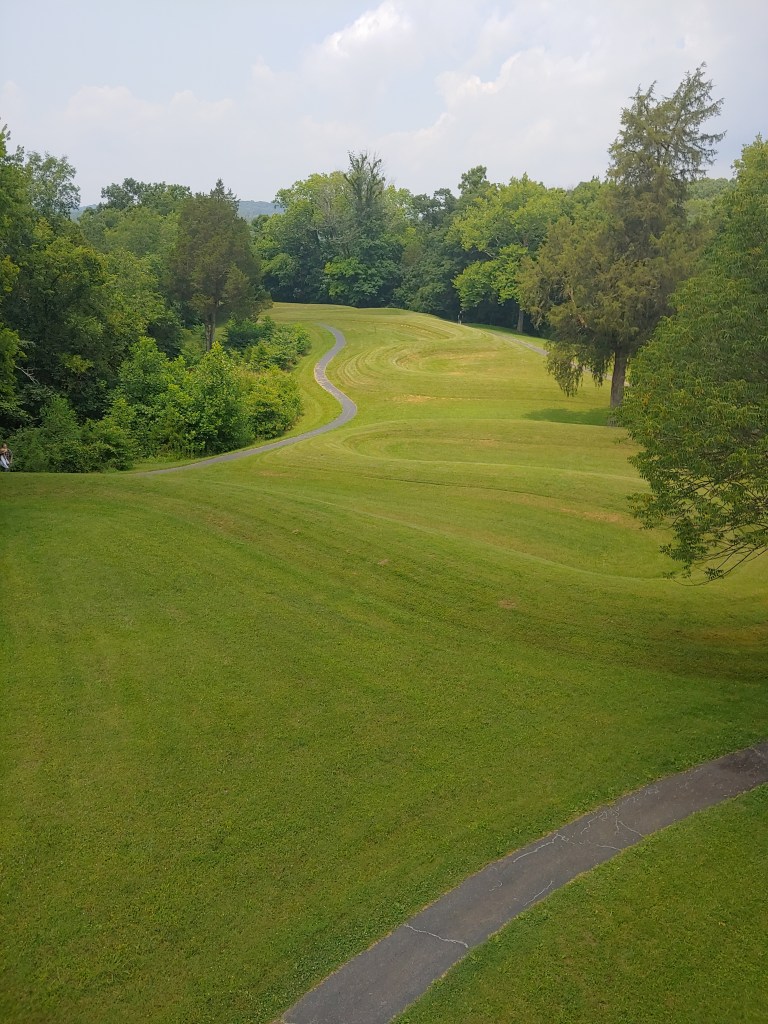
Body of the serpent seen from the viewing tower, looking North
Ohio’s serpent mound was first discovered by
white people in about 1846. It was
difficult to survey or even to find due to being covered in trees and brush. When the brush was partly cleared, it became
obvious that the mound, perched on a cliff at the confluence of a creek (which
cliff itself resembles the head of a serpent), was a really remarkable
earthwork and was designed to be visible from the nearby valley.
The following article will draw on the book The Serpent Mound by E.O. Randall, published in 1905, which is a compilation of maps, surveys, and speculation about the mound by archaeologists of the time; and on my own visit to the mound. One advantage in using these older sources is that we get a variety of voices, we can learn what the Mound looked like when it was first (re)-discovered, and we get an archaeological perspective that is different from the modern one. For example, one source in Randall’s book says the mound appears to be “not more than 1,000 years old, nor less than 350 years” (p.50). This is not very precise, but I actually prefer it to a super-confident proclamation about the mound’s age based on dating methods and assumptions that might be suspect. In fact, the uncertainty of this early source is echoed by the informational video in the mound’s museum. It features an archaeologist saying that we could get “a million different carbon dates” from the mound because the earth was that used to build it was already old and had been through multiple forest fires, etc. He adds that it’s basically impossible to carbon-date earthworks.
On the Road to Serpent Mound
Walking south along the serpent (viewing tower in background)
To get to Serpent Mound (at least
from where we are), you get in your car and head south over the Ohio highways. You leave behind the urban build-up and
progress into farm country. Eventually, the
landscape becomes less Midwestern and more Appalachian. Hills and hollers take
the place of open farmland. Finally,
after hopping from one rural route to another, you find yourself winding
through thickly wooded hills in southern Ohio. You approach the Mound from the South. Though it stands on a bluff overlooking Brush
Creek, the area is so heavily wooded that you can’t catch a glimpse of the
Mound on your way in.
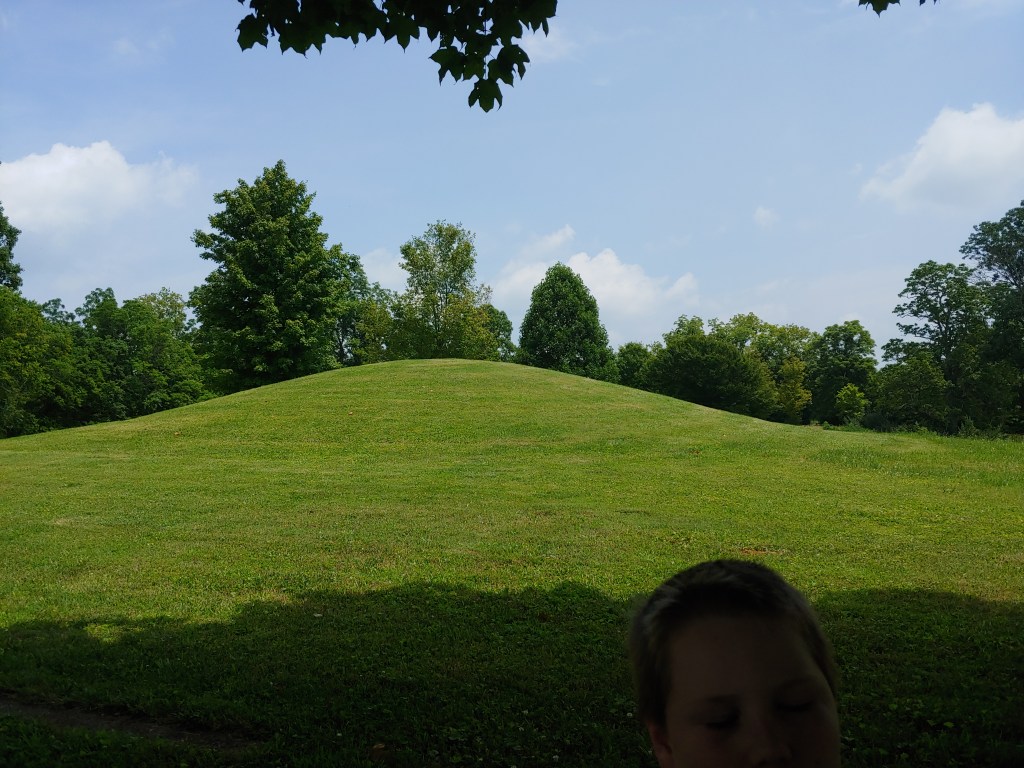
Large burial mound some ways south of the serpent
This land was purchased in
1885. At that time, the land was owned
by a farmer and the Mound was “in a very neglected and deplorable condition”
(Randall 106). To save the Mound from “inevitable
destruction,” a Prof. F.W. Putnam arranged to have it bought by the Trustees of
the Peabody Museum,
Cambridge,
where he was Chief of the Ethnological and Archaeological Department. Putnam later worked to have a law protecting
it passed in Ohio, the first law of its kind
in the United States
(Randall 108). Today the Mound is a
National Historical Landmark. Besides
the Serpent itself, the area includes some additional burial mounds, a picnic
shelter, and a tiny, log-cabin-style museum.
You disembark in the parking lot. The heat, the humidity, the strong sweetish green smells, and the variety of insect life remind you of your Appalachian childhood. They also remind you why you are planning to move out West.
The Serpent Mound Itself
An old drawing of the serpent as it would look if there were no trees around it (Randall p. 8)
Serpent Mound is difficult to
describe in words, so please see the associated maps and photographs. It is 1335 feet long (winding over an area of
about 500 feet), varies from three to six feet high, and slopes downward from
the spiral tail to the jaws and egg which stand on the tip of the
overlook. The head faces West towards
the sunset at Summer Solstice. The body
includes three bends which may sight towards the sunrises at Summer Solstice,
Equinox, and Winter Solstice (short lines of sight and the gentle curves of the
Serpent make it difficult to tell whether these alignments were intended for
astronomical viewing).
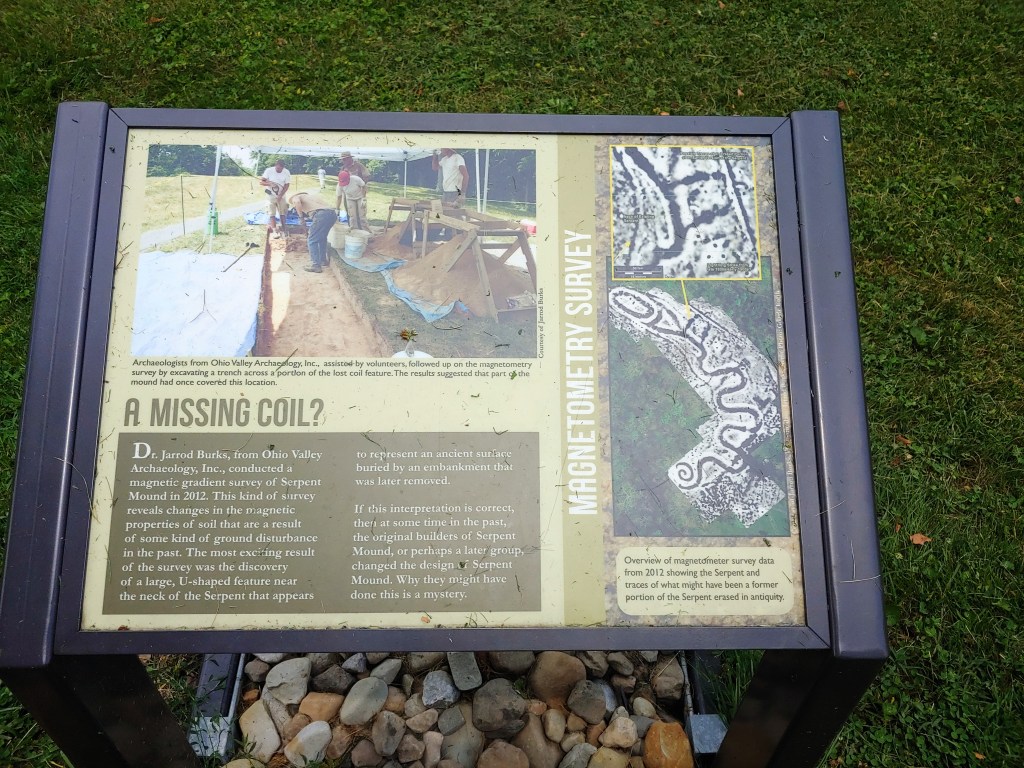
Archaeologists have discovered the serpent once had a fourth coil near the head, which was deliberately dismantled.
It was made apparently by hand on a
base of clay, followed by rocks, more clay, dirt, and then sod. Though it cannot be carbon-dated, there is
evidence that it is not as ancient as some megaliths elsewhere in the world. The bluff it sits on and the creeks that
surround it cannot be older than the retreat of the glaciers. The
burials near it date to the Adena period, which runs 600 B.C. to 100 A.D., though
there is no way to tell if the burials are contemporaneous with the Serpent or
were added later. There has even been
speculation that the Mound could have been built by the Fort Ancient
culture, which flourished around 1000 A.D.
The “egg” which the Serpent
contains in its jaws (or, the Serpent’s eye) used to have in its center a stone
altar which bore traces of fire. (In the
largest burial, too, the corpse was placed on a bed of hot coals and then
covered with clay while the coals were still smoldering.) We
assume, then, that the Serpent was the site of ceremonies, but we have no way
of knowing anything about their nature.
A close up view of the oval “egg.” It once contained an altar.
The Serpent, despite its name, does
not give a spooky or “wrong” feeling. The
scale of it is very human and does not overwhelm. The shapes and proportions of the curves are
pleasing and give a sense of calm and beauty.
The Serpent is, in fact, inviting to walk on. One is tempted to walk along the curves,
climb down into the oval of the egg, step into the middle of the spiral tail. One cannot do this, of course, as it is
strictly forbidden.
The only problem with Serpent aesthetically (if this is a problem) is that it’s impossible to view it all at once. This is mostly because of the bend in the tail. In modern times an understated observation tower has been placed next to the Serpent, right near the tailmost curve. But even from the top of this tower it is impossible to take in the entire Serpent with either eye or cellphone camera. Looking to the left, we get a view of the spiral tail. Looking to the right, we see the undulations stretching off into the distance and falling away with the slope of the hill, but even then we cannot see the entire head because it takes its own slight curve and is blocked by trees.
Approaching the tail spiral. In the background, the cliff drops away into a wooded vista.
I can’t help but think this effect
is intentional. This monument is not
designed to be taken in all at once, looking along a line of sight, and to
overwhelm the viewer. Instead, it’s
apparently designed to draw us on, tantalizingly offering small charming vista
after small charming vista. There is no
one best place to view it. Perhaps the
architects among us can explain what this says about the minds and intentions
of the people who designed it.
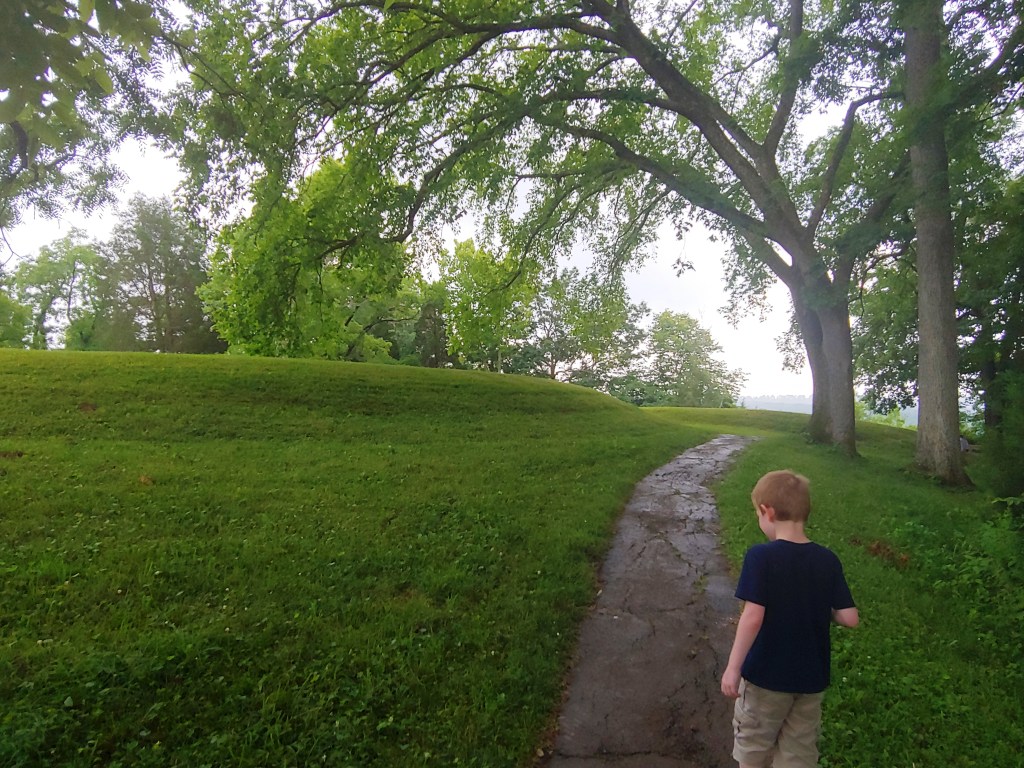
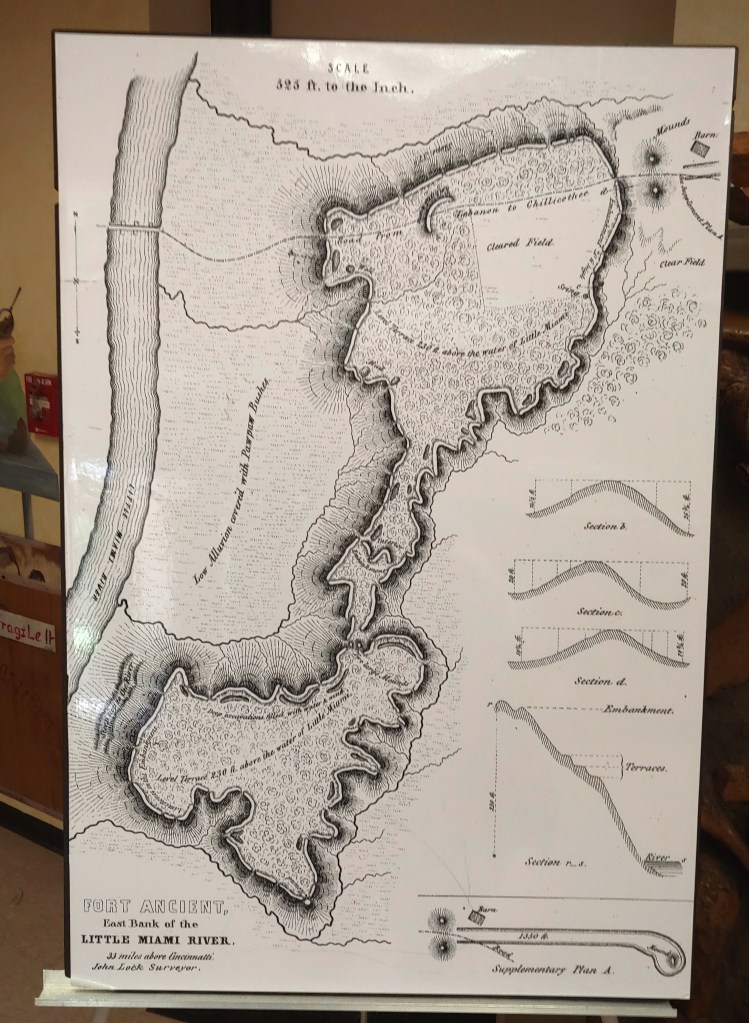
Fort Ancient, another hill-and-plateau complex in southern Ohio, is also sprawling, hard to view, and offers the same “please explore me” effect.
Fort Ancient is a plateau surrounded by man-made hills with gaps in them, overlooking the Little Miami River, Ohio. It has man-made mounds on it as well.
“Effigy Mounds” in North America
The Serpent is definitely not the
only large animal-shaped mound in North America. There are many of them, called by
archaeologists “effigy mounds” (not the usual meaning of the term effigy).
“The effigy mounds appear … in
various parts of … the Mississippi
Valley. They are found in many of the southern
states; many appear in Illinois, but Wisconsin seems to have
been their peculiar field. Hundreds of
them were discovered in that state … In Wisconsin they represent innumerable
animal forms: the moose, buffalo, bear, fox, deer, frog, eagle, hawk, panther,
elephant, and various fishes, birds and even men and women. In a few instances, a snake. In Wisconsin
the effigies were usually situated on high ridges along the rivers or on the
elevated shores of the lake. Very few
effigy mounds have been found in Ohio
– though it is by far the richest field in other forms of mounds.” (Randall
31)
There are, of course, large animal-shaped terraforms in other parts of the world, such as the Uffington and Westbury White Horses in Britain and the Nazca Lines in Peru.
So Ohio’s serpent mound is not unique. It is, however, impressive and well-done, and tends to strike people as mysterious and significant.
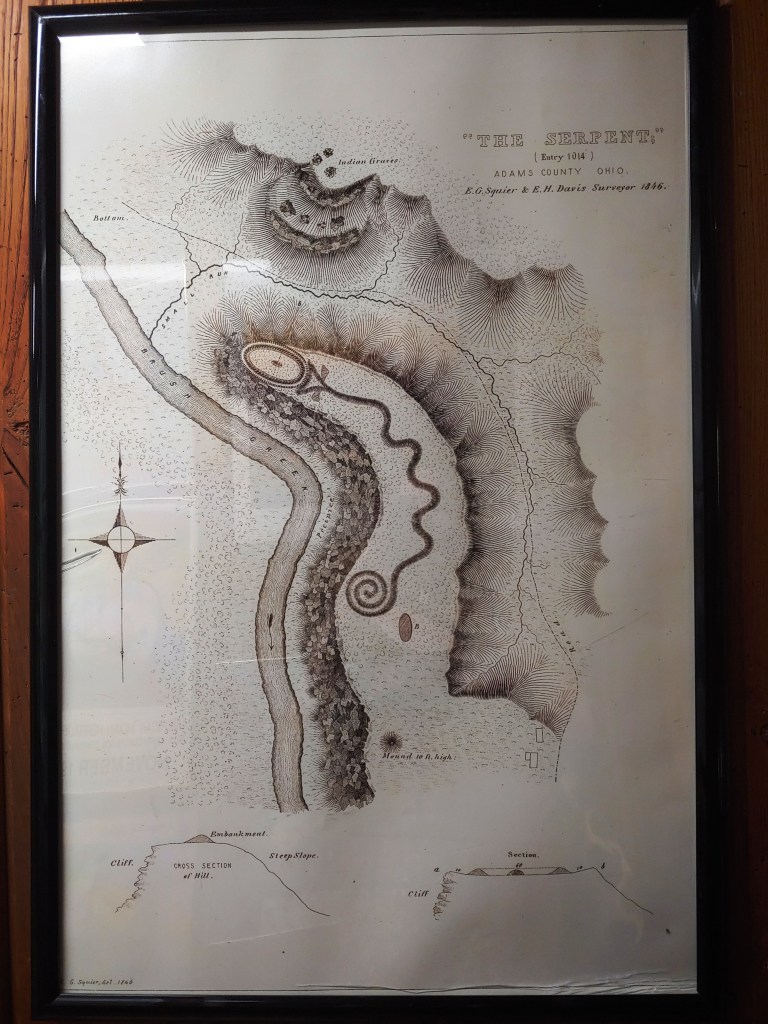
The Serpent Mound is a Giant Rorschach Blot
Map of the serpent found in the museum
Whatever else it might be, the Serpent Mound reliably functions as a giant Rorschach blot. It appears significant but ambiguous. Everyone who is not content to admit that we don’t know its purpose tends to bring their own interpretation.
Here are four examples.
One example, roundly mocked in
Randall’s book, is the “amusing and ridiculous” “Garden of Eden fancy” (p. 93).
This theory, put forward by a Baptist minister of the day, is that the
Mound was built by God Himself to commemorate the eating of the forbidden fruit
and to warn mankind against the Serpent.
The oval object, which many people take to be an egg, is on this view the
forbidden fruit itself, which the Serpent is taking in its jaws as if to eat or
offer. Furthermore, the three streams
that come together nearby represent the Father, the Son, and the Holy
Spirit. “Pain and death are shown by the
convolutions of the serpent, just as a living animal would portray pain and
death’s agony … America is, in fact, the land in which Eden was located” (pp
99, 101).
Now, here’s another interpretation,
based on the accepted anthropology of the day: “Students of anthropology,
ethnology and archaeology seem to agree that among the earliest of religious
beliefs is that of animism or nature worship.
Next to this in the rising scale is animal worship and following it is
sun worship. Animism is the religion of
the savage and wilder races, who are generally wanderers. Animal worship is more peculiarly the
religion of the sedentary tribes … Sun worship is the religion of the village
tribes and is peculiar to the stage which borders upon the civilized. ‘Now judging from the circumstances and
signs,’ says Dr. Peet, ‘we should say that the
emblematic mound builders were in a transition state between the conditions of
savagery and barbarism and that they had reached the point where animal
worship is very prevalent’” (pp. 37 – 38).
This theory of the slow development
of man’s religion as they rise out of “savagery” into “barbarism” and finally
into “civilization” is reported with much more respect than the Baptist
pastor’s theory, but it is in fact just as fanciful. It is based on an overly neat-and-tidy and,
frankly, snobby view of the history of religion that was popular for many years
but that actual history does not support.
But, again, Rorschach blot.
Many other observors have linked
the Mound with its oval to the “egg and
serpent” origin mythology that crops up in many places in the world,
including Greece and India.
This theory receives many pages in Randall’s book.
We got rained on while at Serpent Mound. Coincidence? I think not!
To take just one more out of many other examples, on this very blog we learned from a book review that Graham Hancock’s latest book prominently features the Serpent Mound as part of his latest theory that North America is, in fact, the source of the Atlantis legends. He believes that the Mound is meant to represent the constellation Draco and was built during an era when Draco was ascendant. Or something like that.
I, too, have taken the Serpent Mound Rorschach test and here is what I see. I see more evidence that serpent mythology (with or without eggs) and the strong motivation to build large, long-lasting religious monuments are both universal in human culture. I personally think that these things didn’t arise independently in every corner of the world but were carried distributively and that they represent distant memories of certain events in human history, which are hinted at but not fleshed out in the early chapters of Genesis. However, I am not fool enough to think that the existence of Serpent Mound “proves” any of this. It is, as I said, a Rorschach blot.
Other Serpent Mounds Around the World
Otonabee Serpent Mound sits on the
north shore of Rice
Lake, not far from the city of Toronto, Ontario (Randall 114). It
is 189 feet long. The head faces “a few degrees north of east,” with an oval
burial mound in front of the head which could represent an egg (115).
In Scotland, there is the stone
serpent of Loch Nell:
“The mound is situated on a grassy
plain. The tail of the serpent rests
near the shore of Loch Nell, and the mound gradually rises seventeen to twenty
feet in height and is continued for 300 feet, ‘forming a double curve like the
letter S’ … the head lies at the western end [and] forms a circular cairn, on
which [in 1871] there still remained some trace of an altar, which has since
wholly disappeared, thanks to the cattle and herd boys. … The mound has been formed in such a
position that worshippers, standing at the altar, would naturally look eastward,
directly along the whole length of the great reptile, and across the dark lake
to the triple peaks of Ben Chruachan. This position must have been carefully
selected, as from no other point are the three peaks visible. General Forlong … says, ‘Here we have an
earth-formed snake, emerging in the usual manner from dark water, at the base,
as it were, of a triple cone – Scotland’s Mount Hermon, – just as we so
frequently meet snakes and their shrines in the East.’” (Randall pp. 121 – 122)
Speaking of Mount Hermon. This large, lone mountain sits at the northern end of the Golan Heights in Israel. It is so high that it is home to a winter ski resort. In ancient times, this region was called Bashan. It was known for its large and vigorous animals (the “bulls of Bashan”), and for its humanoid giants. Down to Hellenistic times, Bashan was a center for pagan worship (the Greek god Pan had a sacred site there). And guess what else it has? A serpent mound.
“The serpent mound of Bashan has ruins on its head and tail. The ruins are square (altars?) on top of small circular mounds” (Van Dorn 144).
The Ohio serpent’s spiral tail, which evokes a stone circle. Viewing tower in the background.
This serpent mound is less than mile from a stone circle called Gilgal Rephaim (“Wheel of the Giants”). (Stone circles, as sacred sites, are also found throughout the world.) “The Wheel contains some 42,000 tons of partly worked stone, built into a circle 156 meters in diameter and 8 feet high on the outer wall. It is aligned to the summer solstice. The area is littered with burial chambers … If you go due North of the Wheel, [sighting] through the serpentine mound [and proceed] for 28 miles, you will run straight into the summit of Mt. Hermon” (Van Dorn 145).
Serpent, altar, circle, and sacred mountain. I don’t know about you, but the site in Golan sounds a lot scarier to me than Ohio’s Serpent Mound. However, it also makes me wonder whether people in Ohio – and Scotland – were trying to re-create this arrangement.
Sources
Giants:
Sons of the gods by Douglas Van Dorn, Waters of Creation Publishing, Erie, Colorado,
2013.
The
Serpent Mound: Adams County, Ohio:
Mystery of the Mound and History of the Serpent: Various Theories of the Effigy
Mounds and the Mound Builders, by E.O. Randall (L.L., M., Secretary Ohio
State Archeological and Historical
Society; Reporter Ohio Supreme Court), Coachwhip
Publications, Greenville Ohio, 2013.
First published 1905. This book
is a compilation: “The effort has been made not merely to give a description,
indeed several descriptions, of Serpent Mound, but also to set forth a summary
of the literature concerning the worship of the serpent. … It is hoped that
this volume, while it may not solve the problem of the origin and purpose of
the Serpent Mound, will at least add to its interest and give the reader such
information as it is possible to obtain.” (page 5)









 Out of Babel Books