
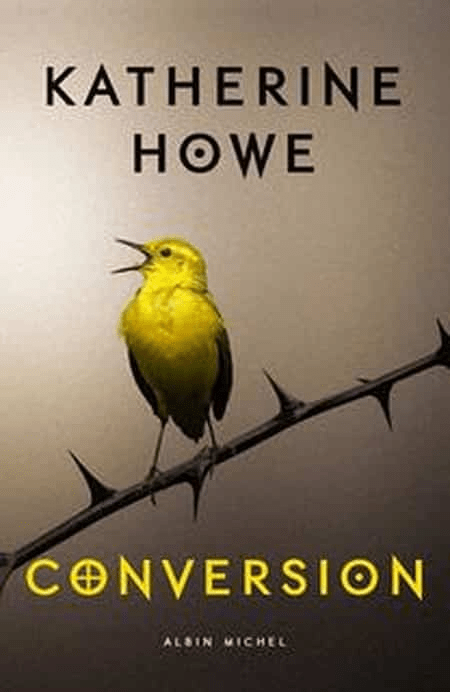
My vision is crowded with whispers and movement and strange shapes narrowing in. I feel my heart thudding in my chest, the sweat flowing freely in my hair, under my arms.
Something inside me breaks. I close my eyes and open my mouth, and a piercing scream tears out of me. The scream relieves the pressure in my head, and it feels so good that I scream again.
“It’s there!” I jabber, lurching in my seat. “I see it there! Goody Corey’s yellow bird sits on Reverend Lawson’s hat! I see it plain as day, the Devil’s yellow bird sits on the Reverend’s hat!”
Conversion, p. 362 – 363
I picked up this book from the public library, among a few others, to have fiction to read over Christmas break. After one false start (a high-school drama that was unable to hold my attention), I cracked open Conversion, and it was a winner.
Here’s the blurb from Howe’s website:
A chilling mystery based on true events, from New York Times bestselling author Katherine Howe.
It’s senior year, and St. Joan’s Academy is a pressure cooker. Grades, college applications, boys’ texts: Through it all, Colleen Rowley and her friends keep it together. Until the school’s queen bee suddenly falls into uncontrollable tics in the middle of class.The mystery illness spreads to the school’s popular clique, then more students and symptoms follow: seizures, hair loss, violent coughing fits. St. Joan’s buzzes with rumor; rumor erupts into full-blown panic.
Everyone scrambles to find something, or someone, to blame. Pollution? Stress? Are the girls faking? Only Colleen—who’s been reading The Crucible for extra credit—comes to realize what nobody else has: Danvers was once Salem Village, where another group of girls suffered from a similarly bizarre epidemic three centuries ago . . .Inspired by true events—from seventeenth-century colonial life to the halls of a modern-day high school—Conversion casts a spell.
The story goes back and forth between modern St. Joan’s and 17th-century Salem. The excerpts from Salem are fairly long. I would say they take up a quarter to a third of the book. The Salem storyline is told from the perspective of Ann Putnam, one of the “afflicted” girls who, years later, made a public apology which stated that she now thought the people accused of witchcraft had been innocent.
Coming into this, I wasn’t sure I would finish it. Books about the Salem witch frenzy, after all, can easily go sideways into facile Christianity / patriarchy bashing. And at first, it did look like Howe was implying that: It’s suh-sigh-uh-tee! These girls had no pow-er! Some of them were servants! The first person they accused was a slave! However, Howe never veered into caricatures. She painted a fairly complex picture, held the girls also responsible, and the writing was good enough that I ended up finishing the book.
I do think Howe’s interpretation of what went down would be more feminist than my own. In the Salem scenes, the men are, to a person, cold, harsh, and uncaring as fathers. (Also, the women can’t read.) However, in the Danvers scenes, Colleen has loving, involved parents who are still married, a kindly younger brother, an apparently goodhearted boyfriend, and a priest at her school who seems like a good egg. The pressure on the Danvers girls comes more in the form of an academically competitive environment where they are all hoping to get into Ivy League colleges. In fact, the fact that none of the girls’ parents seem to be divorced is striking.
Spoiler Town
Howe’s diagnosis of the St. Joan’s girls – and, apparently, of the Salem girls also – is a medical phenomenon called conversion, whereby intense mental stress is “converted” into bizarre physical symptoms.
In the case of the Salem girls, as Howe tells it, it begins with one little girl who genuinely takes sick with what used to be called a nervous breakdown. It’s implied, but never drawn out, that she has been abused by her father. The phenomenon is then taken up by a servant girl living in the same house who is clearly faking at first, for attention and to get out of being worked hard. She even bites herself on the arm to manifest mysterious wounds. The phenomenon then spreads through a combination of this particular girl enjoying the attention; other girls being unwilling to speak up but just saying what they think the adults want to hear; possible suggestion as the girls work themselves into a genuine state; and simmering resentments in the town, as the girls and their parents use the trials to get revenge on those they envy.
In the case of the St. Joan’s girls, Howe is able to offer medical explanations for even the most bizarre physical phenomena. For example, one girl who has been coughing up pins turns out to have pica (a mineral deficiency that causes a compulsion to eat things that are not food, such as dirt). You see, there is a medical explanation for everything!
This book was published in 2014 and the modern-day story is set in 2012. Now, since the Plandemic, Howe’s trust of the medical establishment struck me as naive and dated. The Department of Public Health is the voice of sanity in the St. Joan’s hysteria, and it’s they who figure out that conversion (not the HPV vaccine or environmental pollution) is what’s causing it. Near the end of the book, when the phenomenon has been taken care of by these experts, Colleen narrates that “We are all on the same antidepressant.” This is a red flag to anyone who’s familiar with the research about how harmful behavioral meds can be to kids and teenagers, and how they have been chronically overprescribed, often for way too long at a time, and what a huge moneymaker they are for pharmaceutical companies. I have only a very basic, passing familiarity with this stuff, and even I was concerned. But Howe seems to believe in The Science just as firmly as the Puritains believed in The Devil.
Nevertheless, Howe draws back from explaining away the strange phenomena completely. There’s an odd scene near the end of the book when Colleen’s best friend’s mother, who is always described as pale blonde, ghostly, suffering from migraines, and almost never leaving her house, pulls Colleen into a dark corner and whispers creepily that her daughter is “like me.”
“She’s prone to spells. But it can be managed. Helps to have the family close by. I’m only telling you so you don’t have to worry.”
My mouth went dry.
“But how did you –” I stopped, because it almost seemed as though her eyes were glowing faintly red.
“Anyhow,” Mrs. Blackburn said, her smile widening, a tooth glinting in the darkness under the stairs, “They said what caused it, in the news. Didn’t they.”
“Y — yes.” I swallowed.
“Good. So there’s no problem.”
The hand released my wrist.
ibid, p. 393
I’m not sure what the purpose of this creepy scene is. Is Howe trying to buy back the “mystery” element of her book, even though by that point in the story, all the explanations have been offered? If she is trying to keep the story somewhat paranormal, I’d say the attempt is not successful. Nothing else that happens in the book, not even the scenes in Salem, hint that any actual paranormal activity might be going on. It is all just the girls’ minds deteriorating. Or is Howe trying to imply that Mrs. Blackburn is displaying Munchhausen by Proxy and is somehow making her own daughter sick? If that’s the theory, it’s way too late in the novel to introduce it, and it never gets further explored. There does seem to be a longer version of this book (“not condensed”) out there. Perhaps the Mystery of Mrs. Blackburn is explained in the longer version, but in the book I read, it just comes off like the author wants to add complexity even though she clearly believes the Harmless Medical/Societal Pressure Explanation.
When Witchcraft Was a Thing
I do not know enough about the Salem witch trials — or witch trials in general — or even the Puritains, although I have read some of them — to speak authoritatively about the degree to which Howe’s explanations are correct. Howe has done a lot of research about the Salem trials, and even includes long excerpts from the transcripts in her novel. It’s not clear, however, whether she has done much research about other witch trials in New England (or Old England), or about Puritan theological beliefs.
Fortunately, I have a book by someone who has.

When you read a lot, serendipities sometimes happen. I bought this book many, many years ago, at a used book shop in Kansas City, when I was there for a vacation with extended family. My dad has Used Bookstore Radar, and he always likes to visit the used bookstores whenever he is in a strange city. So I went with him and bought my own armload. This book was an impulse buy that survived several rounds of elimination, because Salem was one of those historical topics that I “really needed to learn more about.” Well, now the time has come.
John Putnam Demos, interestingly, found out only after he had begun witchcraft research that he is descended from the Putnams, the family who were instrumental in many of the witchcraft convictions in Salem.
I’ve only begun the book, but here is what I can tell you. Although Salem has become famous for cases getting out of hand, witchcraft (“entertaining Satan”) was a recognized crime during the 1600s, on both sides of the Atlantic. As with other crimes under English common law, any accusation had to be first investigated informally, and many of these were settled without going to court, which means we have no official records of them. If the stage of going to court was reached, there were still legal proceedings, evidence presented, and so forth, and the magistrates could and often did acquit the accused or void the case on a technicality. People who had been accused of witchcraft could also sue their accuser for slander. Some countries, and some regions of each country, prosecuted people for witchcraft far more often than others.
It is this background of which Demos wants to draw a detailed picture. He tells us that he is going to look at the biographical details of certain accused and accusers. He is going to look at this from a sociological, psychological, and historical point of view. I am sure I will learn a lot from him. But, when it comes right down it, Demos is still studying witch trials as a sociological phenomenon. He is not examining whether the paranormal may have played an actual role.
The Dominant Narrative
Possibly the most annoying scene in Conversion is when Colleen’s teacher, Ms. Slater, tells Colleen that a good historian should “look beyond the dominant narrative” about Salem. I’m not certain what Slater thinks the “dominant narrative” about the Salem witch trials is. Surely, in modern times, most people see nothing more than a story of injustice and superstition played out in an overly rigid, hierarchical society. That’s certainly not the narrative that was dominating in Salem at the time. The only way I can detect that Slater’s preferred emphasis differs from the dominant modern narrative, is that she wants us to have more sympathy for the teenaged girls who were doing the accusing, for the pressure they were probably under.
This is actually a new thought. If I may speak from my own experience, when we read accounts of the trials, the girls definitely come off as the villains of the piece: screaming accusations, making their adult victims cry. The tendency is to attribute malice. I wouldn’t say that comes from listening to a narrative told by people in power, though; rather, it’s the immediate first impression that we get from just observing their behavior.
By contrast, here’s how Ann Putnam’s experience went down in Conversion:
“Oh, Annie, tell them how we suffer!” Abigail beseeches me.
“I … I …” I stumble over my words, terrified. If I continue the lie, I’m sinning in the eyes of God. A vile, hell-sending sin. If I speak the truth, I’ll be beaten sure, and all the other girls will, too. My mouth goes dry, and bile rises in my throat.
At length, I whisper, “I cannot say whose shape it is.”
page 221
And here:
I’m beginning to panic, and I want to get up and run away [from the courthouse] and hide in the barn behind our house, but everyone is there and everyone is watching me, and my father is there and I have to stay strong and do what they want me to, and so I stay where I am, making myself small on the pew, and soon enough the tears are springing from my eyes, too.
page 258
The picture here is of a girl trapped in a story she knows there is something wrong with, but afraid to out her friends and to displease the adults. This is also very plausible. It reminds me of so-called “trans” children, trapped in an even more harmful delusion foisted upon them by the adults in their lives and by their peers, manipulated into believing this is what they themselves want and have chosen. This could have been one of many factors operating in Salem. This is how social contagions work. There is a big lie; there are vulnerable, confused children or teenagers; there are culpable adults and confused adults; there is social pressure; there is mass deception.
Multiple Causes
So let’s look at some factors, remembering that many things can be true at once.
- Hysterical Teenaged Girls: Teen and pre-teen girls tend to be stressed out in every society. Their bodies are changing, they are noticing boys, hormones are making them nervous and emotional and edgy. No, they don’t have much social power, but we need to consider whether it is actually a good idea to give teen girls a lot of social power. I think most girls hate themselves at thirteen (the age of Ann Putnam when the story takes place). Teen girls are also known to be susceptible to fads, suggestion, and yes, physical symptoms of stress. The fact that they are not very mentally stable is not an indictment of them or even necessarily of their society; it’s more of a fact that we all have to deal with. This is also the age when, unless guided, girls develop an interest in the occult. So yes, it does seem very natural that the accusers at Salem should have been a bunch of teen girls, and it’s very believable that they were not just “faking,” but had worked themselves into an actual altered state. This created a perfect storm at Salem, because the evidence to be examined a witch trial generally consisted of eyewitness testimony. These were not very reliable witnesses. But the fact that teen girls’ testimony was accepted as evidence actually argues against Salem being a sexist hellhole.
- Vengeance / Scapegoating: Already in Demos’ book, it has become evident that people who got accused of witchcraft tended to be those who had annoyed their neighbors in some way. Maybe they were the sort of person who is always arguing with everyone, or maybe they were upper-class or especially pious and so the target of envy. It’s pretty clear, even to someone not deeply familiar with the records, that accusers saw in a witch trial a way to get revenge on someone who they had perceived wronged them. Envy, resentment, and scapegoating are actually very common in human life, especially in village settings (say as opposed to city settings). If the culture in question believes in magic, then people are likely to suspect their enemies of sabotage by magic, in whatever magical idiom is local to the culture. People find it hard to accept that things can just go wrong for them. They prefer to blame someone when something goes wrong.
- Superstition: If by “Superstition” we mean “There’s no such thing as witchcraft,” then we will get to that in a moment. But if by superstition we mean, “If the New Englanders had not believed in witchcraft, the injustice of the Salem witch trials would never have happened,” then that is manifestly untrue. Of course, they would not have happened in the same way. But what scares us about Salem is not the suggestion of the paranormal so much as the purge-like quality of the proceedings, where an accusation is tantamount to a conviction, and it’s impossible for the accused to prove their innocence. Something has gone wrong with way rules of evidence are applied. A moment’s reflection will show that it is completely possible to conduct a purge in the absence of belief in witchcraft. Purges have been conducted on charges of capitalism, communism, being a heretic, being a Christian, sympathizing with the enemy in wartime, abusing children in daycare centers, date rape on college campuses, racism, not taking the government vaccine, and being insufficiently supportive of the trans agenda. If the purge mentality is present, then any superstition will do. That’s why it is foolish for us to feel superior to the Salem townspeople, as if, not being Puritans, we could never be subject to this common human practice.
- Medical Causes: I have heard theories that there may have been some physical factor, such as a particular kind of mold in their diet, that caused the girls to develop delusions and hallucinations. This seems to me like a modern materialist grasping at straws. We don’t want to believe that a bunch of teenaged girls could be so wicked as to deliberately send their neighbors to their deaths, and we certainly don’t want to consider the paranormal as a real possibility, so it must be the mold. It’s true that certain medical conditions can cause irrational behavior (even heat stroke or fever can do it), because we are embodied people. However, in a case like that I wouldn’t expect the affliction to spread like a fad among just the teen girls in a community … the very ones who are vulnerable to delusions and drama for a bunch of other reasons already covered.
- Actual Occult Activity: Not being a strict materialist, I can’t rule this possibility out. Modern Western materialists don’t believe that a spiritual world exists at all, so when it comes to interpreting things that happened in the past, we have some blind spots. We are quick to accuse people who we know to be otherwise intelligent of making ridiculous things up out of whole cloth, or of believing ridiculous things completely without evidence. But it is actually possible that there was a lot more paranormal activity in the past than now. Paranormal activity tends to manifest itself in forms that make sense to the culture where it is manifesting; so, people in Ireland have encounters with fairies, American Indians might encounter the Windigo, and modern Americans are more likely to be abducted by aliens. This doesn’t mean that nothing spiritual is going on, just that malevolent spiritual forces know how to make themselves intelligible to humans. If we accept that there was actual paranormal (dare I say, demonic) activity happening in Salem, this does not mean that we have to accept that every person who was accused – or even every person who confessed – was in fact a witch in league with the devil. There have been cases before where people confessed to things they didn’t do, because they were worn down by interrogation, eager to please, or easily manipulated. However, there could have been some people practicing the occult in Salem. The girls themselves could have gotten involved in some occult practice, which could have left them open to demonization. And in fact, even if their symptoms were entirely faked, the kind of mob/purge mentality that they displayed is always the work of the devil in the sense of being the fruit of envy, deception, and a false ideology. When people get involved in occult practice or philosophy, one tragic result is often that they lose their ability to think clearly. That certainly seems to have happened in Salem, in some form or other. The devil certainly got a lot of publicity during those months, and I’m sure he was loving it.

 Out of Babel Books