We knew about the Olmec and Maya, but their sites were hard to spot and hard to study because of the jungle. Now, we keep learning more and more.
A train project on the Yucatan Peninsula is uncovering hundreds of Mayan settlements, proving that the area was more densely populated than once thought, as archaeologists have been beginning to suspect.
Meanwhile, Lidar technology is able to peer through the jungle and reveal not onlymore and more ceremonial sites stretching over the Olmec and Mayan culture areas, but also common layouts that seem to indicate a broad shared cultural (or at least, architectural) tradition dating back to 3,400 years ago.
It looks to me like what we have here is a Central American version of the Sumerian urban/bureaucratic/temple-based civilization, giving rise to a series of civilizations that followed the same model: Akkadian, then Babylonian, and so on. And, if we believe the 3,400 YA date, the same thing in Central America was happening at almost the same time. It’s almost as if people tend to set up hierarchical city-states with temples wherever they settle, almost as soon as they settle there, whenever circumstances permit. Almost as if they were dispersing, and remembering something.
So, a member of the Out of Babel research team sent me this cool link. (The research team being blog readers/friends who send me links.)
Apparently, the native peoples of British Columbia made gardens in the temperate rain forests up there. These were patches of forest where they planted edibles such as “hazelnuts, crabapples, cranberries, and hawthorn.” These patches persist to this day. They did not look like agriculture to the Europeans. We are just now realizing what they were, a mere 200 years behind the times as usual.
This article brings to mind the Wild Yam Question, which was raised by an old ethnology professor of mine. Part of the Wild Yam thesis is that people groups who look to city-dwellers’ eyes like hunter-gatherers, may actually be engaging in horticulture, where they plant a staple food (such as sago palm) in clusters in the forest and then rotate where they harvest it, which looks like pure foraging but isn’t. According to the linked article, the forest gardens in BC are the first instance of this kind of horticulture that has been discovered in a temperate climate.
And not to go on a patented Out of Babel rant, but I’ll just note that this kind of discovery undermines the old model of anthropology where people start out as hunter-gatherers and progress to gardens, then large-scale agriculture, and so on, becoming more urban as they go. This suggests that there are a variety of ways to do agriculture and that people can mix elements of different lifestyles to suit their needs. This, in turn, suggests that we can’t just look at whether a given people group has agriculture, and assume that we can infer from this when they lived or what stage of development they were in. There may well have been people groups who went from being farmers or herdsmen to being hunters when forced to do so, either because they were migrating or in response to some disaster. In fact, this is exactly what happens to Enmer’s tribe in my trilogy.
For a tag, you are given a series of prompts around a particular theme, and you answer the prompts, usually with the names of books you’ve read.
Para que lo sepas, I had to restrain myself from naming one of my own books for almost every one of these prompts. After all, the Scattering Trilogy is multigenerational; life-affirming; about rebirth; includes a fair amount of food, etc. Anyway, that’s en mi opinion. But I will do this tag like a normal person and name books by other people.
Photo by Chait Goli on Pexels.com
The Day of the Dead is all about remembering and honoring past generations.
Name a book with an intergenerational cast or a strong focus on family.
Pavilion of Women, by Pearl Buck. Buck is a master at sliding seamlessly through time in her stories. In the opening scene, Madame Wu is sitting in her chamber on the morning of her fortieth birthday. Her maidservant comes in to comb her hair, and suddenly we are in this same bedroom twenty-four years ago, on the morning after Madam Wu married Mr. Wu, and the same maidservant has come in, and she is nervous as a cat around her new mistress, because she knows that she just had sex for the first time. Now, twenty-four years later again, the servant is much more at ease with Madam Wu, but she does not know that her mistress has decided that as of her fortieth birthday, she will stop living to keep the Wu household running smoothly, and start living for herself. She just has to get through the party.
Dia de los Muertos is an important Mexican holiday. Name a book that takes place in Mexico or includes Mexican culture.
I’ve been slo-mo bingeing on books about the archaeology of Mesoamerica. Of course, with books like these, which are about as old as I am, you need to supplement them with current articles, since new discoveries and analyses keep being made.
This holiday is often celebrated with vibrant, colorful imagery and sugar skulls. Name a book with a cover as visually-interesting and colorful as a sugar skull.
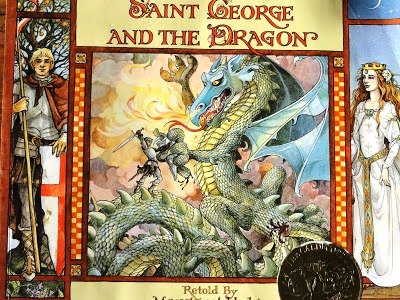
I will never stop promoting the art of Trina Schart Hyman.
Food is an important part of the Dia de los Muertos celebration. Food is set out on altars for the spirits of departed family members.
Tell us a book where food really makes the story!
The No. Ladies’ Detective Agency books. These are written from multiple perspectives, but arguably the main character is Precious Ramotswe, founder of the No. Ladies’ Detective Agency, the only female-run detective agency in Botswana. Mma Ramotswe is fat (“traditionally built”), and while not unusually greedy, she does enjoy her food and thinks about it fairly often. She always likes to visit the formidable Mma Potokwane, who runs an orphanage, because although Mma Potokwane is sure to ask for some kind of favor for her orphans, she always serves Mma Ramotswe a generous piece of cake, sometimes two.
“Some people very clearly and obviously would like to eat more cake. It might as well be printed on their forehead: Greedy person.” Ah yes, that would be me.
Dia de los Muertos is not only celebrated in Mexico, but also in Central and South America. Name a book that takes place in Central or South America or has a Central or South American author.
I’ve read a lot of missionary stories, but Bruchko is one of the most remarkable. It takes place among the Motilone, who live in the jungle somewhere along the border of Venezuela and Colombia.
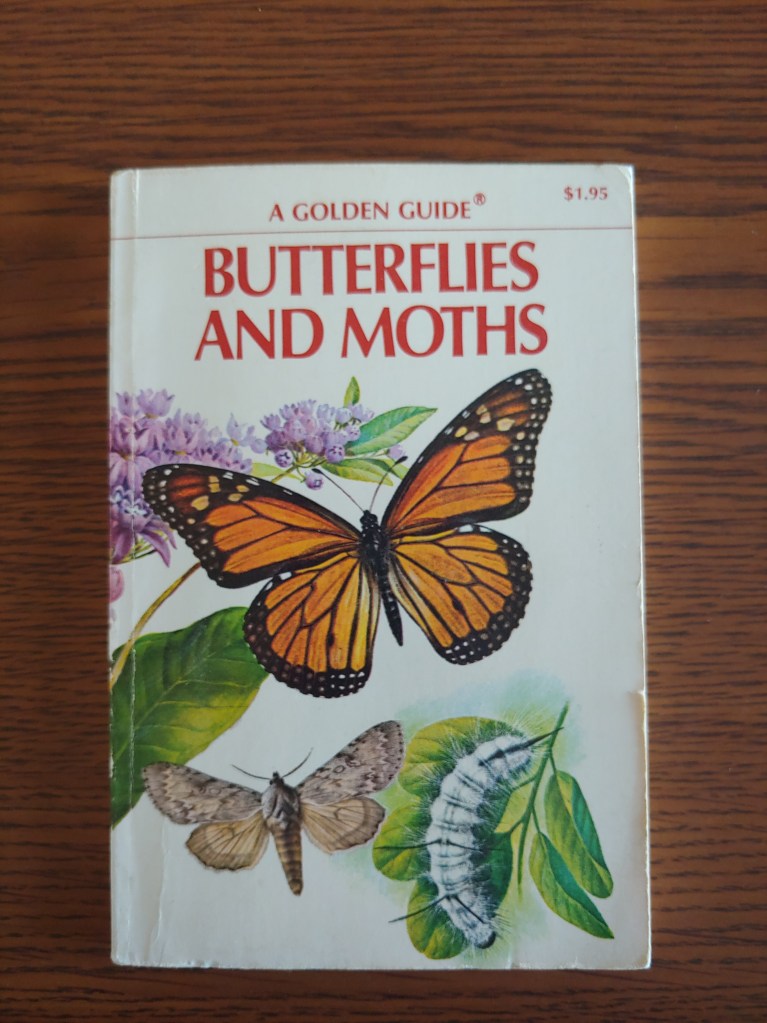
In addition to sugar skulls, flowers and butterflies are also symbols of this holiday. Tell us a book with flowers or butterflies on the cover
Nailed it.
The Day of the Dead is about celebrating life. Name a book that celebrates life.
The book of Job, in the Bible.
You think I’m kidding? No, listen.
Job isn’t about Job patiently putting up with suffering, proving what a good person he is, and then God rewards him. That’s the caricature, but it’s almost the opposite of the real theme of the book.
The consensus in Ancient Near Eastern wisdom literature was that, since God is just, if anything bad happens to anyone, it must be their fault. This is still, by the way, the essence of human wisdom in many parts of the globe, especially in Hinduism. It is also many people’s instinct when we see a horrible disaster befall someone, to find some way that the unfortunate person brought it upon themselves, or “how this could have been avoided.” It makes us feel a little more in control.
The book of Job exists to subvert this universally accepted bit of “wisdom.”
Job starts out as a model of the good person in the Ancient Near East. He has seven sons (the perfect number!), and three daughters; he offers regular animal sacrifices to God. And he’s rich, as he should be. Everything is making sense, see?
Now we take this model Good Person and visit all kinds of punishments on him. And this must be an expose, right? It must be Justice Falling At Last!
Job’s three “friends” show up, and they proceed to preach some very reasonable, theologically sound sermons just like you could hear in any of the wisdom literature of the day. God is just. He rewards the righteous and punishes the wicked. Therefore you must have deserved this somehow. If you say you haven’t, you are defying God! Beat that!
Their logic is flawless. And God sides with Job against them. “You have not spoken of me what is right, as my servant Job has.”
If that’s not life-affirming, I don’t know what is.
It is also a day of remembering loved ones who passed on. Name a book that was either given to you or reminds you of a loved one who passed away.
Let me tell you about Alice.
I can tell you all about her now, because she’s with the Lord. No privacy risk or anything like that. I’d post a picture if I had one, but I don’t.
By the time I knew Alice, she was in her late eighties. (I was in my late teens.) She mentored me for a few years before she got dementia. She was a sweet, little old German-American lady, with a sly sense of humor. She could do impressions, but used this skill judiciously. Once she said to me, “You want to know why I never married?” And then, for an answer, she quoted the King James verse, but with different punctuation: “I would not have thee, ignorant brethren.” Props to you if you get that joke.
The “brethren” that she “would not have” were certainly missing out, because Alice was a treasure. Perhaps they overlooked her good qualities because of a facial deformity. She had been bitten on the cheek by a horse as a child, and it wasn’t until she was an adult that she was able to afford corrective surgery.
Anyway, one day when I was at Alice’s house, I picked up the book The Holiness of God by R.C. Sproul. She encouraged me to borrow it. I expected it to be a dry, academic read, because it was on a lofty theological topic. But no, it was written for the layperson, and was very accessible. A page-turner, in fact. To this day I associate that book with Alice.
El flor del Muerto – The flower of the dead. Marigolds are used in massive quantities on the Day of the Dead. These flowers represent the sun and rebirth. Also believe to guide the spirits back home. Name a book about rebirth.
The Great Good Thing, by Andrew Klavan. Unfortunately, I have lent my copy out, so I can’t show you a picture. This is the story of how Klavan grew up as secular Jew on Long Island, ran away from home, lived as a hobo for several years, became a hard-boiled noir crime writer and a Hollywood success, and then became a Christian at the age of 50. He is now a Christian, Jewish, hard-boiled noir crime writer who also writes YA and fantasy.
If you want to read a novel about rebirth, try Identity Man, also by Andrew Klavan.
Colors are used as a form of symbolism in the decorations and sugar skulls. Some of the colors used in association with Dia de los Muertos are yellow (unity), white (hope and purity), red (blood and life), purple (mourning), and pink (happiness).
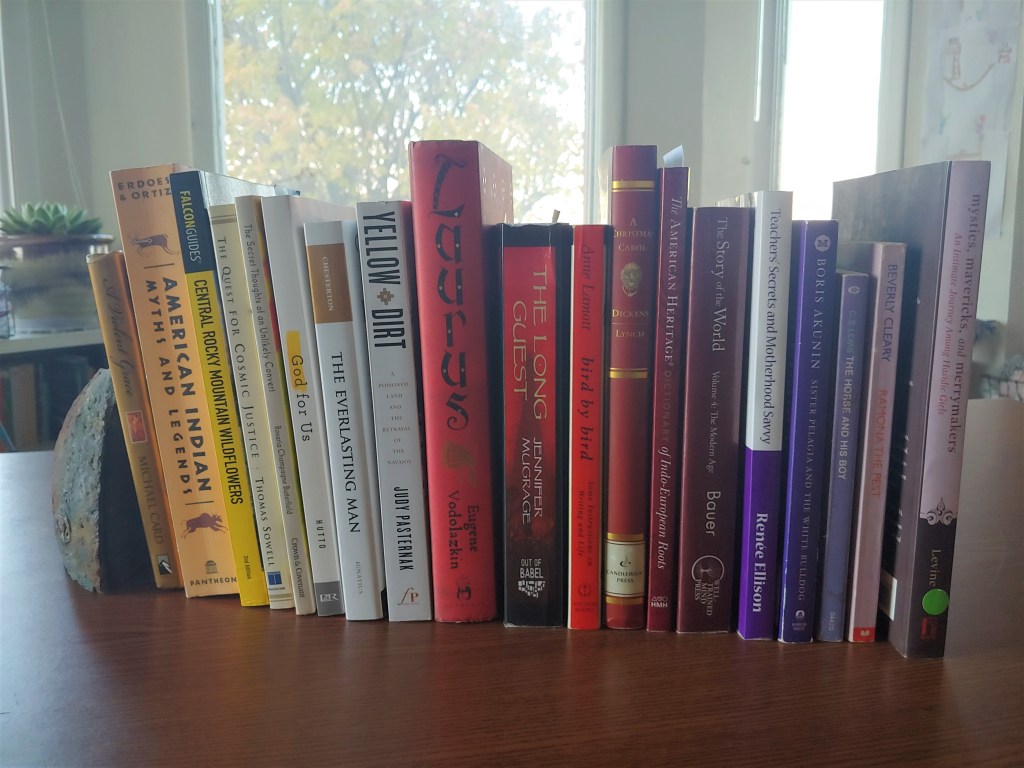
Take a photo of some book spines in the Dia de los Muertos colors!
And a happy Dia de los Muertos to all who celebrate ❤
P.S. Disclaimer about Memorializing Our Dead
If anyone feels uncomfortable with me doing this tag, because, you know, skulls and dead people and paganism, I get it.
Let me reiterate a point I have made before, that pagan practices (especially old ones with deep roots) often fulfill basic human needs that every society needs to fulfill, such as celebration, marking the seasons, etc. In this case, the basic human need is to continue to feel a connection to, and to honor, our loved ones who have died. In a way, it’s part of the mourning process. Modern American society is terrible at this, sorry to say. The only formal time to remember the person is during the funeral and burial, after which the mourners are expected to basically stop talking about the person except to very close friends or relatives. Bringing them up, or continuing to visibly grieve, causes that sin of all sins, social awkwardness. This is pretty harsh, and it does not match well with the way that grieving goes for most people.
There are ways to provide for ongoing grieving, honoring, and remembering that are not ancestor worship. For example, in Indonesia, the Muslims have memorial services at 30 days, 100 days, and a year after the death. The people groups of Kalimantan (pagan and sometimes Christian as well) have a second, larger, funeral ceremony, usually a year later, when they dig up the person’s bones and re-inter them in an ossuary with the bones of the family. The Christians will have about a week or so of viewing services while they wait for people to gather for the funeral; then the graveside service; then that night an additional “comfort” service. Most of these take place at the family’s house, and they mean the house is filled with people, songs, and food. The family is not left alone. The people who attend don’t have to say or do anything special beyond “we share in your grief.” They just have to be physically present. This is also a better social rule than having to come up with something to say.
Christians will also have a vigil at their relatives’ graves on the night before Easter. This might sound creepy – and maybe it is – but sometimes when facing something as awful as death, we have to embrace the creepy and it will actually haunt us less.
So all that to say, while I am not recommending pagan worship, and while Christians are definitely forbidden from trying to contact the dead, I think having something like a Dia de los Muertos is a good idea on a psychological level. And yes, I did get teary-eyed when watching Coco.
I have to admit, I expected that the Etruscans would turn out to have been a Hamitic people. But according to this article, it looks like they came from the Pontic-Caspian steppe, just like the early Romans did … and more or less just like historical tradition said they did …
Of course, the sample size is small (only 82 individuals). It may yet be revealed that the Etruscans intermarried with an earlier, possibly Hamitic people, from whom (maybe?) they also got their language and their metalworking skills? But that’s pure speculation on my part. Who knows? Genetics and history both allow for a lot of speculation.
Cute, right? Plus, he’s thought to have lived in “Doggerland, the now-submerged region between the United Kingdom and continental Europe.” If that’s not cool I don’t know what is. I recently saw a theory somewhere that Doggerland was the inspiration for Tolkien’s map of Middle Earth, that his cycle of stories is supposed to be a history of very ancient times before those lands were swallowed up by the sea.
Now, we could quibble about how much this facial reconstruction owes to imagination. We’d need to know how big was the “piece of skull” used in it. Was it just a fragment, or was it a good bit of the skull? But as for me, I’m not going to look a gift Neanderthal in the mouth. (So to speak.) Also, I know someone who looks a bit like this. A little more chin, a little less nose, but still a human face.
Near Bayou Macon, Louisiana, is an archaeological site called Poverty Point. I am drawing for information about Poverty Point primarily on the book Mysteries of the Ancient Americas, 1986, by the The Reader’s Digest Association Inc., but here is the official Poverty Point web site. It is now a World Heritage Site. Here is a recent article about an archaeological project done at Poverty Point.
First, the Obligatory Eye-Rolling at Mainstream Archaeology
Like many North American sites, Poverty Point was hard to spot because it consists of earthworks that had been overgrown with forest. (And not only North American sites. Radar technology is revealing that the Mayan civilization was much more extensive than first thought — because the jungle took over so quickly — and is also revealing old settlements in what was hitherto thought to be never-before-settled Amazon rainforest.)
Earthworks are basically impossible to date, but for other reasons, Poverty Point is thought to be about 3,000 years old (i.e. about 1,000 B.C.). However, it helps to remember that when dealing with paleontology and even archaeology, dates are often basically just made up — i.e. reached through dead reckoning based on a shaky framework of background assumptions. But let’s accept 1,000 B.C. for now.
Mysteries, which again, was published in 1986, also makes several more or less dubious claims about the builders of Poverty Point. Here’s a sampling:
“[S]cholars think it is doubtful that societies on the chiefdom level existed in North America 3,000 years ago.” (page 111)
“[This civilization] had no writing, no true agriculture, and no architecture except for its earthworks. Its weapons were simple: the spear, the atlatl, the dart, the knife, and possibly the bola. Even the bow and arrow was unknown to these people.” (page 112)
“Considering the massiveness of Poverty Point’s ridges and mounds, one naturally assumes that they were built over many generations or even centuries.” (page 112)
Mysteries of the Ancient Americas
The first of these quotes is 100% pure assumption, based on the noble savage mythology so beloved of modern academics.
The second is also pure assumption. A better way to put it would be that we have found no evidence of writing, agriculture, etc., so far. The findings reported at the first link above seem to confirm that agriculture was not a big thing at Poverty Point, based on the remains of the peoples’ diet, but this could have been simply because the fishing and foraging was so abundant. It does not necessarily mean they were “only hunter-gatherers” who had not “advanced” to the level of agriculture. C.f. similar claims being made about Gobekli Tepe. As for the bow and arrow, I take it that remnants of all these other weapons have been found, but not bows. Even that, I take with a grain of salt, as it seems that almost every week, something is discovered that we had thought this or that ancient group didn’t have. (Here’s the latest example, which even refers to ancient humans as not particularly ‘smart,’ with ‘smart’ in scare quotes.) But even if the Poverty Point people did not use bows and arrows, this does not necessarily mean the weapon was “unknown” to them. Perhaps they had specialized in other weapons instead. Not everybody in the Middle Ages was an English longbowman, but boy oh boy did they know about them!
Finally, the third claim made in the Mysteries quote box (which they at least had the grace to call an assumption), appears to have been possibly disproven by the second link above. “New radiocarbon dating, microscopic analysis of soil, and magnetic measurements of soils at Ridge West 3 found no evidence of weathering between layers of soil, suggesting that the earthwork had been built rapidly.”
Now, the Site Itself
from Mysteries of the Ancient Americas, p. 111
It’s easier to just show you guys this diagram than to try to describe it, but buckle up, here comes the description. The Poverty Point site consists of earthen ridges set concentrically inside each other, in what looks like a C-shape from the air. “The two central aisles point toward the setting sun at solstice” (ibid). Directly to the west of all this is a large man-made mound (Mound A), while a ways farther north there is a smaller mound (Mound B), which seems to be a burial mound. Bayou Macon, directly to the east, cuts through the eastern side of this whole complex. Was this whole thing originally C-shaped, or was it a circle? Probably a C shape, because there are similar, smaller sites around this region which tend to be “constructed in a semicircle or semioval pattern with the open side facing the water and with one or more mounds located nearby.” (ibid)
The book uses the word “ceremonial” a lot, and honestly I can’t fault them. This complex was constructed by human beings, and now, millennia (?) later, more human beings come and look at it and say, “This looks like it was clearly designed for ceremonial purposes.” That’s a valid argument. The architecture is having a certain effect on us, and we can assume that it had that same effect on our long-lost fellows, and was designed to.
Poverty-Point-related sites have yielded thousands of little decorated clay balls, called Poverty Point objects, that we think were used for cooking. There are also little clay sculptures of female torsos (with or without heads), reminiscent of theVenusesfound around ancient Europe. There are also “myriads of stone tools,” including drills, awls, and needles, made both from local stone and from flint imported from as far away as Indiana. They made “plummets,” perhaps as bola weights or perhaps as weights for fishnets, “most often of hematite in graceful teardrop or oval shapes [and] often decorated with beautifully executed stylized designs representing serpents, owls, and human figures.” (ibid, p. 115)
But it is in lapidary work that the Poverty Point people excelled. Pendants, buttons, beads, and small tablets are worked in an array of such colored or translucent stones as red jasper, amethyst, feldspar, red and green talc, galena, quartz, and limonite. Most of these stones were obtained by far-flung trade. Among the pendants are a number of bird effigies — red jasper owls and parakeets, and bird heads worked in polished jasper and brown and black stones. There are also representations of a human face, a turtle, claws, and rattles, and stubby but carefully made tubular pipes.
Mysteries of the Ancient Americas, p. 115
O.K., I’ve changed my mind. Perhaps this C-shaped complex was not ceremonial, it was a lapidary factory.
Regardless, the Poverty Point “hunter-gatherers” have once again made my point for me: that wherever human beings go, they start up civilization and display mathematics, art, and craftsmanship.
The Snake City
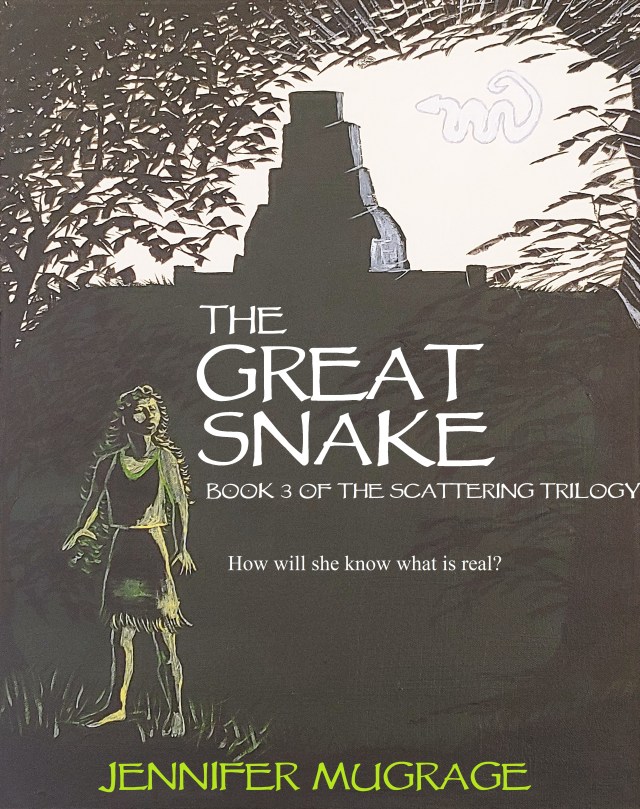
I guess there have been a lot of “snake cities” throughout history. In my third novel, The Great Snake (upcoming, hopefully in 2022), Snake City is founded by a small group who break off from our main group of characters. Their city is like a smaller, less populous version of Poverty Point.
As you can see, our city is much smaller. It overlooks the Mississippi River itself, rather than a bayou. The temple is built not on a man-made mound, but on a natural hill. The people actually live on top of the ridges. They aren’t lapidary craftspeople (at least, not as of the end of the novel). And, finally, this city is about 7,000 years earlier in time than Poverty Point. Other than that, though, it’s exactly the same.
In the cover image, Klee is standing on the lower hill that houses the women’s complex. Behind her, the temple looms over her from atop the hill. It has a Mayan-style roof comb that is facing away from the viewer. In this view, the snake is either hovering in the air just east of the temple, or possibly it is out over the river.
First of all, the tongue twister. Shaman’s snake stick. Say that five times fast! The stick was a carved wooden snake, found in a lake (stop me before I rhyme again!) or swamp, so … possibly released there on purpose?
Secondly, an adorable picture of Finns digging in the mud. They look so happy. (As anyone should when they get to dig in the mud and find archaeological artifacts.)
Thirdly, this quote: “[S]nakes are loaded with symbolic meaning in both Finno-Ugric and Sámi cosmology, and shamans were believed to be able to transform into snakes.” Add these remote people, living at the far northern edge of the world, to the long long list of the world’s peoples who find spiritual and/or cosmological significance in snakes.
This link even has a book tie-in for me! Yes, it does! The upcoming third book in my trilogy will be called The Great Snake. And yes, ithas snake cosmology. And no, this is not very original, but it is based in research. TGS is not available for pre-order yet, but you can get ready for it by buying and reading The Strange Land if you haven’t already done so. TSL is where the serpent makes its debut, at least in my books.
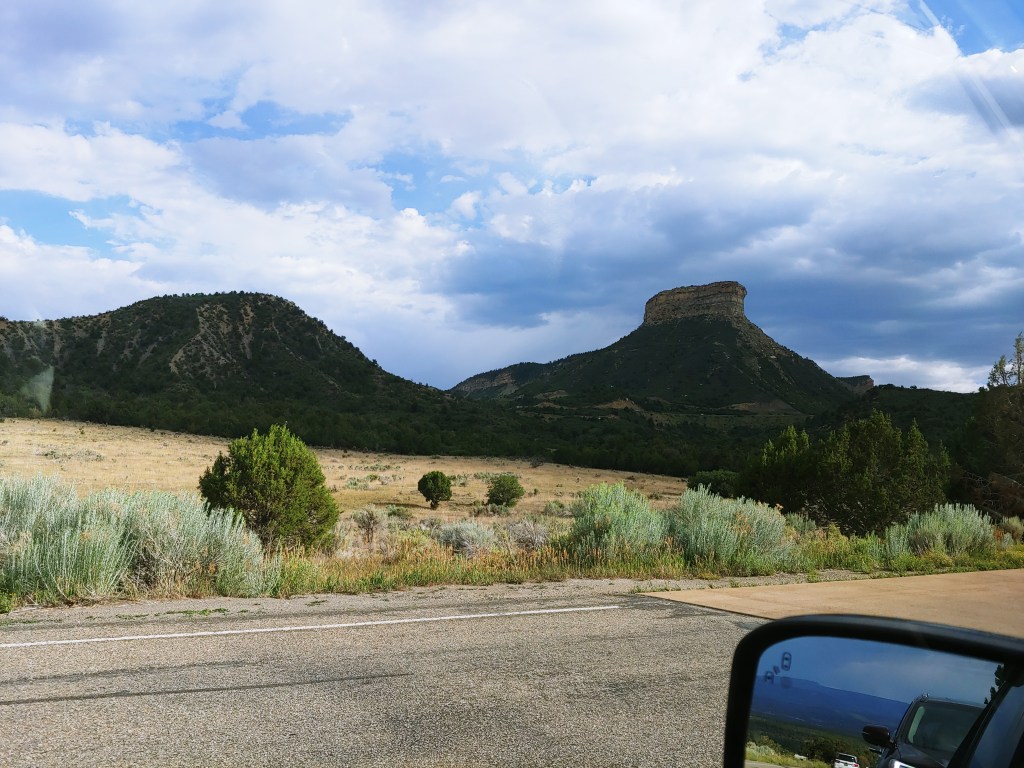
Here is a small part of the Mesa Verde formation, seen from the North, as we head west along Highway 160 towards the town of Cortez. My boys and I “camped” at Mesa Verde last month, but we didn’t really camp camp. We just slept in a tent. We drove into town to get our meals, so I don’t call that camping. There were some much more hard-core campers in the sites near ours, including a family who had come all the way from Maine.
Once you have entered the park and the road has begun to climb, you can stop at an overlook and look out towards the East, over Mancos Valley.
The most famous cliff house in Mesa Verde is called Cliff Palace. It’s the one that you usually see pictures of. To get to it, you take a short but steep hike down into a canyon with a ranger for a guided tour. I’ve done this once in the past, but this year, Cliff Palace Loop road was closed for maintenance. So, we (along with every other visitor) went instead to “the quieter side of Mesa Verde” (per the brochure), namely Wetherill Mesa.
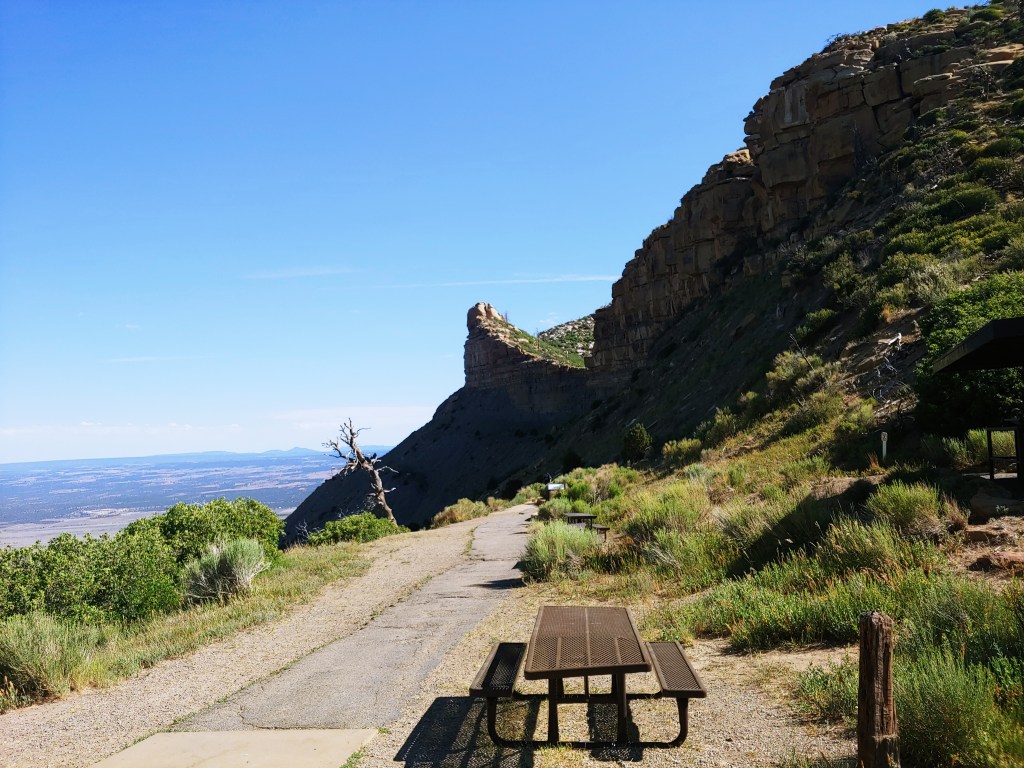
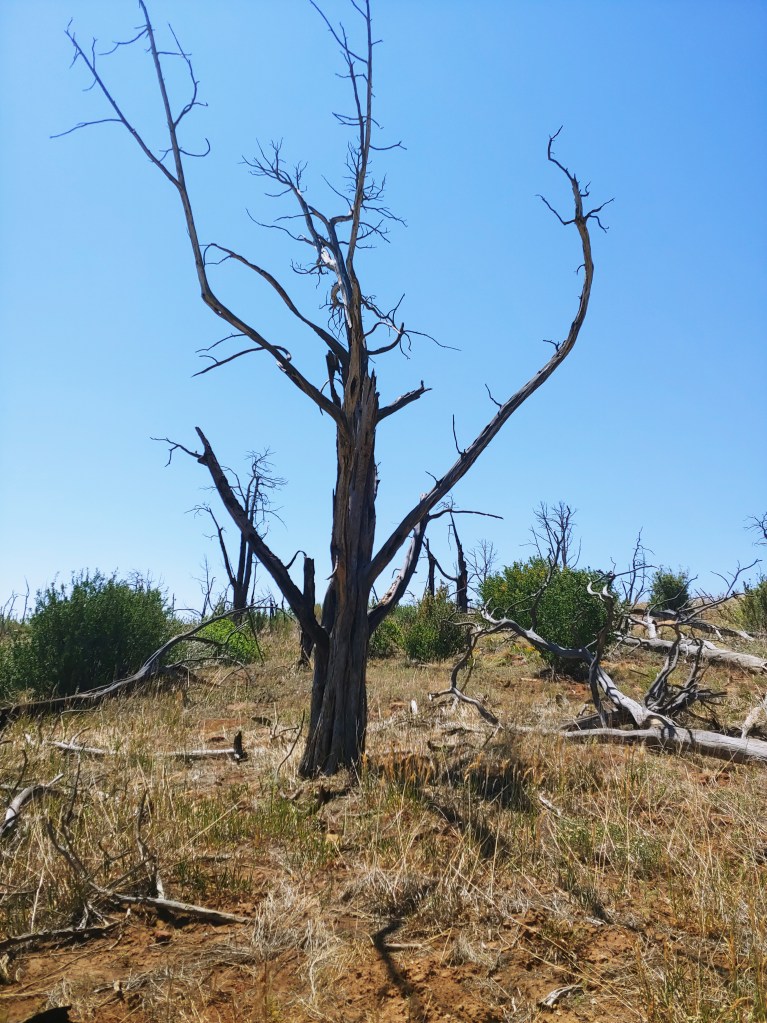
Here’ a view from the top of Wetherill Mesa. As you can see, it’s at a very high elevation, with views in the distance of some of Colorado’s majestic mountains. Notice also the many burned trees. The climate is so dry here that you can see the skeleton forests left by many generations of past forest fires.
Wetherill Mesa is a very large area. There are several different sites of ruins that you can visit, including a couple of “overlooks” from which you can see cliff dwellings but not walk to them. As noted last week, my boys and I did one cliff dwelling hike on Wetherill Mesa, to a site called Step House. Unfortunately I don’t have a picture of the whole complex from a distance, just close-ups of its features. It is not a large ruin, but here are the steps that made it famous:
They look like scattered rocks, but if you look closely, you can see that they have been fitted into steps. To the right is the edge of the “proto-kivas” found at Step House. Farther to the right of that, you would find the dwelling itself, and in front of it a proper kiva (though still smaller than those at some other sites).
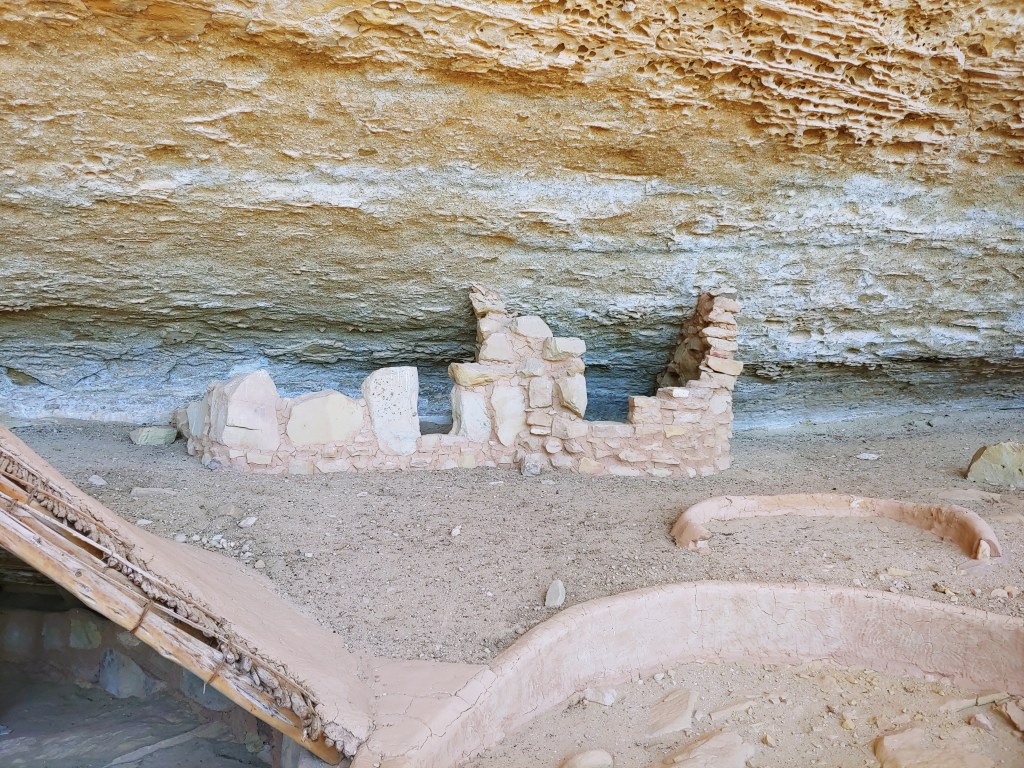
This proto-kiva has burned wood still as it was left about 800 years ago, much as that blows the mind.
Some small rooms behind the proto-kivas (the one on the lower left has a reconstructed roof on it).
Here’s the proper kiva, which is in front of the dwelling part of pueblo.
And here are the walls of the pueblo, rising up from the edge of the kiva in the foreground to the underside of the overhang.
The other place we visited on Wetherill Mesa was a series of dwelling sites that were not cliff houses, but were built up on top of the mesa. A few of these sites were pueblo-style (square buildings made with stones, and attendant kivas), but one was an earlier pit house (cool!). I’ll show you pictures of this stuff another time, and give you some basic archaeological information as well, but for now I’ll close because this post is getting pretty long already. I do just want to add that, as we were informed by a sign, as you walk from the parking lot to get to the excavated dwellings, you are walking past other sites that have not yet been excavated. Mesa Verde, and in fact the Four Corners region in general, is literally covered with archaeological sites, some known, some unknown! You think of people in, say, Jerusalem as people whose daily lives are literally lived atop layers of history, but the more I learn, the more it seems this is true everywhere you go in the world. They are even finding ancient human settlements in the Amazon rainforest now.
O.K., that’s enough archaeological nerding out for one day. I hope you enjoyed the tour! Have a great weekend!
Today I want to share a passage from Acts chapter 14.
This incident took place in the town of Lystra, in what today is Turkey. For context, this means it’s in the same general culture area as Troy, Gobekli Tepe, and according to the map in my NIV study Bible, it is just about 150 miles inland from Tarsus, the town where Paul grew up. Of course, when he was growing up there, surrounded by Roman and Hellenistic and pre-Hellenistic paganism, Paul was Saul: good Jewish boy, overeducated, one of history’s geniuses, fire in his eyes, very purist about the Torah. Since his childhood in Tarsus, Paul has had a number of very formative experiences and is now a very different person. He is still familiar with the local pagan mindset, but now he has a much more inviting attitude towards them.
I post this passage because the appeal that Paul and Barnabas make to the people of Lystra about the Creator is similar to the attitude taken toward Him by Ki-Ki, the shaman in my book The Strange Land. What can you say about the Creator to a people who know nothing about Him except what they can glean from the human experience? Here it is.
[Paul and Barnabas] fled [Iconium] to the Lycaonian cities of Lystra and Derbe and the surrounding country, where they continued to preach the good news.
In Lystra there sat a man crippled in his feet, who was lame from birth and had never walked. He listened to Paul as he was speaking. Paul looked directly at him, saw that he had faith to be healed and called out, “Stand up on your feet!” At that, the man jumped up and began to walk.
When the crowd saw what Paul had done, they shouted in the Lycaonian language, “The gods have come down to us in human form!” Barnabas they called Zeus, and Paul they called Hermes because he was the chief speaker. The priest of Zeus, whose temple was just outside the city, brought bulls and wreaths to the city gates because he and the crowd wanted to offer sacrifices to them.
But when the apostles Barnabas and Paul heard of this, they tore their clothes and rushed out into the crowd, shouting: “Men, why are you doing this? We too are only men, human like you. We are bringing you good news, telling you to turn from these worthless things to the living God, who made heaven and earth and sea and everything in them. In the past, he let all nations go their own way. Yet he has not left himself without testimony: He has shown kindness by giving you rain from heaven and crops in their seasons; he provides you with plenty of food and fills your hearts with joy.” Even with these words, they had difficulty keeping the crowd from sacrificing to them.












 Out of Babel Books