What kind of thing goes on your kitchen bulletin board?
Well, recipes, obviously. Maybe a calendar. I have another, larger bulletin board that houses library and trash collection schedules, photos of friends and family, Christmas letters, things like that. But something else that I need around me is poetry.
A poem is the sort of thing you feed on. You take a moment to stand still and read it to yourself, slowly, like a deep breath for your mind in the middle of the day.
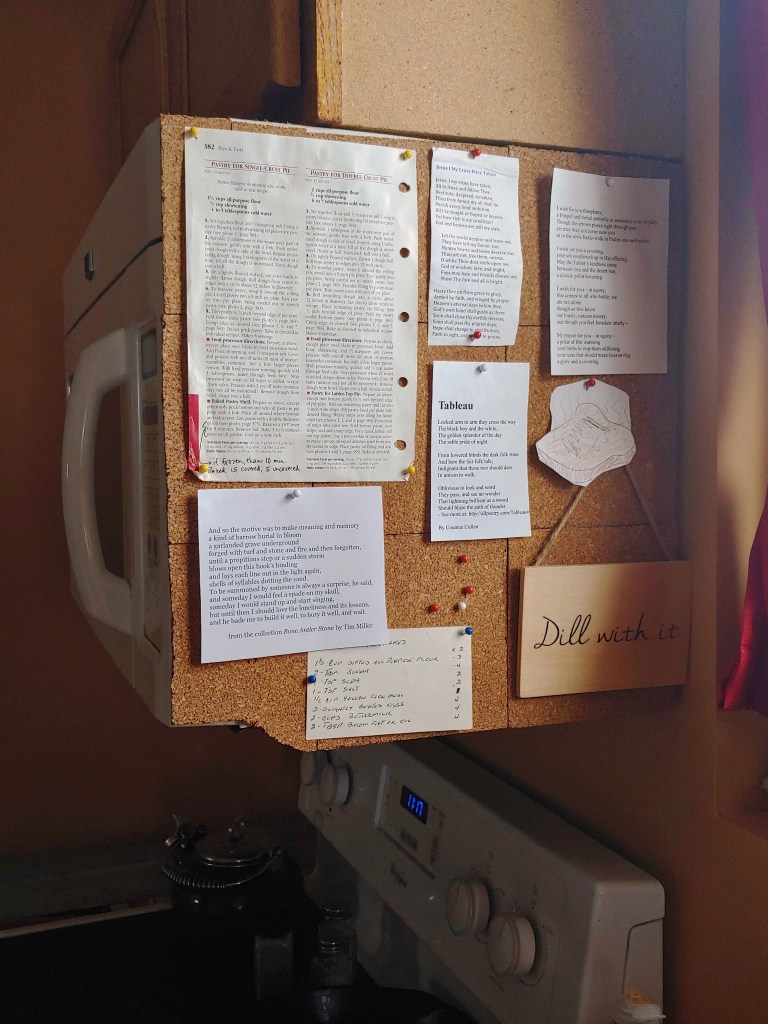
As you can see, on this bulletin board, I have:
Two recipes (pancakes, pie crust. The essentials)
A hand-drawn portrait of buttered toast, done by a toast-loving kid,
“Dill with it,” which was a gift from a loved one who knows my love for dill and script,
And four poems. One is Tableau by Countee Cullen, which I think of whenever my blond son plays with his friend …
One is one of my own, Theophany, which I wrote for a friend who was going through a hard time and then never sent to her …
One is a scrap of poetry posted by a fellow blogger from his collection Bone Antler Stone, which I had to print out because it grabbed me by the throat with its beauty …
And one is actually the lyrics to a hymn, Jesus I My Cross Have Taken, in case I need to refocus during the day.
It’s actually kind of rare that I have four poems up at once, but these four give you a good sense of the range of things that might, at any time, appear upon my bulletin board.
What poems, (say, within the last month), would you have liked to post in your kitchen?
Today is a special day for me and my husband. (Happy Anniversary, Honey!)
It’s not 25 years, but it is an anniversary that I would have thought would make us old, back when I was nineteen.
We don’t look old. Our kids are still school-aged, for crying out loud.
In honor of this day, I am posting what I believe is the sweetest love song in theater.
Tevye and Golde, in this song, are about the same age as my husband and me. Possibly a little younger. But they seem older because they married and began having children very young, and their hard life has aged them. Neither of them is a prince or princess. Instead, they are a peasant couple. After having made a life together, prompted by the newfangled habit of marrying for love they are just now raising the question of whether they love each other.
My own sketch of the wildflower chicory, done in pen and crayon
When I think about The End of the
World as We Know It, one thing I worry about is the availability of coffee.
I am sure this is a concern of
yours as well. Assuming that you get
through the Zombie Apocalypse, the EMP, the Rising Sea Levels, or whatever your
personal big fear is, and find yourself among a group of scrappy survivors, I
guarantee you some of them are going to want coffee. It might even become a hot commodity. Worth its weight in gold.
The Inspiration for this Project
The Change series is also known as the Emberverse series.
The project documented in this post
was inspired by S.M. Stirling’s The Change series. In the first book, Dies the Fire, the world of the 1990s is interrupted when all
electronics, engines, and gunpowder suddenly cease to function. At that point the series becomes alternate
history. The series migrates toward Game
of Thrones style fantasy the longer it goes on, but the first few books
especially are more in the post-apocalyptic genre, about people surviving and
starting to rebuild society in the Northwest and in Northern California. And once they get a steady food supply going,
their coffee substitute is “roasted, ground chicory roots.”
I could probably find chicory
coffee at a co-op type food store, but I want to try to make it myself. That’s the only way I can learn about the process
and find out if such a thing would be feasible.
Let’s go!
Lessons from the Chicory Experiment
Chicory is a wildflower that grows
all along the highways in our region at certain times of year. Though there is an abundant supply of it on
the medians, that’s not the safest place to gather it in this pre-apocalyptic world
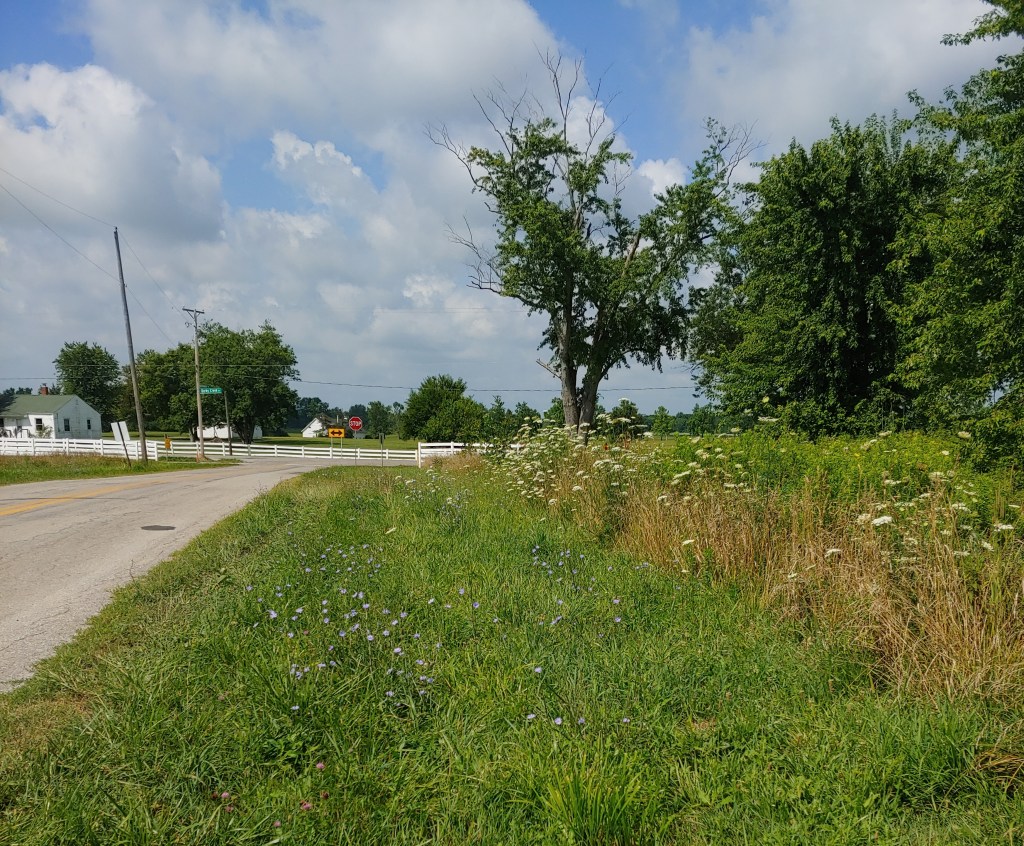
where vehicles of all kinds are still whizzing by. So I had to seek chicory on a back road. In this picture, the plants with lavender
colored flowers are chicory and the ones with white flowers are Queen Anne’s
Lace.
Today’s weather is very humid, and it’s so hot that there is a heat advisory. Also, it turns out that chicory grows surrounded by thistles and extremely sharp-bladed grass.
Lesson 1: Gather chicory in the early morning, before the day gets hot. Wear cowboy boots, not flip flops.
I assumed that chicory would have a
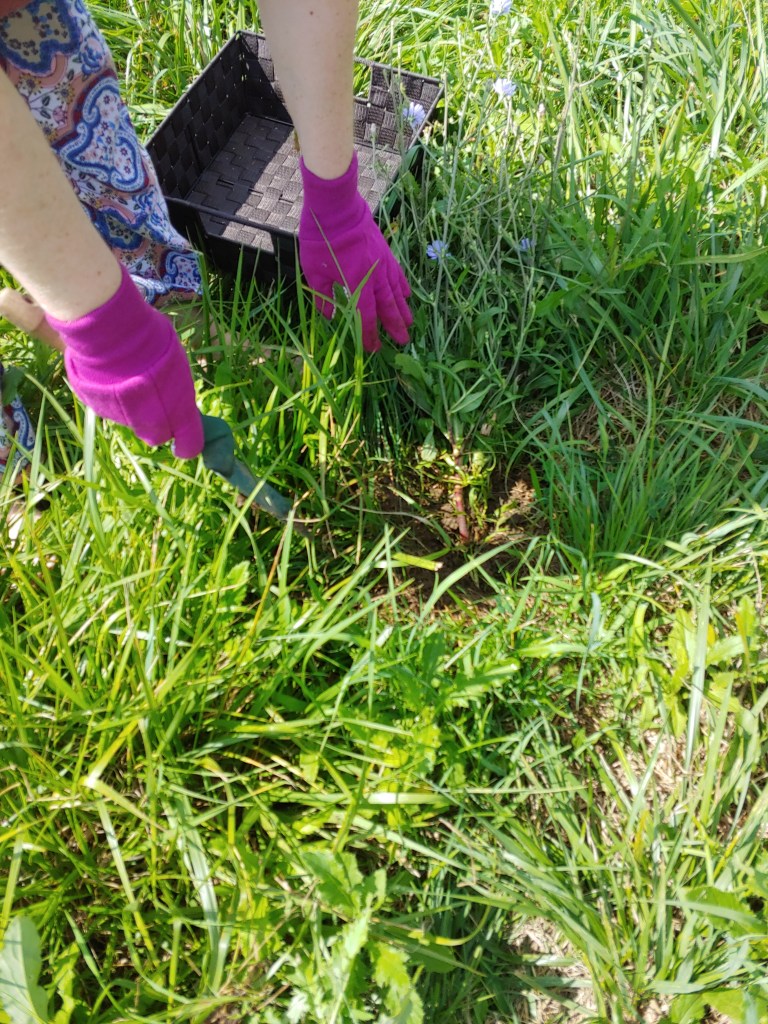
taproot similar to a dandelion’s, so I brought a small trowel. I couldn’t find my dandelion picking tool, so
I brought a large screwdriver, which is almost as good for digging down beside
the taproot to loosen the soil.
It turns out that chicory roots are similar to dandelion’s, but much larger, deeper, and woodier.
Lesson 2: I probably could have brought a regular garden shovel instead.
Here is the chicory I
gathered. I have no idea how much
“coffee” this quantity will make, but I’m hoping it will be enough for one
cup. Finding out is part of the purpose
of this experiment. I don’t have the
time or energy to dig more due to having come at the wrong time of day. Clearly, I have a lot to learn as a
hunter/gatherer.
Next step. Google the process just to make sure I don’t accidentally poison myself by skipping a step. (We won’t be able to Google stuff after the apocalypse, which is all the more reason to do it now.) The search takes me here. Hank Shaw is a “hunter, angler, gardener, forager, and cook” and he seems to know what he’s talking about. Uh-oh, he says you need to harvest chicory in the fall. But he seems to have harvested some in the summer with no ill effects. Onward.
Here are the roots after being washed. I need to cut them into thin slices, dry them for two or three days in the sunshine, and then roast them as directed. Cutting them yields mixed results. Some have a woody core so tough that I have to saw it, with dirt trapped between this core and the outer, soft layer. Others are softer, solid and cuttable all the way through, more like cutting a carrot. My guess is that Hank’s nice, plump “root chicory” is more like this.
Lesson 3: Wild chicory might not be the way to go. It might be smarter
to cultivate it.
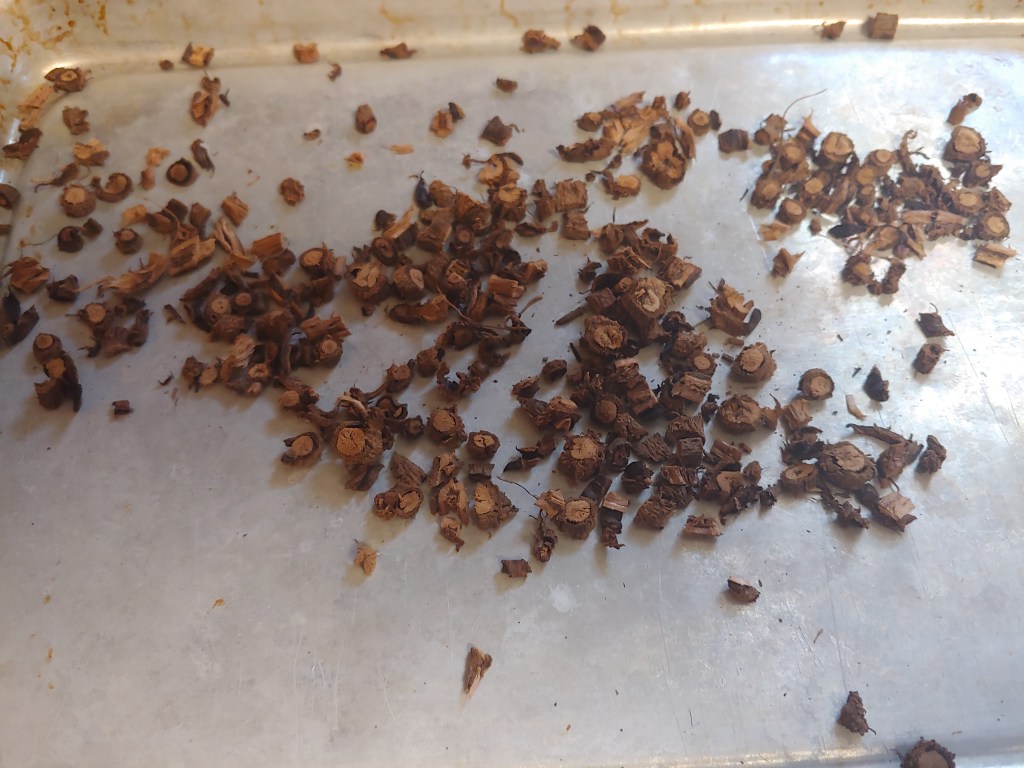
My roots have yielded this measly tray of chicory slices. Following the expert, I sun them on the back of my vehicle. They dry out for a few hours, and then promptly get rained on. I sop them up with a paper towel and move the tray to our sun porch.
Lesson 4: Obvious.
After two days of drying on our sun porch, the chicory slices had visibly shrunk and felt dry. I put them in a 350 degree oven for about an hour and a half. During this time, the house filled with a curious warm malty smell, as predicted on Hank Shaw’s web site. This was reassuring, because it meant that I was in fact roasting the right kind of root. On the other hand, my family complained about the smell.
Lesson 5: There is going to be a lot of complaining around our house after the apocalypse. But I kind of knew that already.
This is what the chicory roots
looked like after about 90 minutes. They
look done.
Next, I ground the chicory in a food processor …
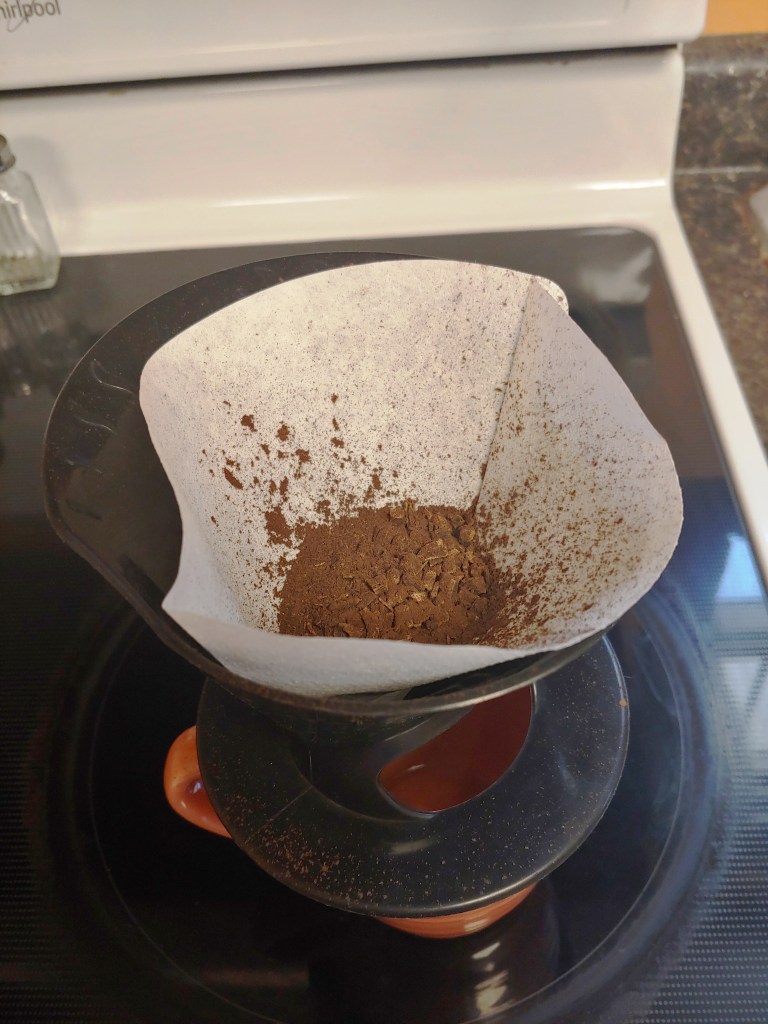
… And put it in a one-cup coffee filter. As I had hoped, it was just the right amount for one mug.
As you can see, the roots don’t
grind up nice and even like coffee grounds.
There are some bigger chunks, and then there’s some powder that’s as
fine as French Press coffee or even baking powder or something. Perhaps I could have gotten the chunks
chopped up further if I’d been willing to grind them for longer, but as I was
grinding, fine dust kept escaping from the food processor and coating the
surrounding counter. I stopped when I
figured the grounds would be sufficient.
If you were grinding roast chicory in large quantities, there’d be
certain to be a lot of dust.
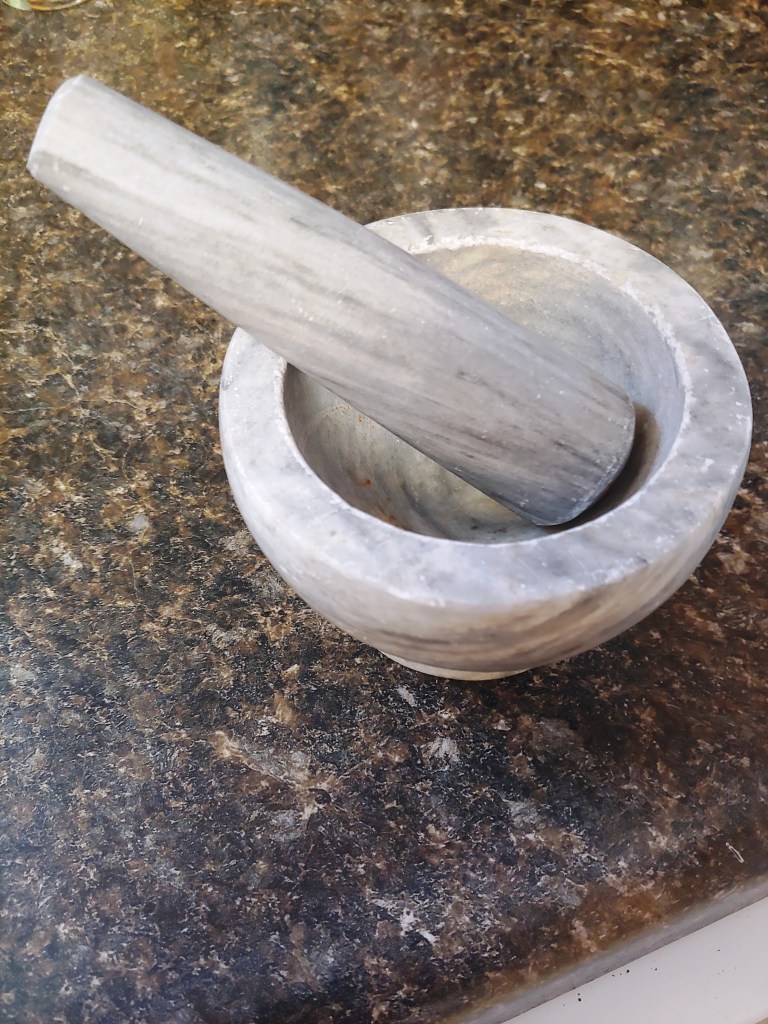
If there were no electricity, I guess I’d be forced to crush it in my marble mortar:
I poured hot water over the
grounds, and it worked great! A very
creditable cup of something that looks exactly like coffee.
The wet grounds, and the liquid
itself, smell very smoky. I’m going to try it black first, because after
the apocalypse there is unlikely to be spare milk, let alone hazelnut creamer.
It tastes exactly as Hank Shaw describes it: “a brighter acidity than coffee and … ‘earthy.'”
I give a sip of it to my trucker
husband, who ought to know about mediocre coffee.
Me: Does it taste like truck stop
coffee?
Him: Truck stops couldn’t sell
coffee if it tasted like this.
Well, it tastes OK to me. But I might be slightly invested, seeing as how I made it.
I add milk and continue to drink. It tastes most coffee-like when hot. As it cools, it begins to taste more and more like … smoke. Now I realize I’ve had this before. I think it was called “smoke tea.” It must have been chicory. I like the flavor, but I realize it wouldn’t be for everybody.
But the bottom line is: I did it! I did it! I dug up a common wildflower and forced it to yield a coffeelike substance. It was a bit of a project, but not hugely inconvenient and actually took less processing than I’ve heard real coffee takes.
Lesson 6: It is possible to make a coffee substitute from chicory, even
if you have little previous knowledge or skills.
A few weeks ago, I posted an awful contemporary Christian song that makes “you” the hero instead of Christ. So I think it only fair to post this one, in which we find out after everything is over that it was he who was calling us. The technical term for this is sovereign grace.
The only problem is, I couldn’t find the version of this song that I like. My first introduction to it was in the form of an arrangement that sounds a bit peppy, like a folk song. In the arrangement, the words of the last verse are used as a fast-moving refrain. But I can’t for the life of me find said arrangement anywhere on YouTube. So, I have posted the original hymn with the lyrics handily printed out. The hymn has a very different sound – almost like plainsong. It’s okay, but I like the energy of the arrangement. So if you can find the arrangement, please post it in a comment.
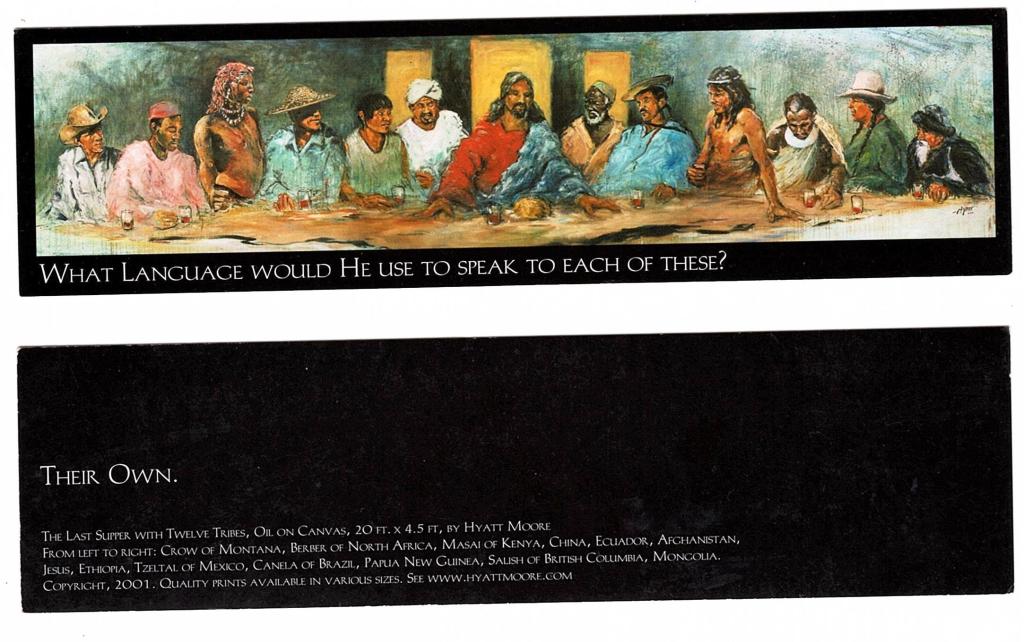
The Last Supper with Twelve Tribes by Hyatt Moore Copyright 2001
Yesterday was Pentecost. It commemorates the following event, which happened after Jesus’ death and resurrection:
Suddenly a sound like the blowing of a violent wind came from heaven and filled the whole house where they were sitting. They saw what seemed to be tongues of fire that separated and came to rest on each of them. All of them were filled with the Holy Spirit and began to speak in other tongues as the Spirit enabled them. When they heard this sound, a crowd came together in bewilderment. Utterly amazed, they asked, “Are not all these men who are speaking Galileans? Then how is it that each of us hears them in his own native language?”
Acts 2:2 – 4, 6 – 8, NIV
I don’t think the point of this story is that every Christian, down to today, ought to be able to “speak in tongues.” The point is that God does.
Although He first revealed Himself to a very specific people group in a very specific cultural context, God has given humanity His word in linguistic form and it’s capable of being translated into any language and culture. Those who have participated in this process will tell you that it’s delightful to see what each unique culture does with it.
Actually, the fact that translation is possible at all is sort of a miracle in itself.
Occasionally you’ll see an essay by an amateur philosopher of language which will try to argue — usually with a fairly abstract argument — that translation is not possible. Sometimes these arguments are logically perfect and very persuasive. And yet. Translation happens every day. It’s sort of like the (apocryphal?) argument that according to the laws of aerodynamics, the bumblebee should not be able to fly.
Other times, someone will try to tell you that a particular word or concept from another culture is “untranslatable.” They will then proceed to explain to you what this word or concept means. In other words, to translate it. In these cases, what they mean by “untranslatable” is that you cannot translate it into, say, English with a one-word gloss. It requires a paragraph, or sometimes a story or a history lesson to give a full sense of the word. But it is still possible to convey, in another language, what the concept is, and once it has been explained, non-native speakers will understand what is meant even if you just continue to use the original, “untranslatable” word. Their argument that the concept cannot be translated ends up being a demonstration that it actually can.
The image at the top of this post is a scan of the front and back of a bookmark … which contains a tiny print … of a huge painting by artist Hyatt Moore. It shows a version of the Last Supper with the twelve disciples represented by a man from each of twelve different minority language communities. (Or, in some cases, countries. For example, Papua New Guinea is represented by just one man, but it has hundreds of different languages.)
God is the ultimate polyglot, and this painting shows a bit of His heart.
Based on the success of the Leviathan post, I conclude that you guys like creature pictures. And I have another one in my archives.
A few years ago, I was assistant teaching in an art class. At one point, the teacher had the students use pastels on black paper to re-create Starry Night. It was beautiful. I got inspired, so naturally I did what one does when one gets inspired. I went home and drew Sasquatch.