The Trove, American Falls, Idaho

American Falls, Idaho, is the ultimate American Small Town.

What do I mean by Small Town?: a brief parenthesis

For those who are not American–by which I mean the United States–“small town” doesn’t have quite the same connotations as “village.” A “village” sounds older, like it might have been there for a thousand years, whereas a small town, because it’s in America, is no more than 300 and often only 100 years old. “Village” also sounds more homogenous (is everyone related?), and more rural. A village might have feuds and unspoken rules in it that go back a millennium. A small town, while it is getting a start on these things, is basically a recent, frontier development. Though there are founding families, there’s also a lot more movement. City folk come in, start businesses, or get jobs as teachers. Newcomers arrive from other small towns. Children grow up and leave. Americans are very mobile, and the composition and atmosphere of a small town reflects that. There isn’t as rigid a class system as in most other places. And, though American Falls, for example, is the county seat, there’s also a lot less bureaucracy and fewer government jobs than in a town of comparable size in Asia.

On the other hand, a “small town” is definitely not the same as “hood” (short for neighborhood), which is a village-like section of a large city. Small towns are typically located in farmland.

Anyway. American Falls has the following: a river. A hydroelectric dam. A railroad to take farm produce away to be sold. A lot with silos, trucks, and piles of produce near where this railroad passes through town. Lots of churches. Post office, barber shop, mom & pop shops on Main Street (tree-lined), one of which is of course a bar. A hometown football team. Gracious parks, a golf course, and a nearby cattle lot that you can smell most days. Pizza, Chinese, and Mexican restaurants, because this is America after all. It also has a small hospital, though like most people I prefer to take emergencies to the city hospital 25 minutes down the road. Oh, and a community theater!

You can walk around American Falls during the day without fear. Law and order is maintained. The town is hilly enough that, on these walks, you can catch glimpses of all these small-town features and feel as if you just stepped into a slightly more modern, drastically less New England Norman Rockwell painting. Rising above the town, on the southwest side, is the Big State Highway, and, beyond that, the rolling foothills.

I felt I had to burst into this paean to American Falls in order to set the scene for the main point of this post, which is that a delightfully hippie shop has come to our small town.

An Art Shop comes to our Small Town
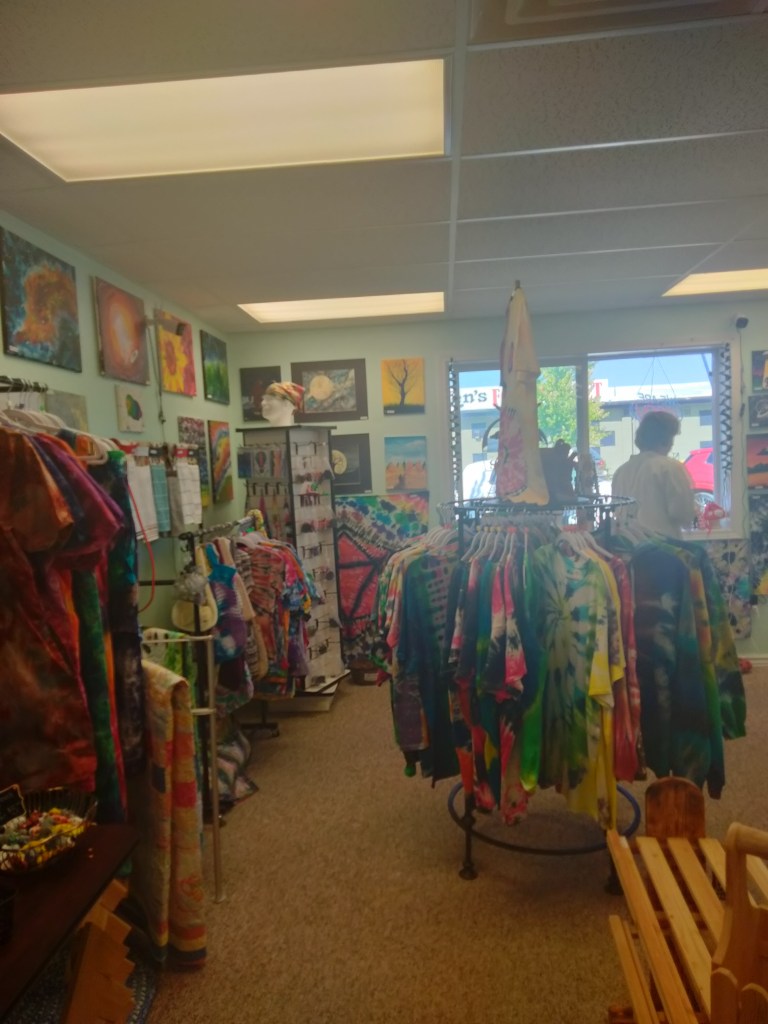
This is the interior of The Trove, which opened in American Falls in May.

Here we are looking towards the back of the shop. Notice that it features jewelry, leather goods, and paintings involving UFOs. And that the owners are fond of 78 records.
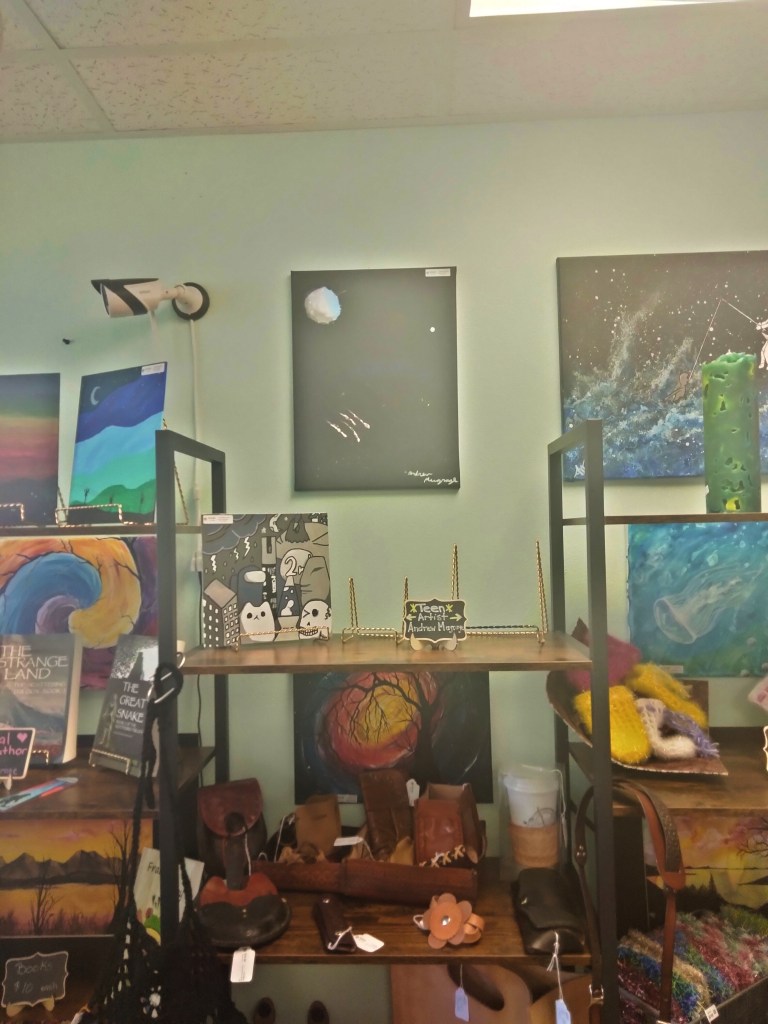
I first heard about The Trove from a person I met at the town festival this summer. This person, who was buying one of my son’s paintings, suggested that The Trove might be happy to carry our work, since its stated mission is to showcase local artists. Although we don’t live actually in American Falls, we figured we might be local enough to count. We headed straight from the town festival to The Trove, with the trunk of our car still full of paintings. Long story short, the owners of The Trove were amenable to this idea, and that’s why some of the paintings pictured above are by my son Andrew.
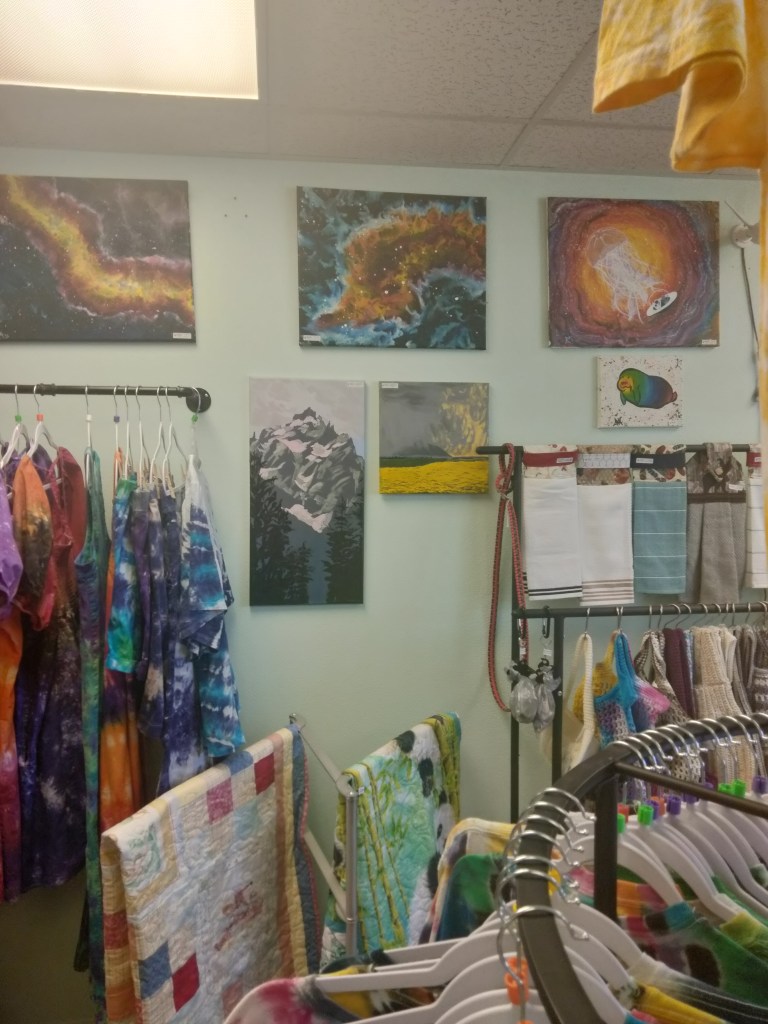
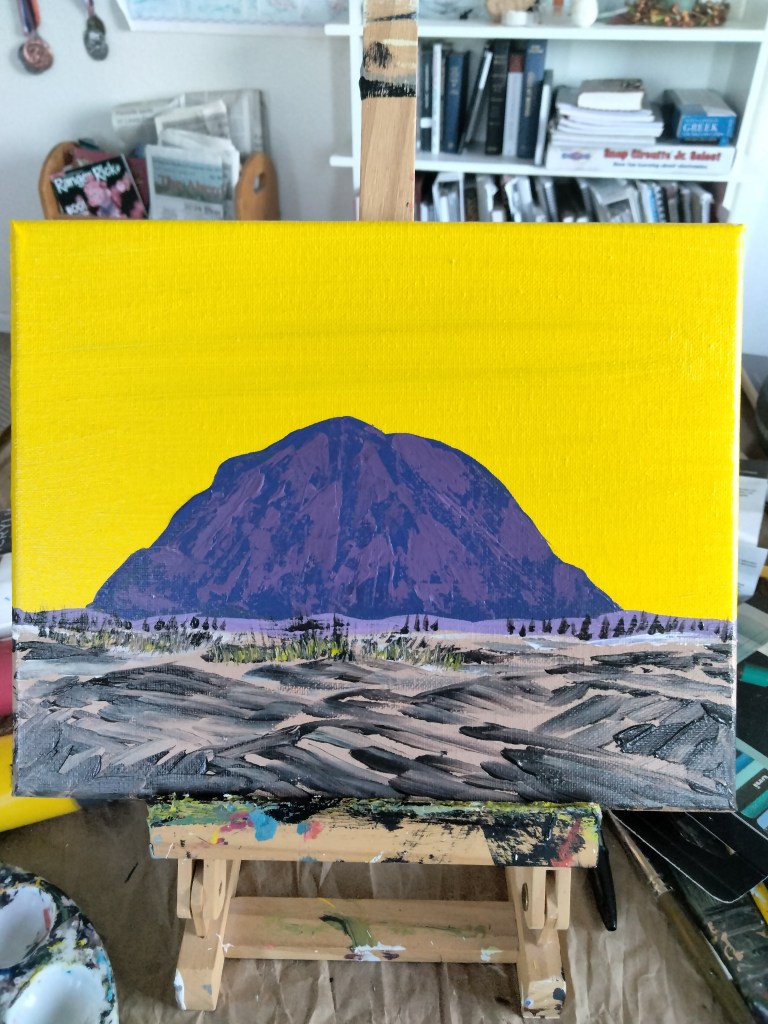
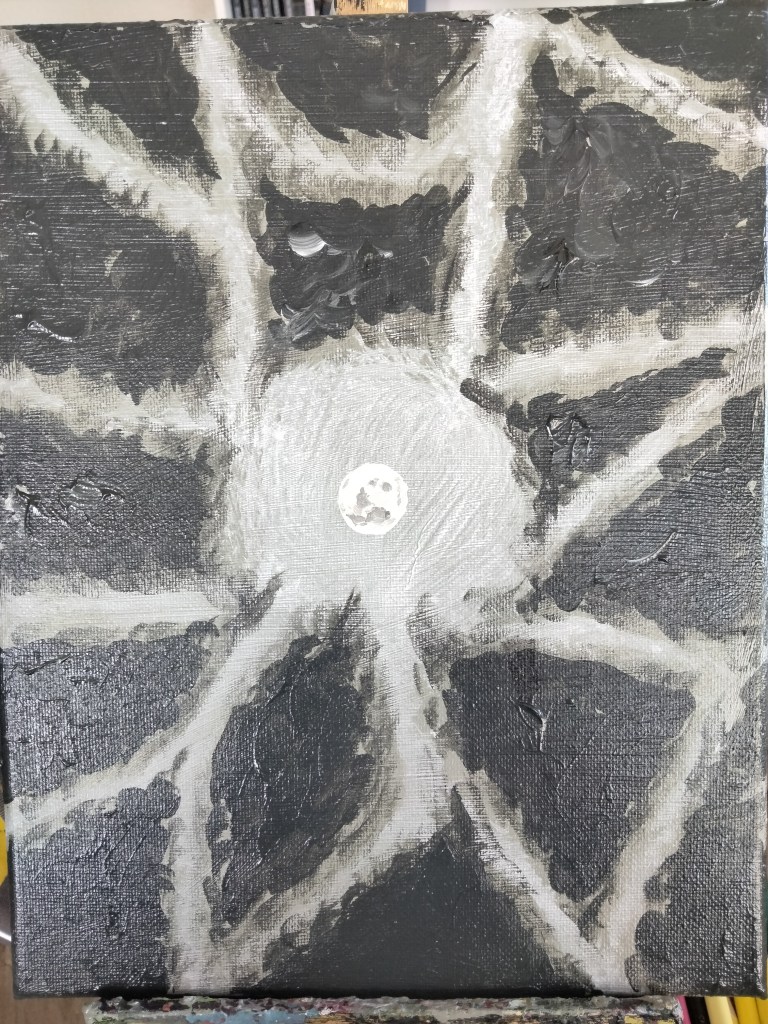
The mountain and the storm are my paintings, hung under the owner’s paintings of space and a (manatee?), over some quilts, and beside dish towels.
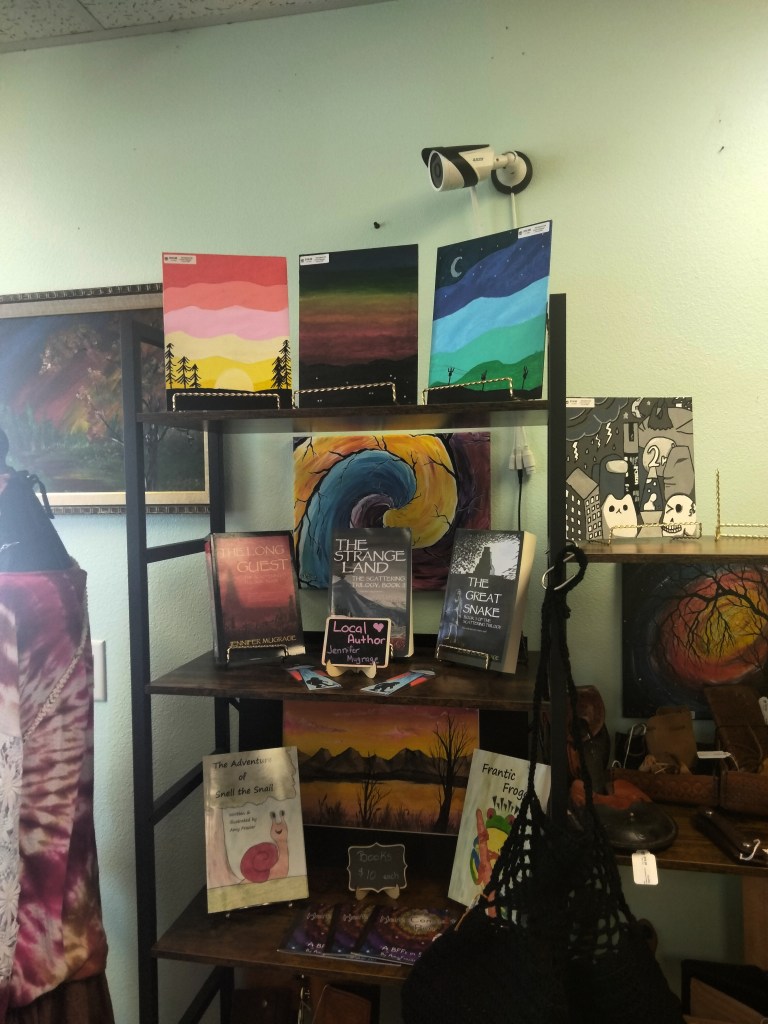
The Trove was even happy to carry a copy of my trilogy! So, if you ever find yourself in southeast Idaho, and want a touristy, artsy shop with lots of cool stuff, know that American Falls has one.

Spooky Farm

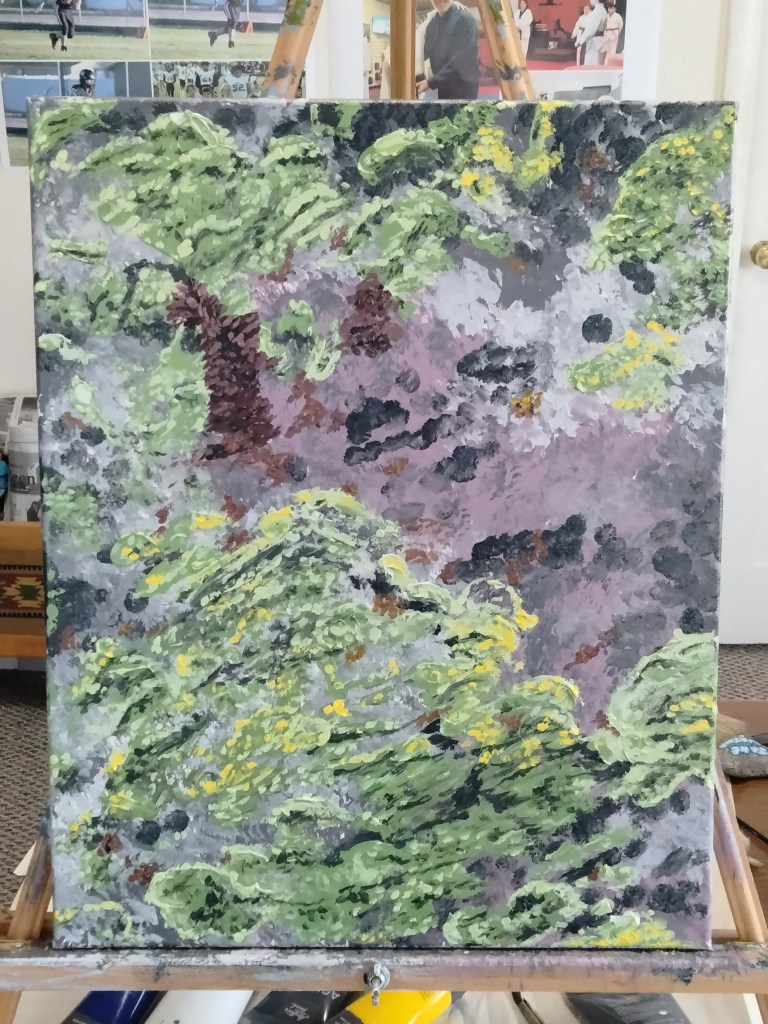
This is it. This is finally the texture-y, right in between Impressionistic and realistic look that I’ve been going for.

I also like the colors in this. Not too sweet, but not too monochromatic either.

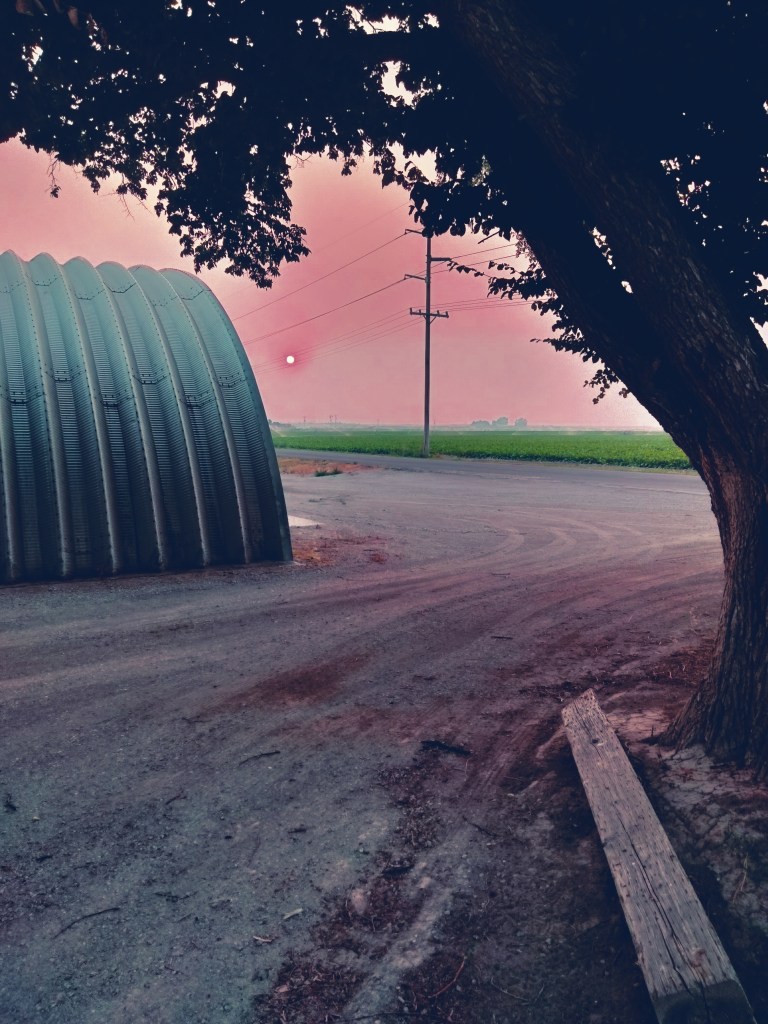
This painting is an attempt to capture the eerie afternoons that happened last summer, when we had our usual season of wildfire smoke blowing in from Oregon. Not only can you smell the smoke, but it can actually dim the sunlight enough to lower the temperature.

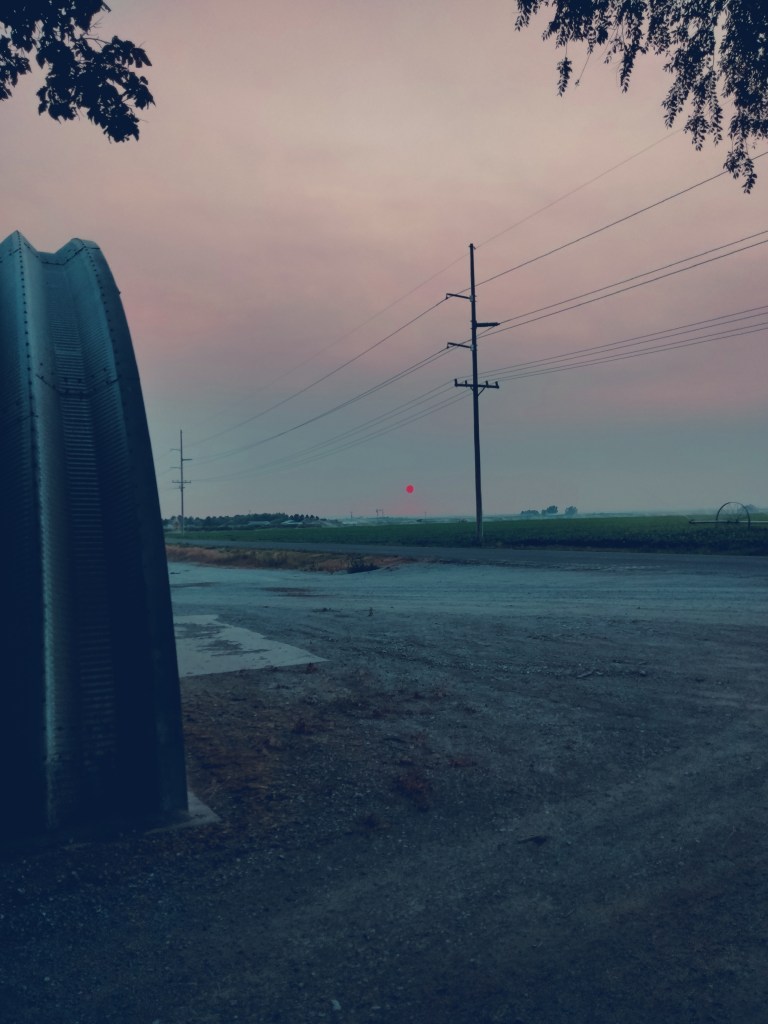
During one of these afternoons last year, I went out and tried to photograph the odd effect the smoke was having on the appearance of the sun.

My initial photos looked like this:

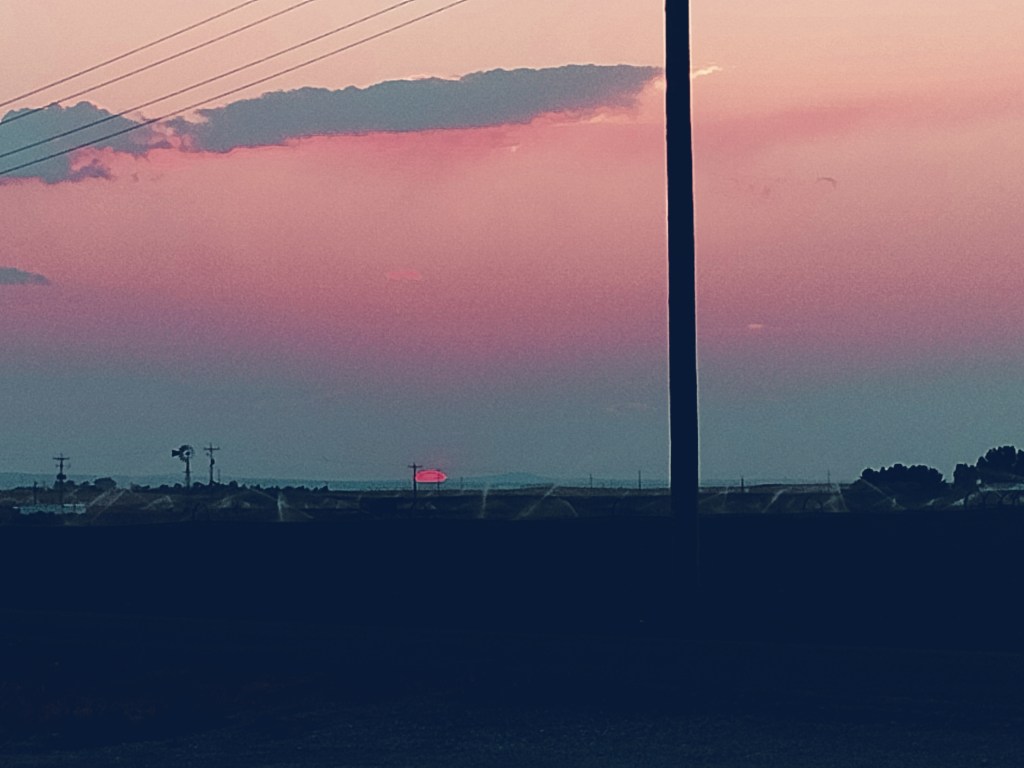
While accurate, these did not perfectly capture the vibe I was getting, so I tried taking some of the same scene with a variety of filters.

The filters do a better job capturing how red the sun looked to the naked eye.

I then did a painting using one of the filtered photos as a reference.

Obviously, there is room for many more paintings here, if I choose to pursue it.

I hope you enjoy being shown the reference photos beside the picture. I know some people like that. I recently learned the term “process journal” from a novel, which I thought was really cool. Apparently this is something that all art majors know about.

If you don’t like hearing about the process, just enjoy the painting and figure that you’ve somehow stumbled onto the cover of a Stephen King farm book.

Big Sky Country, with Canal

This little (8×6) landscape acrylic painting is one of my favorites that I’ve done recently.

The water portrayed is actually a stream leading to the Snake River Reservoir, because the canals are not running at this time of year. However, I thought I’d give you some history about our local irrigation canals, because they are really remarkable.

The scheme diverts water from the [Snake] river about ten miles above Blackfoot. The main canal was planned to be 60-85 feet wide, carrying a depth of six feet of water about sixty miles, with many more miles of laterals and smaller ditches. … The canal is 60 feet wide and 8 feet deep, beginning near Firth and ending near the Lamb Weston Potato Plant at American Falls where a small amount of water then empties into the Snake.

Aberdeen, Idaho: Our Small Town Story, by Celia Klassen, p. 14

The canal system was constructed, essentially by hand, using horses, scrapers, and large baskets, and dynamite for rocky areas, between 1894 and approximately 1910. There were a series of investors, some working groups that fell apart, and two different canal companies that were formed to head up the project. The system includes many “fills” … areas where the canal was built up above the surrounding land, as to pass through a low spot.

During the construction, “Tent camps … were set up at various points, and everything the laborers needed had to be brought through the sagebrush by wagon … Families of canal workers lived along the canal while it was being built in what were called ‘ditch camps’.” (ibid, p. 15)

The canal system allows us to farm the Idaho soil, which is volcanic and very fertile, but doesn’t get enough rain for dryland farming. The Aberdeen-Springfield canal company still maintains the 190 miles of main and lateral canals, with sluice gates and the like. A canal runs right past my backyard, built up above the surrounding fields. The canals are drained in the winter months, and last year, an excavator worked its way slowly by our property, deepening the canal and creating large piles of soil on its banks. In the summer, “canal riders” patrol the system, checking for leaks. This is a wonderful system, and it takes a lot of effort to keep it working properly.

Despite being man-made, the canals also beautify the countryside. The presence of water attracts Russian olive trees, cattails, showy milkweed, and birds. Many farm kids grew up inner-tubing in the canals in the summertime, and their raised banks make a natural hiking route for people who want to walk in nature.

The source for this post was the book Aberdeen, Idaho: Our small town story, published by Celia Klassen in 2019. Celia did not grow up in Aberdeen, but married in. As so often happens, it took someone from the outside to appreciate that our local history was worth researching and recording.

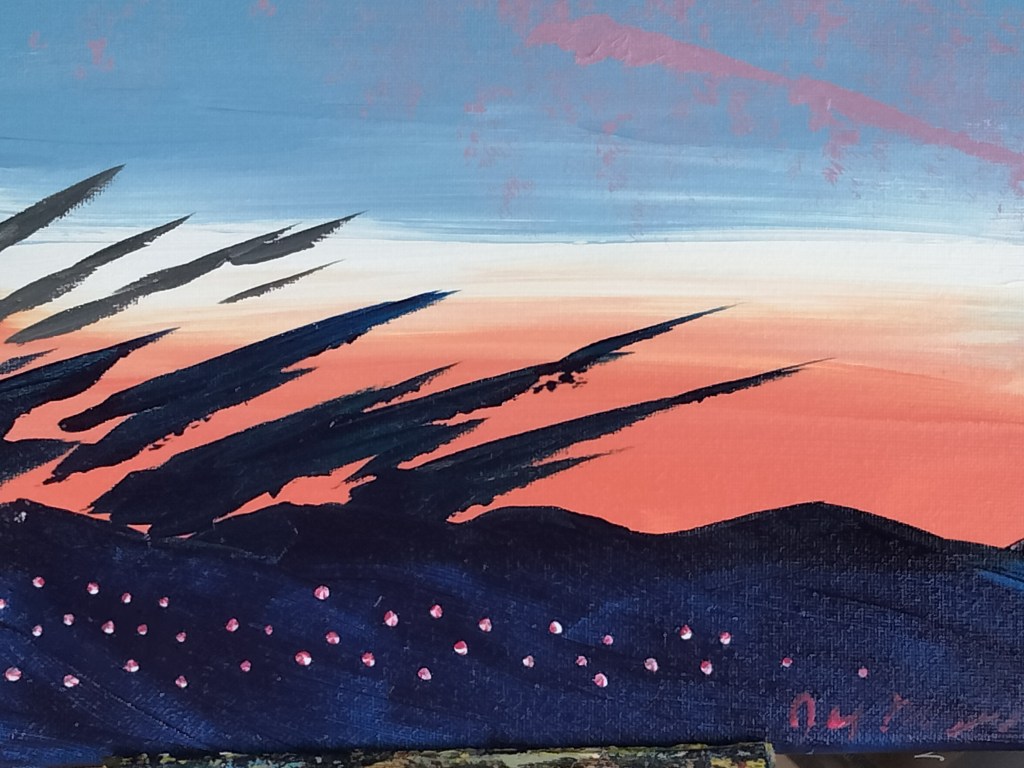
The Wind Farm

I live in the West, where you can see long distances. About twenty-five miles south of our house is wind farm perched on the foothills. At night, you can clearly see the windmills’ lights twinkling. This painting portrays a more close-up view, glimpsed as I started the drive home on a winter evening.

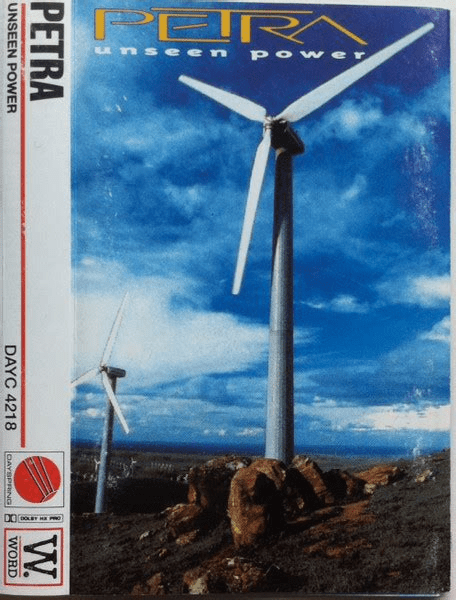
I never minded seeing wind farms, even in the daytime. I had a positive association with them, almost entirely because of the cover of a Petra album I had as a teenager:

I also believed what I was told, that these windmills would provide cleaner power than oil, coal, and natural gas.

Then, I started hearing about the downsides of wind farms. I heard that people who live near them develop health problems. I heard that, shockingly, it is not unusual for birds to get chopped up by them. The windmills have to be built in naturally windy areas, which are also migration routes for birds, which are apparently hard-wired in to the birds and can’t be changed.

Then, I found out that these turbines are expensive to build, last only about twenty years, and are difficult to dispose of:

https://www.prageru.com/video/whats-wrong-with-wind-and-solar

And that they are extremely inefficient, and the energy they do produce has to be stored in costly batteries:

https://www.prageru.com/video/can-we-rely-on-wind-and-solar-energy

Which can only be made with rare-earth minerals that are obtained using child labor:

https://www.prageru.com/video/green-energy-fueled-by-child-labor

Yikes!

Unfortunately, my aesthetic response to these windmills has already been locked in by Petra. I don’t think it’s going to change. Now, though, I no longer think of them as a good thing, a step in the right direction. I think of them as evidence that we are living in a sci-fi dystopia. Maybe some day, the wind farm in my part of the state will come down. But this little painting will remain as evidence that I lived in the Age of Man when we feared the imminent end of the world and thought we could forestall it by building these things.