
“I knew something like this was going to happen,” said Nellie.
Nellie always knew what was going to happen. She’d see someone trip on the sidewalk, two cars crash at an intersection, lightning hit a rooftop, and shake her head.
“I knew that was going to happen.”
During what experts call the “magic years” of childhood, when children believe in impossible behaviors and events, Jane truly thought her mother had special powers. As Jane grew into the less magical years, she grew slightly more judgmental.
“If you knew it was going to happen, Mom, why didn’t you stop it?”
Nellie shrugged. Her powers could not be explained.
Lucky Stuff, by Sharon Fiffer, p. 17
Tag: book reviews
Homeless lady learns a new word
[Ned, the serial killer] went down like a board, as stiff as a 2-by-10. [Pearl, the homeless lady] landed in the middle of his back.
I glanced at Pearl’s face, which was a mask of bruises. One eye was black, one tooth was missing, and a cut at the corner of her mouth oozed blood. She’d positioned herself in the middle of Ned’s back, and the gravity was sufficient to hinder the rise and fall of his chest.
She said, “Sh–. I think I broke my hip again, but right now I’m numb and it doesn’t feel like nothing.”
She bounced a couple of times and I heard an oof of air escape Ned’s lungs. She bounced again, though she winced as she did so. “What’s this here? What I’m doing. You’re a smart girl. I bet you know.”
“As a matter of fact I do. It’s called ‘compressive asphyxia,’ which is mechanically limiting expansion of the lungs by compressing the torso, hence interfering with breathing.”
“Hence. I like that. I’m setting here bouncing on Ned, hence making it impossible for him to draw breath. That’s what he did to them little girls, isn’t it?”
“That was his method of choice.”
Y is for Yesterday, by Sue Grafton, p. 487

Reactionary Feminists, Meet Your New Heroine

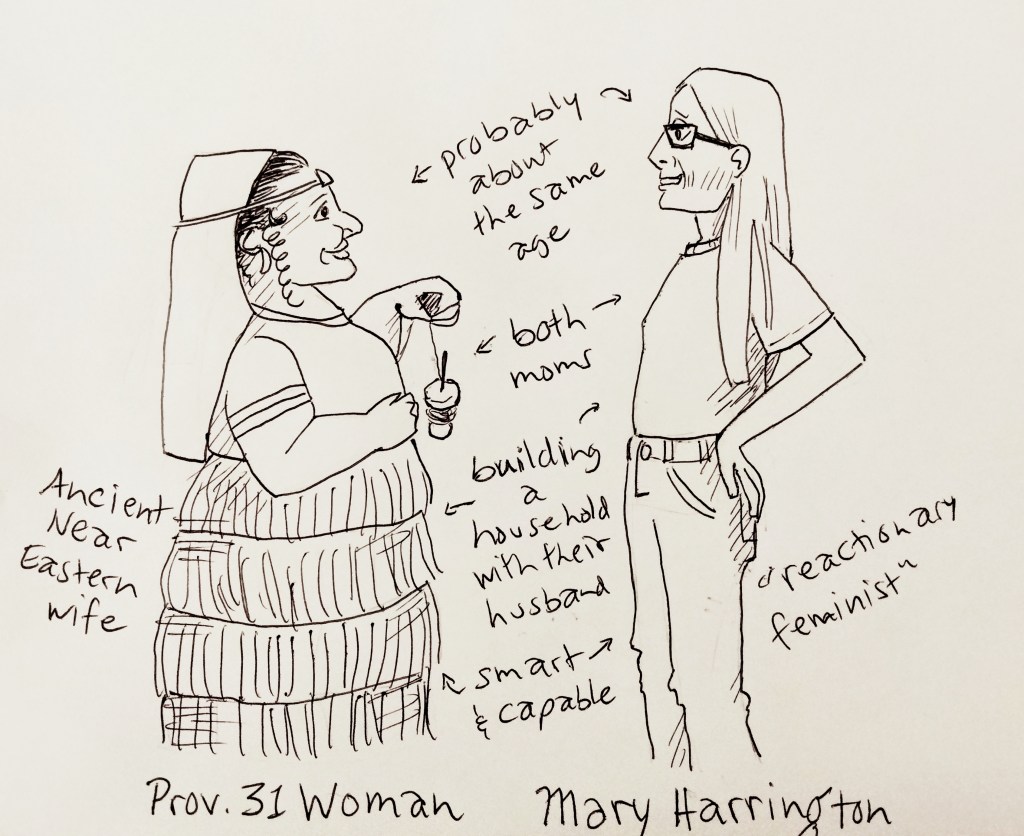
This is Mary Harrington. She has written a book, and here it is:

Mary is an academic. She describes herself as someone who has “liberalled as hard as it is possible to liberal.” She believed all the lies that were told her by the sexual revolution, and though she has no desire to share the details, says her experience of it was comparable to that of Bridget Phetasy, with her famously heartbreaking article, “I Regret Being A Slut.”
Progressivism is no longer in the interests of women
As you can see from the phrase that makes “liberal” into a verb, Mary has quite the way with words. The basic thesis of her book is that the progressive religion, by making personal autonomy the only definition of the good to which everything else must be sacrificed, has gone way past the point of diminishing returns and is now actually harming women rather than helping them. But since Mary is so articulate and fiery, she can put it far better than I can:
We’re increasingly uncertain about what it means to be [sexually] dimorphic. But when we socialise in disembodied ways online, even as biotech promises total mastery of the bodies we’re trying to leave behind, these efforts to abolish sex dimorphism in the name of ‘human’ will end up abolishing what makes us human men and women, leaving something profoundly post-human in its place. In this vision, our bodies cease to be interdependent, sexed and sentient, and are instead re-imagined as a kind of Meat Lego, built of parts that can be reassembled at will. And this vision in turn legitimises a view of men and women alike as raw resource for commodification, by a market that wears women’s political interests as a skin suit but is ever more inimical to those interests in practice.
What we call ‘feminism’ today … should more accurately be called ‘bio-libertarianism,’ [and it is] taking on increasingly pseudo-religious overtones. This doctrine focuses on extending individual freedom as far as possible, into the realm of the body, stripped alike of physical, cultural or reproductive dimorphism in favour of a self-created ‘human’ autonomy. This protean condition is ostensibly in the name of progress. But its realisation is radically at odds with the political interests of all but the wealthiest women — and especially those women who are mothers.
… nothwithstanding the hopes of ‘radical’ progressives and cyborg feminism, a howlingly dystopian scenario can’t in fact be transformed into a dream future just by looking at it differently.
ibid, p. 17, 18, 19
I mean, I couldn’t agree more. The most obvious people to suffer from the real-life application of what Mary elsewhere calls “Meat-Lego Gnosticism,” are children. Babies and children need their moms. In fact, Mary’s thinking began to really change on this topic of progress when she had a child of her own and was shocked by the instant bond.
But even a little bit of thought shows that women are also suffering, because most women, like Mary, actually want to bear and raise their own children, preferably in a household with the child’s father. And, in fact, men are suffering too, not only because half of those motherless children grow up to be men, but because it turns out that humans were made to be embodied, and so living a disembodied life, alienated from our physicality and from human relationships, makes all humans miserable.
Mary calls herself a “reactionary feminist” because she is reacting against “progress” in favor of the interests of women.
Down with Big Romance
Often, when people reject progressive feminism, the only alternative that they hear presented is “traditional marriage,” by which they mean the 1950s sitcom model. But that model is actually not traditional marriage so much as postindustrial marriage.
Harrington spends a lot of space in the book pointing out how, with industrialization, many of the homesteading tasks that were once the responsibility of the housewife got outsourced to the market. She draws on Dorothy Sayers for this, who pointed it out a long time ago in her essay “Are Women Human?” I wanted to quote Sayers directly, but don’t have a copy of the essay on hand. Essentially, she says that before the industrial revolution, women got to do milking, cheesemaking, beer brewing, baking, spinning, weaving, sewing, mending, and a number of other arts and crafts that took quite a lot of skill and are also fun. Sayers’ main point is that, in the wake of all these trades being moved out of the household, it is no wonder that middle- and upper-class women are bored and would like to do something other than sit around the house. Harrington’s application of this point is a little different. She points out that in economic terms, before industrialization a wife contributed really essential labor to the household. A husband could not get along economically without her. Because both spouses were committed to keeping the same ship afloat, the man was less likely to abandon the woman.
Post- Industrial Revolution, the woman (particularly in upper and middle classes) now contributed much less to the household economically. The man was the sole wage earner, which gave him a lot of economic power. He could treat his wife badly, and she’d have no recourse. It is to this shifting dynamic that Harrington attributes the rise of Big Romance. A husband and wife must like each other, must be madly in love, and then he will treat her kindly despite the imbalance of economic power.
I think Harrington’s analysis has merit, though it doesn’t tell the whole story. For example, I would argue that relations between men and women first got badly messed up at the Fall. Wife abuse was certainly possible before the Industrial Revolution. Also, I would argue that Big Romance owes something to the concept of Courtly Love in the Middle Ages, which in turn owes something to Paul’s exhortation to newly Christianized former pagans: “Husbands, love your wives as Christ loved the church and gave Himself up for her.” But all that said, I do think Harrington is on to something here. Obviously, when we are talking in broad strokes about the relationships between men in general and women in general, over centuries or millennia, there are going to be a ton of cultural and historical and literary and religious and yes, economic factors that go into it, even if we confine our survey to just the West.
Mixed-Economy Households
So, if we don’t like Meat-Lego “feminism” and we don’t like 1950s Big Romance, what’s left? At this point, Mary’s book begins to have the feel of re-inventing the wheel. Metaphors abound that compare modern men and women’s situation to rebuilding, using broken tools, in a postapocalyptic wasteland. Mary doesn’t know a lot about what a life that is good for women, children, and men should look like, but she is pretty sure that for the majority of people, it’s going to be in families built on heterosexual marriage. And she’s aware that, to find a good model, we’ll have to go back before the Industrial Revolution.
Here’s what she comes up with.
The weakness of [proposals to go back to 1950s style marriage] isn’t that they’re unworkable, or even that they’re ‘traditional,’ but that they’re not traditional enough. For most of history, men and women worked together, in a productive household, and this is the model reactionary feminism should aim to retrieve.
Remote work, e-commerce and the ‘portfolio career’ are not without risks … But cyborg developments also offer scope for families to carve out lives where both partners blend family obligations, public-facing economic activity and rewarding local community activities in productive mixed-economy households, where both partners are partly or wholly home-based and work collaboratively on the common tasks of the household, whether money-earning, food production, childcare or housekeeping.
ibid, p. 179, 180
She then profiles two young women who are doing just that. Willow, in Canada, is a writer and mom to a small baby who, when childcare allows, also works with her husband on the family woodworking business. (He does the building, she does the finishing, basically.) Ashley and her husband, in Uruguay, have three children and do a mix of homesteading and language teaching.
In [Ashley’s] view, the romance comes not through the ego-fulfillment of a perfectly congenial partner, but working with someone to build something that will outlast them: ‘It’s much more romantic in the end when you realise this home, this life, these children, if they’re thriving it’s a result of our shared ability to create something greater together through our interdependence and cooperation … We’re working towards something bigger than ourselves. We’re building a legacy.’
Isn’t this a rather bleak and utilitarian view of a long-term relationship, though? To this I can only say that in my own experience, in practice the Big Romance focus on maximum emotional intensity and minimum commitment is bleaker. … A commons is, by definition, not available for consumption by anyone with the freedom to contract, or the money to buy, but only to those who share and sustain it.
ibid, pp. 183 – 184
What’s interesting about this vision of the household is that it has been described, not by “conservatives,” but by Reformed Christians, frequently, even within the past few years. Douglas Wilson, whom Mary Harrington has perhaps never heard of, has by now written a small library’s worth of volumes on this very topic. His daughter, Rebekah Merkle, has a book and a documentary about it, both called Eve in Exile.
And here, in his video Theology of the Household, Alistair Roberts lays out a view that is strikingly similar to the one in Harrington’s book:
Not surprisingly, these Christian thinkers are getting their picture of a household that is good for both men and women from … the Bible. And now I’d like you to meet Reactionary Feminism’s poster girl, and surprise! it’s not Mary Harrington.
The Proverbs 31 Woman
A wife of noble character who can find? She is worth far more than rubies. Her husband has full confidence in her and lacks nothing of value. She brings him good, not harm, all the days of her life. She selects wool and flax and works with eager hands. She is like the merchant ships, bringing her food from afar. She gets up while it is still dark; she provides food for her family and portions for her servant girls. She considers a field and buys it; out of her earnings she plants a vineyard. She sets about her work vigorously; her arms are strong for her tasks. She sees that her trading is profitable, and her lamp does not go out at night. In her hand she holds the distaff and grasps the spindle with her fingers. She opens her arms to the poor and extends her hands to the needy. When it snows, she has no fear for her household, for all of them are clothed in scarlet. She makes coverings for her bed; she is clothed in fine linen and purple. Her husband is respected at the city gate, where he takes his seat among the elders of the land. She makes linen garments and sells them, and supplies the merchants with sashes. She is clothed with strength and dignity; she can laugh at the days to come. She speaks with wisdom, and faithful instruction is on her tongue. She watches over the affairs of her household and does not eat the bread of idleness. Her children arise and call her blessed; her husband also, and he praises her: ‘Many women do noble things, but you surpass them all.’ Charm is deceptive, and beauty is fleeting, but a woman who fears the Lord is to be praised. Give her the reward she has earned, and let her works bring her praise at the city gate.
Proverbs 31:10 – 31, NIV
Wow!
So, this is an older lady, a matriarch. She has children, and she is honored both by her husband, her children, and the public for her role as a matriarch. (Contrast this with Meat Lego feminism, where being a mom means you are dumb and irrelevant.) Perhaps this lady is beautiful, but we are not told that. In any case, she is an older woman, and “beauty is fleeting.” Her beauty has faded. But she has style (clothed in linen, purple, and scarlet). There is a lot of emphasis on her strength and capability. She engages in cottage industry, she has employees (servant girls), and she handles money and gets into real estate. She speaks with wisdom and faithful instruction, which probably primarily is directed at her children, but this could include her mentoring younger women and nowadays it could include being a writer like Willow. Her husband is a pillar of the community, and this is not to the exclusion of his excellent wife, but because of her and because of the kind of household they have built together. She, too, is known in the community and opens her hands to the poor. They are the people you go to if you need advice or help.
And, finally, this lady is not meant to be an outlier. “Many women do noble things, but you surpass them all.” The idea is that there are a lot of amazing women out there, but every husband should feel this way about his wife, that she is the best. The Prov. 31 woman is an older matriarch, so she has had time to build up an impressive portfolio of skills and accomplishments that for many young moms is years away. But this is where they can end up, if they are given support and honor in their role as moms and are shown what is possible.
In other words – I wouldn’t make this a headline without context as it would be misunderstood, but — the Prov. 31 Woman is the original Girl Boss.

Review of Breath

Five stars. Would keep breathing.
Just kidding.
My sister gave me this book. I don’t know how she knew it, but I’m a horrible mouth-breather. I also have a habit of holding my breath when: in pain, concentrating, doing a delicate task, listening to someone talk. (I exhale when they finish the sentence. So don’t pause.) Turns out, breath-holding throughout the day might be causing a lot of people chronic anxiety and also causing them to “overbreathe.” Since reading, I’ve been at work to change my ways.
It’s rather shocking to realize the extent to which breathing through the nose affects nearly all other aspects of our health, even aspects that you wouldn’t expect, such as biochemistry and bone structure. But on reflection, it makes sense. We were designed to nose breathe; there is a reason for the way the air is routed through our sinuses; there is even a reason we have two nostrils. (Did you know that air taken in through the right nostril has a different effect than the left … and that your nostrils naturally tag-team throughout the day? Wild!) It makes sense that the more restricted supply of air coming in through our nose compared to our mouth is not only adequate but optimal, even though it doesn’t feel that way for recovering mouth-breathers.
It also makes sense that we were designed spend many hours a day chewing on tough foods (fruit, nuts, wild game), and that this regular daily workout of our jaw muscles would result in wider facial bones, flatter palates, and wider nose-breathing passages. It also explains why so many people in the modern age have crooked teeth: it’s not bad genetic design, it’s that we aren’t chewing enough and our face bones are literally atrophying, making our mouths too narrow. So those cave people who didn’t have orthodontists, also didn’t need them. (Shoutout to my characters! Keep eating game, guys!)
Ahem. Back to the book …
You have to watch out for the usual non sequiters that we have come to expect from Darwinian materialists. Almost any place that Nestor writes, “We evolved to …”, you can safely substitute, “We were designed to …” and come up with the same conclusion. There are a few long paragraphs about how “early life” was anaerobic and how “we” started using oxygen in “our” metabolizing. I skipped those; you can read them if you want to find out how bacteria do things differently from human beings.
Then there is the section on prayer, which finds that the repetitive prayers from all around the world get their practitioners breathing at the ideal rate for humans, which to Nestor’s mind can account for all the health, mind clarity, and relaxation benefits of prayer. (I have long been aware that my breathing changes when I pray – even silently – but this is not to say that there is nothing else going on during prayer or meditation, or that it matters not to whom or to what you pray.)
As someone who doesn’t believe that the spiritual world is a thing, Nestor is free to try – and qualifiedly endorse – all the yoga practices that, he says, are merely applied medical knowledge about breathing and posture. They certainly include some of that, but yoga is also a serious attempt to commune with spiritual entities, and we ignore that at our peril.
There is a helpful appendix that catalogs all the breathing techniques Nestor encountered on his ten-year journey. My big takeaway: breathe through your nose. Tape your mouth shut at night if you have to. Breathe a little slower … you won’t choke. Exhale completely before inhaling. See how many health and emotional problems that clears up for you. I’ll check back in and let you guys know whether I lost any weight.
“He’s learnt better”
[Tally needs to pick up her young handman, Ryan, who might be in trouble. She is giving him directions on the phone.]
“There’s a church, Ryan, All Saints, Margaret Street. Walk up Great Portland Street towards the BBC and Margaret Street is on the right. You can sit quietly in the church until I come. No one will worry or interfere with you. Or you can kneel. No one will speak to you then.”
“Like I’m praying? God’ll strike me dead!”
“Of course He won’t, Ryan. He doesn’t do things like that.”
“He does! Terry — my mum’s last bloke — he told me. It’s in the Bible.”
“Well He doesn’t do things like that now.”
Oh dear, she thought. I’ve made it sound as if He’s learnt better.
The Murder Room, by P.D. James, pp. 237 – 238
Misanthropic Quote of the Week from Garrison Keillor
In the Sanctified Brethren church, a tiny fundamentalist bunch who we were in, there was a spirit of self-righteous pissery and B.S.ification among certain elders that defied peacemaking. They were given to disputing small points of doctrine that to them seemed the very fulcrum of the faith. We were cursed with a surplus of scholars and a deficit of peacemakers, and so we tended to be divisive and split into factions. One dispute when I was a boy had to do with the question of hospitality towards those in error, whether kindness shown to one who holds false doctrine implicates you in his wrongdoing.
Uncle Al had family and friends on both sides of the so-called Cup of Cold Water debate, and it broke his heart.
Leaving Home, Garrison Keillor, p. 155
Good thing this never happens outside of tiny fundamentalist Christian churches.
Book Review: The Sweet Sister, by C. David Belt

Fun story about how I discovered this book: I was at a Fantasy Faire as a vendor. A fantasy faire is sort of a like a RenFaire, but calling it “fantasy” opens it up to more time periods and more imaginative costumes. This Faire took place in southeast Idaho, so quite a few of the booths were from Utah. As I wandered the booths on the first morning, a banner on one of them caught my eye: “Strangely uplifting LDS horror.” In case you don’t know, LDS stands for Latter-Day Saints, which is the more respectful term for Mormon and what the Mormons usually call themselves. I am not Mormon, but I could not help but be intrigued by this advertising phrase. Horror, written by someone from a community that is mostly known for wanting to keep everything in life PG if not G? That’s going to be some interesting horror. Also, I do like my horror uplifting.
So, long story short, I missed meeting the author, but I bought the book. He has a lot of others, but I went for this one because it was a stand-alone.
The LDS horror did not disappoint. The opening scene takes place at fantasy convention, very similar to the event I was at when I started reading. (Nice.) The main character is LDS, and she is a tall, big-boned, plain-faced 30-year-old woman who has a secret crush on her handsome, also LDS, coworker. In short, a very relatable female lead. Being a lonely, not conventionally attractive 30-year-old woman is tough for everyone, but it’s even worse in the LDS community where there is so much emphasis on marriage.
So, the contemporary main characters are Peggy, whom you met above, and Derek, her crush, who is happy to go to conventions and watch fantasy and sci-fi movies with Peggy, but doesn’t like her “that way” and does not see her worth.
But very soon, we get into the spooky stuff. This is not exactly a time-traveling book, but it has characters who move through time by spending decades in a state of suspended animation brought about by eating an apple-like fruit from a magical tree. So, the mysterious, princess-like young woman on whom Derek gets a hopeless crush really is a woman from millennia ago who doesn’t quite know how to function in the modern world because she has been skipping through time.
I don’t want to give more spoilers than that, but let me just say that the research on this book impressed the heck out of me. The author has taken a deep dive into Celtic mythology, Arthurian legends, British/Roman history, and fairy tales, and he ties it all together. Although the main characters do not travel back in time, the story takes jaunts into the past to reveal to us the sleeping princess’s back story. We see how she gave rise to the “sleeping maiden” fairy tales like Sleeping Beauty and Snow White, but what actually happened was … much creepier. These reveals are tantalizingly done. They are not info dumps, and the whole story is not revealed until the very end.
This author takes a unique approach to paganism, one that I really appreciate. As a Mormon (which he understands to be a version of Christianity), Belt does not endorse the ancient Celtic religion and he doesn’t whitewash it either. He is perfectly willing to portray the darkness and terror and human sacrifice that come with Cernunnos and Morrigan. This is very different from most modern fictional treatments of Celtic paganism, which tend to portray the pagans as harmless, live-and-let-live, nature-loving types whose religion has no down side. However, although Belt mines paganism for horror, he passes the “love test” (the author must love the culture he’s writing about). He writes about the ancient pagans with sympathy and seems to understand their point of view. They are real human beings to him, and their gods are real entities.
And that’s why this horror is “strangely uplifting.” Unlike some horror writers I could name (ahem Stephen King), there are actually good, admirable characters in this book alongside the horror.
If you like fairy tale re-tellings, Arthurian legends, Celtic paganism, or modern-day horror, you might like this book. If you like all four, this book is definitely for you!
Becoming Free Indeed: My story of disentangling faith from fear, by Jinger Duggar Vuolo: A Review

Wow. This was devastating. It shows exactly how, not only the weird Christian subculture created by Bill Gothard, but the patriarchy and Christianity itself, which supports it, create an environment where sexual abuse and cover-ups are rampant.
Just kidding. That’s what the media desperately wanted this book to say. And because it doesn’t, that’s why they are going to call this book just another cover-up. In a moment, I’ll address the claims in the paragraph above. But first, what is this book actually?
A Memoir and A False Teacher
I would say the book has two goals. One, it’s a memoir. Two, it tackles head-on the false teaching offered by Bill Gothard’s Institute in Basic Life Principles, and distinguishes it from the true Gospel. These two purposes are woven together in a very natural way in this book.
In case you didn’t know, Jinger was one of the Duggar family. They were a Christian family who, partly because of the teachings of Bill Gothard, came to the conviction that it is wrong to use birth control of any kind. Now, some families who make this decision only end up with a few children. But the Duggars ended up having nineteen. Later, they were approached about making their family the subject of a reality show, and after praying about it, decided to do it. They did not expect that the show would continue for ten years. Part of their rationale for agreeing to do the show was that they believed their family could be an example to the watching world of how following Gothard’s teachings leads to happiness.
Unfortunately, Gothard was, in retrospect, an obvious false teacher.
In the late 1960s, Gothard started teaching his seminars at churches, Christian schools, camps, and youth programs around the country. His timing could not have been better. For Bible-believing Christians, [the 1960s] were a scary, uncertain time. Parents feared losing their children to sex, drugs, and rock and roll. Bill Gothard offered parents confidence. In his lectures, he claimed that he had discovered the key to a successful Christian life. According to Gothard, to enjoy God’s blessing, a Christian should closely follow the seven principles he laid out in his seminars.
ibid, p. 26
Right away, Gothard displays several marks of a false teacher. The number one red flag is that he made himself indispensable to living the Christian life. He would find secret principles in the Bible that no one else had, and would identify unintentional sins that a person could commit that could wreck their entire life. Like a classic cult leader, he created fear in his followers (in this case, fear of accidentally displeasing God, which could lead to any number of bad consequences including death). Then, he offered himself as the solution to that fear. In other words, he was trying to take the place of Christ, the Bible, and the Holy Spirit.
I shouldn’t need to point this out, but Gothard was teaching what the Apostle Paul would have called “a different gospel.” In this case, it was the hoary old heresy of works righteousness, whereby a person can save themselves simply by following the right rules. Gothard didn’t seem to understand that sin nature is far too powerful to be restrained by rules. Nor did he understand the need for the new birth. It was a new insight to Jinger to realize:
Contrary to what I grew up believing, the ultimate threat to you and me is not the world. Instead, the ultimate threat to me is … me. I need freedom not from the influence of world, not even from a religious system, but from myself. I am born enslaved by my own sin.
ibid, p. 130
(Reformed folks call this idea “total depravity,” and it’s the first of the five theses in the TULIP acronym. Needless to say, Bill Gothard’s teaching was far from Reformed.)
Gothard also didn’t seem to think that God has revealed His plan of salvation clearly in the Bible, implying instead that God was a trickster who hides His will from people. Jinger gives many examples in this book of how Gothard would cherry-pick proof texts to support whatever point he was trying to make, but never taught straight through a long passage of the Bible, following the flow of thought. Finally, Gothard appears to have added a little “health and wealth” heresy to his teaching: follow these rules, and you will be blessed in every way.
Interestingly, Jinger remembers having an overall positive experience as she grew up in the Duggar household. Her parents did actually understand the Gospel and teach it to her, so she got that alongside Gothard’s harmful false teaching. However, Gothard’s false teaching seriously stunted her spiritual growth, causing her to live with an attitude that was simultaneously fearful and Pharisaical. It wasn’t until she met her future husband that she was exposed to better, more solid biblical teaching and was encouraged to study the Bible on her own, looking at what the passages were actually saying, not through the lens of Gothard. She left his false teaching in order to step in to a truer, richer understanding of the Gospel. I think it’s entirely appropriate that she share her story in a memoir that also examines Gothard’s false teachings. Through no choice of her own, as a Duggar she has been made a minor public figure and a representative of Christianity (not to be confused with Gothard’s teachings).
However, not everyone who grew up in a Gothard community was so fortunate. Gothard himself, who never married even though he gave lots of marriage and parenting advice (think that’s a red flag???), for years flirted with and sexually abused young women in his community. And Jinger’s older brother, Josh, became a sexual predator who ended up going to jail for possession of child pornography. As Paul points out about rules like Gothard’s, “Such regulations indeed have an appearance of wisdom, with their self-imposed worship, their false humility, and their harsh treatment of the body, but they lack any value in restraining sensual indulgence.” (Col. 2:23)
However, instead of seeing these sexual sins as an indictment of false teaching like Gothard’s, many people will see them as the natural outcome of Christianity. They will hold Jinger, as it were, responsible for these things unless she also rejects Christ. So, let’s look at the claims in my intro paragraph.
A Series of Theses About Sexual Abuse in the Church
- Claim: Sexual abuse in any church, anywhere, proves that Christianity is harmful and false. Reality: By some estimates, 1 in 4 girls and 1 in 6 boys are sexually molested. Some people think this sounds high, but I have found it to be true. Any time I am in a group of three to five women, it invariably comes out that one of them was molested. This is true in all kinds of different contexts. What this tells me is that the human heart is deceitful and desperately wicked. Another lesson: Any group of, say, twenty or more people is going to have a molester in it, whether that group is a public school, a private school, a camp, a church, or yes, a large family. Every institution that involves people and lasts more than a year or two is going to have to deal with a molester. I’m not happy about this, but it is better to face this reality.
- Claim: Anything short of immediate jail time is a cover-up. Reality: Sadly, most institutions don’t know what to do with cases of abuse, especially with young offenders. This requires a lot of wisdom, which many leaders don’t have. Some institutions do, indeed, cover things up, and protect and keep moving their offenders. Others don’t do this, but nevertheless don’t handle the situation perfectly (which is very hard to do). Even if there is not an actual cover-up, the victims often feel that there has been, or that they have been blamed (often because the abuser has told them they will be blamed). This, too, is a less than ideal situation. Acknowledging reality #1 would help mitigate this somewhat.
- Claim: Sexual abuse is caused by Christianity, because it is sexist, or by the patriarchy, which Christianity supports. Reality: Sexual abuse is caused by the depraved human heart. Not every religion acknowledges that the human heart is “deceitful and desperately wicked.” Christianity does, so Christians at least start out in a better position to tackle this issue. (Note, again, that Gothard’s teaching was subChristian, and did not recognize human depravity or the need for a new birth). Regarding the alleged sexism of Christianity, see Nancy Pearcy’s book Love Thy Body, which points out that the most reliable historical index for the spread of Christianity in the ancient world, was the outlawing of sex slavery. As for “the patriarchy” causing sexual abuse, this is true only if by “the patriarchy” we mean “human sinful nature and a fallen world.” Men are more powerful than women; in a fallen world, men and women are both sinful; therefore, in a fallen world, the powerful sinners tend to exploit the less powerful ones. This the world into which Christ came to redeem it. It is foolish to look only at the exploitation that has happened during Christian history, without looking at the much worse exploitation that happened before Christ came, and still happens in many places that have not been deeply Christianized.
- Claim: Christians are in favor of sexual abuse, because they think women are inferior to men. Reality: Give me a break. That is slander.
- Claim: Cover-ups are more common in religious institutions, because of concern about looking righteous at all times. Reality: Most human institutions are concerned with looking righteous at all times, and therefore are tempted to engage in cover-ups. This is true whether or not they are overtly religious in the sense of talking about a God or gods. I give you Exhibit A: Loudon County School district.
- Claim: Jinger Duggar Vuolo should have written this book denouncing her brother, not telling her own story. Reality: Reader, have you ever been in a workplace, school, church, or family where sexual abuse occurred? Did you therefore condone it? Should you not be allowed to talk about any topic without first mentioning and denouncing that incident?
A Wrong ‘Un
After a minute or two, while [the two men] stood watching Lombard’s progress [climbing down the cliff on a rope], Blore said:
“Climbs like a cat, doesn’t he?”
There was something odd in his voice.
Dr. Armstrong said:
“I should think he must have done some mountaineering in his time.”
“Maybe.”
There was a silence and then the ex-Inspector said:
“Funny sort of cove altogether. D’you know what I think?”
“What?”
“He’s a wrong ‘un!”
Armstrong said doubtfully:
“In what way?”
Blore grunted. Then he said:
“I don’t know — exactly. But I wouldn’t trust him a yard.”
And Then There Were None, by Agatha Christie, pp. 107 – 108
This is a very tense book. I was planning to dedicate an entire Friday post to it, but being short on time, I’m just using this quote from it on Quote Wednesday.
This bit of dialogue really shows the atmosphere of the book, and how the atmosphere is coming from the theme. In most Christie murder mysteries, there is one murderer among a group of people who are not murderers (even if they are not innocent in other ways). In this book, ten people are trapped together on a small island. None of them knows the others very well, and so they don’t trust each other either. As the book unfolds, it becomes clear that this lack of trust is well founded. Every single guest on the island has committed a murder in the past. They are all capable of killing. As Christie says in her other books, once a murderer has killed, they will do it again. So, any one of them could be “the murderer” who is picking off the guests one by one. In a sense, they are all “the murderer.” They are all a “wrong ‘un.”
I didn’t much enjoy this book the first time I read it, because it so disorienting (one point of the book was to create “an impossible puzzle”). The second time through, I was of course less confused, but I also didn’t enjoy it much because there is no character we can sympathize with. The one who comes closest, Vera, turns out to have been responsible for the death of a child. She, too, is a wrong ‘un.
The third time, this summer, I appreciate that this book is a sort of exaggerated picture of our predicament as human beings. We are trapped in this world (the island) surrounded by people, including ourselves, who are all totally depraved, who are all “wrong ‘uns.”
I Love It When them Aliens Be Comin’ Around
I posted the following several years ago in response to some information being released from Navy pilots about UFOs. Making the necessary adjustments, most of what I say below is still relevant to the more recent sensational revelations about aliens, which are getting ignored by everyone except Matt Walsh.
If you want more interesting theories about all this, see also the interviews I’ve done with Jason McLean. I am watching his YouTube channel, SIRU papers, for his reaction to these latest news stories.
So, now for the repost …
Finally Facing the News
You guys may have noticed, there has been a spate of news articles and videos about U.S. Navy pilots sighting what appear to be UFOs.
U.S. Navy videos declassified last year
60 Minutes interview with Navy pilots
Former head of the Pentagon’s UFO program says they have “exotic material” … what???
I’ve ignored these news items for a long time, mostly because I didn’t know what to do with them. Now I’m ready to give my analysis. It will be just as expert as anyone else’s, and no more expert than any comments you may leave.
Problems with all the Possible Theories
- This is all just a big hoax by our government, to distract us from the attempted power grab by [fill in your favorite villains]. The problems: First of all, it’s not working if that was indeed the plan. The media have not camped on this nearly as hard as on some other, less sensational things, and even when they have run stories, the public (including me, I might add) seem much more interested in their own problems. The government and media are not using these reports to whip up fear or preparations for an intergalactic war, nor are they trying to turn this into a scandal about past administrations’ lack of preparedness on the space alien issue. They have just kind of thrown out all this newly declassified information with a clunk, a shrug, and a big trombone slide. Secondly, the pilots who were interviewed seemed like sane, professional people. They did not seem like people who “want to believe” in space aliens. Thirdly, some of these reports and videos go back for decades.
- These aircraft belong to another world power, such as China, which has developed technology far more advanced than we suspected. Possible but implausible, because again, these sightings go back for decades. It’s hard to imagine a geopolitical rival having advanced millennia beyond us in terms of their technology, and not having already used it to conquer us. Regular earth people don’t have that kind of self-control.
- The aircraft belong to a private, independently wealthy genius, like Elon Musk, who does not want to take over the world but just zips over the Pacific Ocean as a hobby. Possible. Very possible. Although again, it would take phenomenal humility and self-control for a private organization to have these capabilities and not try to leverage them for whatever their own pet project is: fame, space travel, stopping perceived climate change, etc.
- The aircraft belong to an advanced civilization of space aliens. The first problem with this is that, if this is an invading force, they are taking their time. At the risk of repeating myself: these sightings go back decades. So if these are space aliens, they frankly don’t seem super interested in us. Perhaps they are just here as tourists. The Pacific Ocean would certainly be a worthy destination for tourism, and perhaps it is more interesting to them than humans. But there is another huge problem with the space alien theory; that is, if we are imagining these space aliens as they are usually conceived of: physical beings, designed to live in three dimensions, like us, physically inhabiting a very different ecosystem on a distant planet or planets in a distant solar system. The problem is this: any possible life-supporting planets in our universe are prohibitively distant for vehicles traveling at normal speeds. The time (and, if I may say so, the risks) involved are not at all practical for tourism or warfare, or even for beings not designed for space to survive the journey probably. Of course, there is a that hoary sci-fi trope of hyperspace (going faster than the speed of light). But everything I’ve ever heard about this indicates it’s either not possible, or would almost certainly destroy any object that accelerated to that speed, and would certainly kill any physical being, designed to live in three dimensions, that tried it. All of this makes it impossible for me to swallow a Star Wars or Avatar-like scenario where there are physical aliens living galaxies away, who have traveled through hyperspace to get to Earth. But there is another possibility.
Interdimensional Beings
In the short satirical novel Flatland, the protagonist is a square who lives in a two-dimensional world of geometric beings. These two-dimensional beings are visited by a sphere. The sphere shows himself to them by intersecting his body with the plane of their universe. The way this looks to the two-dimensional beings is that a point appears out of nowhere, then becomes a rapidly growing circle as the sphere inserts more of his diameter into their plane of existence. When he wishes to, the sphere can move out the other side. This looks to the two-dimensional shapes as if the circle shrinks and then vanishes. The sphere can then move to somewhere else on the two-dimensional plane and appear there, again giving the impression that he has appeared out of nowhere. Later, the sphere takes the square on a mystical journey to observe lower dimensions, so as to give him an idea of how higher dimensions might exist. There is a one-dimensional world (a line) where the inhabitants are all line segments. Each can only see the end of his neighbor (he or she looks like a point), but they can hear one another and communicate by harmonizing. The square is also shown a universe that consists of a single point. This point is the only being in its universe and thinks it is God. It is impossible to communicate with this point. If it hears a voice not coming from within its own universe, it imagines that it must be having auditory hallucinations.
Returning to the vehicles in the section above, I’m sure you can see where I’m going with this. If these mysterious vehicles turn out to be piloted by nonhuman beings, it seems most probable to me that they would be creatures designed to live in more dimensions than we do. Creatures in a higher dimension can do things that appear miraculous in lower dimensions, such vanishing abruptly or appearing to defy the laws of physics. Though wild, the “higher-dimensional beings” theory seems to me more plausible than the idea of three-dimensional beings who are subject to the same laws of physics that we are, yet somehow have managed to pull off intergalactic travel and vanishing through “technology.”
And, by the way, notice your own reaction to this. Did you breathe a sigh of relief? Does the phrase “interdimensional beings” sound way more intelligent than “space aliens” or “angels”? I confess it rolls off my tongue much more smoothly. (More syllables = better?) Some people might say that interdimensional beings was what they meant all along by “aliens,” and moving through multiple higher dimensions was what they meant by “technology.” O.K., that’s fair. Such beings would certainly be alien to us. Still, I think it’s a helpful distinction to make, because I don’t think “creatures designed to live in a higher dimension” is the first thing that comes to most people’s minds when they hear “aliens,” or especially “space aliens.” We might think of aliens as having the ability to mess with higher dimensions than we can, but I think most people think of that as a sort of extra, while conceiving of the aliens as primarily creatures like us (perhaps smarter and uglier), who make their primary home on a physical planet and are anchored in the three dimensions (four if you count time).
The Third Circle of Weird
Ready to get even stranger with me? Let’s go.
On this blog, I have in the past reviewed the excellent, very odd, very mind-blowing Collision Series, which consists of the books The Resolve of Immortal Flesh and The Formulacrum. That series is a lot of things, including a hilarious, Hitchhiker’s Guide-style romp … but more than anything it’s an extended exploration of this idea of interdimensional beings. Human characters in the series get ahold of a vehicle that can travel in higher dimensions. They exploit their access to higher dimensions to move through walls, travel the depths of the sea, and vanish when there’s trouble, and they do it a lot. Of course, the convenience of this is limited by the fact that throughout the books, the human protagonists are at different times being hunted by beings who also have access to these higher dimensions.
A major thesis of these books is that the beings we are used to referring to as angels and demons are actually interdimensional beings whose goals intersect with human life in complex ways. One interesting thing that comes up is that humans do in fact move through some of these higher dimensions, but we do so without knowing it. We experience our interdimensional blunders as intuitions, insights, creepy feelings, etc. This makes sense. After all, in theory there’s nothing to stop a two-dimensional creature from blundering through the body of a three-dimensional creature, right? Anyway, that’s an interesting detail but I’m getting off track here.
Helped by Rich Colburn, the author of The Formulacrum, I am now ready to cap off the weirdness by integrating this interdimensional beings idea into the world view of my own book series.
The Long Guest and The Strange Land both proceed on the premise, taken from Genesis 6, that in ancient times “the sons of God” (interdimensional beings?) walked the earth in some kind of physical form that allowed them somehow to reproduce with human women, thus producing a race of monsters. The resulting chaos was in fact the main reason for the Flood: God was doing triage to save the human race as originally created. This horrifying period in history was also the source of the all the legends and origin stories about gods, giants, and monsters that we find in cultures worldwide. For more on this theory, see my post, here, or the book Giants: sons of the gods by Douglas Van Dorn.
So, yes, strange as it sounds, I am speculating that your “aliens” might be what the ancient world called “gods” … but only if we specify that they were not regular “space aliens” but interdimensional beings who could probably appear as people or animals or whatever they wanted to look like (hat tip to the Greek myths).
So, Why Am I Not Terrified?
I’m not terrified because the gods ain’t what they used to be.
I see the “gods” as having less influence on human life now than ever before. I basically see three phases of this. In the first phase, they were actually here, manifesting physically, demanding worship in person. God put a stop to that with the Flood.
After the Flood, people still remembered the gods, and they seem to have continued to be pretty active on earth, but unable to manifest physically. So, each nation had a god that was responsible for it (or that it was responsible to). They built altars to these gods, identified them with different stars and constellations, and kept trying to get in touch with them physically even though that door had now been closed. “In the past,” Paul says, “God let all nations go their own way.” He picked one people and told them not to worship false gods (gods which were not the Creator and which, in many cases, didn’t even try to hide the fact that they were evil). If we look at legends and even recorded history, it seems to me that often these gods were actual spiritual presences who, though they could no longer manifest physically, could have quite an influence on human life through things like visions, possessions, illnesses, and disasters. For example, in Palestine in Jesus’ day we see many cases, unironically reported, of people being possessed by “unclean spirits.” This is in a region that had been heavily Hellenized, and where people were definitely still worshipping the Roman gods, the Greek gods, and the pre-Hellenistic local deities such as Artemis of the Ephesians. In this second phase, it was truly a dangerous thing to turn from your local deity to worship “the living God,” the God of Israel. Local deities perhaps could actually harm people they took a hate-on to. God spends a lot of time in the Old Testament reassuring the people that if they forsake the fertility and rain gods, and worship Him, He will bless their households and crops and will take care of them.
So, in phase two, God has set some limits on the interdimensional beings but there are still lots of manifestations from other dimensions and lots of communication (or attempts at such) between them and humans.
In phase three, we get Jesus. He opens the way for all human beings to relate directly to the living God. When people turn to Him, they turn away from the worship of the lesser gods. And when people do this in large numbers, a funny thing happens. Paganism no longer works any more. It’s as if the lesser gods have been banished — not partially, but completely now — from their traditional territories. In the Christian era, as worship of the true God spreads slowly but surely throughout the world like leaven, the world becomes less and less spooky. Now, 2000 years later, in many parts of the world, interdimensional/spooky/spiritual manifestations are so rare that we do not have to worry about them and many people don’t even believe that they exist or ever did. If we see a weird thing, we have to find some kind of physical explanation for it, whether it’s a hallucination caused by chemicals in our brain or physical, three-dimensional beings from somewhere else in our physical galaxy.
I’m OK with this change, frankly. It might make the world a little more boring … but, my gosh, it makes it so much less scary! It even means that, if these tic-tac-shaped spacecraft are being driven by interdimensional beings, we probably don’t have to worry. Probably the reason they have not used their capabilities to enslave us is that they aren’t allowed to interact with us in any significant way. Zip around a little, make us scratch our heads, yes. Manifest, show their power, attack us, no. Those days are gone. Christ is the victor. We can all breathe a sigh of relief.
 Out of Babel Books