Wrapping Up the Romance Readalong

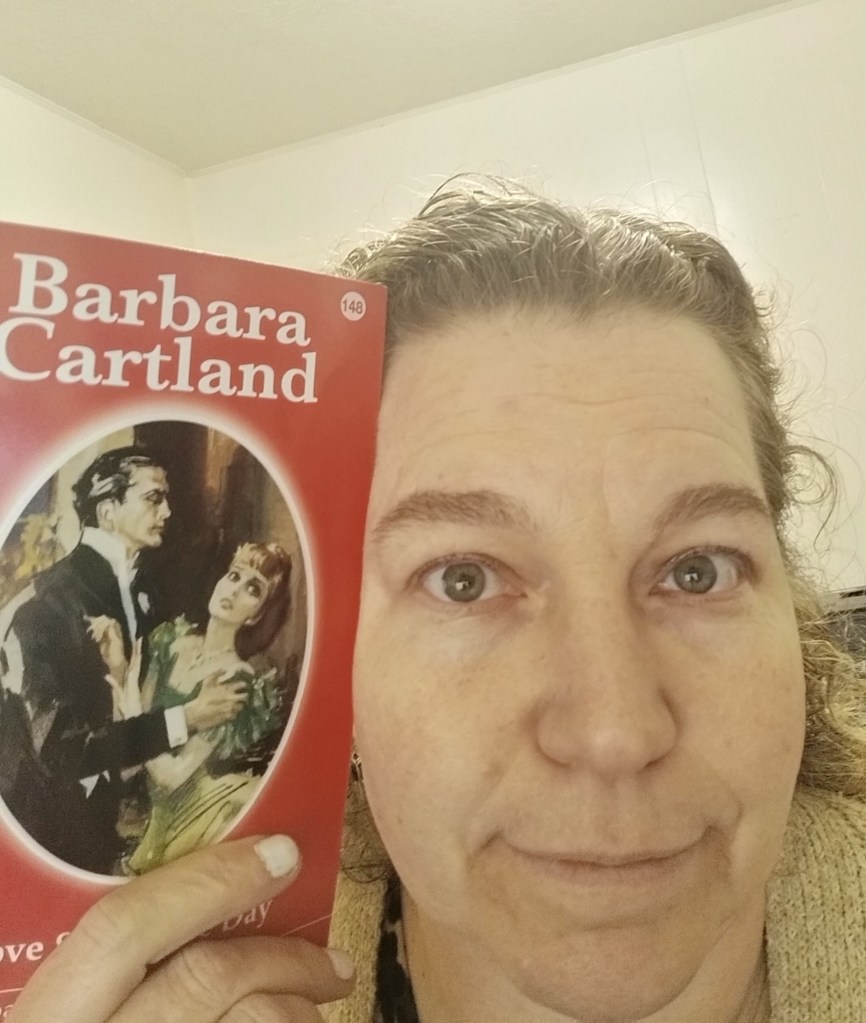
To recap, I joined a readalong with Bookstooge of a book with a cover that looks like this:

and whose author looks like this:

… which gives you a better sense of what the book is like than the cover does, really.

Barbara Cartland turned out a book every two weeks for the last twenty years of her life. Keep that in mind.

So, I finished this book pretty quickly. I was expecting a formulaic romance, and that’s what I got. The book does not drag. I can’t say I was super invested in it emotionally, but that’s because I’m a cynical middle-aged woman. And when Richard thinks to himself,

Oh, God, he loved her so much.

page 109

… I believed him. Behold the magic of Barbara Cartland!

Now, this book remains a first draft, and there are some first draft-y things in it, such as a shawl starting out as “lace” in one chapter, and getting transformed into “green silk” in the next. My favorite of these “first draft” moments is this one:

But now — how can I bear to be his wife knowing that he is already be in love with someone else?

page 106

I mean, I can relate. The most comical and confusing typos always show up in my most emotional scenes … and I always get so carried away when re-reading the scenes, that I can never catch them myself.

So, all in all, this was a not-terrible romance novel that read sort of like an outline, because it basically was an outline. If the book had been re-written to be much longer, then I feel certain that many of the minor plot holes/historical vaguenesses would have been ironed out, plus the potential emotional heft might have been successfully deepened to actual emotional heft. But, every author has to say “done” at some point, and in Cartland’s case, that was after whipping up the first draft, because that was her business model. She let readers take care of the historical details and the emotions, handling them with suspended disbelief and imagination. And that’s fair.

There was only one thing I did not like: the angry almost-kiss. (“Almost” because the couple are interrupted by a maid, so they don’t actually kiss except once at the very end of the book.) Anyway … “angry” and “kissing,” they do not go well together, no precious, they do not. I do not want Tiana’s marriage to be the kind of relationship where Richard ever kisses her angrily. And in fact, in most of the book, that is quite out of line with his character. It just happens in one scene, where they both lost their tempers “horribly” (actually quite mildly), and then were nearly overcome with passion. I don’t know why this is a romance trope. I guess I’ve missed something during my four decades of living. But, tip for you guys, in the middle of a fight is not the greatest time to start kissing your beloved.
Misanthropic Quote from a Funny Book

I peer over the half wall of my cubicle towards hers, which boasts a shelf lined with an assortment of dusty trinkets, inspirational quotes printed on crinkled yellow paper affixed to the wall, and a file box I know is filled with medications, tea bags, and biscuits that expired in 2012. It’s as though she anticipates being trapped here one day and not only surviving the ordeal, but thriving.

I Hope This Finds You Well, by Natalie Sue, p. 2

Quote: a machine with only one command

We can thus understand the synthetic goal of Critical Race Theory. It is to awaken a critically conscious racial awareness … In this sense, Critical Race Theory is, as the warning in artificial intelligence ethics research might describe, a Theoretical paperclip maximizer, except instead of making paperclips, it makes Critical Race Theorists.

James Lindsay, Race Marxism, pp. 217, 224

Readalong with Bookstooge: Love Saves the Day

My faithful fellow blogger, Bookstooge, is doing a readalong of a book someone, possibly as a prank, recommended to him: Love Saves the Day by Barbara Cartland. I went so far as to order this book from Amazon in order to participate. I don’t usually read in the romance genre, but I have read a few, and I don’t despise the genre or its readers or anything like that.

I waited to post this until after Bookstooge’s first reaction post went up on Friday, but I am composing my reaction before I see his.

First, let’s talk about this cover, eh? The word “terrifying” comes to mind. The guy looks more like Dracula – or a 60-year-old uncle- than like a romantic hero. Note that he is grasping the heroine by the upper arms. She, for her part, appears to be very concerned and trying to get away. I don’t mind the fact that this is impressionistically rendered – I don’t even completely mind that her hair is not, as it is described in the book, curly — but the emotional tone of this cover does not match the promised content.

I am, as of this posting, almost all the way through Chapter 4 because I mistakenly remembered that Bookstooge was going to be writing about chapters 1 – 6 in his first post. My impression so far: the plot is a very capable romance plot. The heroine is young, brave, idealistic; the hero is a little older, world-weary, etc.; there’s a rival romantic hero in the picture who is young, blond, and charming; financial circumstances are forcing the couple into co-operation they wouldn’t otherwise undertake. There’s even a bitter, scheming housekeeper a la Rebecca. I can’t see any big holes in the plot.

My first impression of the wordsmithing is that this is a first draft.

There are a ton of comma splices. There is head-hopping. (Though that may be intentional; sometimes it’s hard to tell head-hopping from an omniscient narrator. I omnish, myself.) The tone of the dialog is slightly inconsistent. It’s as if Cartland wants this to be an Edwardian-era novel, like Austen, or even earlier, but it’s set in 1903, and sometimes it comes off as if the characters are pretending to be from an earlier era. I can’t tell whether clothes, technology, and so forth, contain any anachronisms. The clothes are fairly generically described, but there are “omnibuses.” (Edit: I just looked it up, and oops! Edwardian is 1901 – 1910. So, spot on. So, the language sounds like it’s going for … Victorian? But obviously I’m not very savvy about this, so perhaps her language is also period accurate.)

Anyway, after noticing that this read like a first draft, I then went back to the introduction (which, like a good fiction reader, I had skipped), and, lo and behold …. it is a first draft.

Dame Barbara Cartland[‘s] most amazing literary feat was to double her output from 10 books a year to over 20 books a year when she was 77 to meet the huge demand.

She went on writing continuously at this rate for 20 years and wrote her very last book at the age of 97, thus completing an incredible 400 books between the ages of 77 and 97.

Her publishers finally could not keep up with this phenomenal output, so at her death in 2000 she left behind an amazing 160 unpublished manuscripts, something that no other author has ever achieved.

Barbara’s son, Ian McCorquodale, together with his daughter Iona, felt that it was their sacred duty to publish all these titles for Barbara’s millions of admirers all over the world who so love her wonderful romances.

So in 2004 they started publishing the 160 brand new Barbara Cartlands as the The Barbara Cartland Pink Collection, as Barbara’s favourite colour was always pink — and yet more pink!

The Barbara Cartland Pink collection is published monthly exclusively by Barbaracartland.com and the books are numbered in sequence from 1 to 160.

–the introduction

Barbara Cartland was cranking out about one novel every two weeks for twenty years. I’m not even mad, I’m impressed. And I am now a little bit jealous of her. Imagine having such high demand for your books that you can just dash off all your ideas and the publisher will publish them as fast as they can.

Also, I’m tickled. That selection above gets funnier every time I read it. I mean, it sounds made-up, like something from a Bertie Wooster novel. Even the names of Barbara’s son and granddaughter sound like characters from her books. And the fact that they are calling it the pink collection because that was her favorite color … the fact that she loved pink so much … the fact that her author photo looks like this:

Now that I think about, the section above might be my favorite part of the book. The romance between Tiana and Richard is going to have to get awfully good in order to compete with Cartland herself.

Mini Reviews

This book was recommended to me by The Geeky Jock, who has since dropped off my feed.

The author is a wilderness writer, and like many wilderness writers, he can write lyrically about the Canadian forests, giving you a sense of eerie beauty, and then he can turn around and be funny with the hardships that he and his hiking partner have to go through. In this book, he’s on the hunt for “the Traverspine demon,” a mysterious creature that, according to historical records, terrorized a remote outpost in Labrador. It sounds like a Sasquatch (which Shoalts, oversimplifying merrily, says is only attested in the Pacific region), but it leaves cloven footprints.

Shoalts and his friend push on through conditions that would have made this Bigfoot buff turn back, such as days of impassable brush. They don’t find the creature, but they do find a theory. Shoalts, a materialist, decides it was probably a combination of sightings of a wolverine, and moose tracks (both animals were rare in the region at the time). His theory is pretty convincing. He undermines his case a bit by dismissing the Greek centaurs as people’s first sighting of a man on a horse, while ignoring all the other, harder-to-dismiss chimeras that populate Greek legend.

Jack Reacher, drifting through town as is his wont, stops to help out a random guy who’s being bullied, and once again ends up stopping an international plot basically single handedly. He then has a gratuitous affair (not graphically described) with a female character he will never meet again, before leaving town.

Also, Nazis. (Not very creative, guys. Do better.)

One thing I like about the Reacher books is that I’m never worried about him. No matter how outnumbered or apparently outgunned he is, I know Reacher is smarter, quicker, and has more martial arts and military skills than his opponents. But, at the same time, he consistently gets into situations where any sane person would be worried, and I know I should be scared for him. In that way, these books strike a good balance. I’m neither terrified nor bored.

Heartbreaking novel about an American ex-cop who has recently moved to rural Ireland. Super well-written. Very evocative of the landscape, the weather, and the people, including the way they use the English language. For example, they say things like, “He’s after leaving for work” instead of “He just left for work.”

Felix Francis has carried on the beloved institution of “racing thrillers” written by his jockey father, Dick Francis. All novels by Francis (pater and fils) take place in “the racing world.” Sometimes the main character is a jockey, sometimes a trainer or an owner, and sometimes the connection to racing is looser. All are written in the first person.

In this novel, the main character, Chester, very profitably runs a “syndicate.” He buys racehorses and sells shares of them to wealthy people who want to participate in the lifestyle. So each horse has multiple owners, but Chester is the main owner, and the one who liases with the trainers and jockeys to plan out the horses’ careers. Chester is less of a tough-guy character than the typical Francis protagonist. He’s also older and more established than Franics main characters usually are. His children are grown (just), and his wife is aging and losing interest in their marriage.

Syndicate had less action than previous Francis books I’ve read, and considerably less violence (though Francis books do vary a lot in this regard). It is not as tense as the cover makes it appear. I also wasn’t too impressed with some of Chester’s choices. All in all, this wasn’t the strongest Francis novel I’ve read, though it was on-brand. Three stars.

An indispensable reference book. Neither easy nor fun to read. I’ll be reviewing this in greater detail later.

Reminder: Purchase The Scattering Trilogy for your Bookworm Loved Ones for Christmas

But don’t take my word for it!

Reviews of The Long Guest

On onlinebookclub

On Amazon

Reviews of The Strange Land

Didn’t like the abuse scenes: https://forums.onlinebookclub.org/viewtopic.php?f=21&t=535834 ,

Didn’t like the tribal rituals scenes: https://forums.onlinebookclub.org/viewtopic.php?f=21&t=552727

Liked the bear scene: https://forums.onlinebookclub.org/viewtopic.php?f=21&t=519407

Liked the whole thing: https://forums.onlinebookclub.org/viewtopic.php?f=21&t=563318 , https://forums.onlinebookclub.org/viewtopic.php?f=21&t=523075

Reviews of The Great Snake

Wanted more relationship development: https://forums.onlinebookclub.org/viewtopic.php?f=21&t=521141

Wanted more cowbell snake: https://forums.onlinebookclub.org/viewtopic.php?f=21&t=533607

“I felt her pain, her joy, and everything in between”: https://forums.onlinebookclub.org/viewtopic.php?f=21&t=545809

William Bradford Be Like

“Here’s a long letter from our pastor in Holland.

“Here are five pages about the financial trouble our supplies broker got us into. This is greatly abridged.

“Here are a few paragraphs about the time we had to break up a commune, but they were so drunk that we were able to just walk up to them and physically take their rifles.”

This has been a review of Of Plymouth Plantation.

The Belated Hallowe’en / Horror Tropes Tag

I got this tag from Snapdragon Alcove. I hope it’s OK that I’m posting it after Halloween (life is busy!). Because of the relatively narrow range of my horror consumption, I’m freely mixing movies and books.

Pick your favorite example of a …

Zombie apocalypse

The Book of Eli (a movie)

Not exactly zombies, but as I recall, there is an older couple that seems normal, but then you find out they have some sort of neurological disease from having eaten human flesh to survive. Creepy.

Also, I love the characters Denzel Washington usually plays, and this is no exception. I like my apocalyptic movies to be somewhat uplifting, and this fits the bill.

Vampire

The Unwilling, by C. David Belt (a book). Cheating a little, ‘cause I recently reviewed it here. This one made me cry, because there is a child vampire who wants to be “a real boy.”

Haunted house

I guess I don’t read many haunted house books, because Monster House is the only one I can think of. It is just as sad as ghost stories usually are.

Psychological thriller

Fractured and Shutter Island (both movies). I was very angry with both of these movies, but Fractured probably made me angrier.

Creepy doll

The Collision series, by Rich Colburn. So far, it has only two volumes: The Resolve of Immortal Flesh and The Formulacrum. But The Formulacrum ended on a literal cliffhanger, so that means Colburn owes us another one.

Neither of these books is exclusively about creepy dolls, but one very memorable creepy doll is featured … and that’s just about the only book I have ever read with a creepy doll.

Monster

Beowulf, duh.

And, in case you are not up to speed on this, Grendel is a t-rex. But there are plenty of other monsters in this how-to-defeat-monsters book, including the sea monsters Beowulf encounters while swimming in the North Sea, and Grendel’s mother, who appears to be some sort of octopus.

Comedy-horror

The Tremors franchise. It is the best. Extreme gross-outs, but also extreme humor. Survivalist Ed really steals the show.

Teen Horror

Stranger Things.  I will die on this hill.

The series starts out where the kids are about twelve and it more resembles E.T. or The Goonies, but the events cover several years and we see the kids discovering the opposite sex, feeling left out as they grow up at different rates, dealing with problems with their parents and problems involving finding a career and their place in the world. Their lives have all the teen challenges, plus the ghosts and demonic creatures and stuff to deal with. And yes, there are a few make-out scenes that it would be nice if we could skip. I will also say that the series seems to be equally sensitive to the experiences of teen boys and girls.

Some people think the episodes are too long and detailed, but that’s the point. They work in a lot of human drama in addition to the scary stuff, and I am here for it.

Demonic possession

Perelandra and That Hideous Strength by C.S. Lewis both feature possession that gets more terrifying the longer you think about it.

In Perelandra, the possessed man gets to come out and speak instead of the demon once in a while, and this gives a more evocative glimpse into his mind than we might prefer.

In That Hideous Strength, the people that are serving the demons get dehumanized to an even greater extent, and we see the beginning of this dehumanization process happen to one of the main characters. There is also a memorable scene where one of the villains, who up until now has been the most formidable because of his intelligence, wants to put a stop to something, but “he could not think of any words.” This moment of aphasia shows us how close his mind is to total disintegration.

Science fiction

Science fiction reliably pulls towards horror, for obvious reasons. Human nature doesn’t mix well with dimensional portals … or genetic engineering … or time travel.

That second image is from a movie called Paradox. It turns out there are quite a few of those, but this one involves time travel being exploited by a bitter coworker to go postal, and even though the team has an awful lot of information, they can’t figure out what is happening quickly enough.